Showing posts with label EEE. Show all posts

Tuesday, March 26, 2013

Florida: An Early Case Of EEE


image

Credit FL DOH

# 7031


Although much of the rest of the country has endured a long procession of bitter winter storms, Florida has enjoyed one of its milder winters in recent years. While great for tourists and residents alike, balmy winters make a great environment for mosquitoes as well.


Overnight, local media has been reporting on the EEE (Eastern Equine Encephalitis) infection of an 11 year-old boy from Hillsborough County (Tampa) which began (unusually, even for Florida) in February.


The boy – who is now recovered - spent three days in intensive care after apparently being bitten by an infected mosquito during a field trip to a local nature preserve (see local ABC News coverage).


This marks the first EEE case in Hillsborough County since 2010 (see Third Florida EEE Death in July).  In January of this year, another EEE case was reported in a Levy County resident (see Florida Arbovirus Surveillance Report).


EEE (Triple `E’) is an often serious, but exceedingly rare illness in humans.  It is one of more than 100 kinds of arbovirus (viruses transmitted by arthropods  e.g., Mosquitoes, sandflies, midges, or ticks).


According to the MMWR  (here), between 1999 and 2008 there were a median of seven (range: 3--21) EEE cases (not deaths) reported in the United States each year.


In addition to EEE, West Nile virus (WNV), La Crosse virus (LACV), and St. Louis encephalitis virus (SLEV) also circulate at low levels in the United States.


While the number of yearly cases is low, the distribution of EEE in the United States far ranging. Often, the heaviest EEE activity is reported in northern states.  

 image

You may recall that last October, I blogged on the surprising role that snakes play in the ecology of the EEE virus (see A Disease Detective Story: Figuring Out Where EEE Spends The Winter).


To keep things in perspective, on average 58 people are struck and killed by lightning each year in the United States, and Bee stings account for an additional 40 deaths each year.


Which isn’t to minimize EEE or any of the other arboviruses, or to suggest that people not take precautions against mosquitoes, but is simply a reminder that a lot of the diseases we talk about in this column are pretty rare.


Hillsborough County Health Department has issued a mosquito advisory based on this most recent case.


Human Case of Eastern Equine Encephalitis Confirmed Mosquito-Borne Disease Advisory Issued for Hillsborough County

For Immediate Release
March 25, 2013


Compared to Dengue and West Nile Virus, the ecology and epidemiology of EEE is fairly complicated.


The natural host for the EEE virus are songbirds, which can become infected generally without suffering ill effect.  The virus is spread among these birds by the blood feeding of female mosquitoes (males don’t bite).


After an infected mosquito feeds on a bird, the bird becomes infected and the virus begins reproducing. After a few days, and for only a few days, the bird’s bloodstream contains enough virus to infect subsequent mosquitoes that feed on it.


Culiseta melanura, which means "curly black hairs", is the species of swamp mosquito that serves as the primary vector for this virus among birds.


It, however, isn’t usually predisposed to d to biting humans.


So it generally requires a secondary type of mosquito - one that isn’t quite as picky a feeder - such as the Aedes albopictus or  Coquillettidia perturbans  `salt and pepper’ mosquito, to bite an infected bird in order to move it into the equine or human population.


Humans and horses don’t develop a high enough viral EEE titer in their bloodstream to pass on the virus if they are subsequently bitten by a mosquito, so they are considered a `dead-end host’.


For more on this fascinating topic, there’s an absolutely terrific multimedia presentation on arboviruses in Florida.


It is a narrated slide show, by Rebecca Shultz, the Arthropod-borne Disease Surveillance Coordinator for the Florida Department of Health, and it covers EEE, SLEV, and West Nile Virus.


The presentation runs just over 20 minutes.   The transcript is here.  Click the image below (or this link )to go to the slide show, and turn on your speakers.


Highly recommended.

image


2012 was a near-record year for West Nile Virus across the nation as well, which resulted in at least 5,387  confirmed cases, including 243 deaths(see DVBID: Final West Nile Report For 2012).


image


Which is why the State Health Departments around the nation continue to urge residents and visitors to follow the `5 D’s’:


image

Thursday, October 04, 2012

A Disease Detective Story: Figuring Out Where EEE Spends The Winter


# 6606


While West Nile Virus infections are far more common (see DVBID: West Nile Infections Continue Record Pace), the Eastern Equine Encephalitis (EEE) virus elicits considerable concern because of its high fatality rate (30%+) and the large number of survivors who suffer ongoing neurological impairment.


Most years, only about 6 cases (range: 3—21) of human EEE are reported in the United States.


But this year – just as we’ve seen with WNV – is an unusually active year, and thus far the USGS is reporting 12 cases of EEE.


image


Given the devastating effects of infection in humans, and the fact that there is no vaccine available for humans to prevent it, learning about the ecology of the EEE virus is of particular importance.


We know that the natural hosts for the EEE virus are songbirds, which can become infected usually without suffering ill effect. The primary vector that spreads the virus among birds is the female Culiseta melanura mosquito (males don’t bite).


image


After an infected mosquito feeds on a bird, the bird becomes infected and the virus begins reproducing. After a few days - and for only a few days - the bird’s bloodstream amplifies the virus enough to infect subsequent mosquitoes that feed on it.


Culiseta melanura, however, isn’t usually attracted to bite humans.


So it requires a secondary type of mosquito - one that isn’t quite as picky a feeder - such as the Aedes albopictus or  Coquillettidia perturbans  `salt and pepper’ mosquito, to bite an infected bird in order to move it into the equine or human population.


The Transmission cycle is illustrated by the following graphic from the CDC.


image

Humans and horses don’t develop a high enough viral EEE titer in their bloodstream to pass on the virus if they are subsequently bitten by a mosquito, so they are considered to be `dead-end hosts’.


This explains the transmission cycle of the virus, but for one rather conspicuous hole in the equation.


Since birds are only viremic for a few days after being bitten, and since mosquitoes die out for several months during the winter  . . . . how does the virus manage to return each spring and summer?


For years scientists have suspected there had to be another host in the wild that could provide the EEE virus a safe place to overwinter.


But it would have to be one that could carry a high enough viral titer throughout the winter in order to reseed the virus in mosquito populations the following spring.


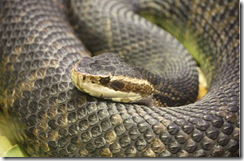
All of which brings us to some fascinating research that points to snakes – cottonmouths and copperheads, in particular – as being the winter residence of the EEE virus. 


image

Cottonmouth – Credit Wikipedia


This new study, which appears in the American Journal of Tropical Medicine and Hygiene, provides strong support for the idea that hibernating snakes serve as a bridge for the EEE virus to make it from one year to the next.


Detection of Eastern Equine Encephalomyelitis Virus RNA in North American Snakes


Andrea M. Bingham, Sean P. Graham, Nathan D. Burkett-Cadena, Gregory S. White, and Thomas R. Unnasch 

ABSTRACT

The role of non-avian vertebrates in the ecology of eastern equine encephalomyelitis virus (EEEV) is
unresolved, but mounting evidence supports a potential role for snakes in the EEEV transmission cycle, especially as over-wintering hosts.


To determine rates of exposure and infection, we examined serum samples from wild snakes at a focus of EEEV in Alabama for viral RNA using quantitative reverse transcription polymerase chain reaction.


Two species of vipers, the copperhead (Agkistrodon contortrix) and the cottonmouth (Agkistrodon piscivorus), were found to be positive for EEEV RNA by using this assay. Prevalence of EEEV RNA was more frequent in seropositive snakes than seronegative snakes. Positivity for the quantitative reverse transcription polymerase chain reaction in cottonmouths peaked in April and September. Body size and sex ratios were not significantly different between infected and uninfected snakes.


These results support the hypothesis that snakes are involved in the ecology of EEEV in North America, possibly as over-wintering hosts for the virus.

(Continue . . . )


The entire article is available online, and is a fascinating disease detective story . . . well worth reading in its entirety.


While probably not the preferred target for hungry mosquitoes - during the early spring and late fall when other blood meal sources may be in short supply - mosquitoes do feed on snakes.


They bite – not through their tough skin – but through the soft membranes around the snake’s eyes.  


Beyond discovering antibodies to the EEE virus in 35% of the cottonmouths sampled, the also found a number of snakes positive (via qRT-PCR) for the EEE virus.


This, they believe, is the first time that the active EEE virus has been documented in wild-caught snakes.


Previous tests had showed that snakes experimentally infected with the EEE virus remain viremic only for 7 to 10 days before they clear the infection – not enough time for the virus to overwinter.  


But now it appears that when a snake hibernates, it can carry the virus over the winter, and can likely reintroduce it to mosquitoes the following spring.


All of which introduces an interesting notion regarding control of the virus. Normally spraying for mosquitoes doesn’t begin until EEE starts showing up in mosquito surveillance traps, horses, or worse . . . humans.


If spraying were conducted during the early spring in swampy areas where mosquitoes and snakes are likely to meet - it might be possible to interrupt this annual cycle - and thus thwart the virus’s reintroduction to the mosquito and bird population.


As the abstract states, this study supports the hypothesis that snakes are the `bridge’ host for the EEE virus, but there is still more research needed. 


For more on this story Maggie Fox of NBC News has a good report, along with some comments from the lead author of the study; Dr. Thomas Unnasch of the University of South Florida.


Snakes may harbor deadly virus


And for more on the EEE virus, you may wish to revisit some of these earlier blogs.


MMWR: Arboviral Disease Surveillance – 2010
ASTMH: Dengue and Insect-Borne EIDs In The US
Eastern Equine Encephalitis (EEE)

Saturday, August 18, 2012

EEE: Eastern Equine Encephalitis


image

# 6501


While West Nile Virus is making headlines in Texas and across much of the nation, another mosquito-borne virus – EEE (Eastern Equine Encephalitis) – has the attention of Massachusetts health officials.


On Thursday, the Massachusetts Department of Health & Human Services released the following alert:


State Health Officials Raise EEE Threat Level in Two Communities after Detection of EEE-Positive Mosquitoes

New Bedford and Westborough raised to High; ground spraying to be enhanced

BOSTON — Thursday, August 16, 2012 – The Massachusetts Department of Public Health (DPH) today announced the detection of mammal-biting mosquitoes infected with Eastern Equine Encephalitis (EEE) in New Bedford and Westborough. As a result, health officials have raised the EEE threat level to “High” in these two communities and recommend that outdoor evening events are curtailed there for the remainder of the summer. Ground-based spraying by mosquito control projects is ongoing in both New Bedford and Westborough and will be enhanced.

(Continue. . . )


So far, only one human case of EEE has been detected in Massachusetts this year, and that one is believed to have been acquired out of state. This risk of seeing additional cases, however, is deemed high in communities where human-biting mosquitoes are found to carry the virus.


Although far less common than West Nile Virus, EEE is of concern because it has a high fatality rate (35%), and among the survivors, a large number suffer ongoing neurological problems.


Over the past decade there have been an average of about 7 cases (not deaths) of `Triple E’ in the United States each year (range range: 3—21), which makes EEE an exceedingly rare disease in humans.


But given its severity (and the co-circulation of other mosquito borne diseases like West Nile, La Cross Virus, & SLEV), it makes sense to take steps to protect against mosquito bites – even if your local officials have not issued a warning.


The Florida Department of Health’s advice to protect  against mosquito borne diseases is that people should practice the "5 D's"

Don't go outdoors at DUSK and DAWN when mosquitoes are most active.

DRESS so your skin is covered with clothing

Apply mosquito repellent containing DEET to bare skin and clothing. 

Other effective repellents include picaridin, oil of lemon eucalyptus, and IR3535

Empty containers and DRAIN standing water around your home where mosquitoes can lay eggs.


While the number of yearly cases is low, the distribution of EEE in the United States far ranging.

image


The natural host for the EEE virus are songbirds, which can become infected usually without suffering ill effect.  The virus is spread among these birds by the blood feeding of female mosquitoes (males don’t bite).


After an infected mosquito feeds on a bird, the bird becomes infected and the virus begins reproducing. After a few days, and for only a few days, the bird’s bloodstream amplifies the virus enough to infect subsequent mosquitoes that feed on it.


Culiseta melanura, which means "curly black hairs", is the species of swamp mosquito that serves as the primary vector for this virus among birds.

image 

Culiseta melanura, however, isn’t usually attracted to humans.


So it generally requires a secondary type of mosquito - one that isn’t quite as picky a feeder - such as the Aedes albopictus or  Coquillettidia perturbans  `salt and pepper’ mosquito, to bite an infected bird in order to move it into the equine or human population.


The Transmission cycle is illustrated by the following graphic from the CDC.

image


Humans and horses don’t develop a high enough viral EEE titer in their bloodstream to pass on the virus if they are subsequently bitten by a mosquito, so they are considered to be `dead-end hosts’.


As there is no vaccine against EEE, the best tactic is prevention, and high in that category is the use of mosquito repellants.


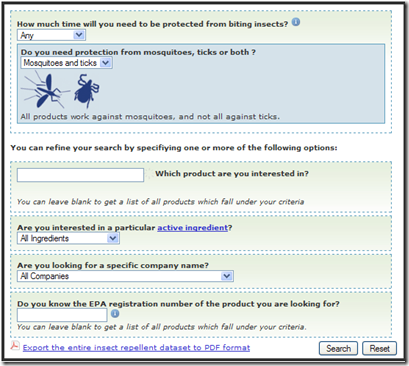
To help you with choosing the right repellant the EPA has developed an interactive insect repellant search engine that will that will allow you to input your needs and it will spit out the best repellants to use.


image

(click image to go to search engine)


For more on Arboviruses in the United States you may wish to revisit this blog from last year:


MMWR: Arboviral Disease Surveillance – 2010

Friday, August 05, 2011

MMWR: Arboviral Disease Surveillance – 2010


# 5738


Arboviruses belong to a large group of viruses carried and transmitted by biting mosquitoes, ticks, and other arthropods when they take a blood meal from susceptible vertebrate hosts.


The map below shows the global distribution of some of the more common encephalitis producing arboviruses.


image


A few of my blogs from last year on these viral threats included:


EEE Reports In Michigan And R.I.
Florida Records 4th EEE Death In July
ASTMH: Dengue and Insect-Borne EIDs In The US
Eastern Equine Encephalitis (EEE)


This week the CDC’s MMWR contains a surveillance report on arthropod-borne viruses – or arboviral - infections (excluding Dengue which is tracked separately) in the United States during 2010.


And last year, it turns out, was a banner year for arboviral disease in the United States, with the number of West Nile Virus (WNV) cases (1,021) up sharply over 2009, and 62% of those producing neuroinvasive disease (i.e., meningitis, encephalitis, or acute flaccid paralysis).


Other viral players included California serogroup viruses (CALV), eastern equine encephalitis virus (EEEV),  St. Louis encephalitis virus (SLEV) and Powassan virus (POWV).


A few excerpts from the report follow (slightly reformatted for readability). Follow the link to read it in its entirety.


West Nile Virus Disease and Other Arboviral Diseases --- United States, 2010

Weekly

August 5, 2011 / 60(30);1009-1013

Arthropod-borne viruses (arboviruses) are transmitted to humans primarily through the bites of infected mosquitoes and ticks. Since West Nile virus (WNV) was first detected in the Western Hemisphere in 1999, it has become the leading cause of neuroinvasive arboviral disease in the United States (1).


However, several other arboviruses continue to cause sporadic cases and seasonal outbreaks of neuroinvasive disease (i.e., meningitis, encephalitis, or acute flaccid paralysis) (1,2).


This report summarizes surveillance data reported to CDC in 2010 for WNV and other nationally notifiable arboviruses (excluding dengue, which is reported separately).


In 2010, 40 states and the District of Columbia (DC) reported 1,021 cases of WNV disease. Of these, 629 (62%) were classified as WNV neuroinvasive disease, for a national incidence of 0.20 per 100,000 population. States with the highest incidence were Arizona (1.60), New Mexico (1.03), Nebraska (0.55), and Colorado (0.51).


After WNV, the next most commonly reported cause of neuroinvasive arboviral disease was California serogroup viruses (CALV), with 68 cases, followed by eastern equine encephalitis virus (EEEV), 10 cases, St. Louis encephalitis virus (SLEV), eight cases, and Powassan virus (POWV), eight cases. WNV and other arboviruses continue to cause focal outbreaks and severe illness in substantial numbers of persons in the United States. Maintaining surveillance remains important to guide arboviral disease prevention activities.


(Continue . . . )

Given the limitations of surveillance, and the fact that many people experience mild, or non-specific symptoms of infection, the true burden of these (mostly) mosquito borne viruses in the United States can only be estimated.


The editorial note to this report states:


Detection and reporting are incomplete, leading to a substantial underestimate of the actual number of cases. Based on previous studies, for every case of WNV neuroinvasive disease, approximately 140 human WNV infections occur, with 80% of infected persons remaining asymptomatic and 20% developing nonneuroinvasive disease (7,8).

Extrapolating from the 629 reported WNV neuroinvasive disease cases, an estimated 88,000 infections and 17,600 cases of nonneuroinvasive disease might have occurred in 2010; however, only 392 (2%) nonneuroinvasive disease cases were reported.


As the chart below indicates, the older adults are more apt to develop neuroinvasive disease from a WNV infection.

FIGURE. Incidence* of cases (N = 629) of West Nile virus neuroinvasive disease,† by age group --- United States, 2010

The figure shows the incidence of cases (N = 629) of West Nile virus neuroinvasive disease, by age group, in the United States in 2010. WNV neuroinvasive disease incidence increased with age group, with the highest incidence among persons aged ≥70 years.

* Per 100,000 population, based on July 1, 2010, U.S. Census estimates.

† Meningitis, encephalitis, or acute flaccid paralysis.


A summation of the report reads:

What is already known on this topic?

Since West Nile virus (WNV) was first detected in the Western Hemisphere in 1999, it has become the leading cause of neuroinvasive arboviral disease in the United States. However, several other arboviruses can cause sporadic cases and seasonal outbreaks of neuroinvasive disease.

What is added by this report?

WNV was the most common cause of neuroinvasive arboviral diseases in the United States in 2010; however, La Crosse virus was the most common cause among children. Eastern equine encephalitis, although rare, remained the most severe arboviral disease, with a 50% case-fatality rate.

What are the implications for public health practice?

WNV and other arboviruses continue to be a source of severe illness each year for substantial numbers of persons in the United States. Maintaining surveillance remains important to help direct and promote prevention activities.


While the odds of contracting a serious illness from mosquito bites in the United States remains very low - if you visit or live in mosquito territory – it is worth remembering Florida Department of Health’s, (FDOH)
recommendation that individuals protect themselves by following the “5 D’s”.

5 Ds

Monday, August 16, 2010

EEE Reports In Michigan And R.I.


# 4812


Last month I wrote several blogs (here, here, and here) on 4 fatal cases of an exceedingly rare mosquito borne infection - called `Triple E’ (Eastern Equine Encephalitis) - in Florida during July.


As I pointed out at the time, although the spotlight was focused on Florida, this wasn’t just a problem for the sunshine state.


The graphic below shows that while Florida leads the pack that over the years Massachusetts, New Jersey, Georgia, and Louisiana have seen their share of cases as well.


image


This summer, Michigan – which has only reported 13 cases in the past half century – has two suspected human cases (WTVB news report). 


Additionally, according to this report from WNDU-TV, more than 5 dozen horses in the southwestern part of the state have died of the virus – the most in 30 years.


Meanwhile, the Boston Globe is reporting (see R.I. man contracts EEE, Mass. health official says) on a Rhode Island man in his 20s who is in critical condition after contracting the virus during a visit to Southeastern Massachusetts.


EEE is arguably the most serious, but also one of the least common, mosquito-borne diseases found in the United States.   In a typical year, only about 7 human infections (not deaths) are reported.


While not a huge health risk - when you add in somewhat higher rates of West Nile Virus, St. Louis Encephalitis, La Crosse Virus  . . . and now a small number of Dengue Fever cases in Florida – it makes sense to take reasonable precautions against being bitten.


image

MMWR Domestic Arboviral Diseases 1999-2008


Many communities have stepped up the spraying for mosquitoes this summer based on a variety of surveillance methods. 


The State of Rhode Island has an informative page describing their Mosquito Borne Disease Risk Assessment Matrix, which takes into account the physical environment (temperature, wind speeds, humidity) along with surveillance data (mosquito density, species, and reported infections), and the time of year.  


While communities can do much to protect their citizenry against mosquitoes, individuals need to take protective steps as well.


To help you choose the right mosquito repellant, the EPA has set up an insect repellant search engine that will that will allow you to input your needs and it will spit out the best repellants to use.


image


In Making Themselves At Home, I detailed how Aedes Albopictus or the `Asian tiger’ mosquito is perfectly happy to set up light housekeeping inside the home, and the importance of eliminating interior breeding locations as well as those outside.


And of course, I’ve repeated the `5 D’s’ of mosquito protection often.  But it never hurts to remind people.


Don't go outdoors at DUSK and DAWN when mosquitoes are most active.


DRESS so your skin is covered with clothing


Apply mosquito repellent containing DEET to bare skin and clothing. 

Other effective repellents include picaridin, oil of lemon eucalyptus, and IR3535

Empty containers and DRAIN standing water around your home where mosquitoes can lay eggs.


While I wouldn’t let concerns over mosquito borne diseases ruin my summer, when it comes to avoiding illness, a little bit of prevention can pay big dividends.

Sunday, August 01, 2010

Florida Records 4th EEE Death In July


# 4774


Over the past decade there have been an average of about 7 cases (not deaths) of `Triple E’ (Eastern Equine Encephalitis) in the United States each year (range range: 3—21), which makes EEE an exceedingly rare disease in humans.


What makes EEE such a concern is that it has a high fatality rate (35%), and among the survivors, a high percentage suffer ongoing neurological problems.


Among the mosquito-borne encephalitis viruses, however, it runs a distant third when compared to the number of California serogroup (predominantly La Crosse virus (LACV)) and St. Louis Encephalitis (SLEV) cases.


image

MMWR Domestic Arboviral Diseases 1999-2008


Given its rarity, it is therefore a bit surprising that Florida has just recorded its fourth EEE death for the month of July (My thanks to the reader who alerted me to this latest victim).


LCHD ISSUES MOSQUITO-BORNE ILLNESS ADVISORY

LEON COUNTY HEALTH DEPARTMENT ISSUES MOSQUITO-BORNE ILLNESS ADVISORY


--Medical director urges precautions against mosquitoes--


Tallahassee-- The Leon County Health Department announces that there has been increased mosquito-borne disease activity in Leon County. “We have had a confirmed human death due to Eastern equine encephalitis (EEE),” said Dr. Marjorie Kirsch, medical director, and,“the risk of transmission of mosquito-borne viruses to humans is increased.” A Leon County horse has also been recently diagnosed with EEE.


EEE virus is spread by the bite of an infected mosquito. It isn’t spread person to person. An average of six human cases of EEE are reported each year in the United States.


The Leon County Health Department reminds residents and visitors to avoid being bitten by mosquitoes that may cause disease. Leon County Mosquito Control and the Leon County Health Department continue surveillance and prevention efforts and encourage everyone to take basic precautions to help limit exposure. More Info Available


This update was submitted at 7/31/2010 6:04:43 PM


While obviously a concern, and certainly worthy of public discussion, it is only fair to point out that the odds of contracting EEE from a mosquito in Florida are extremely low. 


And while the spotlight right now is focused on Florida, this isn’t just a problem for the sunshine state. 


The graphic below shows that while Florida leads the pack that over the years Massachusetts, New Jersey, Georgia, and Louisiana have seen their share of cases as well.

image


Given its severity (and the prevalence of other mosquito borne diseases like West Nile, Dengue, SLEV), it makes sense to take steps to protect yourself and your family.


Yesterday I wrote about the Aedes Albopictus or `Asian tiger’ mosquito’s willingness to move in, and breed inside your home (see Making Themselves At Home). 


So today would be a good day to go around and look for likely breeding places in, and around your home. This should become a weekly habit – at least during mosquito season.


I’ve repeated the Florida Department of Health’s mantra that to help protect themselves against mosquito borne diseases people  should practice the "5 D's"

Don't go outdoors at DUSK and DAWN when mosquitoes are most active.

DRESS so your skin is covered with clothing

Apply mosquito repellent containing DEET to bare skin and clothing. 

Other effective repellents include picaridin, oil of lemon eucalyptus, and IR3535

Empty containers and DRAIN standing water around your home where mosquitoes can lay eggs.

Today I’ve got a new resource for you.  


An interactive insect repellant search engine developed by the EPA that will that will allow you to input your needs and it will spit out the best repellants to use.


image

(click image to go to search engine)


Since knowledge is power, and prevention is a far better strategy than trying to cure a disease, here are some some of my earlier blogs on EEE:


Third Florida EEE Death in July
Eastern Equine Encephalitis (EEE)


And here is a list of recent Dengue/Arbovirus posts as well:


ASTMH: Dengue and Insect-Borne EIDs In The US
Update On The Florida Dengue Cases
Dengue Reports From The Caribbean
MMWR: Dengue Epidemic In Puerto Rico
MMWR: Dengue Fever In Key West 

Friday, July 30, 2010

Third Florida EEE Death in July


# 4770


A little over a week ago I wrote about `triple E’, or Eastern Equine Encephalitis, which had claimed the life of a Hillsborough County (Florida) woman earlier this month.


While exceedingly rare, Florida sees on average 1 or 2 (range 0-5) human cases each year, and about 70 equine infections.   


Nationally, between 1999 and 2008 there were a median of seven (range: 3--21) EEE cases (not deaths) reported in the United States each year.


So the unusual news yesterday of another death in the same county – this time of an infant -  has prompted the local health department to upgrade a mosquito advisory issued last April to a full Alert.


This is the third death this month in Florida from the virus, as earlier this month a retired postal worker in the panhandle (Wakulla County) also succumbed to the virus.


The St. Petersburg Times has the story.


Brandon infant dies of equine encephalitis

Friday, July 30, 2010


As the chart below shows, the months of June-July-August historically produce the most human cases of EEE in Florida, with July by far seeing the most.


Still, the average for the month of July over the past 50 years has been less than 1 case per year.

image


The Florida Department of Health reminds residents that to help protect themselves against mosquito borne diseases they should practice the "5 D's"

Don't go outdoors at DUSK and DAWN when mosquitoes are most active.


DRESS so your skin is covered with clothing


Apply mosquito repellent containing DEET to bare skin and clothing. 


Other effective repellents include picaridin, oil of lemon eucalyptus, and IR3535


Empty containers and DRAIN standing water around your home where mosquitoes can lay eggs.

For more details visit the Florida DOH Mosquito-borne Disease Prevention webpage.  


And for a good deal more background on EEE - including a link to a terrific slideshow narrated by by Rebecca Shultz, the Arthropod-borne Disease Surveillance Coordinator for the Florida Department of Health, on mosquito borne diseases -  you might want to check out my earlier essay:


Eastern Equine Encephalitis (EEE)


And of course, over the past year, a small number of Dengue Fever cases have turned up in Florida as well.  Of these, 45 are imported cases, while 19 cases are believed to be locally acquired.


Update On The Florida Dengue Cases


In addition West Nile virus (WNV), La Crosse virus (LACV), and St. Louis encephalitis virus (SLEV) also circulate at very low levels in the United States. 


So these precautions against mosquitoes aren’t just important for Floridians to heed.  

Wednesday, July 21, 2010

Eastern Equine Encephalitis (EEE)


# 4741


Yesterday the local news carried word of the death of an adult female in Hillsborough County (ie. Tampa region), Florida from mosquito borne EEE (Eastern Equine Encephalitis).


EEE (Triple `E’) is an often serious, but exceedingly rare illness in humans.  It is one of more than 100 kinds of arbovirus (viruses transmitted by arthropods  e.g., Mosquitoes, sandflies, midges, or ticks).


According to the MMWR  (here), between 1999 and 2008 there were a median of seven (range: 3--21) EEE cases (not deaths) reported in the United States each year.


In addition to EEE, West Nile virus (WNV), La Crosse virus (LACV), and St. Louis encephalitis virus (SLEV) also circulate at low levels in the United States.


While of concern, to keep things in perspective, on average 58 people are struck and killed by lightning each year in the United States, and Bee stings account for an additional 40 deaths each year.


Which isn’t to minimize EEE or any of the other arboviruses, or to suggest that people not take precautions against mosquitoes, but is simply a reminder that a lot of the diseases we talk about in this column are pretty rare.


In recent weeks, Dengue has become a big story here in Florida, but once again, we’re talking a couple of dozen confirmed cases out of a population of 18 million.


The actual incidence of Dengue is probably much higher, but as with most viruses, many cases are sub-clinical or asymptomatic and are therefore never diagnosed.  


First, the story about the EEE fatality, then a bit of discussion about the way this rare virus makes its way into the human population.


First human EEE death confirmed in Hillsborough County

State's first encephalitis death in two years

Updated: Wednesday, 21 Jul 2010, 6:18 AM EDT
 

MyFoxTampaBay.com staff report

TAMPA - Health officials in Hillsborough County have confirmed the first human death this year from Eastern Equine Encephalitis.


A woman living in the northern part of the county died July 1, the county health department said, and it is believed that she had other health issues as well.


This is the first human death from EEE in the state of Florida since 2008.


Four horses in the county have also tested positive for the disease in the last several weeks, according to the health department. Officials say finding the disease in animals means that the likelihood of humans becoming infected increases.


Hillsborough County Mosquito Control will be spraying pesticides over much of the county Wednesday morning.

(Continue . . . )


While the number of yearly cases is low, the distribution of EEE in the United States far ranging.


image


The natural host for the EEE virus are songbirds, which can become infected generally without suffering ill effect.  The virus is spread among these birds by the blood feeding of female mosquitoes (males don’t bite).


After an infected mosquito feeds on a bird, the bird becomes infected and the virus begins reproducing. After a few days, and for only a few days, the bird’s bloodstream contains enough virus to infect subsequent mosquitoes that feed on it.


Culiseta melanura, which means "curly black hairs", is the species of swamp mosquito that serves as the primary vector for this virus among birds.


It, however, isn’t usually attracted to bite humans.


So it generally requires a secondary type of mosquito - one that isn’t quite as picky a feeder - such as the Aedes albopictus or  Coquillettidia perturbans  `salt and pepper’ mosquito, to bite an infected bird in order to move it into the equine or human population.


Humans and horses don’t develop a high enough viral EEE titer in their bloodstream to pass on the virus if they are subsequently bitten by a mosquito, so they are considered a `dead-end host’.


For more on this fascinating topic, I’ve found an absolutely terrific multimedia presentation on arboviruses in Florida.


It is a narrated slide show, by Rebecca Shultz, the Arthropod-borne Disease Surveillance Coordinator for the Florida Department of Health, and it covers EEE, SLEV, and West Nile Virus.


The presentation runs just over 20 minutes.   The transcript is here.  Click the image below (or this link )to go to the slide show, and turn on your speakers.


Highly recommended.


image


As the Miami-Dade County Health Department reminds us, to protect yourself from mosquitoes, you should practice the “5 D's”:


  • Dusk and Dawn – avoid being outdoors when mosquitoes are very active 
  • Dress – wear clothing that covers most of your skin 
  • DEET – repellents containing up to 30 percent DEET (N, N-diethyl-meta-toluamide) are recommended. Other effective mosquito repellents include picaridin, oil of lemon eucalyptus, and IR 3535. Always read label directions for approved usage before your apply a repellent. Some repellents are not suitable for children. 
  • Drainage – check around your home to remove standing water, where mosquitoes may lay eggs.


As long as you observe these simple precautions (and this isn’t just advice for Floridians), you can reduce your (already slight) risk of being infected by any of these mosquito borne illnesses.


For those who would like to follow Florida’s surveillance program for arboviruses, weekly reports are available from the Florida Department of Health.


Weekly Data for Arbovirus Surveillance