Showing posts with label EMS. Show all posts

Sunday, December 14, 2014

COCA Call Dec 15th: EMS & Ebola – Transporting Patients

image


# 9437


Although there are some hopeful signs of progress in the fight against Ebola – at least in some regions of West Africa – the potential for having infected individuals arrive in this country will likely persist for many months to come. While we’ve seen a good deal of training information already for hospitals and emergency rooms, it is often falls to the local EMS system to make first contact with a symptomatic Ebola patient. 


Tomorrow the CDC will hold what I expect will be a well attended COCA call dedicated to EMS transporting of suspected or confirmed Ebola patients.  For those unable to listen in live – or if attendance exceeds system capacity – this presentation will be archived for later viewing.  


The PDF slide presentation for tomorrow’s call  can be downloaded in advance.   Full details can be found at the following link.


Date:Monday, December 15, 2014

Time:2:00 – 3:00 PM (Eastern Time)

How to Participate:

  • Join early. Lines open 15 minutes before the live call
  • When possible dial in as a group
  • High interest call. If lines reach capacity, listen on demand a few days after the live call

Join By Phone:

  • 888-972-6898 (U.S. Callers)
  • 630-395-0194 (International Callers)

Passcode:5076538

Join by Live Audio Web Streaming:(Listen only)


http://event.on24.com/r.htm?e=904387&s=1&k=03FDB410EBC7591029B2E4F85D2F0F3F

Access on Demand: Call materials (slides, audio, and transcript) will be posted to this webpage a few days after the live call

Presenter(s)

Drew E. Dawson
Director
Office of Emergency Medical Services
National Highway Traffic Safety Administration
US Department of Transportation
Alexander Isakov, MD, MPH
Director
Section of Prehospital and Disaster Medicine
Emory University School of Medicine
John J. Lowe, PhD
Associate Director of Research
Nebraska Biocontainment Patient Care Unit
University of Nebraska Medical Center
P.J. Schenarts, MD, FACS
Professor & Vice Chairman of Surgery
Chief of Trauma, Surgical Critical Care & Emergency Surgery
University of Nebraska College of Medicine
Medical Director, Omaha Fire EMS

Overview

Healthcare systems across the United States are actively preparing to treat patients with Ebola. Emergency Medical Services (EMS) play an important role in the identification, assessment, and transportation of suspected or confirmed patients with Ebola. As designated treatment facilities, Emory University Hospital and the University of Nebraska Medical Center have received patients with confirmed Ebola. During this COCA Call, clinicians will learn about the field experiences of EMS personnel in the two jurisdictions and discuss unique planning considerations for EMS.

Objectives

At the conclusion of the session, the participant will be able to accomplish the following:

  • Discuss the unique field experiences of EMS personnel in two jurisdictions who transported patients with Ebola.
  • Describe training, equipment, policy, and procedural considerations related to Ebola for EMS personnel.
  • Identify partners to include in planning for the transport of patients suspected or confirmed to have Ebola.

Call Materials

Additional Resources

Call Format

  • Audio conference call on 12/15/14: 2:00 - 3:00 PM
  • Web-on-demand training after 3:00 PM on 12/15/14
  • Materials: PowerPoint slide set

(Continue . . .)


While primarily of interest to clinicians and healthcare providers, COCA (Clinician Outreach Communication Activity) calls are designed to ensure that practitioners have up-to-date information for their practices.  For those who may have missed them, some earlier Ebola-related COCA calls (now archived and available online) include:

COCA Call : Caring For Ebola Patients – A Nursing Perspective
COCA Call: Approaches to Clinical Management for Patients with Ebola
Hospital Ebola Preparedness COCA Call Now Online
CDC COCA Call: Ebola Preparations For Hospitals - Transcript & Audio

Tuesday, October 21, 2014

Ebola Preparedness Webinar For EMS Personnel

image

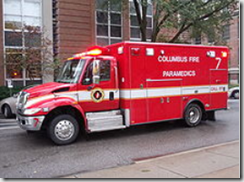
Columbus Fire Department Medic 7 - Wikipedia


# 9226


As part of their continuing efforts to prepare frontline medical personnel on what to do if they are presented with a possible or suspected Ebola case, the CDC and the Office of the Assistant Secretary for Preparedness and Response (ASPR) will hold a webinar tomorrow afternoon geared for EMS personnel.


Webinar: Ebola Preparedness for Emergency Medical Services

ASPR and CDC staff will discuss the previously developed and distributed Detailed Emergency Medical Services Checklist for Ebola Preparedness, which highlights activities that EMS agencies and systems should consider to prepare for managing patients with Ebola and other infectious diseases. This checklist is intended to enhance collective preparedness and response by highlighting key areas for EMS agencies to review in preparation for a person under investigation (PUI) for Ebola. The checklist provides practical and specific suggestions to ensure agencies are able to detect possible Ebola cases, protect employees, and respond appropriately.


Additionally, CDC collaborated with staff and representatives from the Federal Interagency Committee on EMS (FICEMS) to develop

Interim Guidance for Emergency Medical Services Systems and 911 PSAPs. FICEMS staff will discuss this guidance, intended for use by managers to understand and explain to staff how to respond and stay safe and by individual providers to respond to suspected Ebola patients and to stay safe.


The purpose of this webinar is to further explain these documents and address any questions that you may have.  Staff from several FICEMS member agencies will field questions. FICEMS includes representatives from ASPR, CDC, the National Highway Traffic Safety Administration, the Department of Homeland Security’s Office of Health Affairs, the U.S. Fire Administration, an appointed State EMS Director and other agencies. 


Please note that we will ONLY be taking live questions via the webinar Q&A feature during this event. Due to the expected high volume of questions, we will not be able to address all questions during the call.

In an effort to maximize availability of call-in lines, please consider joining this webinar with multiple colleagues on one computer.

Please note: An audio recording and transcript will be made available on this page following the call.

Saturday, September 27, 2014

CDC: Checklist For EMS Ebola Preparedness

image


# 9118


The CDC has been busy over the summer producing interim guidance, and checklists for specific groups, for dealing with the potential introduction of Ebola into the United States.   While a large outbreaks are not anticipated in most developed countries, the importation of individual cases – with the potential of limited spread to others – cannot be ignored.


On Monday of next week, NACCHO will hold a webinar to go over the Hospital Checklist Preparedness For Ebola.

Last night the CDC released two more checklists:

September 26, 2014 - Checklist for Healthcare Coalitions for Ebola Preparedness[PDF - 4 pages]

September 26, 2014 - Detailed Emergency Medical Services (EMS) Checklist for Ebola Preparedness[PDF - 6 pages]


Since EMS organizations are far more likely to have initial contact with potential Ebola cases,  I’ll restrict today’s blog to their checklist.   You’ll want to download the entire (6-page) PDF document.


Detailed Emergency Medical Services (EMS) Checklist for Ebola Preparedness

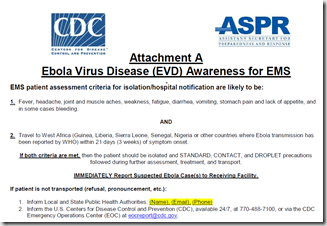
The U.S. Department of Health and Human Services (DHHS) Centers for Disease Control and Prevention (CDC) and Office of the Assistant Secretary for Preparedness and Response (ASPR), in addition to other federal, state, and local partners, aim to increase understand ing of Ebola and encourage U.S.-based EMS agencies and systems to prepare for managing patients with Ebola and other infectious diseases. Every EMS agency and system, including those that provide non-emergency and/or inter-facility transport, should ensure that their personnel can detect a person under investigation (PUI) for Ebola, protect themselves so they can safely care for the patient, and respond in a coordinated fashion. Many of the signs and symptoms of Ebola are non-specific and similar to those of other common infectious diseases such as malaria, which is commonly seen in W est Africa. Transmission of Ebola can be prevented by using appropriate infection control measures.


This checklist is intended to enhance collective preparedness and response by highlighting key areas for EMS personnel to review in preparation for encountering and providing medical care to a person with Ebola. The checklist provides practical and specific suggestions to ensure the agency is able to help its personnel detect possible Ebola cases, protect those personnel, and respond appropriately.


Now is the time to prepare, as it is possible that individuals infected with Ebola virus in W est Africa may travel to the U.S., develop signs or symptoms of Ebola , and seek medical care from EMS personnel.


EMS agencies, in conjunction with their medical directors, should review infection control policies and procedures and incorporate plans for administrative, environmental, and communication measures.


The checklist format is not intended to set forth mandatory requirements or establish national standards. It is a list of activities that can help each agency prepare. Each agency is different and should adapt this document to meet its specific needs. In this checklist, EMS personnel refers to all persons, paid and volunteer who provide pre-hospital emergency medical services and have the potential for direct contact exposure (through broken skin or mucous membranes) with an Ebola patient’s blood or body fluids, contaminated medical supplies and equipment, or contaminated environmental surfaces.

This detailed checklist for EMS is part of a suite of HHS checklists. This guidance is only for EMS agencies and systems; the CDC’s Interim guidance for EMS includes information for individual providers and for 9-1-1 Public Safety Answering Points.

image

(Continue . . . )

For additional guidance on Ebola for healthcare settings, the CDC has put together an impressive list of documents which may be accessed at:

Information for Healthcare Workers