Showing posts with label LPAI. Show all posts

Thursday, March 26, 2015

Netherlands: Another (likely LPAI H7) Outbreak In Poultry

image

Photo Credit – FAO


# 9868


Two weeks after we saw the Netherlands: (Probably) Mild Bird Flu In Barneveld, we have another reported outbreak in Tzummarum on the northern coast.   While likely LPAI H7 (like the last outbreak)  these two farms are more than 100 km apart.


This announcement from Rijksoverheid.nl.


News

Mild flu in Tzummarum

News item | 26-03-2015

In Tzummarum (Friesland) is a poultry farm with 22,000 hens bird flu (avian influenza, AI) established. This company has one barn with outdoor access. It is likely that the mild H7 variant.

Because a low pathogenic (mild) H7 variant can mutate to a highly pathogenic (highly contagious and deadly for chickens) variant, the company has both a low culling as a highly pathogenic variant. This is based on European rules. Depopulation is by the Dutch Food and Consumer Product Safety Authority (NVWA).

Measures

From Thursday, March 26th, 2015 from 13:00 applies in an area of ​​over one kilometer around the holding in Tzummarum a ban on transporting poultry, eggs, poultry manure and used bedding. Within the area is one other poultry. This company is sampled and tested for avian influenza.

Wednesday, March 25, 2015

Kansas Dept. Agriculture: LPAI Bird Flu At Commercial Turkey Farm

image

Crawford County – Credit Wikipedia


# 9864


Although the subtype isn’t mentioned in the press release, today Kansas authorities have announced the detection of a low pathogenic avian flu at a commercial turkey farm in Crawford county, on the border with western Missouri.


Culling has been ordered and the carcasses will be buried on site.


Two weeks ago Missouri reported two HPAI outbreaks in Turkeys (see Missouri Dept. Ag. Statement On Avian Flu At Missouri Turkey Farm) while Arkansas to the south reported (HPAI H5N2 Confirmed In Arkansas Turkey Flock) a couple of days later.


Low Path (LPAI) strains are viewed as being much less serious than HPAI strains – and often only cause minor illness in birds – but need to be quickly contained because LPAI H7 and H5 viruses have the potential to evolve into highly pathogenic strains.


This from the Kansas Department of Agriculture.


Low Pathogenic Avian Influenza case confirmed in Crawford County

MANHATTAN, Kansas – The Kansas Department of Agriculture was notified Tuesday that samples collected from a commercial poultry flock in Crawford County tested positive for low pathogenic avian influenza (LPAI).

The flock will be depopulated on Thursday by company officials and buried on site.  Working in conjunction with the Kansas Department of Health and Environment, a disposal area has been identified.  This area has been determined to be acceptable for the burial of the livestock carcasses based on data evaluated including groundwater depth, soil type, depth to bedrock and slope of land in the area.  KDHE will monitor the disposal site as part of their normal inspection of the facility.

Because this is LPAI, as opposed to Highly Pathogenic Avian Influenza (HPAI), no quarantine will be issued by KDA. 

“We are dedicated to providing the necessary assistance and precautions to avoid any possible spreading of the disease,” Dr. Bill Brown Kansas Animal Health Commissioner said.  “Even though this is the low path variety, it still requires immediate action and animal health officials are responding.”

Symptoms of avian influenza in poultry include coughing, sneezing, respiratory distress, decreased egg production and sudden death.  

If you suspect your flock has contracted the disease, quarantine the affected animals immediately.  Infected animals must be humanely destroyed and disposed of properly to prevent the disease from spreading. 

Although vaccines are available, they are not commonly used because no vaccine covers all 15 strains of the disease.  Prevention is the best way to combat Avian Influenza.  Keep wild birds away from your home or farm, and stay informed about the health of neighboring animals. 

For more information please check www.agriculture.ks.gov/avianinfluenza


Wednesday, November 19, 2014

mBio: Not All LPAI Flu Subtypes Are Created Equally

image

Credit NIAID


# 9343


Until avian H7N9 showed up a couple of years ago, LPAI (Low Pathogenic Avian Influenza) in birds was considered to constitute a minor human health threat, and our concerns were mostly they would evolve into HPAI (highly pathogenic) strains – with most of that concern focused on H5 and H7 subtypes.


H7N9 showed us that an avian influenza could be LPAI in birds and yet extremely pathogenic in humans.


Furthermore, in the summer of 2013 Taiwan reported the first known human infection with an avian H6N1 virus, and a few months later mainland China reported the first three cases of H10N8 (two fatal), further widening the range of avian subtypes capable of causing serious illness in humans.


Suddenly, there seemed to be more to keep an eye on than just HPAI H5 and H7.


All of which brings us to a fascinating study, published yesterday in the open-access journal mBio, that attempts to compare the pathogenicity of different HA Subtype LPAI flu strains in mammals, and finds some subtypes are far more virulent than others.


Researchers constructed identical LPAI avian flu viruses – differing each only by their hemagglutinin protein (H1-H16) - and tested them in mice and against human cell cultures.


They found the H1, H6, H7, H10, and H15 HA genes demonstrated enhanced virulence in mice and were destructive to human bronchial epithelial cells (in vitro), while chimeric H2, H3, H5, H9, H11, H13, H14 and H16 subtypes caused no significant disease.


Leading the study is noted NIAID virologist Jeffrey Taubenberger, who was the first to sequence the the genome of the 1918 Spanish Flu virus.  First some excerpts from the mBio article (follow the link to read in its entirety), followed by a link and excerpt from the press release.


Contemporary Avian Influenza A Virus Subtype H1, H6, H7, H10, and H15 Hemagglutinin Genes Encode a Mammalian Virulence Factor Similar to the 1918 Pandemic Virus H1 Hemagglutinin

Li Qia, Lindsey M. Pujanauskia, A. Sally Davisa, Louis M. Schwartzmana, Daniel S. Chertowa,b,  David Baxterc, Kelsey Scherlerc, Kevan L. Hartshornd,  Richard D. Slemonse,  Kathie-Anne Waltersc,  John C. Kasha,  Jeffery K. Taubenbergera

ABSTRACT

Zoonotic avian influenza virus infections may lead to epidemics or pandemics. The 1918 pandemic influenza virus has an avian influenza virus-like genome, and its H1 hemagglutinin was identified as a key mammalian virulence factor. A chimeric 1918 virus expressing a contemporary avian H1 hemagglutinin, however, displayed murine pathogenicity indistinguishable from that of the 1918 virus. Here, isogenic chimeric avian influenza viruses were constructed on an avian influenza virus backbone, differing only by hemagglutinin subtype expressed. Viruses expressing the avian H1, H6, H7, H10, and H15 subtypes were pathogenic in mice and cytopathic in normal human bronchial epithelial cells, in contrast to H2-, H3-, H5-, H9-, H11-, H13-, H14-, and H16-expressing viruses. Mouse pathogenicity was associated with pulmonary macrophage and neutrophil recruitment. These data suggest that avian influenza virus hemagglutinins H1, H6, H7, H10, and H15 contain inherent mammalian virulence factors and likely share a key virulence property of the 1918 virus. Consequently, zoonotic infections with avian influenza viruses bearing one of these hemagglutinins may cause enhanced disease in mammals.

IMPORTANCE Influenza viruses from birds can cause outbreaks in humans and may contribute to the development of pandemics. The 1918 pandemic influenza virus has an avian influenza virus-like genome, and its main surface protein, an H1 subtype hemagglutinin, was identified as a key mammalian virulence factor. In a previous study, a 1918 virus expressing an avian H1 gene was as virulent in mice as the reconstructed 1918 virus. Here, a set of avian influenza viruses was constructed, differing only by hemagglutinin subtype. Viruses with the avian H1, H6, H7, H10, and H15 subtypes caused severe disease in mice and damaged human lung cells. Consequently, infections with avian influenza viruses bearing one of these hemagglutinins may cause enhanced disease in mammals, and therefore surveillance for human infections with these subtypes may be important in controlling future outbreaks.

(Continue . . .)

From the  American Society for Microbiology we get the following press release:


Some flu viruses potentially more dangerous than others

WASHINGTON, DC - November 18, 2014 - Certain subtypes of avian influenza viruses have the potential to cause more severe disease in humans than other avian influenza subtypes and should be monitored carefully to prevent spread of disease, according to a study published this week in mBio®, the online open-access journal of the American Society for Microbiology.

The work, directed by researchers at the National Institute of Allergy and Infectious Diseases in Bethesda, Md., found that flu viruses expressing the low pathogenicity avian H1, H6, H7, H10 or H15 hemagglutinins (genes that encode the major surface protein for the virus) led to fatal infections in mice and caused more cell damage in normal human lung cells grown in culture as compared to avian influenza viruses with other subtypes. The 1918 H1 subtype hemagglutinin has been already identified as a key virulence factor in the pandemic influenza virus of 1918. That virus, which caused the so-called "Spanish flu," spread rapidly around the world, resulting in approximately 50 million deaths.

"Viruses with these avian hemagglutinins have some type of inherent virulence motif to them, in that they induce a marked inflammatory response in mammals including human cells in culture," said senior study author Jeffery K. Taubenberger, MD, PhD, chief of the Viral Pathogenesis and Evolution Section of NIAID's Laboratory of Infectious Diseases. In 2013-2014 there have been close to 400 cases of avian influenza H7N9 infections in people in China, many severe, along with small numbers of severe human infections with H10N8 and H6N1 subtypes. "From a public health and epidemiology standpoint, it's useful to know that avian viruses of these subtypes (for example, H6, H7, or H10) might lead to more severe infections in humans and is something to look out for."

(Continue . . .)

Monday, August 05, 2013

Taiwan Reports LPAI H5N3

image

H5N3 location - Map Credit OIE


# 7541


When we talk about `bird flu’ outbreaks in poultry we tend to think of H5N1, H5N2, H9N2 or the newly emerging H7N9 virus. Occasionally we’ll see outbreaks of the less common H7, H10, and H11 subtypes.


But in truth, there are many other HA/NA influenza combinations – particularly circulating among wild birds – and they occasionally find their way into domesticated poultry.


Other than H5N1 and H7N9, these viruses are believed to pose only a minor threat to human health.


Taiwan has been battling repeated outbreaks of H5N2 for years, but today we are learning that they have discovered the H5N3 virus on the island for the first time.


Two stops, the OIE report and a brief item from Taiwan Focus, after which I’ll be back with more on the history of H5N3.


Information received on 02/08/2013 from Dr Ping-Cheng Yang, Director, Animal Technology Institute Taïwan, Council of Agriculture, Taïwan, Chinese Taipei

image


During the first round surveillance conducted on the poultry farms around the H5N2 infected duck farm detected in Hua-Lien County, the H5N3 avian influenza virus was isolated from swabs taken from a meat-type duck farm on 16 July 2013.


Movement restriction was conducted on this infected farm. The result of clinical investigation showed that the duck were in healthy condition without clinical signs and abnormal mortality. Subsequently, the national laboratory confirmed this H5N3 case as LPAI by virological tests and pathogenicity test on 2 August 2013.


The surveillance of poultry farms around the H5N3 affected farm are in progress. Note by the OIE Animal Health Information Department: H5 and H7 avian influenza in its low pathogenic form in poultry is a notifiable disease as per Chapter 10.4. on avian influenza of the Terrestrial Animal Health Code (2012).

image


From Focus Taiwan:


Taiwan reports first occurrence of H5N3 bird flu

2013/08/05 15:14:48

Taipei, Aug. 5 (CNA) An outbreak of low pathogenic H5N3 avian influenza has been detected on a duck farm in the eastern county of Hualien, the first occurrence of the virus strain in Taiwan.


The virus was isolated from swabs taken from the farm July 16 and confirmed by the national laboratory Aug. 2, according to a report submitted by the Council of Agriculture to the World Organization of Animal Health (OIE) that same day.
Twenty of the 13,400 ducks on the farm tested positive for the virus, the report said.


The results of a clinical investigation showed that the ducks were healthy and without clinical signs or abnormal mortality, it said, adding that surveillance of poultry farms around the H5N3- affected farm is being conducted.


(By Lung Jui-yun and Y.F. Low)
ENDITEM/J


While perhaps not at the top of our avian flu hit parade, H5N3 holds the distinction of being one of the first flu strains isolated in wild birds, over 50 years ago. This from the Journal of Wildlife Diseases, July 2007.


VIROLOGY OF AVIAN INFLUENZA IN RELATION TO WILD BIRDS

Ron A. M. Fouchier, Vincent J. Munster, Juthatip Keawcharoen, Albert D. M. E. Osterhaus and Thijs Kuiken

(Excerpt)

The first recorded isolation of influenza virus from wild birds was from a common tern (Sterna hirundu) in 1961. This HPAI H5N3 virus was responsible for an outbreak in South Africa where at least 1,600 of these birds died (Alexander, 2000).


Readers with good memories will recall we saw an outbreak of H5N3 in Germany back in 2008 (see Low Pathogenic Bird Flu In Germany). Before that, H5N3 was reported in both Quebec and Sweden in 2005.


More recently, in January of 2012 the H5N3 virus was detected in Victoria, Australia (see DAFF Biosecurity Bulletin - March 2012), and again in February of 2013, H5N3 showed up in a backyard duck in Henley Brook, Western Australia (OIE link).


Currently, all H5 and H7 avian flu subtypes (regardless of pathogenicity) are required to be reported to the OIE due to their ability to mutate from a low pathogenic virus to highly pathogenic virus.


Up until March of this year, H7 avian flu strains were considered to pose only a minor threat to human health. Then the H7N9 virus arrived in China, and changed the rules.


Which is why we pay attention to outbreaks such as this one in Taiwan, even though it appears to have low public health implications.


With influenza, the only real constant is change.  And what we believe to be true about a strain today, can’t be guaranteed to remain true tomorrow.

Sunday, January 13, 2013

(Presumably) LPAI H5N1 Found In New York

image

Photo Credit – FAO


# 6851


On Friday a small news item appeared in the National Chicken Council’s Washington Report indicating that (presumably Low Pathogenic) H5N1 avian influenza had been detected at a New York live bird market, resulting in a halt of poultry exports to Japan & Taiwan.


Avian Influenza Found in New York Live Bird Market; Japan and Taiwan Halt Poultry Exports from New York

On January 11, 2013, in Avian Influenza

USDA’s National Veterinary Services Laboratories has confirmed H5N1 (presumably low pathogenic) from a live bird market in New York . . .


While quite common in other countries, many Americans may be surprised to know that there are more than 90 live bird markets in and around New York (cite Cornell University).  Live markets can also be found in other states as well.


The newshounds at FluTrackers have been all over this story since early yesterday (see thread), but there’s been nothing new reported over the weekend.  Sharon Sanders put in a call to the National Chicken Council yesterday, unfortunately their offices are closed until Monday.


ProMed Mail issued an alert overnight AVIAN INFLUENZA, H5N1, LPAI - USA: (NEW YORK) POULTRY, REQUEST FOR INFORMATION, from a news item submitted by Gert van der Hoek at FluTrackers.


As you might expect, there is a certain degree of frustration in Flublogia this weekend over the lack of details available on this story.


There are two broad categories of avian influenza; LPAI (Low Pathogenic Avian Influenza) and HPAI (Highly Pathogenic Avian Influenza).


  • LPAI viruses are quite common in wild birds, cause little illness, and only rarely death.  They are not considered to be a serious health to public health. The concern is (particularly with H5 & H7 strains) that LPAI viruses have the potential to mutate into HPAI strains.
  • HPAI viruses are more dangerous, can produce high morbidity and mortality in wild birds and poultry, and can sometimes infect humans with serious result. The type of bird flu scientists have been watching closely for the past decade has been HPAI H5N1 (and to a lesser extent HPAI H7s & H9s).


Before the middle of the last decade, there was no uniform requirement to report or track LPAI infections.  That changed in 2006 when the OIE made reporting of LPAI H5 & H7 viruses mandatory.


LPAI H5N1 has been detected before across North America, and a partial list (from the USDA Release No. 0296.06) Includes:


LPAI H5N1 ("North American" H5N1)

LPAI, or "low path" AI, commonly occurs in wild birds. In most cases, it causes minor sickness or no noticeable signs of disease. It is rarely fatal in birds. LPAI strains are not a human health concern. This includes LPAI H5N1.


Evidence of LPAI H5N1 has been found in wild birds in the United States in recent years and is not closely related to the more severe HPAI H5N1 circulating overseas. Examples of historical reports of LPAI H5N1 received by USDA include:


  • 1975 - LPAI H5N1 was detected in a wild mallard duck and a wild blue goose in Wisconsin as part of routine sampling, not as a result of noticeable illness in the birds
  • 1981 and 1985 - the University of Minnesota conducted a sampling procedure in which sentinel ducks were monitored in cages placed in the wild for a short period of time and LPAI H5N1 was detected in those ducks in both years.
  • 1983 - LPAI H5N1 was detected in ring-billed gulls in Pennsylvania.
  • 1986 - LPAI H5N1 was detected in a wild mallard duck in Ohio as part of routine sampling, not as a result of noticeable illness in the birds.
  • 2002 - LPAI H5N1 antibodies were detected in turkeys in Michigan but the virus could not be isolated; therefore this detection could not be confirmed.
  • 2005 - LPAI H5N1 was detected in ducks in Manitoba, Canada.
  • 2006 - LPAI H5N1 was confirmed in two Michigan mute swans and mallard ducks; Maryland resident wild mallard ducks, and Pennsylvania wild mallard ducks; and Delaware green-winged teals, all sampled as part of USDA's expanded avian influenza surveillance.  


Another, more current list, is available on FluTrackers, with nearly 20 LPAI detections reported between 2006-2013 in the United States.


The discovery of LPAI H5N1 in the United States is neither unusual, nor is it a public health concern.  But as LPAI viruses can be progenitors of more virulent HPAI strains, steps will have to be taken to contain and eradicate this virus.


Hopefully we’ll get more information on the location and extent of this detection, and some details on the steps being taken to contain it over the coming days. While I’ll update this story, the latest news is likely to be found on this FluTrackers thread first.

Tuesday, March 20, 2012

Netherlands: LPAI H7 Bird Flu Identified In Turkeys


image

Photo Credit – FAO


UPDATE:  The OIE REPORT filed for this incident now identifies this as an H5N2 (not H7 as previously reported) avian influenza strain. (Link)

# 6336


Although this news broke yesterday, I was away from my desk most of the day, and was unable to blog it.  Early reports had suggested an H5 strain, but the most recent reporting (via Reuters) is that a low pathogenic H7 avian influenza virus is the culprit.


My thanks to the reader who forwarded this Reuters story to me. I’ll return with a little background on the H7 avian viruses.


Dutch cull 42,700 turkeys after bird flu found

Reuters

12:06 p.m. CDT, March 19, 2012

AMSTERDAM (Reuters) - Dutch authorities said 42,700 turkeys have been culled at a farm in the south of the country after a mild variant of the H7 bird flu strain was reported over the weekend.

(Continue . . . )


While we pay greatest attention to the H5N1 virus due to its observed high mortality in the roughly 600 human cases we’ve identified, there are other – less deadly -avian influenza strains that have been known to infect humans.


Currently, H5s and H7s are both reportable diseases in poultry, due to their ability to mutate from a low pathogenic virus to highly pathogenic virus.


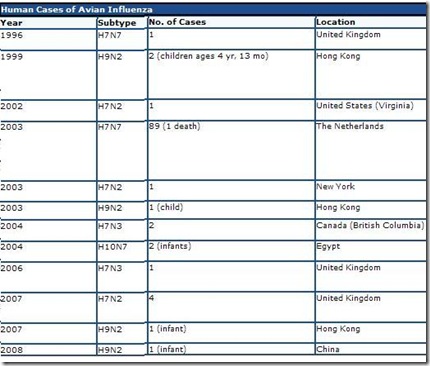
Below you’ll find a chart lifted and edited from CIDRAP’s excellent overview Avian Influenza (Bird Flu): Implications for Human Disease  showing non-H5N1 avian flu infections in humans over the past decade.


CIDRAP FluA


Perhaps the most notorious outbreak of H7 in humans occurred in 2003 in the Netherlands.  It  produced (mostly mild) symptoms in at least 89 people, but did cause 1 fatality. 


CIDRAP describes it this way:

During an outbreak of H7N7 avian influenza in poultry, infection spread to poultry workers and their families in the area (see References: Fouchier 2004, Koopmans 2004, Stegeman 2004). Most patients had conjunctivitis, and several complained of influenza-like illness. The death occurred in a 57-year-old veterinarian. Subsequent serologic testing demonstrated that additional case-patients had asymptomatic infection.


In 2006 and 2007 there were a small number of human infections in Great Britain caused by H7N3 (n=1)  and H7N2 (n=4), again producing mild symptoms.


Since surveillance is – at best - haphazard (or even non-existent) in many parts of the world,  how often this really happens is unknown.


For now, H7 avian influenzas pose only a minor public health threat. 


Since the H7 viruses generally produce mild symptoms in humans, you may be wondering why all the fuss over an outbreak of H7?


First, eradicating the virus can be time consuming, and horrendously expensive.  In 2003 outbreak in the Netherlands mentioned above required the culling of 30 million birds.


And second, the H7s, like all influenza viruses, are constantly mutating and evolving.


While considered mild today, there are no guarantees that the virus won’t pick up virulence over time, or reassort with another `humanized’ virus and spark a pandemic.


In fact, four years ago we saw a PNAS article that suggested that some `humanization’ of the virus was occurring.


Contemporary North American influenza H7 viruses possess human receptor specificity: Implications for virus transmissibility


As we all know, the last pandemic came out of left field; from a region of the world (North America), host species (swine), and influenza strain (H1N1) considered unlikely to spark a global epidemic.


Which is why even relatively benign avian strains are regarded as potential threats, and dealt with swiftly.

Friday, January 27, 2012

Australia Finds LPAI H5 On Two Duck Farms


image

Victoria, Australia – Credit Wikipedia

# 6103


Overnight the wire services have been abuzz with news of the discovery of a low pathogenic form of of avian influenza (LPAI) on a couple of duck farms in Victoria, Australia.  


A few samples of the media coverage include:


Chicken safe to eat, despite Victorian bird flu


Bird flu detected in ducks near Melbourne


Bird flu outbreak sparks duck cull


While all of the stories (rightfully) point out that this is a low-path strain - and not considered to be a serious health hazard to humans – noticeably absent from any of the above reports is any identification of the strain of avian flu detected.


There are, of course, a great many LPAI strains out there, but only the H5s and H7s are required to be reported to the OIE because of their potential to evolve into a more pathogenic strain.


For a good background on avian influenza in agriculture I would invite you to visit CIDRAP’s  Avian Influenza (Bird Flu): Agricultural and Wildlife Considerations - Last updated January 21, 2012


A visit to Victoria’s Department of Primary Industries website solves the subtype mystery (stated to be H5), which is included in the following statement by Victoria’s Chief Veterinary Officer, Dr Andrew Cameron.


Chief Veterinary Officer’s Avian Influenza Update

27 January 2012

The Department of Primary Industries (DPI) has quarantined a commercial duck farm in two locations north-west of Melbourne after birds there tested positive to Low Pathogenic Avian Influenza (LPAI).


DPI Chief Veterinary Officer, Dr Andrew Cameron said analytical tests carried out at the Australian Animal Health Laboratory at Geelong, Victoria, had given a positive response to low pathogenic H5 subtype avian influenza virus, prompting authorities to act immediately.


This low pathogenic subtype of avian influenza is not the highly pathogenic H5N1 virus affecting poultry and humans throughout much of Asia. The wider community is not at risk from this incident.”


Dr Cameron has said, “The virus is relatively harmless now, but we do not want to take the risk it could linger in bird populations and mutate to a more virulent strain.”


The farm has been placed under strict quarantine and no birds, eggs, meat or associated equipment can be taken off the property.


The Consultative Committee for Emergency Animal Diseases (CCEAD) will meet on Friday 27 January, to discuss containment, surveillance and next steps.


Victoria’s Acting Chief Health Officer Dr Rosemary Lester reinforced the assurances that the public is not at risk. “Our poultry meat and eggs continue to be safe under normal food handling and cooking arrangements” she said.


For further information about Avian Influenza review the links below or call 1300 135559.


In Victoria, strict biosecurity guidelines apply to all poultry farms to prevent poultry, feed and water from mixing with wild birds. This minimises the risk of disease. It is a good practice to protect the food and water used for your pet birds and to ensure wild birds cannot come into contact with them. Finally, it is important for all of us to follow good hygiene practices to minimise the risk of any disease, such as washing hands after contact with animals and birds and, in particular, not handling sick or dead birds. These are sensible precautions that will prevent many diseases, not just AI.

Dr Andrew Cameron
Chief Veterinary Officer, Victoria


You’ll find another press release on this site, providing greater detail on the steps that are being taken to eradicate this virus.


Media release: Swift Action to Contain Avian Influenza

27 January 12

Wednesday, November 11, 2009

South Korea: LPAI Detected


# 3989


image

Chuncheon, Gangwon Province


We’ve very little information right now, other than this report from the Chosun Ilbo.    It doesn’t even tell us what strain of avian influenza virus was detected, only that it was low path.


Assuming that it is an H5 or an H7 virus, the OIE should receive notification in the next couple of days.


Fresh Bird Flu Outbreak Worries Health Officials

The resurgence of bird flu in Chuncheon, Gangwon Province is causing concerns to health authorities as the H1N1 flu scare continues. A low pathogenic bird-flu virus was found in excrement of migratory birds in a reservoir in Chuncheon.


Despite the low infectiousness, health authorities claim they cannot rule out danger to humans or mutation and pledged to stay alert.


The worst-case scenario is that patients infected with the H1N1 virus could additionally contract bird flu, leading to a mutation that gives rise to a new supervirus. "But that doesn't necessarily mean that a new form of virus will be formed when the bird flu virus appears amid the spread of H1N1 virus," a health official said. "But if that did actually happen, the situation we've seen so far would be a mere shadow of what lies ahead. That's why we have to take preventive measures."


Disease prevention headquarters on Tuesday said it will vaccinate some 40,000 fowl breeders from the third week of this month instead of December as originally planned.

 Nov. 11, 2009 11:43 KST