Showing posts with label Liberia. Show all posts

Saturday, May 09, 2015

WHO Declares Ebola Outbreak In Liberia Over

image

Credit WHO – May 6th Ebola Activity Map


# 10,029


With no new reported cases of Ebola in Liberia in 42 days, the World Health Organization has officially declared that embattled nation free of the disease.  Neighboring Sierra Leone and Guinea – while also making gains – continue to battle the virus, and so the entire region remains vigilant for any new outbreak.


The victory in Liberia, while welcome, is also fragile. 


This statement was emailed out by the World Health Organization this morning.  Follow the link to read it in its entirety.


The Ebola outbreak in Liberia is over

Report

from World Health Organization

Published on 09 May 2015

Today, 9 May 2015, WHO declares Liberia free of Ebola virus transmission. Forty-two days have passed since the last laboratory-confirmed case was buried on 28 March. The outbreak of Ebola virus disease in Liberia is over.

Interruption of transmission is a monumental achievement for a country that reported the highest number of deaths in the largest, longest, and most complex outbreak since Ebola first emerged in 1976. At the peak of transmission, which occurred during August and September 2014, the country was reporting from 300 to 400 new cases every week.

During those two months, the capital city Monrovia was the setting for some of the most tragic scenes from West Africa’s outbreak: gates locked at overflowing treatment centres, patients dying on the hospital grounds, and bodies that were sometimes not collected for days.

Flights were cancelled. Fuel and food ran low. Schools, businesses, borders, markets, and most health facilities were closed. Fear and uncertainty about the future, for families, communities, and the country and its economy, dominated the national mood.

Though the capital city was hardest hit, every one of Liberia’s 15 counties eventually reported cases. At one point, virtually no treatment beds for Ebola patients were available anywhere in the country. With infectious cases and corpses remaining in homes and communities, almost guaranteeing further infections, some expressed concern that the virus might become endemic in Liberia, adding another – and especially severe – permanent threat to health.


(Continue . . . )

Wednesday, September 10, 2014

Ebola Preparedness Advice From Monrovia

image

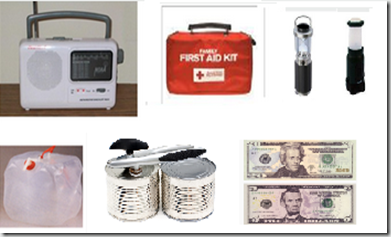
Preparedness items every household should have


#9061


I received a link to an article that appeared in a Liberian online newspaper (The Liberian Observer) earlier this week (thanks Judy), that lists the ten items people need to stockpile in their homes during the ongoing Ebola crisis. The article warns that food prices are going up as the economy falters, and that some items are already in short supply.


The advice offered is to  buy up supplies while they are still available.  From the article:


My advice to you: “Do that shopping that you’ve been putting off since last month.” Make sure you have mostly everything you need in the house (if not all) for you and your family for at least two to three months.


The problem, of course, is that few have the financial means to buy enough food and other supplies to last the recommended 60 to 90 days. If even 10% of Monrovia’s population followed through, the shelves would be emptied overnight, leaving nothing – save for hunger and rage – for those who followed.


It is, in the middle of a crisis, a recipe for chaos.


There is nothing wrong telling people to have an adequate supply of food, water, and other critical supplies on hand for an emergency.  I advocate that sort of thing all the time.  The problem is with the timing.


For Monrovians trapped by this Ebola outbreak – and indeed for anyone caught up in the middle of a major disaster –  the logistical and ethical window of opportunity for that kind of aggressive stockpiling has already passed.  


A link to the article, after which I’ll have a bit more.


10 Things You Need in Your Home During The Ebola Crisis

Sun, 09/07/2014 - 19:35 admin

By: Makanfi Kamara

When last did you go shopping in one of the local markets or supermarkets? If recently, I’m sure you’ve noticed the rapid increase of prices on everything; and believe me, with time, it’s going to go from bad to worse. Unless you live in the interior or you are a complete and total mindless follower of the establishment media, you should be able to see very clearly that our society is more vulnerable now than it ever has been.

(Continue . . . )


The items listed are pretty much the sorts of things you’d want here in the United States, or anywhere, for a prolonged crisis. And had this article suggested procuring a week, or even two, worth of supplies, or if it had been published several months ago - before the impact of Ebola outbreak really set in -  I’d have no qualms about it.


As long as supply chains are intact, store shelves are full and capable of being restocked, and no major shortages exist it is not hoarding, selfish, or unethical to  stockpile emergency supplies for you, your family, and others you might be able to assist during a disaster.


But once a crisis begins, once shortages appear, it becomes a whole different proposition to go out and buy up a 3-month supply of food, or other essentials.  Even if it were possible, I suspect doing so would not go unnoticed by those in dire need, and it would likely put a target on your back.


Ten days ago, in NPM 2014: Be Disaster Aware, Take Action to Prepare, I wrote about how quickly mass stockpiling can lead to a supply chain breakdown, in that case sparking the great toilet paper shortage of 1973. 


While I don’t advocate that every household have a three-month supply of food, water, and other necessities on hand, I heartily recommend at least 10 days of essentials, and thirty days isn’t unreasonable.


September is National Preparedness Month, and FEMA and Ready.gov are urging all Americans to become better prepared to weather a disaster. While they recommend (as a bare minimum) sufficient emergency supplies to last  72 hours, they – and local emergency management officials – would be happier to see you with a week or ten days on hand (see When 72 Hours Isn’t Enough).


But the only good time to acquire these things is now – before the next disaster strikes. 

Monday, August 25, 2014

Liberian Doctor Who Received ZMapp Treatment Dies

image


# 8997


There’s sad news overnight, as one of the three Ebola stricken Liberian doctors who received a dose of ZMapp – an experimental monoclonal antibody cocktail produced in the United States  – has suddenly died.


Doctor Abraham Borbor, Deputy Chief of Medicine at John F. Kennedy Medical Centre in Monrovia, appeared to be improving after receiving the drug a little over a week ago, and was described as `walking around’  yesterday, but  his condition deteriorated unexpectedly last night.


Dr. Borbor  is the second fatal outcome among the six recipients of ZMapp.  The first loss was the Spanish Priest Father Pajares who died very shortly after receiving the drug two weeks ago. 


Two others - Dr. Kent Brantly and  Nancy Writebol have made full recoveries – while two more Liberian doctors who were given the drug continue to improve in Monrovia. While early reports on this drug have been encouraging (see WHO Update: Anecdotal Evidence On Experimental Ebola Drugs), with only 6 cases treated, there is too little data to reach any firm conclusions regarding its efficacy or safety.


This report from DPA (Deutsche Presse-Agentur).

Liberian doctor dies of Ebola despite experimental treatment

August 25, 2014 4:22 pm

Cape Town - A Liberian doctor died of Ebola despite being treated with the experimental drug ZMapp, local newspaper Front Page Africa reported on Monday.

Abraham Borbor was one of three doctors who received ZMapp in Liberia. He became infected with the virus when treating Ebola patients at the John F. Kennedy Medical Centre in the capital, Monrovia.


Information Minister Lewis Brown said Borbor’s death late on Sunday came as a shock.

(Continue . . .)


The supply of ZMapp has been temporarily exhausted, and it may be months before more can be created in the lab.


While there are a handful of other investigational drugs out there, they are untested in humans, and are also in very short supply.  There are also serious logical and ethical challenges ahead in the distribution and use of any untested therapies (see WHO: Full Report Of Ethics Committee On Experimental Drugs For Ebola).


For more on ZMapp you may wish to revisit CDC FAQ On Experimental Ebola Treatments & Vaccine Development.

Sunday, April 06, 2014

WHO Updates On West Africa’s Ebola Outbreak

image

Ebola Testing Now Done locally – Twitter picture Promoted by WHO


# 8437


It may be an early Sunday morning, but the World Health Organization (@WHO) and their spokesperson Gregory Hartl (@Haertlg) have been very busy the past few hours providing updates on the latest developments in Africa’s Ebola outbreak via their respective twitter accounts. 


With more than 1.2 million followers, the WHO now routinely dispenses breaking news and information first from their twitter account, and then follows up with more detailed postings on their website.


Aside from updating the case counts in Guinea & Liberia, and ongoing activities to combat this outbreak, this morning the WHO reports they have been notified of 4 suspected cases of VHF (Viral Hemorrhagic Fever) from neighboring Mali.


Note - while their symptoms may be consistent with Ebola, they have not yet been confirmed by laboratory testing.

image


First stop this morning, a link and some excerpts from a detailed update posted yesterday on the Ebola Outbreak, which details the situation in Guinea and Liberia, and then a sampling of some of the messaging coming out of WHO.


Ebola virus disease, West Africa (Situation as of 5 April 2014)


5 April 2014 – As at 4 April 2014, the Ministry of Health of Guinea has reported a cumulative total of 143 clinically compatible cases of Ebola virus disease (EVD), of which 54 are laboratory confirmed by PCR. The total number includes 86 deaths (CFR 60%). New cases have been reported from Conakry, Guekedou and Macenta; 23 patients are currently in isolation units. The date of onset of the most recent laboratory confirmed case is 3 April.

The current number of clinical and confirmed cases and deaths by place of report is Conakry (18 cases, including 5 deaths), Guekedou (85 cases/59 deaths), Macenta (27 cases/14 deaths), Kissidougou (9 cases/5 deaths), and Dabola and Djingaraye combined (4 cases/3 deaths).  Sixteen of the 18 clinical cases in Conakry have been laboratory confirmed for EVD. There has been no increase in the number of affected health care workers (HCW) from the 14 reported previously, including 8 deaths; 11 of the affected HCWs are laboratory confirmed cases. Sixteen of the 86 deaths overall are laboratory confirmed, 65 are classified as probable cases and 5 as suspected cases.

Case investigation and contact tracing are continuing, with 623 contacts requiring medical follow-up; this includes 74 new contacts identified on 3 April while 49 have been released from observation as they have remained well after the maximum incubation period for EVD of 21 days following the last exposure to a case. Laboratory support for the investigation is being provided by Institut Pasteur Dakar, Senegal, and the mobile laboratory in Guekedou. Reference laboratory functions have been provided by Institut Pasteur Lyon, France, the Bernhard-Nocht Institute of Tropical Medicine Hamburg, Germany, and the Centre International de Recherche en Infectiologie (CIRI) laboratory in Lyon, France.

WHO, in collaboration with technical partners in the Global Outbreak Alert and Response Network (GOARN) has deployed field laboratory support, and experts in anthropology, epidemiology, logistics, clinical case management and infection prevention and control and outbreak coordination to support the response in Guinea.

The Ministry of Health and Social Welfare (MOHSW) of Liberia has reported 18 suspected and 2 confirmed cases of EBV, including 7 deaths, since 24 March (CFR 31%); 7 patients are currently in an isolation unit while 2 suspected cases have been discharged.  Four new clinically compatible cases were reported on 4 April.  One of the suspected cases is in a health care worker.  Both of the laboratory confirmed cases, sisters from Lofa County, have died.  The suspected cases include a hunter treated at a hospital in Tapita, Nimba County, who died shortly after presenting to the health facility and a 3 year old boy with a clinically compatible illness who had travelled from Guinea. The deceased hunter gave no history of contact with known cases in Liberia or Guinea and his exposure is being investigated to exclude transmission from an animal source (bush meat). The laboratory results for both of these suspected cases are pending.  The MOHSW has placed 46 contacts under medical observation, including those of the second confirmed case who travelled from Foyah, Lofa Country, to Monrovia, Montserrado Country, and then to Firestone in Margibi County. A total of 21 clinical samples have been sent to Conakry, Guinea, for laboratory testing. Counties of concern for EVD in Liberia include Lofa, Bong, Nimba, Margibi and Montserrado.

(Continue . . . )


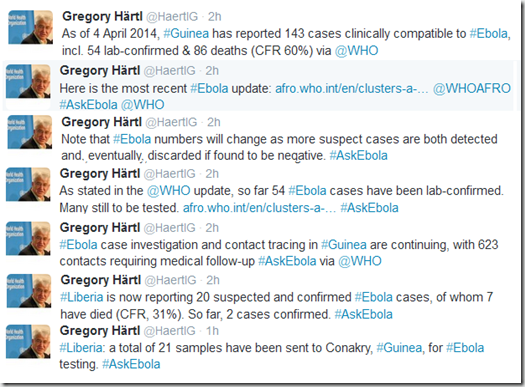
The following messages come from the WHO twitter account between approximately 0900hrs and 1100hrs UTC April 6th, 2014.

image


Similarly, the following messages come from WHO spokesperson Gregory Hartl (who is tweeting in multiple languages), during roughly the same time span.  A good deal of his time is spent answering specific questions posed by journalists, or  providing reality checks when the media occasionally gets ahead of the story.

image


Aside from following the WHO twitter accounts or searching for #AskEbola on Twitter – you will find that Crawford Kilian has devoted considerable time and energy on Crofsblog to chronicling this outbreak


For more background on Ebola, you may also wish to revisit these earlier blogs.


CDC Video: Responding To An Ebola Outbreak
A Brief History Of Ebola

Monday, March 31, 2014

Liberia: MOH Press Conference On Ebola Outbreak

image

 @WHO & Partners Ebola Response In Guinea


# 8417


While the planned webcast of the Liberian Ministry of Health’s press conference ran into technical difficulties, the United Nations Mission in Liberia twitter account (@UNMILNews) live-tweeted the key points, which I’ve captured and reproduced below:

image

My thanks go to the UNMIL social media team for their terrific work in getting the details out on this press conference via twitter.


LIVE: "We are working around the clock to reach out to the public." - #Liberia Ministry of Health Press Conference on #Ebola.

LIVE: Out of 7 samples tested, 2 are positive for Ebola virus. - #Liberia Ministry of Health Press Conference on #Ebola.

LIVE: Woman w/ #Ebola took taxi from Foya to Firestone Clinic for treatment. - #Liberia Ministry of Health Press Conference on #Ebola.

LIVE: "This is a preventable disease." - #Liberia Ministry of Health Press Conference on #Ebola.

LIVE: "We need to follow those who have had contact w/ Ebola patients for 21 days." -#Liberia Ministry of Health Press Conference on #Ebola.

LIVE: "Traditional practices that could spread this disease need to be avoided." -#Liberia Ministry of Health Press Conference on #Ebola.

LIVE: "Avoid eating bats and other bush meat during this period." -#Liberia Ministry of Health Press Conference on #Ebola.

LIVE: "Ebola is transmitted from person to person through direct physical contact." -#Liberia Ministry of Health Press Conference on #Ebola.

LIVE: "National taskforce established & working tirelessly for effective response." -#Liberia Ministry of Health Press Conference on #Ebola.

LIVE: "Any sudden death or person w/ fever needs to be reported immediately." -#Liberia Ministry of Health Press Conference on #Ebola.

LIVE: "Lofa is the epicenter of the epidemic. One case is an epidemic." -#Liberia Ministry of Health Press Conference on #Ebola.

LIVE: "Don't travel if you have symptoms. Report to nearest medical facility." - #Liberia Ministry of Health Press Conference on #Ebola.

LIVE: "Media: please help us. Help the people to avoid fear, panic and denial." - #Liberia Ministry of Health Press Conference on #Ebola.

LIVE: "We're tracing down, isolating & investigating all who had contact w/ cases." -#Liberia Ministry of Health Press Conference on #Ebola.

LIVE: "Incubation period is from 3-21 days." - #Liberia Ministry of Health Press Conference on #Ebola.

LIVE: "Not all cases will show all the symptoms." - #Liberia Ministry of Health Press Conference on #Ebola.

LIVE: "@WHO has teams supporting the Government in all affected areas." - #Liberia Ministry of Health Press Conference on #Ebola.

LIVE: "Don't get contaminated by doing own investigations. Tell a medical officer." -#Liberia Ministry of Health Press Conference on #Ebola.

LIVE: "Media: don't take pictures of suspected patients. Respect confidentiality." - #Liberia Ministry of Health Press Conference on #Ebola.

LIVE: "Media: don't expose yourself & widen the net of people we have to monitor." - #Liberia Ministry of Health Press Conference on #Ebola.

LIVE: "Out of every 10 people who get the disease, up to 9 of them will die." - #Liberia Ministry of Health Press Conference on #Ebola.

Q&A session is underway. Followers can post questions for the Minister of Health, Chief Medical Officer, WHO, or the Min of Info on #Ebola

LIVE: "Tests require certain technology so for now we are relying on #Guinea." - #Liberia Ministry of Health Press Conference on #Ebola.


LIVE: "The fact that we cannot test for Ebola doesn't mean we don't have labs." - #Liberia Ministry of Health Press Conference on #Ebola.

LIVE: "Response will cost approx. $1.2 million over 3 month period." - #Liberia Ministry of Health Press Conference on #Ebola.

LIVE: "Don't buy bush meat until outbreak is over -> 42 days after last case." - #Liberia Ministry of Health Press Conference on #Ebola.

LIVE: "The country remains open and business goes on." - #Liberia Ministry of Health Press Conference on #Ebola.

LIVE: "Let people remain where they are, be informed, be supported & be treated." - #Liberia Ministry of Health Press Conference on #Ebola.

LIVE: "Chief Medical Officer available on-call 24/7 for media." - #Liberia Ministry of Health Press Conference on #Ebola.

LIVE: "Government is taking every step to trace every movement of cases." - #Liberia Ministry of Health Press Conference on #Ebola.

LIVE: "We need to get timely & truthful information out to people not sensation." - #Liberia Ministry of Health Press Conference on #Ebola.

#Liberia Ministry of Health Press Conference on #Ebola coming to a close. We'll be posting the mp3 for download momentarily.


(NOTE: I’ll post a link to the MP3 file when it becomes available)


Meanwhile, as this press conference proceeded, the issue of the safety of consuming bushmeat was addressed by WHO Spokesperson Gregory Hartl in a series of tweets to UNMIL and @MicatLiberia  (Liberia’s Ministry of Information, Cultural Affairs, and Tourism).

image


An important reminder that bushmeat can be an important vector for a variety  zoonotic diseases, and that just because an outbreak may have been contained in a region, that doesn’t mean the pathogen isn’t still lurking in a local animal reservoir. 


For more on these risks, which is often exacerbated by the exporting or smuggling of  bushmeat (or live animals), you may wish to revisit:


Vienna: 5 Smuggled Birds Now Reported Positive For H5N1
WSJ: Nathan Wolfe & Viral Chatter
Bushmeat,`Wild Flavor’ & EIDs