Showing posts with label Mali. Show all posts

Tuesday, November 25, 2014

WHO Update : 2 More Ebola Cases In Mali

image

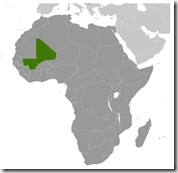
Mali – Credit Wikipedia


# 9373


On Thursday of last week, in WHO Update On Ebola In Mali – Nov 20th, the number of Ebola cases in Mali stood at six; the original 2 year-old who died in  October, and 5 unrelated cases stemming from the treatment of an Imam from Guinea at a local clinic.  


Since then, there have been sporadic media accounts suggesting two more cases had emerged, but today we get the details from the following World Health Organization update.


Mali confirms 2 new cases of Ebola virus disease

Ebola situation assessment
25 November 2014

Mali’s Ministry of Health has confirmed an additional 2 new cases of Ebola virus disease. The first, confirmed on 22 November, occurred in the 23-year-old fiancée of the 25-year-old nurse who attended the Grand Imam from Guinea (the index case in this outbreak) and died of Ebola on 11 November.

The young woman developed symptoms on 19 November and, on 20 November, was hospitalized in isolation at Bamako’s Ebola treatment centre, a new facility which opened last week.

Because of her association with the nurse, most of her close contacts were already under surveillance. Her case was detected early in the disease course. Her quick isolation has further reduced opportunities for community exposures.

The second new case is part of a family of previously confirmed and deceased patients. The 27-year-old man lost his mother and half-brother to Ebola.

He developed symptoms on 19 November and was admitted for treatment at the new facility on 24 November. Laboratory confirmation was received the same day.

The identification of patient contacts for daily monitoring has reportedly reached 99%. Based on experiences in Senegal and Nigeria, this achievement could augur well for rapid containment of Mali’s outbreak.

Collaboration with health officials in Guinea

To date, all 7 cases in this second wave of infections can be linked to contact with an Imam who developed symptoms on 17 October in his native village of Kourémalé, Guinea, and arrived in Bamako on 25 October for treatment at the Pasteur Clinic.

His case has been classified as a Guinea case as he developed symptoms there. After his death on 27 October, his body was returned to Kourémalé for a funeral the following day that attracted a large number of mourners.

These events ignited additional chains of transmission in Guinea, including several deaths, which are currently under investigation by WHO epidemiologists. Most of these patients had symptom onset in early to mid-November, indicating ongoing chains of transmission.

With WHO support, staff from Mali’s Ministry of Health will be meeting with health officials from Guinea to discuss cross-border measures for coordinating control efforts and reducing the likelihood that additional cases will be imported from Guinea into Mali.


Thursday, November 20, 2014

WHO Update On Ebola In Mali – Nov 20th

image

Mali – Credit Wikipedia


# 9347


It has now been a little over a week since we learned of the second introduction of Ebola into the nation of Mali (see Media Reports: A Second Ebola Case In Mali), and unlike the first imported case in October, this time there are a number of secondary cases.  


While there has been a fair amount of reporting from the region, the situation there is obviously difficult, and the numbers often conflict. 


Today we’ve an update from the World Health Organization that details the individual cases from each importation,  and gives us a good sense of the size and progress of the epidemiological investigation.  


For now, Mali’s total stands at six Ebola cases (including the 2 year old from October), with 5 deaths.  Another 338 potential contacts have been identified, and 303 are under daily surveillance. Based on a maximum 21 day incubation period, we should know in the next week to 10 days whether additional contacts have been infected.


The size of the infected Imam’s funeral in Guinea adds considerably to the risks of further transmission in that country, and an additional 300 contacts are being traced there.


Mali: Details of the additional cases of Ebola virus disease

Ebola situation assessment - 20 November 2014

As of today, Mali has officially reported a cumulative total of 6 cases of Ebola virus disease, with 5 deaths. Of the 6 cases, 5 are laboratory confirmed and one remains probable as no samples were available for testing.

These numbers include the 2-year-old girl who initially imported the virus into Mali and died of the disease on 24 October.

Intensive tracing and monitoring of the child’s numerous contacts, including many who were monitored in hospital, failed to detect any additional cases. All 118 contacts, including family members, have now passed through the 21-day incubation period without developing symptoms.

The virus was almost certainly re-introduced into Mali by a 70-year-old Grand Imam from Guinea, who was admitted to Bamako’s Pasteur Clinic on 25 October and died on 27 October. He has been reclassified as a Guinea case, as he developed symptoms in that country. No samples were available for testing.

Pasteur Clinic: direct and indirect links

All 5 cases in this new outbreak are linked, 3 directly and 2 indirectly, to the patient in the Pasteur Clinic.

The first was a 25-year-old male nurse who worked at the clinic and was assigned to care for the Imam. He was hospitalized on 8 November. His case was laboratory-confirmed on 11 November and he died the same day.

The second case was confirmed in a doctor who worked at the clinic and treated the Imam. He developed symptoms on 5 November and was hospitalized on 8 November. Laboratory confirmation was received on 12 November. He is currently undergoing treatment

The third case was a 51-year-old friend of the Imam who visited him at the Pasteur Clinic. He developed symptoms on 7 November and died on 10 November from an undiagnosed cause. He is the country’s single probable case.

The friend’s infection led to an additional two confirmed and fatal cases. The first was a 57-year-old woman who had direct contact with the friend. She developed symptoms on 29 October. She was admitted to another clinic on 11 November and then transferred to a hospital on 12 November. She died that same day.

The second case was the woman’s son. He visited yet another clinic on 5 November and died at home on 14 November. Ebola infection was laboratory-confirmed in both cases.

Stepped up contact tracing

A massive effort is currently under way to identify all potential chains of transmission, monitor contacts, and prevent the outbreak from growing larger. At present 338 contacts have been identified and 303 (90%) of these have been placed under daily surveillance.

This rigorous “detective” work shows that the deceased nurse from the Pasteur Clinic had the largest number of contacts, at 98, including 75 family members.

As the successful experiences in Senegal and Nigeria show, aggressive contact tracing, which seeks to find and break every chain of transmission immediately after an imported case, can hold the number of additional cases to very small numbers and support a rapid end to the outbreak.

The Ministry of Health, with assistance from the WHO country office, has augmented the number of staff engaged in contact tracing by drawing on polio surveillance teams and using local medical students with training in epidemiology.

In addition, WHO has deployed 10 epidemiologists through its Global Outbreak Alert and Response Network, or GOARN.

The country is also ramping up its capacity to perform exit screening at the Bamako airport.

Guinea: Many mourners attended the funeral

The Imam was buried in his native village of Kourémalé, Guinea, on 28 October. That event has now been investigated. Thousands of mourners may have attended the funeral. Some of them touched the body as part of the traditional funeral ceremony. About 300 contacts are being traced.

Experts in Mali and at WHO agree that Mali will remain at risk of further imported cases as long as transmission across the border in ongoing.

Monday, November 17, 2014

CDC Updates Ebola Travel Warnings

image

Credit http://wwwnc.cdc.gov/travel


# 9335


Although the number of Ebola cases in Mali remains small, unlike with their first introduction of the virus last month - local transmission has occurred and may still be occurring (see WHO Statement On 2nd Introduction Of Ebola Into Mali)- prompting the CDC to issue an updated travel Alert.


Level 3 Warnings remain in effect for Sierra Leone, Liberia, and Guinea, while a Level 2 Alert has been issued for Mali.    


I’ve only posted some excerpts from the Mali update. Follow the link to read it in its entirety. 


Ebola in Mali

 Alert - Level 2, Practice Enhanced Precautions

 Updated: November 16, 2014

The purpose of this alert is to notify travelers that a few Ebola cases have been reported in Bamako, Mali, and to inform travelers of actions they can take to reduce their risk of getting the disease.

CDC recommends that travelers to Mali protect themselves by avoiding contact with the blood and body fluids of people who are sick, because of the possibility they may be sick with Ebola. Although the current cluster of cases has been reported only in Bamako, travelers to all parts of Mali should be alert for reports of possible further spread within the country.

At a Glance
  • Total Cases: 4
  • Laboratory-Confirmed Cases: 3
  • Total Deaths: 3

More

What is the current situation?

As of November 12, 2014, the World Health Organization reported a cluster of Ebola cases in Bamako, Mali (see box for case counts). The cluster in Bamako is linked to a man who had been in a clinic in Bamako after becoming sick in Guinea. Since that time, a small number of Ebola cases linked to this patient have been reported in Bamako. (An unrelated death from Ebola occurred in Kayes, Mali on October 24, 2014 and no additional cases related to that person have been reported.) The Malian government has taken actions to contain further spread of Ebola. CDC recommends that travelers to Mali avoid contact with the blood and body fluids of people who are sick and follow the other recommendations listed below, in order to protect themselves from Ebola.

The cases of Ebola in Bamako, Mali, are related to an ongoing Ebola outbreak that has been occurring since March 2014 in Guinea, Liberia, and Sierra Leone and is the largest outbreak of Ebola in history.

For more information about the ongoing outbreak in West Africa, visit 2014 Ebola Outbreak in West Africa on the CDC Ebola website.

<SNIP>

Returning to the United States

Entry Screening

The United States now requires all travelers to the United States whose trip starts in Guinea, Liberia, or Sierra Leone to enter through one of five US airports (JFK in New York, Newark in New Jersey, Dulles in Virginia near Washington D.C., Hartsfield-Jackson in Atlanta, and O’Hare in Chicago). Beginning November 17, 2014, air travelers to the United States whose trip starts in Mali will also be required to enter the United States through one of these five airports. These airports have enhanced entry screening, which helps identify travelers who may be sick with Ebola or may have had an exposure to Ebola and ensure that these travelers are connected with a health department and given medical care, if needed.

If you are traveling from Mali to the United States,

  • You should be prepared for screeners to check your temperature and look for signs and symptoms of illness. You will also be asked to answer questions about possible exposures to someone with Ebola.
  • You will be given a CARE (Check and Report Ebola) Kit with information about Ebola and tools to help you check your temperature and symptoms each day for 21 days.

Symptom Monitoring and Movement Restrictions

You will be connected to a health department in your final destination. Public health workers will assess your health and Ebola risk level to decide how best to monitor you for symptoms and what other restrictions may be needed.

  • All returning travelers will be actively monitored, which means that public health workers are responsible for checking at least once a day to see if you have a fever or other Ebola symptoms. This will continue for 21 days after the last possible exposure (such as 21 days after leaving Mali).
  • You will be asked to take your temperature 2 times a day and watch yourself for Ebola symptoms.
  • A public health worker will tell you how to report your temperature and any symptoms each day. You might do this by phone, during a daily visit, or online.
  • The public health worker will also tell you what to do if you have a fever (temperature of 100.4°F/38°C or above) or other symptoms (severe headache, fatigue [feeling very tired], muscle pain, vomiting, diarrhea, stomach pain, and unexplained bleeding or bruising).
    • If you have a fever or other symptoms, it is very important that you get medical care right away. Follow the directions the public health worker tells you. But if you cannot reach someone right away, you can contact your state health department or call CDC at 1-800-232-4636. If you have a medical emergency, call 911.
  • Based on your level of possible exposure to Ebola, your travel and public activities may be limited.

(Continue . . .)


Wednesday, November 12, 2014

Mali MOH Statement On Newly Confirmed Ebola Case

image

Mali with 500 mile-long border (in red) With Guinea


# 9310


While it doesn’t tell us anything more than we already knew, a statement has been posted on Mali’s MOH website (http://www.sante.gov.ml) that confirms the media reports of last night indicating a nurse had died from Ebola at a clinic in Bamoko after treating a patient from Guinea roughly 2 weeks ago.


Unlike Mali’s earlier case – that of a 2 year-old from Guinea who died in October – this case represents a local transmission of the virus.  There are media reports (unconfirmed) that a doctor at the clinic where this nurse worked who is also sick, and a large scale epidemiological investigation is underway.


Mali – a landlocked nation of more than 16 million people– shares a 500 mile-long border with Guinea and is highly dependent upon the ports of neighboring nations (like Guinea, Senegal & Cote D’Ivoire) to handle their import needs. 


In late October the government of Mali reiterated their decision to keep their borders open with Guinea, even after their first imported Ebola case was revealed, with President Ibrahim Boubacar Keita saying it would be impossible to  completely seal his country off from Ebola in neighboring Guinea.


With few exceptions, political borders around the world are more theoretical boundaries than practical ones, and are rarely an effective physical deterrent to the spread of infectious diseases. 


Which means that the longer that Ebola rages in Guinea, Sierra Leone, and Liberia the greater the chances are for it to seep into neighboring countries like Mali, Senegal, Cote D’Ivoire and Guinea-Bissau.


(translation)

Ebola: new confirmed case in Bamako

As part of the fight against Ebola virus disease in the country, health services conducted Monday, November 10, 2014 to investigate a health worker reported having had contact with a patient from Guinea made charge by a private clinic located in Commune IV in Bamako District.

 
During the investigation, a blood sample was taken Monday, November 10, 2014 on the subject. The results of the analysis of the samples were positive to Ebola Tuesday, November 11, 2014. The Mali and knows his second case of Ebola virus disease.


While her care were administered agent aged 25 health years sadly passed away Tuesday, November 11, 2014.

In these painful circumstances, the Government extends its condolences to the bereaved family and reminds the public that hygiene measures enacted remain effective means of disease prevention.


The Government assures that according to the protocol of care for patients Ebola virus in force, all measures are taken to identify the persons who had contact with the deceased. The premises of the private clinic who supported and the patient's home has been completely disinfected and placed under observation.


The Government informs the public that the health services, with the support of partners are hard at work to prevent the spread of the virus from this case linked to imported cases of Guinea.


It invites the population to remain calm, serenity but also and especially to the vigilance and compliance with hygiene measures enacted in the area.


Following the guidance of the President of the Republic, the Government of the Republic of Mali to thank all its partners for their assistance in his fight against this disease, reminds people to avoid unnecessary trips to the epidemic areas and observe hygiene measures and safety regulate the matter.

Bamako, November 12, 2014

Updated Wednesday, November 12, 2014 11:05


Tuesday, November 11, 2014

Media Reports: A Second Ebola Case In Mali

image


# 9309


A story the newshounds on FluTrackers and elsewhere have been watching (see FluTrackers Thread) most of the day has concerned reports of a suspected second Ebola case in Mali, unrelated to the first case, a 2 year-old who traveled while ill from Guinea in October. .


Over the past few hours several media sources have reported that a nurse has died and has tested positive for Ebola. The nurse had reportedly treated a patient from Guinea, who also died but who was not tested.


Details are still scant, but a couple of major newswire reports include:


Mali suffers second Ebola case with death of a nurse

Bamako (AFP) - Mali has suffered a new case of Ebola infection -- separate from its only other one detected last month -- with the death of a nurse who treated a patient from Guinea, medical sources said late Tuesday.

"The nurse, who had been in contact with a Guinean national who died of the illness, died in turn," said official at the Pasteur Clinic in the capital Bamako, where the male nurse worked.

Tests had confirmed the presence of the Ebola virus, the official added.

(Continue . . . )


Mali confirms new case of Ebola, locks down Bamako clinic

BAMAKO Tue Nov 11, 2014 7:15pm EST

(Reuters) - The government of Mali confirmed the country's second case of Ebola late on Tuesday and police deployed outside a clinic in the capital, Bamako, that authorities said had been quarantined.

In a statement via Twitter, Mali's Information Minister Mahamadou Camara said "prevention measures" were being taken, but gave no details on the case. Local officials and diplomats said the new case was unrelated to the first one last month.

(Continue . . .)


While it was beginning to look as if Mali had dodged a bullet with their first introduction of the virus last month – as the 21 day monitoring period for contacts is coming to a close – this latest case restarts the clock, and will set off another intensive round of contact tracing and monitoring.


The fact that the nurse has died, and a doctor at the clinic is reportedly ill, suggests there will be plenty of contacts who must be followed up on in the coming days.

Saturday, November 01, 2014

WHO Ebola Update: Mali - Oct 31st

image


# 9275


One week ago, in WHO Ebola Update – Mali Confirms 1st Ebola Case, we got the worrisome details of an Ebola infected child traveling to – and eventually dying in – the sixth African nation to be affected by the current epidemic; Mali.


Yesterday the World Health Organization updated the investigation, public health response, which so far has not turned up any additional cases. 


The good news is, out of 85 known contacts, none have tested positive for the virus.  The bad news is A) there may be other contacts not identified or contacted and  B) most contacts are only about half-way through the 21 day window of incubation.


Ebola virus disease – Mali

Disease outbreak news
31 October 2014

On 23 October 2014, WHO was notified by Mali's Ministry of Health of a laboratory-confirmed case of infection with Ebola Virus Disease (EVD). This is the first EVD case in Mali.

Details of the case are as follows:

The case is a 2-year-old female who developed symptoms, presumably on 19 October 2014, while in Beuila, Guinea and then travelled across by road to Mali. On 20 October 2014, the patient was admitted to a healthcare facility in Kayes, Mali. On 21 October 2014, she was referred to the Fousseyni Daou Hospital in Kayes. On 22 October 2014, samples for EVD were taken and analysed at the Center for TB and AIDS Research in Mali. Samples came back positive for EVD. Confirmation of test results is being carried out at the Centers for Disease Control and Prevention (CDC) in Atlanta and at Institute Pasteur de Dakar Senegal. The case died on 24 October 2014.

To date, 85 contacts have been identified and are under follow-up.

Public health response

1. Under the leadership of the Government of Mali, WHO, Médecins Sans Frontières, the Alliance for International Medical Action, International Medical Corps, Project Muso, Save the Children and Plan Mali, national and international specialists have been deployed in Bamako and Kayes.

2. In collaboration with WHO, the Ministry of Health is putting in place an incident command structure in order to: (i) mount a coordinated response including surveillance and contact tracing, case management, safe burials, social mobilization and logistics; (ii) accelerate the completion of the isolation facility at the Center for Vaccine Development in Bamako, Mali; and (iii) provide regular communication to the public.

3. WHO convened an EVD Task Force meeting to prioritize actions and to discuss roles and responsibilities with partners.

4. Local authorities are carrying out training activities for the personnel working in the healthcare facilities where the patient was admitted; furthermore, these facilities are undergoing disinfection and equipment replacement. A management plan for EVD cases has been drafted at the Fousseyni Daou Hospital.

WHO and other partners are mobilizing and deploying additional experts to provide support to the Ministry of Health. The necessary supplies and logistics required for supportive management of patients and all aspects of outbreak control are also being mobilized.

Future WHO updates on EVD in Mali will not be posted on the Disease Outbreak News. Further information will be available in WHO’s Ebola Situation Reports which provide regular updates on the WHO response:

Ebola situation reports

WHO does not recommend any travel or trade restrictions be applied by countries except in cases where individuals have been confirmed or are suspected of being infected with EVD or where individuals have had contact with cases of EVD. Contacts do not include properly-protected health-care workers and laboratory staff.

Temporary recommendations from the Emergency Committee with regard to actions to be taken by countries can be found at:

Sunday, April 06, 2014

WHO Updates On West Africa’s Ebola Outbreak

image

Ebola Testing Now Done locally – Twitter picture Promoted by WHO


# 8437


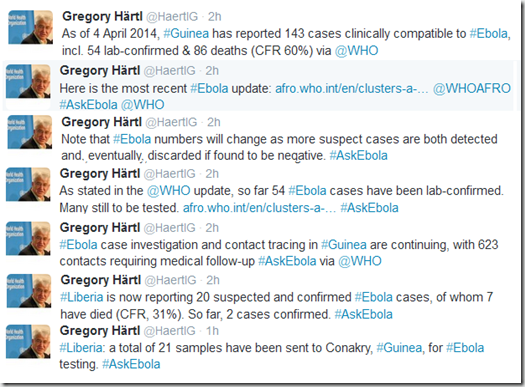
It may be an early Sunday morning, but the World Health Organization (@WHO) and their spokesperson Gregory Hartl (@Haertlg) have been very busy the past few hours providing updates on the latest developments in Africa’s Ebola outbreak via their respective twitter accounts. 


With more than 1.2 million followers, the WHO now routinely dispenses breaking news and information first from their twitter account, and then follows up with more detailed postings on their website.


Aside from updating the case counts in Guinea & Liberia, and ongoing activities to combat this outbreak, this morning the WHO reports they have been notified of 4 suspected cases of VHF (Viral Hemorrhagic Fever) from neighboring Mali.


Note - while their symptoms may be consistent with Ebola, they have not yet been confirmed by laboratory testing.

image


First stop this morning, a link and some excerpts from a detailed update posted yesterday on the Ebola Outbreak, which details the situation in Guinea and Liberia, and then a sampling of some of the messaging coming out of WHO.


Ebola virus disease, West Africa (Situation as of 5 April 2014)


5 April 2014 – As at 4 April 2014, the Ministry of Health of Guinea has reported a cumulative total of 143 clinically compatible cases of Ebola virus disease (EVD), of which 54 are laboratory confirmed by PCR. The total number includes 86 deaths (CFR 60%). New cases have been reported from Conakry, Guekedou and Macenta; 23 patients are currently in isolation units. The date of onset of the most recent laboratory confirmed case is 3 April.

The current number of clinical and confirmed cases and deaths by place of report is Conakry (18 cases, including 5 deaths), Guekedou (85 cases/59 deaths), Macenta (27 cases/14 deaths), Kissidougou (9 cases/5 deaths), and Dabola and Djingaraye combined (4 cases/3 deaths).  Sixteen of the 18 clinical cases in Conakry have been laboratory confirmed for EVD. There has been no increase in the number of affected health care workers (HCW) from the 14 reported previously, including 8 deaths; 11 of the affected HCWs are laboratory confirmed cases. Sixteen of the 86 deaths overall are laboratory confirmed, 65 are classified as probable cases and 5 as suspected cases.

Case investigation and contact tracing are continuing, with 623 contacts requiring medical follow-up; this includes 74 new contacts identified on 3 April while 49 have been released from observation as they have remained well after the maximum incubation period for EVD of 21 days following the last exposure to a case. Laboratory support for the investigation is being provided by Institut Pasteur Dakar, Senegal, and the mobile laboratory in Guekedou. Reference laboratory functions have been provided by Institut Pasteur Lyon, France, the Bernhard-Nocht Institute of Tropical Medicine Hamburg, Germany, and the Centre International de Recherche en Infectiologie (CIRI) laboratory in Lyon, France.

WHO, in collaboration with technical partners in the Global Outbreak Alert and Response Network (GOARN) has deployed field laboratory support, and experts in anthropology, epidemiology, logistics, clinical case management and infection prevention and control and outbreak coordination to support the response in Guinea.

The Ministry of Health and Social Welfare (MOHSW) of Liberia has reported 18 suspected and 2 confirmed cases of EBV, including 7 deaths, since 24 March (CFR 31%); 7 patients are currently in an isolation unit while 2 suspected cases have been discharged.  Four new clinically compatible cases were reported on 4 April.  One of the suspected cases is in a health care worker.  Both of the laboratory confirmed cases, sisters from Lofa County, have died.  The suspected cases include a hunter treated at a hospital in Tapita, Nimba County, who died shortly after presenting to the health facility and a 3 year old boy with a clinically compatible illness who had travelled from Guinea. The deceased hunter gave no history of contact with known cases in Liberia or Guinea and his exposure is being investigated to exclude transmission from an animal source (bush meat). The laboratory results for both of these suspected cases are pending.  The MOHSW has placed 46 contacts under medical observation, including those of the second confirmed case who travelled from Foyah, Lofa Country, to Monrovia, Montserrado Country, and then to Firestone in Margibi County. A total of 21 clinical samples have been sent to Conakry, Guinea, for laboratory testing. Counties of concern for EVD in Liberia include Lofa, Bong, Nimba, Margibi and Montserrado.

(Continue . . . )


The following messages come from the WHO twitter account between approximately 0900hrs and 1100hrs UTC April 6th, 2014.

image


Similarly, the following messages come from WHO spokesperson Gregory Hartl (who is tweeting in multiple languages), during roughly the same time span.  A good deal of his time is spent answering specific questions posed by journalists, or  providing reality checks when the media occasionally gets ahead of the story.

image


Aside from following the WHO twitter accounts or searching for #AskEbola on Twitter – you will find that Crawford Kilian has devoted considerable time and energy on Crofsblog to chronicling this outbreak


For more background on Ebola, you may also wish to revisit these earlier blogs.


CDC Video: Responding To An Ebola Outbreak
A Brief History Of Ebola