Showing posts with label Oklahoma. Show all posts

Tuesday, May 27, 2014

Oklahoma DOH Reports 1st Heartland Virus Fatality

image

Lone Star Tick - Credit CDC MMWR


# 8671


In August of 2012, in a New Phlebovirus Discovered In Missouri, I wrote about the CDC’s announcement of a new tick-borne virus phlebovirus detected in two Missouri farmers with no epidemiological links and living 60 miles apart.


Dubbed `The Heartland Virus’ (HLV),  the virus was  named after the Heartland Regional Medical Center in St. Joseph, Mo which alerted the CDC back in 2009 about these cases.


Phleboviruses are part of the large family Bunyaviridae - which includes such infamous pathogens as Crimean-Congo hemorrhagic fever and Rift Valley Fever.  Bunyaviruses -  are mostly spread via arthropod vectors (ticks, mosquitoes & sand flies).


This newly described `Heartland virus’  is genetically similar to another tickborne disease identified in China in 2011 called the SFTS virus (see EID Journal  dispatch Severe Fever with Thrombocytopenia Syndrome Virus, Shandong Province, China Jun 2012).  Since then, SFTS-like viruses have been found in ticks in Japan, Korea, and Australia.


Last March (see MMWR: Heartland Virus Disease — United States, 2012–2013) we saw an update from the CDC indicating that 6 more cases had been identified (5 in Missouri, 1 in Tennessee).   This from CDC’s emailed press release:


CDC studies to date have shown Heartland virus is carried by Lone Star ticks, which are primarily found in the southeastern and eastern United States. Additional studies seek to confirm whether ticks can spread the virus to people and to learn what other insects or animals may be involved in the transmission cycle. CDC is also looking for Heartland virus in other parts of the country to understand how widely it may be distributed.


Today, via the Oklahoma State Health Department  we learn that the number of cases has grown to 10, and that Oklahoma is reporting its first Heartland virus related fatality.


For Release:  May 27, 2014 – Pamela Williams, Office of Communications – 405-271-5601

Oklahoma State Health Department Confirms First Case and Death of Heartland Virus

The Oklahoma State Department of Health has confirmed the state's first case and death of Heartland virus. A Delaware County resident died recently from complications of the virus. The virus is found in the Lone Star tick (Amblyomma americanum), and is likely spread through tick bites. 

Heartland virus was first identified in Missouri in 2009. The Oklahoma case is only the tenth person confirmed with the virus and the second person to die from it. Other cases have occurred in Missouri and Tennessee. All of the patients diagnosed with Heartland virus reported spending several hours per day in outside activities or occupations.

Symptoms can include fever, fatigue, headaches, muscle aches, loss of appetite, nausea, bruising easily and diarrhea. There is no routine testing available for Heartland virus. However, protocols are in place for investigational diagnostic testing. Healthcare providers can contact the Oklahoma State Department of Health's Acute Disease Service at (405) 271-4060 for consultation regarding protocol enrollment for patients who have acute illnesses compatible with Heartland virus infection.


There is no vaccine or drug to prevent or treat the disease. Preventing bites from ticks and mosquitoes may prevent this and other infections. The Oklahoma State Department of Health recommends the following:


--Use insect repellents, following package instructions.
--Wear long sleeves and pants when outdoors so that ticks are easily seen and removed.
--Avoid bushy and wooded areas where ticks can be transferred onto you.
--Perform thorough tick checks soon and daily after spending time outdoors.
For more information on reducing exposure to ticks, visit:

http://www.ok.gov/health/Disease,_Prevention,_Preparedness/Acute_Disease_Service/Disease_Information/Tickborne_and_Mosquitoborne_Diseases/index.html.


The CDC’s Heartland Virus FAQ (updated March 26th), provides the following advice regarding HLV.

How can people reduce the chance of getting infected with Heartland virus?

There is no vaccine or drug to prevent or treat the disease. Preventing bites from ticks and mosquitoes may prevent this and other infections.

  • Use insect repellents
  • Wear long sleeves and pants
  • Avoid bushy and wooded areas
  • Perform thorough tick checks after spending time outdoors

Additional information on reducing exposure to ticks is available on the CDC Ticks website.


For more on this virus, and SFTS-like viruses in North America, you may wish to revisit: EID Journal: Novel Bunyavirus In Livestock - Minnesota

Tuesday, May 06, 2014

USGS/OGS Joint Statement On Increased Earthquake Threat To Oklahoma

image

USGS-OGS Oklahoma Earthquake Activity


# 8577


In 2009, after decades of little or no serious seismic activity, the number of earthquakes in Oklahoma began tor rise.  In 2011, a 5.6 Mag Quake Rattled Oklahoma, which was the strongest quake in that state’s history. Since then, the number of quakes has continued to increase, which has been the subject of several blogs here at AFD.


USGS: Oklahoma Earthquake Swarm Update

Oklahoma Insurance Commissioner Warns On Earthquake Risks

USGS: Oklahoma Earthquake Swarm Continues


While 2013 was a record year for Oklahoma quakes over M3.0, the first 5 months of 2014 have produced quakes at more than twice last year’s rate, leading the USGS and the Oklahoma Geological Survey  (OGS) to issue a joint statement on the ongoing earthquake risk in that state.


First a link, and a few excerpt from that statement, after which I’ll return with more.


Record Number of Oklahoma Tremors Raises Possibility of Damaging Earthquakes

oklahoma-geological-survey Updated USGS-Oklahoma Geological Survey Joint Statement on Oklahoma Earthquakes
Originally Released: 10/22/2013 1:07:59 PM; Updated May 2, 2014

The rate of earthquakes in Oklahoma has increased remarkably since October 2013 – by about 50 percent – significantly increasing the chance for a damaging magnitude 5.5 or greater quake in central Oklahoma.

View map of Oklahoma seismicity.
View animation of Oklahoma Seismicity.

A new U.S. Geological Survey and Oklahoma Geological Survey analysis found that 145 earthquakes of magnitude 3.0 or greater occurred in Oklahoma from January 2014 (through May 2; see accompanying graphic). The previous annual record, set in 2013, was 109 earthquakes, while the long-term average earthquake rate, from 1978 to 2008, was just two magnitude 3.0 or larger earthquakes per year. Important to people living in central and north-central Oklahoma is that the likelihood of future, damaging earthquakes has increased as a result of the increased number of small and moderate shocks.

Oklahoma’s heightened earthquake activity since 2009 includes 20 magnitude 4.0 to 4.8 quakes, plus the largest earthquake in Oklahoma’s history – a magnitude 5.6 earthquake that occurred near Prague on Nov. 5, 2011. The 2011 Prague earthquake damaged a number of homes and the historic Benedictine Hall at St. Gregory's University in Shawnee. Prior to the 2011 Prague earthquake, the largest earthquake of Oklahoma’s history was a magnitude 5.5 earthquake that occurred in 1952 near El Reno and damaged state buildings in Oklahoma City.

“While it’s been known for decades that Oklahoma is ‘earthquake country’, we hope that this new advisory of increased hazard will become a crucial consideration in earthquake preparedness for residents, schools and businesses in the area,” said Dr. Bill Leith, Senior Science Advisor for Earthquakes and Geologic Hazards at USGS. “Building owners and government officials should have a special concern for older, unreinforced brick structures, which are vulnerable to serious damage during sufficient shaking.”

(Continue . . .)


While no specific predictions as to time, location, or intensity are offered, these agencies believe there is a heightened risk for larger, potentially damaging earthquakes in Oklahoma – at least in the near term.


The bottom line is that Oklahomans (and anyone else who lives an a seismically active region) need to seriously include earthquake preparedness as part of their overall emergency plans.


The State of Oklahoma maintains an earthquake safety webpage at EARTHQUAKE SAFETY,  while additional Oklahoma specific earthquake monitoring and research information can be found at the Oklahoma Geological Survey.


Although the west coast is most noted for its seismic hazards, much of America’s heartland and parts of the Eastern Seaboard are also susceptible to moderate to strong quakes.   A topic I covered more than a year ago in USGS: Eastern Earthquakes - Rare But Powerful.


image


At a bare minimum, every household should have a disaster plan, a good first aid kit (and the knowledge to use it), an emergency battery operated NWS weather radio, and emergency supplies to last a minimum of 72 hours during a disaster.To become better prepared as an individual, family, business owner, or community, I would invite you to visit the following preparedness sites.

FEMA http://www.fema.gov/index.shtm

READY.GOV http://www.ready.gov/

AMERICAN RED CROSS http://www.redcross.org/


For more on increasing your level of preparedness, a partial list of some of my preparedness blogs include:

When 72 Hours Isn’t Enough

In An Emergency, Who Has Your Back?

An Appropriate Level Of Preparedness

Wednesday, March 05, 2014

USGS: Oklahoma Earthquake Swarm Update

image

M2.5+  Swarm last 7 Days -  Credit USGS  Earthquake Map


# 8351


Last November, in Oklahoma Insurance Commissioner Warns On Earthquake Risks,  I wrote about the recent uptick in moderate earthquake activity in and around Oklahoma City, OK which began in earnest back in 2009. This `swarm’ includes the largest earthquake ever reported in Oklahoma, a 5.6 Mag Quake near Prague on Nov. 5, 2011.


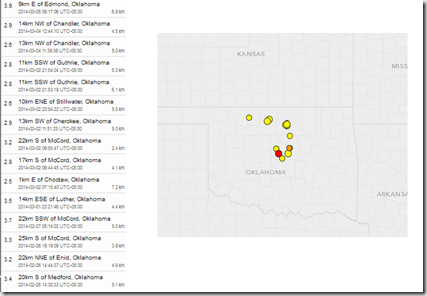
While most of Oklahoma’s temblors since then have come in under 4.0, on average they’ve seen at least a couple of 2.5+ quakes every day for the past month.  Not strong enough to cause significant damage, but strong enough to be felt, and to raise concerns.


Today, the USGS is reporting a M3.9 - 9km E of Edmond, Oklahoma, the strongest temblor in that region since February 8th’s M4.1 quake. 


Earlier this year, the USGS produced the following update, which links the increase in earthquake activity in the Midwest and East to induced seismicity – or man-made causes.

Man-Made Earthquakes Update

Categories: Featured, Natural Hazards
Posted on January 17, 2014 at 1:00 pm
Last update 2:03 pm By: William Ellsworth (ellsworth@usgs.gov), Jessica Robertson (jrobertson@usgs.gov), and Christopher Hook (703-648-4460)

Seismicity of the coterminous United States and surrounding regions, 2009–2012. Black dots denote earthquakes with a magnitude ≥ 3.0 are shown; larger dots denote events with a magnitude ≥ 4.0. Background colors indicate earthquake hazard levels from the U.S. National Seismic Hazard Map (NSHM). Learn more about the NSHM at http://earthquake.usgs.gov/hazards/?source=sitenav.

Seismicity of the coterminous United States and surrounding regions, 2009–2012. Black dots denote earthquakes with a magnitude ≥ 3.0 are shown; larger dots denote events with a magnitude ≥ 4.0. Background colors indicate earthquake hazard levels from the U.S. National Seismic Hazard Map (NSHM). Learn more about the NSHM at http://earthquake.usgs.gov/hazards/?source=sitenav.


The number of earthquakes has increased dramatically over the past few years within the central and eastern United States. Nearly 450 earthquakes magnitude 3.0 and larger occurred in the four years from 2010-2013, over 100 per year on average, compared with an average rate of 20 earthquakes per year observed from 1970-2000.

This increase in earthquakes prompts two important questions: Are they natural, or man-made? And what should be done in the future as we address the causes and consequences of these events to reduce associated risks? USGS scientists have been analyzing the changes in the rate of earthquakes as well as the likely causes, and they have some answers.

USGS scientists have found that at some locations the increase in seismicity coincides with the injection of wastewater in deep disposal wells. Much of this wastewater is a byproduct of oil and gas production and is routinely disposed of by injection into wells specifically designed for this purpose.

Review Article on Injection-Induced Earthquakes

U.S. Geological Survey geophysicist William Ellsworth reviewed the issue of injection-induced earthquakes in a July 2013 study published in the journal Science. The article focused on the injection of fluids into deep wells as a common practice for disposal of wastewater, and discusses recent events and key scientific challenges for assessing this hazard and moving forward to reduce associated risks.

What is Induced Seismicity?

Although it may seem like science fiction, man-made earthquakes have been a reality for decades. It has long been understood that earthquakes can be induced by impoundment of water in reservoirs, surface and underground mining, withdrawal of fluids and gas from the subsurface, and injection of fluids into underground formations.

(Continue . . . )

While the scientific debate over the exact cause of, and best remedy for, this increased seismic activity continues, last October the USGS warned (bolding mine):


Important to people living in the Oklahoma City region is that earthquake hazard has increased as a result of the swarm. USGS calculates that ground motion probabilities, which relate to potential damage and are the basis for the seismic provisions of building codes, have increased in Oklahoma City as a result of this swarm.  While it’s been known for decades that Oklahoma is "earthquake country," the increased hazard has important implications for residents and businesses in the area.


Which means that Oklahomans (and anyone else who lives an a seismically active region) need to seriously include earthquake preparedness as part of their overall emergency plans. The State of Oklahoma maintains an earthquake safety webpage at EARTHQUAKE SAFETY,  while additional Oklahoma specific earthquake monitoring and research information can be found at the Oklahoma Geological Survey.


Although the west coast is most noted for its seismic hazards, much of America’s heartland and parts of the Eastern Seaboard are also susceptible to moderate to strong quakes.   A topic I covered more than a year ago in USGS: Eastern Earthquakes - Rare But Powerful


image


At a bare minimum, every household should have a disaster plan, a good first aid kit (and the knowledge to use it), an emergency battery operated NWS weather radio, and emergency supplies to last a minimum of 72 hours during a disaster.To become better prepared as an individual, family, business owner, or community, I would invite you to visit the following preparedness sites.


FEMA http://www.fema.gov/index.shtm

READY.GOV http://www.ready.gov/

AMERICAN RED CROSS http://www.redcross.org/

For more on increasing your level of preparedness, a partial list of some of my preparedness blogs include:

When 72 Hours Isn’t Enough

In An Emergency, Who Has Your Back?

An Appropriate Level Of Preparedness

Saturday, November 02, 2013

Oklahoma Insurance Commissioner Warns On Earthquake Risks

image

Earthquakes last 7 Days – Credit Leonard Geophysical Laboratory


# 7930


While Oklahomans are more accustomed to threats dropping down from the sky than they are from those rising under their feet, as I wrote about 10 days ago (see USGS: Oklahoma Earthquake Swarm Continues), Oklahoma has seen an abrupt rise in the number of small earthquakes since 2009. 


A reminder that that threats can change over time, and with that, so must our readiness and response.


The swarm of (mostly small) earthquakes - particularly north and east of Oklahoma City -  continues unabated, which has prompted the Insurance Commissioner of the state to remind residents that regular homeowners policies do not cover earthquake damage, and encourages them to buy earthquake coverage.


First stop, the press release, followed by some `Earthquake Insurance’ realities,  after which I’ll be back with a bit more.


News Release Header

Commissioner Doak Encourages Homeowners to Purchase Earthquake Insurance

OKLAHOMA CITY – Oklahoma Insurance Commissioner John D. Doak is encouraging Oklahomans to purchase earthquake insurance after a new report predicts continued seismic activity in the central part of the state. The U.S. Geological Survey (USGS) said central Oklahoma has experienced more than 200 magnitude 3.0 or greater earthquakes since January 2009.

“Looking into earthquake insurance after your home or business has sustained damage resulting from an earthquake will do little good to help you recover,” said Doak. “Now is the time to protect yourself before the next one occurs.”

USGS reports an average of 40 earthquakes per year in Oklahoma from 2009 to 2013, an increase from an average of two to six yearly from 1975 to 2008. Oklahoma’s record-breaking 5.6-magnitude quake in November 2011 destroyed 14 homes and damaged dozens more. However, an estimated less than one percent of Oklahomans carry earthquake insurance. Standard homeowners or renters insurance policies do not cover damage caused from earthquakes.

(Continue . . .)


The State of Oklahoma  provides an Earthquake Insurance `Basics’ webpage, which provides a great deal of information on how to obtain coverage, and some of the limitations of these policies.  

oklahoma earthquakes

  • Earthquake insurance typically must be purchased apart from a standard homeowners policy, either as an “endorsement” added to the policy by the company that carries the purchaser’s homeowners insurance, or as a separate policy from a company specializing in earthquake coverage. Consumers will also have to wait a period of time – usually 30 to 60 days – after the most recently reported earthquakes in their area before they can purchase new earthquake insurance, due to the likelihood of aftershocks.
  • The cost of an earthquake policy varies depending on factors, including the carrier and the policyholder’s desired level of coverage, but typically an Oklahoma homeowner might expect to pay between $100 and $150 per year for earthquake insurance.
  • Earthquake policies frequently have nuances, such as providing or not providing coverage for brick or stone veneers on the home.
  • Earthquake insurance carries a separate and often substantial deductible, apart from the standard homeowners deductible. Often this deductible is calculated as a percentage of the insured property’s value – commonly 5 to 10 percent, but occasionally lower or higher – meaning that a $100,000 home would require a deductible of $5,000 to $10,000. 
  • (Continue . . . )


    Less costly, but no less important, is having a good earthquake disaster plan, and the supplies you will need in the event of a major quake. 


    While many natural disasters – like hurricanes, wild fires, and tornados – have a `season’, earthquakes can come at any time and without warning.  Which means that any earthquake plan – particularly in the North and Midwest – must anticipate what you would do if a quake hits in the middle of winter.


    Compared to West Coast earthquakes, those that occur in the Midwest and Eastern half of the country tend to be felt across a much larger area (see USGS: Eastern Earthquakes - Rare But Powerful). The following shake map from the USGS shows the areas reporting shaking from two recent quakes, a 6.0 in Central California, and the recent 5.8 Virginia quake. By an incredibly large margin, the smaller eastern quake was felt over a much bigger area.

    image


    And the effects of an earthquake can go far beyond the loss of life and property damage.  Ripple effects caused by economic losses can affect regions far removed from the epicenter. In 2011, in The Ripple Effect, we saw that 2/3rds of all businesses in New Zealand were economically impacted by the Christchurch earthquakes.


    Working to improve earthquake awareness, preparation, and safety is Shakeout.org, which promotes yearly earthquake drills and education around the country (see NPM13: A Whole Lotta Shakeouts Going On).  If you live in one of these seismically active areas, I would encourage you to take part in these yearly drills.

    image


    As a bare minimum, everyone should have a well thought out disaster and family communications plan, along with a good first aid kit, a `bug-out bag’, and sufficient emergency supplies to last at least 72 hours.


    In When 72 Hours Isn’t Enough, I highlighted  a colorful, easy-to-follow, 100 page `survival guide’ released by Los Angeles County, that covers everything from earthquake and tsunami preparedness, to getting ready for a pandemic.

    image

    The guide may be downloaded here (6.5 Mbyte PDF).

    While designed specifically for the nearly 10 million residents of Los Angeles County, this guide would be a valuable asset for anyone interested in preparing for a variety of hazards. And in Los Angeles, the advice is to have emergency supplies (food, water, etc) to last up to 10 days. In my humble opinion, 2-weeks in an earthquake zone isn’t overkill.


    To become better prepared as an individual, family, business owner, or community to deal with all types of disasters, I would invite you to visit the following preparedness sites.


    FEMA http://www.fema.gov/index.shtm

    READY.GOV http://www.ready.gov/

    AMERICAN RED CROSS http://www.redcross.org/


    And lastly, in NPM13: The Greatest Prep Of All,  I wrote about what I consider to be the most important preparedness step you can take – having, and being,  a disaster buddy.  Cultivating a network of family and friends to whom you can turn for help in a disaster, to who can turn to you for aid,  if they need it.


    Because no matter where you live, its just a matter of time before the next disaster strikes.

    Tuesday, October 22, 2013

    USGS: Oklahoma Earthquake Swarm Continues

    image

      3.5+Mag quakes – Credit USGS 


    # 7887


    Almost 2 years ago, in November of 2011, I wrote about a 5.6 Mag Quake that Rattled Oklahoma.  At the time I noted that the state of Oklahoma had seen an unusual number of earthquakes over the previous couple of years. In 2010, the Oklahoma Geological Survey Observatory recorded 1,047 earthquakes, of which 103 were strong enough to be felt by the public.


    Since that time, Oklahoma’s earthquake swarm has continued, producing more than 200 3.0+ magnitude temblors over the past 4 years.


    Today the USGS, in partnership with the Oklahoma Geological Survey, has released a report on this ongoing swarm, and how it affects the risks for seeing larger quakes in the region.   I’ve excerpted the key message (bolding mine) below:

    Important to people living in the Oklahoma City region is that earthquake hazard has increased as a result of the swarm. USGS calculates that ground motion probabilities, which relate to potential damage and are the basis for the seismic provisions of building codes, have increased in Oklahoma City as a result of this swarm.  While it’s been known for decades that Oklahoma is "earthquake country," the increased hazard has important implications for residents and businesses in the area.


    The full news release follows:


    Earthquake Swarm Continues in Central Oklahoma


    Released: 10/22/2013 1:07:59 PM

    Contact Information:
    U.S. Department of the Interior, U.S. Geological Survey
    Office of Communications and Publishing
    12201 Sunrise Valley Dr, MS 119
    Reston, VA 20192
    Heidi  Koontz 1-click interview
    Phone: 303-202-4763

    In partnership with: Oklahoma Geological Survey

    Since January 2009, more than 200 magnitude 3.0 or greater earthquakes have rattled Central Oklahoma, marking a significant rise in the frequency of these seismic events.


    The U.S. Geological Survey and Oklahoma Geological Survey are conducting collaborative research quantifying the changes in earthquake rate in the Oklahoma City region, assessing the implications of this swarm for large-earthquake hazard, and evaluating possible links between these earthquakes and wastewater disposal related to oil and gas production activities in the region.


    Studies show one to three magnitude 3.0 earthquakes or larger occurred yearly from 1975 to 2008, while the average grew to around 40 earthquakes per year from 2009 to mid-2013.


    "We've statistically analyzed the recent earthquake rate changes and found that they do not seem to be due to typical, random fluctuations in natural seismicity rates," said Bill Leith, USGS seismologist. "These results suggest that significant changes in both the background rate of events and earthquake triggering properties needed to have occurred in order to explain the increases in seismicity. This is in contrast to what is typically observed when modeling natural earthquake swarms."


    The analysis suggests that a contributing factor to the increase in earthquakes triggers may be from activities such as wastewater disposal--a phenomenon known as injection-induced seismicity. The OGS has examined the behavior of the seismicity through the state assessing the optimal fault orientations and stresses within the region of increased seismicity, particularly the unique behavior of the Jones swarm just east of Oklahoma City. The USGS and OGS are now focusing on determining whether evidence exists for such triggering, which is widely viewed as being demonstrated in recent years in Arkansas, Ohio and Colorado.


    This "swarm" includes the largest earthquake ever recorded in Oklahoma, a magnitude 5.6 that occurred near Prague Nov. 5, 2011.  It damaged a number of homes as well as the historic Benedictine Hall at St. Gregory's University, in Shawnee, Okla.  Almost 60 years earlier in1952, a comparable magnitude 5.5, struck El Reno and Oklahoma City. More recently, earthquakes of magnitude 4.4 and 4.2 hit east of Oklahoma City on April 16, 2013, causing objects to fall off shelves.


    Following the earthquakes that occurred near Prague in 2011, the agencies issued a joint statement, focusing on the Prague event and ongoing seismic monitoring in the region.  Since then, the USGS and OGS have continued monitoring and reporting earthquakes, and have also made progress evaluating the significance of the swarm.


    Important to people living in the Oklahoma City region is that earthquake hazard has increased as a result of the swarm. USGS calculates that ground motion probabilities, which relate to potential damage and are the basis for the seismic provisions of building codes, have increased in Oklahoma City as a result of this swarm.  While it’s been known for decades that Oklahoma is "earthquake country," the increased hazard has important implications for residents and businesses in the area.


    To more accurately determine the locations and magnitudes of earthquakes in Oklahoma, the OGS operates a 15-station seismic network.  Data from this system, and from portable seismic stations installed in the Oklahoma City region, are sent in real-time to the USGS National Earthquake Information Center, which provides 24x7 reporting on earthquakes worldwide.


    The State of Oklahoma maintains an earthquake safety webpage at EARTHQUAKE SAFETY,  while additional Oklahoma specific earthquake monitoring and research information can be found at the Oklahoma Geological Survey.


    Although the west coast is most noted for its seismic hazards, America’s heartland and parts of the Eastern Seaboard are susceptible to moderate to strong quakes.   A topic I covered about a year ago in USGS: Eastern Earthquakes - Rare But Powerful


    image


    Given the risks, the United States government devoted their National Level Exercise (NLE 2011) two years ago to a simulated catastrophic earthquake in the New Madrid Seismic Zone (NMSZ).We live on a violent planet, one that is prone to storms, fires, floods, drought, volcanoes, earthquakes and myriad other natural disasters.Emergencies happen every day.


    Disasters, admittedly, less often. But in either event, preparedness is key.


    At a bare minimum, every household should have a disaster plan, a good first aid kit (and the knowledge to use it), an emergency battery operated NWS weather radio, and emergency supplies to last a minimum of 72 hours during a disaster.To become better prepared as an individual, family, business owner, or community, I would invite you to visit the following preparedness sites.

    FEMA http://www.fema.gov/index.shtm

    READY.GOV http://www.ready.gov/

    AMERICAN RED CROSS http://www.redcross.org/


    For more on increasing your level of preparedness, a partial list of some of my preparedness blogs include:

    When 72 Hours Isn’t Enough

    In An Emergency, Who Has Your Back?

    An Appropriate Level Of Preparedness