Showing posts with label Ontario. Show all posts

Monday, April 27, 2015

Third Ontario Farm Hit By HPAI H5

image


# 9982


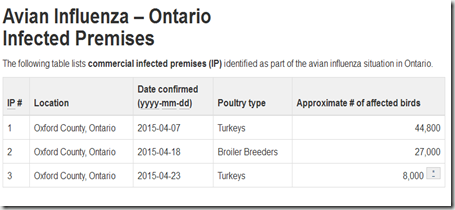
Although Canada’s food Inspection Agency CFIA hasn’t exactly shouted the news from the highest rooftop, over the past several days their Avian Influenza Website has quietly updated a timeline and infected premises table showing a third Ontario farm has tested positive for the HPAI H5 virus.


Timeline of Events - Notifiable Avian Influenza - Ontario – 2015

April 24

The CFIA notifies national industry associations and key international trading partners of IP3.

April 23

The Animal Health Laboratory at the University of Guelph notifies the CFIA of the detection of presumptive H5 avian influenza at a turkey farm in Oxford County, Ontario. This is IP3.

The premises has been under quarantine since April 19, 2015 and is part of the second avian influenza control zone.

Samples from the affected farm are sent to the CFIA National Centre for Foreign Animal Disease (NCFAD) for official confirmation.


The last statement from the CFIA, released on the 22nd (see The Canadian Food Inspection Agency Establishes a Second Avian Influenza Control Zone) dealt with the second infected premises.  This morning, the Ottawa Sun and Toronto Sun are both carrying a report on this third infected farm.


Third Ontario farm hit with deadly bird flu


Megan Stacey, Postmedia Network

First posted: Monday, April 27, 2015 07:14 AM EDT | Updated: Monday, April 27, 2015 07:19 AM EDT

WOODSTOCK, Ont. -- The strain has begun to wear on Southwestern Ontario poultry farmers now battling a third case of deadly bird flu.

This one -- an 8,00-bird turkey farm -- is within a quarantine zone where heightened levels of biosecurity were meant to safeguard against the virus.

(Continue . . . )

Wednesday, April 08, 2015

CFIA: Ontario HPAI Outbreak Identified As H5N2

image


# 9916


We’ve been awaiting the results from the Canadian Food Inspection Agency (CFIA) which is investigating a farm in Southern Ontario, near Woodstock, which tested positive for an HPAI H5 virus on April 6th.   This afternoon the verdict was announced, and not unexpectedly it is HPAI H5N2.

This is the same strain that appeared in British Columbia in December and has hop scotched across a dozen American states over the past several months, infecting both wild and migratory birds and poultry.


Although only one farm has tested positive for the virus, 9 farms are under quarantine and are being tested. Of 34,000 turkeys at the infected farm, 7,500 have already died and the remainder will be destroyed. Helen Branswell has a few more details in the following Canadian Press report.


Ont. bird flu outbreak caused by H5N2, same virus that hit B.C. in December

By Helen Branswell, The Canadian Press | The Canadian Press 

TORONTO - The Canadian Food Inspection Agency says the virus responsible for a bird flu outbreak in southwestern Ontario is a highly pathogenic H5N2 virus.

The virus is the same one that caused a large outbreak in British Columbia that started last December and which has been found in a number of U.S. states more recently.

(Continue . . . )

Tuesday, April 07, 2015

CFIA: H5 Avian Flu Found On Ontario Turkey Farm

image


# 9007


The Canadian Food Inspection Agency (CFIA) is investigating a farm in Southern Ontario, near Woodstock, which has experienced recent elevated turkey mortality.  Preliminary testing indicates an H5 virus, and further testing is being done to determine the subtype and pathogenicity.  A neighboring farm is also under quarantine. 


Given the events of this winter, with the rapid eastward spread of HPAI H5, suspicions are running in that direction.  


If this turns out to be HPAI H5 (H5N2, H5N8, H5N1, etc.), then this would represent the most eastern detection of these subtypes to date.  We should know in a day or two.


Avian influenza confirmed on farm in Southern Ontario

OTTAWA, April 6, 2015

Preliminary testing by the Province of Ontario has confirmed the presence of H5 avian influenza on a turkey farm near Woodstock, Ontario.

The Canadian Food Inspection Agency (CFIA) has placed the farm, and a neighbouring farm, under quarantine to control disease spread and the industry sector has been notified to adopt enhanced biosecurity practices. Further testing by the CFIA is underway to confirm pathogenicity and to determine the precise subtype and strain of the virus. Pathogenicity refers to the severity of the illness caused in birds. Results are expected within days.

Avian influenza does not pose a risk to food safety when poultry and poultry products are properly handled and cooked. Avian influenza rarely affects humans that do not have consistent contact with infected birds. Public health authorities stand ready to take precautionary measures as warranted.

Initial tests for the disease were conducted on April 5 at the Animal Health Laboratory at the University of Guelph, after the turkey farm experienced sudden deaths of birds over several days.

All birds on the infected premises will be humanely euthanized and disposed of, in accordance with provincial environmental regulations and internationally accepted disease control guidelines. As lead response agency the CFIA will ensure the quarantine of the infected farm, and determine a surrounding surveillance zone for further testing and movement control measures. The CFIA will also lead on required depopulation of birds, while the Province will provide technical support on required carcass disposal. Once all birds have been removed, the CFIA will oversee the cleaning and disinfection of the barns, vehicles, equipment and tools to eliminate any infectious material that may remain.

The Province of Ontario, the CFIA, the owner of the infected birds, and the poultry industry are working closely together to manage the situation. Both levels of government will work with the poultry industry to address issues as they emerge. The Canadian poultry sector currently practices a high level of biosecurity that reduces the risk of disease spread.

Tuesday, September 25, 2012

Ontario Confirms H1N1v Case


image

Credit Wikipedia


# 6779


While details are somewhat scant this morning, the Province of Ontario, Canada has announced that they have detected a single of case of H1N1v flu infection in a person who had contact with pigs.


First the press release, then I’ll return with a bit more:


Case of Influenza A H1N1 Variant Detected in Ontario

September 25, 2012 8:00 AM

Today, Dr. Arlene King, Ontario's Chief Medical Officer of Health, issued the following statement on a case of influenza A H1N1 variant detected in Ontario:


"An Ontario resident has been confirmed as having been infected with an H1N1 variant (H1N1v) influenza virus. An influenza virus that normally circulates in animals is referred to as a variant virus when it infects humans.


This adult male patient became ill after close contact with pigs. He is being treated and closely monitored in a hospital in southwestern Ontario.


I would like to reassure Ontarians that this variant influenza virus rarely spreads from animals to humans. Subsequent human-to-human transmission is also rare. I would also like to stress that this is not a food safety issue; the consumption of properly cooked pork continues to be safe.  Proper cooking of meats, including pork, kills all bacteria and viruses.


Ontarians should remember that hand washing is the single best infection prevention and control measure against respiratory illnesses such as influenza. Individuals should wash their hands often with soap and running water, or use an alcohol-based hand rub if soap and water are not available.


I also would like to remind Ontarians that it is important to get immunized every year with the seasonal flu vaccine when it becomes available each fall. This will protect you against seasonal influenza viruses that are expected to circulate. Everyone six months of age and older should get the seasonal flu vaccine each year.


The identification of this case is the result of the strength of our current surveillance system here in Ontario. It is not an unexpected occurrence and there have been a number of human infections with variant influenza viruses in the United States over the past year.


I would like to thank health officials in Ontario who displayed the utmost vigilance in identifying, treating and closely investigating this case. Protecting the health of Ontarians is a priority and we will continue to monitor the situation."


H1N1v is one of the `viral contenders’ I wrote about several weeks ago in An Increasingly Complex Flu Field, and until just over a year ago, was the most commonly reported variant swine flu virus detected in humans since 2005.


In the past twelve months, it has primarily been the H3N2v flu virus that we’ve seen jumping from pigs to humans (300+ cases).  But 2 weeks ago, we saw a single case of H1N1v was reported out of Missouri (see The Return Of H1N1v).


This was only the second H1N1v case reported in a year, and it was also the second time that the H1N1v virus had been found to carry the M (matrix) gene from the 2009 H1N1 pandemic virus. 


This M gene  has been showing up regularly in swine variant viruses (H1N1v, H1N2v, H3N2v) for more than a year. The CDC has previously stated that `This M gene may confer increased transmissibility to and among humans, compared to other variant influenza viruses.’


A couple of cases of H1N1v, hundreds of miles apart, while of concern  .  .  .  does not a pandemic make. 


But this is further evidence that these variant viruses (H1N1v, H1N2v, H3N2v) continue to evolve, and spread widely in swine, and on occasion manage to make the jump to humans.


The concern is that over time one of these viruses may become a more human adapted virus, and begin to spread more easily among the population.


So we watch reports such as this with more than a little bit of interest.


For more on the flu risks from swine reassortments, I  heartily recommend Helen Branswell’s terrific piece in SciAm  from late 2010 called Flu Factories.

Flu Factories

The next pandemic virus may be circulating on U.S. pig farms, but health officials are struggling to see past the front gate

By Helen Branswell  | December 27, 2010 |


And for some of my earlier looks at swine influenza, you may wish to revisit:


H3N2v: When Pigs Flu

You Say You Want An Evolution?

The (Swine) Influenza Reassortment Puzzle