Showing posts with label Post Disaster. Show all posts

Wednesday, March 19, 2014

Tulane University: Post-Katrina Heart Attack Rates - Revisited

image

Hurricane Katrina Approaching New Orleans August 2005


# 8388


In March of 2009, in a study led by Dr. Anand Irimpen (Associate Professor of clinical medicine at Tulane), it was disclosed that residents of New Orleans saw a 300% increase in heart attacks in the first 2 years after hurricane Katrina.


The Tulane University news NEW WAVE carried this report in 2009.

Post-Katrina Stress, Heart Problems Linked

March 30, 2009

(Excerpt)

There were 246 admissions for heart attacks, out of a total census of 11,282 patients, post-Katrina compared with 150 admissions out of a total 21,229 patients in the two years before the storm. In addition to a three-fold increase in heart attacks and a 120 percent increase in coronary interventions, the post-Katrina group had significantly higher prevalence of unemployment, lack of medical insurance, medication noncompliance, smoking, substance abuse, first-time hospitalization and people living in temporary housing. There were no significant differences in the racial, gender or age distribution of the two groups.


In 2011, we looked at an update to this Tulane study (see Post-Katrina Heart Attack Rates) that found – four years after the disaster – that heart attack rates remained 300% higher than pre-Katrina levels in the City, and that:


While psychiatric conditions such as clinical depression, a history of coronary artery disease and marital status did not appear to contribute to heart attacks in the two-year analysis, these factors seem to play a significant role as time has progressed.

Irimpen suggests there is a lag phase between the onset of psychiatric illness and its manifestation in the form of a heart attack. 


Today, Tulane University has announced a 6-year follow up to this study, and once again the impact of Katrina on cardiac health remains pronounced.  First some details on the study, after which I’ll return with more:


Rise in Heart Attacks After Hurricane Katrina Persisted Six Years Later

Researchers also find a lasting disruption in the timing of heart attacks after the disaster.

Released: 3/18/2014 10:00 AM EDT
Source Newsroom:
Tulane University

Mayo Clinic Proceedings

Newswise — Lingering stress from major disasters can damage health years later, according to a new Tulane University study that found a three-fold spike in heart attacks continued in New Orleans six years after Hurricane Katrina.

Researchers also found a lasting disruption in the timing of heart attacks in the six years after the storm with significantly more incidents occurring on nights and weekends, which are typically times hospitals see fewer admissions for heart attacks.

The research, which will be published in the journal Mayo Clinic Proceedings, is an update of an ongoing study tracking the increases in admissions for heart attacks at Tulane Medical Center in downtown New Orleans after Hurricane Katrina. The new study confirmed the increase persisted even six years later.

“Prior to Hurricane Katrina, about 0.7 percent of the patients we were treating in our medical center were suffering from myocardial infarctions (heart attacks),” said lead author Dr. Matthew Peters, internal medicine resident at Tulane University School of Medicine. “This increased to about 2 percent in first three years after Katrina and continued to increase to almost 3 percent in years four through six after the storm.”

The hospital had 1,177 heart attack cases during the six years after the storm, representing 2.4 percent of patient admissions; only 0.7 percent of its patients were admitted for heart attacks two years before Katrina.

Researchers attribute the increase to several factors, most notably chronic stress, higher unemployment and greater risk factors for heart disease, such as increased rates of smoking, substance abuse, psychiatric disorders and noncompliance in taking prescribed medications.

“We found more patients without insurance, who were unemployed and more who had a previous history of coronary artery disease, showing us that the milieu of patients was a sicker population,” said senior author Dr. Anand Irimpen, an associate professor of medicine for the Tulane Heart and Vascular Institute and chief, cardiology section, Southeast Louisiana Veterans Health Care System.

Video interviews with both researchers are available online:

image

Dr. Matthew Peters – http://youtu.be/2oPOUZZLOmE

image

Dr. Anand Irimpen - http://youtu.be/nWANLTsSnzY


We’ve looked at other post-disaster health impacts in the past, such as in Post Disaster Stress & Suicide Rates. One disaster discussed was a 1999 7.3 earthquake that struck in Chi-Chi, Nantou county in central Taiwan killing more than 2,300 people.


A study that subsequently appeared in the Taiwan Journal of Medicine (Disease-specific Mortality Associated with Earthquake in Taiwan Hsien-Wen Kuo, Shu-Jen Wu, Ming-Chu Chiu) found `a considerable increase in the number of suicides after the earthquake’.


A little over a year ago, in Disaster’s Hidden Toll, we looked at the long-term, largely unseen, effect on nursing home patients who were forced to evacuate to temporary facilities after Japan’s Great Earthquake & Tsunami of 2011.


A study showed a 2.4 fold increase in deaths during the 8 months following the earthquake.  Deaths not caused by the quake, tsunami, or radiation release itself – but likely brought on by the stress of having to live in make-shift emergency shelters.


And just last month, in The Long Term Effects Of A Major Disaster, we looked at the post-tsunami deaths due to stress and displacement that exceeded – at least in one prefecture – those experienced during the initial earthquake and tsunami.


Closer to home, last fall in Sandy 1 Year Later: Coping With The Aftermath, we looked at the lingering psychological effects of New England’s brush with that late season super storm of 2012.


While the psychological impact of a major disaster cannot be fully prevented, individual, family, and business preparedness can go a long ways towards reducing the impact of any disaster.


FEMA, Ready.gov, along with organizations like the American Red Cross (and indeed, this blog), spend a great deal of time trying to convince individuals, families, businesses and communities of the value of preparing for a wide variety of emergencies and disasters.


Having a modest supply of food, water, and medicine – and a workable family or business disaster plan – can go a long ways toward reducing both stress and hardship during and after a disaster. The standard advice is that everyone needs to be prepared to deal with a disaster for at least 3 days (meaning having a first aid kit, emergency supplies, and a plan) before help arrives.


Sure . . .  they’d like you to be prepared for longer . . .  but 72 hours is a reasonable start. I personally advocate having 2 week’s worth of supplies, but then I live in the heart of hurricane country, and have a fondness for eating regularly (see NPM11: Living The Prepared Life). 


Although a good disaster plan and emergency kit are imperative to get you through the opening hours, days, or even weeks of a disaster, knowing how to help friends, family, and neighbors deal with the psychological effects of a disaster can be equally important.


While often hidden from view, the psychological impact of a disaster can be enormous and ongoing. Last year in Post Disaster Stress & Suicide Rates we looked at the impact of disaster-related PTSD (Post Traumatic Stress Disorder). Luckily, there are things that can be done - even by the layperson - to help reduce the psychological impact of a disaster. 


A few resources you may wish to revisit:


In Psychological First Aid: The WHO Guide For Field Workers we looked a simple guidebook anyone can use to help others in emotional distress.


The CDC also provides a website which contains a number of resources devoted to coping with disasters.


Coping With a Disaster or Traumatic Event

Trauma and Disaster Mental Health Resources

The effects of a disaster, terrorist attack, or other public health emergency can be long-lasting, and the resulting trauma can reverberate even with those not directly affected by the disaster. This page provides general strategies for promoting mental health and resilience. These strategies were developed by various organizations based on experiences in prior disasters.


Last August the World Health Organization released a comprehensive Guidelines For Post-Trauma Mental Health Care book on the treatment of PTSD, acute stress, and bereavement:

image

The bottom line is that those who follow FEMA’s, and Ready.gov’s advice to Have A Plan, Make A Kit, and Be informed  will be not only be better able to deal with a disaster, they will be better prepared to weather the rigors of a long recovery as well.


And that, in turn, could help reduce the risks of post-disaster health issues, such as has plagued New Orleans since Katrina.


A few of my (many) blogs on disaster preparedness include:

  • In An Emergency, Who Has Your Back?
  • When 72 Hours Isn’t Enough
  • When Evacuation Is The Better Part Of Valor
  • Thursday, February 20, 2014

    The Long Term Effects Of A Major Disaster

    image +

    Credit NHK News – Fukushima evacuation zone March 2011


    # 8316


    We are approaching the third anniversary of the Great East Japan Earthquake and Tsunami of 2011, and despite massive recovery operations, living conditions remain difficult for many in the hardest hit prefectures. As we’ve seen before with other major disasters, the emotional and physical challenges during the recovery phase can often equal or even exceed those experienced during the actual event.


    Adding to the already enormous stress levels from this disaster are the almost daily reports of radiation readings in and around the damaged Fukushima power plant, and concerns over the safety of food, water, and even the air they breathe. Concerns that are likely to persist for years to come.


    Today it is being widely reported that the number of post-tsunami deaths due to stress and displacement have exceeded – at least in one prefecture – those experienced during the initial earthquake and tsunami.  This from the Japan Times:


    Fukushima stress deaths top 3/11 toll

    Uncertainties amid nuclear crisis acutely felt by elderly

    Kyodo

    Feb 20, 2014

    FUKUSHIMA – Stress and other illnesses related to the 2011 quake and tsunami had killed 1,656 people in Fukushima Prefecture as of Wednesday, outnumbering the 1,607 whose deaths were directly tied to disaster-caused injuries, according to data compiled by the prefecture and local police.

    A prefectural official said many people “have undergone drastic changes in their lives and are still unable to map out their future plans, such as homecoming, causing increased stress on them.”

    Around 136,000 people are still displaced in the prefecture, which has had to cope with the devastating effects of the natural disasters and meltdowns at the Fukushima No. 1 nuclear station.

    (Continue . . . )


    According to this report, roughly 90% of those killed by indirect causes were 66 years of age or older.  A little over a year ago, in Disaster’s Hidden Toll, we looked at the long-term, largely unseen, effect on nursing home patients who were forced to evacuate to temporary facilities.


    A study showed a 2.4 fold increase in deaths during the 8 months following the earthquake.  Deaths not caused by the quake, tsunami, or radiation release itself – but likely brought on by the stress of having to live in make-shift emergency shelters.


    A unusually large number of these excess deaths were due to pneumonia or bronchitis, which many attribute to insufficient emergency shelters provided for the elderly and frail.


    We’ve looked at other post-disaster health impacts in the past, such as in Post Disaster Stress & Suicide Rates. One disaster discussed was a 1999 7.3 earthquake that struck in Chi-Chi, Nantou county in central Taiwan killing more than 2,300 people.


    A study that subsequently appeared in the Taiwan Journal of Medicine (Disease-specific Mortality Associated with Earthquake in Taiwan Hsien-Wen Kuo, Shu-Jen Wu, Ming-Chu Chiu) found `a considerable increase in the number of suicides after the earthquake’.

    PTSD (Post Traumatic Stress Disorder) can often occur in the wake of a disaster or traumatic experience. Symptoms may include anxiety, depression, suicide and PTSD may even lead to drug and alcohol-related disorders.


    Victims of personal violence, rescue and medical workers, victims of disasters, terrorism, physical or psychological trauma, and/or a combat zone are all at risk of suffering some level of PTSD.


    I’ve written about post-disaster psychological first aid (PFA) several times in the past, including in Post Disaster Stress & Suicide Rates, PTSD Awareness Day, and Promising Practices: Psychological First AidLast August the World Health Organization released a comprehensive Guidelines For Post-Trauma Mental Health Care book on the treatment of PTSD, acute stress, and bereavement:

    image

    Credit WHO

    Publication details

    Number of pages: 273
    Publication date: 2013
    Languages: English
    ISBN: 978 92 4 150540 6

    Downloads
    Overview

    These WHO mhGAP guidelines were developed to provide recommended management strategies for conditions specifically related to stress, including symptoms of acute stress, post-traumatic stress disorder and bereavement.

    The guidelines were developed by an independent Guidelines Development Group and inform a new mhGAP module on the Assessment and Management of Conditions Specifically Related to Stress.


    While there is much variability in the levels of stress created by different disasters (exacerbated by both the severity and duration), cultural attitudes towards suicide, and in the effectiveness of individual coping skills, there seems little doubt that major disasters can cause both temporary and long-term mental health problems.


    The CDC’s website contains a number of resources devoted to coping with disasters.


    Coping With a Disaster or Traumatic Event

    Trauma and Disaster Mental Health Resources

    The effects of a disaster, terrorist attack, or other public health emergency can be long-lasting, and the resulting trauma can reverberate even with those not directly affected by the disaster. This page provides general strategies for promoting mental health and resilience. These strategies were developed by various organizations based on experiences in prior disasters.

    (Continue . . .)


    And from the National Center For PTSD, you’ll find abundant resources - including videos - on how to provide Psychological First Aid.

    Lastly, while the psychological impact of a major disaster cannot be fully prevented, individual, family, and business preparedness can go a long ways towards reducing both the physical and emotional impact of any disaster.


    Having a modest supply of food, water, and medicine – and a workable family or business disaster plan – can go a long ways toward reducing both stress and hardship.

    image

    Basic Preps: Emergency Weather Radio, First Aid Kit, Battery Lantern, Water storage


    Those that follow FEMA’s, and Ready.gov’s advice to Have A Plan, Make A Kit, and Be informed  will be better equipped to deal with any eventuality.  Which is why I promote basic preparedness at every opportunity in this blog.


    A few of my (many) blogs on that subject include:


  • In An Emergency, Who Has Your Back?
  • When 72 Hours Isn’t Enough
  • When Evacuation Is The Better Part Of Valor
  • NPM13: Pandemic Planning Assumptions
  • Monday, October 21, 2013

    Sandy 1 Year Later: Coping With The Aftermath

    image
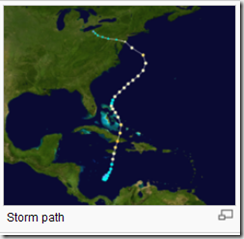
    Sandy’s Path – Credit Wikipedia


    # 7884


    As a former medic, I can tell you that no one comes out of a major disaster unscathed.   Some people are more adept than others at covering up the effects, but that doesn't mean they aren't affected.


    Unfortunately, with our short attention span and the never-ending parade of dramatic news being live-streamed to us via the Internet, TV, and other media, we often lose track of a disaster hit community’s struggles to rebuild once the cameras move on. 


    While a storm may last less than 24 hours, the rebuilding of lives, families, and businesses can sometimes take years. For many, life never goes back to the way it was before the disaster.


    We are coming up to the one-year anniversary of Super-storm Sandy’s onslaught on the eastern seaboard, with the coastal areas of New Jersey being particularly hard hit. 


    In terms of dollar losses, Sandy ranks second among Altantic hurricanes (65 billion),  exceeded only by 2005’s Hurricane Katrina.  But the damage left behind extends far beyond monetary losses.


    PTSD (Post Traumatic Stress Disorder) is increasingly recognized as a serious factor in the wake of any traumatic event, and early recognition and treatment can be invaluable in reducing its impact  (see WHO: Guidelines For Post-Trauma Mental Health Care).  Symptoms may include anxiety, depression, suicide and PTSD may even lead to drug and alcohol-related disorders. 


    Victims of personal violence, rescue and medical workers, victims of disasters, terrorism, physical or psychological trauma, and/or a combat zone are all at risk of suffering some level of PTSD. Sadly, not everyone who could benefit from psychological first aid  or post-disaster counseling, seeks it out, or receives it.


    We’ve looked at other post-disaster health impacts in the past, such as in Post Disaster Stress & Suicide Rates. One disaster discussed was a 1999 7.3 earthquake that struck in Chi-Chi, Nantou county in central Taiwan killing more than 2,300 people.


    A study that subsequently appeared in the Taiwan Journal of Medicine (Disease-specific Mortality Associated with Earthquake in Taiwan Hsien-Wen Kuo, Shu-Jen Wu, Ming-Chu Chiu) found `a considerable increase in the number of suicides after the earthquake’.


    In the wake of Hurricane Katrina, a study funded by the National Institute of Mental Health, which surveyed 1,043 survivors,  found:

    • More than 11% were diagnosed with a serious mental illness following the storm. This compares to just over 6% before the hurricane.
    • 9.9% had mild-moderate mental illness, compared to 9.7% before Katrina.
    • They estimated  200,000 people facing serious mental problems, such as PTSS (Post Traumatic Stress Syndrome) and depression, in the three states most affected.


    All of which serves as prelude to a story that appears today on http://www.njspotlight.com/ , which looks at the long term effects from Hurricane Sandy on the residents of New Jersey.


    Sandy Survivors Still Bear Emotional Scars of Their Ordeal

    Andrew Kitchenman | October 21, 2013

    Mental-health experts report many NJ residents still hesitant to seek support
    sandy mental health panel

    Among those taking part in forum on mental-health issues related to Hurricane Sandy were Carolyn Beauchamp, president of the Mental Health Association in New Jersey; Dr. John R. Lumpkin, director of the Robert Wood Johnson Foundation’s healthcare group; Faith Liguori, a Seaside Park resident who lost her home to the storm; and Mayor Matt Doherty of Belmar.

    For many survivors of Hurricane Sandy, emotional well-being remains as much a work in progress as the construction sites and vacant homes scattered across the New Jersey landscape.


    Mental health professionals say it's as urgent for Sandy victims to seek help now as it was nearly 12 months ago, when the storm forever altered their lives.


    Counselors are reporting that many marriages that survived the first several months after Sandy are breaking up as the one-year anniversary approaches, according to Carol Benevy, the project lead for New Jersey Hope and Healing

    (Continue . . . )


    The entire report is well worth reading.


    The Mental Health Association of New Jersey is working to provide badly needed emotional support to those affected by this disaster, offering both hope and healing.

    image


    Obviously, the impact and the response to Hurricane Sandy extends far beyond just the state of New Jersey.  The Mental Health Association for New York City offers post-Sandy counseling services, as do many other affected states and municipalities.


    While there is much variability in the levels of stress created by different disasters (exacerbated by both the severity and duration), cultural attitudes towards suicide, and in the effectiveness of individual coping skills, there seems little doubt that major disasters can cause both temporary and long-term mental health problems.


    The CDC’s website contains a number of resources devoted to coping with disasters.


    Coping With a Disaster or Traumatic Event

    Trauma and Disaster Mental Health Resources

    The effects of a disaster, terrorist attack, or other public health emergency can be long-lasting, and the resulting trauma can reverberate even with those not directly affected by the disaster. This page provides general strategies for promoting mental health and resilience. These strategies were developed by various organizations based on experiences in prior disasters.

    Information for Individuals & Families

    (Continue . . . )


    And from the National Center For PTSD, you’ll find abundant resources - including videos - on how to provide Psychological First Aid.


    Lastly, while the psychological impact of a major disaster cannot be fully prevented, individual, family, and business preparedness can go a long ways towards reducing the impact of any disaster.


    Those that follow FEMA’s, and Ready.gov’s advice to Have A Plan, Make A Kit, and Be informed  will be better equipped to deal with any eventuality.


    September is National Preparedness Month, but being ready to deal with an emergency – large or small – should be a year-round endeavor.


    A couple of my (many) blogs on that subject include:


  • In An Emergency, Who Has Your Back?
  • An Appropriate Level Of Preparedness