Showing posts with label Fukushima. Show all posts

Thursday, February 20, 2014

The Long Term Effects Of A Major Disaster

image +

Credit NHK News – Fukushima evacuation zone March 2011


# 8316


We are approaching the third anniversary of the Great East Japan Earthquake and Tsunami of 2011, and despite massive recovery operations, living conditions remain difficult for many in the hardest hit prefectures. As we’ve seen before with other major disasters, the emotional and physical challenges during the recovery phase can often equal or even exceed those experienced during the actual event.


Adding to the already enormous stress levels from this disaster are the almost daily reports of radiation readings in and around the damaged Fukushima power plant, and concerns over the safety of food, water, and even the air they breathe. Concerns that are likely to persist for years to come.


Today it is being widely reported that the number of post-tsunami deaths due to stress and displacement have exceeded – at least in one prefecture – those experienced during the initial earthquake and tsunami.  This from the Japan Times:


Fukushima stress deaths top 3/11 toll

Uncertainties amid nuclear crisis acutely felt by elderly

Kyodo

Feb 20, 2014

FUKUSHIMA – Stress and other illnesses related to the 2011 quake and tsunami had killed 1,656 people in Fukushima Prefecture as of Wednesday, outnumbering the 1,607 whose deaths were directly tied to disaster-caused injuries, according to data compiled by the prefecture and local police.

A prefectural official said many people “have undergone drastic changes in their lives and are still unable to map out their future plans, such as homecoming, causing increased stress on them.”

Around 136,000 people are still displaced in the prefecture, which has had to cope with the devastating effects of the natural disasters and meltdowns at the Fukushima No. 1 nuclear station.

(Continue . . . )


According to this report, roughly 90% of those killed by indirect causes were 66 years of age or older.  A little over a year ago, in Disaster’s Hidden Toll, we looked at the long-term, largely unseen, effect on nursing home patients who were forced to evacuate to temporary facilities.


A study showed a 2.4 fold increase in deaths during the 8 months following the earthquake.  Deaths not caused by the quake, tsunami, or radiation release itself – but likely brought on by the stress of having to live in make-shift emergency shelters.


A unusually large number of these excess deaths were due to pneumonia or bronchitis, which many attribute to insufficient emergency shelters provided for the elderly and frail.


We’ve looked at other post-disaster health impacts in the past, such as in Post Disaster Stress & Suicide Rates. One disaster discussed was a 1999 7.3 earthquake that struck in Chi-Chi, Nantou county in central Taiwan killing more than 2,300 people.


A study that subsequently appeared in the Taiwan Journal of Medicine (Disease-specific Mortality Associated with Earthquake in Taiwan Hsien-Wen Kuo, Shu-Jen Wu, Ming-Chu Chiu) found `a considerable increase in the number of suicides after the earthquake’.

PTSD (Post Traumatic Stress Disorder) can often occur in the wake of a disaster or traumatic experience. Symptoms may include anxiety, depression, suicide and PTSD may even lead to drug and alcohol-related disorders.


Victims of personal violence, rescue and medical workers, victims of disasters, terrorism, physical or psychological trauma, and/or a combat zone are all at risk of suffering some level of PTSD.


I’ve written about post-disaster psychological first aid (PFA) several times in the past, including in Post Disaster Stress & Suicide Rates, PTSD Awareness Day, and Promising Practices: Psychological First AidLast August the World Health Organization released a comprehensive Guidelines For Post-Trauma Mental Health Care book on the treatment of PTSD, acute stress, and bereavement:

image

Credit WHO

Publication details

Number of pages: 273
Publication date: 2013
Languages: English
ISBN: 978 92 4 150540 6

Downloads
Overview

These WHO mhGAP guidelines were developed to provide recommended management strategies for conditions specifically related to stress, including symptoms of acute stress, post-traumatic stress disorder and bereavement.

The guidelines were developed by an independent Guidelines Development Group and inform a new mhGAP module on the Assessment and Management of Conditions Specifically Related to Stress.


While there is much variability in the levels of stress created by different disasters (exacerbated by both the severity and duration), cultural attitudes towards suicide, and in the effectiveness of individual coping skills, there seems little doubt that major disasters can cause both temporary and long-term mental health problems.


The CDC’s website contains a number of resources devoted to coping with disasters.


Coping With a Disaster or Traumatic Event

Trauma and Disaster Mental Health Resources

The effects of a disaster, terrorist attack, or other public health emergency can be long-lasting, and the resulting trauma can reverberate even with those not directly affected by the disaster. This page provides general strategies for promoting mental health and resilience. These strategies were developed by various organizations based on experiences in prior disasters.

(Continue . . .)


And from the National Center For PTSD, you’ll find abundant resources - including videos - on how to provide Psychological First Aid.

Lastly, while the psychological impact of a major disaster cannot be fully prevented, individual, family, and business preparedness can go a long ways towards reducing both the physical and emotional impact of any disaster.


Having a modest supply of food, water, and medicine – and a workable family or business disaster plan – can go a long ways toward reducing both stress and hardship.

image

Basic Preps: Emergency Weather Radio, First Aid Kit, Battery Lantern, Water storage


Those that follow FEMA’s, and Ready.gov’s advice to Have A Plan, Make A Kit, and Be informed  will be better equipped to deal with any eventuality.  Which is why I promote basic preparedness at every opportunity in this blog.


A few of my (many) blogs on that subject include:


  • In An Emergency, Who Has Your Back?
  • When 72 Hours Isn’t Enough
  • When Evacuation Is The Better Part Of Valor
  • NPM13: Pandemic Planning Assumptions
  • Tuesday, August 20, 2013

    TEPCO Reports New Leak In Fukushima Plant

    image

    Photo credit IAEA


    # 7581


    It’s been nearly 2 &1/2 years since the Great East Japan Earthquake and tsunami of March 2011 which sparked the worst nuclear disaster since the Chernobyl meltdown and explosion of 1986.


    Over the past 30 months crews have been working to safe and decommission the stricken Fukushima Daiichi #1 nuclear plant – a process that is expected to take decades.


    About a month ago, TEPCO (Tokyo Electric Power Company) admitted that the Fukushima nuclear plant was likely leaking contaminated water into the Pacific (see AP article Japan nuclear plant likely contaminating sea).


    Overnight, TEPCO announced the discovery of a new leak, which involves highly radioactive water.  The following coverage from AFP, BBC, and Reuters, after which I’ll have more. 


    TEPCO reports worst radioactive leak from tank at Japan's Fukushima

    AFP

    Tuesday, Aug 20, 2013

    TOKYO - Some 300 tonnes of radioactive water is believed to have leaked from a tank at Japan's crippled nuclear plant, the worst such leak since the crisis began, the operator said Tuesday.


    Tokyo Electric Power Company (TEPCO) said the leak was believed to be continuing Tuesday at Fukushima and it had not yet pinpointed the source of it.


    TEPCO said puddles with extremely high radiation levels - about 100 millisieverts per hour - have been found near the water tanks at the ruined plant.


    "This means you are exposed to the level of radiation in an hour that a nuclear plant worker is allowed to be exposed to in five years," a TEPCO spokesman told a press conference.

    (Continue  . . .)


    Fukushima nuclear plant: Radioactive water leak found

    BBC 20 August 2013 Last updated at 06:57 ET

    Radioactive water has leaked from a storage tank into the ground at Japan's Fukushima plant, its operator says.

    Tokyo Electric Power Company (Tepco) said the leak of at least 300 tonnes of the highly radioactive water was discovered on Monday.

    (Continue . . .)


    Wrecked Fukushima plant springs highly radioactive water leak

    By Yoko Kubota and Yuka Obayashi

    TOKYO | Tue Aug 20, 2013 10:31am BST

    (Reuters) - Contaminated water with dangerously high levels of radiation is leaking from a storage tank at Japan's crippled Fukushima nuclear plant, the most serious setback to the cleanup of the worst nuclear accident since Chernobyl.

    (Continue . . .)


    While officials are describing this newest leak as a LEVEL 1 incidentthe lowest level of concern on the 7 point International Nuclear and Radiological Event Scale - this is the first such declaration since the initial event in 2011.


    The long term effects or implications of this release of radioactive water have not been determined, but at the very least, this is another psychological blow to those living or working in the stricken region.  


    Last February, in  WHO: Estimated Health Risks From The Fukushima Radiation Release, we saw a report that stated the radiation risks to those living outside of the immediate Fukushima region were low, but `that the estimated risk for specific cancers in certain subsets of the population in Fukushima Prefecture has increased and, as such, it calls for long term continued monitoring and health screening for those people.’


    But the  press release went on to state that cancers are not the only serious long-term health consequences from the Fukushima disaster.


    As well as the direct health impact on the population, the report notes that the psychosocial impact may have a consequence on health and well-being. These should not be ignored as part of the overall response, say the experts.


    In Disaster’s Hidden Toll, we looked at a report on the  long-term, largely unseen, effect of this disaster on nursing home patients who were forced to evacuate to temporary facilities.


    The study showed a 2.4 fold increase in deaths during the 8 months following the earthquake.  Deaths not caused by the quake, tsunami, or radiation release itself – but likely brought on by the stress of having to live in make-shift emergency shelters.


    A unusually large number of these excess deaths were due to pneumonia or bronchitis, which many attribute to insufficient emergency shelters provided for the elderly and frail.


    We’ve looked at other post-disaster health impacts in the past, such as in Post Disaster Stress & Suicide Rates. One disaster discussed was a 1999 7.3 earthquake that struck in Chi-Chi, Nantou county in central Taiwan killing more than 2,300 people.


    A study that subsequently appeared in the Taiwan Journal of Medicine (Disease-specific Mortality Associated with Earthquake in Taiwan Hsien-Wen Kuo, Shu-Jen Wu, Ming-Chu Chiu) found `a considerable increase in the number of suicides after the earthquake’.

    PTSD (Post Traumatic Stress Disorder) can often occur in the wake of a disaster or traumatic experience. Symptoms may include anxiety, depression, suicide and PTSD may even lead to drug and alcohol-related disorders.


    Two weeks ago in WHO: Guidelines For Post-Trauma Mental Health Care we looked at a new report from the World Health Organization on post-disaster management of stress-related illness.


    image

    Credit WHO


    The aftermath of disasters often results in social, economic, and psychological upheavals (see Surviving A Different Kind Of Aftershock).


    Our short attention span, combined with the news media’s proclivity for moving on to the next big disaster or story, can make us forget that the struggle to rebuild devastated families and communities can take years.


    Although a good disaster plan and emergency kit are imperative to get you through the opening hours and days of a disaster, knowing how to help friends, family, and neighbors deal with the psychological effects of a disaster can be equally important.


    In Psychological First Aid: The WHO Guide For Field Workers we looked a simple guidebook anyone can use to help others in emotional distress.


    The CDC also provides a website which contains a number of resources devoted to coping with disasters.


    Coping With a Disaster or Traumatic Event

    Trauma and Disaster Mental Health Resources

    The effects of a disaster, terrorist attack, or other public health emergency can be long-lasting, and the resulting trauma can reverberate even with those not directly affected by the disaster. This page provides general strategies for promoting mental health and resilience. These strategies were developed by various organizations based on experiences in prior disasters.


    As does the National Center For PTSD - including videos - on how to provide Psychological First Aid.

    Psychological First Aid: Field Operations Guide

    Psychological First Aid

    For Disaster Responders

    Developed jointly with the National Child Traumatic Stress Network, PFA is an evidence-informed modular approach for assisting people in the immediate aftermath of disaster and terrorism: to reduce initial distress, and to foster short and long-term adaptive functioning.


    A small reminder that not all wounds bleed, not all fractures will show up on an X-ray, and that the best treatment may not always reside inside your first aid kit.

    Thursday, February 28, 2013

    WHO: Estimated Health Risks From The Fukushima Radiation Release


     image


    # 6973


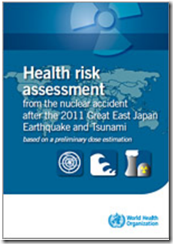
    The World Health Organization has today published a 172-page Health risk assessment from the nuclear accident after the 2011 Great East Japan earthquake and tsunami, based on a preliminary dose estimation  based on a preliminary estimate of radiation doses published in May 2012.


    First some excerpts from the press release, then I’ll be back with a little more.


    Global report on Fukushima nuclear accident details health risks

    News release

    28 February 2013 | GENEVA - A comprehensive assessment by international experts on the health risks associated with the Fukushima Daiichi nuclear power plant (NPP) disaster in Japan has concluded that, for the general population inside and outside of Japan, the predicted risks are low and no observable increases in cancer rates above baseline rates are anticipated.


    The WHO report ‘Health Risk Assessment from the nuclear accident after the 2011 Great East Japan Earthquake and Tsunami based on preliminary dose estimation’ noted, however, that the estimated risk for specific cancers in certain subsets of the population in Fukushima Prefecture has increased and, as such, it calls for long term continued monitoring and health screening for those people.


    Experts estimated risks in the general population in Fukushima Prefecture, the rest of Japan and the rest of the world, plus the power plant and emergency workers that may have been exposed during the emergency phase response.


    “The primary concern identified in this report is related to specific cancer risks linked to particular locations and demographic factors,” says Dr Maria Neira, WHO Director for Public Health and Environment. “A breakdown of data, based on age, gender and proximity to the nuclear plant, does show a higher cancer risk for those located in the most contaminated parts. Outside these parts - even in locations inside Fukushima Prefecture - no observable increases in cancer incidence are expected.”


    In terms of specific cancers, for people in the most contaminated location, the estimated increased risks over what would normally be expected are:

    • all solid cancers - around 4% in females exposed as infants;
    • breast cancer - around 6% in females exposed as infants;
    • leukaemia - around 7% in males exposed as infants;
    • thyroid cancer - up to 70% in females exposed as infants (the normally expected risk of thyroid cancer in females over lifetime is 0.75% and the additional lifetime risk assessed for females exposed as infants in the most affected location is 0.50%).

    For people in the second most contaminated location of Fukushima Prefecture, the estimated risks are approximately one-half of those in the location with the highest doses.


    The report also references a section to the special case of the emergency workers inside the Fukushima NPP. Around two-thirds of emergency workers are estimated to have cancer risks in line with the general population, while one-third is estimated to have an increased risk.


    The almost-200-page document further notes that the radiation doses from the damaged nuclear power plant are not expected to cause an increase in the incidence of miscarriages, stillbirths and other physical and mental conditions that can affect babies born after the accident.


    “The WHO report underlines the need for long-term health monitoring of those who are at high risk, along with the provision of necessary medical follow-up and support services,” says Dr Maria Neira, WHO Director for Public Health and Environment. “This will remain an important element in the public health response to the disaster for decades.”

    (Continue . . . )


    This press release deals primarily with the relative increases in risk among populations living or working very close to the Fukushima nuclear accident who received the highest exposure to radiation.


    While relative risk is a valid way of looking at this accident’s impact - it is also helpful to look at the absolute risk (which is done in the FAQ and in the actual report) - particularly when looking at cancers that have a low baseline rate.


    • The largest increase in relative risk was for developing thyroid cancer among infant girls in their lifetime. The baseline rate in Japan is roughly .75% (1 in 133). Those living closest to the radiation leaks are expected to see a 70% increase, which elevates the absolute risk to approximately 1.25% (1 in 80).


    • Another example is breast cancer, which carries a lifetime risk of 5.53% (1 in 18).  The 6% increase in females exposed as infants raises that to 5.89% (1 in 17).


    • Lifetime leukemia risks in infant boys is estimated at roughly .60% (1 in 165). Adding in the extra Fukushima radiation exposure adds an additional 7% risk, which raises absolute risk to .64%  (1 in 156).


    None of which is meant to minimize the overall impact of this nuclear accident in the least, or the devastating individual and family impacts that these additional cancers will bring.


    But it does help to put these numbers in perspective.


    Additional resources from WHO on the Fukushima radiation release include:


    And lastly, as the press release notes, cancers are not the only serious long-term health consequences from the Fukushima disaster.


    As well as the direct health impact on the population, the report notes that the psychosocial impact may have a consequence on health and well-being. These should not be ignored as part of the overall response, say the experts.

    Friday, January 11, 2013

    Disaster’s Hidden Toll


     image +

    Credit NHK News – Fukushima evacuation zone March 2011


    # 6846


    With our short attention span, and the news media’s proclivity for moving on to the next big disaster or story, we often don’t closely follow the struggle to rebuild disaster stricken communities, which can take months or even years.


    And for some caught in harm’s way, whose homes and businesses were destroyed - and loved ones lost - there is no going back to the way things used to be.


    Not surprisingly, that can produce significant mental and physical health challenges for those affected.


    Today we’ve a report out of Japan showing that the earthquake/tsunami of March 2011 that killed more than 20,000 people in Japan also had a long-term, largely unseen, effect on nursing home patients who were forced to evacuate to temporary facilities.


    A study shows a 2.4 fold increase in deaths during the 8 months following the earthquake.  Deaths not caused by the quake, tsunami, or radiation release itself – but likely brought on by the stress of having to live in make-shift emergency shelters.


    A unusually large number of these excess deaths were due to pneumonia or bronchitis, which many attribute to insufficient emergency shelters provided for the elderly and frail.


    This report from the Ashasi Simbum.


    Death rates spike among elderly evacuees from Fukushima

    January 11, 2013

    By YURI OIWA/ Staff Writer

    Former residents of nursing homes near the Fukushima No. 1 nuclear plant died at a higher rate than usual in 2011, a study has shown, likely because of the stress of evacuation and having to live in temporary accommodations such as draughty school gyms.


    Researchers from the Fukushima Medical University studied reports submitted to the Fukushima prefectural government by 34 institutions for the elderly and found that the death rate over eight months in 2011 was 2.4 times that of the same period in 2010.

    (Continue . . . )


    A similar result was found in this study of nursing home evacuations from the University of South Florida.


    The Effects of Evacuation on Nursing Home Residents With Dementia

    Lisa M. Brown, PhD, David M. Dosa, MD, MPH, Kali Thomas, MA, Kathryn Hyer, PhD, MPP, Zhanlian Feng, PhD, Vincent Mor, PhD

    Background: In response to the hurricane-related deaths of nursing home residents, there has been a steady increase in the number of facilities that evacuate under storm threat. This study examined the effects of evacuation during Hurricane Gustav on residents who were cognitively impaired.


    Conclusions: The findings of this research reveal the deleterious effects of evacuation on residents with severe dementia. Interventions need to be developed and tested to determine the best methods for protecting this at risk population when there are no other options than to evacuate the facility.


    We’ve looked at other post-disaster health impacts in the past, such as in Post Disaster Stress & Suicide Rates. One disaster discussed was a 1999 7.3 earthquake that struck in Chi-Chi, Nantou county in central Taiwan killing more than 2,300 people.


    A study that subsequently appeared in the Taiwan Journal of Medicine (Disease-specific Mortality Associated with Earthquake in Taiwan Hsien-Wen Kuo, Shu-Jen Wu, Ming-Chu Chiu) found `a considerable increase in the number of suicides after the earthquake’.


    PTSD (Post Traumatic Stress Disorder) can often occur in the wake of a disaster or traumatic experience. Symptoms may include anxiety, depression, suicide and PTSD may even lead to drug and alcohol-related disorders.


    Victims of personal violence, rescue and medical workers, victims of disasters, terrorism, physical or psychological trauma, and/or a combat zone are all at risk of suffering some level of PTSD.


    In Psychological First Aid: The WHO Guide For Field Workers we looked at the need for, and a guide for providing psychological first aid (PFA) in a post-disaster environment.


    The CDC also provides a website which contains a number of resources devoted to coping with disasters.


    Coping With a Disaster or Traumatic Event

    Trauma and Disaster Mental Health Resources

    The effects of a disaster, terrorist attack, or other public health emergency can be long-lasting, and the resulting trauma can reverberate even with those not directly affected by the disaster. This page provides general strategies for promoting mental health and resilience. These strategies were developed by various organizations based on experiences in prior disasters.


    As does the National Center For PTSD - including videos - on how to provide Psychological First Aid.

    A reminder that a disaster’s impact can linger long after the story has fallen off the front pages, and that indirect casualties can follow months after the initial event.

    Tuesday, July 17, 2012

    Estimating Fukushima’s Health Impact


    image

    Photo credit IAEA


    # 6438


    While the worst fears from last year’s radiation release from Japan's Fukushima Daiichi nuclear disaster have not been realized, the long-term health impacts remain largely unknown. 


    Today, researchers at Stanford University have released a modeling study – published in the journal Energy and Environmental Science – that attempts to quantify the mortality and morbidity due to that nuclear release.


    Worldwide health effects of the Fukushima Daiichi nuclear accident

    John E. Ten Hoeve and Mark Z. Jacobson

    Energy Environ. Sci., 2012, Advance Article

    Abstract

    A 3-D global atmospheric model evaluated against data is used to quantify worldwide health effects from the Fukushima nuclear accident.


    As you will see, the actual numbers are fairly low, but the range of possibilities is considerable. The press release from Stanford University provides us with the details.


    Stanford researchers calculate global health impacts of the Fukushima nuclear disaster

    Radiation from Japan's Fukushima Daiichi nuclear disaster may eventually cause anywhere from 15 to 1,300 deaths and from 24 to 2,500 cases of cancer, mostly in Japan, Stanford researchers have calculated.


    The estimates have large uncertainty ranges, but contrast with previous claims that the radioactive release would likely cause no severe health effects.


    The numbers are in addition to the roughly 600 deaths caused by the evacuation of the area surrounding the nuclear plant directly after the March 2011 earthquake, tsunami and meltdown.


    Recent PhD graduate John Ten Hoeve and Stanford civil engineering Professor Mark Z. Jacobson, a senior fellow at the Precourt Institute for Energy and the Stanford Woods Institute for the Environment, are set to publish their findings Tuesday (July 17) in the journal Energy and Environmental Science. The research constitutes the first detailed analysis of the event's global health effects.


    (Continue . . . )


    As Professor Emeritus of Statistics at the University of Wisconsin George E. P. Box famously observed:


    All models are wrong, but some models are useful.”


    While this study may not be the last word on the health impacts from Fukushima, and it only provides a range of effects, it at least provides a starting point. 


    Interestingly, the authors modeled what a similar meltdown would look like if it occurred in the United States. 


    From the press release:


    To test the effects of varying weather patterns and geography on the reach of a nuclear incident, the two researchers also analyzed a hypothetical scenario: an identical meltdown at the Diablo Canyon Power Plant, near San Luis Obispo, Calif.


    Despite California's population density being about one-fourth that of Japan's, the researchers found the magnitude of the projected health effects to be about 25 percent larger.


    The model showed that rather than being whisked toward the ocean, as with Fukushima, a larger percentage of the Diablo Canyon radioactivity deposited over land, including population centers such as San Diego and Los Angeles.


    Jacobson stressed, however, that none of the calculations expressed the full scope of a nuclear disaster.


    "There's a lot more to the issue than what we examined, which were the cancer-related health effects," he said. "Fukushima was just such a large disaster in terms of soil and water contamination, displacement of lives, confidence in government oversight, cost and anguish."


    In May we saw the WHO Report On Radiation Exposure From Fukushima Reactor Accident, which concluded that:


    . . . the estimated effective doses outside Japan from the Fukushima Daiichi NPP accident are below (and often far below) dose levels regarded as being very small by the international radiological protection community. Low effective doses are also estimated in much of Japan.


    Another report is expected from the World Health Organization later this summer that will attempt to quantify the short and long term health-risk due to exposure to radioactivity from Fukushima.


    It will be interesting to compare those findings with the ones released today.

    Wednesday, May 23, 2012

    WHO Report On Radiation Exposure From Fukushima Reactor Accident


    # 6341


    Today, a little more than a year after Japan’s catastrophic earthquake and tsunami, the World Health Organization has released a 120 page preliminary assessment of radiation exposure from the crippled nuclear plants in Fukushima Japan.


    Preliminary Dose Estimation from the nuclear accident after the 2011 Great East Japan Earthquake and Tsunami

     Authors:
    WHO

    Publication details

    Number of pages: 120
    Publication date: 2012
    Languages: English
    ISBN: 9789241593662

    Downloads
    Overview

    The earthquake and tsunami in Japan on 11 March 2011 led to releases of radioactive material into the environment from the Fukushima Daiichi nuclear site. This report describes a preliminary estimate of radiation doses to the public resulting from this accident. These doses are assessed for different age groups in locations around the world, using assumptions described in the report.


    The dose assessment forms one part of the overall health risk assessment being carried out by WHO of the global impact of the accident at the Fukushima Daiichi nuclear power plant. The health risk assessment is the subject of a separate WHO report which will be published in Summer 2012.

    Related links


    From the FAQ page, we get the bottom line, and for just about everyone living outside of Fukushima and neighboring prefectures, the news is very reassuring.


    Q5. What does the report conclude?

    It can be concluded that the estimated effective doses outside Japan from the Fukushima Daiichi NPP accident are below (and often far below) dose levels regarded as being very small by the international radiological protection community. Low effective doses are also estimated in much of Japan.


    In the Fukushima prefecture and in neighbouring prefectures the effective doses are estimated to be below 10 mSv, which can be considered within the order of magnitude of the natural radiation background, except in two locations. In these two locations in the most affected part of Fukushima prefecture, the effective doses were estimated to be within a dose band of 10–50 mSv. Please see table 3 for more data on effective doses, and table 8 for comparative effective dose levels in different contexts.


    This report focuses on effective dose as an appropriate measure given that it takes into account both internal and external exposures. In addition, the report includes information about thyroid doses because of this organ’s capacity for iodine concentration.


    It is important to note that effective doses and thyroid doses are two different quantities that cannot be compared. Thyroid doses are organ-specific equivalent doses. See table 4 for data on specific exposure to thyroid doses.


    As far as the short and long term health-risk due to exposure to radioactivity, a report is expected from the WHO later this summer.

    Thursday, March 29, 2012

    Fukushima Nuke Plant Remains In `Precarious State’


     image

    Photo credit IAEA

    # 6251


    Unless we are directly affected by them, once a disaster moves off the front pages, we tend move on as the never ending parade of newer, more immediate concerns emerge.


    A year ago, the world watched in horror as Japan reeled from a monstrous earthquake/tsunami followed by a major nuclear accident.


    Over time, as the recovery efforts proceeded and the nuke plants were finally deemed `stable’, the triple disaster of Fukushima has faded for most of us.


    But as we learn from a report in the New York Times today, the reactor at Fukushima may be in worse shape than previously admitted, and its current stability is precarious at best.


    Japan Admits Nuclear Plant Still Poses Dangers

    By HIROKO TABUCHI 

    TOKYO — The damage to the core of at least one of the meltdown-stricken reactors at Fukushima could be far worse than previously thought, raising fresh concerns over the plant’s stability and gravely complicating the post-disaster cleanup, a recent internal investigation has shown.

    (Continue . . .)


    Follow the link to read the entire article to learn about the specifics, including much lower water levels over the fuel rods than previously reported, and much higher levels of radiation inside the containment buildings.


    But the `money quote’ comes from Kazuhiko Kudo, a professor of nuclear engineering at Kyushu University, at the end of the article who warns:


    “The plant is still in a precarious state.

    Unfortunately, all we can do is to keep pumping water inside the reactors, and hope we don’t have another big earthquake.”


    Cleanup of these plants may take decades, and until that can be accomplished, they remain vulnerable to additional seismic shocks.

    Friday, March 02, 2012

    Bulletin Of The Atomic Scientists: Fukushima Crisis in review


    image

    # 6189


    It’s been nearly a year since the disastrous earthquake & subsequent tsunamis hit northern Japan, leaving a major nuclear accident to unfold in the debris.


    Only recently have we begun to hear detailed reports of just how chaotic, and apparently ineffectual, the disaster response was in the opening days and weeks of that nuclear crisis.


    Yesterday, the Bulletin of Atomic Scientists published a 14-page analysis of Japan’s initial response to this nuclear crisis, which found (among other things)  that the Japanese government, and plant owner TEPCO, were:


    “. . .  astonishingly unprepared, at almost all levels, for the complex nuclear disaster that started with an earthquake and a tsunami.”


    This entire analysis makes for sobering reading, and is freely available on their website.


    Fukushima in review: A complex disaster, a disastrous response

    Yoichi Funabashi Kay Kitazawa

    Abstract

    On March 11, 2011, an earthquake and tsunami crippled the Fukushima Daiichi Nuclear Power Station. The emerging crisis at the plant was complex, and, to make matters worse, it was exacerbated by communication gaps between the government and the nuclear industry.


    An independent investigation panel, established by the Rebuild Japan Initiative Foundation, reviewed how the government, the Tokyo Electric Power Company (Tepco), and other relevant actors responded.


    In this article, the panel’s program director writes about their findings and how these players were thoroughly unprepared on almost every level for the cascading nuclear disaster.


    This lack of preparation was caused, in part, by a public myth of “absolute safety” that nuclear power proponents had nurtured over decades and was aggravated by dysfunction within and between government agencies and Tepco, particularly in regard to political leadership and crisis management.


    The investigation also found that the tsunami that began the nuclear disaster could and should have been anticipated and that ambiguity about the roles of public and private institutions in such a crisis was a factor in the poor response at Fukushima.  

    Thursday, June 09, 2011

    NHK News:`Widespread’ Strontium-90 Contamination In Fukushima


    # 5616


    image

    Photo credit NHK World NewsVideo Link


    Those with long memories will recall that it was concerns over the accumulation of radioactive strontium-90 in milk (and in humans that consumed that milk) that led to the banning of above-ground nuclear testing in 1963.


    Prior to that time, incredibly, hundreds of above-ground atomic tests were conducted all around the world, releasing significant quantities of radioactive isotopes including (americium-241, cesium-137, iodine-131, strontium-90).


    But it was strontium-90 - which acts much like calcium in the human body - that was of particular concern as it ends up deposited in bones and teeth, raising serious concerns over future cancer risks.


    Back in April Crofsblog carried an NHK report on low levels (3.3 to 32 becquerels) of Strontium-90 detected last March in regions around the stricken power plant (see Fukushima: Strontium-90 detected outside 30 km zone).


    Today, NHK World News is reporting on considerably higher levels of strontium-90 detected in some of the eleven samples taken outside of the 30km evacuation zone – including Fukushima City - some 60 km from the site of the nuclear accident.


    Survey: strontium widespread in Fukushima

    Thursday, June 09, 2011 06:02 +0900 (JST)

    Soil samples from around Fukushima Prefecture have revealed concentrations of radioactive strontium.
    Japan's science ministry conducted a survey for radioactive substances at 11 locations in 10 municipalities from late March to mid-May.


    It says strontium-90 was detected in all 11 locations.
    In Namie Town, the reading stood at 250 becquerels per kilogram of soil, while in Iitate Village the reading was 120 becquerels per kilogram. The readings in the other locations were between 2 and 18 becquerels.

    (Continue . . . )


    According to this report, Japan’s Nuclear Safety Commission insists that the detected levels of strontium are minor, and do not pose any immediate health risk.


    A radiation expert at a hospital in Fukushima City disagrees.  Dr. Doctor Osamu Saito says even small quantities of strontium-90 pose a high health risk.


    Whatever the ultimate health risks involved, the news of greater radioactive contamination – particularly from a persistent isotope like strontium - is bound to increase the public’s concerns.


    As I wrote yesterday (see A Different Kind Of Nuclear Fallout), public confidence in the safety of nuclear energy production in Japan will be crucial if the plants that are shut down now – or are scheduled for maintenance shutdown over the next 12 months – are to be restarted.

    Tuesday, June 07, 2011

    Cutting Through The Fukushima Fog


    # 5610

    image

    Photo credit IAEA


    As I noted in The Fog Of Disaster Reporting, written less than 48 hours after the earthquake/tsunami combination that devastated northern Japan, my confidence level in the accuracy of many of the stories coming out of the disaster zone was pretty low.


    So low, that in many cases I opted not to use them in this blog.


    Since then, we’ve learned that the nuclear accident at the Fukushima Daiichi facility was much worse than first reported. 


    Despite what we now know was a meltdown of three reactors within hours of the quake, the severity level of the incident was held at a 5 for a full month (the same as Three Mile Island), before being raised to a  Chernobyl-comparable level 7 on April 11th.


    Today, the Yomiuri News Agency is reporting that two of these damaged reactors may have suffered a `Melt Through’ – an even more serious event than a meltdown –where nuclear fuel actually melted through the walls or floors of reactor vessel.


    Melted Fuel at Fukushima May Have Leaked Through, Yomiuri Says

    By Go Onomitsu - Jun 7, 2011 2:02 AM ET


    NHK World News is also reporting that today (Tuesday) a government appointed expert panel met for the first time to investigate the Fukushima nuclear accident (see Govt panel on nuclear accident holds 1st meeting).


    The panel is expected to produce an interim report by the end of the year, but according to committee's head - Professor Emeritus at the University of Tokyo, Yotaro Hatamura - will not aim to clarify who is responsible for the accident.


    Meanwhile, just hours before the first meeting of this expert panel was held, it was revealed that the amount of radiation released from the damaged Fukushima facility during the first week of the disaster was likely more than double what had previously been estimated.


    Japan doubles plant radiation leak estimate

    (AFP) – 4 hours ago

    TOKYO — Japan has more than doubled its initial estimate of radiation released from the crippled Fukushima nuclear plant in the week after the March 11 tsunami, ahead of the launch of an official probe Tuesday.


    The nation's watchdog, the Nuclear and Industrial Safety Agency (NISA), now says it believes 770,000 terabecquerels escaped into the atmosphere in the first week -- compared to its earlier estimate of 370,000 terabecquerels.

    (Continue . . . )


    The hits, as they say, just keep on coming.


    There are now concerns that the environmental contamination surrounding the plant may be worse than previously suspected, and that people beyond the 20 km evacuation radius may have been exposed to more radiation than previously thought.


    These belated and incrementally worsening status reports from plant operator TEPCO and Japan’s Nuclear Safety Commission probably won’t do a lot to inspire confidence in their future pronouncements.


    Of course, early reports from the ground during any major disaster are usually fragmentary, often misleading, and occasionally just downright wrong.


    How much of this `bad information’ is due to attempts to `manage’ the crisis by doling out bad news a piece at a time – and how much comes from a genuine impenetrable `fog’ of disaster – is hard to know.


    Often it is a mixture of both.


    But as was noted last month in  Sandman & Lanard On Worst-Case Crisis Communications, it is important for officials to get out in front of any crisis.


    Playing catch-up, or worse, appearing to intentionally withhold bad news, can make a bad situation worse.


    Telling the truth and telling it early, are key points to effective crisis communications.


    Simple advice, yet it is often ignored.


    In Japan’s nuclear crisis: The need to talk more candidly about worst case scenarios Peter Sandman wrote:


    The main communication problem results from the public’s inability to know how much of the situation is under how much control, and what might happen if things get worse. Japanese officials have not helped us to understand that.


    Worse, they have not communicated in ways that encourage us both to trust that they are telling us everything they know and everything they’re worried about, and to trust that they know what they are doing.


    And earlier, in Cultural differences regarding Fukushima crisis communication Peter wrote about the consensus document on crisis communications from the World Health Organization  entitled “WHO Outbreak Communication Guidelines”.


    In an excerpt from the section on Announcing early”, it states:


    People are more likely to overestimate the risk if information is withheld. And evidence shows that the longer officials withhold worrisome information, the more frightening the information will seem when it is revealed, especially if it is revealed by an outside source….


    Early announcements are often based on incomplete and sometimes erroneous information. It is critical to publicly acknowledge that early information may change as further information is developed or verified.


    Peter Sandman Website logo


    For anyone even remotely involved as a spokesperson for an agency, organization, or company during a crisis, their site should be viewed as essential reading. 


    Unfortunately, the stream of continually revised information coming out of Japan over the past three months appears more akin to the hoary old tale of the wealthy Englishman who, after traveling the world for many months, called home and spoke to his butler.


    "Well James, has anything happened in my absence?"


    "Yes, sir.  Your dog died."


    "He died? Whatever from?  He was a young pup."


    "Probably from eating burned horse flesh, sir."


    "Burned horseflesh?  Where on earth did he get burned horseflesh?"


    "From the stables, Sir. They burned to the ground two weeks ago."


    "How did the stables catch fire?"


    "Probably flames from the house, sir."


    "The house burned down too!  How did that happen?


    "We suspect the drapes caught fire from the candles, sir."


    "Candles!  We have electricity. Why on earth were you using candles?"


    "They were around your mother's coffin in the parlor, sir."


    "Mum is dead!  My God James, what happened!"


    "Well Sir, we suspect it was from the shock of your wife running off with the gardener . . ."


    You get the idea.


    While the exchange above may make for good comedy, any semblance of it in the real world makes for lousy crisis communications.

    Wednesday, June 01, 2011

    IAEA Preliminary Assessment Of The Fukushima Disaster


    # 5589


    Last week IAEA nuclear experts from 12 countries (Argentina, China, France, Hungary, India, Indonesia, Russia, South Korea, Spain, Turkey, United Kingdom and the United States) arrived in Fukushima, Japan to conduct interviews with local officials and to visit nuclear facilities, including the earthquake and tsunami damaged Fukushima Daiichi power plant.


    They have produced a brief (3-page) preliminary assessment of the safety issues related to the Fukushima nuclear crisis. A full report will be delivered to the Ministerial Conference on Nuclear Safety at IAEA headquarters in Vienna in about 3 weeks.


    image


    They describe the level of cooperation, and access, their expert mission received as being `excellent’, and the response of the workers at the stricken plant as `exemplary’ and `brave’


    They also reassure that: To date no health effects have been reported in any person as a result of radiation exposure from the nuclear accident.


    From today’s  UPDATE: IAEA Fact-Finding Team Completes Visit to Japan (1 June 2011) on the IAEA website, we get an overview of the expert mission, and a synopsis of their findings:


    The expert team made several preliminary findings and lessons learned, including:

    • Japan's response to the nuclear accident has been exemplary, particularly illustrated by the dedicated, determined and expert staff working under exceptional circumstances;
    • Japan's long-term response, including the evacuation of the area around stricken reactors, has been impressive and well organized. A suitable and timely follow-up programme on public and worker exposures and health monitoring would be beneficial;
    • The tsunami hazard for several sites was underestimated. Nuclear plant designers and operators should appropriately evaluate and protect against the risks of all natural hazards, and should periodically update those assessments and assessment methodologies;
    • Nuclear regulatory systems should address extreme events adequately, including their periodic review, and should ensure that regulatory independence and clarity of roles are preserved; and
    • The Japanese accident demonstrates the value of hardened on-site Emergency Response Centres with adequate provisions for handling all necessary emergency roles, including communications.


    While cloaked in the polite language of diplomacy, the bottom line is that what disaster planners and nuclear regulatory agencies assumed to be a `worst-case scenario’, and planned for  – a 5.7 meter tsunami – turned out to completely inadequate on March 11, 2011 when a series of 14+ meter tsunamis slammed into the Fukushima nuclear power facility.


    It has recently emerged that this wildly optimistic worst-case disaster scenario’ came from a 1-page, decade-old memo generated by Fukushima plant operators, and that it provided little in the way of scientific data to back up their assessment (see AP article AP Exclusive: Fukushima tsunami plan a single page).


    Those expecting any sort of critical exposé here will find this report lacking. Given Japan’s level of social, political, and economic uncertainty in the wake of this three-pronged disaster, the IAEA is obviously (and understandably) treading carefully here.


    Prime Minister Naoto Kan faces a no-confidence vote this week, the Japanese economy is reeling, public confidence in TEPCO and the Japanese government’s disaster response is waning, and the Japanese people are enduring a collective tragedy almost beyond comprehension.


    So diplomatically, this report avoids assigning blame or directing criticism, so as not to aggravate what is obviously a precarious situation.


    A full post-mortem analysis of what happened - and what continues to transpire as crews attempt to contain this nuclear crisis - will no doubt have to wait until the emergency has passed.


    And given the size and scope of this disaster, that could be months or even years from now.

    Tuesday, May 17, 2011

    IAEA To Send Fact Finding Mission To Fukushima


    # 5558


    The UN’s Atomic Energy Agency (IAEA) will dispatch an expert fact-finding mission to Japan on May 24th to  make a preliminary assessment of nuclear safety issues at the Fukushima Daiichi nuclear power plant following the March 11th earthquake and Tsunami.


    The press announcement reads:


    Press Release 2011/06

    IAEA Sends International Fact-finding Expert Mission to Japan

    17 May 2011 | The International Atomic Energy Agency will dispatch an international expert fact-finding mission to Japan.


    Based upon the agreement between the IAEA and the Government of Japan, the mission, comprising nearly 20 international and IAEA experts from a dozen countries, will visit Japan between 24 May and 2 June 2011. Under the leadership of Mr. Mike Weightman, HM Chief Inspector of Nuclear Installations of the United Kingdom, the mission will conduct fact-finding activities at Tokyo Electric Power Company's Fukushima Dai-ichi Nuclear Power Station (NPS) site and in other locations.


    The expert mission will make a preliminary assessment of the safety issues linked with TEPCO's Fukushima Dai-ichi NPS accident following the Great East Japan Earthquake and Tsunami. During the mission, areas that need further exploration or assessment based on the IAEA safety standards will also be identified.


    In the course of the IAEA mission, the international experts will become acquainted with the Japanese lessons learned from the accident and will share their experience and expertise in their fields of competence with the Japanese authorities.


    Mr. Weightman will present the mission's report at the Ministerial Conference on Nuclear Safety organised by the IAEA in Vienna from 20 to 24 June 2011, as an important input in the process of reviewing and strengthening the global nuclear safety framework that will be launched by the Conference.


    Updates on the situation at the damaged Fukushima facility are coming less frequently from the IAEA, with the last one issued on Friday May 13th.


    IAEA Briefing on Fukushima Nuclear Accident (4 - 11 May 2011, 17:00 UTC)

    by International Atomic Energy Agency (IAEA) on Friday, May 13, 2011 at 12:27pm

    On Friday, 13 May 2011, the IAEA provided the following information on the status of nuclear safety in Japan:

    1. Emergency at Fukushima Daiichi Nuclear Power Plant

    Overall, the situation at the Fukushima Daiichi nuclear power plant remains very serious.

    (Continue . . . )


    Each day, however, seems to bring new revelations on the extent of the damage to the fuel rods at the damaged reactors and revised plans to rectify the crisis.


    The following report comes from the Voice Of America.


    Japan Revises Plan to Bring Fukushima Reactors Under Control

    Martyn Williams | Tokyo  May 17, 2011

    Workers wearing protective suits are seen near cable trench pit for the water intake of No.2 reactor at Tokyo Electric Power (TEPCO) Co.'s Fukushima Daiichi Nuclear Power Station in Fukushima prefecture in this handout photo taken on May 6, 2011 and relea

    Photo: Reuters

    Workers are seen near cable trench pit for the water intake of No.2 reactor at Tokyo Electric Power (TEPCO) Co.'s Fukushima Daiichi Nuclear Power Station in Fukushima prefecture in this handout photo released by TEPCO on May 17, 2011

    Tokyo Electric will step up measures to prevent groundwater contamination at the stricken Fukushima nuclear-power plant amid worries that highly radioactive water is leaking from the core of at least one reactor.


    Company officials say work will begin immediately to build a drainage system that will pump the water to a reprocessing facility where much of the radioactivity can be removed. It will then be re-circulated through the cooling system.


    Recent data analysis concluded a meltdown of nuclear fuel likely occurred within a day of the March 11 earthquake and tsunami that devastated the region. The melted fuel is thought to have created holes allowing water to leak from the center of the reactor.


    The work is one of the new measures in Tokyo Electric's plan for taking the Fukushima Daiichi plant from crisis to stability. Other measures will be visually apparent at the plant in the coming months.


    (Continue . . . )


    That more than two months later the story continues to evolve regarding the hours and days immediately following the disaster should come as no great surprise.


    As I wrote in The Fog Of Disaster Reporting, two days after the earthquake struck:


    Early reports from the ground during any major disaster are usually fragmentary, often misleading, and occasionally just downright wrong.


    Over the past 60 days, we’ve seen our share of `erroneous’ reports.


    Obviously, it is important to learn exactly what happened at Fukushima, what responses were mounted, and what worked . . .  and what didn’t.


    While one always hopes another disaster of this sort never happens, there are lessons to be learned here. Particularly from the things that did not work as planned.


    Lessons that could save lives the next time the `unthinkable’ happens.

    Monday, April 25, 2011

    NSC: Fukushima Radiation Leak Underestimated


    # 5519


    image

    Photo credit IAEA


    Six weeks after the combination earthquake and tsunami that devastated Japan and severely damaged several nuclear reactors we continue to get revised estimates on the amount of radioactivity that has been (and is being) released into the atmosphere.


    On April 5th, Japan’s Nuclear Safety Commission (NSC) estimated that the release of radiation from the Fukushima No. 1 nuclear power plant as being "less than 1 terabecquerel per hour."


    Which would make the daily release somewhat under 24 terabecquerels.


    Today the Daily Yomiuri (Yomiuri Shimbun) (h/t Makoto on FluTrackers)  is reporting that the NSC revised their estimates over the weekend, raising them to 154 terabecquerels per day as of April 5th.


    Or a rate at least 6 times higher than previously stated.


    This report from the Yomiuri Shimbun.


    Atmospheric radiation leak underestimated

    The Yomiuri Shimbun

    Data released by the government indicates radioactive material was leaking into the atmosphere from the Fukushima No. 1 nuclear power plant in early April in greater quantities than previously estimated.


    Radioactive material was being released into the atmosphere from the plant at an estimated rate of 154 terabecquerels per day as of April 5, according to data released by the Cabinet Office's Nuclear Safety Commission on Saturday.


    The NSC previously estimated radiation leakage on April 5 at "less than 1 terabecquerel per hour."

    (Continue . . .)


    Given that TEPCO’s plans don’t call for stopping the radiation release for another 2 or 3 months, this is less than encouraging news.

    Thursday, April 14, 2011

    Fukushima: A 10-Year Decommissioning Plan


    # 5492


    Although a decade is a long time to deal with a crisis, compared to other estimates (see ABC News Crews 'facing 100-year battle' at Fukushima), today’s report actually sounds optimistic.


    image

    Photo credit IAEA


    The plan comes from manufacturing giant Toshiba, which helped build the Fukushima Daiichi plant, and was generated in consort with 4 US companies in the nuclear industry.


    It envisions a 3-phase decommissioning and cleanup strategy, with the first phasecooling and stabilizing the reactors and spent fuel pools – expected to take several months


    Phase II – removing the nuclear fuel rods – would take 5 years.


    And Phase III - dismantling the reactors and environmental cleanup – will take another 5 years.


    NHK World News has more in the following report:


    Reactor makers draft 10-year decommission plan

    updated at 13:57 UTC, Apr. 14

    Tuesday, April 12, 2011

    IAEA Briefing On Fukushima Severity Level


    # 5486


    The International Atomic Energy Agency (IAEA) released an update over the last few hours on the revision to the Fukushima severity level I reported last night (see Fukushima: Brief Fire, 6.4 Aftershock & Severity Level To Be Raised).


    While sharing the same severity level as Chernobyl, Japan’s Nuclear and Industrial Safety Agency (NISA) is quick to point out that the amount of radiation released from Fukushima is estimated to be 1/10th that of the Russian disaster.


    NISA, however, has come under increasing criticism for its handling of the disaster and the speed in which it has released radiation readings from the reactor facilities and surrounding areas.


    There have been frequent calls from the public, international agencies, and world governments for better dissemination of information on the nuclear crisis (including Kyoto News China urges Japan to release timely, precise info on nuke crisis).


    Yesterday NISA publicly admitted that their actions have not always been adequate for the task at hand (see NHK News Nuclear safety regrets its response to Fukushima).


    Events and admissions that are likely to do little to assuage criticism and frustration over NISA’s ongoing assessment and handling of the nuclear risks at Fukushima.


    Here is the IAEA update, followed by links to the NISA announcement.


    IAEA Update on Fukushima Nuclear Accident (12 April 2011, 4:45 UTC)

    by International Atomic Energy Agency (IAEA) on Tuesday, April 12, 2011 at 12:43am

    The Japanese Nuclear and Industrial Safety Agency (NISA) today issued a new provisional rating for the accident at the Fukushima Daiichi nuclear power plant on the IAEA International Nuclear and Radiological Event Scale (INES).


    The nuclear accident at Fukushima Daiichi is now rated as a level 7 "Major Accident" on INES. Level 7 is the most serious level on INES and is used to describe an event comprised of "A major release of radioactive material with widespread health and environmental effects requiring implementation of planned and extended countermeasures." Japanese authorities notified the IAEA in advance of the public announcement and the formal submission of the new provisional rating.


    The new provisional rating considers the accidents that occurred at Units 1, 2 and 3 as a single event on INES. Previously, separate INES Level 5 ratings had been applied for Units 1, 2 and 3. The provisional INES Level 3 rating assigned for Unit 4 still applies.


    The re-evaluation of the Fukushima Daiichi provisional INES rating resulted from an estimate of the total amount of radioactivity released to the environment from the nuclear plant. NISA estimates that the amount of radioactive material released to the atmosphere is approximately 10 percent of the 1986 Chernobyl accident, which is the only other nuclear accident to have been rated a Level 7 event.


    Earlier ratings of the nuclear accident at Fukushima Daiichi were assessed as follows:


    On 18 March, Japanese authorities rated the core damage at the Fukushima Daiichi 1, 2 and 3 reactor Units caused by loss of all cooling function to have been at Level 5 on the INES scale. They further assessed that the loss of cooling and water supplying functions in the spent fuel pool of the Unit 4 reactor to have been rated at Level 3.


    Japanese authorities may revise the INES rating at the Fukushima Daiichi nuclear power plant as further information becomes available.


    INES is used to promptly and consistently communicate to the public the safety significance of events associated with sources of radiation. The scale runs from 0 (deviation) to 7 (major accident).


    For further information on the INES scale:

    http://www-ns.iaea.org/tech-areas/emergency/ines.asp

    Further details regarding this development can be found in the following NISA press release:

    http://www.nisa.meti.go.jp/english/files/en20110412-4.pdf