Showing posts with label Sudan. Show all posts

Thursday, June 19, 2014

Dengue, Not MERS, In Red Sea State (Sudan)

image

Credit Wikipedia


# 8761


For several weeks there have been reports of a `hemorrhagic’ fever in Sudan, which in turn gave rise to some highly speculative news reports earlier this week (see Sudan: Port Sudan Hit by Unknown Virus, MERS Suspected), despite the fact that little about the reports matched MERS.


Today (h/t Ronan Kelly on FluTrackers) we have a dispatch from the World Health Organization which identifies this `mystery’ virus as Dengue.


Dengue – which was fairly limited 40 years ago – has blossomed into a major public health concern, with 40% of the world’s population (2.5 billion) now at risk of infection. Each year  WHO estimates between 50 and 100 million people will be infected, including 500,000 cases of DHF (Dengue Hemorrhagic Fever), the most severe  form of the illness. 


This from WHO EMRO.


Dengue fever outbreak in Red Sea State, Sudan

18 June 2014 - An outbreak of dengue fever has been reported in Red Sea State, Sudan. As of 17 June 2014, a total of 738 cases with six deaths have been reported.


On 16 and 17 June, 57 new suspected dengue fever cases were reported - 36 cases from Port Sudan locality and 21 cases from Tokar locality.


Sudan’s Federal Ministry of Health, the State Ministry of Health and the World Health Organization (WHO) have been implementing control measures to reduce the risk of sustained transmission, as well as to minimize the impact on the affected population. Several activities have been taking place over the last weeks including strengthening of the surveillance system, vector control activities, improving case management and diagnosis through various training activities.


In addition, a joint action plan has been endorsed including vector control and health promotion activities in all affected localities with support from the Italian Cooperation, WHO, UNICEF, Sudanese Red Crescent Society, as well as community-based organization volunteers.


Dengue fever is transmitted by the bite of an Aedes mosquito infected with any one of the four dengue viruses. Symptoms, which appear from 3-14 days after infection, range from mild fever to incapacitating high fever with severe headache, pain behind the eyes, bleeding manifestations, muscle and joint pains, as well as rash.


The public are advised to take individual protective measures during the day to reduce mosquito bites if travelling to areas with dengue fever outbreak.


Since 2003, the Red Sea state has been hit by dengue fever. The worst outbreak so far was in 2010, with 4008 cases and 12 deaths.

Middle East respiratory syndrome coronavirus (MERS-CoV)

No suspected case of MERS-CoV has been reported from the Red Sea State. The haemorrhagic fever cases reported earlier were diagnosed as dengue fever. However, health authorities are in active search for any suspected MERS-CoV cases by strengthening surveillance in the state general hospital, private clinics and hospitals.

Thursday, December 06, 2012

Sudan Yellow Fever Update: WHO


image

Credit CDC Yellow Book


# 6765


Five weeks ago Yellow Fever was confirmed in Sudan after several weeks of reports of a `mysterious illness’ that had claimed several dozen lives (see WHO: Yellow Fever Outbreak In Sudan).


Yellow fever (aka Yellow Jack) is a viral disease transmitted by the Aedes mosquito (and others). A relatively safe and effective vaccine is available and travelers to parts of equatorial Africa and South America are often advised to get it.


Today the World Health Organization has updated the situation in Sudan, including details on a planned mass vaccination campaign.


Yellow fever in Sudan - update

6 December 2012 - As of 4 December, a total of 732 suspected cases of yellow fever, including 165 deaths have been reported in 33 out of 64 localities in Darfur. Laboratory results have confirmed yellow fever by IgM ELISA test and PCR in 40 clinical samples. Tests were conducted at the National Public Health Laboratory in Khartoum, with support from the US Naval Medical Unit 3 (NAMRU-3), WHO Collaborating Center for Emerging Infectious Diseases.


Currently, the Federal Ministry of Health is organizing an emergency mass vaccination campaign against yellow fever. The first phase of the campaign began on 21 November 2012, to cover 2.2 million people, and the second phase of the campaign is planned for this month, to cover an additional 1.2 million at risk population.


The vaccination campaign is being supported by the International Coordinating Group on Yellow Fever Vaccine Provision (YF-ICG1), GAVI Alliance, ECHO, Central Emergency Response Fund (CERF), Sudan Common Humanitarian Fund (CHF), and non-governmental organizations working where the campaign is being carried out.


A comprehensive assessment of the outbreak is ongoing, to obtain additional epidemiological, laboratory and entomological information to understand the evolution of the outbreak and the risk of the epidemic.

WHO has activated the Global Outbreak Alert and Response Network (GOARN) and is deploying additional experts including an entomologist, virologists and an epidemiologist to support the ongoing response in the country.


1 The YF-ICG is a partnership that manages the stockpile of yellow fever vaccines for emergency response on the basis of a rotation fund. It is represented by United Nations Children's Fund (UNICEF), Médecins Sans Frontières (MSF) and the International Federation of Red Cross and Red Crescent Societies (IFRC) and WHO, which also serves as the Secretariat. The stockpile was created by GAVI Alliance.


The CDC’s 2012 Yellow Book describes the clinical presentation of Yellow Fever this way:


Asymptomatic or clinically inapparent infection is believed to occur in most people infected with YFV. For people who develop symptomatic illness, the incubation period is typically 3–6 days.


The initial illness presents as a nonspecific influenzalike syndrome with sudden onset of fever, chills, headache, backache, myalgias, prostration, nausea, and vomiting. Most patients improve after the initial presentation.


After a brief remission of hours to a day, approximately 15% of patients progress to a more serious or toxic form of the disease characterized by jaundice, hemorrhagic symptoms, and eventually shock and multisystem organ failure. The case-fatality ratio for severe cases with hepatorenal dysfunction is 20%–50%.


On November 29th the CDC’s Traveler’s Health division issued an Outbreak Notice for Yellow Fever in Sudan, with the following recommendations (excerpt).


How Can Travelers Protect Themselves?

Travelers can protect themselves from yellow fever by getting vaccinated against yellow fever and by preventing mosquito bites.

  • Get yellow fever vaccine.
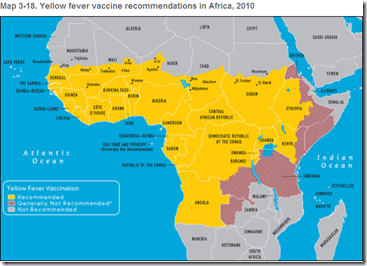
    • CDC recommends that all travelers 9 months of age or older receive a yellow fever vaccine if they are traveling to areas south of the Sahara Desert. The vaccine is not recommended for people traveling only to the Sahara Desert or the city of Khartoum. (See map.)   
    • Visit a yellow fever vaccination (travel) clinic to get your vaccine.
  • Prevent mosquito bites
    • Cover exposed skin by wearing long-sleeved shirts, long pants, and hats.
    • Use an insect repellent with one of the following active ingredients. Higher percentages of active ingredient provide longer protection.
      • DEET
      • Picaridin (also known as KBR 3023, Bayrepel, and icaridin)
      • Oil of lemon eucalyptus (OLE) or PMD
      • IR3535 (Avon Skin So Soft Bug Guard Plus)
    • Always use insect repellent as directed.
      • If you are also using sunscreen, apply sunscreen first and insect repellent second.
      • Reapply as directed.
    • Follow package directions for using repellent on children
  • If you feel sick and think you might have yellow fever
    • Talk to your doctor or nurse  immediately if you develop a fever during or soon after travel
    • Get lots of rest, and drink plenty of liquids.
    • Use acetaminophen to reduce pain and fever. Do not take pain relievers that contain aspirin or nonsteroidal anti-inflammatory medications such as ibuprofen
    • By avoiding mosquito bites, you are less likely to spread the disease to others.
    • Seek health care immediately if you have cold, clammy skin; confusion; shortness of  breath; swelling in the face; and weakness


Thursday, November 15, 2012

Ugandan MOH Statement On New Ebola Outbreak

image

Ebola Virus - Credit CDC


# 6720


Ebola was first discovered in Zaire and Sudan in 1976 and since then has become almost legendary for its incredibly high fatality rate and gruesome hemorrhagic symptoms. 


Luckily, mostly due to the virulence of the disease, outbreaks have remained small and geographically contained.


While the primary zoonotic reservoir for the Ebola virus has yet to be firmly established, bats are considered to be the most likely candidate. Intermediate hosts, which are often consumed as bushmeat, are also suspected as harboring these viruses.


There are currently five known strains of the disease, of which four are highly pathogenic in humans. The odd virus out - Ebola Reston - which can infect and kill non-human primates, has not been shown to produce disease in man.


Which brings us to a press release today that confirms, for the third time time in five months, that Uganda is facing an outbreak from a rare, but deadly, hemorrhagic fever.


The first outbreak, in late July was Ebola Zaire Sudan (see comments) . That outbreak was declared over in early October (see WHO UPDATE) after 17 deaths (and 11 laboratory confirmed cases).


Within a couple of weeks, another outbreak, this time of Marburg hemorrhagic fever (a close cousin to Ebola) was reported in Kitumba sub-county, Kabale district in South-western Uganda.


The Marburg outbreak is still ongoing with- at last count -18 cases and 9 deaths, including a health worker, reported from 5 districts.


Over the past few days there have been reports of yet another Ebola outbreak, this time in the Luweero district, which is  located in the central part of the country.


The twist to this story is that the strain of Ebola in Luweero is Sudan, not Zaire, (correction, the July outbreak was Sudan – see comments below) as was seen earlier this year.


Readers with good memories will remember this blog about a dispatch in the August 2012 edition of the CDC’s EID Journal regarding a single case of Ebola Sudan detected in a 12-year old girl in 2011 from – you guessed it – the same district (Luweero) as is now reporting fresh cases.


Here are some excerpts from the Minister of Health’s press announcement from earlier today. Follow the link to read it in its entirety.


EBOLA OUTBREAK IN LUWEERO DISTRICT

Ministry Of Health
15th November 2012
PRESS STATEMENT
EBOLA OUTBREAK IN LUWEERO DISTRICT


KAMPALA - The Ministry of Health would like to inform the general public that another Viral Hemorrhagic fever, Ebola, has broken out in the country. This follows confirmation from the laboratory investigations done at the Uganda Virus Research Institute in Entebbe that two people, all from one family in Kakute sub-county, Sambu parish in Nyimbwa sub-county, Luweero district, had died of Ebola, the Sudan strain.


A total of three people have since the onset of the outbreak died in Luweero district located in the central part of the country. The first case, a boda boda rider, died on October 25th after presenting with signs of high fever and bleeding from some body parts. However, no samples were taken from this case as it was not reported to the health facility.


The second death occurred on November 10th 2012 at Nyimbwa Health Center IV. This was 25-year-old woman who had had nursed the boda boda rider. She too, presented with signs and symptoms of Ebola. The third case, also from the same family occurred on October 12 at Nyimbwa Health Center.


A number of suspects have already been identified and attended to appropriately. Currently, there are five suspects closely being monitored by our surveillance team. One is admitted at Bombo Military Hospital, two at Mulago National Referral Hospital Isolation facility while three are still in the communities. Those admitted have an epidemiological link with the index family and nursed the earlier two who were confirmed to have died of the disease.


The Ministry of Health and its partners have to this effect moved fast and beefed up all the necessary measures to control the spread of this highly contagious disease.


  • A team of experts from the Ministry, World Health Organisation, MSF, AFENET are already on ground to support the response plan.
  • A national taskforce coordinated by the Ministry of Heath has now refocused its attention to the Luweero epidemic since the Marburg situation in western Uganda is fully under control.
  • Plans are underway to create an isolation facility at Nyimbwa Health Center IV or Bombo Military Hospital.
  • The Luweero district taskforce has been reactivated and is developing a response plan
  • Active and sustained tracing and listing of all possible contacts that were exposed to the suspected and confirmed cases are in high gear. So far, a number of contacts have been recorded and are closely being monitored.
  • The isolation facility at Mulago National Referral Hospital has already been reopened and has admitted two suspect cases.
  • The necessary drug supplies and logistics for case management have been mobilized. The National Medical Stores have been requested to send the necessary logistics.
  • MSF is already on the ground to evaluate and mobilise the necessary requirements for setting up an appropriate isolation centre at Nyimbwa health center IV or Bombo Military Hospital
  • The Ministry has already dispatched Personal Protective Equipment (PPEs) and body Bags to Luweero district
  • Collection of samples from suspect and probable cases has already commenced. Last evening, two samples from taken from suspect cases admitted at Mulago National Referral Hospital 

With the above measures, the Ministry of Health is confident that the outbreak will be effectively controlled and there should be no panic among the population.


(Continue . . . )

Wednesday, October 31, 2012

WHO: Yellow Fever Outbreak In Sudan


image

Source Lancet Infect Dis. 2011;11:622-32 via CDC


# 6681


For three weeks the newshounds on FluTrackers (among others) have been keeping track of a disease outbreak  in Sudan that has claimed several dozen lives.


Today, the World Health Organization’s regional office for the Eastern Mediterranean has posted the following notice (h/t Ronan Kelley on FluTrackers), indicating they’ve been notified of a yellow fever outbreak in that country.


Yellow fever hits Central and South Darfur

29 October 2012 – Sudan’s Federal Ministry of Health has notified the World Health Organization (WHO) of a yellow fever outbreak in seven localities in Central and South Darfur. Since the first week of October, a total of 84 suspected cases, including 32 deaths, have been reported from the districts of Azoom, Kass, Mershing, Nertiti, Nyala, Wadi Salih and Zalingei.


The Federal Ministry of Health has said that the immediate priority is to control the vector, reinforce the disease surveillance system and raise public awareness of prevention and control of this disease. Preparations for a mass vaccination campaign are underway to vaccinate the at-risk population in Darfur.


Yellow fever is spread by mosquitoes. There is no specific treatment for yellow fever, only supportive care to treat dehydration and fever, and blood transfusion, if and when needed. It is a preventable disease with symptoms and severity varying from case to case. Protective measures such as the use of bednets, insect repellent and long clothing are considered the best methods to contain an outbreak.


Vaccination is the single most important measure for preventing yellow fever.


The Federal Ministry of Health, WHO and other health partners are working on the ground to ensure timely containment of the outbreak.


Yellow fever (aka Yellow Jack) is a viral disease transmitted by the Aedes mosquito (and others). There is a relatively safe, and effective, vaccine available and travelers to parts of equatorial Africa and South America are often advised to get it.


The CDC’s 2012 Yellow Book describes the clinical presentation this way:


Asymptomatic or clinically inapparent infection is believed to occur in most people infected with YFV. For people who develop symptomatic illness, the incubation period is typically 3–6 days.


The initial illness presents as a nonspecific influenzalike syndrome with sudden onset of fever, chills, headache, backache, myalgias, prostration, nausea, and vomiting. Most patients improve after the initial presentation.


After a brief remission of hours to a day, approximately 15% of patients progress to a more serious or toxic form of the disease characterized by jaundice, hemorrhagic symptoms, and eventually shock and multisystem organ failure. The case-fatality ratio for severe cases with hepatorenal dysfunction is 20%–50%.


In the 18th and 19th century Yellow fever caused major epidemics in Europe and in the United States, up the Atlantic seaboard and as far north as New England (Boston was hard hit in 1780, and Philadelphia saw several thousand deaths in 1793).


Yellow Fever has been cited as one of the primary reasons why the French abandoned their attempt to build a Panama canal in the late 1800’s, as the combined burden of Yellow Fever and Malaria reportedly claimed the lives of more than 20,000 construction workers.


For more on the fascinating history of `Yellow Jack’, I would point you to Ian York’s excellent Mystery Rays blog, where he gives us some terrific background in:


Yellow fever, stasis, and diversification
The deadliest, most awe-inspiring of the plagues
The good old days


While currently not a threat in Europe and the United States, yellow fever is on the radar screens of some epidemiologists as climate change, and the spread of suitable vectors, continue.


This from Eurosurveillance in 2010, and it is an excellent overview of the issue.


Eurosurveillance, Volume 15, Issue 10, 11 March 2010


Yellow fever and dengue: a threat to Europe?

P Reiter

The introduction and rapidly expanding range of Aedes albopictus in Europe is an iconic example of the growing risk of the globalisation of vectors and vector-borne diseases.

The history of yellow fever and dengue in temperate regions confirms that transmission of both diseases could recur, particularly if Ae. aegypti, a more effective vector, were to be re-introduced.  The article is a broad overview of the natural history and epidemiology of both diseases in the context of these risks.


You can find more information on yellow fever at these websites:


http://www.cdc.gov/yellowfever/

http://wwwnc.cdc.gov/travel/yellowbook/2012/chapter-3-infectious-diseases-related-to-travel/yellow-fever.htm

http://www.who.int/topics/yellow_fever/en/