Showing posts with label Uganda. Show all posts

Friday, October 10, 2014

WHO Marburg Update – Uganda

image


# 9175


Five days ago, in Uganda Reporting Apparent Marburg Outbreak, we learned of what appeared to be the first case of Marburg virus infection since 2012, involving 1 `confirmed’ case in Kampala, Uganda, along with a number of contacts under observation.


Marburg hemorrhagic fever (Marburg HF) is normally found in parts of eastern and central Africa, and is less commonly reported than its more famous Ebola cousins.


Today we’ve an update from the World Health Organization that – while confirming the index case – reports that so far, none of this index case’s 146 contacts have tested positive for the virus.


Marburg virus Disease - Uganda

Disease outbreak news
10 October 2014

On 5 October 2014, the Ministry of Health (MoH) of Uganda notified WHO of a confirmed case of Marburg virus disease (MVD) in Kampala, Uganda.

The confirmed case was a healthcare worker who had onset of disease on 11 September 2014 while working at Mengo Hospital, Kampala. The case presented to Mpigi District Health Center on 17 September 2014, and transferred to Mengo Hospital, Kampala, on 23 September 2014. On admission the case presented with symptoms including fever, headache, abdominal pain, vomiting and diarrhoea and died on 28 September 2014.

The case reported no history of travel beyond Mpigi, no contact with a person with similar illness. He had not eaten bush meat nor had had contact with bats in the last 4 weeks.

A preliminary result indicating the specimen was positive for Marburg virus disease was received on 3 October 2014, and further confirmed on 4 October 2014 by the Uganda Virus Research Institute (UVRI).

As of today, a total of 146 contacts have been identified and are being monitored for signs and symptoms compatible with MVD. Eleven of the contacts developed signs and symptoms compatible with Marburg virus disease. All samples from symptomatic contacts have tested negative so far. Second samples have been taken from them and are being tested at the Uganda Virus Research Institute (UVRI). One contact, Kenyan mortician who travelled back to Kenya, developed a fever and cough but tested negative for both Marburg and Ebola virus. The contact in Kenya continues to be followed up by the Kenyan Rapid Response Team.

Public health response

The Ministry of Health of Uganda has activated the National Task Force which is meeting regularly and sub-committees have been established.

WHO, Médecins Sans Frontières (MSF) and the US Centers for Disease Control (CDC) are supporting the national Ugandan authorities in the investigation and response operations including, enhancements and establishment of isolation and treatment units; prepositioning personal protective equipment (PPE), and training health workers on infection control and prevention, as well as in case management and social mobilization.

Four multi-disciplinary teams have been deployed to perform an in-depth risk assessment. Surveillance and contact tracing, and follow-up activities are currently being implemented in Kampala, Mpigi and Kasese.

WHO recommendations

Marburg virus disease is a severe and highly fatal disease caused by a virus from the same family as the one that causes Ebola virus disease. Both viruses can cause large outbreaks such as the ongoing Ebola virus disease outbreak in West Africa. The last outbreak of MVD in Uganda occurred in 2012 during which 20 cases, including 9 fatal cases were reported from Kabale District, Kampala, Ibanda, Mbarara, and Kabarole.

WHO advises against the application of any travel or trade restrictions on Uganda based on the current information available on this outbreak.

Sunday, October 05, 2014

Uganda Reporting Apparent Marburg Outbreak

image


# 9150


We've word today of what appears to be an outbreak of Marburg Virus – another hemorrhagic fever similar to  Ebola  – coming out of Uganda. That country saw a similar outbreak in 2012 which involved a total of 20 cases, including 9 deaths from 4 districts in Uganda (Kabale, Ibanda, Mbarara, and Kampala) (see Marburg haemorrhagic fever in Uganda – update).


First a couple of press reports on the current outbreak, then I’ll return with some background on the Marburg virus.


Over 60 health workers monitored after Marburg outbreak in Uganda

Xinhua, October 5, 2014

Over 60 health workers in central Uganda are being monitored after the deadly Marburg hemorrhagic fever broke out in the East African country, a senior health official said Sunday.

Elioda Tumwesigye, minister of state for health who announced the outbreak here on Sunday said that the health workers interacted with the index case which died on Sept. 28.

The index case was a health worker who worked at Mengo Hospital in the capital Kampala and at a health center in Mpigi district, all in central Uganda.

The minister said 38 health workers are being monitored at Mengo Hospital while 22 others are monitored at a health center in Mpigi.

Tumwesigye said 20 other people who were involved in the burial process of the deceased are also being monitored in Kasese district in western Uganda.

He said World Health Organization (WHO) has provided technical and logistical support to contain the disease.

(Continue . . .)

Another Marburg outbreak confirmed in Uganda

October 5, 2014 in   

The ministry of health has confirmed an outbreak of Marburg fever in the country following the death of a medical worker.

This has been revealed by the Minister of State for Health Elioda Tumwesigye at a news conference held this afternoon at the Ministry Headquarters in Wandegeya.

He says the victim who died on September 30th has only been identified as a 30 year old man recently recruited as a radiographer at Mengo hospital.

“8O suspected cases have been isolated, 38 are Mengo workers, 22 are from Mpigi Health Center Four, while 20 are in Mukunyu village in Kasese district where the deceased was buried” Dr. Tumwesigye explained.

He added that one of them who had obvious symptoms has been referred the Virus Research Institute in Entebbe and the results are expected tomorrow.

(Continue . . . )


While rare, Marburg was the first of the filovirus family of hemorrhagic diseases to be recognized. Normally only found in parts of eastern and central Africa, Marburg – surprisingly - was first detected in Germany in the late 1960s.

Marburg virus negative stain image

Negative stain image of an isolate of Marburg virus, showing filamentous particles as well as the characteristic "Shepherd's Crook." Magnification approximately 100,000 times. Image courtesy of Russell Regnery, Ph.D., DVRD, NCID, CDC.


In 1967, several workers involved with Polio research at a laboratory in Marburg, Germany fell ill with an unknown illness. What began with fever, vomiting, and diarrhea progressed rapidly to internal bleeding, shock, and for 7 of the 31 victims, death.


An investigation identified the source of the virus: Green monkeys imported from Uganda for research, and in time, the virus was isolated. 

It lead to the creation of a new virus family; the Filoviridae, of which Marburg and the five Ebola viruses are the principal members.


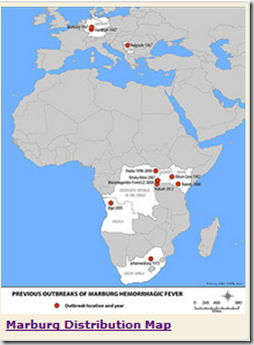
For the next three decades, the virus only showed up sporadically.  In South Africa in 1975 (3 cases), Kenya in 1980 (2 cases) and again in 1987 (1 case), and in a pair of laboratory accidents in the Soviet Union in 1988 and 1990.


Between 1998 and 2000 more than 150 cases were recorded in the Democratic Republic of the Congo, and a second marburgvirus (RAVV) was identified.


In 2004-2005, the largest known outbreak occurred in Angola, where 90% of the 252 cases died.  This from the CDC’s MMWR in 2005.


Outbreak of Marburg Virus Hemorrhagic Fever — Angola, October 1, 2004–March 29, 2005

On March 23, 2005, the World Health Organization (WHO) confirmed Marburg virus (family Filoviridae, which includes Ebola virus) as the causative agent of an outbreak ofviral hemorrhagic fever (VHF) in Uige Province in northernAngola. Testing conducted by CDC’s Special Pathogens Branchdetected the presence of virus in nine of 12 clinical specimens from patients who died during the outbreak.

During October 1, 2004–March 29, 2005, a total of 124 cases were identified; of these, 117 were fatal (1). Approximately 75% of the reported cases occurred in children aged <5 years; cases also have occurred in adults, including health care workers.

Predominant symptoms have included fever, hemorrhage, vomiting, cough, diarrhea, and jaundice.

(Continue . . .)


Another small outbreak (3 cases) was reported in 2007, and quite famously, alarm bells rang when a Dutch tourist returned to the Netherlands from a trip to Uganda and was diagnosed with Marburg in 2008. 


This from the CDC’s EID Journal .

Response to Imported Case of Marburg Hemorrhagic Fever, the Netherlands

Aura Timen , Marion P.G. Koopmans, Ann C.T.M. Vossen, Gerard J.J. van Doornum, Stephan Günther, Franchette van den Berkmortel, Kees M. Verduin, Sabine Dittrich, Petra Emmerich, Albert D.M.E. Osterhaus, Jaap T. van Dissel, and Roel A. Coutinho1
Abstract

On July 10, 2008, Marburg hemorrhagic fever was confirmed in a Dutch patient who had vacationed recently in Uganda. Exposure most likely occurred in the Python Cave (Maramagambo Forest), which harbors bat species that elsewhere in Africa have been found positive for Marburg virus.


image


While similar, Marburg is antigenically distinct from Ebolaviruses, and the CDC maintains a separate webpage for it on their Viral Special Pathogens Branch (VSPB) website.


Marburg hemorrhagic fever (Marburg HF)

Friday, November 30, 2012

WHO Update On Ebola In Uganda


image

Ebola Virus - Credit CDC


# 6750


Uganda’s second Ebola outbreak of the year continues in the Luweero and Kampala districts, with six confirmed cases over the past several weeks.  The last Ebola update (along with an update on their Marburg virus outbreak) came a week ago (see WHO Update On Marburg Outbreak In Uganda).


Today the World Health Organization has released the following update, which encouragingly, hasn’t seen an increase in confirmed cases over the past week. 


Ebola in Uganda - update

30 November 2012 - As of 28 November 2012, the Ministry of Health in Uganda reported 7 cases (6 confirmed, 1 probable) with Ebola haemorrhagic fever in Luweero and Kampala districts. Of these cases, 4 died.


Field teams continue to investigate cases alerted to them from the communities. The major challenge faced in some communities is the belief that witch-craft and not Ebola was the cause of deaths, despite ongoing intensive awareness campaigns. Social mobilization teams are working closely with traditional healers and religious leaders to raise awareness on prevention and control of the disease.


WHO and partners, including the US Centers for Disease Control and Prevention (CDC), Médecins Sans Frontières (MSF), the Uganda Red Cross (URCS), African Field Epidemiology Network (AFENET) and Plan Uganda continue to support the national authorities in the response to the outbreak. Through WHO, an expert on infection prevention and control has been deployed to the field.


With respect to this event, WHO does not recommend that any travel or trade restriction be applied to Uganda.


Note: The total number of cases reported on 23 November2012 was 10 (6 confirmed, 4 probable) Probable cases that tested negative for Ebola have been classified as Non-Cases and excluded from the case counts.


While the primary zoonotic reservoir for the Ebola virus has yet to be firmly established, bats are considered to be the most likely candidate. Intermediate hosts, which are often consumed as bushmeat, are also suspected as harboring these viruses.


There are currently five known strains of the disease, of which four are highly pathogenic in humans. The odd virus out - Ebola Reston - which can infect and kill non-human primates, has not been shown to produce disease in man.

Friday, November 23, 2012

WHO Update On Marburg Outbreak In Uganda

image

Credit CDC PHIL

# 6735


The World Health Organization has updated the Marburg Virus outbreak situation in Uganda, with encouraging news that no new laboratory confirmed cases have been hospitalized since October 31st.


Marburg haemorrhagic fever in Uganda - update

23 November 2012 - As of 23 November 2012, a total of 20 (probable or confirmed) cases, including 9 deaths have been reported from4 districts in Uganda (Kabale, Ibanda, Mbarara, and Kampala).


The last confirmed case was hospitalised on 31 October 2012.


The Ministry of Health continues to conduct active surveillance and investigation on all cases alerted in the 4 districts. Close contacts of the Marburg cases are being followed-up for a period of 21 days.


WHO and international partners, including the US Centers for Disease Control and Prevention (CDC), the Uganda Red Cross (URCS), African Field Epidemiology Network (AFENET), Plan Uganda and Médecins Sans Frontières (MSF) are supporting the national authorities in the investigation and response to the outbreak. Experts have been deployed through the Global Outbreak Alert and Response Network (GOARN) to strengthen the field team.


Trainings are being provided to health professionals on infection prevention and control (IPC), and on field information management. Social mobilization activities are being conducted to raise awareness on prevention and control of Marburg haemorrhagic fever.


With respect to this outbreak, WHO does not recommend that any travel or trade restriction be applied to Uganda.


Earlier blogs on this outbreak include:

CDC Travelers’ Notice:The Ugandan Marburg outbreak
WHO Update: Marburg Virus In Uganda
Marburg Virus Reported In Western Uganda


Meanwhile, their second Ebola outbreak of the year (see Ugandan MOH Statement On New Ebola Outbreak) continues in the Luweero district, which is  located in the central part of the country.


Today the WHO posted this update:


Ebola in Uganda

23 November 2012 - As of 23 November 2012, the Ministry of Health (MoH) of Uganda has reported 10 cases (6 confirmed and 4 probable,), including 5 deaths in Luweero and Kampala.


The last confirmed case was hospitalised on 17 November 2012. Close contacts of the Ebola cases are being identified and followed up for a period of 21 days. All the cases alerted to the field teams are being investigated.


WHO and partners, including the US Centers for Disease Control and Prevention (CDC), Médecins Sans Frontières (MSF), the Uganda Red Cross (URCS), African Field Epidemiology Network (AFENET) and Plan Uganda are supporting the national authorities in the investigation and response to the outbreak.


Experts in the area of field epidemiology, health promotion, logistics management, and infection prevention and control , have been mobilized by WHO through the Global Outbreak Alert and Response Network (GOARN), to provide support to the response.


With respect to this event, WHO does not recommend that any travel or trade restriction be applied to Uganda.

Thursday, November 15, 2012

Ugandan MOH Statement On New Ebola Outbreak

image

Ebola Virus - Credit CDC


# 6720


Ebola was first discovered in Zaire and Sudan in 1976 and since then has become almost legendary for its incredibly high fatality rate and gruesome hemorrhagic symptoms. 


Luckily, mostly due to the virulence of the disease, outbreaks have remained small and geographically contained.


While the primary zoonotic reservoir for the Ebola virus has yet to be firmly established, bats are considered to be the most likely candidate. Intermediate hosts, which are often consumed as bushmeat, are also suspected as harboring these viruses.


There are currently five known strains of the disease, of which four are highly pathogenic in humans. The odd virus out - Ebola Reston - which can infect and kill non-human primates, has not been shown to produce disease in man.


Which brings us to a press release today that confirms, for the third time time in five months, that Uganda is facing an outbreak from a rare, but deadly, hemorrhagic fever.


The first outbreak, in late July was Ebola Zaire Sudan (see comments) . That outbreak was declared over in early October (see WHO UPDATE) after 17 deaths (and 11 laboratory confirmed cases).


Within a couple of weeks, another outbreak, this time of Marburg hemorrhagic fever (a close cousin to Ebola) was reported in Kitumba sub-county, Kabale district in South-western Uganda.


The Marburg outbreak is still ongoing with- at last count -18 cases and 9 deaths, including a health worker, reported from 5 districts.


Over the past few days there have been reports of yet another Ebola outbreak, this time in the Luweero district, which is  located in the central part of the country.


The twist to this story is that the strain of Ebola in Luweero is Sudan, not Zaire, (correction, the July outbreak was Sudan – see comments below) as was seen earlier this year.


Readers with good memories will remember this blog about a dispatch in the August 2012 edition of the CDC’s EID Journal regarding a single case of Ebola Sudan detected in a 12-year old girl in 2011 from – you guessed it – the same district (Luweero) as is now reporting fresh cases.


Here are some excerpts from the Minister of Health’s press announcement from earlier today. Follow the link to read it in its entirety.


EBOLA OUTBREAK IN LUWEERO DISTRICT

Ministry Of Health
15th November 2012
PRESS STATEMENT
EBOLA OUTBREAK IN LUWEERO DISTRICT


KAMPALA - The Ministry of Health would like to inform the general public that another Viral Hemorrhagic fever, Ebola, has broken out in the country. This follows confirmation from the laboratory investigations done at the Uganda Virus Research Institute in Entebbe that two people, all from one family in Kakute sub-county, Sambu parish in Nyimbwa sub-county, Luweero district, had died of Ebola, the Sudan strain.


A total of three people have since the onset of the outbreak died in Luweero district located in the central part of the country. The first case, a boda boda rider, died on October 25th after presenting with signs of high fever and bleeding from some body parts. However, no samples were taken from this case as it was not reported to the health facility.


The second death occurred on November 10th 2012 at Nyimbwa Health Center IV. This was 25-year-old woman who had had nursed the boda boda rider. She too, presented with signs and symptoms of Ebola. The third case, also from the same family occurred on October 12 at Nyimbwa Health Center.


A number of suspects have already been identified and attended to appropriately. Currently, there are five suspects closely being monitored by our surveillance team. One is admitted at Bombo Military Hospital, two at Mulago National Referral Hospital Isolation facility while three are still in the communities. Those admitted have an epidemiological link with the index family and nursed the earlier two who were confirmed to have died of the disease.


The Ministry of Health and its partners have to this effect moved fast and beefed up all the necessary measures to control the spread of this highly contagious disease.


  • A team of experts from the Ministry, World Health Organisation, MSF, AFENET are already on ground to support the response plan.
  • A national taskforce coordinated by the Ministry of Heath has now refocused its attention to the Luweero epidemic since the Marburg situation in western Uganda is fully under control.
  • Plans are underway to create an isolation facility at Nyimbwa Health Center IV or Bombo Military Hospital.
  • The Luweero district taskforce has been reactivated and is developing a response plan
  • Active and sustained tracing and listing of all possible contacts that were exposed to the suspected and confirmed cases are in high gear. So far, a number of contacts have been recorded and are closely being monitored.
  • The isolation facility at Mulago National Referral Hospital has already been reopened and has admitted two suspect cases.
  • The necessary drug supplies and logistics for case management have been mobilized. The National Medical Stores have been requested to send the necessary logistics.
  • MSF is already on the ground to evaluate and mobilise the necessary requirements for setting up an appropriate isolation centre at Nyimbwa health center IV or Bombo Military Hospital
  • The Ministry has already dispatched Personal Protective Equipment (PPEs) and body Bags to Luweero district
  • Collection of samples from suspect and probable cases has already commenced. Last evening, two samples from taken from suspect cases admitted at Mulago National Referral Hospital 

With the above measures, the Ministry of Health is confident that the outbreak will be effectively controlled and there should be no panic among the population.


(Continue . . . )

Wednesday, October 31, 2012

WHO Update: Marburg Virus In Uganda


image

Credit CDC PHIL


# 6684


The World Health Organization has updated the situation in Uganda, where authorities are dealing with a rare outbreak of Marburg virus.


The Marburg virus was first isolated after an outbreak at a lab in Germany (hence the name) imported via African Green Monkeys, but is normally found in parts of equatorial Africa.  It is closely related to the Ebola viruses, and is of the same family; Filoviridae.

Two weeks ago, in Marburg Virus Reported In Western Uganda, I recounted a bit of the history of the virus since it’s discovery in 1967.


As of now, there are 18 confirmed cases (9 deaths), and perhaps of most concern, cases have now been detected in 5 districts;  Kabale district, Kampala (the capital city), Ibanda, Mbarara and Kabarole.


Marburg haemorrhagic fever in Uganda - update

31 October 2012 - As of 28 October 2012, a total of 18 cases and 9 deaths, including a health worker, have been reported from 5 districts namely Kabale district, in south-western Uganda, Kampala (the capital city), Ibanda, Mbarara and Kabarole. The case fatality rate is 50%. The outbreak was declared by the Ministry of Health in Uganda on 19 October 2012. Blood samples from 9 cases have been confirmed for Marburg virus at the Uganda Virus Research Institute (UVRI).


Currently, 13 patients have been admitted to hospital (2 in Kampala, 8 in Kabale, 3 in Ibanda) and their contacts are listed for daily follow up. The latest confirmed case was admitted to Ibanda district isolation ward on 26 October 2012.


The World Health Organization (WHO) and international partners including, the Centers for Disease Control and Prevention (CDC), the Uganda Red Cross (URCS), African Field Epidemiology Network (AFENET) and Médecins-Sans-Frontières (MSF) are supporting the national authorities in outbreak investigation and response. The national task force has identified additional health care workers and epidemiologists to strengthen the teams in the field. Training of health workers on infection prevention and control, surveillance and clinical case management is ongoing. Social mobilization activities are being conducted which include the dissemination of IEC (Information Education Communication) material, sensitization on Marburg prevention and control and broadcast of information through radio channels. The first shipment of personal protective equipment (PPE) provided by WHO arrived over the weekend.


The WHO Regional office has deployed an epidemiologist and a logistician to Uganda to support the response teams on the ground. In addition, a social mobilization expert from WHO Zambia Country Office and a logistician from the Regional Rapid Response Team network have been mobilized for immediate deployment. More experts are being identified by the Global Outbreak Alert and Response Network (GOARN).


As the investigation into the outbreak continues, WHO and partners continue to support the national authorities as needed in the areas of coordination, infection prevention and control, surveillance, epidemiology, public information and social mobilization, anthropological analysis and logistics for outbreak response.


Neighbouring countries have been contacted to strengthen cross border surveillance and preparedness to prevent cross border spread of the outbreak.


WHO advises that there is no need for any restrictions on travel or trade with Uganda.

Monday, October 29, 2012

Uganda MOH: Update On Marburg Outbreak

image

  Credit Wikipedia


# 6675


The Ugandan Minister of Health, Dr. Christine Ondoa, has issued the following update on the Marburg virus outbreak which has been ongoing in that nation since October 19th.


The major points are that there are now 8 deaths confirmed, and that cases have now been confirmed in three districts; Kabale , Ibanda, and Mbarara.


This from the Ugandan Media Centre.


PRESS STATEMENT ON THE UPDATE OF MARBURG OUTBREAK

October 29th 2012


Today on behalf of the Ministry of Health, I take this opportunity to welcome you all to this press briefing organized to update you on the outbreak of Marburg in the country. You will recall that we declared an outbreak of this highly infectious disease on October 19th and since then the Ministry of Health and its partners have undertaken a number of interventions to control the spread of the disease.

 
I wish to inform you that cases are now reported in the neighbouring districts of Ibanda and Mbarara. However, I want to assure you that the Ministry of Health and its partners are on the ground in the mentioned districts to contain the spread and manage the identified cases.


To date, the death toll of both the probable and confirmed cases stands at eight, with the latest being a case that died at the isolation facility at Rushoroza Health Centre III on October 27th (Saturday). The case that was referred from Ibanda Hospital – Ibanda to Mbarara Regional Referral Hospital died on October 24th.


I wish to clarify that since the onset of the outbreak, we have collected a total of 45 samples of which nine were confirmed positive; five in Kabale, two in Kampala and two from Ibanda.


Working closely with the US Center for Disease Control and Prevention (CDC), we have set up a field diagnostic laboratory at Kabale Regional Referral Hospital. All samples from the affected neighbouring districts will hence be taken to this laboratory for quick diagnostics. This will shorten the time when we get results to three hours from the original 24 hours due to distance. Further serological testing will be undertaken at the Uganda Virus Research Institute (UVRI).


Due to the presence of cases in other districts, we have established temporary isolation facilities to accommodate the suspected and confirmed cases. In Ibanda, a temporary isolation ward has been created at Ibanda Hospital, while plans are underway to set up a proper isolation facility by tomorrow.


At Mbarara Regional Referral Hospital, a separate temporary has been designated for the suspect Marburg cases. A triage has also been set up at the causality ward.


We have assembled a team of experts to work in the newly established isolation facilities and they are expected in these districts today.  We also plan to undertake infection control procedures in these facilities as safety measures for the workers and the admitted patients.


Today, the total number of cases admitted is 12. Eight are currently admitted at Rushoroza Health Center III in Kabale. Two confirmed cases, a couple (husband and wife) still remain admitted at Mulago National Referral Hospital. Another two suspect cases are currently admitted at Mayanja Memorial Hospital in Mbarara.


There are seven suspect cases (student nurses) quarantined at Ibanda. These cases attended to the confirmed case that later died at Mbarara Regional Referral Hospital on October 24th. Other health workers who attended to the patient are closely being monitored.


We have line-listed a total of 436 contacts for close observation in four districts of  Kabale, Kam-pala, Ibanda, Mbarara, Fort Portal and Rukungiri. Those being monitored got into contact with either the dead or confirmed cases. The team continues to monitor them on a daily basis for possible signs and symptoms of this highly infectious disease until they have completed 21 days without showing any signs and symptoms.


We have completed an orientation of the Kabale district taskforce on Marburg case presentation and prevention, barrier nursing and infection control. Plans are underway to conduct the orien-tation at Ibanda and at Mbarara Regional Referral Hospital.
We have trained a total of 42 volunteers from the Uganda Red Cross Society and deployed them to conduct house to house community sensitization and active case tracing.


We plan to set up burial committees in Ibanda district to manage burials of people suspected to have died of the disease. The committee will be oriented on burial procedures and infection prevention and control. This is one of the control measures to curb the spread of the highly con-tiguous disease.

The Ministry of Health would also wish to clarify on media reports that one of its officers, Dr. Sheila Ndyanabangi, the head of the Mental Health Unit Division, had contracted Marburg and had been isolated. Dr. Ndyanabangi has not been isolated but has been advised to exercise social distancing. She is one of the contacts who are being monitored. She has not developed any signs or symptoms of the disease and therefore cannot be isolated from the community. She is due to complete the 21 days of observation.


I once again urge the public to take the following measures to avert the spread of the disease.

  • Report immediately any suspected patient to a nearby health unit
  • Avoid direct contact with body fluids of a person suspected to be suffering from Marburg by using protective materials like gloves and masks
  • Persons who have died of Marburg must be handled with strong protective wear and buried immediately
  • Avoid eating dead animals
  • Avoid unnecessary public gathering especially in the affected district
  • Burial of suspicious community deaths should be done under close supervision of well trained burial teams
  • Report all suspicious deaths to a nearby health facility 


Once again the Ministry of Health calls upon the public to stay calm as all possible measures are being undertaken to control the situation. 


For a history of the Marburg virus, you may wish to revisit Marburg Virus Reported In Western Uganda.

Thursday, October 25, 2012

Ugandan MOH Statement On Marburg Outbreak

image

Credit Wikipedia


# 6662


While we’ve been following reports of a Marburg virus outbreak in Uganda since late last week, the Ugandan government has had very little public comment. Even today, the front page of the Ugandan Ministry of Health makes no mention of the outbreak.


But earlier today (h/t Treyfish on FluTrackers) the MOH published the following statement on the Uganda Media Centre Website providing details on the outbreak.


PRESS STATEMENT ON THE UPDATE ON THE MARBURG OUTBREAK

October 25th 2012 MINISTRY OF HEALTH

The Ministry of Health declared an outbreak of Marburg in Kabale district on October 19th 2012 after receiving laboratory results from the Uganda Virus Research Institute (UVRI) confirming that two family members had died of the highly infectious viral hemorrhagic fever.  Three other members of the same family had earlier died of a strange disease in a period of one month.


The death of these people prompted the District Health Office to undertake further investigations of this strange disease that had ravaged Kitumba parish in Kitumba sub-county, Kabale district.


According to the reports, the patients presented with symptoms of diarrhoea, vomiting, fever, headache, dizziness and generalized convulsions. Initial samples of blood and cerebral spiral fluid taken from the sick people ruled out Malaria and Meningitis. The family then invited a cult leader, a retired Reverend from Rukungiri, district to visit their household and pray for the sick.


The index case is believed to have been a member of a family in Rwabirondo village, Kitumba parish in Kitumba sub-county which occurred on 20th September 2012.  After the death of the index case, two other people, a sister and mother reportedly got sick and died.


This outbreak comes barely two weeks after the Ministry declared an end to another viral Hemorrhagic Fever (Ebola) on October 4th 2012. The last Marburg outbreak was witnessed in October 2007 in Kamwenge district.


Marburg is a highly infectious viral hemorrhagic fever which kills in a short time but can be prevented. Marburg is spread through direct contact with, body fluids like blood, saliva, vomitus, stool and urine of an infected person.


A person suffering from Marburg presents with sudden onset of high fever with any of the following; headache, vomiting blood, joint and muscle pains and bleeding through the body openings, i.e. eyes (red eyes), nose, gums, ears, anus and the skin.


How is Marburg Spread?

  • It is spread through;
  • Direct contact with wounds, body fluids like blood, saliva, vomitus, droplets, stool and urine of a person suffering from Marburg.
  • Unsterilised injections, contaminated linen, beddings and clothes.
  • Using skin piercing instruments that have been used by an infected person.
  • Direct physical handling of persons who have died of Marburg


Current Status (Update)


The Ministry of Health has developed a response plan and budget for the Marburg control amounting to sh2.3b of which sh1.75 is for central level activities including Ministry of Health, six general hospitals and Kampala Capital City Authority. This will be majorly for case management, surveillance, research and social mobilisation and procurement of protective gears. The district budget totals 651,047,576 and it covers case management, surveillance, research and social mobilisation.
  • Out of the six people who have died so far, only three were confirmed positive for Marburg. 
  • Currently, there is only one confirmed case admitted in our isolation facility at Mulago National Referral Hospital. One convalescent case is detained at  Rushoroza Health Center III while five suspect cases linked to the initial cases  are admitted there awaiting blood results.  Special teams of doctors and nurses have been assigned to attend to the patients in both the isolation facilities. The patient admitted at Mulago National Referral Hospital is from Kitumba sub-county and is a relative of the index case. 
  • The Ministry of Health surveillance team has listed up a total of 196 contacts for close monitoring. These contacts are mainly in Kabale, Rukungiri and Ibanda districts while 29 are from Kampala. Those being monitored reportedly got into contact with either the dead or confirmed cases. The team continues to monitor them on a daily basis for possible signs and symptoms of this highly infectious disease until they have completed 10 days without showing any signs and symptoms. 
  • A team of experts from the Ministry of Health, U.S Center for Disease Control and Prevention and World Health Organization have so far collected a total of 18 n  samples from suspected cases for further investigations. The samples are being analyzed at the Uganda Virus Research Institute, Entebbe.
  • The Ministry is conducting an orientation of local healthcare workers in Kabale Regional Referral Hospital and in the other peripheral health facilities on infection prevention and control, barrier nursing, surveillance and clinical case management. This is being done to build health workers’ capacity to handle such cases.  
  • In Rushoroza Health Centre, a burial committee has  been set up to manage burials of people suspected to have died of Marburg. The committee has been oriented on burial procedures and infection prevention and control. This is one of the control measures to curb the spread of the highly contiguous disease. The committee has so far supervised two burials.

A team from the Centers for Disease Control (CDC) is expected in the country to undertake anthropological studies.


The Ministry of Health once again urges the public to take the following measures to avert the spread of the disease.


  • Report immediately any suspected patient to a nearby health unit 
  • Avoid direct contact with body fluids of a person suspected to be suffering from Marburg by using protective materials like gloves and masks 
  • Persons who have died of Marburg must be handled with strong protective wear and buried immediately
  • Avoid eating dead animals 
  • Avoid unnecessary public gathering especially in the affected district 
  • Burial of suspicious community deaths should be done under close supervision of well trained burial teams   
  • Report all suspicious deaths to a nearby health facility 


Once again the Ministry of Health calls upon the public to stay calm as all possible measures are being undertaken to control the situation. 


Hon. Dr. Christine Ondoa
Minister of Health


I’ve blogged (here & here) on this outbreak earlier in the week, including a history of the Marburg virus. To keep up with breaking news, you’ll want to visit this FluTrackers Thread.

Monday, October 22, 2012

WHO Update on Marburg Virus In Uganda


# 6653


The World Health Organization has posted a brief update on the Marburg virus outbreak in Uganda, which I blogged about on Friday (see Marburg Virus Reported In Western Uganda).


Marburg haemorrhagic fever in Uganda - update

22 October 2012 - As of 21 October 2012, nine (9) probable and confirmed cases, including 5 deaths have been reported with Marburg haemorrhagic fever in Kitumba sub-county, Kabale district in South-western Uganda. Of these, 3 have been laboratory confirmed by the Uganda Virus Research Institute (UVRI).


An investigation into the outbreak is ongoing. Preliminary investigations indicate that all these cases belong to the same cluster – family and relatives of the index case.


WHO is supporting the Ministry of Health and partners in controlling the outbreak.


Marburg virus - like its better known cousins the Ebola viruses – produce hemorrhagic fevers with a high fatality rate. 

image


The natural host for the Marburg virus is believed to be fruit bats of the Pteropodidae family, which can pass the virus on to other intermediate hosts, or directly to humans.


The red areas of the map above show the areas where Marburg is found in Africa, while the purple outline shows the range of the Pteropodidae fruit bat.


While most cases have occurred in central Africa, a few cases have been exported, via humans or lab animals, to other regions.  The first known outbreak (in 1967) occurred at a laboratory working with green monkeys from Uganda in Marburg, Germany. 


For more on the Marburg Virus, including narratives of previous outbreaks,  you may wish to visit the WHO’s Marburg Resources page.


Information resources

Friday, October 19, 2012

Marburg Virus Reported In Western Uganda


 image

Credit Wikipedia


# 6647


Just a couple of weeks after the declared end of an Ebola outbreak in Uganda, media reports today are indicating that at least three cases of Marburg virus – another virulent hemorrhagic fever of the same family - have been detected in the Kabale district in western Uganda


This report from Reuters, after which I’ll return with more:


Three Ugandans die in Marburg virus outbreak

Fri, 19 Oct 2012 13:25 GMT

KAMPALA, Oct 19 (Reuters) - Three people have died in southwest Uganda from an outbreak of Marburg virus disease, officials said on Friday, a severe and highly fatal infection, just two weeks after the east African nation said it was free of the deadly Ebola virus.


Another four people who have died since October 4 were also suspected to have been killed by the disease, the Ugandan government said in a statement.

(Continue  . . . )


While rare, Marburg was the first of the filovirus family of hemorrhagic diseases to be recognized. Normally only found in parts of eastern and central Africa, Marburg – surprisingly - was first detected in Germany in the late 1960s.


Marburg virus negative stain image

Negative stain image of an isolate of Marburg virus, showing filamentous particles as well as the characteristic "Shepherd's Crook." Magnification approximately 100,000 times. Image courtesy of Russell Regnery, Ph.D., DVRD, NCID, CDC.

In 1967, several workers involved with Polio research at a laboratory in Marburg, Germany fell ill with an unknown illness. What began with fever, vomiting, and diarrhea progressed rapidly to internal bleeding, shock, and for 7 of the 31 victims, death.


An investigation identified the source of the virus: Green monkeys imported from Uganda for research, and in time, the virus was isolated. 


It lead to the creation of a new virus family; the Filoviridae, of which Marburg and the five Ebola viruses are the principal members.


For the next three decades, the virus only showed up sporadically.  In South Africa in 1975 (3 cases), Kenya in 1980 (2 cases) and again in 1987 (1 case), and in a pair of laboratory accidents in the Soviet Union in 1988 and 1990.


Between 1998 and 2000 more than 150 cases were recorded in the Democratic Republic of the Congo, and a second marburgvirus (RAVV) was identified.


In 2004-2005, the largest known outbreak occurred in Angola, where 90% of the 252 cases died.  This from the CDC’s MMWR in 2005.


Outbreak of Marburg Virus Hemorrhagic Fever — Angola, October 1, 2004–March 29, 2005

On March 23, 2005, the World Health Organization
(WHO) confirmed Marburg virus (family Filoviridae, which includes Ebola virus) as the causative agent of an outbreak ofviral hemorrhagic fever (VHF) in Uige Province in northernAngola. Testing conducted by CDC’s Special Pathogens Branchdetected the presence of virus in nine of 12 clinical specimens from patients who died during the outbreak.


During October 1, 2004–March 29, 2005, a total of 124 cases were identified; of these, 117 were fatal (1). Approximately 75% of the reported cases occurred in children aged <5 years; cases also have occurred in adults, including health care workers.

Predominant symptoms have included fever, hemorrhage, vomiting, cough, diarrhea, and jaundice.

(Continue . . .)


Another small outbreak (3 cases) was reported in 2007, and quite famously, alarm bells rang when a Dutch tourist returned to the Netherlands from a trip to Uganda and was diagnosed with Marburg in 2008. 


This from the CDC’s EID Journal .


Response to Imported Case of Marburg Hemorrhagic Fever, the Netherlands

Aura Timen , Marion P.G. Koopmans, Ann C.T.M. Vossen, Gerard J.J. van Doornum, Stephan Günther, Franchette van den Berkmortel, Kees M. Verduin, Sabine Dittrich, Petra Emmerich, Albert D.M.E. Osterhaus, Jaap T. van Dissel, and Roel A. Coutinho1
Abstract

On July 10, 2008, Marburg hemorrhagic fever was confirmed in a Dutch patient who had vacationed recently in Uganda. Exposure most likely occurred in the Python Cave (Maramagambo Forest), which harbors bat species that elsewhere in Africa have been found positive for Marburg virus.


A multidisciplinary response team was convened to perform a structured risk assessment, perform risk classification of contacts, issue guidelines for follow-up, provide information, and monitor the crisis response. In total, 130 contacts were identified (66 classified as high risk and 64 as low risk) and monitored for 21 days after their last possible exposure.


The case raised questions specific to international travel, postexposure prophylaxis for Marburg virus, and laboratory testing of contacts with fever. We present lessons learned and results of the follow-up serosurvey of contacts and focus on factors that prevented overreaction during an event with a high public health impact.

(Continue . . . )


For more on this rare but highly feared virus we turn to the CDC’s Special Pathogens Branch, which deals with the most virulent of viral pathogens.


Questions and Answers About Marburg Hemorrhagic Fever

View PDF PDF Document Icon [PDF - 310 KB]

What is Marburg hemorrhagic fever?

Marburg hemorrhagic fever is a rare, severe type of hemorrhagic fever which affects both humans and non-human primates. Caused by a genetically unique zoonotic (that is, animal-borne) RNA virus of the filovirus family, its recognition led to the creation of this virus family. The five species of Ebola virus are the only other known members of the filovirus family.

<SNIP>

Where is Marburg virus found in nature?

Recent scientific studies implicate the African fruit bat (Rousettus aegyptiacus) as the reservoir host of the Marburg virus. The African fruit bat is a sighted, cave-dwelling bat which is widely distributed across Africa. Fruit bats infected with Marburg virus do not to show obvious signs of illness. Primates, including humans, can become infected with Marburg virus, which can progress to serious disease with high mortality. Further study is needed to determine if other species may also host the virus. Given the fruit bat's wide distribution, more areas are at risk for outbreaks of Marburg HF than previously suspected. The virus is not known to be native to other continents, such as North America.


<SNIP>

How do humans get Marburg hemorrhagic fever?

Just how the animal host first transmits Marburg virus to humans is unknown. However, as with some other viruses which cause viral hemorrhagic fever, humans who become ill with Marburg hemorrhagic fever may spread the virus to other people. This may happen in several ways. Persons who have handled infected monkeys and have come in direct contact with their fluids or cell cultures, have become infected. Spread of the virus between humans has occurred in a setting of close contact, often in a hospital. Droplets of body fluids, or direct contact with persons, equipment, or other objects contaminated with infectious blood or tissues are all highly suspect as sources of disease.


Despite the fact that fewer than a thousand deaths have been attributed to the Marburg virus – its vivid hemorrhagic symptoms and its portrayal in movies and books has made it a high profile disease.


Ironically, getting far less respect are common killers like pneumonia, which claims 1.8 million lives each year (cite) and Malaria which claims between one half, to one million lives a year (cite).


We’ll keep track of this story on AFD, but you may wish to visit this thread on FluTrackers for the latest reports.

Wednesday, August 15, 2012

WHO: Ebola Update


image

Credit Wikipedia


# 6493


A couple of weeks ago in Update: Ebola Reported In Uganda’s Capital, I wrote about the re-emergence of Ebola in Uganda, a disease that had not been seen in that country in nearly a year (see Uganda: Ebola Sudan And A Timely Dispatch From The EID Journal).


Between the diligent newshounds on FluTrackers,  day-to-day coverage on Crofsblog, and informative blogs by Tara C. Smith (here) and Dr. Vincent Racaniello  (here), this story has received a good deal of coverage these past couple of weeks.


Overnight the World Health Organization released an update which indicates that no new confirmed cases have been detected in more than 10 days.


An encouraging sign, but not proof that the outbreak has ended. The incubation period for Ebola can be up to three weeks.


Here is the latest from WHO:


Global Alert and Response (GAR)

Ebola in Uganda – update

14 August 2012 - The Ministry of Health of Uganda (MoH) continues to work with partners including WHO, CDC, Red Cross, MSF, World Vision, PREDICT, among others to control the outbreak of Ebola haemorrhagic fever in Kibaale district. The national and district task forces continue to meet daily to coordinate the response to the outbreak.


To date, 24 probable and confirmed cases including 16 deaths have been reported. 10 cases have been laboratory confirmed by the Uganda Virus Research Institute (UVRI) in Entebbe. The most recent confirmed case was admitted in Kagadi isolation facility on 4 August 2012.


Suspected cases which tested negative during the laboratory investigations have been discarded as Ebola patients, treated symptomatically for their ailments and discharged following recovery. A total of 43 people have been discharged from the isolation facility including one confirmed case. With the support of the psychosocial team, these 43 people have been counselled prior to discharge and reintegrated into the community. Even for the people who were negative for Ebola, psychosocial counselling of the communities to which they are returning, has been very important. It has allayed fears and reduced stigma, enabling them to be accepted back in the community.


All contacts of probable and confirmed cases are followed up daily for 21 days and are monitored for any possible signs or symptoms of illness. All alerts of suspected cases in the other districts have been investigated and are negative for Ebola.


In Kibaale district, the MoH is working in close coordination with Médecins Sans Frontières (MSF) in clinical management of suspected and confirmed cases.


Social mobilization teams comprising Red Cross volunteers and village health teams have reached most of the villages and households in the most affected sub-counties in Kibaale district. These activities are reinforced by the distribution of Information, Education and Communication (IEC) materials, and by the broadcast of health awareness messages on radio and by film vans.

Neighbouring countries

Countries sharing borders with Uganda are taking steps to enhance surveillance for Ebola; at the time of this update, none of them have reported any confirmed cases.


WHO does not recommend that any travel or trade restrictions are applied to Uganda.


The spread of Viral Hemorrhagic Fevers (which include Ebola, Marburg & Lassa) has thus far been limited. They strike quickly, with profound and debilitating symptoms, and that helps to limit human-to-human spread.


In terms of numbers affected, the worst known outbreak occurred in Uganda in 2000-2001, with 425 cases and 224 deaths (cite).


Since this is a zoonotic disease, the index case in each outbreak is believed to have contracted it from contact with an infected animal. The virus may then spread to others via direct contact with their infected blood and/or secretions.


The CDC elaborates by saying:


Thus, the virus is often spread through families and friends because they come in close contact with such secretions when caring for infected persons. People can also be exposed to Ebola virus through contact with objects, such as needles, that have been contaminated with infected secretions


The CDC’s  Viral Special Pathogens Branch (VSPB) maintains a helpful Ebola Hemorrhagic Fever page, with background information on the disease, and the latest Outbreak Notices.

Monday, July 30, 2012

Update: Ebola Reported In Uganda’s Capital

image

Ebola Virus - Credit CDC

UPDATED:  My thanks to Sharon Sanders of FluTrackers for this link to President Museveni’s Radio Address. See FluTrackers complete Ebola Outbreak thread here.


# 6459


A brief update to yesterday’s post on the Ugandan Ebola outbreak. Overnight AFP (and other media sources) have reported that two cases (1 fatal) have been detected in Uganda’s capital city Kampala.


Ebola virus reported in Kampala

July 30 2012 at 12:52pm

Uganda's president on Monday banned all physical contact after a victim of a deadly outbreak of the Ebola virus was reported in the capital Kampala for the first time.

(Continue . . .)


In a state radio broadcast Ugandan President Yoweri Museveni gave the death toll as 14 and stated that 7 doctors and 13 healthcare workers are in quarantine at Kampala’s Mulago hospital after two cases were detected there.


Museveni warned the public to avoid physical contact and to call for assistance from health workers to bury any dead suspected to have died from the virus.


With a population of more than 1.6 million people, Kampala is the largest city in Uganda, and is nearly 100 miles from the outbreak’s origin. 


News of the virus’s spread to the capital city has raised concerns in neighboring Kenya, according to their Daily Post.


Kenya on high alert as Ebola virus reaches Kampala

The Kenyan DAILY POST News 03:52

Monday, the 30th of July 2012 - The country is now on high alert after it was confirmed that one person has died of the Ebola virus in the Ugandan capital Kampala. This brings the number of people who have died in the country as a result of the Ebola virus, or Hemorrhagic fever, to 14.

(Continue . . . )


For more background on the Ebola virus the CDC’s Special Pathogens Branch has an extensive webpage on the virus.


Ebola Hemorrhagic Fever

About the Disease

For the General Public
For Travelers
For Healthcare Professionals in Africa
For Health Professionals in the U.S.

Outbreak Resources

Outbreak Notices
Prevention Information

Additional Resources

Sunday, July 29, 2012

Uganda: Ebola Sudan And A Timely Dispatch From The EID Journal


image

Credit Wikipedia


# 6458


For the past week the newshounds on FluTrackers have been watching reports of a `mystery disease’ in Uganda which had killed more than a dozen people, and that has now been identified as Ebola Sudan.


This morning Ronan Kelly posted the following update from the IFRC (International Federation of Red Cross  and Red Crescent Societies).


28 July 2012

Ebola outbreak

Uganda - Information Bulletin no. 1

The situation

A deadly outbreak of Ebola has been confirmed in Kibaale Western Uganda by the Ministry of Health of
Uganda. So far, 20 cases have been reported, 13 people are reported dead, 3 cases have been admitted to Kagadi hospital and 3 patients confirmed still in the village (about 200 km from the capital Kampala).  Kibaale district, in which the cases have been conformed, has a total population of about 646,700 people.

 
According to the World Health organization (WHO), there is no treatment and no vaccine against Ebola,
which is transmitted by close personal contact and, depending on the strain, kills up to 90 percent of those who contract the virus.  WHO has also stated that the origin of the outbreak had not yet been confirmed, but 18 of the 20 cases are understood to be linked to one family.


Ebola was first discovered in Zaire and Sudan in 1976 and since then has become almost legendary for its incredibly high fatality rate and gruesome hemorrhagic symptoms. 


Despite its rarity, movies like 1995’s Outbreak with Dustin Hoffman, and books like Tom Clancy’s Executive Orders and The Hot Zone by Richard Preston, have helped to turn Ebola into the ultimate nightmare disease in the eyes of the public.


While the zoonotic reservoir for the Ebola virus has yet to be firmly established, bats are considered to be the most likely candidate. 


There are currently five known strains of the disease, of which four are highly pathogenic in humans. The odd virus out - Ebola Reston - which can infect and kill non-human primates, has not been shown to produce disease in man.


Almost as if a harbinger, concurrent with this week’s outbreak we’ve a dispatch that appears in the August edition of the CDC’s EID Journal regarding a single case of Ebola Sudan detected in a 12-year old girl from Uganda last year.


This dispatch provides an excellent background on the epidemiological detective work that goes on during an Ebola outbreak, along with cooperation between the CDC’s Viral Special Pathogens Branch and the Uganda Virus Research Institute.


Reemerging Sudan Ebola Virus Disease in Uganda, 2011

Trevor Shoemaker, Adam MacNeilComments to Author , Stephen Balinandi, Shelley Campbell, Joseph Francis Wamala, Laura K. McMullan, Robert Downing, Julius Lutwama, Edward Mbidde, Ute Ströher, Pierre E. Rollin, and Stuart T. Nichol

Abstract

Two large outbreaks of Ebola hemorrhagic fever occurred in Uganda in 2000 and 2007. In May 2011, we identified a single case of Sudan Ebola virus disease in Luwero District. The establishment of a permanent in-country laboratory and cooperation between international public health entities facilitated rapid outbreak response and control activities.

<SNIP>

Conclusions

We were unable to identify an epidemiologic link to any suspected EHF cases before the girl’s illness onset, or to conclusively identify a suspected environmental source of infection in and around the village in which she lived. This suggests that her exposure was zoonotic in nature and must have occurred in the vicinity of her residence, since her relatives reported that she did not travel. The fact that an additional family member had serologic evidence of an epidemiologically unrelated EBOV infection further supports the notion that zoonotic exposures have occurred in the vicinity of the case-patient’s village.

(Continue . . . )


Spread of these Viral Hemorrhagic Fevers (which include Ebola, Marburg & Lassa) has thus far been geographically limited. The illness strikes quickly, with profound and debilitating symptoms, and that helps to limit human-to-human spread.


But as Maryn Mckenna pointed out in her 2010 blog Lassa fever: Coming to an airport near you, with our increasingly mobile population, opportunities for exotic tropical diseases like VHF to hop on an airplane and arrive in any major city in the world are increasing.


Despite this potential, the threat of seeing a major Ebola outbreak outside of equatorial Africa right now is pretty low. Not zero, of course. 


But pretty low, nonetheless.


A interesting side note to Ebola  story is that the one strain of that doesn’t cause illness in man (Ebola Reston) has been shown to cause serious illness in pigs. 


Ebola Reston was first discovered in crab-eating macaques, imported from the Philippines, at a research laboratory in Reston, Virginia (USA) (hence the name) in 1989. This discovery was recounted in the book, The Hot Zone, by Richard Preston.


Since pigs and humans share many commonalities in their physiology (if that induces discomfiture in you, think how the pig feels) any disease that jumps to (and causes illness) in swine is of concern to scientists. 


While humans can be infected by the this non-lethal strain (3 researchers in Reston developed high antibody titers to the virus), it has not been shown to cause human illness.


In 2009, the World Health Organization reported the following on Ebola Reston infections in humans and pigs in the Philippines.


Ebola Reston in pigs and humans in the Philippines

3 February 2009 - On 23 January 2009, the Government of the Philippines announced that a person thought to have come in contact with sick pigs had tested positive for Ebola Reston Virus (ERV) antibodies (IgG). On 30 January 2009 the Government announced that a further four individuals had been found positive for ERV antibodies: two farm workers in Bulacan and one farm worker in Pangasinan - the two farms currently under quarantine in northern Luzon because of ERV infection was found in pigs - and one butcher from a slaughterhouse in Pangasinan. The person announced on 23 January to have tested positive for ERV antibodies is reported to be a backyard pig farmer from Valenzuela City - a neighbourhood within Metro Manila.

(Continue . . .)


The good news is, none of the human cases developed signs of illness.


The bad news is, that viruses can, and do, mutate over time. And we have no idea what changes would be needed to turn Ebola Reston into a pathogenic virus for humans.


Which is why the FAO, OIE, and the WHO have made it a point to track and study this virus (see FAO/OIE/WHO joint mission to the Philippines to investigate Ebola Reston virus in pigs), and why we continue to watch outbreaks of disease around the world closely for signs of changes in virulence, host range, and behavior.

Wednesday, December 29, 2010

Ugandan Mystery Disease Identified As Yellow Fever


# 5185


More than two months after it began, we now appear to have an official cause of the mystery disease outbreak in northern Uganda; Yellow Fever. 


My first blog on this outbreak came in mid-November (see Uganda: Unidentified Hemorrhagic Outbreak), and at that time a hemorrhagic fever like Ebola, Marburg, or Lujo virus was considered the likely cause.


Two weeks later, I reported that Health Ministry officials had stated that laboratory tests had come back negative for the usual suspects from that part of the world; Ebola, Marburg, Congo Crimean fever, Rift Valley fever and Typhoid.


On December 7th, it was widely reported that Plague (pneumonic and bubonic) had been identified as the cause of the outbreak, which I covered in Uganda Outbreak Identified As Plague: Officials.  


Within a few days, the plague diagnoses began to look less and less likely, and in recent days Yellow Fever – a disease not seen in Uganda in nearly 40 years – has come to the forefront.


For a detailed history of this outbreak’s progression, FluTrackers has an extensive thread on this story, with more than 150 entries as of this morning.


Treyfish has been a particularly close follower of this story, and has posted many of these reports, although he is by no means alone in this effort.  


Yesterday afternoon Treyfish posted a U.S. Embassy Warden Message that identifies the outbreak as Yellow Fever.


Warden Message

U.S. Embassy Kampala, Uganda
Warden Message - December 28, 2010

Outbreak of Unidentified Illness Now Confirmed as Yellow Fever in Northern Uganda

After discussions with the Ugandan Ministry of Health and WHO, the U.S. Centers for Disease Control and Prevention (CDC) now confirms that the unknown severe illness reported in Mission Kampala’s November 30 Warden Message is an outbreak of Yellow Fever.


Although as many as seven districts are now reporting occurrences - including two possible cases from southern Sudan- almost all of the reported severe cases (characterized by fever, vomiting and bleeding) continue to be concentrated in three districts of Northern Uganda, namely Abim (specifically Morulem sub-county), Agago (Omiya P’Chua, Adilang and Paimoi sub-counties) and Kitgum (Orum, Namokora and Kitgum Town Council).


In light of these findings, the U.S. Mission in Kampala recommends that U.S. citizens residing and traveling in Uganda avoid travel to Northern Uganda unless they have been vaccinated against Yellow Fever within the past 10 years.  If vaccinated recently, do not travel to Northern Uganda for at least 10 days after receiving the vaccination.  (Yellow Fever vaccinations do not take effect for 10 days.)  Only U.S. government officials with Yellow Fever vaccinations are permitted to travel to the affected areas.


(Continue . . . )


Via newshound Alert we get this update from Uganda’s leading independent daily, The Daily Monitor.


National

Yellow fever deaths reach 48

By Flavia Nalubega

Posted Wednesday, December 29 2010 at 00:00

Kampala

The number of people killed by yellow fever in northern Uganda has reached 48 and 187 are hospitalised, an official has confirmed. Dr Isa Makumbi, a commissioner in the health ministry, made the revelations last night.


Earlier, Junior health minister James Kakooza had told Daily Monitor on phone that the viral disease has been confirmed in Abim, Agago, Lamwo, Kitgum, Pader, Gulu, Arua, Kaabong and Lira districts.


“The infection was in place as early as two months ago. Since then, we have been doing investigations to ascertain the disease. It is only two weeks ago that we confirmed the viral infection as yellow fever,” Mr Kakooza said. He said the disease has taken a new string of infection where patients suffer severe vomiting of blood, diarrhoea and swollen eyes.

(Continue . . . )


Yellow fever is a mosquito borne viral illness, that according to the World Health Organization, infects roughly 200,000 people each year and claims 30,000 lives.


Once the scourge of Africa, the Americas and Europe, Yellow fever is now endemic only to the tropical areas of South America and Africa. 


image

(Source link)


In the 18th and 19th century, Yellow fever caused major epidemics in Europe and in the United States, up the Atlantic seaboard and as far north as New England (Boston was hard hit in 1780, and Philadelphia saw several thousand deaths in 1793).


Yellow Fever has been cited as one of the primary reasons why the French abandoned their attempt to build a Panama canal in the late 1800’s, as the combined burden of Yellow Fever and Malaria reportedly claimed the lives of more than 20,000 construction workers.


For more on the history of `Yellow Jack’, I would point you to Ian York’s excellent Mystery Rays blog, where he gives us some terrific background in:


Yellow fever, stasis, and diversification

The deadliest, most awe-inspiring of the plagues

The good old days


You can find more information on yellow fever at these websites:

http://www.cdc.gov/ncidod/dvbid/yellowfever/

http://wwwnc.cdc.gov/travel/yellowbook/2010/chapter-2/yellow-fever.aspx

http://www.who.int/topics/yellow_fever/en/