Showing posts with label Surgical Mask. Show all posts

Friday, October 04, 2013

Masks, MERS, and The Upcoming Hajj

image

Credit Wikipedia


# 7834


Although it has been mentioned previously (see last July’s KSA MOH Updates Health Protection Advice For Umrah & Hajj),  this week the Saudi Ministry of Health has reiterated their advice to pilgrims going to the Hajj this month to wear facemasks when in crowded areas.  While seemingly prudent advice - unless visitors are given some instruction on how to safely don and remove these protective devices, the need for constant good hand hygiene (before and after handling the masks), and how to properly dispose of a mask after use - its actual value may prove more psychological than physical.


Complicating matters will be the incessant heat (forecast today, 108F or 42C) - which will make wearing a mask for prolonged periods of time uncomfortable - the uncertain protective qualities of surgical masks (see The Great Mask Debate Revisited) against the MERS coronavirus, and the need for fit testing (see Survival Of The Fit-tested) for the more protective N95 respirator.


Additionally, facemasks don’t address another potential route of infection, via the eyes (see PPEs & Transocular Influenza Transmission).


Limitations that may at least  partially explain why the World Health Organization has not advised travelers to Saudi Arabia to wear masks (see WHO: Interim Travel Advice On MERS-CoV For KSA Pilgrimages), and is instead focusing on issues like good hand hygiene, and avoiding contact with farm animals, and seeking medical attention if they develop `a significant acute respiratory illness with fever and cough’.


First, this report from the Arab News, after which I’ll return with more:


MERS safety: Pilgrims must wear masks

mask.jpg

RIYADH: MD RASOOLDEEN

Published — Thursday 3 October 2013

The Ministry of Health advised Haj pilgrims on Wednesday to wear face masks in the holy cities to protect themselves from the deadly MERS virus.


Dr. Nazreen Sherbini, a specialist in infectious diseases and influenza, said MERS is transmitted through droplets from coughing and sneezing.


“Pilgrims should wear protective masks that cover the noses and mouths in crowded places and follow basic health etiquette while sneezing or coughing,” Sherbini said.


She advised pilgrims to avoid people who cough and sneeze incessantly, have runny noses, and temperature over 38 degrees Celsius.

(Continue . . . )


Although it is unlikely that many pilgrims en route to the Hajj will be reading this blog, it is important for everyone to know how to safely don and remove a facemask or respirator in the event of a serious respiratory outbreak.  So this morning, a handful of short tutorials on the wearing of facemasks and N95 respirators.

image image

Surgical Facemask N-95 Respirator 

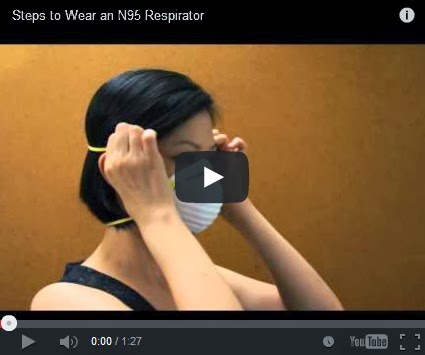
First, a short video on donning and removing an N95 respirator from Raffles Hospital in Singapore: 

NOTE: You should first be fit-tested to determine the proper N95 style that fits your face.
 

Next  from the CDC/NIOSH, a poster (suitable for framing) on using the N95 respirator (link):

image


From the San Francisco Department of Public Health, steps for putting on and removing surgical masks.

Note: Surgical masks have traditionally been used to prevent the wearer from spreading germs, and its effectiveness in protecting the wearer has been the subject of some debate.


How to Put on and Remove a Face Mask (Excerpts)


How to put on and remove a face mask

Disposable face masks should be used once and then thrown in the trash. You should also remove and replace masks when they become moist.

Always follow product instructions on use and storage of the mask, and procedures for how to put on and remove a mask.  If instructions for putting on and removing the mask are not available, then follow the steps below.

How to put on a face mask

1 Clean your hands with soap and water or hand sanitizer before touching the mask.

2 Remove a mask from the box and make sure there are no obvious tears or holes in either side of the mask.

3 Determine which side of the mask is the top. The side of the mask that has a stiff bendable edge is the top and is meant to mold to the shape of your nose.

4 Determine which side of the mask is the front. The colored side of the mask is usually the front and should face away from you, while the white side touches your face.

5 Follow the instructions below for the type of mask you are using.

  • Face Mask with Ear loops: Hold the mask by the ear loops. Place a loop around each ear.
  • Face Mask with Ties: Bring the mask to your nose level and place the ties over the crown of your head and secure with a bow.
  • Face Mask with Bands: Hold the mask in your hand with the nosepiece or top of the mask at fingertips, allowing the headbands to hang freely below hands.  Bring the mask to your nose level and pull the top strap over your head so that it rests over the crown of your head.  Pull the bottom strap over your head so that it rests at the nape of your neck.

6 Mold or pinch the stiff edge to the shape of your nose.

7 If using a face mask with ties: Then take the bottom ties, one in each hand, and secure with a bow at the nape of your neck.

8 Pull the bottom of the mask over your mouth and chin.

How to remove a face mask

1 Clean your hands with soap and water or hand sanitizer before touching the mask.

2 Avoid touching the front of the mask. The front of the mask is contaminated. Only touch the ear loops/ties/band.

3 Follow the instructions below for the type of mask you are using.

  • Face Mask with Ear loops: Hold both of the ear loops and gently lift and remove the mask.
  • Face Mask with Ties: Untie the bottom bow first then untie the top bow and pull the mask away from you as the ties are loosened.
  • Face Mask with Bands: Lift the bottom strap over your head first then pull the top strap over your head.

4 Throw the mask in the trash.

5 Clean your hands with soap and water or hand sanitizer.


While a fit-tested N95 respirator is undoubtedly more protective, N95s are far more expensive, bulky, and can be more uncomfortable to wear for extended periods of time than a surgical mask. During any major respiratory epidemic or pandemic, N95s are likely to be in very short supply as well (see Caught With Our Masks Down).


Which means, if all I had  available were surgical masks, and I was expecting to be in a potential exposure situation, I wouldn’t hesitate to use them.


As we saw last month in CDC: Infection Control Guidance For Home Care Of MERS-CoV Cases, facemasks are recommended for use (worn by either by the patient, or caregivers) in a home environment.  This advice would also apply during any major flu epidemic (including bird flu).


Which means that while supplies are ample, and prices are low, it wouldn’t be such a terrible idea to pick up a box of surgical masks to tuck away with the rest of your disaster and emergency supplies.

Friday, March 08, 2013

With Influenza Virus Particles, Size Matters

image

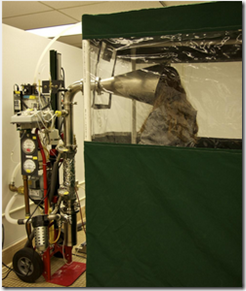
The Gesundheit II machine collects the breath exhaled from flu sufferers Credit: Donald Milton


# 6991


Another study from PloS Pathogens this morning makes a surprising discovery about the quantity of influenza virus contained in large droplets versus tiny aerosol particles, and gauges the ability of surgical masks to reduce their spread.


The study is called:

Influenza Virus Aerosols in Human Exhaled Breath: Particle Size, Culturability, and Effect of Surgical Masks

Donald K. Milton, M. Patricia Fabian equal contributor, Benjamin J. Cowling, Michael L. Grantham, James J. McDevitt equal contributor

Author Summary

The relative importance of direct and indirect contact, large droplet spray, and aerosols as modes of influenza transmission is not known but is important in devising effective interventions. Surgical facemasks worn by patients are recommended by the CDC as a means of reducing the spread of influenza in healthcare facilities.


We sought to determine the total number of viral RNA copies present in exhaled breath and cough aerosols, whether the RNA copies in fine particle aerosols represent infectious virus, and whether surgical facemasks reduce the amount of virus shed into aerosols by people infected with seasonal influenza viruses.


We found that total viral copies detected by molecular methods were 8.8 times more numerous in fine (≤5 µm) than in coarse (>5 µm) aerosol particles and that the fine particles from cases with the highest total number of viral RNA copies contained infectious virus.


Surgical masks reduced the overall number of RNA copies by 3.4 fold. These results suggest an important role for aerosols in transmission of influenza virus and that surgical facemasks worn by infected persons are potentially an effective means of limiting the spread of influenza.


The surprise here is that large droplets - long believed the the primary delivery vessel of influenza viruses - actually contained far fewer viral copies than did fine (≤5 µm) aerosol particles.


And surgical masks, when worn by someone who is infected, do a credible job of protecting others from the virus.


From the University of Maryland we get a press release with more.


UMD study provides new clues to how flu virus spreads

Shows that using a surgical mask on flu patients can reduce the release of even the smallest droplets containing infectious virus

People may more likely be exposed to the flu through airborne virus than previously thought, according to new research from the University of Maryland School of Public Health. The study also found that when flu patients wear a surgical mask, the release of virus in even the smallest airborne droplets can be significantly reduced.


"People are generally surprised to learn that scientists don't know for sure how flu spreads," says Donald Milton, M.D., Dr.P.H., who directs the Maryland Institute for Applied Environmental Health and led the study of influenza virus aerosols published in the journal PLOS Pathogens on March 7, 2013.


"Our study provides new evidence that there is nearly nine times more influenza virus present the smallest airborne droplets in the breath exhaled from those infected with flu than in the larger droplets that would be expected to carry more virus," explains Dr. Milton. "This has important implications for how we prevent the spread of flu."


Routes of flu transmission include: 1) direct or indirect (e.g., doorknobs, keyboards) contact with an infected person, 2) contact via large droplet spray from a respiratory fluid (via coughs and sneezes), and 3) inhalation of fine airborne particles, which are generated by the release of smaller, virus-containing droplets via normal breathing and coughing. The relative importance of these modes of influenza transmission has not been well understood, but is critical in devising effective interventions to protect healthcare workers and vulnerable people, such as infants and the elderly.


The Centers for Disease Control recommends that persons with influenza wear surgical masks to prevent transmission to susceptible individuals. Yet, this recommendation has been supported so far by only one study of mask impact on the containment of large droplet spray during influenza infection. Maryland's study is the first to provide data showing that using a surgical mask can reduce the release of even the smallest droplets containing infectious virus. For this reason, health care facilities should put surgical masks on those suspected of having influenza, and individuals with influenza can protect their families by wearing a mask.

Study Methods

Dr. Milton and his research team, including scientists from Harvard and Boston University Schools of Public Health and the University of Hong Kong, collected the exhaled breath from 38 flu patients and tested both the coarse (≥ 5 µm) and fine (< 5 µm) particles for the number of viruses using molecular methods. They found that the fine particles had 8.8 times more virus than the coarse particles (larger but still airborne droplets). They also tested the airborne droplets for "culturable" virus and found that virus was not only abundant in some cases, but infectious. However, there was a big range of how many viruses people put into the air – some were undetectable while others put out over 100,000 every 30 minutes.


The researchers also tested the impact of wearing a surgical mask on the virus shedding into airborne droplets. Wearing a surgical mask significantly decreased the presence of virus in airborne droplets from exhaled breath. There was a 2.8 fold reduction in the amount of virus shed into the smallest droplets, and a 3.4 fold overall reduction in virus shed in both the coarse and fine and airborne particles.


Buried mid-way through this press release is the take-home message from this study:


Maryland's study is the first to provide data showing that using a surgical mask can reduce the release of even the smallest droplets containing infectious virus.


For this reason, health care facilities should put surgical masks on those suspected of having influenza, and individuals with influenza can protect their families by wearing a mask.


The high viral load detected in fine aerosol particles may also help explain how those infected may be able to spread the influenza virus up to 24 hours before overt symptoms (fever, cough, etc.) begin to appear.


The debate over the ability of surgical masks to protect the wearer against airborne viruses remains unresolved (see Influenza Transmission, PPEs & Super Emitters), but this study provides reassurance over their value in reducing the spread of respiratory infections from the wearer to others.

Friday, March 30, 2012

Study: Aerosolized Influenza And PPEs

image

Photo Credit PHIL (Public Health Image Library)


# 6253


We’ve a new study, appearing yesterday in the journal Clinical Infectious Diseases, that once again raises questions over the effectiveness of different types of PPEs (Personal Protective Equipment) used by Health Care Workers (HCWs) in an infectious environment.


image

Ideally, the well-protected HCW (Health Care Worker) working in an infectious environment would be wearing an N95 mask, gloves, gown and eye protection.


But during the opening months of the 2009 pandemic, it became apparent that our world faced a shortage of PPEs, and so strategies were adopted to maximize their use.


In some cases nurses were issued only one N95 mask to be used for an entire 8 hour shift, and told to don it only when in direct contact with a potentially infected patient.


In other venues, HCWs were issued surgical masks in lieu of N95s, despite the recommendation at the time from the CDC that N95 masks were the preferred level of protection.


Fortunately, the virulence of the novel 2009 H1N1 virus was less than originally feared. Had the pandemic carried a higher mortality and morbidity rate, the lack of PPEs would have become a much bigger issue.


For decades, the assumption was that only properly fitted N95 masks protected the wearer, and that surgical masks were only worn by HCWs to protect the patient during invasive procedures.


image image

N-95 Respirator         Surgical mask


But in recent years we’ve seen dueling studies that alternately show surgical masks to be a reasonable protective barrier against respiratory viruses  . . . or pretty much useless.


Take your pick.


A brief tour of these conflicting reports include:


In October of 2009 the NEJM published a perspective article (see NEJM Perspective: Respiratory Protection For HCWs) based on a 2009 IOM evaluation of surgical masks vs. respirators, and came out in favor of the N95.


A few days later JAMA (Journal of the American Medical Association) published a study which reported that HCWs using surgical masks experienced `noninferior rates of laboratory-confirmed influenza’.


In March of 2010, we saw the following study (see Study: Efficacy of Facemasks Vs. Respirators) in Clinical Infectious Diseases, that suggested that surgical masks are just as effective as respirators in protecting HCWs.


In guidance, updated as late as March of 2010, the CDC continued to recommend N95 respirators for HCWs who came in close contact with suspected or confirmed influenza patients.


But in June of 2010, the CDC proposed new guidance that relaxed those recommendations to using surgical masks for routine care, and reserving N95 masks for aerosol producing procedures (intubation, suctioning, etc).


Still, the controversy remains. 


Adding to the confusion, we’ve seen recent studies that give more credence to the notion that influenza may be spread in aerosolized form (see Study: Aerosolized Transmission Of Influenza), as opposed to primarily by large droplets, and may also be contracted via the transocular route.


Our knowledge of how influenza spreads, and what barriers work well to protect HCWs, remains limited.


All of which serves as prelude to this new study, that simulates the aerosolization of influenza viruses and measured the protective qualities of surgical masks and respirators by constructing a simulated  exam room using `coughing and breathing manikins’.


Although the full paper is behind a pay wall, we can get a pretty good idea of the study’s content from the abstract.


Detection of Infectious Influenza Virus in Cough Aerosols Generated in a Simulated Patient Examination Room

John D. Noti, William G. Lindsley, Francoise M. Blachere, Gang Cao, Michael L. Kashon, Robert E. Thewlis, Cynthia M. McMillen, William P. King, Jonathan V. Szalajda, and Donald H. Beezhold

ABSTRACT (Excerpts)

Methods. National Institute for Occupational Safety and Health aerosol samplers collected size-fractionated aerosols for 60 minutes at the mouth of the breathing manikin, beside the mouth, and at 3 other locations in the room. Total recovered virus was quantitated by quantitative polymerase chain reaction and infectivity was determined by the viral plaque assay and an enhanced infectivity assay.

Results. Infectious influenza was recovered in all aerosol fractions (5.0% in >4 μm aerodynamic diameter, 75.5% in 1–4 μm, and 19.5% in <1 μm; n = 5). Tightly sealing a mask to the face blocked entry of 94.5% of total virus and 94.8% of infectious virus (n = 3). A tightly sealed respirator blocked 99.8% of total virus and 99.6% of infectious virus (n = 3). A poorly fitted respirator blocked 64.5% of total virus and 66.5% of infectious virus (n = 3). A mask documented to be loosely fitting by a PortaCount fit tester, to simulate how masks are worn by healthcare workers, blocked entry of 68.5% of total virus and 56.6% of infectious virus (n = 2).

Conclusions. These results support a role for aerosol transmission and represent the first reported laboratory study of the efficacy of masks and respirators in blocking inhalation of influenza in aerosols. The results indicate that a poorly fitted respirator performs no better than a loosely fitting mask.


The results here are fascinating.


First, this study provides more evidence of the role of aerosolized virus particles in the transmission of influenza. Important because these particles can stay aloft and viable for some time, and spread further than large droplets can.


From a more practical standpoint, the big revelation is that a surgical mask, as normally worn by HCWs, only blocked 56.6% of infectious virus particles.


But . . . if you tightly seal the surgical mask against the face , you can achieve a level of protection approaching that of a well fitted N95 respirator (94.8% versus 99.6%).


And a poorly fitted N-95 respirator provided little more protection (66.5%) than a loosely fitted surgical mask.


This study will no doubt add further fuel to the debate over what constitutes appropriate PPEs for healthcare workers during a pandemic.


For the rest of us, the takeaway message here is that surgical masks (which are much cheaper, and easier to stockpile) appear to provide a reasonable level of protection against aerosolized influenza viruses when tightly sealed against the face.


Which means, I suppose, that now I need to think about beefing up my supply of paper surgical tape.

Tuesday, August 31, 2010

Another Mask Study To Ponder


# 4853


Long-time readers of this blog are aware of a number of conflicting studies that have come out in recent years regarding the relative efficacy of surgical masks and N95 respirators in protecting HCWs (Health Care Workers) against airborne infections.


For decades, the assumption was that only properly fitted N95 masks protected the wearer, and that surgical masks were worn by HCWs to protect the patient during invasive procedures.


image image

N-95 Respirator         Surgical Facemask


Last year, during the summer outbreak of pandemic H1N1, many hospitals citing shortages of N95 masks, opted to equip their nurses with surgical masks instead. 


This went against the recommended infection control guidelines issued by the CDC at the time, but was supported by several major infectious disease professional organizations.


This resulted in numerous protests last fall by nurses and other care givers, as I reported in:


CNA/NNOC Plan Protest Over Inadequate H1N1 Protection


(Photo from CNA/NNOC Webpage)


Since then, we’ve seen several `semi-reassuring’ studies that suggested that surgical masks are acceptable protection.


In October the NEJM published a perspective article (see NEJM Perspective: Respiratory Protection For HCWs) based on the recent IOM evaluation of surgical masks vs. respirators, and reiterated the advice:


Until more data are available, the committee recommends that clinicians reach for the N95 respirator when confronting patients with influenza-like illnesses, particularly in enclosed spaces.


A few days later JAMA (Journal of the American Medical Association) published a study which reported that HCWs using surgical masks experienced `noninferior rates of laboratory-confirmed influenza’.

In March of this year, we saw the following study (see Study: Efficacy of Facemasks Vs. Respirators).


Study finds surgical masks provided effective protection of health-care workers against H1N1

The effectiveness of ordinary surgical masks as opposed to respirators in protecting health care workers against the 2009 H1N1 influenza virus has been the subject of debate. An observational study published in the April 1, 2010 issue of Clinical Infectious Diseases, available online, suggests that surgical masks are just as effective as respirators in this regard.


The evidence over the winter, it seemed, was largely supportive of the notion that surgical masks were adequate protection against influenza viruses.


So in June of this year, the CDC released revised infection control guidance proposals which relaxed their previous recommendations to the allowing of surgical masks for routine care, and reserving N95 masks for aerosol producing procedures (intubation, suctioning, etc).


CDC: Proposed Influenza Infection Control Guidance


To complicate matters, however - after these studies suggested that surgical masks are reasonably protective against influenza - we now get a new study that questions whether surgical masks or N95 respirators provide any substantial protection to the wearer at all.


No . . .  I don’t make these things up.  I just report on them.


The study appears in the September issue of the AJIC (American Journal of Infection Control), and is titled:


Quantifying exposure risk: Surgical masks and respirators

Keith T. Diaz, MD, Gerald C. Smaldone, MD, PhD


These researchers (using mannequins fitted with a variety of masks, and using radiolabeled wet aerosols) determined that wearing surgical masks and N95 masks without an airtight (Vaseline) seal provided little more protection than wearing no mask at all.


They did find that placing a surgical mask on an infected source (patient) could significantly reduce the spread of a virus to the environment.


Since only the abstract is freely available, it is helpful that the SurgiStrategies website has posted a summary of these findings.  


A hat tip to Tetano on FluTrackers for passing along this link.


AJIC Releases New Study on Face Masks and H1N1


The authors of this review quote the researchers as stating the type of mask (N95 vs Surgical) “does not play a significant role in reducing exposure to the recipient unless a respirator is physically sealed to the face of the source."


While obviously not the last word on the subject, the issue of just how protective various types of masks are to the wearer has just gotten a bit more murky.


Obviously, we will await the next mask efficacy study with considerable interest. In the meantime, I guess I’d better check my supply of Vaseline.

Friday, March 26, 2010

Study: Efficacy of Facemasks Vs. Respirators


# 4462


For decades the assumption by just about everyone – from OSHA to the CDC, to medical professionals – has been that surgical facemasks did little to protect the wearer.   Surgical masks were designed to contain the wearer’s germs and protect those around them, not the other way around.


If you wanted to protect yourself against respiratory viruses, you needed to wear a properly fitted N-95 (or better) respirator.


image image

N-95 Respirator               Surgical Facemask


Using an N-95 respirator is problematic on a number of fronts, however. 


  • They are uncomfortable to wear for long periods of time. 
  • They saturate with exhaled moisture relatively quickly, and must be changed out every couple of hours. 
  • The must be fit tested for each wearer
  • The are 10 times more expensive than surgical masks.  
  • And our national supply of N-95s is totally inadequate to supply Health Care Workers during a prolonged pandemic wave.

Despite these limitations, many HCWs (Health Care Workers) have demanded that they be afforded the extra protection of N95 respirators when dealing with pandemic flu cases.


Indeed, the CDC’s  pandemic infection control guidelines  (updated March 10th) continue to recommend:

For the purposes of this document, close contact is defined as working within 6 feet of the patient or entering into a small enclosed airspace shared with the patient (e.g., average patient room):


Respiratory Protection –


Recommendation: CDC continues to recommend the use of respiratory protection that is at least as protective as a fit-tested disposable N95 respirator for healthcare personnel who are in close contact with patients with suspected or confirmed 2009 H1N1 influenza. This recommendation applies uniquely to the special circumstances of the current 2009 H1N1 pandemic during the fall and winter of 2009-2010 and CDC will continue to revisit its guidance as new information becomes available, within this season if necessary.


Masks and respirators, the CDC stresses, are the last line of defense in a health care facility.  And they make allowances for supply problems as well, saying that respirators may be prioritized for higher risk aerosol producing procedures.


The CDC’s stance, however, isn’t universally accepted or followed.  These are recommendations, after all, not mandates. 


Many hospitals have opted to use surgical masks as a matter of routine, except when performing aerosol producing procedures.  And this has caused no small amount of controversy in the healthcare profession.


The Respirator Controversy Continues
A Surgical Mask Strike
IOM Recommends N95s For HCWs


In a major turnaround, over the past few months we’ve seen a series of studies that suggest that surgical masks may be `non-inferior’ to N95 masks, or that they provide a similar level of protection as the more expensive respirator.


Most of these are observational studies, and as such, may be open to some criticism.   Health care workers do not work, and live, in a vacuum.  Controlling (or quantifying) the effects of non-patient (community) exposure to respiratory viruses becomes a real challenge.


Today we’ve another such study, that suggests that inexpensive facemasks may be more effective than previously thought in protecting against the H1N1 virus.


First the press release, then a link to the study.


Study finds surgical masks provided effective protection of health-care workers against H1N1

The effectiveness of ordinary surgical masks as opposed to respirators in protecting health care workers against the 2009 H1N1 influenza virus has been the subject of debate. An observational study published in the April 1, 2010 issue of Clinical Infectious Diseases, available online, suggests that surgical masks are just as effective as respirators in this regard.


Researchers analyzed the incidence of H1N1 among health care workers from April through August of 2009 at Tan Tock Seng Hospital in Singapore. A small percentage tested positive for H1N1 during this period. None had cared for any patients with H1N1 or worked in H1N1 screening areas of the emergency room. In all cases, transmission was believed to have occurred outside of patient care, when health care workers were in contact with roommates, the general public, and other sources.


From June 19 to July 21, health care workers at the hospital wore N95 respirators in the emergency room and an H1N1 isolation area. From July 22 to Aug. 31, surgical masks were used by workers in these areas. The incidence of H1N1 among workers remained low during both periods. Although the study was observational, the findings suggest that surgical masks and respirators did not differ in their effectiveness in preventing hospital staff from acquiring H1N1.


"What is more important than using high-filtration or respirator masks for known or suspected cases is to have a uniform policy, such as using surgical masks, when in close contact with all patients," said study author Brenda Sze Peng Ang, MD, of the Tan Tock Seng Hospital in Singapore. "This way, health care workers are protected from getting infected by patients not initially thought to have H1N1."

Here is the link to the journal article, with a few choice excerpts.  If you are in the Health Care field, you will probably want to read this in its entirety.


DOI: 10.1086/651159

BRIEF REPORT

Surgical Masks for Protection of Health Care Personnel against Pandemic Novel Swine‐Origin Influenza A (H1N1)–2009: Results from an Observational Study

Brenda Ang,Bee Fong Poh, Mar Kyaw Win, and Angela Chow

There is ongoing debate about the efficacy of surgical masks versus N95 respirators for protection against pandemic novel swine‐origin influenza A (H1N1)–2009. Our hospital, which is designated to manage outbreaks of emerging infection, has robust surveillance systems to detect infection in staff. The incidence of pandemic H1N1‐2009 remained low in staff with use of surgical masks.


<SNIP>


Discussion. Although this is an observational study, nonetheless our findings show that surgical masks and N95 respirators do not appear to differ in efficacy in the prevention of the acquisition of pH1N1 by staff. Our findings also highlight the importance of a robust HCW surveillance system for the detection of nosocomial transmission of pathogens, including novel pathogens.


<SNIP>

Conclusion. Our surveillance systems were effective in detecting infection among HCWs. None of the HCWs who cared for pH1N1 patients acquired infection from them. Those HCWs who did acquire pH1N1 appeared to have been infected from community exposure or in social settings with colleagues. The incidence of pH1N1 remained low in exposed staff, even when staff used surgical masks.


We are still some ways off from having a complete understanding of the relative efficacy of surgical masks vs. N95 respirators.


Definitive answers are notoriously hard to come by.


We were, in retrospect, very lucky that H1N1 proved to have a lower R0 (reproductive number) than originally feared.  That limited transmission. H1N1 also produced lower than expected mortality rates.


Again, a stroke of luck. 


Had this been a highly lethal H5 avian virus, or even a SARS-like virus, the clamor for the greater perceived protection afforded by N95 masks would have been overwhelming.


And our supply would have been exhausted in a matter of weeks.


So it would indeed be good news if surgical masks turn out to be equally protective against respiratory viruses as are fit-tested N95 respirators.  


They are cheaper, easier to wear, and in far more abundant supply.


But for that to be accepted by HCWs – particularly in the face of a dangerous pathogen – more convincing studies are going to be needed. Decades of practice and teaching are not easily swept aside. 


Hopefully we’ll get better answers to all this before the next pandemic arrives.

Thursday, October 01, 2009

JAMA: Surgical Masks vs N95 Respirators


# 3791


Just two weeks after Raina MacIntyre, head of public health at the University of New South Wales in Sydney, presented evidence at the ICAAC conference on the lack of protection offered by surgical facemasks (see A Surgical Mask Strike) we get another study, that this time seems to support the notion that surgical masks may offer protection against influenza infection.


Given the reported shortage of N95 masks and reluctance of some health care workers to wear them for long periods of time, many health care facilities would like to move to the less expensive and easier to obtain surgical mask for staff not performing aerosol generating procedures on influenza patients.


Yesterday the NEJM published a perspective article (see NEJM Perspective: Respiratory Protection For HCWs) based on the recent IOM evaluation of surgical masks vs. respirators, and reiterated the advice:


Until more data are available, the committee recommends that clinicians reach for the N95 respirator when confronting patients with influenza-like illnesses, particularly in enclosed spaces.


Today JAMA (Journal of the American Medical Association) published a study which reports that HCWs using surgical masks experienced `noninferior rates of laboratory-confirmed influenza’.


The major implication here, according to the authors, is that surgical masks provide similar protection to N95 respirators in a routine health care setting.  

The authors acknowledge certain limitations to their study, including an inability to determine whether those participants who became infected contracted influenza in the workplace, at home, or in the greater community. They believe that such exposures were balanced between both groups, however.


Obviously we are some distance away from reaching a consensus on this issue.   


Here is a link, and excerpts, from the study’s abstract.


Surgical Mask vs N95 Respirator for Preventing Influenza Among Health Care Workers

A Randomized Trial

Mark Loeb, MD, MSc; Nancy Dafoe, RN; James Mahony, PhD; Michael John, MD; Alicia Sarabia, MD; Verne Glavin, MD; Richard Webby, PhD; Marek Smieja, MD; David J. D. Earn, PhD; Sylvia Chong, BSc; Ashley Webb, BS; Stephen D. Walter, PhD

JAMA. 2009;302(17):(doi:10.1001/jama.2009.1466).


Results Between September 23, 2008, and December 8, 2008, 478 nurses were assessed for eligibility and 446 nurses were enrolled and randomly assigned the intervention; 225 were allocated to receive surgical masks and 221 to N95 respirators.
Influenza infection occurred in 50 nurses (23.6%) in the surgical mask group and in 48 (22.9%) in the N95 respirator group (absolute risk difference, –0.73%; 95% CI, –8.8% to 7.3%; P = .86), the lower confidence limit being inside the noninferiority limit of –9%.


Conclusion Among nurses in Ontario tertiary care hospitals, use of a surgical mask compared with an N95 respirator resulted in noninferior rates of laboratory-confirmed influenza.


The link to the entire article is:

Surgical Mask vs N95 Respirator for Preventing Influenza Among Health Care Workers Published October 1, 2009.


A hat tip to Ironorehopper on Flutrackers for posting this link.