Showing posts with label waves. Show all posts

Tuesday, May 25, 2010

Study: Prior Immunity And Pandemic Waves


# 4595


One of the great mysteries about influenza pandemics is why illness seems to come in waves, sometimes separated by months with little or no flu activity. 


The 1918 pandemic appeared in many regions as three separate waves.  A milder wave during the spring and summer of 1918, followed by an intense and very deadly wave in the fall, and  a return of the following spring. 


image

The progression of the Spanish Flu in the UK, in 1918-1919.


Again in 1957, and in 1968, we saw pandemic influenza come in repeated waves, but the exact reason why the virus should flare, infect some – but not all – then recede for months only to return,  has never been adequately explained.


Today from BMC Infectious Diseases we get this open access research articles where the authors postulate that pre-existing immunity from exposure to previous influenza’s may have been partially protective to selected (largely urban) populations during the 1918 pandemic, which may help explain the wave phenomenon.


Here is the abstract, and this link will take you to the provisional PDF. 


Prior immunity helps to explain wave-like behaviour of pandemic influenza in 1918-9

John D Mathews , Emma S McBryde , Jodie McVernon , Paul K Pallaghy  and James M McCaw

BMC Infectious Diseases 2010, 10:128doi:10.1186/1471-2334-10-128

Published:
25 May 2010

Abstract (provisional)
Background

The ecology of influenza may be more complex than is usually assumed. For example, despite multiple waves in the influenza pandemic of 1918-19, many people in urban locations were apparently unaffected. Were they unexposed, or protected by pre-existing cross-immunity in the first wave, by acquired immunity in later waves, or were their infections asymptomatic?

Methods

We modelled all these possibilities to estimate parameters to best explain patterns of repeat attacks in 24,706 individuals potentially exposed to summer, autumn and winter waves in 12 English populations during the 1918-9 pandemic.

Results

Before the summer wave, we estimated that only 52% of persons (95% credibility estimates 41-66%) were susceptible, with the remainder protected by prior immunity. Most people were exposed, as virus transmissibility was high with R0 credibility estimates of 3.10-6.74. Because of prior immunity, estimates of effective R at the start of the summer wave were lower at 1.57-3.96. Only 25-66% of exposed and susceptible persons reported symptoms. After each wave, 33-65% of protected persons became susceptible again before the next wave through waning immunity or antigenic drift. Estimated rates of prior immunity were less in younger populations (19-59%) than in adult populations (38-66%), and tended to lapse more frequently in the young (49-92%) than in adults (34-76%).

Conclusions

Our model for pandemic influenza in 1918-9 suggests that pre-existing immune protection, presumably induced by prior exposure to seasonal influenza, may have limited the pandemic attack-rate in urban populations, while the waning of that protection likely contributed to recurrence of pandemic waves in exposed cities. In contrast, in isolated populations, pandemic attack rates in 1918-9 were much higher than in cities, presumably because prior immunity was less in populations with infrequent prior exposure to seasonal influenza.


Although these conclusions cannot be verified by direct measurements of historical immune mechanisms, our modelling inferences from 1918-9 suggest that the spread of the influenza A (H1N1) 2009 pandemic has also been limited by immunity from prior exposure to seasonal influenza. Components of that immunity, which are measurable, may be short-lived, and not necessarily correlated with levels of HI antibody.

Thursday, December 10, 2009

Butler-Jones: Flu Threat Not Over


# 4143


Every time a hurricane approaches the coastline, the weather bureau warns residents not to be fooled by a lull in the storm caused by the eye passing overhead.  The storm winds could return from the opposite direction as fiercely as before.


While pandemics don’t have a calm eye like hurricanes, they do tend to come in waves.   And the lull in between waves can lead some to believe the pandemic is over when it isn’t.


image

In 1918 there were two deep lulls between the three pandemic waves.    And in the decade that was to follow, there were repeated flare ups of virulent influenza.


The graph below comes from:

REVIEW AND STUDY OF ILLNESS AND MEDICAL CARE WITH SPECIAL REFERENCE TO LONG-TIME TRENDS
Public Health Monograph No. 48, 1957 (Public Health Service Publication No. 544)

image


And it shows the spikes of influenza in the United States in the decade following the 1918 pandemic.    Similar reports came from around the world.


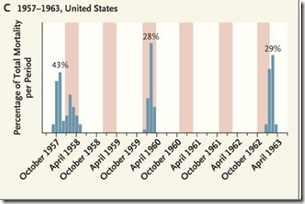
And in 1957, the Asian Flu pandemic seemed to disappear completely for more than a year, only to return in 1959 and again after a two year lull during the 1962-63 flu season.  


image

NEJM 2009


When a sufficient percentage of the population develops (herd) immunity (or a virus mutates to something less `fit’), a pandemic winds down. 


Case levels drop below the epidemic threshold, and the pandemic is declared to be `over’.


Viruses are notoriously unstable, and mutate constantly, and can learn to evade acquired immunity. Even years after a pandemic is over, the responsible virus can flare up in some localities, and cause significant morbidity and mortality.


The recent drop in reported infections here in the US and in Canada has led many to believe the pandemic of 2009 is almost over.   That there is no longer a need to get vaccinated.


Maybe we get lucky, and the worst is over.  Hopefully that’s true.  But history tells us, you have to look back from a distance to know when a pandemic really ended.  


This reminder from Canada’s chief public health officer, Dr. David Butler-Jones.


Top doc: Flu threat not over


By CHRISTINA SPENCER, NATIONAL BUREAU

Last Updated: 10th December 2009, 5:13am

OTTAWA -- Critics are off-base to suggest the worst of the H1N1 pandemic is over or that vaccination is no longer needed, Canada's chief public health officer says.


Between 30% and 40% of Canadians have been immunized for H1N1, Dr. David Butler-Jones told reporters yesterday, but he still wants millions more to get the shot.


"Unfortunately, there are Canadians who are denying themselves the benefits of immunization because they believe that we've reached a critical mass of our population with immunity," he said.


"I question that logic. The whole point of medical and public health efforts is to improve health and reduce illness and suffering."


TV CAMPAIGN


The Public Health Agency of Canada plans a TV campaign to convince Canadians they should still get the shot. Despite statistics showing a continued slowdown in flu activity in Canada, Butler-Jones said it would be "imprudent to declare a peak."

(Continue . . .)

Friday, October 09, 2009

WHO: Pandemic Level May Remain For Years


# 3818


Anyone expecting the pandemic of 2009 to be over in 2009 (or probably even 2010) is setting themselves up for a big disappointment. 


At least that’s the message today from the WHO (World Health Organization).


The novel H1N1 virus is almost certainly here to stay for a while as it travels around the globe, and if previous pandemics are any indication, won’t settle into becoming a `seasonal flu’ for a year or two.


Maybe longer.


First, this report from Reuters on the WHO pandemic statement today, then a look at some previous pandemics.


Could take years to lower pandemic alert level – WHO


Fri Oct 9, 2009 11:06am EDT

* Pandemic flu could become seasonal-like virus in 2-3 years

* Spread slows with rising immunity from exposure, vaccines * "No indication" of slowdown so far, nor any big mutations

By Laura MacInnis

GENEVA, Oct 9 (Reuters) - It could take years for the World Health Organisation to downgrade the H1N1 flu from a pandemic to seasonal-like virus, the U.N. agency said on Friday.


The WHO moved its six-point pandemic alert level to the top rung in June  in response to the spread of the new virus widely known as swine flu, which has killed at least 4,500 people, especially in North America.


WHO spokesman Gregory Hartl said that health warning would stay in place until people can better fend off infection from the H1N1 strain.


"At some point in the future, there would be a recognition of the fact that if it's no longer circulating on a sustainable basis in communities. Then you would lower the pandemic level," he said, while stressing: "There is absolutely no indication yet of that happening."

(Continue . . .)


The next three graphs come from NEJM (The Signature Features of Influenza Pandemics ) and demonstrate just how variable pandemics can be.  


The 1918 pandemic lasted about 18 months (although outbreaks with higher than normal mortality persisted for years), while the 1957 pandemic produced 3 distinct waves over a 5 year period of time.


No doubt, when November and December rolled around in 1958 and flu levels were normal, most scientists thought the pandemic was over.  It literally skipped the 1958-59 flu season before returning in 1960.  It then went quiescent again until the 1962-63 flu season, when it flared back up again.


image

image


image


Which is why scientists caution that if you’ve seen one pandemic . . . you’ve seen one pandemic.


The world is a different place than it was in 1918, or even 1957 or 1968.  We travel far more often, and go farther and faster than ever before.   How this will affect the spread of the virus is hard to say.


But no one should plan on seeing this virus disappear anytime soon, or for it to slip into a quasi-comfortable seasonal flu role.  It may very well pick up antigenic changes along the way, rendering this year’s immunity (either from catching the virus, or the vaccine)obsolete by next fall.


In other words, this is apt to be a prolonged journey.


Welcome to the `flu normal’