Tuesday, February 28, 2023

USDA Update On H5N1 In Mammalian Wildlife & Wild Birds


#17,320

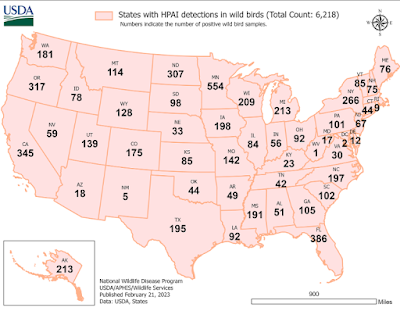
With the dual caveats that many birds and mammals die in remote and difficult to access places, and are never discovered or tested - and some states appear to be more proactive in investigating outbreaks than others - we have the latest update from the USDA on wild bird die offs from H5N1, and spillover into mammalian wildlife. 


Since their last update 3 weeks ago, the USDA has added 10 additional mammalian infections with H5N1, with the bulk of those (n=7) coming from Colorado (note: only 9 shown in the list below).  Species include bobcat (n=2), red fox (n=2 ), mountain lion (n=3 ), skunk (n=1) and American Black bear (n=2).


With the lone exception of a single infected Bottlenose Dolphin in Florida, all of the reports of mammalian infection have come from the northern tier of states.

While this may be due to more mammalian adapted strains circulating in those regions (see Preprint: Rapid Evolution of A(H5N1) Influenza Viruses After Intercontinental Spread to North America), it may also come down to differences in climate and terrain (swamps vs. forests vs. deserts), and the fact that some states may be looking harder than others.

Peridomestic mammals, like red foxes and skunks, remain the most commonly reported terrestrial mammals infected, although we are seeing an increasing number of big cats and bears being infected in recent months.

While the full extent of H5N1's impact on wildlife is unknown, we are likely seeing only the tip of the iceberg.  

So far, unlike with SARS-CoV-2 in deer, we haven't seen signs of H5N1 transmitting efficiently in mammalian wildlife (possible, but unproven exceptions are in marine mammals). But once again, surveillance is extremely limited. 

For more on the risks from avian flu spilling over into wildlife, you may wish to revisit:


COCA Call Today (Feb 28th): Extensively Drug-Resistant Shigellosis


#17,319

Last Friday the CDC released a HAN (Health Alert Network) Advisory (see below) on the recent rise in Extensively-Drug-Resistant Shigellosis in the United States.  Today, about 1 in 20 Shigella infections in the United States is classified as XDR, while a decade ago, it was virtually unheard of. 

Increase in Extensively Drug-Resistant Shigellosis in the United States
Distributed via the CDC Health Alert Network
February 24, 2023, 11:30 AM ET
CDCHAN-00486

Summary
The Centers for Disease Control and Prevention (CDC) has been monitoring an increase in extensively drug-resistant (XDR) Shigella infections (shigellosis) reported through national surveillance systems [1]. In 2022, about 5% of Shigella infections reported to CDC were caused by XDR strains, compared with 0% in 2015. Clinicians treating patients infected with XDR strains have limited antimicrobial treatment options. Shigella bacteria are easily transmissible. XDR Shigella strains can spread antimicrobial resistance genes to other enteric bacteria. Given these potentially serious public health concerns, CDC asks healthcare professionals to be vigilant about suspecting and reporting cases of XDR Shigella infection to their local or state health department and educating patients and communities at increased risk about prevention and transmission.

Shigellosis is an acute enteric infection that is an important cause of domestically acquired and travel-associated bacterial diarrhea in the United States. Shigellosis usually causes inflammatory diarrhea that can be bloody and may also lead to fever, abdominal cramping, and tenesmus. Infections are generally self-limiting; however, antimicrobial treatment may be indicated to prevent complications or shorten the duration of illness [2]. CDC defines XDR Shigella bacteria as strains that are resistant to all commonly recommended empiric and alternative antibiotics azithromycin, ciprofloxacin, ceftriaxone, trimethoprim-sulfamethoxazole (TMP-SMX), and ampicillin.
Currently, there are no data from clinical studies of treatment of XDR Shigella to inform recommendations for the optimal antimicrobial treatment of these infections. As such, CDC does not have recommendations for optimal antimicrobial treatment of XDR Shigella infections.

          (Continue . . . . )


Later today the CDC will hold an online COCA Call for clinicians on this growing concern. These presentations are often technical, and are of greatest interest to clinicians and healthcare providers, but also may be of interest to the general public.

As always, If you are unable to attend the live presentation, these (and past) webinars are archived and available for later viewing at this LINK.


Epidemiology, Testing, and Management of Extensively Drug-Resistant Shigellosis 

Overview

The Centers for Disease Control and Prevention (CDC) has detected an increase in extensively drug-resistant (XDR) Shigella infections (shigellosis) reported through national surveillance systems. XDR shigellosis is resistant to all generally recommended antibiotics in the United States, making it difficult to treat. XDR shigellosis is a serious public health threat: XDR Shigella bacteria have limited antimicrobial treatment options, are easily transmissible, and can spread antimicrobial resistance genes to other enteric bacteria. Clinicians should understand the nuances of testing and managing infections, especially when treating patients from populations at increased risk of drug-resistant shigellosis including: young children; gay, bisexual, and other men who have sex with men; people experiencing homelessness; international travelers; and people living with HIV.

During this COCA Call, subject matter experts from CDC, the Colorado Department of Public Health and Environment, and the UK Health Security Agency will provide updates on the current domestic and global epidemiology of XDR shigellosis, discuss its relevance for clinicians in the United States, describe infection presentation, explain the importance of having a detailed sexual and travel history, share approaches for clinical management, and review how clinicians should test and report shigellosis.

Presenters

Naeemah Logan, MD
LCDR, U.S. Public Health Service
Medical Officer
National Antimicrobial Resistance Monitoring System for Enteric Bacteria (NARMS) Team
Division of Foodborne, Waterborne, and Environmental Diseases
National Center for Emerging and Zoonotic Infectious Diseases
Centers for Disease Control and Prevention

Meseret Birhane, MPH, MAS

Surveillance Epidemiologist
National Antimicrobial Resistance Monitoring System for Enteric Bacteria (NARMS) Team
Division of Foodborne, Waterborne, and Environmental Diseases
National Center for Emerging and Zoonotic Infectious Diseases
Centers for Disease Control and Prevention

Louise Francois Watkins, MD, MPH
Medical Officer
National Antimicrobial Resistance Monitoring System for Enteric Bacteria (NARMS) Team
Division of Foodborne, Waterborne, and Environmental Diseases
National Center for Emerging and Zoonotic Infectious Diseases
Centers for Disease Control and Prevention

Laura Hinkle Bachmann, MD, MPH, FIDSA, FACP
Chief Medical Officer
Division of STD Prevention
National Center for HIV, Viral Hepatitis, STD, and TB Prevention
Centers for Disease Control and Prevention

Rachel Jervis, MPH
Program Manager
Foodborne, Enteric, Waterborne, and Wastewater Diseases Program
Colorado Department of Public Health and Environment

Gauri Godbole, MD, FRCPath

Consultant Medical Microbiologist
UK Health Security Agency

Hannah Charles, MSc, DFPH
Senior Epidemiologist
UK Health Security Agency

Call Materials

Materials will be available prior to the webinar.
Call Details

When:
Tuesday, February 28, 2023,
2:00 PM – 3:00 PM ET


Webinar Link:
https://www.zoomgov.com/j/1609840852

Webinar ID: 160 984 0852

Passcode: 204251

Telephone:
US: +1 669 254 5252 or +1 646 828 7666
or
+1 646 964 1167 or +1 669 216 1590
or
+1 415 449 4000 or +1 551 285 1373

One-tap mobile:
US: +16692545252,,1609840852#,,,,*204251#
or +16468287666,,1609840852#,,,,*

Denmark SSI: Low to Moderate Risk of Human Infection With Bird Flu From Mink


#17,318

Last October Spain reported a large outbreak of avian flu at a mink farm (Spain: Avian H5N1 Spillover Into Farmed Mink), which was followed up in January by a Eurosurveillance report that found evidence of a rare mammalian adaptation - (T271A), which `enhances the polymerase activity of influenza A viruses in mammalian host cells and mice' - in the virus.

Elsewhere, over the past 18 months we've seen a growing number of spillovers of H5N1 into both terrestrial and aquatic mammals, sometimes producing large die offs (see Peru Reports At Least 585 Sea Lions killed by Avian Flu). 

While still primarily adapted to birds, the concern is that over time, the virus could better adapt to mammals (including humans), increasing its pandemic threat. How likely that is to happen is unknown. 

Farmed mink are members of the Mustelidae family of carnivorous mammals, which also includes otters, badgers, weasel, martens, ferrets, and wolverines, many of which are susceptible to both influenza, and more recently SARS-CoV-2.  

We reviewed this history most recently in That Touch of Mink Flu (2023 Edition), with reports going back nearly 40 years. 

In late 2020 Danish authorities were alarmed when they discovered several mutated strains of COVID-19 had arisen in farmed mink and had transmitted to humans (see Denmark Orders Culling Of All Mink Following Discovery Of Mutated Coronavirus).

This emergency was relatively short-lived, as the Alpha variant emerged in Europe in late 2020 and quickly supplanted these mink-variants. But it did illustrate the problem; carriage of SARS-CoV-2 by other host species can produce new variants, which can jump back into humans.

While Denmark temporarily banned the commercial raising of mink following that incident, that ban expired on January 1st, 2023, although the government expects `significantly reduced' mink production going forward. 

Today Denmark's SSI, along with the Danish Veterinary Consortium, has published a 19-page risk assessment on the risks of HPAI H5N1 in farmed mink.  While it is published in Danish, I've (machine) translated some excerpts below. 

While generally reassuring, you'll note that their confidence level for a number of their conclusions is low. 

First the brief announcement from the SSI:

Low to moderate risk of infection with bird flu from mink to humans

In connection with a new risk assessment on the likelihood of Danish mink becoming infected with bird flu, the Statens Serum Institute has also assessed the risk of a potential infection among mink being transferred to humans.
Last edited on February 28, 2023

SSI assesses that the risk of infection to humans from mink is low to moderate in the event of exposure to infected mink. This assessment is in line with assessments from ECDC and WHO.

The risk of humans becoming infected is greatest if the virus spreads between mink. Early detection of viruses in mink and humans is essential to reduce the overall health risk.

In addition, the mink breeders can protect themselves and limit the risk of infection from mink with bird flu by using masks, washing hands and changing clothes before entering and leaving the farms, as they must in advance to avoid infection with covid- 19.

Read the risk assessment from the Danish Veterinary Consortium


(Translated Excerpts)
 Summary

An infection of mink with highly pathogenic avian influenza (HPAI) subtype H5N1 has been confirmed, with subsequent signs of infection spreading among the mink on a mink farm in Spain in October 2022. HPAI is notifiable in Denmark if the disease is suspected in all animals, thus also in mink. In this connection, the Danish Veterinary and Food Administration must decide on the further handling of HPAI in relation to the recently resumed mink production in Denmark. For this purpose, the Danish Veterinary and Food Administration has requested the Danish Veterinary Consortium's (DK-VET's) assessment of a number of issues arising from the Spanish outbreak. DK-VET's experts have reviewed the available evidence and carried out a qualitative risk assessment with contributions from the human area at Statens Serum Institut (SSI).

There is limited knowledge about the occurrence and course of HPAI virus infections in mink. DK-VET assesses that the probability of introduction of HPAI in Danish mink primarily depends on the occurrence of HPAI in the wild birds in the area in question and will therefore vary over the year. The occurrence of HPAI in wild birds is usually highest in the winter, although in recent years HPAI has been detected in wild birds all year round. Furthermore, the risk for the individual farm will depend on the layout, size and location. For farms located close to areas where there are many wild birds and which consist of open halls where there is access for wild birds, the risk of infection of Danish mink with HPAI is generally assessed to be unlikely (1-10 % ) (cf. EFSA criteria) during periods of high HPAI activity in wild birds. For farms with a high level of infection protection, where there is limited access for wild birds, and for all farms in periods of the year with low HPAI activity in wild birds, the risk is assessed to be extremely unlikely (0.001-0.1%) (cf. EFSA criteria).

These estimates represent respectively the highest and lowest probability for the individual farm, but there will be farms where the probability of infection lies between the two estimates. The highest probability is estimated to be in the period October-November. Import of mink from abroad is considered to pose a lower risk of introduction of HPAI to Danish mink compared to the probability of mink being infected with HPAI from birds in Denmark.

The greatest risk of infection of mink with the HPAI virus is estimated to be through direct or indirect contact with infected wild birds, including seagulls. The hygienic infection prevention measures introduced to limit the risk of SARS-CoV-2 infection of mink from humans and the environment will also contribute to reducing the risk of introduction of the HPAI virus in mink and may contribute to reducing the risk of infection by humans in the event that mink become infected with the HPAI virus. However, this is on the condition that the infection prevention measures are all implemented and that there is full compliance. Specific measures in herds, which are established with a view to reducing the probability of wild birds and other wild animals coming into direct and indirect contact with the minks, will help to reduce the probability of introduction of the HPAI virus.

It is assessed that the risk of infection to humans from mink is low to moderate (cf. ECDC criteria) in the event that there is exposure to HPAI-infected mink. The risk of people becoming infected is greatest if the virus spreads between mink on the farm, as it is theoretically possible that virus variants with an increased ability to infect and between people are developed and thus an increased risk of community infection. Early detection of HPAI virus in mink and humans is therefore essential to reduce the overall health risk.

         (SNIP)

Conclusion and perspective

The risk of HPAI virus infection in humans from mink can be divided into three different risks: the risk of mink becoming infected with the HPAI virus, the risk of the mink subsequently infecting humans with a non-adapted virus and the risk of virus variants developing in mink that have increased risk of infection to and between people (adapted viruses).

Infection of mink with HPAI virus

The risk of introduction of HPAI in Danish mink depends on the occurrence of HPAI in the wild birds in the area in question and will therefore vary over the year. Furthermore, the risk for the individual farm will depend on a number of herd-specific factors. For farms located close to areas where there are many wild birds and which have a low level of infection protection, the probability of infection is assessed to be unlikely (1-10%) in periods of high HPAI activity in wild birds. For farms with a high level of external infection protection and for all farms in periods of low HPAIV activity in wild birds, the probability is assessed to be extremely unlikely (0.001-0.1%). The highest risk is assessed to be in the period October November when there is both high HPAI activity and many animals on the farms. Import of mink from abroad and introduction from other mink farms in Denmark is considered to pose a lower risk of infection of Danish mink compared to the risk of infection via wild birds in Denmark.

The greatest risk of infection of mink with the HPAI virus is estimated to be through direct or indirect contact with infected wild birds, including seagulls. Specific measures in herds, which are established with a view to reducing the risk of wild birds coming into direct and indirect contact with the minks, will help to reduce the risk of introduction of the HPAI virus.

A number of the measures introduced to limit the risk of SARS-CoV-2 infection of mink will also reduce the risk of introduction of the HPAI virus as well as contribute to reducing the risk of infection of humans in the event that mink are infected with HPAI virus. Just as the passive surveillance for SARS-CoV-2 with the obligation to report clinical signs of SARS-CoV-2 simultaneously can be used as a possible indicator of infection with HPAI, in that the clinical signs overlap to a large extent. However, this requires that samples taken from clinically ill mink are also tested for HPAI. Similarly, mink workers who are currently recommended SARS-CoV-2 tests for respiratory symptoms will also be able to be offered tests for influenza. 

Transmission to humans from mink

The risk of people becoming infected is greatest if the virus spreads between mink on the farm, as people are then exposed for a longer period of time.

The overall risk of infection to humans exposed to HPAI-infected mink is assessed to be low to moderate. It is also estimated that some of the infection protection measures introduced in relation to SARS CoV-2 will also have an effect on HPAI infection.


Development of virus variants in mink that have an increased risk of infection to and between humans (adapted viruses)

There is a theoretical risk that by passage in mink over a longer period of time variants may be developed that are better adapted to mammals and therefore perhaps also to humans. Studies of avian influenza A virus infection in other animals, including wild mammals and ferrets, have shown that adaptive mutations occur quickly both at first exposure and when the virus passes from animal to animal (20) . In a situation where mink have already been infected with HPAI and the virus spreads between mink, it is considered to be very likely (cf. EFSA criteria) that variants of HPAI can develop that are adapted to mammals and thereby also potentially adapted to people. The certainty of this assessment is low. The consequence in the worst case will be that a variant of the virus arises that can be transmitted from person to person, and thus trigger widespread social contagion.

Early recognition of the HPAI virus in mink and humans is therefore essential to reduce the overall health risk.

Monday, February 27, 2023

Cambodian MOH: Update On H5N1 Situation (Feb 27th)


#17,317

Despite a few people still retweeting the original (and erroneous) report of 12 people infected with H5N1 in Cambodia, and some clickbait headlines suggesting the father of the girl has also died (also not true) - the the situation, according to a post on the Cambodian MOH Facebook page - is under control. 

The only real changes are the father - who is being treated in the hospital with antivirals - has now tested negative for the virus, and the number of additional people being tested has increased to 29 (13 of which have ILI symptoms), but all have tested negative for H5N1. 

It is obviously cold and flu season in Asia, just as it is here.  So there are a lot of people with flu-like symptoms.  Today's brief statement follows: 


Article by: Lok Chumteav Dr. O Vandin, Secretary of State and Spokesperson of the Ministry of Health and Chair of the Commission for Kovid-19 Vaccination in the Nationwide Framework

February 27, 2023

Responding to many questions by media, I would like to kindly inform the public
that the situation of H5N1 in Roleang village, Romleach commune, Sithorkandal
district, Prey Veng province, Cambodia is now under control.
Only 2 cases of H5N1 are detected and confirmed by the lab. A girl (11 years old and 6 months) passed away and her father confirmed positive H5N1 under the medical care and treatment in district hospital. After treating him, his additional sample was tested and got negative result as I received the information this morning of 27 Feb 2023, but he is still in hospital to complete his treatment course according to the drug usage's protocol. 
Total of 29 samples (16 closed contacts and 13 Illness like influenza (ILI)) collected by the investigation team were tested by laboratory with all negative results. Be vigilant and for your own safety, please implement precaution measures by regularly hand washing with soap and water, do not touch or stay away from sick or dead poultry, eat well cooked foods,...
Any suspect, kindly report to a local health authority or if any suspected signs and symptoms shall seek medical examination at a hospital nearby or call 115.


While additional infections with H5N1 would not be unexpected, as of now, there are no indications that this outbreak has spread beyond the two members of this family. 

FAO Update: Global Avian Influenza Viruses with Zoonotic Potential


#17,316

Although it can be a bit misleading, the above map shows the reported incidence of zoonotic HPAI around the globe since October 1st of 2022.  While the heaviest concentrations are depicted in Europe, North America, Japan, and along the Pacific coast of South America, vast swaths of the globe show little or no activity. 

The reality is, many countries - either due to a lack of surveillance and testing ability, or for economic or political reasons - don't report outbreaks. 
Countries are essentially on the `honor' system to report outbreaks in poultry, wild birds, mammals, and even humans.  There is currently little that international organizations like the FAO, WOAH, and WHO can do to ensure compliance.  

Complicating matters further, only HPAI H5 and H7 viruses are considered `reportable', even though other subtypes can pose a risk to human health.  As a result, outbreaks of LPAI H9N2LPAI H3N8, or LPAI H10N3 often go unreported. 

Over the weekend the FAO posted their monthly summary of global avian flu (with zoonotic potential) activity. Due to its length I've only posted some excerpts, so follow the link to read it in its entirety.  I'll have a brief postscript after the break. 


Global Avian Influenza Viruses with Zoonotic Potential

23 February 2023, 17:00 hours; Rome

Overview

This update covers avian influenza viruses with zoonotic potential occurring worldwide, i.e. H5Nx, H7Nx high pathogenicity avian influenza (HPAI) viruses and H3N8, H5Nx, H6N1, H7Nx, H9N2, H10N3, H10N7, H10N8 and H11 low pathogenicity avian influenza (LPAI).

Specific information is available for Avian Influenza A(H7N9) virus viruses and Sub-Saharan Africa HPAI in related FAO Avian Influenza situation updates.

HPAI outbreaks in animals officially reported since last update (26 January 2023): in total, 1098 outbreaks have been reported in four geographic regions caused by HPAI (19), H5 HPAI (33), H5N1 HPAI (1073), H5N2 HPAI (5), H5N5 (1) (see Table 1 for details).

LPAI events in animals officially reported since last update (26 January 2023): 4 new events were reported (see Table 2 for details).

Number of human cases officially reported since last update (26 January 2023): 1 new event.

(SNIP)


Table 3. Epidemiological overview for avian influenza viruses with zoonotic potential


Subtype

Epidemiological Situation Overview

H3N8 LPAI


- In April 2022, the first human infected with avian influenza A H3N8 virus was reported in Henan Province, China. In May 2022, a 5-year-old boy was diagnosed with influenza A(H3N8) infection in Changsha City, Hunan Province, China. To date, only two confirmed human cases with influenza A(H3N8) virus have been reported to WHO [reference1; reference2]. Genetically similar H3N8 viruses were detected in chickens at live poultry markets and chicken farms in Hong Kong, China [reference].
- H3 LPAI viruses are commonly found in waterfowl populations in many regions of the world.


H5N1 HPAI (1997)

- The ‘classic bird flu’, a high pathogenicity AI virus that can occasionally infect humans
- Endemic in several countries in Africa, Americas, Europe, and Asia
- Different clade reassortments including 2.3.2.1 and 2.3.4.4 clades
- October 2020: one influenza A(H5N1) case in Lao People's Democratic Republic in a one-year old female that was exposed to backyard poultry. Since 2003, a total of 868 cases of influenza A(H5N1) human infection have been reported worldwide.

H5N1 HPAI (2020-onwards)

- These H5N1 viruses were first detected in Europe in October 2020 after reassortment of H5N8 viruses with wild bird lineage N1 viruses.
- Since Autumn 2021 there has been domination of the H5N1 clade 2.3.4.4b viruses with a relatively stable genotype
- These viruses have spread globally with the movement of wild migratory birds and have reassorted with local low pathogenic viruses in many places.
- In Africa these viruses were first detected in early 2021.
- In late 2021 they were introduced into Asia
- In late 2021 introduction into the Americas.
- In 2022 Extensive infection in coastal seabirds and mass die offs of numerous ecologically important species of wild bird.
- In mid 2022 the virus was first detected in Central America and late 2022 in South America in wild birds and poultry with the southwards migration of wild birds.
- In many areas these viruses have been maintained in poultry populations and there have been re introductions with wild bird movement.
- There have been a number of mammalian infections reported particularly in scavenging species
- For the updated list of bird species affected by H5Nx HPAI see HERE.
- For an updated list of mammalian species infected with H5Nx (all clades) see HERE at bottom of the page.
- For an updated list of confirmed human cases with A(H5N1) see HERE.


H5N8 HPAI (2014)

- New strain spread from Far East to Central Asia, Middle East, Western Europe and Africa in June 2016 – September 2018: 52 countries affected.
- Since December 2019: upsurge in Europe, Central and East Asia, and Middle East. H5N1 and H5N5 HPAI viruses have emerged from reassortments between clade 2.3.4.4b H5N8 HPAI viruses and other LPAI viruses found in wild bird reservoirs.
- Since October 2020, new H5Nx reassortants emerged in Europe originating from the H5N8 HPAI clade 2.3.4.4b and Eurasian LPAI viruses. Several subtypes were detected including H5N1, H5N2, H5N3, H5N4, and H5N5 subtypes. H5N1 HPAI virus clade 2.3.4.4b was also detected in Africa, Asia, and was introduced in North America during end 2021.
- Algeria, Senegal, Lesotho, Mauritania, and Mali reported H5 HPAI for the first time ever in January-February 2021.
- Seven human detections caused by influenza A(H5N8) were reported in the Russian Federation, all cases were asymptomatic and no sustained human-to-human transmission was observed.


H5N6 HPAI (2014)

- To date, 83 human cases of influenza A(H5N6) have been reported, 82 occurring in China and one in Lao People's Democratic Republic.
- H5N6 (2017, Netherlands) was not zoonotic and genetically different.
- Detection of a H5N6 HPAI virus in June 2019 in Nigeria marked the first ever report of this subtype on the African continent.
- Outbreaks in wild birds in Western China, in domestic poultry in Viet Nam, and a new introduction reported by the Philippines in the first quarter of 2020
- Reassortants of these viruses with clade 2.3.4.4b H5 viruses has lead to the emergence of a different H5N6 which has largely replaced the clade 2.3.4.4h H5N6 viruses.


H5N2 HPAI

- A sub-type widespread in its LPAI form, can cause local epizootics in its HPAI form.
- Major epizootics occurred in the United States of America and France in 2015.
- Enzootic in Taiwan Province, China.
- Occasional sporadic reassortments detected in Europe.


H5N5 HPAI

- Enzootic in Taiwan, Province of China first detected in September 2019.


H7N9 LPAI (2013) and HPAI (2017)

- Reported only in China; recent HPAI mutation (observed end 2016)
- Most human cases exposed in live bird markets
- Period 5 (Oct 2016 to Sep 2017): significant increase in case numbers and geographic expansion
- Nation-wide vaccination campaign since Sep 2017: drop in number of animal outbreaks and human cases as well as detections
- See monthly FAO H7N9 situation update.


H7N3 HPAI (2020)

- The United States of America reported an outbreak of H7N3 HPAI in a turkey farm in South Carolina. It was noted this new HPAI virus emerged from spontaneous mutation of an H7N3 LPAI virus that has been circulating in the country since March 2020 and was reported on the same premise. [reference1, reference2]
- H7 HPAI outbreaks have occurred yearly in Mexico since introduction in 2012.


H7N4 LPAI (December 2017)


- Found only in China and Cambodia (through live bird market surveillance)
- One human case in China with reported exposure to poultry


H9N2 LPAI

- First human case reported in 1998
- To date, around 89 influenza A(H9N2) human cases diagnosed worldwide, with at least 82 cases occurring in China since December 2015.
- Cause of significant production losses and mortalities in poultry production systems
- Endemic in several countries in Africa and Asia

H10N3 LPAI

On 31 May 2021, the National Health Commission, China reported the first influenza A(H10N3) human infection. This was the first human case reported globally. [reference]
- In September 2022, a second laboratory-confirmed human case of influenza A(H10N3) was reported in Henan Province, China. To date, two human cases of avian influenza A(H10N3) virus has been reported globally. [reference]
          (Continue . . . )

Nearly 3 months ago ago, in Flying Blind In The Viral Stormwe looked (and not for the first time) at the lack of infectious surveillance and reporting coming out of China - and from many other countries around the globe - and the very real risk of being blindsided by another pandemic virus. 

If anything, the situation has become more dire since then.

Even as global pandemic threats increase, our visibility of what is happening around the globe continues to dim.  We often hear about human infections with avian flu, or MERS-CoV, weeks or even months after the fact.  

Assuming we hear about them at all

While `no news' is generally thought of as `good news', history has shown us repeatedly that isn't necessarily true. 


Sunday, February 26, 2023

WHO Update & Risk Assessment : Avian H5N1 In Cambodia


#17,315


It;s only been about 72 hours since we first learned of an H5N1 case in Cambodia, but the World Health Organization has already published an update and initial risk assessment.  While the WHO assesses the current risk to the general population to be LOW, they do caution that additional cases can be expected.


Avian Influenza A (H5N1) - Cambodia
26 February 2023

Situation at a glance
On 23 February 2023, the Cambodia International Health Regulations (IHR) National Focal Point (NFP) reported one confirmed case of human infection with avian influenza A (H5N1) virus to WHO. A second case, a family contact of the first case, was reported on 24 February 2023. An outbreak investigation is ongoing including determining the exposure of these two reported cases to the virus.

These are the first two cases of avian influenza A (H5N1) reported from Cambodia since 2014. In December 2003, Cambodia reported an outbreak of Highly Pathogenic Avian Influenza (HPAI) H5N1 for the first time affecting wild birds. Since then, and until 2014, human cases due to poultry-to-human transmission have been sporadically reported in Cambodia.

H5N1 infection in humans can cause severe disease, has a high mortality rate, and is notifiable under IHR (2005).
Description of the cases

On 23 February 2023, the IHR NFP of Cambodia notified WHO of a confirmed case of human infection with avian influenza A (H5N1) virus. The case was an 11-year-old girl from Prey Veng province, in the south of Cambodia. On 16 February 2023, the case developed symptoms and received treatment at a local hospital. On 21 February 2023, the case was admitted to the National Pediatric Hospital with severe pneumonia. A sample was collected the same day through the severe acute respiratory infection (SARI) sentinel system and tested positive for avian influenza A (H5N1) virus by the reverse transcriptase-polymerase chain reaction (RT-PCR) at the National Institute of Public Health on the same day. The sample was also sent to Institute Pasteur Cambodia, the National Influenza Center, which confirmed the finding. The patient died on 22 February 2023. Cambodia shared the genetic sequence data of the virus from the index case through the publicly accessible database GISAID. Virus sequencing shows the H5N1 virus belongs to clade 2.3.2.1c, and similar to the 2.3.2.1c clade viruses circulating in poultry in southeast Asia since 2014.

A total of twelve close contacts (eight asymptomatic close contacts and four symptomatic who met the suspected case definition) of the index case were identified and samples were collected and tested. Laboratory investigations confirmed the second case on 23 February 2023, the father of the index child. The father, who is asymptomatic, is in isolation at the referral hospital. The eleven other samples tested negative for A (H5N1) and SARS-CoV-2.

As of 25 February 2023, a total of 58 cases of human infection with avian influenza A (H5N1) virus have been reported in Cambodia since 2003, including 38 deaths (CFR 66%); nine cases and seven deaths between 2003 to 2009 and 47 cases and 30 deaths between 2010 to 2014 were reported.
Public health response


A joint animal-human health investigation is underway in the province of the index case to identify the source and mode of transmission. Additionally, a high-level government response is underway to contain any further spread of the virus.

WHO risk assessment

These are the first human infections reported in Cambodia since 2014. Human infection can cause severe disease and has a high mortality rate. Almost all Influenza A (H5N1) infection cases in people have been associated with close contact with infected live or dead birds, or Influenza A (H5N1)-contaminated environments. Based on evidence so far, the virus does not infect humans easily and spreads from person-to-person appears to be unusual. An outbreak investigation is ongoing including identifying the source of exposure of the two reported cases to the virus.

Since the virus continues to be detected in poultry populations, further human cases can be expected.

Whenever avian influenza viruses are circulating in poultry, there is a risk for sporadic infection or small clusters of human cases due to exposure to infected poultry or contaminated environments. From 2003 to 25 February 2023, a total of 873 human cases of infection with influenza A (H5N1) and 458 deaths have been reported globally from 21 countries.

Public health measures from both the human and animal health agencies have been implemented including monitoring of contacts of the laboratory-confirmed cases. While further characterization of the virus from these human cases is pending, available epidemiological and virological evidence suggest that current A(H5) viruses have not acquired the ability of sustained transmission among humans, thus the likelihood of sustained human-to-human spread is low. Based on available information so far, WHO assesses the risk to the general population posed by this virus to be low.

The risk assessment will be reviewed as needed as further epidemiological or virological information becomes available.

Vaccines against avian influenza A (H5N1) for human use have been developed for pandemic use but are not widely available. WHO, through its Global Influenza Surveillance and Response System (GISRS) monitors the evolution of the virus, conducts risk assessment, and recommends the development of additional new candidate vaccine viruses for pandemic preparedness purposes.

Close analysis of the epidemiological situation, further characterization of the most recent viruses (human and poultry) and serological investigations are critical to assess associated risk and to adjust risk management measures promptly.
WHO advice

Given reports of sporadic influenza A (H5N1) cases in humans, the widespread circulation in birds and the constantly evolving nature of influenza viruses, WHO continues to stress the importance of global surveillance to detect and monitor virological, epidemiological, and clinical changes associated with emerging or circulating influenza viruses that may affect human (or animal) health and timely virus sharing for risk assessment.

When avian influenza viruses are circulating in an area, people involved in high-risk tasks such as sampling sick birds, culling, and disposing of infected birds, eggs, litter and cleaning of contaminated premises should be provided with and trained in the proper use of appropriate personal protective equipment. All persons involved in these tasks should be registered and monitored closely by local health authorities for seven days following the last day of contact with infected poultry or their environments.

In the case of a confirmed or suspected human infection caused by a novel influenza virus with pandemic potential, including a variant virus, a thorough epidemiologic investigation (even while awaiting the confirmatory laboratory results) of history of exposure to animals, of travel, and contact tracing should be conducted. The epidemiological investigation should include early identification of unusual respiratory events that could signal person-to-person transmission of the novel virus and clinical samples collected from the time and place that the case occurred should be tested and sent to a WHO Collaboration Centre for further characterization.
Currently, there is no vaccine widely available to protect against avian influenza in humans. WHO recommends that all people involved in work with poultry or birds should have a seasonal influenza vaccination to reduce the potential risk of reassortment.

Travelers to countries with known outbreaks of animal influenza should avoid farms, contact with animals in live animal markets, entering areas where animals may be slaughtered, or contact with any surfaces that appear to be contaminated with animal faeces.

General precautions include regular hand washing and good food safety and food hygiene practices. Should infected individuals from affected areas travel internationally, their infection may be detected in another country during travel or after arrival. If this were to occur, further community-level spread is considered unlikely as on the basis of available information, this virus has not acquired the ability to transmit easily among humans.

WHO advises against the application of any travel or trade restrictions based on the current information available on this event. WHO does not advise special traveler screening at points of entry or restrictions with regard to the current situation of influenza viruses at the human-animal interface.

All human infections caused by a novel influenza subtype are notifiable under the International Health Regulations (IHR) and State Parties to the IHR (2005) are required to immediately notify WHO of any laboratory-confirmed case of a recent human infection caused by an influenza A virus with the potential to cause a pandemic. Evidence of illness is not required for this report.

EID Journal: Fatal Case of Heartland Virus Disease Acquired in the Mid-Atlantic Region, United States


#17,314

Although much of the country still dealing with winter, tick season is just around the corner, and in addition to the long-established threat from Lyme disease, the CDC maintains a long (and growing) list of tick borne pathogens that can be found in North America, including:

Anaplasmosis, Babesiosis, Borrelia miyamotoi, Colorado tick fever, Ehrlichiosis, Heartland virus, Lyme disease, Powassan disease, Rickettsia parkeri rickettsiosisRocky Mountain spotted fever (RMSF), STARI (Southern tick-associated rash illness)Tickborne relapsing fever (TBRF),  ularemia, and 364D rickettsiosis

Two relatively recent additions to this list have been made in the past decade;

  • Bourbon virus infection has been identified in a limited number patients in the Midwest and southern United States. At this time, we do not know if the virus might be found in other areas of the United States.
  • Heartland virus cases have been identified in the Midwestern and southern United States. Studies suggest that Lone Star ticks can transmit the virus. It is unknown if the virus may be found in other areas of the U.S.

Just over a decade ago, in a New Phlebovirus Discovered In Missouri, I wrote about the CDC’s announcement of a new tick-borne virus phlebovirus detected in two Missouri farmers with no epidemiological links and living 60 miles apart.

Dubbed `The Heartland Virus’ (HLV), the virus was named after the Heartland Regional Medical Center in St. Joseph, Mo which alerted the CDC back in 2009 about these cases.

Phleboviruses are part of the large family Bunyaviridae - which includes such infamous pathogens as Crimean-Congo hemorrhagic fever and Rift Valley Fever.  Bunyaviruses -  are mostly spread via arthropod vectors (ticks, mosquitoes & sand flies).

This newly described `Heartland virus is genetically similar to another tick borne virus identified in China in 2011, called SFTS (see EID Journal Severe Fever with Thrombocytopenia Syndrome Virus, Shandong Province, China Jun 2012).

All of which brings us to an EID Journal Dispatch, which describes a fatal case of Heartland Virus infection from a man in Virginia, and suggests the range of this virus may be increasing across the country.  

Fatal Case of Heartland Virus Disease Acquired in the Mid-Atlantic Region, United States

Sichen Liu1, Suraj Kannan1, Monica Meeks, Sandra Sanchez, Kyle W. Girone, James C. Broyhill, Roosecelis Brasil Martines, Joshua Bernick, Lori Flammia, Julia Murphy, Susan L. Hills, Kristen L. Burkhalter, Janeen J. Laven, David Gaines, and Christopher J. Hoffmann

Abstract

Heartland virus (HRTV) disease is an emerging tickborne illness in the midwestern and southern United States. We describe a reported fatal case of HRTV infection in the Maryland and Virginia region, states not widely recognized to have human HRTV disease cases. The range of HRTV could be expanding in the United States.

(SNIP)

Since HRTV was discovered in 2009 in Missouri, USA, human HRTV disease cases have also been reported in Kansas, Oklahoma, Arkansas, Tennessee, Kentucky, Indiana, Illinois, Iowa, Georgia, Pennsylvania, New York, and North Carolina according to the Centers for Disease Control and Prevention (CDC; https://www.cdc.gov/heartland-virus/statistics/index.html). Studies have documented HRTV RNA in A. americanum ticks and HRTV-neutralizing antibodies in vertebrate animals in these states (813). However, the distribution of A. americanum ticks is wider and growing, possibly because of climate change, which could lead to HRTV range expansion (3,11). 

Of note, vertebrate animals with neutralizing antibodies to HRTV have been documented in states without confirmed human cases, including Texas, Florida, South Carolina, and Louisiana in the south and Vermont, New Hampshire, and Maine in the northeast (12,13). To date, no seropositive animals have been reported from Maryland or Virginia in the mid-Atlantic region. We describe a fatal human case of HRTV infection with secondary HLH in which initial infection likely occurred in either Maryland or Virginia.

(SNIP)

The patient was a man in his late 60s who had a medical history of splenectomy from remote trauma, coronary artery disease, and hypertension. He was seen at an emergency department in November 2021 for 5 days of fever, nonbloody diarrhea, dyspnea, myalgias, and malaise. At initial examination, he appeared fatigued but was alert and oriented. Laboratory results were notable for hyponatremia, mildly elevated liver enzymes, leukopenia, and thrombocytopenia (Table).
The patient had homes in rural areas of Maryland and Virginia and had not traveled outside of this area in the previous 3 months. He spent time outdoors on his properties but did not recall attached ticks or tick bites. Despite the lack of known tick bites, the symptom constellation and potential exposure led clinicians to highly suspect tickborne illness; they prescribed doxycycline and discharged the patient home.

Two days later, on day 7 after symptom onset, the patient returned to the emergency department with confusion, an unsteady gait, and new fecal and urinary incontinence; he was admitted for inpatient management. He had progressive encephalopathy with hyponatremia and rising transaminases (Table). Results of neurologic workup and imaging were unremarkable (Table). Computed tomography imaging of the abdomen and pelvis showed new pelvic and inguinal lymphadenopathy. The patient was treated with hypertonic saline, intravenous doxycycline, and piperacillin/tazobactam.

Because of clinical deterioration, he was transferred to a tertiary care center. At arrival at the tertiary center, he was fatigued and disoriented. Physical examination demonstrated new hepatomegaly and lower extremity livedo reticularis. Results of broad testing for infectious etiologies was negative (Appendix Table). Laboratory results demonstrated increased creatine kinase (9,567 U/L), lactate (2.5 mg/dL), lactate dehydrogenase (1,709 U/L), and ferritin (47,445 ng/mL). Interleukin 2 receptor, a marker for HLH, was also elevated (9,390 pg/mL) (Table). Immunosuppressive agents for management of likely secondary HLH were deferred while clinicians conducted a diagnostic work-up of the underlying disease process. An arboviral disease was the leading diagnostic consideration, but limited availability of commercial diagnostic testing for tickborne diseases delayed diagnosis.

The patient’s clinical course continued to deteriorate. He had acute respiratory failure, renal failure, and a cardiac arrest. He was transitioned to comfort care and died on day 13 after symptom onset.

(SNIP)

Conclusions

HRTV disease has been reported in >50 patients in states across the midwestern and southern United States (17). A bite from an A. americanum tick is the only known means of environmental HRTV transmission (1). Corresponding to A. americanum tick seasonal activity, all reported cases have occurred during April–September, and symptoms developed during June in most case-patients (1,3). Because the incubation period for HRTV is estimated to be 2 weeks, this patient was likely infected in late October. Adult ticks are minimally active at that time; however, larval ticks can become infected with HRTV and can still be observed during October (1,14). We suspect this patient was bitten by larval ticks unknowingly because of their small size, and that the bite marks healed before his clinical signs and symptoms appeared.

Maryland and Virginia fall within the A. americanum tick distribution area, but we found no previous reports of HRTV illness from those states during a literature search, and CDC had no reported cases from those states. Among 193 ticks collected during tick drags of both properties, no HRTV-infected vectors were found, but this result does not exclude HRTV in either state. Previous studies report low overall minimum infection rates among A. americanum ticks from other states, ranging from 0.4 to 11/1,000 ticks (1 infected tick/90–2,174 collected) (1,8,10,11). We suspect the Virginia property was the likely location of infection, based on the number of ticks VDH collected while sampling an area that the patient frequented 10–14 days before symptom onset and because fewer ticks were collected from the Maryland property (Appendix).

The patient’s clinical and laboratory findings were consistent with HLH secondary to HRTV infection. HLH has been documented in several cases of infection with the related Bandavirus, severe fever with thrombocytopenia syndrome virus, and in at least 1 case of HRTV infection (1,4). Reports showed corticosteroids and ribavirin did not effectively treat severe fever with thrombocytopenia syndrome–triggered HLH, but preliminary clinical data shows potential benefit from favipiravir (1,15). Currently, clinical management for HRTV infection is supportive care (3).

We hypothesize that HRTV infection is underrecognized and mainly diagnosed when severe disease leads to additional testing at referral centers. Although lack of responsiveness to appropriate antimicrobial agents for bacterial tickborne illness might suggest severe disease (2), self-limited disease likely is undiagnosed or diagnosed as another tickborne disease.
Because tick ranges are increasing overall, incidence of previously regional tickborne infections, such as HRTV, likely will continue to increase. Expanding testing capabilities for arbovirus and tickborne infections, including multiplex testing, would enable real-time assessment and management of patients with potential arboviral and other tickborne infections.
 
About the Authors

Dr. Liu is an infectious disease fellow at the National Institute of Allergy and Infectious Diseases, National Institutes of Health, Bethesda, Maryland, USA. His research interest is in local, targeted antimicrobial therapy. Mr. Kannan is an MD candidate at the Johns Hopkins School of Medicine and a PhD candidate in the Johns Hopkins Department of Biomedical Engineering, Baltimore, Maryland, USA. His research interests include internal medicine and the interface of evidence-based medicine and patient-centered decision-making.

Since an ounce of prevention is worth a pound of doxycycline, the following CDC website offers advice on: Preventing Tick Bites


CDC H5N1 Update: Two Human H5N1 Cases in Cambodia

 http://afludiary.blogspot.com/2018/02/who-genetic-characteristics-of-avian.html

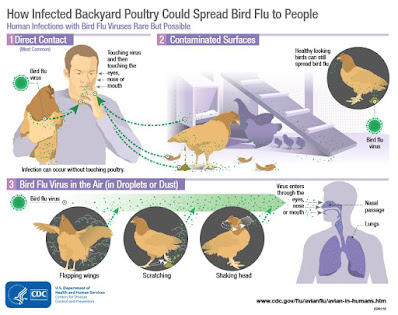
https://www.cdc.gov/flu/pdf/avianflu/avian-flu-transmission.pdf

#17,313

The revelation yesterday from the Cambodian CDC that this week's family cluster of H5N1 was From Clade 2.3.2.1c - and not from clade 2.3.4.4b which is currently circulating in Europe and North America -  is both a relief and a renewed concern. 

While everyone can be heartened by the fact that this fatal case/family cluster was not sparked by the same bird flu virus which is currently in our own backyard, it is a reminder that some of the older, more dangerous H5N1 clades still exist in the wild, and pose a threat.  

Yesterday the CDC released a statement on the two Cambodian cases, along with an excellent timeline of avian flu events since 2020.  


H5N1 Update: Two Human H5N1 Cases in Cambodia

February 25, 2023 — Two human infections with avian influenza A H5N1 (H5N1 bird flu) have been reported by Cambodia. These cases are thought to be a result of exposure to infected birds/poultry. An investigation to try to confirm the source of the infections and detect any potential additional cases is ongoing. Based on preliminary genetic sequencing done in country, the Cambodian Ministry of Health has identified these viruses as being H5 clade 2.3.2.1c, which have circulated in Cambodia among birds/poultry for many years. These viruses have resulted in rare sporadic human infections in the past, but these two cases are the first such infections reported in Cambodia since 2014. The 2.3.2.1c viruses in Cambodia are different from H5N1 viruses currently circulating in wild birds and poultry in the United States and other countries, which are H5 clade 2.3.4.4b.

The cases in Cambodia occurred in a child, who died, and her father, who reported a fever and cough. No additional H5N1 cases have been identified at this time. To date, no indication of person-to-person spread has been found. There is no indication at this time that these two human cases of H5N1 in Cambodia pose a threat to the U.S. public.

What CDC is Doing


The Cambodian Ministry of Health and other global public health officials are leading the investigation into these two human cases with support from in-country CDC staff and a CDC rapid response team. Investigation efforts include contact tracing, monitoring and/or testing of close contacts including health care workers who cared for the two patients, and testing of animals in the village. CDC also is providing testing materials and reagents. CDC will continue to work with the Cambodian Ministry of Health and will provide updates as needed.

Risk and Prevention Measures in the U.S.

For the United States, the ongoing outbreaks of 2.3.4.4b clade H5N1 bird flu in wild birds and poultry with sporadic spillover events into some mammals remains mainly an agricultural issue. The current risk to the general public from bird flu viruses remains low; however, it is important to remember that risk depends on exposure, and people with more exposure might have a greater risk of infection. People who have job-related or recreational exposures to infected birds or sick or dead mammals are at higher risk of infection and should take appropriate prevention measures. CDC also has guidance for clinicians on monitoring, testing, and antiviral treatment for patients with bird flu virus infections.

People should avoid contact with poultry, and wild birds and mammals that appear ill or are dead and avoid contact with surfaces that appear to be contaminated with feces from wild birds and mammals, or domestic poultry. Observe wild birds and mammals only from a distance, if possible. Wild birds and mammals can be infected with bird flu viruses without always appearing sick. If you must handle wild birds and mammals or sick or dead poultry, minimize direct contact by wearing gloves and wash your hands with soap and water after touching them. If available, wear respiratory protection such as a medical facemask and eye protection such as goggles.

The U.S. poultry industry has strict health and safety standards, including regular monitoring for bird flu. It is safe to eat properly handled and cooked poultry and poultry products in the U.S. The proper handling and cooking of poultry and eggs to an internal temperature of 165˚F kills bacteria and viruses, including H5 viruses.

The U.S. Department of Interior and USDA APHIS are the lead federal agencies for H5N1 in birds, poultry, and animals in the U.S. They are respectively responsible for outbreak investigation and control of bird flu in wild birds and in domestic poultry. CDC is the lead federal agency on the human health side.

CDC has been actively working on the domestic H5N1 situation since the initial detection of H5N1 in U.S. wild birds and poultry in early 2022. This includes preparing for the possibility that H5N1 viruses circulating in birds in the United States and in other countries gain the ability to easily infect and spread between people. This includes ensuring that there are prevention and treatment tools, in addition to testing capacity.

CDC’s existing influenza surveillance systems are well-equipped to rapidly detect cases of avian influenza A virus infection, including H5N1 virus, in people. CDC’s influenza virus tests, which can detect both seasonal and novel influenza A viruses, are used in all 50 U.S states and globally. Additionally, there are CDC diagnostic tests that specifically detect the current H5 viruses, which are available in public health laboratories in all 50 U.S. states and international laboratories.

An H5 candidate vaccine virus (CVV) produced by CDC is identical or nearly identical to the hemagglutinin (HA) protein of recently detected clade 2.3.4.4b H5N1 viruses in birds and mammals (including a 2022 H5 outbreak in mink in Spain) and could be used to produce a vaccine for people, if needed, and which would provide good protection. This H5 CVV is available and has been shared with vaccine manufacturers. Because flu viruses are constantly changing, CDC continually analyses viruses to identify genetic changes that suggest these viruses might spread more easily to and between people, and cause serious illness in people, or for changes that suggest reduced susceptibility to antivirals, as well as changes in the virus that might mean a new vaccine virus should be developed.

CDC, along with state and local public health partners, also continues to actively monitor people who have been exposed to infected birds and poultry for 10 days after exposure. To date, public health departments have monitored more than 6,300 people in more than 50 jurisdictions who were exposed to birds/poultry infected with H5N1 virus. Of these, more than 160 people showed symptoms and subsequently were tested for novel influenza A and seasonal flu viruses along with other respiratory viruses. H5N1 virus genetic material has been only detected in a respiratory specimen from one person in Colorado.

Additional information on protective actions around birds, including what to do if you find a dead bird, is available. CDC also has guidance for specific groups of people with exposure to poultry, including poultry workers and people responding to poultry outbreaks. CDC will continue to provide further updates to the situation and update guidance as needed.

Human infections with avian influenza viruses are rare but can happen following exposure to infected birds/poultry. Even more rarely, some limited, non-sustained person-to-person spread has happened. More information about avian influenza is available on the CDC website.


HPAI H5Nx remains a diverse, and evolving, threat.  Whether clade 2.3.2.1c or clade 2.3.4.4b viruses have what it takes to spark a human pandemic remains to be seen. We've stood on the precipice before, only to see the virus recede and regroup. 

And that could happen again. 

But influenza's superpower lies in its ability to evolve, adapt, and reinvent itself (via reassortment). 


Which means we can't count it out simply because it hasn't stumbled upon the right combination of mammalian adaptations yet.  And if H5N1 ultimately fails, there is a long list of other novel viruses which pose credible public health threats.

Stay tuned. 

Saturday, February 25, 2023

Cambodian CDC: H5N1 Cluster From Clade 2.3.2.1c (Not 2.3.4.4b)


 #17,312

With thanks and a hat-tip to Jurre Y Siegers, PhD @jurreysi on twitter, we have an announcement from the Cambodian CDC indicating that the cluster of H5N1 cases reported this week have been analysed, and found to be from the Asian clade 2.3.2.1c - not from the 2.3.4.4b clade which is currently circulating across most of the world.

This is obviously good news for those in Europe and the Western Hemisphere, who are currently dealing with a different H5N1 virus. 

In addition to 2.3.4.4b, the WHO has identified 3 other clades of H5N1 circulating around the globe over the past 6 months:

  • Clade 2.3.2.1a viruses were detected in poultry in Bangladesh. There were up to 10 amino acid substitutions in the HA of recent viruses compared to the HA of A/duck/Bangladesh/17D1012/2018, from which a CVV has been developed. Some of the recent viruses did not react well to a post-infection ferret antiserum raised against the A/duck/Bangladesh/17D1012/2018 CVV but instead reacted well with a post-infection ferret antiserum raised against the A/duck/Bangladesh/19097/2013 CVV. 
  • Clade 2.3.2.1c viruses were detected in birds in Viet Nam and Lao People’s Democratic Republic. Viruses from Viet Nam reacted well with a post-infection ferret antiserum raised against the A/duck/Vietnam/NCVD1584/2012 CVV, despite recent strains having up to 9 amino acid substitutions in the HA. 
  • Clade 2.3.2.1e viruses were detected in Timor-Leste. The HAs of these viruses were most closely related to viruses previously detected in Indonesia. There are no CVVs representative of this HA clade and the viruses from Timor-Leste reacted poorly with post-infection ferret antisera raised against clade 2.3.2.1a and 2.3.2.1c CVVs. No human infections have been associated with viruses of this clade and the extent of their circulation is uncertain.

This brief announcement from the Cambodian CDC Facebook page:

នាយកដ្ឋានប្រយុទ្ធនឹងជំងឺឆ្លង CDC

Currently, February 26, 2020

Bird flu virus H5N1, which is the cause of death of girls living in Rolang village, Khlach commune, Central Sitha district, is a virus that has been studied among local birds, wild birds in Cambodia during the last few years.

Bird flu H5N1 (clade 2.3.2.1c): Different from H5N1 bird flu in other countries around the world. Monitoring of the disease is ongoing, while the population in contact with the patient remains monitored.

As of today, there has not been any clear evidence of transmitting H5N1 bird flu from person to person. Request all citizens to avoid direct harm with sick or dead birds. Let's protect and prevent together for our health.

For more information, please contact phone number 118


Although we've not heard much about this clade over the past few years, 2.3.2.1c is a familiar foe.  It is descendant from a clade (2.3.2) which emerged in 2009 in migratory birds in China, and is notable for producing severe - and often neurological - symptoms. 

In January of 2015 we saw another large die off of birds in China (see H5N1 Detected In Swan Die Off In Henan Province) which was subsequently identified as clade 2.3.2.1c (see Novel H5N1 Reassortment Detected In Migratory Birds - China).

A few months later we learned that the H5N1 virus that reappeared in West Africa in late 2014 after a seven year absence was also clade 2.3.2.1c (see EID Journal: H5N1 In Nigerian Poultry – 2015).
This suggests that the novel Sanmenxia Clade 2.3.2.1c-like H5N1 viruses possesses tropism for the nervous system in several mammal species, and could pose a significant threat to humans if these viruses develop the ability to bind human-type receptors more effectively.

While today's announcement is a bit of a relief for much of the world, it is a reminder that HPAI H5 is a multi-faceted threat, and that it is fully capable of producing surprises going forward.