Showing posts with label Africa. Show all posts

Friday, August 15, 2014

EID Journal: Three Decades Of MERS-CoV Antibodies In Camels

Photo: ©FAO/Ami Vitale

Credit FAO


# 8957


Although it certainly seems longer, it has been just over a year since we saw the first real evidence linking camels to the MERS-CoV virus (see Lancet: Camels Found With Antibodies To MERS-CoV-Like Virus).  Since then, as testing procedures have matured and been deployed, we’ve seen a steady stream of studies showing that many Middle Eastern dromedaries either carry the live virus, or antibodies indicating prior infection.


mBio: Airborne Fragments Of MERS-CoV Detected In Saudi Camel Barn

Eurosurveillance: MERS-CoV Antibodies & RNA In Camel’s Milk – Qatar

Kuwait Tests Camels - Finds 6% Positive For MERS-CoV

mBio: MERS-CoV Carriage By Dromedaries


While bats are still a prime suspect as the reservoir host for this emerging coronavirus, camels increasingly are viewed as an important intermediate host, and possible bridge to infecting humans (see WHO Update On MERS-CoV Transmission Risks From Animals To Humans & FAO: `Stepped Up’ Investigations Into Role Of Camels In MERS-CoV).


While human cases have only originated on the Arabian peninsula, that region imports tens of thousands of camels each year from the Horn of Africa, leading some to suspect the actual `source’ of the MERS coronavirus might come from the East African nations of Somalia, Kenya, or Sudan. 


Last May, in  EID Journal: MERS Antibodies In Camels – Kenya 1992-2013, we saw a study using archived camel blood samples going back 20 years that found MERS antibodies were circulating in Kenya as early as 1992.  Today, we’ve a new study that pushes back the clock at least another 10 years.

Volume 20, Number 12—December 2014
Dispatch

MERS Coronavirus Neutralizing Antibodies in Camels, Eastern Africa, 1983–1997

Marcel A. Müller1Comments to Author , Victor Max Corman1, Joerg Jores, Benjamin Meyer, Mario Younan, Anne Liljander, Berend-Jan Bosch, Erik Lattwein, Mosaad Hilali, Bakri E. Musa, Set Bornstein, and Christian Drosten
Abstract

To analyze the distribution of Middle East respiratory syndrome coronavirus (MERS-CoV)–seropositive dromedary camels in eastern Africa, we tested 189 archived serum samples accumulated during the past 30 years. We identified MERS-CoV neutralizing antibodies in 81.0% of samples from the main camel-exporting countries, Sudan and Somalia, suggesting long-term virus circulation in these animals.

image

(Continue . . .)


You’ll want to read the entire paper for methods, materials, and their detailed findings.  In the conclusion, the authors write:


MERS-CoV sequences from camels in Saudi Arabia and Qatar were closely related to sequences found in humans and did not show major genetic variability that would support long-term evolution of MERS-CoV in camels (10,11). The MERS-CoV sequence from a camel in Egypt was phylogenetically most distantly related to all other known camel-associated MERS-CoVs but closely related to the early human MERS-CoV isolates (10). An urgent task would be to characterize the diversity of MERS-related CoV in other camels in Africa to elucidate whether the current epidemic MERS-CoV strains have evolved toward more efficient human transmissibility.

The existence of unrecognized human infections in African or Arabian countries in the past cannot be ruled out. Resource-limited African countries that have been exposed to civil unrest, such as Somalia and Sudan, are not likely to diagnose and report diagnostically challenging infections resembling other diseases. The lack of MERS-CoV antibodies in a small cohort serosurvey in Saudi Arabia did not suggest the long-term circulation of MERS-CoV in humans on the Arabian Peninsula (15).

Large serosurveys in countries where camels are bred and traded, especially in eastern Africa, are needed to explore the general MERS-CoV seroprevalence in camels and humans, particularly humans who have close contact with camels. Such serosurveys could provide the data needed to ascertain whether MERS-CoV has been introduced into, but unrecognized in, the human population on the African continent.

Friday, April 04, 2014

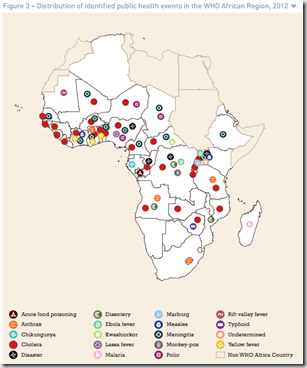
WHO/AFRO: Responding To Public Health Events Of Unknown Etiology

image

Public Health Events in 2012 – Credit WHO/AFRO


# 8430


As recent events in Guinea and Western Africa illustrate, we often hear about `mysterious’ outbreaks of unknown etiology in remote areas of the world days or weeks before an official diagnosis can be made.  It takes time, and most importantly – a coordinated response - to identify and contain an infectious disease outbreak.


To that end the World Health Organization and The WHO African Regional Office (AFRO) have released a new 40-page document entitled: Public Health Events of Unknown Etiology: A framework for response in the African Region (1.55 MB), the seeks to set up a standardized response framework.


image


Here are some excerpts from the press release accompanying this document:


WHO/AFRO Issues Guidance on Preparing for & Responding to Public Health Events


Brazzaville, 4 April 2014 -  What is a public health event (PHE)? How can Member States more effectively prepare for, and respond to PHEs which now occur fairly frequently in the WHO African Region? 

These and related questions are answered in a publication entitled “Public Health Events of Unknown Etiology: A framework for response in the African region”. 

The guidance document, just issued by the WHO Regional Office  (WHO/AFRO) for Africa in Brazzaville was developed in close collaboration with USAID, the United States Centers for Disease Control and the Global Outbreak Alert and Response Network (GOARN), a technical partnership of institutions which provide technical sup-port to countries for outbreak response.

WHO defines a PHE as any event that may have negative consequences for human health, including those that have not yet led to disease or illness, but have the potential to do so, and  require a coordinated response.

The cause or origin of PHEs is not known when they first occur, making scientists and researchers refer to them as PHEs of initially unknown etiology (IUE). This means PHEs for which the causes have not been determined.

What, one may ask, makes the issue of this publication timely and important?

The answer is embedded in background information contained in the 40-page guide.

The document says that in the WHO African Region,  an average of 80 to 100 public health events were reported between 2000 and 2012. These include infectious disease outbreaks of known or unknown causes, moderate or severe malnutrition, natural and human-made disasters, animal disease outbreaks, and toxins and chemical exposures.

However, this increasing frequency of PHEs is not matched by availability of solid technical guidelines  to address them.

Says Dr Francis Kasolo, Director of the Disease Prevention and Control Cluster at WHO/AFRO: “There is currently a dearth of guidance related to appropriate steps in the early phases of detection, reporting, alert management, field investigation and response to PHEs.

“Therefore, this concise, easy-to-use technical framework has deliberately set out the modus operandi on how countries, working with various partners can effectively prepare for, and respond to, PHEs.

(Continue . . . )

Monday, March 31, 2014

WHO Update & Messaging On Ebola Outbreak

image

Photo Credit - CDC


NOTE: For far more complete coverage of the Ebola outbreak in Western Africa you’ll most certainly want to check in with Crofsblog several times a day, as he is doing a phenomenal job covering breaking events there.


# 8417


Not unexpectedly, the World Health Organization confirmed yesterday that at least two cases of Ebola infection have been confirmed in Liberia.


While obviously a concerning geographic expansion of the outbreak beyond the borders of Guinea, WHO spokesperson Gregory Hartl noted this morning on Twitter that the Liberian cases were all exposed in Guinea, before traveling to that country.


image


Excerpts from the WHO announcement follow:


Ebola Haemorrhagic Fever, Liberia (Situation as of 30 March 2014)

30 March 2014 – The Ministry of Health (MoH) of Liberia has provided updated details on the suspected and confirmed cases of Ebola Haemorrhagic Fever (EHF) in Liberia.  As of 29 March, seven clinical samples, all from adult patients from Foya district, Lofa County, have been tested by PCR using Ebola Zaire virus primers by the mobile laboratory of the Institut Pasteur (IP) Dakar in Conakry.  Two of those samples have tested positive for the ebolavirus. There have been 2 deaths among the suspected cases; a 35 year old woman who died on 21 March tested positive for ebolavirus while a male patient who died on 27 March tested negative.  Foya remains the only district in Liberia that has reported confirmed or suspected cases of EHF.  As of 26 March, Liberia had 27 contacts under medical follow-up.

In accordance with the International Health Regulations (IHR, 2005), the MoH of Liberia is communicating regularly with WHO and neighbouring countries to help coordinate and harmonise surveillance, prevention and control activities.

Response activities within health care facilities include strengthening infection prevention and control (IPC) at the Foya Hospital, the provision of additional personal preventive equipment (PPE) and medical supplies to support case isolation and clinical management and training for health care workers in IPC. Health care workers are receiving training on EHF; 50 clinicians from 5 hospitals in Montserrado County received training on 27 March. PPE and medical supplies have also been sent to Bong and Nimba Counties which border Guinea.

As this is a rapidly changing situation, the number of reported cases and deaths, contacts under medical observation and the number of laboratory results are subject to change due to enhanced surveillance and contact tracing activities, ongoing laboratory investigations and consolidation of case, contact and laboratory data.

(Continue . . . )

As @WHO notes in their twitter messaging overnight, two of the most recently diagnosed cases in Guinea are healthcare workers, highlighting the need for vigilance in infection control procedures during this outbreak.


image


Reports of nosocomial transmission of VHF (Viral Hemorrhagic Fevers) are a reminder that many healthcare facilities – particularly in developing countries – often work with a limited supply of basic disposable infection control supplies like masks, gloves, and gowns.


More sophisticated isolation procedures - such as Airborne Infection Isolation Rooms (AIIR) as might be found in the United States and Europe - are a luxury few hospitals in the developing world can afford.


Out of necessity, Infection control advice tends to be more basic and mindful of limited resources, such as is provided in the following WHO interim guidance document.


Interim Infection Control Recommendations for Care of Patients with Suspected or Confirmed Filovirus (Ebola, Marburg) Haemorrhagic Fever

March 2008

This document provides a summary of infection control recommendations when providing direct and non-direct care to patients with suspected or confirmed Filovirus haemorrhagic fever (HF), including Ebola or Marburg haemorrhagic fevers. These recommendations are interim and will be updated when additional information becomes available.

Download document

Wednesday, May 22, 2013

WHO: Polio Outbreak In Horn Of Africa

image

@WHO #Polio Tweeted announcements today.


# 7306


The battle to eradicate polio has seen a number of setbacks over the past year, including multiple attacks aimed at polio vaccination teams (see 7 More Aid Workers Killed In Pakistan, Nigeria: Nine Polio Workers Murdered), news in January that the Polio Virus was Detected By Environmental Surveillance In Egypt, and now the discovery of an outbreak of wild poliovirus type 1 in the Horn of Africa.


Since only about 1 person in 100 who becomes infected develops signs of acute flaccid paralysis (AFP), the discovery of even a single confirmed case suggests there are likely many more in a community who may be infected and are shedding the virus.


News of the outbreak in Kenya came late last week, as reported in this story from the GPEI (Global Polio Eradication Initiative) website.


Friday, May 17, 2013

Wild poliovirus in Kenya

Emergency response planned

An investigation team is in Dadaab, Kenya following reports of a child paralyzed by wild poliovirus type 1 (WPV1). This is the first WPV case confirmed in Kenya since July 2011. The location is close to the border with Somalia, where a child was paralyzed by polio in the capital Mogadishu on 18 April. Dadaab hosts a major refugee camp, housing nearly 500,000 persons from across the Horn of Africa, including from Somalia.

(Continue . . . )


In today’s WHO update we learn that three cases are confirmed (only one is symptomatic), and the World Health Organization fears the potential for spread of the virus to neighboring countries is `very high’.


Wild poliovirus in the Horn of Africa

22 May 2013 - The Horn of Africa is currently experiencing an outbreak of wild poliovirus type 1 (WPV1). A four-month-old girl near Dadaab, Kenya, developed symptoms of acute flaccid paralysis (AFP) on 30 April 2013. Two healthy contacts of the child tested positive for WPV1. They are the first laboratory confirmed cases in Kenya since July 2011. Investigation into this outbreak is ongoing. In addition, a case of WPV1 in Banadir, Somalia was confirmed on 9 May 2013.


In response to the outbreak, the first vaccination campaign, reaching 440 000 children began on 14 May 2013 in Somalia and a second round of vaccination is planned for 26 May 2013 in synchronization with the affected parts of Kenya.


The risk to neighbouring countries is deemed as very high, due to large-scale population movements across the Horn of Africa and persistent immunity gaps in some areas. Dadaab hosts a major refugee camp, housing nearly 500 000 persons from across the Horn of Africa.


An alert for enhanced surveillance for polio has been issued to all countries across the Horn of Africa, highlighting the need to conduct active searches for any suspected cases. All countries are urged to rapidly identify sub-national surveillance gaps and to take measures to fill the gaps.


In 2005, polio spread east across the African continent, and into Yemen and the Horn of Africa, resulting in over 700 cases. Since then, international outbreak responses have been adopted and new monovalent and bivalent oral polio vaccines have been developed, which can significantly reduce the severity and length of polio outbreaks.


Some areas of Somalia (south-central) are also affected by an outbreak due to circulating vaccine-derived poliovirus type 2 (cVDPV2), which has resulted in 18 cases in Somalia since 2009. In 2012, this strain spread to Dadaab, causing three cases.


WHO’s International Travel and Health recommends that all travellers to and from polio-infected areas be fully vaccinated against polio.

Sunday, September 30, 2012

Study: Intra-Continental Spread of Invasive Non-Typhoidal Salmonella

image 

 Salmonella typhimurium bacteria – Credit CDC PHIL


# 6599


You might not think there’d be much of a connection between an emergent serotype of Salmonella and the HIV epidemic in Sub-Saharan Africa - but if researchers from the Wellcome Trust Sanger Institute have it right - this highly pathogenic bacterial strain may have had a powerful viral ally.


There are more than 2500 serovars of Non-Typhoidal Salmonella (NTS) that can produce gastroenteritis or other infections in humans. Taken together, these Gram negative, anaerobic bacteria are believed to be the second most common source of food poisoning in the United States.


Those infected often develop diarrhea, fever, vomiting, and abdominal cramps that may persist for several days.


In the western world most recover without treatment, although the CDC estimates that nearly 400 people infected die each year in the United States (Cite  CDC Food borne Illness Estimates).


In developing countries, Non-typhoidal Salmonella can (and does) exact a much higher toll, particularly among those who may be malnourished or suffer from chronic ailments such as malaria and HIV.


In recent years researchers have also noted a much more virulent form of NTS, spreading across sub-Saharan Africa, that they’ve dubbed  Invasive Non-Typhoidal Salmonella (iNTS). 


Not only is it a multi-drug resistant strain, it is fatal in about 25% of those who contract it.


Today, we’ve a study that appears in Nature Genetics that links the Intracontinental spread and evolution of this invasive and severe form of Salmonella to the emergence and spread of HIV.


Intracontinental spread of human invasive Salmonella Typhimurium pathovariants in sub-Saharan Africa

Chinyere K Okoro,Robert A Kingsley,Thomas R Connor,Simon R Harris,Christopher M Parry,Manar N Al-Mashhadani,Samuel Kariuki,Chisomo L Msefula,Melita A Gordon,Elizabeth de Pinna,John Wain,Robert S Heyderman,Stephen Obaro,Pedro L Alonso,Inacio Mandomando,Calman A MacLennan, Milagritos D Tapia,Myron M Levine,Sharon M Tennant,Julian Parkhill & Gordon Dougan

Published online 30 September 2012


While the bulk of the study is behind a pay wall, the Abstract is available, as is this press release from the Wellcome Trust Sanger Institute.


New pathogen epidemic identified in sub-Saharan Africa

image

Researchers track the spread of human invasive non-Typhoidal Salmonella in sub-Saharan Africa

A new study out today (Sunday 30 September) reveals that the emergence and spread of a rapidly evolving invasive intestinal disease, that has a significant mortality rate (up to 45%) in infected people in sub-Saharan Africa, seems to have been potentiated by the HIV epidemic in Africa.


The team found that invasive non-Typhoidal Salmonella (iNTS) disease is caused by a new form of the bacteria Salmonella Typhimurium that has spread from two different focal hubs in Southern and Central Africa beginning 52 and 35 years ago, respectively. They also found that one of the major contributing factors for the successful spread of iNTS was the acquisition of genes that afford resistance to several front line drugs used to treat blood-borne infection such as iNTS.


iNTS is a blood-borne infection that kills approximately one of four people in sub-Saharan Africa who catch it. Yet, in the rest of the world, NTS is a leading cause of acute inflammatory diarrhoea that is self-limiting and tends to be fatal in less than 1 per cent of people infected. The disease is more severe in sub-Saharan Africa than the rest of the world because of factors such as malnutrition, co-infection with malaria or HIV and potentially the novel genotype of the Salmonella bacteria.


"The immune system susceptibility provided by HIV, malaria and malnutrition at a young age, may provide a population in sub-Saharan Africa that is large enough for this detrimental pathogen to enter, adapt, circulate and thrive," says Chinyere Okoro, joint first author from the Wellcome Trust Sanger Institute. "We used whole genome sequencing to define a novel lineage of Salmonella Typhimurium that is causing a previously unrecognised epidemic across the region. Its genetic makeup is evolving into a more typhoid like bacteria, able to efficiently spread around the human body"


<SNIP>


"There has been some evidence that this disease can be passed from human to human. Now the race is on to discover how NTS is actually transmitted in sub-Saharan Africa so that effective intervention strategies can be implemented."


(Continue . . . )


And for more on all of this, here’s Debra McKenzie’s article for New Scientist.


HIV could be turning salmonella nastier


18:00 30 September 2012 by Debora MacKenzie


A nastier kind of salmonella infection has emerged alongside the HIV epidemic in Africa. The finding is the first evidence that HIV might be allowing new human pathogens to evolve in immunosuppressed people.


(Continue . . . )


Friday, September 23, 2011

When Pig Viruses Fly


# 5860


Being of swine origin, the pandemic producing 2009 H1N1 virus – to no great surprise – moved easily from human hosts back into pig populations around the globe.


By the fall of 2009 we’d seen reports of pigs in Canada, the US, Japan, Ireland, Norway, Australia, Argentina, Iceland, and China  showing infection with the humanized H1N1 virus. 


Since humans are far more traveled than your average pig, a virus that might have remained confined to swine herds in one region of the world for years soon spread to every continent via international travel.


Each year, more than 17 million commercial airline flights transport hundreds of millions of people across the globe (see Pathological Flyers).


You can literally travel from just about any two cities (with airports) anywhere in the world in 24 hours or less. No longer are the oceans, or distance, a protection against diseases normally seen only in remote areas of the world.


Which is why the pandemic of 2009 spread so quickly around the globe.


Given the very limited animal testing and surveillance in the United States and around the world (see Swine Flu: Don’t Test, Don’t Tell) the true scope of the spread of the H1N1 virus back into the pig population remains unknown.


The concern is that once `humanized’, and then reintroduced back into the swine population, the virus will have enhanced opportunities to meet up with – and reassort with – other flu viruses. 


Reassortment happens when two different influenza viruses co-infect the same host, swap genetic material, and produce a hybrid virus. 


image


We’ve already seen multiple reports of pdmH1N1 reassortments, although none have emerged that pose a renewed pandemic threat. 


With global pig production growing rapidly to meet the demands of a hungry world, each year we add millions more `mixing vessels’ to natures laboratory.  And the bulk of the predicted growth in hog farming is expected in developing countries where testing is pretty much non-existent.


image

Credit – FAO


Illustrating the problem is a report yesterday from UCLA on the prevalence of the pandemic H1N1 virus among pigs in Cameroon.


In one village, nearly all of the pigs tested showed evidence of current or past infection.


I’ve a small excerpt from a much longer UCLA Newsroom background article, along with a link to the study.


UCLA scientists find H1N1 flu virus prevalent in animals in Africa

By Stuart Wolpert September 22, 2011


UCLA life scientists and their colleagues have discovered the first evidence of the H1N1 virus in animals in Africa. In one village in northern Cameroon, a staggering 89 percent of the pigs studied had been exposed to the H1N1 virus, commonly known as the swine flu.


"I was amazed that virtually every pig in this village was exposed," said Thomas B. Smith, director of UCLA's Center for Tropical Research and the senior author of the research. "Africa is ground zero for a new pandemic. Many people are in poor health there, and disease can spread very rapidly without authorities knowing about it."

(Continue . . . )


The study appears (behind a pay wall) in Veterinary Microbiology.


Pandemic A/H1N1/2009 influenza virus in Swine, Cameroon, 2010

Kevin Y. Njabo,  Trevon L. Fuller, Anthony Chasar, John P. Pollinger, Giovanni Cattoli, Calogero Terregino, Isabella Monne, Jean-Marc Reynes, Richard Njouom, Thomas B. Smith


The viruses detected in Cameroon were  reportedly `virtually identical’ to the H1N1 viruses detected early in the pandemic in San Diego. Thomas B. Smith, the senior author of the research is quoted as saying:


"When different strains of influenza are mixed in pigs, such as an avian strain with a human strain, you can get new hybrid strains that may affect humans much more severely and can potentially produce a pandemic that can allow human-to-human infection. This is how a pandemic can arise; we need to be very vigilant.


Of course, it isn’t just the 2009 H1N1 virus in swine that we concern ourselves with. In recent years we’ve seen a variety of reassorted H1N1 and H3N2 viruses in pigs, and on rare occasions these have been passed on to humans.


Pigs in Indonesia have also been found to have contracted the H5N1 bird flu virus (see EID Journal: Asymptomatic H5N1 In Pigs).


Most recently, four cases of a reassorted H3N2 virus with the M gene from H1N1 turned up in children in Pennsylvania and Indiana (see CDC Update On Recent Novel Swine Flu Cases).


While the epidemiological investigation continues, so far we’ve no evidence of sustained human transmission.


It is likely that limited infection by novel influenza reassortments such as these occur occasionally (and largely unnoticed) all over the world. Since only a tiny fraction of influenza flu viruses are ever sequenced, we really don’t know how often these types of novel infections occur.


But it’s probably more often than we think.


These rare SOIV infections are important to monitor and analyze, and may give us an early warning about the next pandemic threat. But for now they pose a very low public health threat.


Admittedly, it may be years or even decades before another pandemic emerges and threatens the human population. The timing of these events is impossible to predict.


But surveillance studies like the one above show that flu viruses will literally go to the ends of the earth looking for new hosts and an evolutionary advantage.


For more on the reassortment potential of avian, swine, and human flu viruses, you can’t do better than  Helen Branswell’s excellent Scientific American article from last December called Flu Factories, or her SciAm Podcast interview.

Tuesday, November 16, 2010

Uganda: Unidentified Hemorrhagic Outbreak


5057


In December of 2007 I wrote several blogs about an Ebola outbreak in Bundibugyo, located in western Uganda.  


A brief excerpt from one of those posts follows:


Ugandan Nightmare


# 1328

The picture above gives a pretty good indication of how the Ebola virus is spreading in Uganda. Notice the lack of gloves on the attendant's hands, the lack of goggles, and the use of only a simple surgical mask.


Disposables, like gloves, are in very short supply even in the hospitals, and this has led to the deaths of 5 health care workers.


(Continue . . . )


We didn’t realize it at the time, but what they were seeing was a new – previously unidentified strain – of ebola.   A strain which would eventually be named Bundibugyo ebolavirus after its place of discovery.


While less deadly (34% Case Fatality Rate) than other strains of ebola (excluding Ebola Reston), the emergence of this new strain was a sober reminder that a year rarely passes when we don’t discover a new zoonotic disease capable of jumping to humans.


A year later (2008) doctors in Zambia and South Africa ran across a mysterious, previously unclassified virus that caused hemorrhagic symptoms in its victims similar to Ebola.


It appeared to be highly contagious, and was fatal in 4 of the 5 identified victims.    Like most other infectious disease bloggers, I covered the story a bit, although the amount of information available then was pretty thin.


WHO Update On South African `Mystery Disease'

South African `Mystery Virus' Identified


On October 13th, 2008 the virus was tentatively identified as a new arenavirus, but since that time more exacting studies have been done.   In 2009, this virus was named the Lujo Virus, and detailed in the PloS Pathogens report.


Genetic Detection and Characterization of Lujo Virus, a New Hemorrhagic Fever–Associated Arenavirus from Southern Africa


Today, again from western Uganda, we are seeing reports of a new hemorrhagic disease outbreak – cause unknown – that has reportedly killed 13 people so far.


This report courtesy of Shiloh on FluTrackers, indicates that preliminary testing by the Uganda Virus Research Institute has ruled out Ebola, Marburg, and Lassa.  Samples have been sent to the CDC in Atlanta for analysis.


13 dead, as strange disease spreads

Monday, 15th November, 2010


By David Labeja and Sam Oboke
THIRTEEN people have been reported dead in Abim and Agago districts, following an outbreak of a strange disease in Abim.


Twenty cases have been reported in Abim district, out of whom eight have already died.


In neighouring Agago district, five cases have been reported in the sub counties of Omiya P’Chua and Paimol, which border Abim district.

(Continue . . . )


Additional reports will most certainly be posted on this FluTrackers Thread.


Hemorrhagic viruses, while horrific, are usually self-limiting and generally only pose a threat to the area where they emerge. 


Most are believed initially contracted by eating (or preparing) bush meat, and are subsequently spread via bodily fluids.


Health care workers – particularly in areas where personal protective equipment is unavailable – are at particularly high risk of contracting the illness.


When we know more about this particular outbreak, I’ll update this story.