Showing posts with label Aftershock. Show all posts

Tuesday, May 12, 2015

Strong M7.3 Aftershock Hits Nepal

image

# 10,037


A little over 2 weeks after the devastating M7.9 earthquake which struck just west of Nepal’s Capital Kathmandu, a pair of strong after shocks (M7.3 & M6.3) have hit roughly 50 miles east of the city.  Damage and injury reports are just coming in, but the USGS estimates the severity potential as Orange in their immediate pager alert.

image image


Aftershocks can go on for weeks or month after a major quake, although the risks for the largest ones (typically 1 level of magnitude lower than the original quake) usually diminish after a couple of weeks.  

Monday, June 13, 2011

5.5 & 6.0 Aftershocks Strike Christchurch


# 5623


An Active Ring of Fire

image

Original Map – USGS


Overnight here in the USA, and early afternoon local time (1pm & 2:20pm), two strong and very shallow earthquakes struck near Christchurch, New Zealand, reportedly injuring a small number of people and causing major power outages and widespread local damage.


This comes a little less than four months after the devastating 6.3 mag aftershock (see NZ: Aftershocks, Rescue Attempts, Casualties, And The Mounting Toll) of the September 2010 quake, and at a time of year when winter nighttime temperatures are dropping uncomfortably to near freezing.


Kiwibird, an editor and senior moderator of FluTrackers, has started a new news thread on the new quake. You’ll find local news stories, photos, and first hand accounts posted there.


As the residents of Japan and Chile can testify, aftershocks – sometimes only a magnitude less than the original quake – are common during the months and years following a major earthquake.


They can pose a continual physical danger, and ongoing psychological challenge, to the to residents of the stricken area.


The USGS has  released this Tectonic Summary on these latest temblors.


image

The June 13, 2011 South Island, New Zealand earthquake is a continuing part of the earthquake sequence that initiated with the magnitude 7.0 September 3, 2010 Darfield, New Zealand earthquake. The June 13, magnitude 6.0 earthquake is a dominantly strike-slip faulting earthquake that is at the eastern end of the inferred rupture of the 21 February 2011 magnitude 6.1 earthquake. Both this magnitude 6.0 event and the previous magnitude 6.1 event have an inferred fault plane striking approximately east-northeast. The entire earthquake sequence is broadly associated with regional plate boundary deformation as the Pacific and Australia plates interact in the central South Island, New Zealand.


This latest earthquake, similar to the February 21 earthquake, is close to the main population centers of Christchurch, New Zealand. This region has suffered substantial casualties and damage to buildings, infrastructure, and lifelines from a series of events starting with the February 21 earthquake. Additionally, the earthquakes close to Christchurch caused substantial liquefaction in residential areas. The June 13 earthquake was preceded by a nearby magnitude 5.2 foreshock, about 1 hour and 20 minutes earlier. There is no specific surface fault that has been observed for the post-September 3 earthquakes near Christchurch, or directly linking them to the observed September surface fault rupture. There have however been a substantial number of aftershocks forming a continuous swath extending from the September 3 events to the June 13 earthquake.


As I wrote last March in The Ring Of Fire, we live on a seismically active planet, and while `Great Quakes’ are relatively rare (happening somewhere in the world – on average – of once a year), very damaging quakes of between 7.0-7.9 happen on practically a monthly basis.


image

(USGS chart)


And quakes the size of the one that struck Christchurch today happen about 10 times each month.  


Many,  of course, don’t occur this close to a populated area and this shallow, and so their impact isn’t always felt.


Tens of millions of people, however, live in high risk zones - and yet - many are unprepared for these all-too-common disasters. 


No matter where you live, the images coming out of Japan, New Zealand, Haiti and Chile over the past couple of years should serve as a wake-up call to become better prepared.


From the USGS Great Southern California Shakeout website,  we’ve this 4 and 1/2 minute video called Preparedness Now (Streaming | Video) that  “depicts the realistic outcome of a hypothetical, but plausible, magnitude 7.8 earthquake on the San Andreas fault in Southern California.”

image


Which makes this a pretty good time to remind my readers about the study last year (see Revised Risk Of `The Big One’ Along San Andreas Fault) that suggests that Southern California may be more overdue for another major quake than previously thought.


For more on earthquake and general disaster preparedness, you might wish to look at these essays as well.


The L. A. County Emergency Survival Guide
An Appropriate Level Of Preparedness
FEMA Asks: Are You Earthquake Prepared?
Inside My Bug Out Bag
 

And of course, Ready.gov  and FEMA are great resources for earthquake, and general, disaster preparedness information.

Monday, April 11, 2011

Japan: 7.1 Mag Aftershock


# 5482


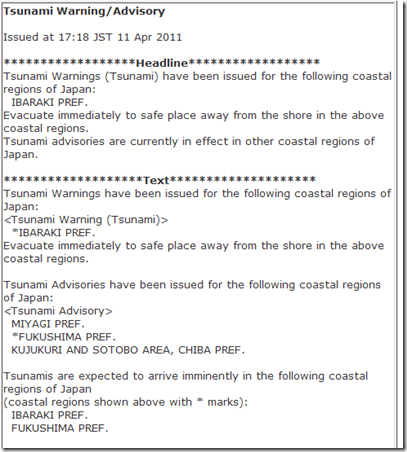
Although data is still coming in, and the final magnitude may be adjusted, the JMA (Japan’s Meteorological Agency) is showing their latest aftershock as a 7.1 and have issued localized tsunami warnings and advisories.


NO PACIFIC WIDE TSUNAMI WARNING HAS BEEN ISSUED (see PTWC statement)


The USGS currently shows the magnitude of this quake considerably lower than does the JMA.


image


By either measure this is the strongest aftershock since last Thursday (see 7.4 Mag Aftershock Hits Japan).  Since the March 11th 9.0 earthquake more than 70 6.0+ aftershocks have been recorded.


Thus far, we’ve seen no reports of new damage from this latest quake.


image

image


Media reports indicate these warnings may already have been lifted, but as of this posting they still appear on the JMA site.

Friday, April 08, 2011

Japan: IAEA Briefing April 8th


# 5477


In the wake of a 7.1 magnitude aftershock yesterday, the IAEA has issued a new briefing that includes status updates on several other nuclear reactors in northern Japan.


Yesterday’s temblor was the largest aftershock yet since the March 11th 9.0 quake that generated a massive tsunami, devastated northern Japan, and severely damaged several nuclear reactors.


The IAEA continues to categorize the status of these damaged reactors by stating: 


Overall, the situation at the Fukushima Daiichi plant remains very serious although there are early signs of recovery in some functions such as electrical power and instrumentation.


I’ve only reproduced the opening section which pertains to this latest aftershock’s effects on Japan’s nuclear facilities. 


Follow the link to read this update in its entirety.


IAEA Briefing on Fukushima Nuclear Accident (8 April 2011, 15:00 UTC)

by International Atomic Energy Agency (IAEA) on Friday, April 8, 2011 at 10:57am

1.      Earthquake of 7th April

The IAEA confirms that an earthquake occurred in Japan at 14:32 UTC 7th April. The IAEA International Seismic Safety Centre has rated it as a 7.1 magnitude, revised from an initial 7.4 magnitude.

The epicenter of the earthquake was 20 km from the Onagawa nuclear power plant and approximately 120 km from the Fukushima Daiichi and Daini nuclear power plants.


The IAEA has been in contact with NISA and can confirm the status of the following nuclear facilities:

Fukushima Daiichi NPP

No changes have been observed at the on-site radiation monitoring posts. The injection of water into the reactor pressure vessels of Units 1, 2 and 3 was not interrupted.

Fukushima Daini NPP

No changes have been observed of the readings at the on-site radiation monitoring posts.

Onagawa NPP

All reactors have been in cold shutdown since the 11th March earthquake.


Two out of the three lines supplying off-site power to the site were lost following the 7th April earthquake. Off-site power continues to be supplied through the third line.


Cooling of the spent fuel pool was temporarily lost, but has subsequently been restored.


No change has been observed in the readings from the on-site radiation monitoring post. The status of the plant is currently being checked.

Tokai Daini NPP

Tokai Daini nuclear power plant remains in cold shutdown since the 11th March earthquake. No abnormality has been observed.

Higashidori NPP

The Higashidori NPP was shut down and in a maintenance outage at the time of the 7th April earthquake. Off-site power was lost temporarily. Emergency power supply to the site operated as expected until off-site power was restored. All the fuel had been removed from the reactor core and stored in the spent fuel pool. Cooling of the spent fuel pool is operational.

Tomari NPP (in Hokkaido)

At the time of the 7th April earthquake Tomari Unit 1 and Unit 2 were in operation. Following the 7th April earthquake, the Hokkaido Electric Power Company reduced the generating power to 90% of capacity.

Rokkasho Reprocessing Plant

Rokkasho Reprocessing Plant and uranium enrichment facility lost off-site power. Emergency power supply to the site is operating.

(Continue . . . )


Seismologists warn that additional strong aftershocks are still possible over the next few weeks and months.

Thursday, April 07, 2011

7.4 Mag Aftershock Hits Japan


UPDATE #2:  As of 1135 hrs 4/711 -  As often happens, the initial readings on earthquakes can bounce around a bit as more data comes in. 

Right now, the USGS is showing this as a 7.1 Magnitude with a depth of 49km

image

These numbers may well change again before they are finalized.

UPDATE #1: as of 1112hrs 4/7/11 -  The USGS has revised the depth of this earthquake to 25.6 km.

NHK World News is broadcasting live from Tokyo on the situation.


# 5475


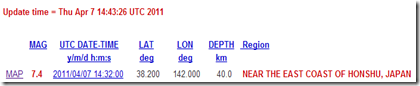
Scientists have been warning for a month that another 7+ aftershock could strike northern Japan, and a short time ago one did.


This aftershock registered as being 40 km deep, which is considerably deeper than the massive quake that struck on March 11th.


So far, we’ve received no word on damages.


image

image


While a local Tsunami advisory has been issued, NO PACIFIC WIDE TSUNAMI THREAT is anticipated.


The following statement comes from the Pacific Tsunami Warning Center.


000
WEHW42 PHEB 071442
TIBHWX
HIZ001>003-005>009-012>014-016>021-023>026-071642-
TSUNAMI INFORMATION STATEMENT NUMBER   1
NWS PACIFIC TSUNAMI WARNING CENTER EWA BEACH HI
442 AM HST THU APR 07 2011

TO - CIVIL DEFENSE IN THE STATE OF HAWAII
SUBJECT - TSUNAMI INFORMATION STATEMENT
THIS STATEMENT IS FOR INFORMATION ONLY. NO ACTION REQUIRED.


AN EARTHQUAKE HAS OCCURRED WITH THESE PRELIMINARY PARAMETERS


   ORIGIN TIME - 0432 AM HST 07 APR 2011
   COORDINATES - 38.2 NORTH  142.0 EAST
   LOCATION    - NEAR EAST COAST OF HONSHU  JAPAN
   MAGNITUDE   - 7.4  MOMENT

EVALUATION

BASED ON ALL AVAILABLE DATA A DESTRUCTIVE PACIFIC-WIDE TSUNAMI IS  NOT EXPECTED AND THERE IS NO TSUNAMI THREAT TO HAWAII. REPEAT. A  DESTRUCTIVE PACIFIC-WIDE TSUNAMI IS NOT EXPECTED AND THERE IS NO TSUNAMI THREAT TO HAWAII.

THIS WILL BE THE ONLY STATEMENT ISSUED FOR THIS EVENT UNLESS ADDITIONAL DATA ARE RECEIVED.

Sunday, March 27, 2011

Miyagi: Tsunami Advisory After 6.5 Magnitude Aftershock


# 5453


The strongest aftershock in several days  struck off the east coast of Miyagi Prefecture  at 7:27 JST, on Monday Morning  (1827hrs EST Sunday).


While far less powerful than the earthquake of March 11th, a local Tsunami advisory has been issued by Japan’s Meteorological Agency.


They anticipate the quake might have generated of a series of waves less than 1 meter in height.


A destructive tsunami is not expected.


image

image

Friday, March 25, 2011

USGS: 6.4 Aftershock Rattles Northern Japan


# 5446


The strongest aftershock since Wednesday struck northern Japan a short while ago (8:36 pm local time).


Local reports have listed the quake as a 6.2, but the USGS is currently showing it as a 6.4.  Magnitude readings are often changed as more data comes in.


While strong enough that buildings in Tokyo (nearly 400km to the south) reportedly swayed - no tsunami warning has been issued.


image 

Magnitude 6.4 - NEAR THE EAST COAST OF HONSHU, JAPAN

2011 March 25 11:36:24 UTC

Location 38.763°N, 141.942°E

Depth   39.2 km (24.4 miles)

Region   NEAR THE EAST COAST OF HONSHU, JAPAN

Distances

  • 108 km (67 miles) ENE (58°) from Sendai, Honshu, Japan
  • 127 km (79 miles) SE (146°) from Morioka, Honshu, Japan
  • 172 km (107 miles) NE (48°) from Fukushima, Honshu, Japan
  • 395 km (246 miles) NNE (29°) from TOKYO, Japan

Tuesday, March 22, 2011

Japan: 6.6 Magnitude Aftershock


UPDATED  0620 hrs EDT:  Two additional strong aftershocks (6.4 & 6.6) have been reported in the three hours since today’s first strong temblor occurred.


image


# 5429


The strongest aftershock in more than a week struck off the coast of Honshu at 1817 hours local time today, measured by the USGS at magnitude 6.6.


image


No immediate reports of damage have been received, and no tsunami was generated.


Seismologists continue to warn that strong aftershocks, up to and greater than 7.0, are still possible in the Honshu region.

Sunday, March 20, 2011

Japan: 6.1 Magnitude Aftershock


# 5423


image


A little more than 24 hours after Japan’s last 6.0+ aftershock, another 6.1 magnitude temblor rattled the east coast of Honshu island at just past 9 pm local time today. 


While there were no immediate reports of additional damage, the quake was reportedly strongly felt as far away as Tokyo several hundred kilometers to the south.


Over the past 24 hours more than 30 aftershocks of 4.5 mag. or greater have been recorded in the region.


Although their frequency and average strength are declining, seismologists continue to warn that another large (7.0+) aftershock is still possible in the region.