Showing posts with label Japan. Show all posts

Monday, March 09, 2015

Four Years After Japan’s Great Earthquake & Tsunami

image +

Credit NHK News – Fukushima evacuation zone March 2011


# 9798


This week marks the fourth anniversary of Japan’s greatest modern natural disaster, and as the following Red Cross summary shows, thousands of (mostly elderly) people are still displaced, and for many life remains far from normal.  


First the statement, then I’ll be back with more on the long-term effects of disasters.


Great East Japan Earthquake and Tsunami – 4 years on. Despite progress in recovery, Red Cross continues to address high levels of vulnerability amongst survivors
2015/03/09

Four years have now passed since the Great East Japan Earthquake and Tsunami devastated large areas of Eastern Japan and while much progress has been made in overall recovery, there are serious delays in rebuilding communities, and the Red Cross continues to support thousands of mainly elderly survivors who still live in temporary housing. The tsunami also caused meltdown at the Fukushima Daiichi nuclear plant forcing the evacuation of large numbers of people who will not be able to return home in the foreseeable future because of radioactive contamination.

“There has been considerable progress in overall recovery from the devastation,” said Tadateru Konoe, President of the Japanese Red Cross (JRCS) and of the International Federation of Red Cross and Red Crescent Societies (IFRC), “however, there have been critical delays in rebuilding communities back and particular attention must be given to the needs of many elderly and other vulnerable people who have been unable to get back on their feet. The Red Cross will continue to support them.”

Clean-up efforts have reduced the levels of radioactivity around the Fukushima nuclear power plant, but areas close to the reactor will remain uninhabitable for years to come. With support from the IFRC and national Red Cross & Red Crescent societies around the world, the JRCS continues to provide extensive support to those displaced by the Fukushima meltdown, including health services and psychosocial support. Meanwhile the IFRC is supporting the newly established JRCS Nuclear Disaster Resource Center, which operates a digital library that collects information and experiences related to the nuclear disaster. The center has also drafted an operational manual which will be referred to in developing the IFRC’s guideline for nuclear emergency preparedness.

The Japanese Red Cross has been instrumental in the rebuilding of hospitals, nursery homes, and other vital institutions, and most of these large scale projects are either finished or nearing completion. The rebuilding of permanent homes for the affected population has not progressed as quickly, mainly due to constraints in land acquisition, but several Red Cross supported housing projects for elderly people have been constructed.

Whereas the living conditions of younger generations have by now mostly returned to normal, the situation is more serious for a large number of elderly people who lack a supporting family network and have not yet been able to restore their lives. The Red Cross maintains a focus on providing services to displaced elderly people who need assistance. This includes organizing social activities for residents of both temporary and permanent housing projects.

In addition to the mostly completed large scale construction projects the Japanese Red Cross Society continues to provide medical services, psychosocial support and other assistance to affected people in Iwate, Miyagi and Fukushima prefectures.

(Continue . . . )


Although a relatively rich country, Japan is still rebuilding after the devastation of the earthquake/tsunami/nuclear accident four years later, and the decommissioning of the Fukushima plant will take many more years.   


In Haiti, which suffered a horrific 7.0 earthquake in January of 2010, at last report more than 80,000 people still live in makeshift tent cities, often without running water or adequate sanitation (see USA Today Voices: Haiti, still suffering 5 years after earthquake).  


Although news headlines, and the public’s interest in disasters tend to wane and move to the next big story relatively quickly, recovery from disasters like these - and others like Hurricane Sandy in New York & New Jersey, tornadoes in Joplin and Tuscaloosa, and typhoons in the Philippines – can often take years.


Underappreciated is the toll these disasters can have on the mental and physical health of those heavily affected, and that those effects can continue for years. 


While often hidden from view, the psychological impact of a disaster can be enormous and ongoing.


Three years ago, in  Post Disaster Stress & Suicide Rates we looked at the impact of disaster-related PTSD (Post Traumatic Stress Disorder). This has been recognized as such a pressing problem that in 2013 the World Health Organization released a comprehensive Guidelines For Post-Trauma Mental Health Care book on the treatment of PTSD, acute stress, and bereavement:

image

While the psychological impact of a major disaster cannot be completely mitigated, encouraging individual, family, and business preparedness can go a long ways towards reducing the impact of any disaster.


FEMA, Ready.gov, along with organizations like the American Red Cross (and indeed, this blog), spend a great deal of time trying to convince individuals, families, businesses and communities of the value of preparing for a wide variety of emergencies and disasters.

image

Basic kit : NWS radio, First Aid Kit, Lanterns, Water & Food & cash
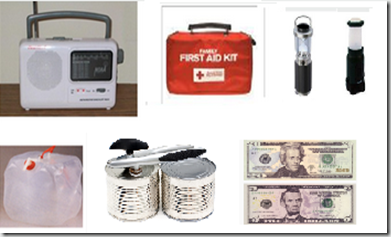
 

Having a modest supply of food, water, and medicine – and a workable family or business disaster plan – can go a long ways toward reducing both stress and hardship during and after a disaster. The standard advice is that everyone needs to be prepared to deal with a disaster for at least 3 days (meaning having a first aid kit, emergency supplies, and a plan) before help arrives.


Sure . . .  they’d like you to be prepared for longer . . .  but 72 hours is a reasonable start. I personally advocate having 2 week’s worth of supplies, but then I live in the heart of hurricane country, and have a fondness for eating regularly (see NPM11: Living The Prepared Life). 


Although a good disaster plan and emergency kit are imperative to get you through the opening hours, days, or even weeks of a disaster, knowing how to help friends, family, and neighbors deal with the psychological effects of a disaster can be equally important.


A few resources you may wish to revisit:


In Psychological First Aid: The WHO Guide For Field Workers we looked a simple guidebook anyone can use to help others in emotional distress.


The CDC also provides a website which contains a number of resources devoted to coping with disasters.

Coping With a Disaster or Traumatic Event

Trauma and Disaster Mental Health Resources

The effects of a disaster, terrorist attack, or other public health emergency can be long-lasting, and the resulting trauma can reverberate even with those not directly affected by the disaster. This page provides general strategies for promoting mental health and resilience. These strategies were developed by various organizations based on experiences in prior disasters.


For more on disaster preparedness, you may wish to revisit:


When 72 Hours Isn’t Enough

In An Emergency, Who Has Your Back?

An Appropriate Level Of Preparedness

The Gift Of Preparedness – 2014 Edition

Sunday, January 18, 2015

Japan: HPAI H5 Confirmed In Saga Prefecture

image

Saga Prefecture - Credit Wikipedia


# 9592


On the heels of two earlier outbreaks in Miyazaki Prefecture and one in Yamaguchi in December, and one just last week in Okayama prefecture, today we learn that HPAI H5 has been confirmed at a farm in Saga Prefecture, and that culling has been ordered on two local farms.


While the NA subtype of this latest outbreak has yet to be determined, the other four outbreaks have all tested as HPAI H5N8, apparently carried to Japan by overwintering migratory birds (see Japan: H5N8 Detected In Izumi Crane).


H5N8 first emerged as a threat to poultry in January of 2014 on the Korean Peninsula, and since that time has infected poultry farms in China, Japan, Germany, The Netherlands, The UK, Italy, and most recently Taiwan.  The virus has also turned up in wild and migratory birds in the Pacific Northwest of the United States, California, Utah, and far northern Russia.


While not currently viewed as posing a threat to human health, we’ve seen this well-traveled virus readily reassort with other avian viruses in Taiwan (producing new variants of both H5N2 and H5N3), plus it continues to evolve on its own (see EID Journal: Describing 3 Distinct H5N8 Reassortants In Korea).


Which makes any characterization of this virus subject to a range of caveats.  For now, however, it H5N8 is viewed as primarily being a threat to the poultry industry.

.


The following announcements (translated) were posted on Japan’s MAFF website overnight.


For confirmation of suspected affected animals of highly pathogenic avian influenza in Saga Prefecture

January 18, 2015, in the poultry farm of Saga Prefecture, are suspected of highly pathogenic avian influenza, which is a livestock epidemic has been confirmed. We ask everyone to how the livestock officials, including the poultry breeding farmers, we ask that I am absolutely sure to early detection of thorough and abnormal poultry of again feeding and health management.

Related notification
Press release

According to this article from the Japan Times, 73,000 birds on two farms will be immediately culled, and a local ban on the shipment of chickens and eggs has been imposed while adjacent farms are tested.


Saga begins culling of nearly 73,000 chickens after bird flu confirmed

Kyodo, JIJI

Jan 18, 2015

SAGA – The Saga Prefectural Government began culling about 72,900 chickens Sunday at two poultry farms in the town of Arita after confirming a bird flu outbreak at one of two farms operated by the same owner.

(Continue . . .)

Friday, January 16, 2015

HPAI H5 In Okayama - Major Culling Ordered

image

Credit Wikipedia


# 9583


Meanwhile, in Japan, their avian flu woes continue with another farm – this time in Okayama – testing positive for the highly pathogenic H5 (and likely H5N8) virus.  Roughly 200,000 birds will be culled over the next few days – far more than all three earlier outbreaks this winter combined (see Japan: H5 Confirmed in Miyazaki Poultry – Testing In Yamaguchi).

.


First, the notification on Japan’s MAFF website (note: translated), followed by a report from Xinhua News.


For confirmation of suspected affected animals of highly pathogenic avian influenza in Okayama Prefecture

January 15, 2015, in poultry farm in Okayama Prefecture, are suspected of highly pathogenic avian influenza, which is a livestock epidemic has been confirmed. We ask everyone to how the livestock officials, including the poultry breeding farmers, we ask that I am absolutely sure to early detection of thorough and abnormal poultry of again feeding and health management.

Related notification
Press release


Japan's Okayama starts culling 200,000 chickens after bird flu confirmed

(Xinhua)    13:31, January 16, 2015


OSAKA, Jan. 16-- A cull of some 200,000 chickens began on Friday at a farm in Okayama Prefecture in western Japan, following confirmation of a highly pathogenic H5 strain of bird flu virus, local media reported.

The cull is expected to take four days, with roughly 50,000 birds killed each day. The dead birds will be incinerated.

The case was reported to the local livestock health center by the farm on Thursday morning, after 28 of its birds were found dead beginning on Wednesday.

Four of the dead chickens and one living one tested positive, and a further genetic test confirmed the virus.

The prefectural government has imposed a ban on the movement of chickens and eggs at six farms within a 3-km radius of the farm.

Fifteen other farms in a 10-km radius have been ordered not to ship their products. The 21 farms raise nearly one million birds all together.

This is the fourth avian influenza case detected in Japan this winter. The previous three cases, two in southwestern prefecture Miyazaki and one in western prefecture Yamaguchi, have resulted in the killing of chickens ranging from 4,000 to 42,000 per instance.

Okayama is the fourth largest chicken egg producing prefecture in Japan, with around 10 million chickens.


Monday, December 29, 2014

Japan: H5 Confirmed in Miyazaki Poultry – Testing In Yamaguchi

image

Map source - Wikipedia


# 9506


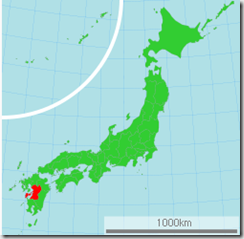
Yesterdays’ preliminary positive tests at a poultry farm in Miyazaki Japan have been confirmed as HPAI H5, and 42,000 birds are to be culled in the second outbreak in two weeks in the same region of southern Japan.  The outbreak reported on December 16th was H5N8, although of a different sub clade than previously seen in Japan.


Meanwhile, further north in Yamaguchi Prefecture, officials report a preliminary positive test as well.


These poultry outbreaks come amid the backdrop of repeated detections of H5N8 in wild and migratory birds which come to southern Japan each year to overwinter (see Japan: H5N8 Detected In Izumi Crane & H5N8 In Migratory Bird Droppings).


Two reports, therefore.  The first from NHK News:

And dispose of the bird flu detected about 42 000 birds

December 29 12:13

The 28th, in response to the fact that the H5 type of avian influenza virus from poultry farms of chicken Miyazaki has been detected, Miyazaki Prefecture, and dispose of the chicken about 42 000 birds of this poultry farms, the work to fill in the site we are.

The 28th, it was confirmed the 30 chickens are dying at a poultry farm in Miyazaki Takaoka-cho, where Miyazaki Prefecture were in detail inspection, bird flu virus that could of virulent of "the H5" is detected from a few birds has been. For this reason, Miyazaki Prefecture dispose of the chicken about 42 000 birds that had been raised in this poultry farms based on the country of guidelines, we are currently working and disinfection to fill

(Continue . . .)


And this report from Asahi.com, on a suspected outbreak in Nagato.


Nagato of poultry farms suspicion of highly pathogenic avian influenza infection in Yamaguchi

At 20:44 on December 29, 2014 Yamaguchi Prefecture on the 29th, cases of infection were suspected to highly pathogenic avian influenza virus in the prefecture has been confirmed, was announced. According to the prefecture, that chickens suspected infected with poultry farms of the prefecture Nagato is found. In this poultry farm, you are reared about 30 007 Senba Beef chicken. Ken open measures conference from the same day 18:30, to discuss the correspondence.

(Continue . . .)


While biosecurity measures at poultry operations in Japan tend to be excellent, in 2011 an outbreak of H5N1 in Miyazaki forced the destruction of a million birds, and so concerns over the extent of this latest intrusion by HPAI into Japan are running high.

Sunday, December 28, 2014

Miyazaki, Japan: Another Farm With Suspected Bird Flu

image

Credit Wikipedia


# 9501


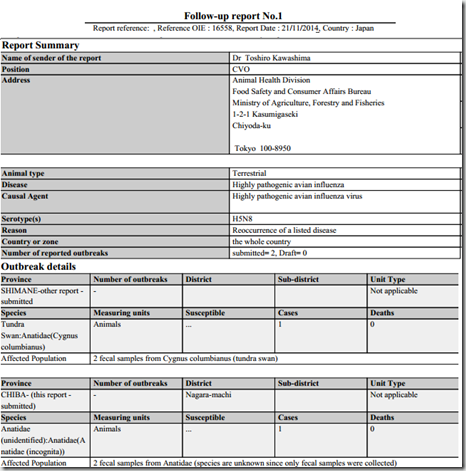
On December 16th we saw a report of a small farm infected with the H5N8 virus (see Japan: Preliminary Positive Test For H5 Bird Flu In Miyazaki) which last Friday was announced by NARO: Miyazaki H5N8 Outbreak A Different Sub Clade than previous Japanese outbreaks.


Now another, larger, poultry farm in the same prefecture has tested positive in a preliminary test, although additional testing will be needed to confirm the subtype (and ultimate, the sub clade).


This report from NHK.


Suspicion of poultry farms avian influenza in Miyazaki

December 28 21:22

The 28th in the poultry farm in Miyazaki, and found the dead one after another chicken, a result of the simple test, positive reaction of the bird flu virus was out of this Five birds.

Miyazaki Prefecture as well as perform a detailed inspection, to such as poultry farms located within 10 km radius of this farm, was asked to refrain from moving, such as chicken and eggs.

The 28th morning, there is a report from the poultry farm in Miyazaki Takaoka-cho, that "the number of die chicken is increasing", where Miyazaki Prefecture were examined, of approximately 42 000 birds that have been raised in this poultry farm of chicken The out 30 birds is dead I was confirmed.

(Continue . . .)

Friday, December 26, 2014

NARO: Miyazaki H5N8 Outbreak A Different Sub Clade

image

Credit Wikipedia


# 9488


While not a huge surprise – given the ever-growing diversity of H5 avian viruses in general and previous reports of multiple reassortants of H5N8 in Korea – this morning Japan’s National Agriculture and Food Research Organization (NARO) has announced that an analysis of the recent H5N8 outbreak in Miyazaki Prefecture shows it differs enough from previous Japanese outbreaks to be considered a different sub clade.


First some excerpts from the press release (machine translated), then I’ll return with a bit more.


      Summary

      • January 2014 or later, Korean house Kinya has continued to prevalent in wild bird H5N8 subtype highly pathogenic avian influenza virus 1) (Highly Pathogenic Avian Influenza Virus: HPAIV), the poultry of Kumamoto Prefecture in April in Japan cause the occurrence of HPAI in place since November, feces of Chiba Prefecture of wild birds (ducks), and is separated from Kagoshima Prefecture of vine, etc.. In addition, has been reported the occurrence of HPAI is caused by viruses of the same subtype in November and later Europe and North America of poultry, etc..

      • The NARO National Institute of Animal Health, HPAI causative virus of that occurred in the poultry farm in Miyazaki Prefecture in December 16, 2014 is H5N8 subtype 2) as well as to identify that it is a HPAIV, of all of the genes of this virus The nucleotide sequence I was quickly determined.

      • And are separated by the South Korea and Europe on the Chiba strains and public gene information database that has been separated from the feces of ducks in Kumamoto stocks and November 2014 that has been separated from dead chickens the determined nucleotide sequence in April 2014 I made a comparative analysis of the H5N8 subtype HPAIV gene.

      • This time, isolated virus (Miyazaki Ltd.) is, Kumamoto stock, Chiba stock, and South Korea since January, is derived from a common ancestor with the H5N8 subtype HPAIV that have occurred in the European poultry since November It is now clear.

      • On the other hand, Miyazaki strain, from the difference of gene sequences, Kumamoto stocks and Chiba stock, and Europe generated stock has been clearly distinguished.

      • HPAI that occurred in this Miyazaki Prefecture, Kumamoto Prefecture of poultry farms in April this year, the cases of wild birds in Chiba Prefecture in November found that direct relationship does not. This will be different from the one that occurred in April 2014, after the fall, we have suggested that at least two types of H5N8 subtype HPAIV are newly entering the country.

      • From the fact that mutation of the amino acid sequence deduced to be involved in the infection to humans was observed, Miyazaki strains I are considered less likely to infect humans directly.

          (Continue . . . )

        Until now, all of the Japanese H5N8 samples (and most Korean and European samples) have all fallen from the same branch of the H5 2.3.4.6 phylogenic tree (highlighted in yellow below), a clade that includes the H5N1 and H5N6 viruses as well. 

        image

        Adapted from FAO-EMPRES Report On The Emergence And Threat Of H5N6.

        It will be interesting to see exactly where this Miyazaki virus falls into the H5 phylogenic tree.


        Influenza viruses are constantly throwing the genetic dice, and while most of these variants will be evolutionary failures and fade away quickly, sometimes a `biologically fit’ and competitive strain appears and thrives.  


        Influenza viruses normally evolve through a process called antigenic drift – a relatively slow process where minor amino acid substitutions accrue during (flawed) reproduction –  but sometimes a new `hybrid’ virus will emerge from a process called antigenic shift, or reassortment.

        image

        Reassortment of two Avian Viruses Producing a Hybrid (Reassortant) Virus

        Shift occurs when one virus swap out chunks of their genetic code with gene segments from another virus.  Like viral tinker toys, these interchangeable parts allow for the creation of many different hybrids.  While far less common than drift, shift can produce abrupt and sometimes dramatic changes to the virus (see NIAID Video: How Influenza Pandemics Occur).


        When an avian influenza virus remains in its reservoir host (predominantly waterfowl) – to which it is already well adapted – it usually changes very slowly. When it enters a new host population – like commercial poultry  – it can begin to evolve rapidly, producing numerous clades and subclades.


        After a decade of pretty much only having to worry about H5N1 (2003-2013), over the past couple of years we’ve seen the sudden emergence and/or spread of multiple clades of HPAI avian H5N8, H5N6, H5N3, and H5N2 along side H7N9, H10N8 and a handful of `minor players’ like canine & equine H3N8, canine H3N2, and even H10N7 in marine mammals.


        The concern is - while one can’t predict where any of these viruses will end up - the greater the diversity of novel viruses in circulation, the greater the chances of someday seeing one jump to, and adapt to, humans.


        For more on this rapidly expanding array of novel flu viruses you may wish to revisit:

        The Expanding Array Of Novel Flu Strains

        EID Journal: Predicting Hotspots for Influenza Virus Reassortment

        Viral Reassortants: Rocking The Cradle Of Influenza

        Monday, December 15, 2014

        Japan: Preliminary Positive Test For H5 Bird Flu In Miyazaki

        image

        Credit Wikipedia


        # 9444


        After the earlier reports from Germany & Canada along with continued media chatter out of Egypt, I’d say this is turning out to be a busy bird flu Monday - except it is already Tuesday in Japan - where a farm in the far South of the country is currently under suspicion of having an outbreak of H5 avian flu.


        Based on the somewhat cryptic machine translations, a farm in Miyazaki where some birds have recently died has tested positive for avian flu, although the exact subtype has yet to be determined.


        Over the past month we’ve been monitoring the arrival of H5N8 infected migratory birds to their winter nesting grounds in southern Japan (see Japan: H5N8 Detected In Izumi Crane & H5N8 In Migratory Bird Droppings) and local poultry farms have been on high alert. 


        Japan saw a brief incursion of the H5N8 virus last April while South Korea was battling against multiple outbreaks (see Japan’s Avian Flu Outbreak Identified As H5N8 ). More reliable test results – which should provide subtyping -  should be available in the next few hours.   


        A pair of reports:.


        Bird flu: to detect the H5 from chicken poultry farm in Miyazaki Nobeoka

        Mainichi at December 16, 2014 04 

        Miyazaki Prefecture on the 16th, has announced that it has detected the avian influenza virus H5 type in genetic testing from chickens that died in the poultry farm of Nobeoka Kitagawa-cho. Is good that there is a high possibility of highly pathogenic, county and city on the 16th 2:30, began culling of about 4000 birds that have been raised in this poultry farm. The county was set to 3 km radius within the movement restricted areas of chicken, radius of 10 kilometers a carry-out restricted areas.
        Related article

        According to the county animal husbandry nascent Promotion Bureau, the 14th in this poultry farm, died 10 chickens, but agricultural cooperatives staff did a simple test positive reaction was not out. Died newly 19 birds in the 15th. Showed that simple test by sending them two birds alive and 3 birds in Nobeoka Livestock Hygiene Service Center (city), positive reaction was out of the three birds that died. Showed that genetic testing in the three birds Miyazaki Livestock Hygiene Service Center (Miyazaki), it was confirmed virus.

        (Continue . . .)


        Ministry of Agriculture, Forestry and Fisheries held a quarantine headquarters in Miyazaki "bird flu" (12/16 01:17)

        In response to that positive reaction of avian influenza in the simple test from chicken poultry farm in Miyazaki Prefecture Nobeoka came out, the Ministry of Agriculture, Forestry and Fisheries is the early morning of the 16th, was held emergency epidemic prevention headquarters.

        Nishikawa agricultural minister: "for the spread of the disease (spread) prevention, because initial response is more important than anything, and I would like you to cope with tightening the care are placed in Dear"

        MAFF, highly pathogenic If it turns out that the bird flu, as well as carry out the slaughter of chicken about 4000 birds that have been raised in this farm, we want to strengthen the disinfection of peripheral.

        Saturday, November 29, 2014

        Japan: H5N8 Detected In Izumi Crane

        image

        H5N8 Branching Out To Europe & Japan


        # 9385


        Like the Mission San Juan Capistrano’s annual return of the swallows,  Izumi City on southern tip of Japan is famous for the yearly arrival and overwintering of thousands of rare Hooded, and White-naped cranes.  The International Union for Conservation of Nature (IUCN) lists both species as Vulnerable (one step up from Endangered).


        Both species spend their summers in Mongolia, Siberia, or Northwestern China - and of the roughly 10,000 hooded swans in the world - 80% overwinter in Izumi.


        Hooded cranes, and the nature preserve at Izumi, are regarded (and often referred to as) `National Treasures’ in Japan, which is why in 2010-11 we saw a near panic among officials when 5 Hooded Cranes Test Positive For H5N1 in Izumi.  As I discussed in Japan’s Bird Flu Dilemma, there are few options open to officials when a potentially deadly virus strikes a rare, and protected species of birds.


        The impact that year was limited (many birds can carry the virus without ill effect), and we did not see a major return of H5N1 bird flu during the past few winters. 


        Fast forward to 2014, and suddenly Japan, Korea, and Europe are being visited by birds carrying a new – highly pathogenic – H5N8 virus.  This avian influenza subtype emerged as a threat in Korea last January, and last spring caused millions of dollars of damage to their poultry industry. 


        As I reported on Thursday (see Bird Flu Reports From India, Japan, Korea & Taiwan), Japan has already reported three detections of the H5N8 virus in migratory birds this winter.  Today we learn that the virus has now been detected in a White-naped crane at the nature preserve at Izumi city.


        Kagoshima in virulent bird flu = Japan's largest crane wintering grounds - Ministry of the Environment

        Ministry of the Environment has announced that the 29th was detected highly pathogenic avian influenza virus strong toxic from White-naped of Kagoshima Prefecture Izumi (H5N8 subtype). The city, there is Japan's largest wintering grounds that vines more than 10,000 birds to try, vines and about 245 hectares of land has been designated as special national treasure. The detection of highly pathogenic virus, season four cases first. (2014/11 / 29-17: 46)

        While there isn’t a lot of surveillance data available, we’ve already seen the H5N8 virus show up this fall in Korea, China, Japan, Germany, the Netherlands, and the UK – both in domesticated poultry, and in wild or migratory birds.

        Compared to other avian flu viruses we’ve followed over the past decade, this one seems to be spreading geographically at a very rapid rate.


        The good news, is that so far there have been no documented human infections with H5N8, and so this virus remains primarily a threat to wild birds and poultry operations.


        For more on the spread of H5N8, you may wish to revisit:


        FAO Warns On H5N8’s Spread

        Bird Flu Spread: The Flyway Or The Highway?

        EID Journal: Subclinical HPAI In Vaccinated Poultry – China


        Saturday, November 22, 2014

        Germany & Japan Both Report H5N8 In Wild Birds

        image

        International Migratory Flyways


        # 9361


        On Tuesday, in H5N8: A Case Of Deja Flu?, I recounted the history of great H5N1 bird flu expansion of 2005-2007, where that virus jumped from only 9 Southeast Asia countries to 60+ nations across Europe and Asia.  While it is far from clear whether H5N8 will follow H5N1’s flight path, we continue to see evidence of its encroachment to other regions of the world.

        Since Tuesday, the Netherlands has reported several additional farms infected (see Netherlands: 2nd Farm At Kamperveen Showing Signs Of Bird Flu), and both Japan and Germany have found evidence of the virus in wild or migratory birds.

        First stop, a report today from Reuters of a 2nd detection of H5N8 in Germany, this time in wild birds.

        Germany reports second case of bird flu - H5N8 found in wild bird

        BERLIN Sat Nov 22, 2014 10:51am EST

        Nov 22 (Reuters) - German authorities on Saturday confirmed a second case of the H5N8 strain of bird flu in the eastern state of Mecklenburg-Vorpommern, with the virus found in a wild bird.

        The strain is highly contagious among birds but has never been detected in humans.

        "For the first time, the H5N8 virus has been confirmed in a wild bird in Mecklenburg-Vorpommern," Agriculture Minister Christian Schmidt said in a statement.

        (Continue . . .)


        Japan, which saw a brief incursion of the H5N8 virus last April while South Korea was battling against multiple outbreaks (see Japan’s Avian Flu Outbreak Identified As H5N8 ), and which reported a little more than a week ago H5N8 In Migratory Bird Droppings, has now reported to the OIE another detection of H5N8 in Chiba prefecture.

        image


        According to a Japan News article earlier today (Bird flu detected in Chiba Prefecture), with this second detection, Japan will now raise its nationwide bird flu alert from 2 to 3, and dispatch an emergency wild bird survey team.


        While none of this is absolute confirmation that the H5N8 virus arrived in Western Europe on the wings of migratory birds, when you combine these recent detections in birds, and the statement from the OIE: European H5N8 Strain `Closely Related’ To Korean Strain, the preponderance of evidence swings in that direction.


        For more on this you may wish to revisit these recent related blogs:

        FAO On The Potential Threat Of HPAI Spread Via Migratory Birds

        Bird Flu Spread: The Flyway Or The Highway?

        EID Journal: Subclinical HPAI In Vaccinated Poultry – China

        Thursday, November 13, 2014

        Japan: H5N8 In Migratory Bird Droppings

        image

        Credit U.S. Fish and Wildlife Service


        # 9318


        The emergence last January of a new Highly Pathogenic H5N8 avian influenza virus in South Korea resulted in the destruction of more than 13 million birds in dozens of farms throughout the Korean peninsula. 


        Japan saw a brief incursion  last April (see Japan’s Avian Flu Outbreak Identified As H5N8), but forewarned by the Korean outbreak, as able to quickly contain that outbreak.


        Since then sporadic outbreaks continue to pop up in South Korea, and H5N8 was recently reported in Northwestern China, and last week in Northern Germany (see UK: Defra Preliminary Assessment On Germany’s H5N8 Outbreak In Poultry).


        Given its detection in wild ducks in Korea, and its widespread and rapid geographic dispersal, migratory birds are eyed as playing a role in the spread of the virus (see Bird Flu Spread: The Flyway Or The Highway?). 


        With migratory birds heading south for their winter nesting grounds, Japan once again finds itself on guard against another introduction of the virus.  Today, Japan’s Ministry of Environment has announced the detection of the H5N8 virus in migratory bird dropping collected in Yasugi, Shimane Prefecture.

        image

        Avian influenza virus, detected from the migratory bird droppings Shimane Yasugi

        November 14, 2014


        Ministry of the Environment on October 13, Shimane Prefecture Yasugi highly pathogenic from droppings of amber butterfly found in the avian influenza virus (H5N8 subtype) has announced has been detected, and.

        Virus in the droppings of study of migratory birds that Kyotosangyodai is doing on its own, was found from 2 specimens were collected in three days. Ministry of the Environment is to specify the surrounding 10 km close to wild bird monitoring emphasis area, began to dispatch preparation of emergency investigation team.


        Japan, Korea, and Hong Kong are all part of the great East Asian - Australasian Flyway. All three are the winter and fall home for a variety of migrating birds - many of which spend their summers in Siberia, China, and Mongolia – areas where avian influenza viruses have been detected in wild bird populations before (see Siberian Birds Test Positive For H5N1 Antibodies and Siberian Birds Show H5N1 Antibodies).


        In 2010, Japan was faced with multiple introductions of H5N1 (see Japan: Hooded Crane Positive For H5N1) from migratory birds overwintering in the national reserve in Izumi City, Kagoshima Prefecture. In 2011, even more infected birds arrived (see Japan’s Bird Flu Dilemma).


        While there is not a lot that officials can do about migratory birds flying in with highly pathogenic viruses, they can warn local poultry operations to beef up biosecurity and surveillance, and can gear up to respond to any outbreaks.


        With the recent emergence of H5N6, H5N8, H5N3, H10N8  - along with the already established H5N1, H5N2 and H7N9 viruses -  more than ever, much of Asia and Europe must now stay alert for the possibility of seeing the arrival of one of these viruses.


        For more on the potential of migratory birds to spread avian viruses, you may wish to revisit:

        PLoS One: North Atlantic Flyways Provide Opportunities For Spread Of Avian Influenza Viruses

        EID Journal: H5N1 Branching Out

        FAO: On The Trail Of Avian Influenza

        Tuesday, September 02, 2014

        Japan: Locally Acquired Dengue Cases Rise To 34

        image

        Credit Wikipedia


        # 9026


        Less than a week ago, in Japan Reports 1st Locally Acquired Dengue Case In 60 Years, we learned of a teenage girl  (without recent travel history outside the country), living in Saitama prefecture (near Tokyo) who had been diagnosed with Dengue fever.


        This marks Japan’s first locally acquired case of the mosquito-borne virus since the 1940s (although a German tourist came home from a trip to Japan with Dengue in 2013).


        In less than six days the number of Dengue cases reported from Japan has jumped to 34, with nearly all of them associated with recent visits to the  popular Tokyo destination Yoyogi Park (once part of the 1964 Olympic Village) , which is adjacent to the Harajuku railway station and Meiji Shrine in Shibuya.


        Dengue fever cases jump to 34 as outbreak spreads around Japan

        September 02, 2014

        THE ASAHI SHIMBUN

        Health ministry officials announced on Sept. 2 that 12 more cases of dengue fever have been confirmed from mosquitoes at Tokyo's Yoyogi Park, with the outbreak spreading farther across the country.

        The latest patients reside in Tokyo, Osaka, Aomori and Yamanashi prefectures. Like the 22 other cases already confirmed, the 12 individuals have not gone abroad recently, but have visited Yoyogi Park in Shibuya Ward and its vicinity.

        (Continue . . . )


        While having a common, geographically-limited source may make eradicating their infected mosquitoes easier, the danger exists that visitors to the park either have, or will carry the virus to infect other mosquito populations in Japan. 


        We’ll know that has happened if cases not associated with Yoyogi Park begin to emerge. 


        While dengue infected mosquitoes may not survive Japan’s winter, the yearly influx of millions of tourists – many from regions of the world where Dengue is endemic – all but assures the virus will be re-introduced to Japan’s mosquito population in the future.


        The World Health Organization estimates 100 million people are infected with Dengue each year, and 500,000 are sickened enough to require hospitalization.  The WHO considers Dengue to be the most rapidly spreading mosquito borne viral disease in the world, and that increasingly it is posing a threat to both Europe and North America. 

        image

        Countries at risk for Dengue Transmission


        For more on the spread of Dengue around the world you may wish to revisit these recent blogs:


        PAHO/WHO: Epidemiological Alert On Chikungunya & Dengue In the Americas

        Florida: Miami Reports 1st Locally Acquired Dengue Case Of 2014

        Locally Acquired Dengue In New York City.

        Wednesday, August 27, 2014

        Japan Reports 1st Locally Acquired Dengue Case In 60 Years

        image

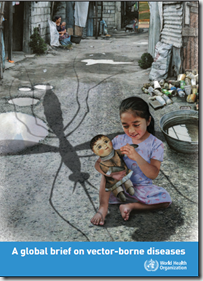
        Global brief on vector-borne diseases
        pdf, 4.45 Mb


        # 9005


        Officially Japan hasn’t seen a locally acquired case of Dengue since the late 1940s, although in January of this year the journal Eurosurveillance published a reports on a German tourist who was diagnosed with the disease upon returning home from a trip to Japan (see Autochthonous dengue virus infection in Japan imported into Germany, September 2013).


        Today, however, the Japanese Ministry of Health is reporting the local acquisition of the virus by a teenage girl (without travel history outside the country) residing in in Saitama prefecture, adjacent to Tokyo (see AP report Japan sees 1st local dengue case in over 60 years).


        Japan, like the United States, sees hundred of imported dengue cases each year – carried by travelers coming from areas of the world where the virus is endemic.


        If an infected traveler is viremic (currently producing large quantities of virus in the blood) - and is bitten by a local mosquito capable of vectoring the disease - it is possible to introduce the virus to a new region. In 2009 Dengue returned to the South Florida after a 60 year absence, and since then we’ve seen a handful of locally acquired cases each year (see MMWR: Dengue Fever In Key West). 


        In order to spread, Dengue requires the right mosquito vector.  And the two species best suited to transmit the virus are the Aedes aegypti and Aedes albopictus mosquitoes, which also can spread such diseases as West Nile, Malaria, Yellow Fever, and Chikungunya.


        While the Aedes Aegypti isn’t a problem in Japan, the Aedes Albopictus (`Asian Tiger’) mosquito is.

        image


        After World War II advances in insecticides and massive mosquito control programs practically eliminated Dengue in all but a few tropical ports.   But over the past 40 years - between the explosion of world travel, a rise in insecticide resistance, and lapses in mosquito control – the incidence of dengue around the world has literally exploded.


        The World Health Organization  estimates 100 million people are infected with Dengue each year, and 500,000 are sickened enough to require hospitalization.  The WHO considers Dengue to be the most rapidly spreading mosquito borne viral disease in the world, and increasingly it is posing a threat to Europe and North America. 

        image

        Countries at risk for Dengue Transmission


        The detection of a single autochthonous Dengue infection in Japan hardly constitutes a public health emergency, but it is another sign that this mosquito borne virus continues to encroach into new regions around the world, and that even places previously thought immune are becoming increasingly vulnerable.


        And since they share a common mosquito vector, that probably holds true for Chikungunya as well. 

        Friday, July 25, 2014

        Study: Reassortants of H1N1pdm & Swine H1 & H3 Viruses in Japan

        image


        # 8866


        We’ve another study, this time from Japan, that shows how quickly the 2009 H1N1 pandemic virus jumped from humans back into the local swine population, and how is has since reassorted into several new, distinct hybrid viruses.  This is a pattern we’ve observed both here in United States, and elsewhere (see J. Virol: Continued Reassortment Of Swine Flu Viruses With Genes From pH1N1 In China).


        While we watch avian H5, H7, and H10 viruses with suspicion, over the past 120 years or so only H1, H2, and H3 influenza viruses  - the type commonly circulating in pigs – are known to have sparked pandemics. Making emerging swine flu viruses of particular concern, a topic we explored a few weeks ago in Are Influenza Pandemic Viruses Members Of An Exclusive Club?

        image


        Here in North America we’ve been watching the evolution of several swine variant viruses (H1N1v, H1N2v, H3N2v) over the past few years, all of which have reassorted with - and picked up the M gene segment from – the 2009 H1N1 virus.


        The CDC has speculated that `This M gene may confer increased transmissibility to and among humans, compared to other variant influenza viruses.’


        Today’s study is a reminder that once the 2009 H1N1 virus spread globally, it was reintroduced into pig herds (which host varying strains of swine influenza viruses (SIVs) around the world), and has since reassorted into new strains.  Strains that continue to evolve – mostly unmonitored – in millions of pigs around the world.


        J Vet Med Sci. 2014 Jul 24. [Epub ahead of print]

        Genomic Reassortants of Pandemic A (H1N1) 2009 Virus and Endemic Porcine H1 and H3 Viruses in Swine in Japan.

        Kirisawa R1, Ogasawara Y, Yoshitake H, Koda A, Furuya T.

        Author information
        • 1Laboratory of Veterinary Virology, Department of Pathobiology, School of Veterinary Medicine, Rakuno Gakuen University.
        Abstract

        From 2010 to 2013 in Japan, we isolated eleven swine influenza viruses (SIVs) from pigs showing respiratory symptoms. Sequence and phylogenetic analyses showed that six H1N1 viruses originated from the pandemic (H1N1) 2009 (pdm 09) virus and the other five viruses were reassortants between SIVs and pdm 09 viruses, representing four genotypes.

        Two H1N2 viruses contained H1 and N2 genes originated from Japanese H1N2 SIV together with internal genes of pdm 09 viruses. Additionally, one H1N2 virus contained a further NP gene originating from Japanese H1N2 SIV. One H1N1 virus contained only the H1 gene originating from Japanese H1 SIV in a pdm 09 virus background. One H3N2 virus contained H3 and N2 genes originating from Japanese H3N2 SIV together with internal genes of pdm 09 virus.

        The results indicate that pdm 09 viruses are distributed widely in the Japanese swine population and that several reassortments with Japanese SIVs have occurred.


        As global pig production grows – particularly in places where biosecurity and surveillance may be lax – it creates increasing opportunities for a new, biologically `fit’  swine variant virus to emerge.  As you can see by the chart below, swine production is growing fastest in developing countries, where biosecurity is likely to be the least stringent.

        image

        Source: FAO 


        Although most novel flu viruses are evolutionary failures, with a playground consisting of billions of avian and porcine hosts -  and with nature’s laboratory churning out new hybrids 24/7 -  the odds of someday seeing another `successful’ swine or avian reassortant emerge and spark a pandemic is  considered all but inevitable.


        It’s just a matter of when.


        For some recent blogs on swine influenza, you may wish to revisit:


        EID Journal: H3N2v Swine To Human Transmission At Agricultural Fairs – 2012
        CDC: Measures to Minimize Influenza Transmission at Swine Exhibitions, 2014
        EID Journal: Predicting Hotspots for Influenza Virus Reassortment

        Thursday, April 17, 2014

        Japan’s Avian Flu Outbreak Identified As H5N8

        image

        Credit Wikipedia


        # 8487


        Last Sunday, in Japan: Detection Of H5 Avian Flu At Poultry Farm, we looked at the first reported outbreak of avian influenza in Japan since 2011.  At the time, the culprit was only identified as an HPAI H5 virus, and I said it would be a few days before we would know if it were H5N1, H5N2, or the recently emerged (in Korea) H5N8 strain.


        Today (h/t Crof) we learn from a report in the Japan Times, that the virus has now been identified as H5N8. First a link to the report, then I’ll return with a bit more on this emerging subtype.


        Kumamoto bird flu strain ID’d as H5N8, new to Japan

        Kyodo

        Apr 17, 2014

        The avian influenza found in chickens in Kumamoto Prefecture has been identified as the H5N8 virus, the agriculture ministry said Thursday.

        The Agriculture, Forestry and Fisheries Ministry said it found H5N8 in samples from birds at a farm in Kumamoto where a surge in chicken deaths set off the culling Sunday and Monday of some 112,000 birds.

        This is the first discovery of the H5N8 virus in Japan. Cases of suspected H5N8 bird infections have been reported since January in South Korea.

        (Continue . . .)


        Ever since the Highly pathogenic H5N8 first emerged in South Korea last January, Japan’s MAFF (Ministry of Agriculture, Forestry, and Fisheries ) has kept a close watch on that outbreak, and has ramped up surveillance across Japan. The reason for local concern being the same migratory birds that likely brought the virus to South Korea also over-winter in Japan.


        image


        Although previously seen in other parts of the world in a low pathogenic form (see CIDRAP 2008 Low-pathogenic avian flu hits Idaho game farm), at least one detection of H5N8 in an HPAI form was previously  recorded in China back in 2009-10 (see Characterization of three H5N5 and one H5N8 highly pathogenic avian influenza viruses in China).


        Despite intensive containment measures, disinfection and culling of farms, and the halting of poultry product transport, the virus has continued to spread across much of the South Korean Peninsula over the past 90 days. 


        Authorities are hoping that the return of warmer weather will aid in their eradication of the virus.  As the MAFF graphic below indicates, the virus has spread widely across the South Korean peninsula.


        image

        Now, with today’s announcement, we’ll have to see if Japan’s head’s up from Korea’s experience will help them to quickly corral the virus.

        Sunday, April 13, 2014

        Japan: Detection Of H5 Avian Flu At Poultry Farm

        image

        Credit Wikipedia


        # 8467


        It’s been three years since Japan has had to deal with an H5 avian flu outbreak in poultry or wild birds (see OIE reports 29/06/11 Final report 48089 & 25/06/11 Final report 48022), but that respite appears over as several birds at a poultry farm in Kumamoto Prefecture have tested positive for the avian virus. 


        The exact subtype has yet to be identified, but any form of H5 influenza is considered a serious threat to the poultry industry, so Japan’s MAFF (Ministry of Agriculture, Forestry & Fisheries) has issued culling and quarantine instructions.


        We should learn in the next day or so whether this outbreak is due to H5N1, H5N2, or the newly emerged H5N8 virus.  Below you’ll find links to announcement from MAFF, along with a translated statement  on the outbreak.


        About the situation of avian influenza in Japan

        April 13, 2014, in the flesh for chicken farm in Kumamoto Prefecture, suspected affected animals of highly pathogenic avian influenza, which is a domestic animal infectious disease has been confirmed.

        The We ask everyone who livestock stakeholders, including the poultry breeding farm, we ask that you deemed to early detection of abnormal poultry breeding and thorough hygiene management again.

        Related notification
        Press release


         April 13, 2014

        Ministry of Agriculture, Forestry and Fisheries

        For the installation of the "Ministry of Agriculture, Forestry and Fisheries avian influenza epidemic prevention task force" and confirmation of suspected affected animals of highly pathogenic avian influenza in Kumamoto Prefecture

        Today, in the flesh for chicken farm I Kumamoto Prefecture, suspected affected animals of highly pathogenic avian influenza, which is a domestic animal infectious disease has been confirmed. For this reason, today, we held by installing the "Ministry of Agriculture, Forestry and Fisheries avian influenza epidemic prevention task force", the Ministry of Agriculture has decided to deal with future policies.

        In addition, since the feeding administrator of the farm, was also carried out another farm management II, by the farm was also determined that the occurrence of farm suspected affected animals.

        2 The farm has been restricting the movement of poultry rearing, etc. from the time the simple test were positive on a farm that symptoms develop.

        It should be noted that, in our country, by eating poultry and egg poultry meat, cases of avian influenza virus was transmitted to humans has not been reported until now.

        That may cause the spread of the disease, because it could violate the privacy of the person of the farmers, coverage in the field, thank you for your cooperation as strictly abstain.

        Overview 1. Farms

        Location:

        I doubt generation farm

        Kumamoto Prefecture Kuma County (Kuma-gun) Taragi Town (Taragi Town)

        II caretaker farms the same

        The prefecture same county Sagara Village (Sagara Village)

        Feeding situation:

        I meat for chicken (about 50,006 Senba)

        II for chicken meat (about 50,006 Senba)

        2. History

        Afternoon (1) yesterday, Kumamoto Prefecture, conduct on-site inspection of the farm I have received a report of dead chickens, etc. increase.

        Positive in five birds 5 birds in dead chickens (2) influenza simple test.

        For the farm, with an instruction to limit movement of poultry, etc., (3) the district conducted a genetic testing.

        (4) today, the results of genetic testing, make sure that it is a subtype H5.

        (5) In addition, for feeding administrator of the farm, was also carried out another farm management II, by the farm also determined that the occurrence of farm suspected affected animals. In addition, the instructions already moved another limitation on the farm is the same prefecture.

        Response 3. Future

        Based on such "specific livestock epidemic quarantine guidelines for low pathogenic avian influenza and highly pathogenic avian influenza", perform the following measures.

        The setting of movement restricted areas for the area of ​​3km radius within baked burial and culling of breeding poultry of 2 farm 1. I said, from II farm, required setting of the carry-out restricted areas for the area of ​​10km within III 3km radius The implementation quickly and accurately epidemic prevention measures.

        For farm 2. Transfer restricted area, and carried out the occurrence confirmation test as soon as possible.

        For three. Spread prevention, strengthen the disinfection of occurrence farm neighborhood and set up a disinfection point on the main road.

        Held a 4. Food, Agriculture and Rural Policy Council Animal Health Subcommittee poultry disease subcommittee, to obtain technical advice necessary to quarantine measures.

        In order to understand exactly 5. Infection status, the route of infection, etc., and to allow the study of precise quarantine policy, and dispatched experts of the National Institute of Animal Health and the Ministry of Agriculture, Forestry and Fisheries.

        In order to support the quarantine measures 却等 embedded fired and killed six. Kumamoto Prefecture, as required, and dispatched "emergency assistance team" animal quarantine station around the country, from the National Livestock Breeding Center, etc..

        Dispatch of 7. Epidemiological study team.

        For 8. Every prefecture, Notification again to thoroughly Early Notification and early detection of the disease.

        While achieving sufficient cooperation and 9. Relevant ministries, and strive to provide the most accurate information producers, consumers, to distributors, etc..

        4. Others

        (1) the farm, you restrict the movement of poultry rearing, etc. from the time that was positive in the simple test.

        (2) Note that, in Japan, by eating poultry eggs and poultry meat, cases of avian influenza virus was transmitted to humans has not been reported until now.

        That may cause the spread of the disease, because it could violate the privacy of the person of the farmer, interview (3) site, we will ask for your cooperation as strictly abstain.

        As there is no possibility that both (4) future, so will endeavor to provide information fast, accurate, consumer officials and producers such as confusion due to unfounded rumors, thank you for your cooperation.