Showing posts with label Basic Reproductive Number. Show all posts

Sunday, May 11, 2014

The Elusive R0 of MERS

image


# 8601


Yesterday, the International Journal of Infectious Diseases published an `article in press’ peer-reviewed manuscript that attempts to quantify the risks from the MERS coronavirus, entitled:


Middle East Respiratory Syndrome Corona virus, MERS-CoV. Conclusions from the 2nd Scientific Advisory Board Meeting of the WHO Collaborating Center for Mass Gathering Medicine, Riyadh.

Ziad A Memisha,,  Jaffar Al-Tawfiqb,  Christian Drostenc,  Abdullah Assiria,  Rafaat Alhakeema, Ali Albarraka, d,  Saber Yezlia,  Malak Almasria,  Alimuddin Zumlaa, e,  Eskild Petersenf

After reviewing what is known about the outbreak, animal reservoirs, human transmission and the management of hospital patients with MERS, the authors enumerate 13 conclusions.

Conclusions

  1. Sequencing of MERS-CoV isolates from Jeddah patients who’s the virus seems stable, showing no signs so far of mutations which indicate an adaption to humans with increased risk of human to human infections.
  2. The primary animal reservoir is camels and dromedars. Transmission is thought to be due to close physical contact or due to consumption of camel products.
  3. The epidemiology since the virus was first found in 2012 is compatible with multiple introductions into humans from the animal reservoir, with no long-term sustained human-to-human transmission.
  4. There is no human reservoir of cases with few or no symptoms.
  5. The basic reproductive rate of the virus (R0) is definitely below 1 and probably below 0.5 clearly showing that the virus has no pandemic or even local epidemic potential.
  6. The incubation period was between 2 to 16 days? Period of infectivity was?
  7. Nosocomial infection is an important risk factor for human to human transmission. Thus infection prevention and control measures are crucial to prevent the possible spread of MERSCoV within health care facilities. Hospital infection control procedures needs to be emphazised and enforced. The Jeddah outbreak showed that it is not always possible to identify patients with MERS-CoV early because some have mild or unusual symptoms.It is important that health-care workers apply standard precautions consistently with all patients irrespective of the diagnosis. Droplet precautions should be undertaken when providing care to patients with symptoms of respiratory tract infection. Contact precautions including eye protection should be added when caring for suspected or confirmed cases of MERS-CoV infection. Airborne precautions should be taken when performing aerosol generating procedures
  8. In patients suspected of MERS-CoV, if initial tests using nasopharyngeal swab is negative, repeat testing should be performed, and other specimens from the lower respiratory tract should be obtained if possible.
  9. Awareness of MERS-CoV is important in countries where camels and dromedars are a common livestock.
  10. The importance of educational campaigns for educating health care workers, the general public, family contacts and travelers to the Middle East was emphasized. General hygiene measures such as regular hand washing, antiseptic before and after handling animals Owners of camels and dromedars should use gloves and mask when handling ill animals.
  11. There is no evidence that camel's milk tested positive for MERS, however, milk has the potential of transmitting other infections. Camel milk should be boiled before consumption. Unpasteurised milk should not be consumed
  12. There was no grounds for preventing children attending schools and closing schools
  13. For the forthcoming Hajj, camel sacrifice or contact with camels should be avoided.


While all significant points of interest, from an epidemic standpoint, #5 in the list above would seem to have the most importance:


The basic reproductive rate of the virus (R0) is definitely below 1 and probably below 0.5 clearly showing that the virus has no pandemic or even local epidemic potential.


A definitive, and highly reassuring statement.   And hopefully correct.  But as with all reviews, at best reports like this can only tell us where this virus has been, not where it is going.  


The R0 (pronounced R-naught) is epidemiological yardstick by which human transmission of an infectious disease is measured. Essentially, the number of new cases in a susceptible population likely to arise from a single infection.


With an R0 below 1.0, a virus (as an outbreak) begins to sputter and dies out.


Above 1.0, and an outbreak can have `legs’.


Calculating the R0 is notoriously difficult, even years after an epidemic has passed. Much hinges upon the existence and subtle differences between viral strains, the accuracy of surveillance and reporting, `seasonality’, and individual host responses to the virus (i.e. number of `super spreaders’).


Like the CFR (Case Fatality Ratio), the R0 can vary considerably over time or geography, often ends up being described as a `range’, and usually isn’t well established (or at least, generally agreed upon) until long after an outbreak has ended.


Last July in The Lancet: Transmissibility Of MERS-CoV we saw the first attempts to quantify the basic reproductive number of this virus – at a time when the total number of MERS cases was still under 70 worldwide. Based on an extremely limited data-set, and hobbled by limited surveillance and reporting out of Saudi Arabia, the authors produced an early estimate of the virus’ apparent R0 (which they fixed at between .60 and .69).


Too low (at that time) to spark a pandemic.


But as Helen Branswell noted in her report - MERS doesn't have pandemic potential – yet  -  experts,  including Drs. Allison McGeer, Marc Lipsitch, and Chris Bauch (who co-authored a commentary on this study) - warned that past performance is no guarantee how this virus will behave in the future.


The following November, we looked at a study published in The Lancet Infectious Diseases, that looks at the likely extent of transmission of the MERS virus in the Middle East.


Middle East respiratory syndrome coronavirus: quantification of the extent of the epidemic, surveillance biases, and transmissibility

Simon Cauchemez PhD a , Prof Christophe Fraser PhD a , Maria D Van Kerkhove PhD a, Prof Christl A Donnelly ScD a, Steven Riley PhD a, Prof Andrew Rambaut PhD b, Vincent Enouf PhD c, Prof Sylvie van der Werf PhD c, Prof Neil M Ferguson DPh

Interpretation

By showing that a slowly growing epidemic is underway either in human beings or in an animal reservoir, quantification of uncertainty in transmissibility estimates, and provision of the first estimates of the scale of the epidemic and extent of case detection biases, we provide valuable information for more informed risk assessment.

The results – that for every case identified, there are likely 5 to 10 that go undetected –  suggest that this virus may be transmitting more efficiently than previously estimated. The authors believed the R0 of the MERS virus is likely close to 1.0, or perhaps even higher, and wrote:


We conclude that a slowly growing epidemic is underway, but current epidemiological data do not allow us to determine whether transmission is self-sustaining in man. Our analysis demonstrates that the transmissibility of MERS-CoV in man is close to the critical threshold of R=1 required for self-sustaining transmission. If R is greater than 1, then the number of human cases we estimate to have occurred to date make it highly likely that self-sustaining transmission has already begun.


Skipping ahead to February of this year, in mBio: Spread, Circulation, and Evolution of MERS-CoV, we looked at a study (also co-authored by Ziad Memish), that warned:


MERS-CoV adaptation toward higher rates of sustained human-to-human transmission appears not to have occurred yet. While MERS-CoV transmission currently appears weak, careful monitoring of changes in MERS-CoV genomes and of the MERS epidemic should be maintained. The observation of phylogenetically related MERS-CoV in geographically diverse locations must be taken into account in efforts to identify the animal source and transmission of the virus.


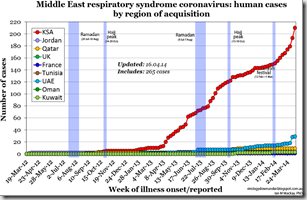
So far we’ve not seen the kind of exponential growth in MERS cases that would indicate that this virus has achieved a high enough basic reproductive number to spark a major epidemic.   Cases are rising, but more in a linear fashion.


Whether that equates to an R0 of <.5  or something approaching 1.0, I’ll leave to the epidemiologists of the world to sort out.


I would only note that there are still a lot of unknowns with this virus, including the incidence (and causes) of community transmission.  Surveillance outside of the hospital environment is spotty at best, and we really have no idea how many cases go unidentified.


The bottom line is that past performance doesn’t guarantee future behavior of this, or any other virus. 


Which means that as long as the MERS coronavirus continues to circulate in humans and animals in the Middle East, its potential to spark a larger epidemic should not be ignored.

Friday, April 18, 2014

The MERS Hospital Cluster Puzzle

image

R0 (pronounced R-nought) or Basic Reproductive Number.

Essentially, the number of new cases in a susceptible population likely to arise from a single infection. With an R0 below 1.0, a virus (as an outbreak) begins to sputter and dies out. Above 1.0, and an outbreak can have `legs’.


# 8490


Two months ago, in mBio: Spread, Circulation, and Evolution of MERS-CoV, we looked at a study that focused on the evolutionary changes in the MERS coronavirus since its introduction to the human population, and its apparent efficiency in transmitting between humans.


At the time, based on 180 human cases reported over roughly 18 months, the authors determined that the MERS virus had an R0 of less than 1.

In other words, it wasn’t spreading efficiently enough to sustain an ongoing epidemic.


They warned, however, that over time evolutionary pressures could allow the virus to better adapt to human hosts, writing:


MERS-CoV adaptation toward higher rates of sustained human-to-human transmission appears not to have occurred yet. While MERS-CoV transmission currently appears weak, careful monitoring of changes in MERS-CoV genomes and of the MERS epidemic should be maintained. The observation of phylogenetically related MERS-CoV in geographically diverse locations must be taken into account in efforts to identify the animal source and transmission of the virus.


Fast forward 60 days, and suddenly we are seeing at least two large clusters of MERS – one in the UAE (12 cases) and the other in Jeddah, Saudi Arabia (45 cases) – and of particular note, both involve a large number of healthcare workers. 


A cohort that, at least in theory, should be practicing stringent infection control protocols. 


While we don’t have the specifics on the source of the initial infection or the subsequent chain of transmission in either cluster, their size and duration are at least suggestive of more robust transmission. 


Dr. Ian Mackay’s chart from earlier this week (see below) illustrates this sudden jump in cases counts in KSA and the UAE. 

image


All of which begs the $64 question: Has something changed with the virus?


It is a question raised by Dr. Michael Osterholm – Director of CIDRAP - yesterday (see Osterholm & Mackay On MERS), and one that has been on the minds of many watching the evolution of these two large clusters.


Definitive answers to that question may be some time in coming, as it will require detailed genetic analysis and an in-depth epidemiological investigation to establish the facts. It isn’t, however, the only possible explanation.


Another possibility is that we are seeing a couple of `super spreader’ events, reminiscent of what was seen in Al-Hasa a year ago (more on that later). 


During the SARS epidemic of 2003, we know that transmission of that coronavirus was typically fairly inefficient.


An infected person might only infect 1 or 2 additional people, and sometimes none.  But a small percentage of those infected were far more efficient in spreading the disease, with some responsible for 10 or more secondary infections.


This super spreader phenomenon gave rise to the 20/80 rule,  that 20% of the cases were responsible for 80% of the transmission of the virus (see 2011 IJID study Super-spreaders in infectious diseases)


Last year, for the 10 year anniversary of the SARS epidemic, the CDC authored a review of the outbreak called Remembering SARS: A Deadly Puzzle and the Efforts to Solve It.   While the whole article is a good read, I’ve lifted some excerpts from the section entitled: Solving the Mystery of “Super Spreaders”.

In the 2003 outbreak, in some instances outside the United States, a single SARS patient infected large numbers of people. At the same time, other patients did not infect people who came in contact with them. 

Researchers found that the virus was typically spread from person to person by large droplets (less efficient spread because it would be too big to linger in the air); however, at other times, clusters of illness suggested aerosol spread (where the virus can linger in the air longer after an ill person coughs) causing more spread of infections from a single sick person. 

CDC investigated the so-called “super spreaders.” They wanted to know if there were differences in when and for how long people ill with SARS might shed the virus, making them contagious to others. In the past, super spreaders had been documented during other disease outbreaks such as rubella, tuberculosis and Ebola. A common feature of super spreaders was that hospitals served as a source for the disease to widely infect others.


Last summer, in Branswell:The NEJM Saudi MERS-CoV Cluster Report, we looked at a review of the  hospital associated cluster involving 23 cases in the Al-Hasa region, occurring between April 1st and May 23rd. 


Helen Branswell’s report, which is still online, discussed the `super spreader’ angle.


Saudi MERS outbreak showed SARS-like features, including possible superspreader

Helen Branswell, The Canadian Press Jun 19, 2013 05:00:17 PM

TORONTO – A long-awaited report on a large and possibly still ongoing outbreak of MERS coronavirus in Saudi Arabia reveals the virus spreads easily within hospitals, at one point passing in a person-to-person chain that encompassed at least five generations of spread.

The study, co-written by Toronto SARS expert Dr. Allison McGeer, also hints there may have been a superspreader in this outbreak, with one person infecting at least seven others.

(Continue . . . )


As was common with SARS, and featured in the Al-Hasa report above, we are once again seeing the familiar pattern of unusually large clusters centered around health care facilities. 


Whether they signify an evolutionary change in the virus, the effects of `super spreaders’, or a combination of both  - or perhaps some other dynamic - is impossible to tell at this point.


All we can say right now is that the pattern of disease spread appears – at least temporarily, and in these two locations - to have changed in recent weeks, and that it bears watching.


As Dr. Osterholm said yesterday, we are definitely in a `stay tuned’ moment.

Wednesday, January 22, 2014

Start Spreading the Flus

image

Photo Credit –CDC PHIL


# 8203


A new study that appeared in the Proceedings of the Royal Society B yesterday, provides a fresh look at a topic I’ve written about several times in the past; the potential downsides of using antipyretic meds (ibuprofen, acetaminophen or paracetamol, etc) for flu-related fever.


While earlier studies have concentrated on the affects of these meds on the individuals taking them, this new study looks at the population-level impact of taking these fever-reducing meds during an influenza outbreak.


Fever is the body’s natural reaction to infection, and since most viruses have a narrow `comfort zone’, a spike in temperature can lower the amount of virus the host is carrying  . ..  and shedding.  Another side effect of fever is that it makes you feel miserable, and so people with a fever are more likely to stay home, rather than go to work or school.


When you artificially reduce the fever, you not only give the virus a better environment in which to replicate, you are also more likely to go out and infect others.  A double whammy.


While neither of these concepts is new, this study attempts to quantify the impact in terms of the virus’s R0 (R naught) or Basic Reproductive Number, and they calculate the use of fever suppression meds increases the number of annual cases by approximately 5%, resulting in more  than 1,000 additional flu deaths each year in North America.


First, a link to the study, then some excerpts from the press release from McMaster University, after which I’ll be back with more.


Population-level effects of suppressing fever

David J. D. Earn,  Paul W. Andrews and Benjamin M. Bolker

Abstract

Fever is commonly attenuated with antipyretic medication as a means to treat unpleasant symptoms of infectious diseases. We highlight a potentially important negative effect of fever suppression that becomes evident at the population level: reducing fever may increase transmission of associated infections. 

(Continue . . . )


McMaster University researchers find fever-reducing medications may aid spread of influenza

Hamilton, ON (Jan. 21, 2014) -- Contrary to popular belief, fever-reducing medication may inadvertently cause more harm than good.

New research from McMaster University has discovered that the widespread use of medications that contain fever-reducing drugs may lead to tens of thousands more influenza cases, and more than a thousand deaths attributable to influenza, each year across North America. These drugs include ibuprofen, acetaminophen and acetylsalicylic acid.

"When they have flu, people often take medication that reduces their fever. No-one likes to feel miserable, but it turns out that our comfort might be at the cost of infecting others," said lead author David Earn, an investigator with the Michael G. DeGroote Institute for Infectious Disease Research (IIDR) and professor of mathematics at McMaster University.

"Because fever can actually help lower the amount of virus in a sick person's body and reduce the chance of transmitting disease to others, taking drugs that reduce fever can increase transmission. We've discovered that this increase has significant effects when we scale up to the level of the whole population."

The study, published in the Proceedings of the Royal Society B today, was co-authored with McMaster professors Ben Bolker, of the departments of mathematics & statistics and biology and the IIDR, and Paul Andrews of the Department of Psychology, Neuroscience and Behaviour.

(Continue . .. )


The authors caution that this work is preliminary, the data is incomplete and heterogeneous, and that more work needs to be done before concrete proposals regarding the use of these drugs can be made.


In a real world example of how fever-reducers can increase the public’s exposure to an influenza virus, in  Vietnam Discovers Passengers Beating Thermal Scanners we looked at reports of people using fever reducing meds to evade airline passenger screening during the 2009 H1N1 pandemic.


I’ve also written about studies that suggest that the concurrent use of antipyretics may inhibit the immune response when receiving vaccines. In fact, it has even been theorized that one of the reasons that the elderly often develop less-than-robust immunity from the flu vaccine may be due to their frequent consumption of NSAIDs.


Several past blogs on this phenomenon include:


Anti-Inflammatory Meds And Vaccines

Common Pain Relievers May Dampen Vaccination Benefits

A Few Inflammatory Remarks


In a another story  from 2011 - the American Academy of Pediatrics (AAP) released a report on the use of antipyretics in children, suggesting that we ought not over-treat fevers.


Clinical Report—Fever and Antipyretic Use in Children

Janice E. Sullivan, MD, Henry C. Farrar, MD,

ABSTRACT EXCERPTS

Fever in a child is one of the most common clinical symptoms managed by pediatricians and other health care providers and a frequent cause of parental concern. Many parents administer antipyretics even when there is minimal or no fever, because they are concerned that the child must maintain a “normal” temperature.

Fever, however, is not the primary illness but is a physiologic mechanism that has beneficial effects in fighting infection. There is no evidence that fever itself worsens the course of an illness or that it causes long-term neurologic complications.

(Continue . . . .)


And in early 2013, in Adding To A Feverish Debate, we looked at another study appearing in the Journal of Pediatrics on another possible (albeit, rare) adverse effect seen in a small number of young children with fever and dehydration at a hospital in Indiana who received treatment with NSAIDs.


A accompanying press release from Indiana University that warned the administration of NSAIDs to reduce fever may result in AKI - Acute kidney Injury – in young children.


Common anti-fever medications pose kidney injury risk for children

Sick children, especially those with some dehydration from flu or other illnesses, risk significant kidney injury if given drugs such as ibuprofen and naproxen, Indiana University School of Medicine researchers said Friday.

In an article published online Jan. 25 by the Journal of Pediatrics, Jason Misurac, M.D., and colleagues from IU and Butler University reported that nearly 3 percent of cases of pediatric acute kidney injury over a decade could be traced directly to having taken the common nonsteroidal anti-inflammatory drugs, or NSAIDs

(Continue . . .).


None of this is designed to demonize a useful, and ubiquitous, class of drugs.  But it is axiomatic that there is no such thing as a 100% safe, 100% benign drug – even those you can buy over the counter.


If there is a health benefit to be had, we must weigh that against the (usually very slight) risks of taking the these meds.


Although the jury is still out on most of these concerns, and more research is needed, there is an increasing body of evidence that suggests we might want to think twice before automatically reaching for fever reducers in the medicine cabinet.

Wednesday, October 02, 2013

BMC: Estimating The Transmission Potential Of H7N9

image

Credit CDC


# 7829


The yardstick by which the epidemic potential of a virus is measured is called the R0 (R naught) or Basic Reproductive Number. Essentially, the number of new cases in a susceptible population likely to arise from a single infection.

With an  R0  below 1.0, a virus (as an epidemic) begins to sputter and dies out. 

Above 1.0, and an epidemic can have `legs’.


Some viruses have extremely high  R0s.  Measles and pertussis are extremely communicable, and fall between 12 and 18.   In comparison, seasonal influenza runs from about 1.7 to to 2.1 (cite Quantifying the transmissibility of human influenza and its seasonal variation in temperate regions).


The  R0  can be difficult to gauge properly, particularly very early in an outbreak, because it requires a lot of good epidemiological data. Often unknown (at least until serological studies can be conducted) is the rate of mild or asymptomatic infection with a virus, and that can skew the results. The R0  can also vary  with time, meaning that the transmissibility of a virus today may be different from its transmissibility next week, or next month.


Still, even with these limitations, estimates of the R0  can help us understand the epidemic (or even pandemic) potential of a virus.


Which brings us to an open access study, that appears in BMC Medicine  (h/t Sharon Sanders on FluTrackers), that looks at the transmission potential of the H7N9 virus,  using confirmed cases from last spring.  The authors – based on the 132 lab confirmed cases  - estimate the virus to have a low R0 -  well below 1.0 – suggesting a low epidemic potential. 


Encouraging results, although there remains significant uncertainty over the total number of H7N9 infections in China last spring (I’ll return with more on that potential complication, after the abstract).


Transmission potential of influenza A/H7N9, February to May 2013, China

Gerardo Chowell, Lone Simonsen, Sherry Towers, Mark A Miller and Cécile Viboud

Background

On 31 March 2013, the first human infections with the novel influenza A/H7N9 virus were reported in Eastern China. The outbreak expanded rapidly in geographic scope and size, with a total of 132 laboratory-confirmed cases reported by 3 June 2013, in 10 Chinese provinces and Taiwan. The incidence of A/H7N9 cases has stalled in recent weeks, presumably as a consequence of live bird market closures in the most heavily affected areas. Here we compare the transmission potential of influenza A/H7N9 with that of other emerging pathogens and evaluate the impact of intervention measures in an effort to guide pandemic preparedness.

<SNIP>

Results

Estimates of R for the A/H7N9 outbreak were below the epidemic threshold required for sustained human-to-human transmission and remained near 0.1 throughout the study period, with broad 95% credible intervals by the Bayesian method (0.01 to 0.49). The Bayesian estimation approach was dominated by the prior distribution, however, due to relatively little information contained in the case data. We observe a statistically significant deceleration in growth rate after 6 April 2013, which is consistent with a reduction in A/H7N9 transmission associated with the preemptive closure of live bird markets. Although confidence intervals are broad, the estimated transmission potential of A/H7N9 appears lower than that of recent zoonotic threats, including avian influenza A/H5N1, swine influenza H3N2sw and Nipah virus.

Conclusion

Although uncertainty remains high in R estimates for H7N9 due to limited epidemiological information, all available evidence points to a low transmission potential. Continued monitoring of the transmission potential of A/H7N9 is critical in the coming months as intervention measures may be relaxed and seasonal factors could promote disease transmission in colder months.

The complete article is available as a provisional PDF. The fully formatted PDF and HTML versions are in production.


Addressing some of the uncertainties in their calculations, the authors write:

Information regarding the reservoir of A/H7N9 and the natural history of this disease is still limited, as would be the case for any emerging zoonosis with limited prior experience. It is intriguing that 23% of A/H7N9 cases do not report any prior contact with poultry (suggesting R is approximately 0.23), and yet clusters are extremely infrequent (suggesting R closer to 0).

These conflicting findings could be reconciled with additional information on the prevalence of asymptomatic infections; unfortunately, recent serological information is currently lacking. Overall, all R estimation methods tend to produce high uncertain ranges for A/H7N9.


Regular readers of this blog are aware that over the summer, we saw several studies that estimated the likely number of H7N9 cases to be much higher than the 132 laboratory confirmed cases used in this analysis. The problem is, with just about every illness or infection, only a fraction of the cases – usually the most severe – are identified.


And it doesn’t matter whether we are talking about seasonal influenza, West Nile Virus, Salmonella, or avian flu.

surveillance


Last April, in H7N9: Trying To Define The Size Of The Iceberg, University of Hong Kong researchers announced that they believed the actual number of cases was at least twice the number being reported.  This from Bloomberg News.


H7N9 Cases May Be Double Known Figure, Hong Kong Researchers Say

By Natasha Khan - Apr 22, 2013 3:46 AM ET

H7N9 bird flu may have infected twice as many people as the 103 cases reported, an analysis by researchers at the University of Hong Kong showed.

(Continue . . . )


A few weeks later, the Eurosurveillance Journal  carried a rapid communications from researchers at the University of Hong Kong, where they announced the likely number of cases to be several times higher than reported.


8, Issue 19, 09 May 2013

Preliminary inferences on the age-specific seriousness of human disease caused by avian influenza A(H7N9) infections in China, March to April 2013

B J Cowling , G Freeman, J Y Wong, P Wu, Q Liao, E H Lau, J T Wu, R Fielding, G M Leung

Between 31 March and 21 April 2013, 102 laboratory-confirmed influenza A(H7N9) infections have been reported in six provinces of China. Using survey data on age-specific rates of exposure to live poultry in China, we estimated that risk of serious illness after infection is 5.1 times higher in persons 65 years and older versus younger ages.

Our results suggest that many unidentified mild influenza A(H7N9) infections may have occurred, with a lower bound of 210–550 infections to date.

(Continue . . .)


By mid-summer, another analysis (by the same researchers) appeared in The Lancet (see Lancet: Clinical Severity Of Human H7N9 Infection) that substantially raised their estimate of the total number of H7N9 cases in China.  In this new study (after citing many limitations to the data) they write:


Our estimate that between 1500 and 27 000 symptomatic infections with avian influenza A H7N9 virus might have occurred as of May 28, 2013, is much larger than the number of laboratory-confirmed cases.


Admittedly a wide range, and without comprehensive serological studies, impossible to prove one way or the other.  If I had to guess, my money would be on the lower end of the range. But that’s strictly a guess on my part.


And that’s the rub.  Without really good data, we are forced to make assumptions. And if the data is incomplete, or the assumptions wrong, that can skew the results.


Ambiguities aside, the fact that only a few small clusters were documented and we haven’t seen ongoing transmission of the virus over the summer, makes for a pretty good prima facie case that the virus’ Rlast spring was less than 1.0.


Whether the virus retains this low R0, or becomes better adapted to mammalian hosts in the days, weeks, or months ahead is the question that keeps public health officials up at night.

Friday, July 05, 2013

The Lancet: Transmissibility Of MERS-CoV


image


# 7449


The epidemiological yardstick by which human transmission of an infectious disease is measured is called the R0 (pronounced R-nought) or Basic Reproductive Number.


Essentially, the number of new cases in a susceptible population likely to arise from a single infection.


With an R0 below 1.0, a virus (as an outbreak) begins to sputter and dies out.


Above 1.0, and an outbreak can have `legs’.


Calculating the R0 is notoriously difficult, particularly since much hinges upon the existence and subtle differences between viral strains, the accuracy of surveillance and reporting, `seasonality’, and individual host responses to the virus (i.e. number of `super spreaders’).


Like the CFR (Case Fatality Ratio), the R0 can vary considereably over time or geography, often ends up being described as a `range’, and usually isn’t well established (or at least, generally agreed upon) until long after an outbreak has ended.


Today The Lancet publishes an analysis – based on very early surveillance numbers  - that attempts to quantify the R0 of MERS-CoV, and its `pandemic potential’.


First a link to the abstract (and an excerpt), then a link to informative report by Helen Branswell that explains why we shouldn’t be lulled by these preliminary findings.


Interhuman transmissibility of Middle East respiratory syndrome coronavirus: estimation of pandemic risk

Romulus Breban PhD, Julien Riou, Prof Arnaud Fontanet PhD

Results

With our most pessimistic scenario (scenario 2), we estimated MERS-CoV R0 to be 0·69 (95% CI 0·50—0·92); by contrast, the R0 for prepandemic SARS-CoV was 0·80 (0·54—1·13). Our optimistic scenario (scenario 1) yielded a MERS-CoV R0 of 0·60 (0·42—0·80). Because of recent implementation of effective contact tracing and isolation procedures, further MERS-CoV transmission data might no longer describe an entire cluster, but only secondary infections directly caused by the index patient. Hence, we calculated that, under scenario 2, eight or more secondary infections caused by the next index patient would translate into a 5% or higher chance that the revised MERS-CoV R0 would exceed 1—ie, that MERS-CoV might have pandemic potential.

Interpretation

Our analysis suggests that MERS-CoV does not yet have pandemic potential. We recommend enhanced surveillance, active contact tracing, and vigorous searches for the MERS-CoV animal hosts and transmission routes to human beings.


Based on an extremely limited data-set, and hobbled by limited surveillance and reporting out of Saudi Arabia, the authors have produced an early estimate of the virus’ apparent R0 (which they fix at between .60 and .69).


Too low (at this time) to spark a pandemic.


But in the following Canadian Press article, Helen Branswell quotes a number of experts - including Drs. Allison McGeer, Marc Lipsitch, and Chris Bauch (who co-authored a commentary on this study) - who warn that past performance is no guarantee how this virus will behave in the future.


Follow the link below to read:


MERS doesn't have pandemic potential – yet

By Helen Branswell The Canadian Press

TORONTO – The new MERS coronavirus currently doesn’t spread well enough among people to trigger a pandemic, says a new study that calculates the rate at which the virus is transmitting person to person.


But the senior author says the pattern of how the virus is spreading now cannot be used to predict whether MERS will become a bigger threat in the future.


“There is absolutely no guarantee that this virus will stay as it is. It could very well follow the same path as SARS did 10 years ago,” Dr. Arnaud Fontanet, who heads the emerging diseases epidemiology unit at the Institut Pasteur in Paris, said in an interview.

(Continue .  .  .)


Highly recommended.