Showing posts with label Hospital. Show all posts

Sunday, October 19, 2014

Texas Health Presbyterian Hospital’s Open Letter To The Community

image


# 9214


While we tend to think of Ebola in terms of the tragic number infected, and the number of deaths, the damage done by this epidemic also includes impacts on society, the economy, and even personal and corporate reputations. 


One small example – Yesterday ABC News reported that the Ebola Scare Turns Dallas Hospital Into a 'Ghost Town', a response to the initial misdiagnosis of America’s index imported Ebola case, and the subsequent infection of at least two hospital employees.


While there is no Ebola risk to the public by visiting this facility, for the time being, they – and that includes thousands of dedicated employees, and the community who depend upon the medical care offered there - are suffering the consequences. 


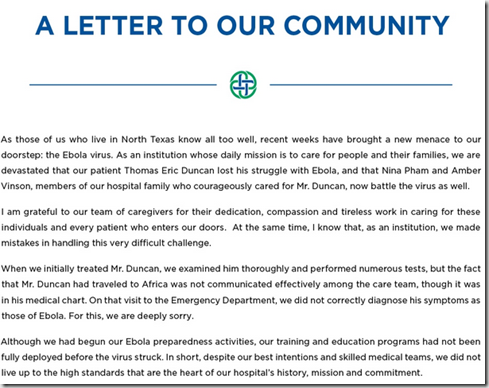
How long it will take to repair the public relations damage is hard to say – and probably depends on whether more employees turn up sick – but this morning the hospital took out a full page ad in the Dallas Morning News to apologize.

image

(Excerpt – read the entire letter here).

Thursday, October 16, 2014

Two Overnight Statements From Texas Health Presbyterian Hospital

image


# 9202


The Dallas Hospital where America’s index case of Ebola died, and where at least two nurses were infected, has issued a pair of statements overnight.  


The first is an offer to employees who have had a potential exposure to the Ebola virus that they can self quarantine at the hospital. The second refutes a number of the claims lodged yesterday by local nurses regarding the infection control protocol used in the treatment of their index case (see Nurses Claim Lack Of Safety Protocols For Dealing With Ebola).


Ebola Update, Oct. 15, 9:44 p.m. CDT
10/15/2014

Ebola Virus

Statement from Texas Health Presbyterian Hospital Dallas

With a second one of our health care workers now infected with the Ebola virus despite following recommended protection procedures, Texas Health Dallas is offering a room to any of our impacted employees who would like to stay here to avoid even the remote possibility of any potential exposure to family, friends and the broader public.

We are doing this for our employees’ peace of mind and comfort.

This is not a medical recommendation. We will make available to our employees who treated Mr. Duncan a room in a separate part of the hospital throughout their monitoring period.

We want to remind potentially affected employees that they are not contagious unless and until they demonstrate any symptoms, yet we understand this is a frightening situation for them and their families. We will be coordinating this effort with the county monitors who are already regularly checking on their temperatures for any sign of infection.

The hospital will contact directly those being monitored to make arrangements. We also ask our potentially affected employees to be the good citizens that we know they are by avoiding using public transportation or engaging in any activities that could potentially put others at risk.


With regard to the charges made yesterday by the coalition of nurses, and the denials today by the hospital, I can only hope that a full and open hearing of the facts will be held, so that we can find out what actually happened.

Ebola Update, Oct. 16, 4:00 a.m. CDT
10/16/2014

Correcting the Record: Facts about Protocols and Equipment at Texas Health Presbyterian Hospital Dallas

National Nurses United recently made allegations regarding the protocols and equipment in place during Thomas Eric Duncan’s treatment at Texas Health Presbyterian Hospital Dallas.

The assertions do not reflect actual facts learned from the medical record and interactions with clinical caregivers. Our hospital followed the Centers for Disease Control (CDC) guidelines and sought additional guidance and clarity.

The following are facts about procedures and protocols in place during Mr. Duncan’s treatment:

  • When Mr. Duncan returned to the Emergency Department (ED), he arrived via EMS. He was moved directly to a private room and placed in isolation. THD staff wore the appropriate personal protective equipment (PPE) as recommended by the CDC at the time.
  • Regarding the ED tube delivery system utilized during Mr. Duncan’s initial visit, all specimens were placed into closed specimens bags and placed inside a plastic carrier that travel through a pneumatic system. At no time did Mr. Duncan’s specimens leak or spill — either from their bag or their carrier — into the tube system.
  • During Mr. Duncan’s second visit, the tube system was not used at all. His specimens were triple-bagged, placed in a container, and placed into a closed transport container and hand-carried to the lab utilizing the buddy system. Additionally, while Mr. Duncan was in the MICU, all lab specimens were hand-carried and sealed per protocol. Routine labs were done in his room via wireless equipment.
  • Nurses who interacted with Mr. Duncan wore PPE consistent with the CDC guidelines. Staff had shoe covers, face shields were required, and an N-95 mask was optional — again, consistent with the CDC guidelines at the time.
  • When the CDC issued updates, as they did with leg covers, we followed their guidelines.
  • When the CDC recommended that nurses wear isolation suits, the nurses raised questions and concerns about the fact that the skin on their neck was exposed. The CDC recommended that they pinch and tape the necks of the gown. Because our nurses continued to be concerned, particularly about removing the tape, we ordered hoods.
  • Protective gear followed governing CDC guidelines at the time.
  • The CDC classified risk/exposure levels. Nurses who were classified as “no known exposure” or “no risk” were allowed to treat other patients per the CDC guidance.
  • Per the CDC guidelines, patients who may have been exposed were always housed or isolated per the CDC guidance.
  • Regarding hazardous waste, the hospital went above and beyond the CDC recommendations. Waste was well-contained in accordance with standards, and it was located in safe and containable locations.
  • Admittedly, when we received Tyvek suits, some were too large. We have since received smaller sizes, but it is possible that nurses used tape to cinch the suits for a better fit.

According to an employee satisfaction survey by Press Ganey, Texas Health Dallas is in the top one percent in the country when it comes to employee engagement and partnership. We support the tireless and selfless dedication of our nurses and physicians, and we hope these facts clarify inaccuracies recently reported in the media.

Wednesday, August 06, 2014

CDC FAQ On Safe Management of Patients with Ebola in U.S. Hospitals

image 

Credit CDC


# 8923


During yesterday’s COCA Call on What U.S. Hospitals Need to Know to Prepare for Ebola Virus Disease many of the questions directed at the presenters concerned the appropriate level of PPEs for Health Care Workers and proper patient placement when dealing with this formidable disease. 


Many of the pictures of HCWs at Emory University caring for their recently arrived Ebola patient, and from the doctors working in the field hospitals in Africa, indicate a much higher level of Personal Protective Equipment (PPEs) in use than is being recommended by the CDC -  giving rise to concerns from several of the callers.


As an indication of the degree of interest in these issues, at the end of the hour session, there were still in excess of 90 questioners left in the telephone queue. Lisa Schnirring at CIDRAP News provided an excellent summary of the call last night (see  CDC experts address Ebola infection control issues).


Today, in order to try to dispel the notion that you have to have a special high-containment facility (like at Emory University) or have HCWs wear head-to-toe PPE coverage in order to safely isolate, and treat Ebola cases, the CDC has released the following guidance.


Safe Management of Patients with Ebola Virus Disease (EVD) in U.S. Hospitals

Frequently Asked Questions

The recent EVD outbreak in West Africa has increased the possibility of patients traveling from the impacted countries to the United States. Additionally, two American citizens with EVD were medically evacuated to the United States to receive care at Emory University Hospital in Atlanta. The following are answers to frequently asked questions about the safety of this medical evacuation and the necessary infection control procedures to protect patients and healthcare providers in U.S. hospitals.

Are U.S. hospitals ready to care for patients with Ebola virus disease (EVD)?

Yes – any U.S. hospital that is following CDC's infection control recommendations and can isolate a patient in a private room‎ is capable of safely managing a patient with EVD. CDC recommends that U.S. hospitals isolate the patient in a private room and implement standard, contact, and droplet precautions.

What should U.S. hospitals do if they have a patient with suspect EVD?

Early recognition is critical for infection control. Healthcare providers should be alert for and evaluate any patients suspected of having EVD who have (see EVD case definition):

  1. A fever of greater than 38.6 degrees Celsius or 101.5 degrees Fahrenheit, and additional symptoms such as severe headache, muscle pain, vomiting, diarrhea, abdominal pain, or unexplained hemorrhage;
    AND
  2. Risk factors within the past 3 weeks before the onset of symptoms, such as contact with blood or other body fluids of a patient known to have or suspected to have EVD; residence in—or travel to—an area where EVD transmission is active; or direct handling of bats, rodents, or primates from disease-endemic areas. Malaria diagnostics should also be a part of initial testing because it is the most common cause of febrile illness in persons with a travel history to the affected countries.

When should patients with suspected EVD in U.S. hospitals be tested?

CDC recommends testing for all persons with onset of fever within 21 days of having a high-risk exposure such as (See CDC's laboratory testing guidance):

  • percutaneous or mucous membrane exposure or direct skin contact with body fluids of a person with a confirmed or suspected case of EVD without appropriate personal protective equipment (PPE),
  • laboratory processing of body fluids of suspected or confirmed EVD cases without appropriate PPE or standard biosafety precautions, or
  • participation in funeral rites or other direct exposure to human remains in the geographic area where the outbreak is occurring without appropriate PPE.

For persons with a high-risk exposure but without a fever, testing is recommended only if there are other compatible clinical symptoms present and blood work findings are abnormal (i.e., thrombocytopenia <150,000 cells/µL and/or elevated transaminases.

If a patient in a U.S. hospital is identified to have suspected or confirmed EVD, what infection control precautions should be put into place?

If a patient in a U.S. hospital is suspected or known to have Ebola virus disease, healthcare teams should follow standard, contact, and droplet precautions, including the following recommendations:

  • Isolate the patient: Patients should be isolated in a single patient room (containing a private bathroom) with the door closed.
  • Wear appropriate PPE: Healthcare providers entering the patients room should wear: gloves, gown (fluid resistant or impermeable), eye protection (goggles or face shield), and a facemask. Additional protective equipment might be required in certain situations (e.g., copious amounts of blood, other body fluids, vomit, or feces present in the environment), including but not limited to double gloving, disposable shoe covers, and leg coverings.
  • Restrict visitors: Avoid entry of visitors into the patient's room. Exceptions may be considered on a case by case basis for those who are essential for the patient's wellbeing. A logbook should be kept to document all persons entering the patient's room. See CDC's infection control guidance on procedures for monitoring, managing, and training of visitors.
  • Avoid aerosol-generating procedures: Avoid aerosol-generating procedures. If performing these procedures, PPE should include respiratory protection (N95 or higher filtering facepiece respirator) and the procedure should be performed in an airborne infection isolation room.
  • Implement environmental infection control measures: Diligent environmental cleaning and disinfection and safe handling of potentially contaminated materials is of paramount importance, as blood, sweat, vomit, feces, urine and other body secretions represent potentially infectious materials should be done following hospital protocols.

Why do responders in Africa wear so much personal protective equipment (that can include full body suits) for this Ebola outbreak when CDC says hospitals here could safely manage the care of an Ebola patient without a full body suit?

There are important differences between providing care or performing public health tasks in Africa versus in a U.S. hospital.

In field medical settings, additional PPE may be necessary to protect healthcare workers. In some places in Africa, workers may not have the ability to prepare for potential exposures. For example, in some places, care may be provided in clinics with limited resources (e.g., no running water, no climate control, no floors, inadequate medical supplies), and workers could be in those areas for several hours with a number of Ebola infected patients. Additionally, certain job responsibilities and tasks, such as attending to dead bodies, may also require different PPE than what is used when providing care for infected patients in a hospital.

Friday, April 18, 2014

The MERS Hospital Cluster Puzzle

image

R0 (pronounced R-nought) or Basic Reproductive Number.

Essentially, the number of new cases in a susceptible population likely to arise from a single infection. With an R0 below 1.0, a virus (as an outbreak) begins to sputter and dies out. Above 1.0, and an outbreak can have `legs’.


# 8490


Two months ago, in mBio: Spread, Circulation, and Evolution of MERS-CoV, we looked at a study that focused on the evolutionary changes in the MERS coronavirus since its introduction to the human population, and its apparent efficiency in transmitting between humans.


At the time, based on 180 human cases reported over roughly 18 months, the authors determined that the MERS virus had an R0 of less than 1.

In other words, it wasn’t spreading efficiently enough to sustain an ongoing epidemic.


They warned, however, that over time evolutionary pressures could allow the virus to better adapt to human hosts, writing:


MERS-CoV adaptation toward higher rates of sustained human-to-human transmission appears not to have occurred yet. While MERS-CoV transmission currently appears weak, careful monitoring of changes in MERS-CoV genomes and of the MERS epidemic should be maintained. The observation of phylogenetically related MERS-CoV in geographically diverse locations must be taken into account in efforts to identify the animal source and transmission of the virus.


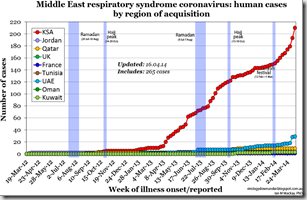
Fast forward 60 days, and suddenly we are seeing at least two large clusters of MERS – one in the UAE (12 cases) and the other in Jeddah, Saudi Arabia (45 cases) – and of particular note, both involve a large number of healthcare workers. 


A cohort that, at least in theory, should be practicing stringent infection control protocols. 


While we don’t have the specifics on the source of the initial infection or the subsequent chain of transmission in either cluster, their size and duration are at least suggestive of more robust transmission. 


Dr. Ian Mackay’s chart from earlier this week (see below) illustrates this sudden jump in cases counts in KSA and the UAE. 
image


All of which begs the $64 question: Has something changed with the virus?


It is a question raised by Dr. Michael Osterholm – Director of CIDRAP - yesterday (see Osterholm & Mackay On MERS), and one that has been on the minds of many watching the evolution of these two large clusters.


Definitive answers to that question may be some time in coming, as it will require detailed genetic analysis and an in-depth epidemiological investigation to establish the facts. It isn’t, however, the only possible explanation.


Another possibility is that we are seeing a couple of `super spreader’ events, reminiscent of what was seen in Al-Hasa a year ago (more on that later). 


During the SARS epidemic of 2003, we know that transmission of that coronavirus was typically fairly inefficient.


An infected person might only infect 1 or 2 additional people, and sometimes none.  But a small percentage of those infected were far more efficient in spreading the disease, with some responsible for 10 or more secondary infections.


This super spreader phenomenon gave rise to the 20/80 rule,  that 20% of the cases were responsible for 80% of the transmission of the virus (see 2011 IJID study Super-spreaders in infectious diseases)


Last year, for the 10 year anniversary of the SARS epidemic, the CDC authored a review of the outbreak called Remembering SARS: A Deadly Puzzle and the Efforts to Solve It.   While the whole article is a good read, I’ve lifted some excerpts from the section entitled: Solving the Mystery of “Super Spreaders”.

In the 2003 outbreak, in some instances outside the United States, a single SARS patient infected large numbers of people. At the same time, other patients did not infect people who came in contact with them. 

Researchers found that the virus was typically spread from person to person by large droplets (less efficient spread because it would be too big to linger in the air); however, at other times, clusters of illness suggested aerosol spread (where the virus can linger in the air longer after an ill person coughs) causing more spread of infections from a single sick person. 

CDC investigated the so-called “super spreaders.” They wanted to know if there were differences in when and for how long people ill with SARS might shed the virus, making them contagious to others. In the past, super spreaders had been documented during other disease outbreaks such as rubella, tuberculosis and Ebola. A common feature of super spreaders was that hospitals served as a source for the disease to widely infect others.


Last summer, in Branswell:The NEJM Saudi MERS-CoV Cluster Report, we looked at a review of the  hospital associated cluster involving 23 cases in the Al-Hasa region, occurring between April 1st and May 23rd. 


Helen Branswell’s report, which is still online, discussed the `super spreader’ angle.


Saudi MERS outbreak showed SARS-like features, including possible superspreader

Helen Branswell, The Canadian Press Jun 19, 2013 05:00:17 PM

TORONTO – A long-awaited report on a large and possibly still ongoing outbreak of MERS coronavirus in Saudi Arabia reveals the virus spreads easily within hospitals, at one point passing in a person-to-person chain that encompassed at least five generations of spread.

The study, co-written by Toronto SARS expert Dr. Allison McGeer, also hints there may have been a superspreader in this outbreak, with one person infecting at least seven others.

(Continue . . . )


As was common with SARS, and featured in the Al-Hasa report above, we are once again seeing the familiar pattern of unusually large clusters centered around health care facilities. 


Whether they signify an evolutionary change in the virus, the effects of `super spreaders’, or a combination of both  - or perhaps some other dynamic - is impossible to tell at this point.


All we can say right now is that the pattern of disease spread appears – at least temporarily, and in these two locations - to have changed in recent weeks, and that it bears watching.


As Dr. Osterholm said yesterday, we are definitely in a `stay tuned’ moment.

Tuesday, December 03, 2013

HK: Hospitals Increase Infection Control Efforts Due To H7N9 Concerns

image

H7N9 Awareness Campaign Summer 2013 - Photo credit Hong Kong’s CHP


# 8036


Hong Kong packs a little more than 7 million people into just 426 sq. miles of territory, making it the fourth most densely packed area in the world (cite). Infectious diseases are better able to transmit among humans when population densities are high, and so Hong Kong’s public health sector takes prevention efforts quite seriously. 


While only one H7N9 case has been identified in Hong Kong thus far, it isn’t unreasonable to assume there might be others – perhaps only mildly ill – in the region.   For this reason hospitals in Hong Kong are ramping up their alert status, patient triage, and imposing new, strict infection control policies (including requiring masks for all visitors).


The following announcement comes from Hong Kong’s Hospital Authority.


Serious Response Level activated in public hospitals


The following is issued on behalf of the Hospital Authority:


The Hospital Authority (HA) spokesman today (December 3) announced the activation of the Serious Response Level in public hospitals to tie in with the Government's raising of the response level of the Preparedness Plan for Influenza Pandemic from "Alert" to "Serious". The HA Central Committee on Infectious Diseases & Emergency Response held a special meeting this morning to discuss and review thoroughly the contingency measures under the Serious Response Level in public hospitals.

The HA spokesman said front-line hospital staff at Accident and Emergency Departments and general outpatient clinics are reminded to stay vigilant to patients seeking consultation at public hospitals. Enhanced surveillance and patient triage guidelines are in place to ensure timely reporting and early arrangement of clinical tests.

"Under the Serious Response Level, more stringent infection control measures, which include visiting arrangements, are enforced in public hospitals. The visiting arrangements include not allowing visiting at isolation wards unless on compassionate grounds. For general acute wards, visiting hours would be no more than two hours per day with no more than two visitors per visit. For convalescent and infirmary wards, visiting hours would be no more than four hours per day with no more than two visitors per visit."

The spokesman also reminded the public that visitors to public hospitals and clinics are now required to put on surgical masks and perform hand hygiene before and after visiting patient areas.

Furthermore, volunteer services and clinical attachment in public hospitals have been suspended under the Serious Response Level. In regard to personal protection equipment, such as surgical masks and N95 masks, the current stockpile is adequate for three months' consumption. The HA will also maintain close liaison with the suppliers to ensure a sustainable supply. The isolation beds in the seven hospital clusters will be deployed when needed.

According to the spokesman, the HA will continue to closely collaborate with the Centre for Health Protection in monitoring the latest situation and keep the general public as well as health-care workers updated on developments on a regular basis.

Ends/Tuesday, December 3, 2013
Issued at HKT 19:46


Tuesday, November 13, 2012

Too Much Of A Good Thing

image

Photo Credit – Wikipedia


# 6714


Today we’ve a bit of a follow up to a blog I wrote last month called The Narrow Margin that looked at the dangers of accidental overdosing with acetaminophen (APAP) which is an ingredient found in more than 600 prescription, and non-prescription, drugs.


While well tolerated and safe at normal doses, too much acetaminophen can cause liver damage, and even death. The maximum safe dose for an adult under 65 is considered to be 4g in 24 hours (3g for those over 65, or those with liver problems).


In October the AAC  (Acetaminophen Awareness Coalition) launched a Know Your Dose campaign to help educate consumers about the safe use of the popular pain reliever.


image

Credit – Acetaminophen Awareness Coalition


The problem goes beyond the public’s mixing and matching over-the-counter medications, as some doctors will typically prescribe  hydrocodone/APAP 5 mg/500 mg 1 to 2 tablets every 4 to 6 hours to give patients some latitude in pain control.


If a patient takes the full prescribed dose (12 pills in 24 hours) they will ingest 6 g of acetaminophen, or 50% more than the maximum daily recommendation.


In 2011 the FDA announced their intention to limit the amount of acetaminophen in opioid/APAP prescriptions like Vicodin and Lorcet to 325mg in order to reduce the risk of liver damage in patients taking these meds for chronic pain. 


Those regulations won’t come into effect until January of 2014, and for now, 500 mg & 600 mg APAP/opioid analgesics are common.


Which brings us to a study today in the Archives Of Internal Medicine called:

Supratherapeutic Dosing of Acetaminophen Among Hospitalized Patients

Li Zhou, MD, PhD; Saverio M. Maviglia, MD, MS; Lisa M. Mahoney, RPh; Frank Chang, MSE; E. John Orav, PhD; Joseph Plasek, MS; Laura J. Boulware; Hong Lou; David W. Bates, MD, MSc; Roberto A. Rocha, MD, PhD

Arch Intern Med. 2012;():1-8. doi:10.1001/2013.jamainternmed.438.


This study, which looked at the records of more than 23,000 patients at two Boston hospitals during the summer of 2010, and found that 14,411 patients during the study period were administered acetaminophen.


Nearly a thousand of those (n=955, or 6.6%) received more than the the 4g daily maximum dose.  Perhaps even more telling, 22.3% of patients older than 65, and 17.6% of patients with chronic liver disease exceeded the 3g/day limit.


No cases of liver toxicity were reported among these patients, although some patients did experience significant elevations of at least one liver enzyme (alkaline phosphatase). The authors caution, however, that a `causal relationship cannot be concluded’.


Patients receiving more than one acetaminophen containing drug, and those in surgical and intensive care units, were most likely to exceed the daily maximum dosage of APAP.


All of which shows that, even in a hospital setting, it is all too easy to exceed the 4 g/day APAP maximum dose.


The phasing in of lower APAP levels in opioid-combo  analgesics over the next year should go a long ways towards reducing this problem, as would better health information technology systems designed to catch such overdoses, and alert the nursing staff.


Until then (and even after) it is always a good idea to be proactive and ask what meds you (or someone in your care) is being given in a hospital, and to speak up if you suspect their might be a problem.


For more on this story, you may wish to check out this report from Reuter’s Health.


Many hospital patients get too much Acetaminophen

By Genevra Pittman

NEW YORK | Tue Nov 13, 2012 12:36pm EST