Showing posts with label Branswell. Show all posts

Friday, January 30, 2015

H7N9 Confirmed In 2nd B.C. Patient

image

Credit Wikipedia


# 9646


On Monday we learned of the first known imported case of H7N9 into North America (see PHAC Statement On Canada’s Imported H7N9 Case) when a woman, recently returned from China with her husband, developed flu-like symptoms and was tested by her doctor in Vancouver.  


Her husband briefly developed flu-like symptoms as well, and also suspected as having been infected. Neither were sick enough to be hospitalized, self-isolated at home, and are now recovered.


Last night it was announced that the husband’s tests had come back positive for H7N9 infection. He developed symptoms about a day before his wife, suggesting they had a shared exposure, but the exact route of their infection remains unknown.  


None of these patient’s close contacts have developed symptoms, and given H7N9’s incubation period, authorities believe it unlikely any additional cases will arise in Canada linked to this event.


This from Helen Branswell.


H7N9 bird flu case confirmed in 2nd B.C. patient

Couple believed to have contracted virus in recent trip to China

By Helen Branswell, The Canadian Press Posted: Jan 29, 2015 9:24 PM PT Last Updated: Jan 29, 2015 9:28 PM PT

A British Columbia man has been confirmed as Canada's second case of H7N9 bird flu.

The unidentified man and his wife are believed to have contracted the virus during a recent trip to China.

They are the first North Americans known to have been infected with this virus.

B.C.'s deputy provincial health officer says the positive test result was confirmed late Thursday by the National Microbiology Laboratory in Winnipeg.

(Continue . . .)


It is remarkable that these cases were diagnosed at all, given their mild symptoms and their occurring during the midst of a very busy regular flu season. 


While 30% of known H7N9 cases have died, this is essentially the mortality rate among those sick enough to be hospitalized and tested.  Unknown is how many mild or moderate cases occur each winter in China, that are never picked up by surveillance.


That two travelers should return from China with mild symptoms suggests that mild or moderate cases are more common than we know .Something that the researchers at the University of Hong Kong have been saying for the past 18 months.


In Lancet: Clinical Severity Of Human H7N9 Infection) we saw a study that proposed, after roughly 130 cases were confirmed in the spring of 2013, that:


Our estimate that between 1500 and 27 000 symptomatic infections with avian influenza A H7N9 virus might have occurred as of May 28, 2013, is much larger than the number of laboratory-confirmed cases.


How accurate these estimates are is unknown, but it is highly likely that the official case counts under-represent the real burden of H7N9, perhaps by a sizable margin.


Somewhat more reassuring, we’ve seen a relatively low number of family clusters or contacts of known cases test positive for the virus, suggesting a low human-to-human transmission rate.  For now, direct contact with infected birds is believed the primary route of infection.


That said, a study published earlier this week (see EID Journal: H7N9 Antibodies In Close Contacts Of Known Cases) looked at 225 close contacts of confirmed H7N9 cases in China, and found 22 (9.8%) with elevated HI H7N9 antibody titers (>1:40). 

All of these seropositive contacts were asymptomatic.


All of which means we still have major gaps in our understanding of how fast and how far this virus is spreading in China.  And given the amount of travel to and from Asia, we should not be surprised to see future introductions of H7N9, and other novel flu viruses, to North America.

Monday, September 15, 2014

Branswell: US & WHO Seek To Ramp Up Ebola Vaccine & Drug Production

image


# 9076


While there are hopes that some of the experimental drugs and vaccines under investigation for use against the Ebola virus will eventually prove both safe and effective, enormous challenges lie ahead in their manufacture and deployment to the field. 


Helen Branswell has the story this morning on efforts to jumpstart the manufacturing process in her article:


WHO, U.S. seek to increase production of Ebola drugs, vaccines

Helen Branswell, The Canadian Press
Published Monday, September 15, 2014 6:57AM EDT

TORONTO -- High level efforts are underway to find ways to substantially ramp up production of experimental Ebola vaccines and drugs, officials at the World Health Organization and within the U.S. government say.

The talks involve trying to find more production capacity for the therapeutics, which before this outbreak had never been tested in people.

On the table is a plan to try to devise a tweaked version of the antibody cocktail known as ZMapp, so that the drug -- currently produced in tobacco plants -- could be made in other production systems for which global capacity is greater.

(Continue . . . .)

Wednesday, August 27, 2014

Branswell On Canada’s Lab Team Evacuation From Sierra Leone

image
Credit CDC PHIL


# 9006


There is a lot we still don’t know about how a WHO deployed technician came to be infected with the Ebola virus in Kailahun (see WHO Statement On Temporary Pull Back From Kailahun, Sierra Leone), but last night Canada’s PHAC announced that they would be withdrawing their three-man mobile laboratory team from the same area as well.


A move apparently spurred by safety concerns after additional infections were identified at their hotel.


Helen Branswell puts together what we currently know about this evolving situation in the following report.


Canada pulls its scientists from Sierra Leone after Ebola breaks out at their hotel

Helen Branswell, Canadian Press | August 27, 2014 7:36 AM ET

TORONTO — Canada is in the process of evacuating its three-member mobile laboratory team from Sierra Leone over concerns for the safety of the scientists.

The Public Health Agency of Canada said late Tuesday that the team is being recalled to Canada after people at the hotel complex where they were staying were diagnosed with Ebola.

The agency did not elaborate on who the people were and why the federal government felt the situation was significant enough to require that the scientists be brought back to Canada.

(Continue . . .)

Tuesday, August 12, 2014

Branswell: Canada To Donate Experimental Ebola Vaccine

image


# 8946


Literally hours after the World Health Organization announced the consensus of their expert panel on the  Ethical Use Of Experimental Drugs In Ebola Outbreak, Canada’s Public Health Authority (PHAC) has offered to donate the bulk of their limited supply of – as yet untested – experimental Ebola vaccine to the afflicted African nations.


Helen Branswell of the Canadian Press has the details, so follow the link below to read:


Canada to donate experimental Ebola vaccine to African outbreak response

Helen Branswell

TORONTO — The Canadian Press

Published Tuesday, Aug. 12 2014, 5:19 PM EDT

The Public Health Agency of Canada is going to donate a made-in-Canada experimental Ebola vaccine to the West African outbreak response.

(Continue . . . )


Tuesday, July 15, 2014

SciAm: Branswell On Lab Biosafety


# 8836


I’ve been away from my desk for most of the day, but I wanted to recommend (very highly) the following Scientific American piece by Helen Branswell on the fallout from the recent laboratory incidents involving select agents at the CDC and FDA.


Bio-Unsafety Level 3: Could the Next Lab Accident Result in a Pandemic?

So-called gain-of-function pathogen research will likely receive closer scrutiny after three U.S. biolab incidents

Jul 14, 2014 |By Helen Branswell

scientist inoculates chicken egg with H5N1 avian flu
A CDC scientist inoculates a chicken egg with H5N1 in a biosafety level 3 lab. 
Credit: CDC/Greg Knobloch

There had to be a sinking feeling in the chest of every researcher who works in a high-containment research laboratory last Friday when the U.S. Centers for Disease Control and Prevention (CDC) released its report on three worrisome incidents that raised safety questions at two well-respected government facilities. But it is likely the sensation was most acute for the influenza scientists who work in a controversial field known as gain-of-function research.

(Continue . . . )


Sunday, April 27, 2014

Drosten: Jeddah MERS Sequences Show No Significant Changes

image

Credit Dr Ian Mackay  VDU Blog


# 8538


The sudden spike in MERS virus detections in Saudi Arabia and the UAE over the last month has sparked a good deal of concern that the MERS coronavirus might be evolving into a more human-adapted virus.  While not the only possible explanation for this increase - it would be the most worrisome - were it true.


On Friday (see Referral: VDU Blog On MERS-CoV Partial Spike Sequence Results),  Dr. Ian Mackay explained the early results of genetic testing performed by Christian Drosten’s lab in Germany  on MERS samples gathered from the recent Jeddah outbreak, which found no changes to the spike protein region of the virus.


A good sign that the virus was relatively unchanged, but as only a subset of MERS genome was examined, not definitive.


Yesterday evening news began to emerge that Dr. Drosten had fully sequenced three virus samples from the Jeddah outbreak, and that these samples showed `no significant changes’ compared to earlier samples sequenced. 


A finding that would appear to remove the `easiest’  explanation for these recent outbreaks from the top of the suspect list.


Dr. Ian Mackay posted a short announcement last night on his VDU blog, which he later updated, along with a second post where he discusses the ramifications of this finding, along with a small but important caveat (note: the `curve’ mentioned refers to his graphic at the top of this post).


If this is what MERS-CoV detections look like with more testing...what is the "normal" community level of virus?? [UPDATED]

For a virus that is chugging along without the aid of any new genetic changes, and perhaps showing up more often (a) because of enhanced testing and/or (b) because of a large-scale breakdown in infection prevention and control (IPC), this curve sure does depict the possibility that we had no idea how much MERS-CoV was transmitting among the population. Still a poor transmitter compared to an influenzavirus, because we have seen a few larger MERS-CoV studies than show few to no MERS-CoV positives, but still more people positive than we thought.

(Continue . . . )


Then `minor caveat’  here is that these three comparative samples came from early in the Jeddah outbreak, which doesn’t preclude the possibility that some evolutionary changes may have occurred since then. But the most likely explanation at this point would involve something other than an adaptation of the virus.


Dr. Drosten wrote a letter to ProMed Mail, outlining his findings, which appeared overnight.  A brief excerpt follows:


MERS-COV - EASTERN MEDITERRANEAN (42): SAUDI ARABIA, GENOME SEQUENCING, JEDDAH OUTBREAK


A ProMED-mail post
http://www.promedmail.org
ProMED-mail is a program of the
International Society for Infectious Diseases
http://www.isid.org
Date: Sat 26 Apr 2014
From: Christian Drosten <drosten@virology-bonn.de> [edited]

(EXCERPT)

We have sequenced near full genomes of 3 viruses from the early phase of the Jeddah outbreak. The samples were submitted to Jeddah regional laboratory on [3, 5 and 7 Apr 2014], and sent to Germany for external confirmatory testing on [14 Apr 2014] by KSA MOH in Riyadh. Two of the sequenced viruses were from patients treated in the major public hospital in which most cases of the Jeddah outbreak seem to have occurred. A 3rd sequence was from another health care facility in the city.

Genome sequences of all 3 viruses are highly similar to each other but not identical, and are highly similar to a large number of known MERS-CoV sequences (consult http://www.virology-bonn.de for a phylogeny; genome overview in Cotten 2014). There are no genome insertions or deletions suggestive of sudden major changes. The receptor-binding domain in the spike protein thought to influence the virus's ability to be transmitted or spread is 100 percent identical to the binding site in a large number of known MERS-CoV genome sequences. Based on genome comparison with other MERS-CoV strains there is no reason to assume that the sequenced viruses from Jeddah have acquired changes increasing their pandemic potential.


(Continue . . )


To this cavalcade of coverage we can add Helen Branswell’s excellent report for the Canadian Press:

MERS virus hasn't changed, not reason for surge in Saudi cases: expert

Helen Branswell / The Canadian Press
April 26, 2014 05:36 PM

A German coronavirus expert says the virus responsible for the MERS infection appears not to have changed.

Dr. Christian Drosten says based on what his laboratory has seen so far, this month's surge in MERS cases cannot be explained by mutations in the virus.

Drosten's lab at the University of Bonn has been looking at genetic sequences of RNA drawn from samples from 30 recent cases from Jidda, Saudi Arabia, where the largest increase in cases has occurred.

In an email, Drosten says the lab has sequenced three nearly full genomes and they see no signs of significant changes that could account for the increase in cases.

(Continue . . . )


As far as what the actual reason for the recent spike in MERS cases might be, it will likely require good old-fashioned gumshoe epidemiology to figure that out. 


An investigation that would include, but not be limited to: extensive contact tracing, broad viral (rRT-PCR) & serological testing, a review of infection control protocols, and a long-promised but never-delivered Case Control Study to determine what specific exposures are most likely to lead to infection.


Basic investigative steps that should have been implemented by Saudi Arabia well over a year ago, and that hopefully with a new Minister of Health in charge, will now get top priority.

Thursday, April 24, 2014

Morning MERS Roundup – 4/24/14

image

Coronavirus – Credit CDC PHIL


# 8520


Although we don’t actually know much more about what is going on with the MERS virus than we did a few weeks ago, the sudden spike in cases being reported in Saudi Arabia and the UAE has raised international concerns that the virus may be evolving.


We won’t know if that’s true – or if there is some other explanation behind this jump in cases (ie. seasonality, super spreaders, breakdown in infection control, etc.) – until fresh sequences are generated and analyzed and some good old-fashioned gumshoe epidemiology can be completed.


In the meantime we are seeing a good deal of media attention focused on, and some serious analysis being given to, the evolving situation.  To get you started this morning, below you’ll find a short list of items published over the past 12 hours from sources and experts I trust.


 CIDRAP NEWS (2 reports)

 Helen Branswell 

Dr. Ian Mackay 


Saturday, April 19, 2014

Referrals: VDU Blog & Branswell On MERS-CoV

image

Credit VDU Blog 


# 8496


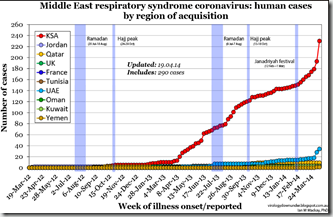
The earliest known human infections with the MERS coronavirus occurred just over two years ago at a hospital in Jordan, and over the first year produced barely a handful of confirmed cases across the Arabian peninsula.  Just over a year ago (March 26th, 2013) the World Health Organization was only reporting a total of 17 cases (11 Fatalities).


An average of 1.5 cases reported per month during the first year.


Cases began  a steady climb – particularly in Saudi Arabia – beginning last spring. From March 26th, 2013 to March 26, 2014 the official tally grew to 200 laboratory-confirmed cases, including 85 deaths.  Roughly  a 10 fold increase over the previous 12 months.


Or an average of 15.25 cases reported per month during the second year.


Over the past three weeks, we’ve seen roughly 80 cases reported (numbers are approximate as not all have been confirmed by the WHO). These come primarily from a pair of large clusters in KSA and the UAE – which together account for more than 25% of all of the cases reported to date.  And it is likely that we’ll see more cases announced in the coming days.


Given the number of mild or asymptomatic cases detected to date – it’s a pretty good bet that we are only counting a subset of the actual number of infections.


A disturbing trend that Dr. Ian Mackay charts, and discusses, in his latest blog. Ian also calls for the quick release of sequences from recent cases, so that we can determine if this is `MERS-CoV Mk II’ – a new & improved coronavirus model for 2014.


Follow the link to read:


MERS-CoV cases continue steep climb thanks most to 2 healthcare-related clusters...

The Jeddah cluster | Jeddah | Kingdom of Saudi Arabia.

It is the biggest of any of the clusters of MERS-CoV cases within the Kingdom of Saudi Arabia, MERS-central (0 to date. It has seeded at least 2 internationally exported cases (a fatal case in Malaysia and now a case in Greece). It totals 53 cases so far; the tally for this cluster began after the onset of illness in the first case, 6-Apr.

The paramedic cluster | Abu Dhabi | United Arab Emirates


Happening simultaneously and right next door is a cluster of cases that began 28-Mar. It stands at 14 cases as I compose this; most recent with an onset of 14-Apr.


These dates, starting points and information are all up in the air of course.

(Continue . . . )

In much the same vein,  Helen Branswell overnight has published a terrific overview of where these latest outbreaks stand – and concerns being voiced by scientists – in her article:

SARS revisited? Sharp jump in cases, hospital outbreaks raise MERS concerns

By Helen Branswell, The Canadian Press April 18, 2014

TORONTO - It’s beginning to feel like SARS revisited.

For some of the scientists and doctors who helped the world battle the 2003 SARS outbreak, the recent rapid rise in human infections in several Middle Eastern countries caused by a cousin virus is creating a sense of sharp unease.

Cases of Middle Eastern respiratory syndrome — MERS — have shot up markedly in the past month, driven it appears by outbreaks in hospitals or among health-care workers in Jeddah, Saudi Arabia, and in Abu Dhabi, in the United Arab Emirates.

(Continue . . .)

Wednesday, March 26, 2014

Branswell On Low Flu Vaccine Effectiveness In 2012-13 Flu Season

image


# 8404


Helen Branswell has the story on a PLoS One study, published yesterday, that found an unusual `production issue’ with last year’s seasonal flu vaccine that resulted in a disappointing level of protection against the H3N2 virus.


The open access study is called:


Low 2012–13 Influenza Vaccine Effectiveness Associated with Mutation in the Egg-Adapted H3N2 Vaccine Strain Not Antigenic Drift in Circulating Viruses

Danuta M. Skowronski mail, Naveed Z. Janjua, Gaston De Serres, Suzana Sabaiduc, Alireza Eshaghi, James A. Dickinson, Kevin Fonseca, Anne-Luise Winter, Jonathan B. Gubbay, Mel Krajden, Martin Petric, Hugues Charest, Nathalie Bastien,  [ ... ], Yan Li


As you might imagine, this is a fairly complex report, so we can be thankful that Helen does such a terrific job deciphering it all for us.  Follow the link to read:


Flu vaccine production issue may be behind last year's modest protection: study

Helen Branswell / The Canadian Press
March 25, 2014 02:20 PM

ORONTO - The 2012-13 influenza season was a harsh one, and one in which flu vaccine offered disappointingly modest protection against the main circulating strain, H3N2.

The limited protection — around 41 per cent for healthy adults and a mere nine per cent for seniors — was surprising, given that the H3N2 viruses causing illness were a close match for one the World Health Organization had selected for inclusion in that winter's vaccine.

New Canadian research is offering an explanation for that puzzling and unfortunate phenomenon. It reveals that the H3N2 component that went into the vaccine wasn't exactly what the WHO's experts ordered.

(Continue . . . )


In her report, Helen quotes Michael Osterholm of Director of CIDRAP, who has long held that that big changes are needed in the way we manufacture vaccines.


These issues were the topic of a blog back in the 2012 called CIDRAP: The Need For `Game Changing’ Flu Vaccines which looked at a truly impressive 160-page CIDRAP report that emphasizes the need for a revolution in vaccine technology.


The Compelling Need for Game-Changing Influenza Vaccines

An Analysis of the Influenza Vaccine Enterprise and Recommendations for the Future

Michael T. Osterholm, PhD, MPH, Nicholas S. Kelley, PhD, Jill M. Manske, PhD, MPH, Katie S. Ballering, PhD, Tabitha R. Leighton, MPH, Kristine A. Moore, MD, MPH

For those not ready to commit to reading a 160-page report, there is a 12-page Executive summary available.

image


Tuesday, January 07, 2014

Referral: Branswell On The MERS-CoV Threat


image

Coronavirus – Credit CDC PHIL


# 8137


Although Crof has already mentioned it, it is simply impossible to over-recommend a Helen Branswell article, so I’ll gladly add my 2 cents as well.   Helen talks to a number of MERS coronavirus researchers on their evolving perceptions of the threat posed by this emerging virus.


Highly recommended.


A global threat or so 2013? Experts read the tea leaves on MERS coronavirus

By Helen Branswell, The Canadian Press on January 6, 2014.2013.

TORONTO – Infectious disease watchers were worried in the late summer of 2013. The largest annual mass gathering in the world, the Hajj, was approaching. Meanwhile, infections with the new MERS coronavirus were mounting weekly in Saudi Arabia, where more than two million of the Muslim faithful would soon gather.

(Continue . . . )

Friday, January 03, 2014

EID Journal: MERS-Like Antibodies In Camels, UAE 2003-2013

image

Photo Credit Wikipedia


# 8123


It was my intent to write a long blog this morning about an EID Journal study, published yesterday, on the seroprevalence of MERS-like antibodies in camel blood samples taken a decade ago.  I’m  more than pleased to say that both Helen Branswell and Dr. Ian Mackay have both beaten me to it, saving me a good deal of effort and sparing countless electrons that I would have seriously inconvenienced in the process.


So, first a link to the study, then links to Helen’s and Ian’s reports.


Volume 20, Number 4—April 2014
Research

Antibodies against MERS Coronavirus in Dromedary Camels, United Arab Emirates, 2003 and 2013

Benjamin Meyer, Marcel A. Müller, Victor M. Corman, Chantal B.E.M. Reusken, Daniel Ritz, Gert-Jan Godeke, Erik Lattwein, Stephan Kallies, Artem Siemens, Janko van Beek, Jan F. Drexler, Doreen Muth, Berend-Jan Bosch, Ulrich Wernery, Marion P.G. Koopmans, Renate Wernery, and Christian DrostenComments to Author

Abstract

Middle East respiratory syndrome coronavirus (MERS-CoV) has caused an ongoing outbreak of severe acute respiratory tract infection in humans in the Arabian Peninsula since 2012. Dromedary camels have been implicated as possible viral reservoirs. We used serologic assays to analyze 651 dromedary camel serum samples from the United Arab Emirates; 151 of 651 samples were obtained in 2003, well before onset of the current epidemic, and 500 serum samples were obtained in 2013. Recombinant spike protein–specific immunofluorescence and virus neutralization tests enabled clear discrimination between MERS-CoV and bovine CoV infections. Most (632/651, 97.1%) camels had antibodies against MERS-CoV. This result included all 151 serum samples obtained in 2003. Most (389/651, 59.8%) serum samples had MERS-CoV–neutralizing antibody titers >1,280. Dromedary camels from the United Arab Emirates were infected at high rates with MERS-CoV or a closely related, probably conspecific, virus long before the first human MERS cases.

(Continue . . . )

Helen Branswell’s report for the Canadian Press, provides a clear and concise overview, which you can read at:


MERS or similar virus has been spreading in camels for at least a decade: study

By Helen Branswell, The Canadian Press on January 2, 2014.

A new study provides the first evidence that MERS or a very similar virus has been spreading in camels in parts of the Middle East for at least a decade.

The research shows that stored blood samples taken from camels in 2003 all contain antibodies to the virus, or something close enough to MERS that antibody tests designed for MERS detect them.

(Continue . . .)


And as a last stop, we get a Virologist’s take on all of this from Professor Ian Mackay, on his Virology Down Under Blog.


Antibodies in 10-year old UAE camel sera suggestive, but not evidentiary, of the presence of MERS-CoV a decade ago

Friday, 3 January 2014

632 of 651 (97.1%) dromedary camel serum samples collected in 2003 and 2013 in the United Arab Emirates (UAE) have been found to react with Middle East respiratory syndrome coronavirus (MERS-CoV) or key pieces thereof.


Meyer and colleagues from the Netherlands, Germany and the UAE also tested 16 control samples from German zoo camels but none reacted to MERS-CoV in their testing system. This indicates that the camels have not been infected by the MERS-CoV (or something very much like it) leading the authors to suggest that the virus is relatively isolated to Arabian peninsula's eastern edge...as far as we know from the testing performed to date.

(Continue . . .)


While there are still more questions than answers when it comes to MERS-CoV, studies like this one can add substantially to our understanding of the emergence and the geographic spread of this virus.


Knowledge that is sorely needed if an effective containment strategy is to be designed and implemented.

Tuesday, December 17, 2013

The Lancet: Identification Of MERS Virus In Camels

image

Photo Credit Wikipedia


#8080


Since early August, when the first evidence was presented (see Lancet: Camels Found With Antibodies To MERS-CoV-Like Virus), researchers have known that some camels on the Arabian peninsula had been exposed to a MERS-like virus, but the exact virus was undetermined. 


It could have been the same MERS-CoV that has been infecting humans for the past two years, or it could have been a close relative.


Subsequent studies have incremented our knowledge, but we’ve not had solid evidence linking the human virus to the camel antibodies.  That is, until now.


On November 27th, Qatari officials announced that the MERS virus had been detected in Camels on a farm where two people had become infected (see Qatar Supreme Council of Health Statement On MERS-CoV In Camels), and that further investigations were underway by the local Health Ministry and RIVM laboratory and Erasmus Medical Centre in the Netherlands. 


Last night The Lancet published a study, led by Marion Koopmans, DVM, PhD, head of virology at the Laboratory for Infectious Diseases at the RIVM in the Netherlands, that determined that the human viruses and the camel viruses were almost an identical match. So close, in fact, that they were unable to determine whether the humans or the camels were infected first.


While pretty much confirming that both humans and camels were infected with the same virus, the report states: “We cannot conclude whether the people on the farm were infected by the camels or vice versa, or if a third source was responsible.”


First, a link to the article’s abstract, then a link to coverage by Helen Branswell and by Robert Roos at CIDRAP.


Middle East respiratory syndrome coronavirus in dromedary camels: an outbreak investigation

Bart L Haagmans PhD a †, Said H S Al Dhahiry PhD b †, Chantal B E M Reusken PhD c †, V Stalin Raj PhD a †, Monica Galiano PhD d, Richard Myers PhD d, Gert-Jan Godeke BSc c, Marcel Jonges MSc c, Elmoubasher Farag MPH e, Ayman Diab MPH e, Hazem Ghobashy PhD e, Farhoud Alhajri BSc e, Mohamed Al-Thani ABCM e, Salih A Al-Marri ABFM e, Hamad E Al Romaihi ABCM e, Abdullatif Al Khal PhD e, Alison Bermingham PhD d, Prof Albert D M E Osterhaus PhD a, Dr Mohd M AlHajri ABCM e , Prof Marion P G Koopmans PhD a c

Summary

Findings

We obtained samples from 14 camels on Oct 17, 2013. We detected MERS-CoV in nose swabs from three camels by three independent RT-PCRs and sequencing. The nucleotide sequence of an ORF1a fragment (940 nucleotides) and a 4·2 kb concatenated fragment were very similar to the MERS-CoV from two human cases on the same farm and a MERS-CoV isolate from Hafr-Al-Batin. Eight additional camel nose swabs were positive on one or more RT-PCRs, but could not be confirmed by sequencing. All camels had MERS-CoV spike-binding antibodies that correlated well with the presence of neutralising antibodies to MERS-CoV.

Interpretation

Our study provides virological confirmation of MERS-CoV in camels and suggests a recent outbreak affecting both human beings and camels. We cannot conclude whether the people on the farm were infected by the camels or vice versa, or if a third source was responsible.


Helen Branswell brings us additional remarks by lead author Dr. Marion Koopmans, in her report entitled:


Questions remain about MERS and camels

By Helen Branswell The Canadian Press

A new scientific paper confirms that camels on a farm in Qatar were sick with MERS earlier this fall.

But the report does not make clear whether camels infected people on the farm in question, whether people infected camels or whether an unidentified third species infected both.

In fact, the senior author of the study says the evidence as it exists cannot determine which way the virus spread.

And virologist Marion Koopmans, of the Dutch National Institute of Public Health, says it is unlikely that the mystery will be cleared up in this case.

(Continue . . . )


And last stop, Robert Roos writing for CIDRAP NEWS files this report:


Nearly identical MERS-CoV strains found in camels, humans

MERS-CoV

Robert Roos | News Editor | CIDRAP News

Dec 16, 2013

Researchers today reported that dromedary camels on a farm in Qatar were infected with a strain of Middle East respiratory syndrome coronavirus (MERS-CoV) nearly identical to that found in two people associated with the farm. The findings point to an outbreak that involved both camels and humans, but they don't answer the key question of whether camels infected humans or the other way around.

Qatari health officials announced Nov 27 that the virus had been found in camels on the farm. Today's report in the Lancet Infectious Diseases spells out the science behind the announcement and says the findings mark the first definitive confirmation of the virus in camels.

(Continue . . . )

Tuesday, November 12, 2013

Branswell: Transmission Estimates Of MERS-CoV – Lancet Infectious Disease

Coronavirus

Photo Credit NIAID


# 7967


Helen Branswell has the story this evening on a fresh study, just published in The Lancet Infectious Diseases, that looks at the likely extent of transmission of the MERS virus in the Middle East.  The results – that for every case identified, there are likely 5 to 10 that go undetected –  suggest that this virus may be transmitting more efficiently than previously estimated.


First, a link to Helen’s excellent review, then a link to the study, after which I’ll return with a bit more.


Most MERS cases going undetected, 'Slow moving epidemic underway': study

Helen Branswell / The Canadian Press
November 12, 2013 03:42 PM


A new analysis of MERS case data suggests a large number of infections are going undetected, with the researchers estimating that for each case that has been found, five to 10 may have been missed.

The scientific paper, from European researchers, further suggests that transmission of the MERS virus is occurring at a rate close to the threshold where it would be considered able to pass from person to person in a sustained manner.

In fact, the authors say based on the available evidence they cannot rule out the possibility that person-to-person spread is the main mode of transmission of the virus at this point. The other option, they say, is that the virus is spreading via a combination of animal-to-person and then person-to-person transfer.

(Continue . . .)


Middle East respiratory syndrome coronavirus: quantification of the extent of the epidemic, surveillance biases, and transmissibility

Simon Cauchemez PhD a , Prof Christophe Fraser PhD a , Maria D Van Kerkhove PhD a, Prof Christl A Donnelly ScD a, Steven Riley PhD a, Prof Andrew Rambaut PhD b, Vincent Enouf PhD c, Prof Sylvie van der Werf PhD c, Prof Neil M Ferguson DPh

Interpretation

By showing that a slowly growing epidemic is underway either in human beings or in an animal reservoir, quantification of uncertainty in transmissibility estimates, and provision of the first estimates of the scale of the epidemic and extent of case detection biases, we provide valuable information for more informed risk assessment.


The epidemiological yardstick by which human transmission of an infectious disease is measured is called the R0 (pronounced R-nought) or Basic Reproductive Number.

Essentially, the number of new cases in a susceptible population likely to arise from a single infection.

With an R0 below 1.0, a virus (as an outbreak) begins to sputter and dies out.

Above 1.0, and an outbreak can have `legs’.


Last July, in The Lancet: Transmissibility Of MERS-CoV, we looked at a preliminary analysis that calculated the R0 of the MERS virus to be between .60 and .69.   Too low (at that time) to spark an epidemic.


But calculating the R0 is notoriously difficult, particularly since much hinges upon the existence and subtle differences between viral strains, the accuracy of surveillance and reporting, `seasonality’’ of the infection, and individual host responses to the virus (i.e. number of `super spreaders’).


Like the CFR (Case Fatality Ratio), the R0 can vary considerably over time or geography, often ends up being described as a `range’, and usually isn’t well established (or at least, generally agreed upon) until long after an outbreak has ended.


The authors in today’s study  believe the R0 of the MERS virus is likely close to 1.0, or perhaps even higher, and write:


We conclude that a slowly growing epidemic is underway, but current epidemiological data do not allow us to determine whether transmission is self-sustaining in man. Our analysis demonstrates that the transmissibility of MERS-CoV in man is close to the critical threshold of R=1 required for self-sustaining transmission. If R is greater than 1, then the number of human cases we estimate to have occurred to date make it highly likely that self-sustaining transmission has already begun


Even assuming low levels of sustained transmission –  with an R0 of greater 1.0 – the timely application of control procedures can sometimes contain, and even halt, an epidemic. 


The R0 of SARS was estimated to be between 2 and 4, but since patients weren’t infectious prior to developing symptoms, aggressive quarantine efforts were able to quell that outbreak.


The question, of course, is whether the current surveillance and testing regimens in place are comprehensive enough to identify and the spreaders of this virus.  And here, the Achilles heel may be asymptomatic or mild cases – which are less likely to be identified and  isolated – but which may still be capable of spreading the virus.


SARS is believed to have had a low percentage of asymptomatic cases (see EID Journal Asymptomatic SARS Coronavirus Infection among Healthcare Workers, Singapore), and they did not appear to be aggressive spreaders of the virus. 


Whether that will be the case with MERS remains to be seen.

Monday, November 11, 2013

WHO: Polio Update In Syria – Nov 11th

image

Syria - Credit Wikipedia


# 7961


The World Health Organization release the following update this morning on the Polio outbreak situation in Syria (see WHO/UNICEF: Polio Vaccination Response For Syria & Neighboring Countries for earlier reports). 


Below that you’ll find a link to Helen Branswell’s terrific report from yesterday on recent gains made against one of the two remaining wild strains of polio; WPV3.


Polio in the Syrian Arab Republic - update

Disease outbreak news

11 November 2013 - Thirteen cases of wild poliovirus type 1 (WPV1) have been confirmed in the Syrian Arab Republic. Genetic sequencing indicates that the isolated viruses are most closely linked to virus detected in environmental samples in Egypt in December 2012 (which in turn had been linked to wild poliovirus circulating in Pakistan). Closely related wild poliovirus strains have also been detected in environmental samples in Israel, West Bank and Gaza Strip since February 2013. Wild poliovirus had not been detected in the Syrian Arab Republic since 1999.


A comprehensive outbreak response continues to be implemented across the region. On 24 October 2013, an already-planned large-scale supplementary immunization activity was launched in the Syrian Arab Republic to vaccinate 1.6 million children against polio, measles, mumps and rubella, in both government-controlled and contested areas. Implementation of a supplementary immunization campaign in Deir Al Zour province commenced promptly when the first ‘hot’ acute flaccid paralysis (AFP) cases were reported. Larger-scale outbreak response across the Syrian Arab Republic and neighbouring countries will continue for at least 6-8 months depending on the area and based on the evolving situation.


Given the current situation in the Syrian Arab Republic, frequent population movements across the region and the immunization level in key areas, the risk of further international spread of wild poliovirus type 1 across the region is considered to be high. A surveillance alert has been issued for the region to actively search for additional potential cases.


WHO’s International Travel and Health recommends that all travellers to and from polio-infected areas be fully vaccinated against polio.


One of 2 remaining types of polio viruses may be wiped out; not seen in a year

By Helen Branswell The Canadian Press

TORONTO – The effort to rid the world of polio is too often a journey of one step forward and two steps back, with the heartbreaking news that polio is crippling toddlers in war-ravaged Syria the most recent evidence of that stuttering progress.

Still, there is some good news on the polio front.

Sunday marks one year since Type 3 polio viruses have been found, suggesting vaccination efforts may – heavy stress on may – have wiped out the second of three strains of polio.

If the Type 3 viruses are indeed gone, it will mean that only Type 1 polio viruses remain to be vanquished before the long-overdue goal of polio eradication can be realized.

(Continue . . . )

Monday, September 16, 2013

Branswell On MERS-CoV At The One Year Mark

Middle East respiratory syndrome coronavirus (MERS-CoV)

Photo Credit WHO


# 7778


This week will mark the one-year anniversary of our learning about the MERS Coronavirus (then named nCoV), and today Helen Branswell of the Canadian Press takes a sobering look at how much we knew about the 2003 SARS coronavirus one-year on, compared to how much we know about this new emerging pathogen.


The current knowledge gap with MERS-CoV, and the continued parsimonious doling out of information from Saudi Arabia, has many researchers visibly concerned.


Helen brings us reactions from CIDRAP Director Michael Osterholm, Dr. Larry Anderson who led the CDC’s SARS research a decade ago,  Dr. Mark Pallansch of the CDS’s MERS task force, Dr. Tony Mounts of the World Health Organization, and others – making her report the `must read’ of the day.


One year later, MERS virus remains largely a mystery

By Helen Branswell, The Canadian Press September 16, 2013 1:01 PM

TORONTO — A year after SARS hit the world’s radar, scads had been learned about the virus that set off outbreaks in China, Hong Kong, Toronto and other spots, and ignited panic far beyond the affected centres.

(Continue . . .)

Wednesday, September 11, 2013

Branswell: Why We Won’t See A MERS Vaccine Anytime Soon


# 7752


Yesterday morning, in mBio: Engineered MERS Strain For Vaccine Research, I wrote about some impressive research that has produced a MERS vaccine candidate virus – but cautioned that having any commercially available vaccine against this virus was likely years away.


Yesterday, Helen Branswell of The Canadian Press examined – in far greater detail – the reasons why a MERS vaccine (at least for humans)  isn’t going to be available anytime soon.


As we’ve come to expect from Helen, this is an extraordinarily well researched and well written piece.   So follow the link below to read:


Is a MERS vaccine coming? For humans, no time soon

MERS coronavirus

A colourized transmission of the MERS coronavirus that emerged in 2012 is shown. (THE CANADIAN PRESS/HO, National Institute for Allergy and Infectious Diseases)

Helen Branswell, The Canadian Press

Published Tuesday, September 10, 2013 7:32PM EDT

TORONTO -- Scientists from Italy are reporting having engineered a MERS virus that could be used in a vaccine, the second announcement in recent days of progress toward a preventive shot for the new coronavirus.

The developments will likely generate hopeful headlines and may create impressions that if MERS starts to spread globally a vaccine might be quickly available to help combat the new virus.

Don't bet on it.

(Continue . . . )

Sunday, September 08, 2013

Nature: Animal Testing Of Drug Combo Shows Potential For Treating MERS

image

Coronavirus – Credit CDC PHIL


# 7743


One of the more worrisome aspects of the recent emergence of MERS coronavirus has been the lack of a specific and effective treatment.  Unlike influenza, there are currently no coronavirus-specific antivirals available.


Treatment has basically been supportive (e.g. fluids, vasopressors, ventilators and/or ECMO, dialysis, and antibiotics for secondary infections). 


Today, in a letter that appears in Nature Medicine, we learn that a drug combination (Interferon-α2b & ribavirin) – which showed promise earlier in the year in in-vitro experiments -  `reduces virus replication, moderates the host response, and improves the clinical outcome’ of rhesus macaques experimentally infected with the MERS coronavirus.


While welcome news, a few caveats are in order.


  • First, the macaque model is not a perfect substitute for humans, as they tend not to be as severely impacted by the MERS virus. 
  • Second, treatment was initiated 8 hours post infection, which is an earlier pharmacological intervention than most humans could hope to see. 
  • And third, most severe human infections have been seen in people with co-morbidities like COPD, cancer, diabetes, asthma . . . variables this study does not attempt to replicate.


Still, this has to be seen as progress. I’ve a link to the Abstract, a brief announcement from NIAID, then a link to Helen Branswells article on this announcement.


Treatment with interferon-α2b and ribavirin improves outcome in MERS-CoV–infected rhesus macaques

Darryl Falzarano, Emmie de Wit, Angela L Rasmussen, Friederike Feldmann, Atsushi Okumura,Dana P Scott, Doug Brining, Trenton Bushmaker,  Cynthia Martellaro, Laura Baseler, Arndt G Benecke, Michael G Katze, Vincent J Munster& Heinz Feldmann

ABSTRACT (Excerpt)

The combination of interferon-α2b and ribavirin was effective in reducing MERS-CoV replication in vitro6; therefore, we initiated this treatment 8 h after inoculation of rhesus macaques. In contrast to untreated, infected macaques, treated animals did not develop breathing abnormalities and showed no or very mild radiographic evidence of pneumonia. Moreover, treated animals showed lower levels of systemic (serum) and local (lung) proinflammatory markers, in addition to fewer viral genome copies, distinct gene expression and less severe histopathological changes in the lungs.


Taken together, these data suggest that treatment of MERS-CoV infected rhesus macaques with IFN-α2b and ribavirin reduces virus replication, moderates the host response and improves clinical outcome. As these two drugs are already used in combination in the clinic for other infections, IFN-α2b and ribavirin should be considered for the management of MERS-CoV cases.

From NIAID:

Sunday, September 8, 2013

MERS-CoV Treatment Effective in Monkeys, NIH Study Finds

WHAT:

National Institutes of Health (NIH) scientists report that a combination of two licensed antiviral drugs reduces virus replication and improves clinical outcome in a recently developed monkey model of Middle East respiratory syndrome coronavirus (MERS-CoV) infection. Their study, which appears as a letter in the Sept. 8 edition of Nature Medicine, expands on work published in April showing that a combination of ribavirin and interferon-alpha 2b stops MERS-CoV from replicating in cell culture. Both antivirals are routinely used together to treat viral diseases such as hepatitis C.


In the latest study, investigators at NIH’s National Institute of Allergy and Infectious Diseases (NIAID) infected six rhesus macaques with MERS-CoV and, eight hours later, treated half of them with the two-drug regimen. Compared to the untreated animals, the treatment group showed no breathing difficulties and only minimal X-ray evidence of pneumonia. The treated animals also had lower amounts of virus and less severe tissue damage in the lungs.


As of Aug. 30, 2013, the World Health Organization has reported 108 human cases of MERS-CoV infection, including 50 deaths. Given the current lack of treatment options, the authors of this study conclude that combined ribavirin and interferon-alpha 2b therapy should be considered as an early intervention. 

(Continue . . . )

And finally, from Helen Branswell, a detailed and informative report, with comments from Matthew Frieman, Professor of Virology at the University of Maryland medical school in Baltimore.


Drug combo helps reduce MERS virus in animals: study

Helen Branswell, The Canadian Press
Published Sunday, September 8, 2013 1:16PM EDT

TORONTO -- New research is adding weight to the idea that a combination of existing drugs may help some patients infected with the new MERS coronavirus.


The findings could prove to be important because there is no vaccine to prevent the infection and no drugs specifically designed to mitigate the damage it does in severe cases.


Infections with the new virus continue to pile up, particularly in Saudi Arabia.


(Continue . . . )

Thursday, August 29, 2013

Branswell: Universal Flu Vaccines & The `Canadian Problem’

image


# 7613


The most intriguing read of the morning, by far, is Helen Branswell’s long report that looks at a study that raises some red flags on the prospects of creating the Holy Grail of immunology; the Universal Flu Vaccine.


The problem, which we’ve discussed before, has recently been dubbed VAERD – or Vaccine Associated Enhanced Respiratory Disease.

Since no one covers these issues better than Helen, I’ll step aside and invite you to read her entire article, after which I’ll be back with a little more.


Study raises red flag for universal flu vaccine

By: Helen Branswell The Canadian Press, Published on Wed Aug 28 2013

Phenomenon, known as the “Canadian problem,” sees vaccination against one strain of flu actually seems to raise the risk of severe infection after exposure to a related but different strain


It is worth noting that 4 years ago, Helen Branswell, was among the first to report on the so-called `Canadian Problem’ (see Branswell On The Canadian Flu Shot Controversy).


First stop, the link to the study and abstract, which appears in the Journal Science Translational Medicine:


Sci Transl Med 28 August 2013:
Vol. 5, Issue 200, p. 200ra114
Sci. Transl. Med. DOI: 10.1126/scitranslmed.3006366

Research Article

Influenza

Vaccine-Induced Anti-HA2 Antibodies Promote Virus Fusion and Enhance Influenza Virus Respiratory Disease

Surender Khurana, Crystal L. Loving, Jody Manischewitz, Lisa R. King, Phillip C. Gauger, Jamie Henningson, Amy L. Vincent, and Hana Golding


For those looking for more can examine contributing author Phillip C. Gauger’s 2012 186-page PhD dissertation - Characterization of vaccine-associated enhanced respiratory disease (VAERD) in swine administered an inactivated δ-cluster influenza vaccine and challenged with pandemic A/H1N1 virus - which is available from Iowa State University’s Digital Repository.  


We’ve looked at other research studies in the past which dealt with related issues of OAS (Original Antigenic Sin) and ADE (Antigenic Dependent Enhancement), which you may wish to revisit. 


Eurosurveillance: H7N9 Virus-Host Interactions & Age Shift

EID Journal: Revisiting The `Canadian Problem’


Last September, in ICAAC: Ferreting Out The `Canadian Problem’, we saw an interview with Dr. Danuta Skowronski, who was involved in the original Canadian studies, and who had recently duplicated the vaccine effect using ferrets in a double-blind study.


How VAERD and OAS and ADE all tie together, and their implications for the creation of a universal flu vaccine remains poorly understood.


What we are learning is that the human immune response is far more complex than we ever imagined and the constantly-changing antigenic face of influenza adds an even greater layer of complexity.


While the development of a `universal flu vaccine’ is a laudable (and hopefully, obtainable) goal – given the limits of our current understanding of our own immune system – a degree of caution remains warranted as research moves forward.

Thursday, August 22, 2013

Branswell: A Deeper Look At Yesterday’s MERS-CoV In Bats Story


image

Credit Wikipedia


# 7593


Amid the flurry of reports yesterday we saw a high profile dispatch published in the EID Journal that announced the Detection Of MERS-CoV In Saudi Arabian Bat


A research team that included Saudi Deputy Health Minister Ziad A. Memish, Dr. Ian Lipkin’s team at Columbia University, and researchers from EcoHealth Alliance -  published they had found  a virus from a bat in Saudi Arabia that they called `A 100% genetic match’ to the MERS Coronavirus.


In yesterday’s blog , I cautioned that this was not a 100% match to the entire viral genome , but to a subsection of the virus.


Today the inimitable Helen Branswell provides far greater detail on how this match was made, what it does and does not mean, and includes comments from the corresponding author Dr. Ian Lipkin and from Andrew Rambaut, a professor of molecular evolution at the University of Edinburgh.


Follow the link to read:


Virus fragment from bat in Saudi Arabia perfect match for MERS virus: study

By Helen Branswell, The Canadian Press August 21, 2013


Highly recommended.

Monday, August 19, 2013

H7N9 Vaccine Challenges

image


#7579


Last June (see CIDRAP: NVAC Weighs H7N9 Vaccine Options) we learned that BARDA (the HHS' Biomedical Advanced Research and Development Authority) had given authorization to several vaccine manufacturers to go ahead with clinical trials on potential H7N9 vaccines.


Yesterday, Helen Branswell of the Canadian Press wrote a detailed update on where these clinical trials stand now, and what lies ahead. I would invite you to read her article in its entirety, and when you return, I’ll have more.


Can a usable H7N9 vaccine be made? Pending research should offer clues soon

By Helen Branswell, The Canadian Press August 18, 2013

TORONTO - Can a usable vaccine against the H7N9 bird flu virus be made? Studies that are about to start should offer clues soon, says the director of the U.S. government program spearheading the work.


Four flu vaccine manufacturers have started or will soon start clinical trials on H7N9 vaccines, with four more expected to conduct trials in the late fall or early winter, says Dr. Robin Robinson. The work will cost the U.S. government about $100 million.

(Continue . . .)


Providing some more background is Dr. Ian Mackay, who writes on China’s recent H7N9 vaccine development work, the use of adjuvants, and other related issues, in his Virology Down Under blog.


H7N9 vaccine update...[UPDATED]

Hat tip to Dr. Nicholas Kelly for JAMA link reminder.


Earlier in the month, Zou Yong, quality directer of China based Sinovac Biotech Ltd  the Chinese Center for Disease Control and Prevention, noted that preliminary work on an adjuvanted (see below) H7N9 vaccines was complete and are ready for safety stability and clinical trials. It has already completed been through animal testing and the vaccine seems to work in our furry little friends.

(Continue . . . )


As Dr. Mackay mentions in his blog, in early May we saw an analysis of some of the problems inherent in creating and deploying an  H7N9 vaccine published in JAMA, penned by CIDRAP’s  Michael T. Osterholm, PhD, MPH; Katie S. Ballering, PhD; and Nicholas S. Kelley, PhD.


Major Challenges in Providing an Effective and Timely Pandemic Vaccine for Influenza A(H7N9)

Michael T. Osterholm, PhD, MPH; Katie S. Ballering, PhD; Nicholas S. Kelley, PhD

JAMA. 2013;():1-2. doi:10.1001/jama.2013.6589.

Published online May 9, 2013


While work is being done on an H7N9 vaccine, and there are hopes that a practical one can be created, we are still a long way from having any quantity of commercial vaccine available to the public.


Which means, should the H7N9 virus threaten this fall or winter, we will be looking to NPIs (Non Pharmaceutical Interventions like social distancing, school closures, hand hygiene & masks) and neuraminidase (NA) inhibiting antiviral drugs  (NAIs) like oseltamivir (Tamiflu ®) and Zanamivir (Relenza ®) to help mitigate its impact. 


The creation of a safe, immunogenic H7N9 vaccine is only the first challenge. It must be mass produced, and then deployed in an orderly and efficient manner.


Difficult decisions will have to be made on vaccine prioritization, and global distribution.


If, as expected, it will require 2 shots - 4 weeks apart to confer a reasonable level of immunity, the logistics of delivering the vaccine grow even greater.


None of which is to suggest that the pursuit of a vaccine is a futile one.


While an H7N9 vaccine may not be available during the opening months of a pandemic, it would be extremely valuable in limiting the effects of the virus down the line.