Showing posts with label MERS-CoV. Show all posts

Tuesday, May 26, 2015

Korea: Confirmation Of 5th Positive MERS Case

image

Coronavirus – Credit CDC PHIL


# 10,097


One of the two health care workers mentioned earlier today (see MERS: South Korea Isolates Two HCWs – Tests Are Pending) – a physician - has apparently tested positive for the virus, bringing to five the number of cases now confirmed in South Korea.


It appears the test results for the second HCW have come back negative.


This from the Korean Herald.

First Homers doctors who treat patients with confirmed infection of five

[Herald] Middle East Respiratory Syndrome (MERS · Homers) infected patients has increased to five. Department of Health and Human Services Centers for Disease Control and Prevention is the Middle East Respiratory Syndrome (Homers) 1 infected patients were announced 27 days been further confirmed. Additional patients Homers the first domestic infection treatment seed doctor E, the first domestic infection of medical staff Homers case is. This domestic Homers patients both increased to five. The classified as suspected cases with Mr. E nurse one out genetic testing results voice turned out to be not infected Homers received a decision.


Although machine translations of Korean text are somewhat syntax-challenged, below you’ll find the official press release.


Middle respiratory syndrome ( Merck's ) 5 second patient identification

- First Homers patient care physicians , genetic test results tested positive -

□ Centers for Disease Control and Prevention ( Director : Yang byeongguk ) is 5.26 at 61 Homers total of close contacts people 4 people get the samples received so far two people were confirmed a genetic test results , a double one person said to have been confirmed positive Homers gene .

* 5.26 at 15 during the press briefing after the two is added to the total cases received four test cases in progress

○ The first patient is a patient Homers 5.17 at C treatment in the clinic as a doctor who , 5.26 days under quarantine treatment by the National Inpatient hospital beds .

※ 5.26 days received genetic test results for samples

image

* A clinic : The first patient 5.12, 5.14 ~ 15 days to visit hospitals
* C clinic : patients first 5.17 days visiting hospitals
* D hospital : Patients First 5.17 ~ 20 days to visit hospitals
* E Hospital : Patient third 5.16 - 20 days Visit institution
□ On the other hand , close contact with the test results confirmed the voice ( Tester 2) whether the symptoms are observed, and is expected to continue the isolation ,
○ Current tests are in progress 2 test results had 5.27 am said that it is possible Checking .

MERS: South Korea Isolates Two HCWs – Tests Are Pending

image


10,094


Although Korea’s current case count stands at 4 (1 imported index case, 3 secondary cases), media reports – backed up by a Korean CDC statement – indicate that at least two others (both HCWs) have been moved into isolation and are being tested for the virus.   


It also appears that the Korean CDC is lowering the threshold of `suspicion’ when it comes to contacts of known cases, moving the fever criteria down from 38 degrees (100.4 F), to 37.5 degrees (99.5).


First, a highly critical report in the Korean Herald which discusses delays in quarantining and testing confirmed case #4, and mentions the two new suspected cases, followed by excerpts from the Korean CDC statement.


Health Ministry under fire for MERS

Updated : 2015-05-26 21:36

As Seoul on Monday confirmed its fourth MERS case ― the daughter of the third confirmed patient, who asked to be quarantined but was rejected by the authorities ― the Health Ministry is under fire for the poor handling of the potential patients.


Fear of the Middle East Respiratory Syndrome in korea further spread on Tuesday as two medical staff members who had been in contact with the patients showed symptoms of fever. The two have were transported to a hospital to test for infection, the Korea Centers for Disease Control and Prevention said.


The fourth confirmed patient, in her 40s, spent about five hours with her 76-year-old father, who was sharing the hospital room with the first two confirmed of MERS patients earlier this month.

(Continue . . . )


Machine translation of Korean leaves a bit to be desired, and so the results are often mind-numbingly-syntax-challenged.  Still, we can get the gist from the following release (bolded & reformatted for readability).


Middle East Respiratory Syndrome (Homers) corresponding status and measures

-Diagnosis patients 4 persons during treatment. It is possible to close contacts of the patients added one, community radio is a possibility low –

-Measures for strengthening non-proliferation in the Mer-

You can select a non-insulated House ever-self-

-Suspected patients of fever over 38 degrees downward adjustment based on the judge: → 37.5 degrees-

□ Disease control headquarters (General Manager: Yang Byung Kook) 5.20 days since until the present Middle East respiratory syndrome (MER) has identified four people as patients, that patients and measures between the brief description elapsed.

○ The first diagnosis the patient is in the Middle East has been infected with the afore-mentioned (4.18-5.3) 5.4, 5.11, fever symptoms occur after patients enter, depending on the diagnostic report 5.19, medical institutions tested, 5.20, MER, after diagnosis as a nationally designated inpatient care on a respirator and undergoing treatment.

* Visit a medical institution: A Senator (5.12, 14, 15), B hospital (5.15-17), C (May 17), D Hospital (May 17-20),

National research hospital treatment Hospital (5.20)

-This patient A ‧ ‧ B C medical care did not say the Middle East at the time of travel powers, D hospital: Bahrain travel power only after diagnosis, know designated inpatient care at the bedside through the mouth's raw epidemiological investigation Saudi Arabia and the UAE, said the fact that travel well

○ Since up until now has been confirmed in three additional expansion pendulum, these are among the hospitalized patient B above in the same room and had to stay in the same room (Mrs.), guardian of the inmate and his guardian (daughter), and is currently hospitalized in stable condition, all State-designated bottle is being treated on a

Close contacts of the patient, on the other hand, pray for us now + 61 2 additional hit daily fever party (first patient care medical staff) have been found to be transferred to the designated inpatient care beds at present, these are the genetic tests will confirm whether the infected in the MERS

(Continue . . . )


Saudi MOH: 1 New MERS Case In Taif

image


# 10,093


Although Taif was the site of extensive MERS activity last fall (see Saudi MOH Reports Another MERS Case From Taif), we’ve only seen a few scattered reports from that city over the past few months.


About 10 days ago we learned that a 48-year-old male from Taif city – without a known risk exposure - developed symptoms and was admitted to hospital on May 8th.  This past Sunday we saw another report detailing a 74-year-old patient who tested positive nearly two weeks after being admitted to a hospital for another condition. 


The WHO report indicated `he was admitted to the same ward and treated by the same health workers as a laboratory-confirmed MERS-CoV case that was reported in a previous DON on 17 May’ .


Today we’ve now a  third reported case from Taif, although the barebones report posted on the MOH website provides few clues as to whether it is related to either of the previous two cases.

image

WHO MERS-CoV Update – Saudi Arabia

image


# 10,092


The World Health Organization has published another MERS update, detailing four recent cases from Saudi Arabia.  Two of these cases may be tangentially linked to the Hofuf (aka `Hafoof’, `Hafouf’,`Hufof;) cluster we’ve been following for the past three weeks, but the circumstances of their infection are far from clear.


As we’ve discussed previously, sometimes the route of infection is pretty obvious, but often we don’t really know how community-acquired cases were exposed (see WHO EMRO: Scientific Meeting Reviews MERS Progress & Knowledge Gaps).


Middle East Respiratory Syndrome coronavirus (MERS-CoV) – Saudi Arabia

Disease outbreak news
25 May 2015

Between 18 and 23 May, the National IHR Focal Point for the Kingdom of Saudi Arabia notified WHO of 4 additional cases of Middle East respiratory syndrome coronavirus (MERS-CoV) infection, including 1 death.

Details of the cases are as follows:
  • A 77-year-old female from Hafouf city developed symptoms on 17 May and was admitted to hospital on the same day. A nasopharyngeal swab tested positive for MERS-CoV on 22 May. The patient has comorbidities. She was admitted to the same hospital as a laboratory-confirmed MERS-CoV case (case 2 – see below). Investigation of history of exposure to other known risk factors in the 14 days prior to the onset of symptoms is ongoing. Currently, the patient is in critical condition in ICU.
  • A 48-year-old male from Hafouf city developed symptoms on 1 May and was admitted to hospital on 10 May. The patient, who has comorbidities, was initially diagnosed with a cardiovascular condition. He was transferred to a cardiac center in Hafouf city on 14 May. On 20 May, a nasopharyngeal swab tested positive for MERS-CoV, which led to the patient being transferred to the MERS-CoV reference hospital in Hafouf on the same day. He was admitted to the same ward and treated by the same health workers as a laboratory-confirmed MERS-CoV case that was reported in a previous DON on 24 May (case n. 12). The patient has no history of exposure to other known risk factors in the 14 days prior to onset of symptoms. Currently, he is in critical condition in ICU.
  • A 73-year-old female from Aflaj City developed symptoms on 14 May while admitted to hospital since 2 May due to an unrelated medical condition. The patient had comorbidities. A nasopharyngeal swab tested positive for MERS-CoV on 17 May. Investigation of history of exposure to known risk factors in the 14 days prior to the onset of symptoms is ongoing. The patient passed away on 18 May.
  • A 59-year-old, non-national female from Riyadh city developed symptoms on 15 May and was admitted to hospital in Riyadh on 16 May. A nasopharyngeal swab tested positive for MERS-CoV on 17 May. The patient has comorbidities. Investigation of history of exposure to known risk factors in the 14 days prior to the onset of symptoms is ongoing. Currently, the patient is in stable condition isolated at home.

Contact tracing of household contacts and healthcare contacts is ongoing for these cases.

The National IHR Focal Point for the Kingdom of Saudi Arabia also notified WHO of the death of 3 previously reported MERS-CoV cases. The cases were reported in previous DONs on 24 May (case n. 5, 9) and on 8 May (case n. 1).

Globally, WHO has been notified of 1139 laboratory-confirmed cases of infection with MERS-CoV, including at least 431 related deaths.

Monday, May 25, 2015

Korean Media Reports 4th MERS Case (Updated)

image


# 10,090


My thanks to Crof for posting a Yonhap news report (South Korea confirms fourth MERS case) which describes the third transmission of the MERS coronavirus virus (all from the index imported case) in South Korea.  This time, the victim is the daughter of the index patient’s hospital roommate (case #3), who visited the room for several hours before the index case was diagnosed and placed in isolation.


As it is 4am in Seoul Korea at this writing, it isn’t terribly surprising that the Korean CDC website hasn’t been updated yet. 

(UPDATED 0650 EST)  The Korean CDC has posted the following (translated) statement:

Date : 2015-05-26 Modified : 2015-05-26 Department : Public Health Crisis Response and 

Middle respiratory syndrome (Merck's) fourth patient identification

3rd Homers patient's daughter (caregiver), tested positive genetic test result - □ Centers for Disease Control (General Manager: Ms. byeongguk) has donated 24 May 25 Middle East during breathing hungun fourth nationally confirmed cases occur in isolation wards He said it is admitted to. The fourth patient was diagnosed 3rd Middle East Respiratory Syndrome (Homers) the patient's daughter (caregiver) while trying to self-observation are classified as isolated target, 5.25 days 11:30 heat through the health centers visited research (38.2) the genetic tests were carried out after the transfer is confirmed by a state-designated isolation wards, it is confirmed positive test results revealed that it has determined to be the fourth confirmed cases. ○ infection of the patient and his father (third Homers patients) B together in the hospital for about four hours and the first confirmed cases has been estimated to be infected with the Father and the while staying in the same room at the same time. ○ patients into inpatient treatment in the current state-designated isolation wards, 5.25 days 24 hour heating according to current medical , no specific details other headache isolated under observation without treatment steady state yeoseo. □ Meanwhile, the Centers for Disease Control is because it was one of the patients is 5.20 days (the first diagnosed patient days) are classified as closely contacts from family and living off alone, this Due to the additional diagnosis and isolation contactor person said did not occur.


Since Crof posted the first account an hour ago,  Yonhap news has updated and fleshed out the story a bit more:


S. Korea confirms 4th MERS case

2015/05/26 02:18

SEOUL, May 26 (Yonhap) -- South Korea confirmed a fourth case of the Middle East Respiratory Syndrome (MERS) on Tuesday, saying a daughter of the third patient was found to have been infected with the viral virus.

The new patient is believed to have contracted the virus from the first patient, just as her father did. She stayed for four hours at a hospital room her 76-year-old father shared with the first patient, according to the Korea Centers for Disease Control and Prevention (CDC).

After her father was diagnosed with the disease, she was placed in isolation at her home. As her fever rose to over 38 degrees Celsius earlier Tuesday, she was sent to a state-designated hospital and then tested positive for the virus, officials said.

She is currently in a stable condition, they said.

The first patient, a 68-year-old man, was diagnosed with the disease after he had travelled to the Middle East in mid-April and returned home on May 4. All three other confirmed cases were transmitted from him, including his wife, according to CDC.

(Continue . . . .)


While we await an official statement, most of the major media organizations in South Korea are reporting this latest development, including the AP, the Chosen Ilbo, and Democra Asia. Recent twitter traffic includes:


image

Saudi MOH Announces 1 New MERS Case In Hafuf (Plus 2 Fatalities)

image


# 10,087


The cluster of MERS cases in Hafuf (aka `Hafoof’, `Hafouf’,`Hufof;) over the past month has risen to 11.  The index case – described by the WHO as:


A 61-year-old male from Hafouf city developed symptoms on 16 April and was admitted to hospital on 18 April. The patient has comorbidities and a history of frequent contact with camels and sheep as well as consumption of raw camel milk.


Since then (starting May 5th) we’ve seen a steady procession of 10 additional cases, all described as `contacts of a previously suspected or confirmed case’, come out of Hafuf.   Some were described as household members, for others the relationship was not specified.

image


Unfortunately, whatever the specifics are behind this prolonged chain of MERS infections, the Saudis aren’t saying. 

Sunday, May 24, 2015

Saudi MOH: 1 More MERS Case In Hafuf

image


# 10,085


The MERS cluster in Hafuf (aka `Hafoof’, `Hafouf’,`Hufof;) which we looked at in some detail earlier today (see WHO MERS-CoV Update – Saudi Arabia) continues to grow more than a month after the first case was identified, with the 10th case reported in today’s MOH update.

image


While some of these cases have been described as `household contacts’, other are simply described as `contacts’ of previous cases, leaving us with no real sense as to whether this is primarily a family cluster, or if this has evolved into a nosocomial cluster as well.

WHO MERS-CoV Updates: South Korea, Qatar, UAE

image

Coronavirus – Credit CDC PHIL


# 10,083


The World Health Organization has also posted updates on three recent MERS events outside of Saudi Arabia.  The first details South Korea’s first imported case, and subsequent transmission of the virus.


Middle East respiratory syndrome coronavirus (MERS-CoV) – Republic of Korea

Disease outbreak news
24 May 2015

On 20 May 2015, the National IHR Focal Point of the Republic of Korea notified WHO of the first laboratory confirmed case of Middle East respiratory syndrome coronavirus (MERS-CoV) infection. On 21 May, two additional confirmed cases were reported.

Details of the case are as follows:

The first case is a 68 year-old male with the following travel history: 18-29 April, Bahrain; 29-30 April, United Arab Emirates; 30 April to 1 May, Bahrain; 1-2 May, the Kingdom of Saudi Arabia; 2 May, Bahrain; and 2-3 May, Qatar. The patient arrived at Korea’s Incheon International airport via Qatar on 4 May. He was asymptomatic on arrival. The patient developed symptoms on 11 May and sought medical care at a clinic from 12 May to 15 May on an outpatient basis. He was then admitted to hospital on 15 May and discharged on 17 May. On the evening of discharge, the patient visited the emergency department of another hospital. A sputum sample tested positive for MERS-CoV on 20 May, whereupon he was transferred to the nationally designated treatment facility for isolation. The patient has no history of exposure to known risk factors in the 14 days prior to detection. Investigation of the source of infection is ongoing.

The two additional cases were laboratory-confirmed for MERS-CoV on 21 May. One is a household contact. The other is a patient who shared the same hospital room with the first case. Currently, all three patients are in stable condition.

(Continue . . . )


This week we’ve also seen reports of two MERS cases from Qatar . The following report details the first of these.


Middle East respiratory syndrome coronavirus (MERS-CoV) – Qatar

Disease outbreak news
24 May 2015

On 21 May 2015, the National IHR Focal Point of Qatar notified WHO of 1 additional case of Middle East respiratory syndrome coronavirus (MERS-CoV) infection

Details of the case are as follows:

A 29-year-old, non-national male from Doha developed symptoms on 15 May and sought medical advice at a primary health care center on 19 May, whereupon he was treated symptomatically and sent home with home isolation instructions. Nasopharyngeal and oropharyngeal swabs tested positive for MERS-CoV on 20 May, whereupon the patient was admitted to hospital. He has no comorbidities. The patient has a history of frequent contact with camels but no consumption of raw camel milk. He has no history of exposure to other known risk factors in the 14 days prior to the onset of symptoms. Currently, the patient is in stable condition in a negative pressure isolation room on a ward. Contact tracing of household contacts and healthcare contacts is ongoing for the case.

(Continue . . . )


And the third reports the finding of a second asymptomatic MERS case among workers who were transporting camels from Oman to the UAE.  Imported camels are routinely tested for the virus, and when a positive reading was found, those with exposure were also tested (see WHO: Asymptomatic MERS-CoV Case – UAE).


Middle East respiratory syndrome coronavirus (MERS-CoV) – United Arab Emirates

Disease outbreak news
24 May 2015

On 18 May 2015, the IHR National Focal Point of the United Arab Emirates notified WHO of 1 additional case of Middle East respiratory syndrome coronavirus (MERS-CoV) infection.

Details of the case are as follows:

The patient is a 33-year-old, non-national male from Al Ain. He has a history of contact with MERS-CoV infected camels imported from Oman (see DON of 18 May). A sputum sample tested positive for MERS-CoV on 17 May, whereupon the patient was admitted to hospital. He was asymptomatic at the time of laboratory testing. He has no comorbidities and no history of exposure to other known risk factors in the 14 days prior to detection. Currently, the case is still asymptomatic and in stable condition in a negative pressure room on a ward.

Contact tracing of household contacts and healthcare contacts is ongoing for the case. The National IHR Focal Point of the United Arab Emirates informed the National IHR Focal Point of Oman about this case. Investigation of human contacts of the MERS-CoV infected camels is ongoing in Oman.

(Continue . . . )


Asymptomatic infections are of particular interest since so many community-acquired cases seemingly have no known exposure risks.  While it isn’t known yet whether asymptomatic cases can transmit the virus, researchers are eager to study these cases to try to figure that out (see Study: Possible Transmission From Asymptomatic MERS-CoV Case)..

WHO MERS-CoV Update – Saudi Arabia

image

Saudi Arabia


# 10,082


We’ve been watching a growing cluster of cases from Hafuf (aka `Hafoof’, `Hafouf’,`Hufof;) which appears to have begun in mid-April (see here).  A second case – described as `a contact’ of the first was reported on May 5th.  Two days later 4 more cases described as `household contacts of a confirmed case’ were reported.


Since then, three more cases from Hafuf have been reported generically as `contacts’ of a previously confirmed case, the most recent coming yesterday.


What we don’t know is the relationship between these cases, the circumstances of exposure, and why new cases continue to pop up more than a month after the index case was first reported.


Although we’ve seen large nosocomial clusters of MERS infection previously, big household clusters are less common (see Community Case Clusters of Middle East Respiratory Syndrome Coronavirus in Hafr Al-Batin, Kingdom of Saudi Arabia: A Descriptive Genomic study by Z.A. Memish et al.), making the details of these cases of particular interest.


Today the World Health Organization has released an update with details on 12 recent MERS case – 5 of which belong to the Hafuf cluster – but that only states that these cases have `a history of contact with two laboratory-confirmed MERS-CoV cases that were reported in previous DONs on 17 May (case n. 4) and on 29 April (case n. 2)’

Of the 7 other cases reported, 1 (in Jeddah) had direct contact with a previous case, 1 fell ill 10 days after entering a hospital (but also had camel contact), 1 (in Taif) fell ill while admitted to the same ward as another MERS case, 1 had frequent camel contact, and three others (from Riyadh) had no known risk exposures.

Middle East Respiratory Syndrome coronavirus (MERS-CoV) – Saudi Arabia

Disease outbreak news
24 May 2015

Between 11 and 13 May, the National IHR Focal Point for the Kingdom of Saudi Arabia notified WHO of 12 additional cases of Middle East respiratory syndrome coronavirus (MERS-CoV) infection, including 2 deaths.

Details of the cases are as follows:
  • A 66-year-old male from Qunfuthah city developed symptoms on 12 May while admitted to hospital since 3 May due to an unrelated medical condition. A nasopharyngeal swab tested positive for MERS-CoV on 14 May. The patient has a history of frequent contact with camels and sheep as well as consumption of raw camel milk. He has no history of exposure to other known risk factors in the 14 days prior to the onset of symptoms. Currently, the patient is in stable condition in a negative pressure isolation room on a ward.
  • A 31-year-old male from Hafouf city developed symptoms on 4 May and was admitted to hospital on the same day. A nasopharyngeal swab tested positive for MERS-CoV on 13 May. The patient is a smoker and has no comorbid conditions. He has a history of contact with two laboratory-confirmed MERS-CoV cases that were reported in previous DONs on 17 May (case n. 4) and on 29 April (case n. 2). The patient has a history of frequent contact with camels and consumption of raw camel milk. He has no history of exposure to other known risk factors in the 14 days prior to onset of symptoms. Currently, the patient is in stable condition in a negative pressure isolation room on a ward.
  • A 36-year-old male from Jeddah city developed symptoms on 10 May and was admitted to hospital on the same day. A nasopharyngeal swab tested positive for MERS-CoV on 11 May. The patient has no comorbidities. He has a history of contact with a laboratory-confirmed MERS-CoV case that was reported in a previous DON on 17 May (case n. 3). The patient has no history of exposure to other known risk factors in the 14 days prior to the onset of symptoms. Currently, the patient is in stable condition in a negative pressure isolation room on a ward.
  • A 46-year-old, non-national male from Riyadh city developed symptoms on 25 April and was admitted to hospital on 9 May. A nasopharyngeal swab tested positive for MERS-CoV on 10 May. The patient has comorbidities. He has a history of frequent contact with camels and consumption of raw camel milk. The patient has no history of exposure to other known risk factors in the 14 days prior to the onset of symptoms. Currently, he is in stable condition in a negative pressure isolation room on a ward.
  • A 71-year-old male from Riyadh city developed symptoms on 3 May and was admitted to hospital on 6 May. A nasopharyngeal swab tested positive for MERS-CoV on 10 May. The patient has comorbidities. Investigation of history of exposure to known risk factors in the 14 days prior to the onset of symptoms is ongoing.
  • A 33-year-old, non-national male from Riyadh city developed symptoms on 1 May and was admitted to hospital on 7 May. A nasopharyngeal swab tested positive for MERS-CoV on 9 May. The patient has no comorbidities. Investigation of history of exposure to known risk factors in the 14 days prior to the onset of symptoms is ongoing. Currently, the patient is in stable condition in a negative pressure isolation room on a ward.
  • A 33-year-old, non-national male from Riyadh city developed symptoms on 1 May and was admitted to hospital on 6 May. A nasopharyngeal swab tested positive for MERS-CoV on 8 May. The patient had no comorbidities. He passed away on 14 May. Investigation of history of exposure to known risk factors in the 14 days prior to the onset of symptoms is ongoing.
  • A 74-year-old male from Taif city developed symptoms on 9 May while admitted to hospital since 28 April due to an unrelated medical condition. A nasopharyngeal swab tested positive for MERS-CoV on 10 May. The patient had comorbidities. He was admitted to the same ward and treated by the same health workers as a laboratory-confirmed MERS-CoV case that was reported in a previous DON on 17 May (case n. 3). The patient had no history of exposure to other known risk factors in the 14 days prior to the onset of symptoms. He passed away on 10 May.
  • A 30-year-old female from Hafouf city developed symptoms on 4 May and was admitted to hospital on the same day. A nasopharyngeal swab tested positive for MERS-CoV on 10 May. The patient has no comorbidities. She has a history of contact with two laboratory-confirmed MERS-CoV cases that were reported in previous DONs on 17 May (case n. 4) and on 29 April (case n. 2). The patient has no history of exposure to other known risk factors in the 14 days prior to the onset of symptoms. Currently, she is in stable condition in a negative pressure isolation room on a ward.
  • A 59-year-old female from Hafouf city developed symptoms on 4 May and was admitted to hospital on the same day. A nasopharyngeal swab tested positive for MERS-CoV on 10 May. The patient has comorbidities. She has a history of contact with two laboratory-confirmed MERS-CoV cases that were reported in previous DONs on 17 May (case n. 4) and on 29 April (case n. 2). The patient has no history of exposure to other known risk factors in the 14 days prior to the onset of symptoms. Currently, she is in stable condition in a negative pressure isolation room on a ward.
  • A 24-year-old female from Hafouf city developed symptoms on 4 May and was admitted to hospital on the same day. A nasopharyngeal swab tested positive for MERS-CoV on 10 May. She has a history of contact with two laboratory-confirmed MERS-CoV cases that were reported in previous DONs on 17 May (case n. 4) and on 29 April (case n. 2). The patient has no history of exposure to other known risk factors in the 14 days prior to the onset of symptoms. Currently, she is in stable condition in a negative pressure isolation room on a ward.
  • A 30-year-old male national from Hafouf city developed symptoms on 4 May and was admitted to hospital on the same day. A nasopharyngeal swab tested positive for MERS-CoV on 10 May. The patient has no comorbidities. He has a history of contact with two laboratory-confirmed MERS-CoV cases that were reported in previous DONs on 17 May (case n. 4) and on 29 April (case n. 2). The patient has no history of exposure to other known risk factors in the 14 days prior to the onset of symptoms. Currently, the patient is in stable condition in a negative pressure isolation room on a ward.

Contact tracing of household contacts and healthcare contacts is ongoing for these cases.


As we’ve discussed often in the past, sometimes the route of infection is pretty obvious, but most of the time we don’t really know how community-acquired cases were exposed (see WHO EMRO: Scientific Meeting Reviews MERS Progress & Knowledge Gaps).


For more on this, you may wish to revisit The Community Transmission Mystery.

Saturday, May 23, 2015

Saudi MOH: Another MERS Case In Hafuf

image

# 10,080


While details remain very sketchy, the month-long saga of (apparently epidemiologically related) MERS cases in Hafuf continues with the 8th case reported from that region since May 5th, and the 9th since April 20th. 

image

Friday, May 22, 2015

Qatar Announces Their 4th MERS Case Of 2015

image


# 10,078


One day after announcing their third case of the year, Qatar’s Supreme Council of Health is back with a report of another MERS case, this time involving a 73 year old.  


Beyond that, very little information is provided – and at this time we don’t even know if these latest two cases are epidemiologically linked.


Qatar’s SCH English language portal indicates that The translation process is in progress, so for now all we have is this machine translation from the Arabic.


Top Health announces record new cases of "Corona"

Date of issue: May 22, 2015

Supreme Council of Health announced a record new cases of laboratory-confirmed virus, Corona virus that causes AIDS Middle East respiratory Qatari citizen at the age of 73 years, This is the fourth case that have been recorded this year, it has been diagnosed with the situation in the reference laboratories in HMC confirmation.

The Council pointed out that the patient is suffering from severe pneumonia and is currently receiving treatment in the hospital.

And immediately upon receipt of the communication by the Field Investigation Team registration of all contacts and check if them from matches the standard definition of a case of suspected according to the World Health Organization definition, as well as to make the necessary them tests, and will be followed for two weeks to make sure you do not receive any symptoms of them and provide them with appropriate preventive advice . And working the joint field investigation team from the Supreme Council of Health and the Department of Livestock Ministry of Environment to conduct epidemiological investigations and field. It is worth mentioning that the team on duty to protect the health and combating diseases transitional working around the clock to receive any communications or queries on the hotline numbers 66740948 66740951 -or


Why, after a couple of relatively quiescent months MERS has suddenly started popping up again (in Saudi Arabia, Iran, the UAE,  and exported to South Korea) isn’t clear.  


But with the yearly influx of religious pilgrims expected for Ramadan (June 17th-July 17th this year) less than a month away, this resurgence has captured the attention of public health agencies around the globe.

Thursday, May 21, 2015

Saudi MOH: 1 New MERS Case (Hafuf Again)

image


# 10,072


After two days without reporting any cases we learn of yet another case from the town of Hafuf, which has been the site of repeated – apparently epidemiologically related – cases over the past month.   The first case was reported on April 20th, followed by another case on May 5th reported to be `a contact’ of the first case.


Exactly how and when this contact occurred wasn’t specified. Since then, we’ve seen 5 more cases from Hafuf listed at `household contacts of a confirmed case’ – although exactly which of these first two patients (or both) they are related to isn’t clear.


Today we’ve another case listed (even more generically) as a `Contact of a suspected or confirmed case in the Community or Hospital’.    We also don’t get onset dates, further clouding the issues.

image

In any event, this appears to be the 8th case from Hafuf (aka `Hafoof’) over the past 30 days, all of which appear to stem from the index case reported on April 20th.


Hopefully we’ll get a WHO report that can sort out the epidemiological chain of events behind these cases for us.

South Korea: 2nd & 3rd MERS Cases Confirmed

image


#10,071


The first imported MERS case reported in South Korea yesterday has expanded today into a local cluster as the patient’s wife, and another patient sharing his hospital room have now both tested positive.  Interestingly, today’s media reports adds Saudi Arabia and the UAE to the first patient’s travel itinerary, in addition to the original reports of Bahrain and Qatar.


Another 64 people – mostly family members and contacts of hospital workers who have been exposed – are also quarantined.


First this update from Reuters and a statement by the Korean CDC,  after which I’ll return with a bit more:


UPDATE 2-South Korea confirms third case of MERS virus; 64 isolated

* Wife of the first patient positive for MERS - officials

* Another who shared hospital room also confirmed

* All three in stable condition - doctors

* Another 64 people isolated (Updates with third case and adds ministry briefing, paragraphs 1-7)

By Meeyoung Cho

SEOUL, May 21 (Reuters) - South Korean health officials confirmed the country's third case of Middle East Respiratory Syndrome (MERS) on Thursday, with the two latest cases found in people who had been in contact with the first patient after he returned from the Middle East.

Authorities have also isolated as a precaution another 64 people who are family members or medical workers treating those three patients, said Yang Byung-guk, director of the health ministry's Korea Centers for Disease Control & Prevention.

Test results came back positive for a 63-year-old woman, the wife of the first proven case, as well as for a 76-year-old man who shared a hospital room with him, the health ministry said.

The first man was diagnosed with the disease on Wednesday after a trip to Bahrain, Saudi Arabia and the United Arab Emirates, where the disease broke out, Yang told a briefing.

(Continue . . . )


The South Korean CDC has issued the following somewhat syntax-challenged (translated) statement  along with a document (alas, in the Hanword .hwp format, which I’m unable to open) describing their heightened level of alert.


Middle East Respiratory Syndrome ( Homers ) related to response measures strengthened

- Add introduced to prevent the spread and strengthen the quarantine , isolation therapy , contact investigations, and active monitoring of symptoms, such as general measures implemented -

□ The government has 21 days ( Thursday 12) to hold a meeting with Merck's infectious disease specialist crisis management organized at Headquarters , the current infectious disease crisis situation assessment and to discuss the next steps crisis, comprehensive measures are " careful steps , " the But maintaining response was to strengthen actions preemptively .

○ The conference is the first confirmed cases last 5.15 from work 5.17 days to B in a hospital admission while trying , with one of the hospitalized elderly patients ( male , 76 years of age ) egeseodo genetic test results conducted in accordance As a follow up positive judgment is out ,

* 5.20 am from the same fever has been confirmed in epidemiological studies to date courses in the afternoon National hospitalized in isolation wards actions already completed power

○ The Conference Results 5 May 20 at " attention " crisis alert level is upgraded to keep but that close contact with the family and medical power doubts (64 people ) to immediately perform the isolation and ,

○ confirmed cases from contact up to one incubation period of 14 days, the daily monitoring through an additional symptoms to take proactive measures to identify whether the expression was .

□ The government further epidemiological investigation first patient outside Bahrain Middle East respiratory syndrome gukin Saudi Arabia , UAE and some have visited history was confirmed that ,

○ The domestic and international cases reported now in the Middle East respiratory syndrome to infection, all patients were on a straight ‧ , so indirectly associated with the Middle East ,

○ with camels known as a mediator hayeotgeona visit to the Middle East, to stay in contact after returning 14 days fever , cough and breathing difficulties such as respiratory symptoms or more visits to hospitals and medical personnel if you have the facts to inform also , who care for these patients, physicians also actively report was advised .


South Korea becomes the 14th nation outside of the Arabian peninsula to see an imported MERS case, yet secondary transmission of the virus outside of the Middle East has been rare.  As we saw in France and the UK back in 2013, and now in South Korea, nosocomial spread of the virus remains a risk.


Two weeks ago, in WHO EMRO: Scientific Meeting Reviews MERS Progress & Knowledge Gaps, we looked at some of the glaring deficits in our understanding of how, and why MERS transmits the way it does. From that report:


Most importantly, they identified many knowledge gaps that need to be addressed to better understand the transmission dynamics of the virus among animals, between animals and humans, and from human to humans. These knowledge gaps include: the risk factors for transmission between camels and humans, the role of mild or asymptomatic cases in the infection transmission, the seasonal trend of the disease, the specific exposures that put the healthcare workers at highest risk illness, the underlying factors that are contributing into the transmissibility of the virus in healthcare settings, and the behaviors that put certain groups of people at higher risk of illness, etc. 


While this year’s outbreak of MERS in the Middle East has been considerably more subdued than last year, we continue to see evidence that the virus is actively circulating in the region.  


With Ramadan now less than a month away – followed in September by the annual Hajj  (see CDC Traveler’s Advice: Umrah, The Hajj and MERS) – millions of religious pilgrims from around the world will visit the Holy Cities and the risks of seeing additional cases exported cannot discounted.


And while many countries will probably attempt to implement some sort of enhanced airport screening, as we’ve discussed often in the past (see Why Airport Screening Can’t Stop MERS, Ebola or Avian Flu), those efforts are unlikely to produce much in the way of solid results.


Making it important that – whenever possible – outbreaks of emerging viruses are quashed as quickly as possible at the source, before they can board an airplane and spread inexorably around the globe.  


A goal toward which, after nearly three years, we don’t seem to be making a lot of progress .

Wednesday, May 20, 2015

UAE Health Authority: 2 More Coronavirus Cases

image


# 10,069


On Monday, in WHO: Asymptomatic MERS-CoV Case – UAE, we learned of an asymptomatic camel transport truck driver who tested positive for the MERS virus, and was in hospital isolation.   Contact tracing was underway to see if anyone he had been in contact with was also infected.


Today we’ve a report of two new asymptomatic coronavirus cases – and while not explicitly referencing the earlier case – they are stated to have been discovered through `active case finding’ ,  which seems likely to have been part of the first case’s epidemiological investigation.


(UPDATE: In reviewing this report, it is possible that one of these `two’ cases may be the original truck driver, although that case was reported to the WHO a week ago. Hopefully we’ll see a clarification from the WHO in the next couple of days).


Although many MERS cases are linked to nosocomial transmission or direct contact with infected cases, and camels are presumed to play some part in introduction of the virus to humans, for most community acquired cases the source of infection remains unknown.


If (and it’s a big `if’) a `plausible chain of infection’ can be established between 2 or more asymptomatic MERS cases, we’d suddenly have a lot more information about how the virus may be being transmitted in the community.


While asymptomatic or very mildly ill cases are not all that uncommon, whether or not they can transmit the virus has not been established (see Study: Possible Transmission From Asymptomatic MERS-CoV Case).


So, while we don’t yet know enough about these cases – or how they might be connected – to come to any firm conclusions, we will definitely be watching these latest MERS infections in the UAE with interest.


Health Authority – Abu Dhabi Announces 2 Coronavirus cases


The Health Authority – Abu Dhabi (HAAD) announced two positive cases with MERS Coronavirus (MERS CoV).

HAAD said that the two cases have no symptoms and are in stable condition - and were confirmed positive through active case finding. The two cases are currently isolated at hospitals as a precautionary measure and the close contacts screening was conducted


From previous asymptomatic cases, individuals tend to clear the virus themselves within 10 - 14 days, but are kept in isolation in hospital during this time.


HAAD confirmed that it is coordinating with the Ministry of Health (MOH) and other Authorities in the country, and has taken all necessary measures as per international standards and recommendations from the World Health Organisation (WHO).


The MOH confirmed that it is monitoring the situation closely to ensure the health and safety of everyone.

Monday, May 18, 2015

WHO: Asymptomatic MERS-CoV Case – UAE

image


# 10,063


We’ve not seen anywhere near the number of MERS cases this year as we did during the spring of 2014, but we continue to see sporadic reports – mostly from Saudi Arabia – but also from Iran and now the UAE. Today’s notification is of an asymptomatic truck driver who was tested after some camels he was transporting from Oman tested positive for the virus.


This is only the second UAE MERS case reported in 2015, with the first being a fatal case last February.


In Lancet: Camels Found With Antibodies To MERS-CoV-Like Virus we saw a study showing specific antibodies to the MERS coronavirus in all 50 (100%) dromedary camel samples gathered (from multiple locations) in Oman, indicating past infection. 


While most have antibodies, since camels clear the virus fairly quickly, most camels are not actively infected at any given time.


Since one of the unknowns with the MERS coronavirus is how it is being transmitted in the community, finding and studying asymptomatic (yet PCR positive) cases is of particular interest.  It is unknown whether asymptomatic cases can spread the virus on to others, but some studies have suggested it is possible (see Study: Possible Transmission From Asymptomatic MERS-CoV Case).


Also unknown is how many asymptomatic (or mildly symptomatic) cases go undetected. Testing of asymptomatic contacts of known cases has turned scores of them, however.


In November of 2013, we looked at a study published in The Lancet Infectious Diseases, that attempted to quantify the likely extent of transmission of the MERS virus in the Middle East. (Middle East respiratory syndrome coronavirus: quantification of the extent of the epidemic, surveillance biases, and transmissibility).


They calculated  that for every case identified, there were likely 5 to 10 that went undetected.


While only an estimate, this is in line with studies of other novel viruses that seek to estimate uncounted cases.  And if true, would provide a plausible answer as to how hundreds of people – without obvious exposures – continue to contract the virus in the community.


Here is today’s report from the World Health Organization.


Middle East respiratory syndrome coronavirus (MERS-CoV) – United Arab Emirates

Disease outbreak news
18 May 2015

On 13 May 2015, the National IHR Focal Point of the United Arab Emirates (UAE) notified WHO of 1 additional case of Middle East respiratory syndrome coronavirus (MERS-CoV) infection.

Details of the case are as follows:

A 29-year-old, non-national male from Abu Dhabi tested positive for MERS-CoV on 12 May. The patient works as a truck driver and frequently transports camels from Oman to UAE. He travelled to Ibri city, Oman on 6 May and transported camels to Abu Dhabi on 9 May. As part of the national policy of testing all imported camels for MERS-CoV, on 9 May, laboratory examinations were carried out on the camels that the truck driver was transporting. The animals tested positive for MERS-CoV on 10 May. This triggered an investigation of the truck driver, which started on the same day. Following hospital admission, the patient tested positive for MERS-CoV on 12 May. He was asymptomatic at the time of laboratory testing. The patient has no comorbidities and no history of exposure to other known risk actors in the 14 days prior to detection. Currently, he is asymptomatic in a negative pressure room on a ward.

Contact tracing of household contacts and healthcare contacts is ongoing for the case. The National IHR Focal Point of the United Arab Emirates informed the National IHR Focal Point of Oman to undertake the necessary investigation back in Oman.

Globally, WHO has been notified of 1118 laboratory-confirmed cases of infection with MERS-CoV, including at least 423 related deaths.

(Continue . . . )

Saudi Weekly MERS Summary

image

Coronavirus – Credit CDC PHIL


# 10,059


When the Saudi MOH posts their parsimonious daily MERS reports they offer a consolation prize of sorts, a promise that `More information on the exposure history will be posted on the weekly update’.  The reality of these weekly MERS updates has been underwhelming in the past. 


They generally cite some dry statistics on how many people they’ve tested, how few have actually tested positive, and remind us what a good job the MOH is doing.


With a sudden uptick in MERS cases (n=12), half of those appearing to stem from a large family cluster in Hofuf (along with a recently installed Health Minister at the helm), I had faint hopes this week’s installment would mark a change, and we’d actually get `more information on the exposure history’ of the Hofuf cluster.


Unfortunately the cookie cutter statement format we’ve seen for months remains intact.  


(machine translated)

(Health) recorded 12 cases of B (CK) during the past week

28 Rajab 1436

Ministry of Health said in a statement that the weekly number was recorded 12 confirmed cases of infection (Corona) throughout the past week in: Hofuf, Taif, Riyadh, Jeddah, and Qunfudah, And during the period from 21 July to 271 436 H, corresponding to 10 to 16 May 2015 m (International Week 20).

The ministry said that although the number of cases is still less than what was recorded in the same period of last year, but it has been observed that the number of cases has increased compared to the week, which was accepted; therefore the ministry confirms the continuation of preparations as they are, and that efforts must continue cooperation All parties, especially the cooperation of community health workers, who represent the main pillar in the face of the disease.

The ministry showed that in 1380 were examined a sample of virus (Corona) in the laboratories of the Ministry of Health during the same period. The number of public health teams in contact visits to 12 positive cases amounted to visit. The number of visits to the Ministry of Agriculture also reached two visits, while the ministry's efforts in health education segments of society continued through the awareness campaign virus (Corona) (appreciate plugged). As it confirmed healing 552 infected cases (La Coruna), thankfully at a rate of 55.3%, from a total total number of confirmed cases and 999 of the case.

And it continues to command and control center at the Ministry of Health efforts around the clock, through carrying out epidemiological surveillance, and to ensure the commitment of all public and private health facilities to apply infection control procedures, as well as coordination with relevant government sectors and international health organizations, including the WHO and the houses of the Organization of experience to follow What about all emerging virus (Corona). The ministry also continue its efforts and fully coordinated with the Ministry of Agriculture to carry out awareness campaigns virus (Corona) in places camels gathered and contacts from her owners and breeders to be cautious and taking the causes of prevention when dealing with camels


While I’d like to be able to report that these sorts of vague, candy-coated updates are unique to the Saudi MOH, the truth is I see these sorts of tactics used every day on agency websites around the world – including many in the United States.  


I suspect there is a university somewhere churning out public information officers with a degree in saying nothing with the greatest possible number of words.


The good news is, the World Health Organization has managed to fill in many of these missing details in their updates in the past. With a little luck we’ll have a better feel for how the Hofuf cluster played out in the next couple of weeks.

Sunday, May 17, 2015

WHO MERS-CoV Update – Saudi Arabia

image

Saudi Arabia


# 10,058


The World Health Organization has published a Disease Outbreak News (DON) report on 5 recent MERS cases in KSA, one of which answers a question we’ve had about the index case of a recent cluster of cases in Hofuf, which now appears to have started almost a month ago.   


On April 20th we learned of a case in Hofuf, later described in the April 29th WHO DON as:


A 61-year-old male from Hafouf city developed symptoms on 16 April and was admitted to hospital on 18 April. The patient has comorbidities and a history of frequent contact with camels and sheep as well as consumption of raw camel milk. He has no history of exposure to other known risk factors in the 14 days prior to the onset of symptoms. Currently, the patient is in stable condition in a negative pressure isolation room on a ward.


Two weeks later (May 5th) we saw another announced case from Hofuf, which we now learn is a contact of the April 20th case (the following excerpt comes from today’s DON):

.

A 39-year-old male from Hofuf city developed symptoms on 28 April and was admitted to hospital on 3 May. The patient is a smoker and has no comorbidities. He is a contact of a laboratory-confirmed MERS-CoV case that was reported in a previous DON on 29 April (case n. 2). The patient has no history of exposure to other known risk factors in the 14 days prior to the onset of symptoms. Currently, he is in critical condition in ICU.


This case is listed as `a contact’ of the April 20th case, although it doesn’t say what the relationship with the index case was.  Since then, we’ve seen 5 more cases from Hafuf listed at `household contacts of a confirmed case’ presumably all part of the same family cluster - although we have yet to see full epidemiological details on those.  


While we’ve seen larger nosocomial or community clusters of MERS infection in Saudi Arabia, this may represent the largest household cluster to date (see Community Case Clusters of Middle East Respiratory Syndrome Coronavirus in Hafr Al-Batin, Kingdom of Saudi Arabia: A Descriptive Genomic study by Z.A. Memish et al.)


It isn’t clear at this point if all seven these Hafof cases are all part of the same household, or perhaps the `household cluster’ only involves the six reported since May 5th.  Details that will hopefully be sorted out soon.


Of the other four unrelated cases reviewed in today’s release, two have no known risk factors, while two others have some level of exposure to camels or sheep (one, however is pretty weak).  While an opportunity for infection, exposure to livestock is no guarantee that was the source of infection.


As we’ve discussed often (see WHO EMRO: Scientific Meeting Reviews MERS Progress & Knowledge Gaps), there remains a lot about how MERS spreads that we simply don’t fully understand, including the role of asymptomatic carriage and transmission of the virus.  


Anyone contemplating a visit to the region will want to review CDC Traveler’s Advice: Umrah, The Hajj and MERS.


Middle East Respiratory Syndrome coronavirus (MERS-CoV) – Saudi Arabia

Disease outbreak news
17 May 2015

Between 4 and 9 May, the National IHR Focal Point for the Kingdom of Saudi Arabia notified WHO of 5 additional cases of Middle East respiratory syndrome coronavirus (MERS-CoV) infection.

Details of the cases are as follows:
  • A 75-year-old male from Abqaiq city developed symptoms on 30 April and was admitted to hospital on 3 May. He is an ex-smoker and has comorbidities. Investigation of history of exposure to known risk factors in the 14 days prior to the onset of symptoms is ongoing. Currently, the patient is in stable condition in a negative pressure room on a ward.
  • A 61-year-old, non-national male from Najran city developed symptoms on 28 April and was admitted to hospital on 1 May. He had comorbidities. The patient had no history of direct contact with camels or consuming raw milk; however, he lived in an area with camels and sheep. The patient had no history of exposure to other known risk factors in the 14 days prior to the onset of symptoms. The patient passed away on 8 May.
  • A 48-year-old male from Taif city developed symptoms on 3 May and was admitted to hospital on 8 May. He has comorbidities. Investigation of history of exposure to known risk factors in the 14 days prior to the onset of symptoms is ongoing. Currently, the patient is in critical condition in ICU.
  • A 39-year-old male from Hofuf city developed symptoms on 28 April and was admitted to hospital on 3 May. The patient is a smoker and has no comorbidities. He is a contact of a laboratory-confirmed MERS-CoV case that was reported in a previous DON on 29 April (case n. 2). The patient has no history of exposure to other known risk factors in the 14 days prior to the onset of symptoms. Currently, he is in critical condition in ICU.
  • A 41-year-old, non-national male from Huraimla city developed symptoms on 13 April and was admitted to hospital on 23 April. He has comorbidities as well as a history of frequent contact with camels and consumption of raw camel milk. The patient has no history of exposure to other known risk factors in the 14 days prior to the onset of symptoms. Currently, he is in critical in ICU.

Contact tracing of household contacts and healthcare contacts is ongoing for these cases.

Globally, WHO has been notified of 1116 laboratory-confirmed cases of infection with MERS-CoV, including at least 423 related deaths.

Friday, May 15, 2015

Saudi MOH Coronavirus Website Back Up

image


# 10,055


Yesterday, in KSA: A Sudden Dearth Of MERS Data, I wrote about the recent glitches on the Saudi’s coronavirus website, their abrupt moving of daily (truncated) MERS updates to wecanstopthis.com, and my fervent hopes that this was just a temporary measure while they fixed their website issues.


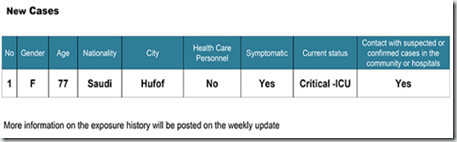
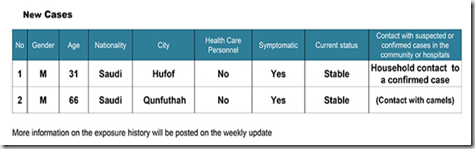
I’m pleased to report that the Saudi’s Coronavirus Command & Control Center is back up and running, they appear to be actively updating it, and we now have the case tables for the three cases reported on May 12th & 13th. 


May 13th


  image

May 12th

image


The May 13th case in Hufof is the 7th case from this region since April 20th,  and the 6th since May 5th.  The last five have all been described as `household contacts of a confirmed case’, suggesting this one of the largest household clusters we’ve seen.


The May 12th case from Jeddah is also listed as a household contact of a confirmed case, which is a bit curious, as we’ve not seen a case reported out of Jeddah in many weeks.  Hopefully we’ll get some clarification on this chain of infection in either their weekly report, or the next WHO update.


While the level of detail we get from these tables leaves a lot to be desired, after three days without them, their return is welcome indeed.

Thursday, May 14, 2015

KSA: A Sudden Dearth Of MERS Data

image


UPDATED 05/15/15:  Saudi MOH Coronavirus Website Back Up


# 10,051


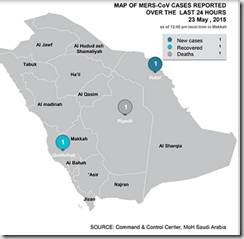
For the third day in a row the Saudi MOH Coronavirus website seems to be having problems loading (sometimes slow, sometimes displaying an error), and for the past two days another Saudi website wecanstopthis.com has carried a single, daily graphic (see above) showing the location and number of MERS cases, recoveries, or deaths.


Gone are the daily tables, although one summarizing cases from April 19-25th is posted. Hopefully this is just a temporary `fix’ while they get their main website working again. 


But over the past year we’ve seen an ongoing degradation of the MERS data provided by the Saudi MOH, with fewer and fewer epidemiological details being released in their daily reports.  The promise has been made that we’d see full details in weekly summaries, but those have been disappointing as well.


This trend in delayed and minimal reporting is something that we’ve also seen adopted by China this year with their H7N9 outbreak, and even more strikingly, by the Egyptian MOH with their H5N1 outbreak (see More Than One Way to `Contain An Outbreak’).


While these countries are presumably still providing the requisite information to the World Health Organization under the IHR reporting regulations, a growing lack of transparency – coupled with increased restrictions on what the media can report  – are a lousy recipe for effective global disease surveillance.


I’ll withhold judgment on this latest change in the way MERS is being reported by the Saudi’s until we see if it is permanent change or simply a stop-gap measure while they address their website issues.


But based on the trends of the past year, I’m not terribly hopeful.

Wednesday, May 13, 2015

Saudi Arabia: Two More MERS Cases

image 


# 10,045


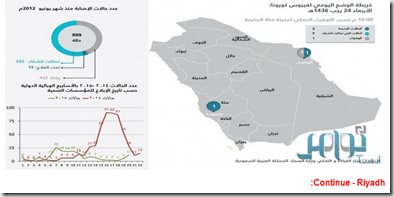
The Saudi Coronavirus Command Center website remains down for a second day, but Arabic media are carrying an MOH graphic showing two new MERS cases for today – one in Mecca and the other in Hafuf.   


Details on these cases are not currently available, beyond the following summation from twasul.info.


The Ministry of Health, on Wednesday, recording two cases of new infection "Corona" in Mecca and Hofuf, in addition to the deaths Balhvov the past 24 hours.

It is noteworthy that the number of cases of HIV infection since its discovery in the Kingdom reached 999 case, recovered, including 552 state, and 432 died, and remained under treatment, 15 cases


Hofuf (aka Hufof) has reported five recent cases (since May 5th), all believed to be part of a family cluster.  It isn’t clear what epidemiological connection – if any – today’s case has with those previously reported cases.