Showing posts with label DRC. Show all posts

Friday, November 21, 2014

WHO: DRC Ebola Outbreak Officially Over

image


# 9356


In late August – at the same time that West Africa’s Ebola epidemic was ramping up – we saw a separate, and unrelated outbreak in the DRC (Democratic Republic of Congo) that according to the last Ebola Roadmap Update, eventually consisted of:

Annex 3: ebola outbreak in democratic republic of the congo

As at 11 November there have been 66 cases (38 confirmed, 28 probable) of EVD reported in the Democratic Republic of the Congo, including 8 among HCWs. In total, 49 deaths have been reported, including 8 among HCWs. No new reported contacts are being followed.


Today marks 42 days since the last case tested negative, which meets the official standard for declaring this epidemic ended.  The DRC has seen more than a half dozen Ebola outbreaks in the past, however, and so future outbreaks are likely. 


This announcement vial email from the World Health Organization.


WHO declares end of Ebola outbreak in Democratic Republic of Congo

Statement 
21 November 2014

On 24 August, WHO was notified by the Democratic Republic of Congo (DRC) of an outbreak of Ebola virus disease (EVD) in Jeera County, Equateur Province. This outbreak, which is unrelated to that affecting West Africa, caused a total of 66 cases of EVD including 8 among health care workers.


By November 20, 42 days had passed since the last case tested negative twice and was discharged from hospital. According to WHO recommendations, the end of an Ebola virus disease outbreak in a country can be declared once 42 days have passed and no new cases have been detected. The 42 days represents twice the maximum incubation period for Ebola (21 days).


Having reached that 42-day mark, the Democratic Republic of Congo is now considered free of Ebola transmission. This outbreak is the 7th outbreak of Ebola virus disease in the DRC since Ebola virus was first identified there in 1976.


WHO commends the Democratic Republic of Congo’s strong leadership and effective coordination of the response that included rapidly mobilising an expert response team to Jeera County, identifying and monitoring contacts and organizing safe burials.


WHO, Médecins Sans Frontières (MSF), the US Centers for Disease Control (CDC), UNICEF and other partners supported the Government of the Democratic Republic of Congo with expertise for outbreak investigation, a mobile laboratory, risk communications and social mobilization, contact tracing and clinical care.


The Government of the DRC moved quickly to mobilize expert teams. Early engagement of traditional, religious and community leaders played a key role in successful containment of this outbreak.


The Government of the Democratic Republic of Congo and staff in the WHO country office are aware that the country remains vulnerable to Ebola virus disease and the country surveillance system remains on high alert.

Thursday, September 11, 2014

WHO Update On DRC Ebola Outbreak

image


# 9062


Although the Ebola outbreak in the Democratic Republic of Congo (DRC) is from the same Zaire species of the ebolavirus, genetic testing has shown it to be most closely matched to an older strain of the virus (see Virological Analysis Shows `No Link’ Between DRC and West African Ebola Outbreaks), similar to one seen in Kitwit in 1995.


Ebola is endemic in the DRC (formerly The Republic of Zaire), and has caused numerous outbreaks in that region since the virus was first discovered in 1976. 


The current outbreak is in a remote area, hindering its ability to spread, but the World Health Organization  has warned that this outbreak needs to be carefully monitored.  Here is their latest GAR (Global Alert & Response) update:


Ebola virus disease outbreak – The Democratic Republic of the Congo


10/09/2014

Epidemiological situation


Between 2 and 9 September 2014, there have been 31 more cases of Ebola virus disease (EVD) reported in the Democratic Republic of the Congo (DRC), increasing the cumulative number of cases to 62 (14 confirmed, 26 probable, and 22 probable). In total, 35 deaths have been reported (9 confirmed and 26 probable). No deaths have been reported among suspected cases. Nine health-care workers have been diagnosed with EVD, including 7 deaths.

All the cases have been localized in Jeera county. The affected villages are Watsi Kengo, Lokolia, Boende, and Boende Muke. Currently, 9 cases have been hospitalized: 4 in Lokolia; 2 in Watsikengo; 2 in Boende; and 1 in Boende Moke. A total of 386 contacts have been listed and 239 contacts have been followed-up. All cases and contacts are linked to the initial index case reported to the World Health Organization on 26 August 2014.


Response activities

During a regional meeting between the Ministry of Health of DRC and the Southern African Development Community on the management and prevention of EVD transmission, the following measures were recommended: standardization of the interventions for the prevention of EVD and enhancement of sanitary border control without impeding international traffic.


Under the leadership of the Government, the international community is providing strong logistical support and sending experts, equipment, food, and transportation means to the field.


A team of national and international specialists have been deployed to work with the local response teams. Patients are being treated in temporary isolation units in Watsi Kengo, Lokolia, Boende, and Boende Muke. A mobile laboratory from the National Institute of Biomedical Research (INRB) has been installed in Lokolia and is currently functional. Two laboratory epidemiologists from the US Centers for Disease Control and Prevention have arrived in DRC to support the INRB field team.


Contact tracing activities are being carried out by an assigned team with supervision from of a medical epidemiologist and a community worker, and when required, psychologists visit and dialogue with communities. Ongoing sensitization activities to mobilize community leaders are being implemented.


Data reported in the Disease Outbreak News are based on official information reported by the Ministry of Health. These numbers are subject to change due to ongoing reclassification, retrospective investigation, and availability of laboratory results.


WHO does not recommend any travel or trade restrictions be applied except in cases where individuals have been confirmed or are suspected of being infected with EVD or where individuals have had contact with cases of EVD. (Contacts do not include properly-protected health-care workers and laboratory staff.)

Tuesday, September 02, 2014

WHO: Virological Analysis Shows `No Link’ Between DRC and West African Ebola Outbreaks

image


# 9028


Actually this doesn’t come as a big surprise, but it does lay to rest an earlier report that suggested the DRC Ebola species was some sort of unusual  `hybrid’ between Ebola Zaire and Ebola Sudan. In fact, the outbreak in the Democratic Republic of Congo has now been identified as Ebola Zaire – and an older lineage at that – being most closely related to a strain that was seen in Kitwit, nearly 20 years ago.


Although the West African outbreak is also Ebola Zaire, it is of a different lineage, and therefore not connected to the DRC outbreak.


Ebola is endemic in the DRC (formerly The Republic of Zaire), and has caused at least 8 outbreaks in that region since the virus was first discovered in 1976.  The 1995 Kitwit outbreak infected 315, and killed 250 (81%). While the current outbreak is in a remote area, hindering its ability to spread, the WHO warns that this outbreak needs to be carefully monitored.


This report posted this morning from the World Health Organization.


Virological analysis: no link between Ebola outbreaks in west Africa and Democratic Republic of Congo

Situation assessment - 2 September 2014

Results from virus sequencing of samples from the Ebola outbreak in the Democratic Republic of Congo (DRC) were received last night. The virus is the Zaire strain, in a lineage most closely related to a virus from the 1995 Ebola outbreak in Kikwit, DRC.

The Zaire strain of the virus is indigenous in the country. Ebola first emerged in 1976 in almost simultaneous outbreaks in the Democratic Republic of Congo (then Zaire) and South Sudan (then Sudan).

Confirmatory testing was done at Gabon’s Centre International de Recherches Médicales in Franceville, a WHO collaborating centre. Earlier, testing in DRC confirmed Ebola in 6 of 8 samples.

The outbreak is located in the remote Boende district, Equateur province in the north-western part of the country.

Results from virus characterization, together with findings from the epidemiological investigation, are definitive: the outbreak in DRC is a distinct and independent event, with no relationship to the outbreak in west Africa.

As the Gabon laboratory report clearly stated, “the virus in the Boende district is definitely not derived from the virus strain currently circulating in west Africa.”

These findings are reassuring, as they exclude the possibility that the virus has spread from West to Central Africa.

Epidemiological investigation has linked the index case, who died on 11 August, to the preparation of bushmeat for consumption.

This is the country’s seventh Ebola outbreak since 1976. The introduction of the virus into the human population following contact with infected bushmeat (usually fruit bats or monkeys) is consistent with the pattern seen at the start of previous outbreaks. The virus is now spreading from person to person.

The response team has, to date, identified 53 cases consistent with the case definition for Ebola virus disease, including 31 deaths. Seven of these deaths were among health care workers. More than 160 contacts are being traced.

The government has rapidly mounted a robust response by reactivating emergency committees at national, provincial, and local levels, setting up isolation centres, and providing community leaders with facts about the disease. The government will ensure that all burials are safe.

The WHO team confirmed that collaboration between the government and its key partners is excellent.

The outbreak zone, where the most intense transmission is occurring, is remote, located some 1200 kilometres from the capital city, Kinshasa. No paved roads run from the outbreak zone to Kinshasa. However, cases have been detected or transmission is ongoing at three sites, underscoring the need to watch the outbreak’s evolution closely.

Motorcycles, canoes, and satellite phones have been supplied to facilitate outbreak investigation and contact tracing. A dedicated helicopter will be made available soon.

Wednesday, August 27, 2014

WHO Statement on DRC Ebola Outbreak

image


# 9007


While we still don’t know which species of Ebola (Sudan, Zaire, etc.) has recently emerged in a remote region of the Democratic Republic of Congo,  we do have an early epidemiological report that provides some details on the outbreak.  The index case appears to have contracted the virus from butchering bush meat, and there are now 24 suspected cases and 13 fatalities.


At this time there is no evidence to suggest this outbreak is linked to the Ebola Zaire outbreak which has been ongoing in Western Africa since early this year.


Ebola virus disease – Democratic Republic of Congo


26 August 2014

Epidemiology and surveillance

On 26 August 2014, the Ministry of Health, Democratic Republic of the Congo (DRC) notified the World Health Organization (WHO) of an outbreak of Ebola virus disease (EVD) in Equateur Province.

The index case was a pregnant woman from Ikanamongo Village who butchered a bush animal that had been killed and given to her by her husband. She became ill with symptoms of EVD and reported to a private clinic in Isaka Village. On 11 August 2014, she died of a then-unidentified haemorrhagic fever. Local customs and rituals associated with death meant that several health-care workers were exposed and presented with similar symptoms in the following week.

Between 28 July and 18 August 2014, a total of 24 suspected cases of haemorrhagic fever, including 13 deaths, have been identified. Human-to-human transmission has been established and includes the health-care personnel who were exposed to the deceased pregnant woman during surgery (one doctor and two nurses) in addition to the hygienist and a ward boy, all of whom developed symptoms and died. Other deaths have been recorded among the relatives who attended the index case, individuals who were in contact with the clinic staff, and those who handled the bodies of the deceased during funerals. The other 11 cases are currently being treated in isolation centres.

Samples have been sent to laboratories in Kinshasa and in Gabon for confirmation of EVD and to identify the strain. The index case and the 80 contacts have no history of travel to the EVD-affected countries in West Africa (Guinea, Liberia, Nigeria, or Sierra Leone) or history of contact with individuals from the affected areas. At this time, it is believed that the outbreak in DRC is unrelated to the ongoing outbreak in West Africa.

Health sector response

The Ministry of Health of DRC has dispatched field teams to the area to monitor and evaluate the situation. Contact tracing has begun and 80 individuals are currently being followed-up. Treatment of patients is ongoing and infection prevention and control measures are in place and are being supported by WHO with the delivery of personal protective equipment to the area.

WHO is currently monitoring the situation with the Government of DRC and awaiting confirmation of the disease strain from the laboratories. A rapid response team is poised to deploy and assist DRC, if needed. This is the seventh outbreak of EVD in the former Zaire / present DRC since 1976.

WHO does not recommend any travel or trade restrictions be applied except in cases where individuals have been confirmed or are suspected of being infected with EVD or where individuals have had contact with cases of EVD. (Contacts do not include properly-protected health-care workers and laboratory staff.) Temporary recommendations from the Emergency Committee with regard to actions to be taken by countries can be found at:

IHR Emergency Committee on Ebola outbreak in west Africa

Monday, August 25, 2014

Referral: Mackay On DRC’s Ebola Outbreak

image


#  8998


Yesterday’s announcement that the  DRC Reported Two `Positive’ Ebola Cases was followed overnight by reports (as yet, uncorroborated) that one of these samples was identified as Ebola Sudan, and the other (a bit perplexingly) was described as a `hybrid’ between Ebola Sudan and Ebola Zaire.


This excerpt from Reuters’  UPDATE 1-Congo declares Ebola outbreak in northern Equateur province.


Numbi said that one of the two cases that tested positive was for the Sudanese strain of the disease, while the other was a mixture between the Sudanese and the Zaire strain -- the most lethal variety.


Given the unusual nature of this claim, I’ll withhold any comment until we can get a confirmation from a WHO Collaborating Centre.  If true, this would appear to exclude the West African Ebola outbreak as the source, along with raising a number of new questions. 


That said, I always take early reports from the field with a sizable grain of salt. We should know more later today or tomorrow.


In the meantime, Dr. Ian Mackay has produced a helpful map, and blog post, on this recent turn of events. 


The battle of Ebola gains a second front...the Democratic Republic of Congo (DRC; f. Zaire)

So there are two reasons for this post.

  • It may be a little while before we get solid confirmed information form the DRC and I think maps are useful for those of us who are ignorant of where countries live!
  • I'm looking for a quick post so I can move the previous post's grisly pictures down the page!

We don't know the details yet but early reports from a country that was the site of the first (known) outbreak of a virus (called Ebola virus [1] or EBOV) of species Zaire ebolavirus, suggest 2 confirmed cases.[2]

(Continue . . .)

Sunday, August 24, 2014

DRC Reporting Two `Positive’ Ebola Cases

image


# 8996


On Thursday I blogged about an outbreak in the DRC (Democratic Republic of the Congo) of a `hemorrhagic’ illness that had reportedly infected more than 500 people, and by some accounts, had killed scores of people. 


At that time, the best information available was that it was  `something other than Ebola’ (see WHO: DRC Outbreak `Definitely Not Ebola’), with  `hemorrhagic gastroenteritis’ being offered as a likely diagnosis.

As sometimes happens, particularly when dealing with early reports from remote areas with less-that-optimal surveillance, initial reports don’t always end up being 100% correct.


Today  the DRC is reporting that at least two cases have tested positive for Ebola. There remains a certain amount of ambiguity here; confirmatory testing will be needed before we know for certain. And if these cases are indeed positive, they should also be able to determine what strain (there are 4 known strains in Africa).


This from BBC NEWS.


Ebola outbreak: DR Congo confirms two deaths

Authorities in the Democratic Republic of Congo say two people have died from Ebola in the country's north-west.


Right now, we have no way of knowing whether these cases, and the outbreak in West Africa are in any way related.  It is certainly possible that a separate outbreak has emerged in the DRC. 


As the following tweets from @WHO & WHO Spokesperson @HaertlG indicate, we should know more tomorrow.


image

image

Thursday, August 21, 2014

WHO: DRC Outbreak `Definitely Not Ebola’

image


# 8983


With the Ebola outbreak raging out of control in Western Africa it is natural to assume that any other report of a `hemorrhagic outbreak’  carrying significant mortality in that part of the world might also be due to one of the Ebola (or Marburg) viruses. 


In recent days we’ve seen media reports of an unidentified outbreak in the DRC, described as having a`hemorrhagic’ component, and that it has claimed as many as 70 lives over the past few weeks.  Major symptoms included fever, vomiting, and diarrhea.


While early speculation centered around the possibility of Ebola, today,  Gregory Hartl – spokesperson for the World Health Organization – confirmed that it definitely isn’t Ebola.

image


Good news, but not terribly surprising.


The reality is, there are plenty of other pathogens out there capable of producing these types of symptoms. E. Coli, Listeria monocytogenes, Salmonella typhi (Typhoid Fever) and Campylobacter jejuni  for instance,  all have a long (and bloody) history of causing severe gastroenteritis.


The infamous 2011 EHEC Outbreak in Germany – traced to E. Coli contaminated sprouts – infected over 4,000 people, produced hundreds of cases of kidney failure, and killed 50 people.


In Canada, 14 years ago , there was an outbreak in Walkerton, a small community  northwest of Toronto, where nearly half of the residents (2,300) developed gastroenteritis. Of these, 65 were hospitalized, 27 developed hemolytic uremic  syndrome (HUS) and seven died (cite A fatal waterborne disease epidemic in Walkerton, Ontario). 


The bottom line from that report:  


The pathogens identified as being primarily responsible were Escherichia coli 0157:H7 and Campylobacter jejuni although other pathogens were likely to have been present


A little bit of research also turned up a gastroenteritis outbreak Kinshasa, DRC a decade ago that claimed 77 lives and sickened more than 2500.  This from Irin News in 2004.

DRC: Gastroenteritis hits Kinshasa, kills 77 children

KINSHASA, 14 July 2004 (IRIN) - Some 77 children have died and 2,599 others are infected following an outbreak of gastroenteritis in Kinshasa, the capital of the Democratic Republic of the Congo, according to a health ministry official.


The associate director of epidemiology at the health ministry, Dr Vital Mondonge Makuma, told IRIN on Wednesday that the disease, caused by a strain of the Escherichia coli bacterium, broke out six weeks ago. It was particularly dangerous to children aged below five years, he added.


There are also viral causes of gastroenteritis (caused by noroviruses, other caliciviruses, astroviruses and adenoviruses for the most part) – and while they are seldom fatal in healthy individuals – they can produce significant mortality in people with comorbidities. 


And there’s no lack of parasites capable of inducing serious gastroenteritis as well (Giardia, Cryptosporidium, etc.)


The point here isn’t to try to pin down what the outbreak in the Congo is. 


There are a number of plausible options, including many I haven’t mentioned. The doctors and epidemiologists on the ground will figure it out, and I’m certain they will let us know when they do.

But it does remind us that while we obsess over the horrors of Ebola - a thousand times more people will be killed this year by far more mundane causes - like waterborne diseases, malaria, and childhood pneumonia.  

But since they don’t provoke the kind of visceral response that Ebola does, we somehow find the intestinal fortitude to tolerate them.

Friday, October 26, 2012

WHO Update On DRC Ebola Outbreak

image

Credit Wikipedia


# 6665


While we continue to watch a Marburg virus outbreak in Uganda, the Ebola outbreak in neighboring Democratic Republic of the Congo is now entering its 6th week.


Today the World Health Organization has posted this update on their Global Alert & Response page:


Ebola outbreak in Democratic Republic of Congo – update

26 October 2012 - As of 24 October 2012, 52 cases (35 laboratory confirmed, 17 probable) with Ebola haemorrhagic fever (EHF) have been reported in the Democratic Republic of Congo (DRC). Of these, 25 have been fatal (12 confirmed, 13 probable).


The cases are reported from Isiro and Viadana health zones in Haut-Uélé district in Province Orientale.


The Ministry of Health (MoH) continues to work with local health authorities and international partners in active surveillance, tracing of contacts of probable and confirmed cases, infection prevention and control in health care settings, management of patients in health care facilities, logistics, social mobilization, provision of psychosocial support and conducting anthropological analysis to support the control of the outbreak.


Surveillance activities are being strengthened in Isiro and neighbouring areas, including Bedhe and Nakwapongo. In Isiro, health care workers are being trained on basic infection prevention and control in health care settings. Through the Global Outbreak Alert and Response Network (GOARN), a field laboratory has been set up by the Public Health Agency of Canada (PHAC).


Social mobilization activities are being carried out in schools and churches in Isiro, Rungu and Ngosaku to provide information on protection against the Ebola virus and to discuss concerns of the local population.

Tuesday, September 18, 2012

WHO: DRC Ebola Update - Sept 18th

UPDATE:   Some media sources are quoting a much higher death toll (see Ebola outbreak 'kills 32' in DR Congo since May) than is being reported below by the WHO. 


Today Sharon Sanders of FluTrackers contracted Gregory Hartl at the World Health Organization for clarification.  He explained that suspected cases are not counted in their report, and the current number of fatalities remains at 19.


image

# 6560


The World Health Organization has posted an update on the Ebola outbreak ongoing in the Democratic Republic of the Congo, indicating an increase of 5 confirmed cases since their last update.


Ebola outbreak in Democratic Republic of Congo – update

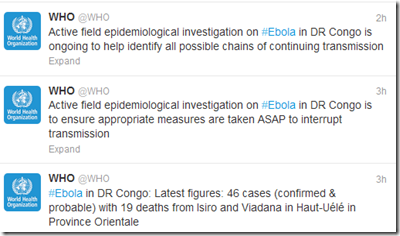
18 September 2012 - As of 15 September 2012, 46 cases (14 laboratory confirmed, 32 probable) with Ebola haemorrhagic fever (EHF) have been reported in the Democratic Republic of Congo (DRC). Of these 19 have been fatal (6 confirmed, 13 probable).


The cases reported are from two health zones of Isiro and Viadana in Haut-Uélé district in Province Orientale. Additionally, 26 suspected cases have been reported and are being investigated.


The MoH continues to work with partners to control the outbreak. Active epidemiological investigation is being done to identify all possible chains of transmission of the illness, and ensure that appropriate measures are immediately taken to interrupt the transmission, and stop the outbreak.

(Continue . . . )


This morning the WHO has also provided brief updates via their Twitter account @WHO.


image


Whenever an outbreak of a hemorrhagic virus occurs somewhere in the world, we are fascinated by its vivid imagery, and its feared potential. Thus far, the spread of Viral Hemorrhagic Fevers (which include Ebola, Marburg & Lassa) has been limited.


These viruses strike quickly, with profound and debilitating symptoms, and that helps to limit human-to-human spread.


In terms of numbers affected, the worst known outbreak occurred in Uganda in 2000-2001, with 425 cases and 224 deaths (cite).


The risks of this virus spreading beyond the endemic areas of central Africa are considered low (see ECDC Risk Assessment), but as Maryn Mckenna wrote in her blog Lassa fever: Coming to an airport near you - with our increasingly mobile population - opportunities for exotic tropical diseases like Ebola to hop on an airplane are increasing.


The World Health Organization maintains an Ebola FAQ Sheet, where you will find more information on the disease:


Ebola haemorrhagic fever

Fact sheet N°103
August 2012


Key facts
  • The Ebola virus causes severe viral haemorrhagic fever (VHF) outbreaks in humans.
  • Viral haemorrhagic fever outbreaks have a case fatality rate of up to 90%.
  • Ebola haemorrhagic fever outbreaks occur primarily in remote villages in Central and West Africa, near tropical rainforests.
  • The virus is transmitted to people from wild animals and spreads in the human population through human-to-human transmission.
  • Fruit bats of the Pteropodidae family are considered to be the natural host of the Ebola virus.
  • There is no treatment or vaccine available for either people or animals.

( Continue . . .)

Friday, September 14, 2012

WHO: DRC Ebola Update

image

Credit Wikipedia


# 6554


After a flurry of news reports yesterday – some suggesting that the Ebola outbreak in the Democratic Republic of the Congo was `out of control’ - we’ve an update from the World Health Organization this morning that endeavors to clarify the situation.


Ebola outbreak in Democratic Republic of Congo – update

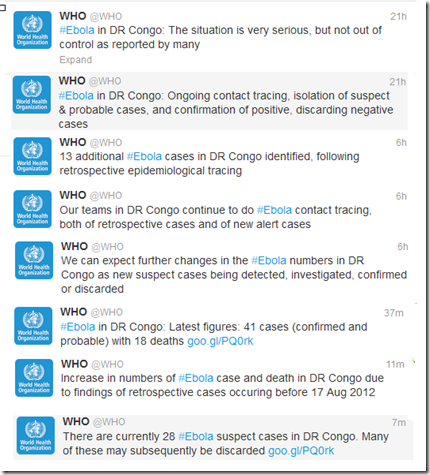
14 September 2012 - Retrospective epidemiological investigation recently identified additional confirmed and probable cases with Ebola haemorrhagic fever (EHF) in the Democratic Republic of Congo (DRC), according to the Ministry of Health (MoH).


As of 12 September 2012, 41 cases (9 laboratory confirmed, and 32 probable) have been reported from Haut-Uélé district in Province Orientale. Of these cases, 18 have been fatal. (5 confirmed and 13 probable). 18 healthcare workers are included among the probable cases. 28 suspected cases have also been reported and are being investigated.


Since the last update, an additional 27 cases (1 laboratory confirmed and 26 probable) of EHF were identified through retrospective epidemiological investigation in the two health zones of Isiro and Viadana. The retrospective epidemiological investigation was done to identify cases of illness which might have been EHF between the end of April 2012 and August 2012, and thus help clarify the possible origins of the outbreak and provide additional information on chains of transmission. In addition, active field epidemiological investigation is continuing to help identify all possible chains of continuing transmission of the illness, to ensure that appropriate measures are immediately taken to interrupt the transmission, and stop the outbreak.

(Continue . . . )

Over the past 24 hours the World Health Organization has been updating the situation via Twitter, as well.  Below you’ll find their tweets (ranked oldest to newest) on the Congo outbreak.

Follow @WHO for more updates.

image


Ebola was first discovered in Zaire and Sudan in 1976 and since then has become almost legendary for its incredibly high fatality rate and gruesome hemorrhagic symptoms. 


As a public health threat, Ebola – which has been blamed for fewer than 2,000 deaths over the past 30+ years - pales in comparison to most of the world’s less feared infectious diseases.


Simple childhood pneumonia, claims 1.8 million lives each year (cite) and Malaria claims between one half, to one million lives a year (cite).


Despite its relative rarity, movies like 1995’s Outbreak with Dustin Hoffman, and books like Tom Clancy’s Executive Orders and The Hot Zone by Richard Preston, have helped to turn Ebola into the ultimate nightmare disease in the eyes of the public.


There are currently five known strains of the disease, of which four are highly pathogenic in humans.; Ebola-Zaire, Ebola-Sudan, Ebola-Ivory Coast and Ebola-Bundibugyo.


This outbreak, in the DRC, is caused by Ebola-Bundibugyo.


The odd virus out - Ebola Reston - which can infect and kill non-human primates, can infect humans, but has not been shown to produce disease.


While the zoonotic reservoir for the Ebola virus has yet to be firmly established, bats are considered to be a likely candidate. 


For more background on the Ebola virus the CDC’s Special Pathogens Branch has an extensive webpage on the virus.


Ebola Hemorrhagic Fever
About the Disease
For the General Public