Showing posts with label Dr. Ian Mackay. Show all posts

Thursday, May 14, 2015

Referral: Mackay On The Road To Zero Ebola Cases In West Africa

image

Credit Dr. Ian Mackay VDU Blog 


# 10,050


Nine months ago were were staring at a nearly apocalyptic worst case estimate of between 550,000 and 1.4 million Ebola cases in Liberia and Sierra Leone by the end of January 2015  - if interventions were not implemented - (see MMWR: Estimating The Future Number of Cases In The Ebola Epidemic).


Of course, interventions were implemented, and that harrowing estimate was never realized. 


Not that one can take a lot of comfort from a tally that conservatively shows nearly 27,000 cases and just over 11,000 deaths.  This single outbreak affected six times more people than all of the previously known outbreaks (1996-2014) combined.


But it wasn’t as bad as it could have been.  And indications are that – barring something unforeseeable – this West African Ebola outbreak may be nearing an end.


This round up and commentary from Dr. Ian Mackay, from which I’ve only excerpted a snippet.  Follow the link to read it in its entirety:


Liberia gave Ebola the boot...and a virus may soon be removed from the wild

image

The people of Liberia have earned our respect, some time for national celebrations and frankly any other rewards that may flow from denying the Makona variant of Ebola virus any hosts among their community.


The world considered this viral species to be one of the list-toppers when it came to ranking the causes of the most scary acute infectious diseases. Ebola virus has been the basis for all sorts of 'end-of 'the-world' mutating virus horror movies, books, and TV shows. It's not at all surprising that the public view of an Ebola virus infection had long been one of blood, fear and terror.

(Continue . . . )

Monday, May 04, 2015

Referral: Mackay Recaps H7N9’s 3rd Wave

image

Credit Dr. Ian MackayVDU Blog 


# 10,004


By just about all measures, `the fog of flu’ in the two countries hardest hit by HPAI (H7N9 & H5N1), has been unusually thick this winter, with data only slowly and intermittently emerging from China and Egypt. While Egypt’s outbreak appears to be ongoing, case reports out of China have slowly ground to a halt.


Last night Ian Mackay blogged on the dearth of data coming out of China (see Hubei province listed its first H7N9 case in April...some rare detail), while today. Ian  has published a recap of this winter’s 3rd wave of H7N9, with an abundance of updated charts and maps.


Follow both links to read:


The third outbreak of influenza A(H7N9) virus seems to be over...

Cumulative curves of reported H7N9 cases and deaths in humans.
Click on graph to enlarge.

By the looks of the curve on the right, the rush of cases that defined the third known outbreak of the low pathogenicity avian influenza A virus subtype, H7N9, is over...for another season anyway.


If we get into the nitty gritty, as I have below, there are a couple of interesting things to see. First though - let us remember that these are just reported data:

(Continue . . .)

Monday, April 06, 2015

Referral: Mackay On Lesser Ebola Transmission Risks

image

Credit CDC PHIL


# 9904


Making news last week was the story Liberia Recommends Ebola Survivors Practice Safe Sex Indefinitely, which came after an Ebola patient died the previous week with just one known risk factor: her boyfriend had been successfully treated for Ebola last September.


You may recall that last  August, Dr. Ian Mackay writing on his VDU Blog, posted Ebola virus in semen is the real deal...., which he followed up 10 days later with  Ebola: Blood, sweat and tears, where Ian described the (somewhat limited) research to date on the level of EBOV detection in other body fluids – like tears, sweat and saliva.


A couple of months later Ian and Dr. Katherine Arden followed up with a piece for The Lancet (see Mackay & Arden On Ebola In Semen Of Convalescent Men), where they wrote:


A clear need exists to ensure that men convalescing after Ebola virus disease are made very plainly aware that they will need to conduct themselves with care to minimise the infectious potential of their seminal fluid. This careful conduct should include the patient maintaining careful personal hygiene after masturbation, practicing safe sex, or abstaining from sexual contact altogether for a suitable period of time.


Yesterday Ian weighed in on another not-so-obvious route of potential convalescent Ebola transmission; urine.  I’ve only excerpted one paragraph, follow the link to read:


Ebola - the lesser transmission risks are still risks...

(EXCERPT)

Another possible, albeit also unproven, transmission route is urine. This fluid seems to me to be a far more likely source of trouble. One cannot abstain from urination. So why worry about urine as a risk for transmission of Ebola virus? An EVD case study last year showed very nicely that infectious Ebola virus could be cultured from urine for about 12 days longer than it could be from blood.[1] Viral RNA has also been found in urine for four weeks.[1,2]


(Continue . . . )

Wednesday, March 18, 2015

Referral VDU Blog: Catching Ebola: mistakes, messages and madness


image

Credit CDC PHIL


# 9840


One of the early `voices of reason’  on the threat posed by the Ebola Virus outside of Africa, was Dr. Ian Mackay on his VDU Blog

While many in  the news media, social media, and the tabloids went nuts last August over improbable `Ebola doomsday scenarios’  (see A Look Down The Ebola Rabbit Hole) –   Ian produced a series of focused, and scientifically grounded looks at the `real risks’ from the virus, and debunked some of the rampant misinformation spreading on the net.


A few examples:

Fake/wrong Ebola virus disease images...

VDU Blog: Droplets vs Airborne - Demystifying Ebola Transmission

Ebola: Blood, sweat and tears...


And a review by Ian and Dr. Katherine Arden in The Lancet, published last November:

Lancet: Mackay & Arden On Ebola In Semen Of Convalescent Men


Today Ian and Kat Arden are back with a look back at the messaging (good and bad) during the height of the Ebola outbreak last fall, and a reality check on the threat Ebola poses to a modern society with decent public health resources.


Follow the link to read:


Catching Ebola: mistakes, messages and madness

Written by Dr. Ian M. Mackay and Dr. Katherine E. Arden

Despite obvious community and media fear, speculation and exclamation that Ebola virus would enter and spread widely within countries outside of the hotzone, such an event did not come to pass in 2014. The early public health messaging on Ebola virus and disease were, for the most part, spot on.


In 2014 and 2015, thousands of cases of Ebola virus disease (EVD) ravaged Guinea, Sierra Leone and Liberia in 2014 (the "hotzone"). A smaller outbreak was defeated in Nigeria [8] and another distinct Ebola virus variant drove an outbreak of EVD in the Democratic Republic of the Congo[7] - they too controlled spread of the virus. Ebola virus traveled from the hotzone to other countries including Senegal, Nigeria, the United States of America (USA), Mali and most recently, the United Kingdom. It did this by hitching a ride in a usually unknowingly infected human host.

(Continue . . . )


Wednesday, February 18, 2015

Referral: VDU Blog On Closure Of Guangdong’s Live Markets

Photo: ©FAO/Tariq Tinazay

Credit FAO


# 9725


Amid news of another H7N9 case reported from Guangdong Province (see CHP notified of additional human case of avian influenza A(H7N9) in Guangdong),  Dr. Ian Mackay weighs in with a blog on the importance of closing live bird markets (LBMs)  in China in order to reduce the spread of the virus.


Follow the link to read:


Guangdong sees sense among the feathers...

Guangdong province in southern China is suspending its poultry markets. All of them. From 15-Feb to 28-Feb.[1] While the closures are only for 2-weeks, this will be very important for stopping human cases of avian influenza, particularity of the H7N9 subtype, during the bustling spring period in China.

Live poultry market closures also remove a traditional dish of fresh cooked chicken. One can be certain that no-one will die because of the substitution of frozen or factory prepared chicken for a fresh chicken, even if chefs don't succumb to the tantrums of last year and refuse to prepare dishes made from anything but fresh market-selected poultry. One can be equally certain that if the markets remain operating during the peak season for influenza virus circulation as they have been, that human infections, and deaths, due to H7N9 infections, will also continue

(Continue . . . )


Last summer, in CDC: Risk Factors Involved With H7N9 Infection we looked at a case-control study conducted by an international group of scientists, including researchers from both the Chinese and the US CDC which concluded.


Exposures to poultry in markets were associated with A(H7N9) virus infection, even without poultry contact. China should consider permanently closing live poultry markets or aggressively pursuing control measures to prevent spread of this emerging pathogen. 


In October of 2013 we saw another study (see The Lancet: Poultry Market Closure Effect On H7N9 Transmission) which found:


Closure of LPMs reduced the mean daily number of infections by 99% (95% credibility interval 93—100%) in Shanghai, by 99% (92—100%) in Hangzhou, by 97% (68—100%) in Huzhou, and by 97% (81—100%) in Nanjing. Because LPMs were the predominant source of exposure to avian influenza A H7N9 virus for confirmed cases in these cities, we estimated that the mean incubation period was 3·3 days (1·4—5·7).


Despite the evidence that it would greatly reduce the transmission of the virus, closing LMBs is a hard sell to the Chinese public. Purchasing live market birds is deeply ingrained in the culture, as it reassures the buyer that the bird is both fresh and healthy. 


China, Indonesia, and other countries have attempted to close or strictly regulate live bird markets in the past – only to be met with tremendous public resistance (see 2009 blog China Announces Plan To Shut Down Live Poultry Markets In Many Cities)


That ambitious plan, announced more than 5 years ago to `shut live poultry markets in all large and medium-sized cities throughout China’, obviously never happened.


While the temporary closure of markets Guangdong will hopefully reduce the impact of this year’s H7N9 outbreak, as Ian points out temporary closures are only expected to provide temporary relief.  

Friday, January 16, 2015

Referral: VDU On MERS In HCWs

image

Credit Dr. Ian Mackay VDU Blog 


# 9584


Dr. Ian Mackay has a new post up today that looks at the unusually high number of Health Care Workers infected with the MERS coronavirus over the past three years. 


As he points out, HCWs are considered `canaries’ in the coalmine, and when those who are supposed to be taking special care not to get infected continue to fall prey to the virus, it is considered a potential red flag.


Along with his patented graphics, Ian provides some excellent commentary the shedding for 42 days of the virus by an infected, but asymptomatic nurse, and how that might help explain some of the community infections for which there is no obvious exposure.


Follow the link to read:


MERS-CoV snapdate on canaries...

MERS-CoV detections among healthcare workers (HCWs)


HCWs are akin to the canary in the coal mine - when HCWs get sick with a particular bug, this can signal that the bug may well be more active in the the wider community.

(Continue . . . )

Monday, November 17, 2014

Referral: Mackay On Early Negative Testing For Ebola

image
Credit CDC PHIL


NOTE:  As I am posting this, NBC News is reporting the death of Dr. Martin Salia, who reportedly initially tested negative for the virus even after becoming symptomatic.

Ebola Patient Dr. Martin Salia Has Died in Nebraska: Officials

Dr. Martin Salia, an Ebola patient being treated in Nebraska, has died, medical officials said Monday.

Salia was diagnosed with Ebola in Sierra Leone and was airlifted to Nebraska on Saturday. He was the 10th Ebola patient to be treated on U.S. soil and the third treated at Nebraska Medical Center.


# 9337


We’ve often heard that Ebola tests aren’t conclusive until they are taken 48-72 hours after symptoms first appear, and based on recent media reports (see WaPo’s A doctor’s mistaken Ebola test: ‘We were celebrating. . . . Then everything fell apart’), that appears to have been the case with Dr. Martin Salia who died this morning.


Dr. Ian Mackay gives us some deep background on the testing for Ebola, and why a 48-72 hour window for testing was selected.


Ebola testing: 48-72 hours for a negative to turn positive

Currently, some fraction of the people who present very early after they may have been infected by Ebola virus for testing, return a negative result. This is probably a rare event because the majority of cases arrive for care with Ebola virus disease (EVD) already well underway.


The latest Centers for Disease Control and Prevention (CDC) guidance in these instances is to wait (48 to) 72 hours and see if the patient remains ill, or becomes more unwell. If they do either of these, a second test is performed.[1] If the suspect case recovers from illness, no repeated testing is indicated.


The test we rely on to confirm a clinically suspected EVD case is called a reverse transcriptase polymerase chain reaction (RT-PCR). RT-PCR is a technique designed to  seek out a tiny but very specific region of the Ebola virus's RNA genome, copy it into DNA then amplify those DNA copies a billion-fold by making more copies. Somewhere during that exponential amplification process, the technology of the day (currently fluorescence detection but formerly agarose gel detection, radiation and chemiluminescence) allows us to identify that the specific DNA we seek is appearing above an arbitrary threshold...we have a positive test result for Ebola virus.


(Continue . . . )

Thursday, October 02, 2014

Mackay On Ebola `Direct Contact’ & Droplet Transmission

image


# 9142


Dr. Ian Mackay once again takes on the subtleties of Ebola transmission on his excellent VDU blog today, and brings a new level of clarity.   As he and I have discussed before (see VDU Blog: Droplets vs Airborne - Demystifying Ebola Transmission), Ebola isn’t an `airborne’ virus – but you can be infected via droplets emanating from an infected individual.


What I’ve dubbed `spittle range’ where large droplets of mucus, blood, sweat, or other bodily fluids could potentially be coughed, sneezed, or otherwise propelled or flung onto another person.  


Last Month, in Ebola: Parsing The CDC’s Low Risk vs High Risk Exposures, we looked at CDC guidance that acknowledged the (low) risks of casual contact; defined as spending a prolonged period of time in the same room with, or within 1 meter, of an infected patient – even without direct physical contact.


image

In the light of all of this, the heavily parsed and highly promoted meme -  that `You can’t get Ebola through air’  -  tends to cause more confusion than reassurance.


To the rescue today comes Dr. Mackay, who explains what `direct contact’  really means.  I’ve only included a snippet, follow the link to read:


It's what falls out of the aerosol that matters....

(Excerpt)

Direct contact.

When we talk about "direct contact" and Ebola virus transmission, we do include the bigger wetter heavier droplets that might be propelled from of a sick person during vomiting, or coughing as a risk for transmitting virus.

Even though that is not physical direct contact, and even though the droplets travel across a gap between people - through the air - it is still a direct line from person A (red in the graphic below) to B (blue). If B is too far away, then those droplets fall to the ground before they hit B. The droplets may remain infectious on the ground. That depends on temperature, humidity, surface type and the type and amount of virus.

(continue . . . .)

Monday, September 29, 2014

Referral: Mackay On The Widening `Control Gap’

image 


# 9122


Dr. Ian Mackay –  presents graphs today showing an intriguing Ebola outbreak trend, and offers a plausible reason behind it, in his latest blog called:


The control gap...

v1.0 290914

I have a theory.


This theory is meant only to apply to disease outbreak/epidemic/pandemic situations, and then only to those which include fatal cases.


This theory of mine has only emerged since I've been plotting Ebola virus cases numbers from the West African epidemic. I precede the explanation with the caveat that there is very probably already a well developed, well-known actual epidemiology term to describe this theory. But I'm not a trained epidemiologist and this is just a blog, so please forgive me my ignorance.


The theory goes that when a gap grows between the number of new cases being reported and the number of deaths or laboratory confirmations in that population, despite the outbreak having been going for a while, this represents an indication that control of the situation is slipping, or has been lost.

(Continue . . . )


Thursday, September 25, 2014

Referral: How Ebola Started, Spread & Spiralled Out Of Control


# 9114


From Ian Mackay, Katherine Arden  & science writer Heather Lander we’ve a terrific overview of how the Ebola outbreak evolved in West Africa, published today in The Conversation.   With a line up like that, there’s nothing for me to do but step aside and invite you to follow the link below to read:


25 September 2014, 5.41am BST

How Ebola started, spread and spiralled out of control

Too slow. Too little, too late. Unprecedented. Out of control. These are just some of the descriptors for the biggest recorded epidemic of human infection by an ebolavirus. The question by some is how…


West African health-care workers are overworked and under-equipped to deal with the outbreak. European Commission DG ECHO/Flickr, CC BY-NC-ND

Too slow. Too little, too late. Unprecedented. Out of control. These are just some of the descriptors for the biggest recorded epidemic of human infection by an ebolavirus.

The question by some is how this happened? As of this writing, 5,347 people are suspected or known to be infected (an undoubted underestimate) in Guinea, Sierra Leone, Liberia, Nigeria and Senegal. And 2,630 have died.

(Continue . . . )


Friday, September 12, 2014

Mackay On The Prospects (Or Not) Of An Airborne Ebola


# 9070


Earlier today, in Osterholm: What We’re Afraid to Say About Ebola, we looked at an Op-Ed by Dr Osterholm, and an interview of Osterholm by Helen Branswell, which discussed the possibility that – over time – the Ebola virus could pick up mutations that would allow it to transmit more readily among humans. 


As you might imagine, this has caused a bit of a stir this morning, even though the possibility had been briefly mentioned a week ago by the director of the CDC, Dr. Thomas Frieden (see CDC & WHO Press Briefings On Ebola).

image


Viral mutations are  fairly common – particularly among single-stranded RNA viruses - but the vast majority of these mutations won’t significantly affect the virulence or transmissibility of a virus one way or another. Some mutations can even degrade a virus’s ability to replicate, transmit, or cause disease, while a relative few are likely to enhance one of those traits.


Since these are random events, Ebola hitting the right (or for us, the `wrong’) combination of mutations is on par with someone winning the lottery.  It can happen, but it’s a long shot.

Still, if you buy enough tickets . . .

Today, Dr. Ian Mackay takes what he has called `an irreverent look at mutation, thinking viruses & another reason to stop the outbreak’ in his VDU blog entry:


The wind beneath my Ebola virus....

Only a couple of weeks ago the report in Science presented 99 genomes representing some of the thousands of those circulating in Sierra Leone this year.[1] I say thousands because each infected person has a range of subtley different viral variants among the billions of viruses per millilitre of blood that all compete to be the champion. The words "mutant" and "ebolavirus" are now hard to avoid. And of course as soon as you talk mutations, you can only see one endgame - a virus that is easily transmissible and turns us all into zombies. spreads across the world in a pandemic and kills as many as 80% of those it infects.

(Continue . . .)


The bottom line, as succinctly expressed by Ian, is that despite the conventional wisdom of the not-so-distant past, Ebola clearly doesn't "need" to be airborne to spread efficiently.

Sunday, August 31, 2014

Mackay On Ebola: Blood, Sweat & Tears

image

Credit CDC PHIL


# 9022


Ian Mackay, in a follow up to his seminal post on Ebola ten days ago, writes today on the level of EBOV detection (often via RNA, or Antigens) in various human body fluids. 


While the blood of  viremic patients is infamously teeming with the virus, Ian describes the (somewhat limited) research to date on the level of EBOV detection in other body fluids – like tears, sweat and saliva.


Although the level of EBOV detection in these fluids have been far lower –and  often even undetectable -  given the believed low infectious dose for contracting viral hemorrhagic fevers and the likely variability of virus shedding across numerous cases, any hint of the virus in these body fluids is deserving of our attention and respect.


Follow the link to read.


Sunday, 31 August 2014

Ebola: Blood, sweat and tears...

This post follows up the recent one on convalescent semen being able to harbour infectious Ebola virus (EBOV; although I am not aware of any infection resulting from this route of transmission there has been at least one report for Marburg virus [4]).


I thought I'd give the same treatment to tears and sweat which are also fluids intermittently listed as possible sources of EBOV infection for humans. Some examples of the scientific literature which support the risk messaging, follow.

(Continue . . .)

Saturday, August 30, 2014

Referral: Mackay On The Expansion Of Ebola Into Senegal

image

Credit Dr. Ian Mackay VDU Blog


# 9019


In his blog overnight, Dr. Ian Mackay adds Senegal to his Ebola outbreak map, and makes an important point about the uniqueness of each disease outbreak, the human variables that drive them, and the danger of assuming that the public health responses of the past will always suffice in the future.


First a link to Ian’s blog, then I’ll be back with a comment.


The fifth I give you...

Senegal.


According to it's Minister of Health, Awa Marie Coll Seck [1,2], a case of Ebola virus disease (EVD) has been imported from Guinea and it is confirmed by testing at the World Health Organization's collaboration Centre, the Pasteur Institute in Dakar.

Interesting that this occurred one week after Senegal closed its borders (again) with Guinea.[3,4] The infected Guinean student travelled on 29-August to Dakar where he presented to a hospital but did not admit to being in contact with known EVD cases. Senegal had closed its borders around 22-August.[5,6].


(Continue . . . )


After forty years of outbreaks – all of which were geographically limited and comparatively small – Ebola had gained the reputation of being a horrific killer – but basically only of `local concern’


Conventional wisdom said that it killed too quickly to allow those infected to spread the disease far. The virus simply didn’t have the `legs’ to spark a major outbreak.


Fast forward to 2014, and those assumptions are taking it on the chin.  Not because the virus has changed, but because Africa has changed (a major point made in Michael Osterholm’s WaPo Article  Aug. 1st).  


Remote villages aren’t nearly as remote as they once were. Cars, busses, trains, even airplanes are far more common today in Africa than they were in 1976 when the virus was first detected.  Society is more mobile today than ever before, and that applies to just about everywhere on this planet.


The world was caught flat-footed in its initial response to this Ebola outbreak – no doubt lulled by earlier successes in containing the virus -  and that has allowed it to spread unchecked. Given its lack of `airborne’ transmission, I fully expect it will eventually be brought under control, albeit at a terrible cost. 


The takeaway lesson here goes beyond Ebola, and well beyond the continent of Africa.


As the world changes, so do the capabilities of its pathogens. A side effect of modern society is that it has become the great enabler of infectious disease.  A novel virus or resistant bacteria can hitch a ride in New Delhi or Shanghai this morning and can be in London, or New York by tonight.


Which means that we no longer have the luxury of ignoring `small disease outbreaks’  anywhere in the world, no matter how remote. 


Because the next pathogen to crawl out of the woodwork may be far more `pandemic-ready’  than Ebola could ever be. 

Monday, August 25, 2014

Referral: Mackay On DRC’s Ebola Outbreak

image


#  8998


Yesterday’s announcement that the  DRC Reported Two `Positive’ Ebola Cases was followed overnight by reports (as yet, uncorroborated) that one of these samples was identified as Ebola Sudan, and the other (a bit perplexingly) was described as a `hybrid’ between Ebola Sudan and Ebola Zaire.


This excerpt from Reuters’  UPDATE 1-Congo declares Ebola outbreak in northern Equateur province.


Numbi said that one of the two cases that tested positive was for the Sudanese strain of the disease, while the other was a mixture between the Sudanese and the Zaire strain -- the most lethal variety.


Given the unusual nature of this claim, I’ll withhold any comment until we can get a confirmation from a WHO Collaborating Centre.  If true, this would appear to exclude the West African Ebola outbreak as the source, along with raising a number of new questions. 


That said, I always take early reports from the field with a sizable grain of salt. We should know more later today or tomorrow.


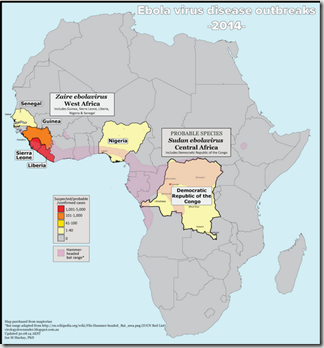
In the meantime, Dr. Ian Mackay has produced a helpful map, and blog post, on this recent turn of events. 


The battle of Ebola gains a second front...the Democratic Republic of Congo (DRC; f. Zaire)

So there are two reasons for this post.

  • It may be a little while before we get solid confirmed information form the DRC and I think maps are useful for those of us who are ignorant of where countries live!
  • I'm looking for a quick post so I can move the previous post's grisly pictures down the page!

We don't know the details yet but early reports from a country that was the site of the first (known) outbreak of a virus (called Ebola virus [1] or EBOV) of species Zaire ebolavirus, suggest 2 confirmed cases.[2]

(Continue . . .)

Sunday, August 24, 2014

Referral : Mackay On Fake/False Ebola Images

image

Credit VDU Blog 


# 8992


One of the tools we bloggers use to glean `real-time’ information is to filter twitter using a #hashtag, so as to view only those tweets dealing with particular subject. If you want Ebola-specific tweets, you search using #Ebola


Yesterday I spent most of my time searching #Bárðarbunga, which some wag aptly pointed out was technically an #ashtag.  But more on that later.


While you can often get good information off these twitter streams, they also contain a lot of nonsense.  Some of it, dangerous or even damaging, such as the misinformation spread during and after Hurricane Sandy (see Caveat Twitter).


I isn’t just Twitter, of course. 


A couple of weeks ago in A Look Down The Ebola Rabbit Hole I wrote about some of the alarmist, and false, information being spread on Youtube and Internet websites regarding the Ebola outbreak and the Yellowstone super volcano.


Some of these videos are very professional looking, and by cherry picking (or just making up) facts, they can be very convincing.


Today Ian presents a series of photos from twitter purporting to show the physical manifestations of Ebola infection (warning, you might want to have breakfast first).   Unfortunately, most of these photos are NOT of Ebola patients.  


Follow the link below to read:


Sunday, 24 August 2014

Fake/wrong Ebola virus disease images...

As if there isn't enough misery in the world that we need add false imagery to the mix.


Fake or hoax or just plain misunderstood images purporting to be from cases of Ebola virus disease are everywhere at the moment. The ones below are images I see regularly in the #ebola Twitter stream.

(Continue . . .)


In a bit of synchronicity, in my blog yesterday -  Bárðarbunga Volcano Aviation Alert Raised To Red - I mentioned the twitter feeds for this rumbling volcano (while warning Caveat Lector). 


No sooner had a small  sub-glacial `eruption’ been announced, hundreds of spectacular photos of  volcanoes  violently erupting (but NOT of #Bárðarbunga) – began to appear on twitter announcing the event. 

`Artistic license’, I suppose.  But disappointing nonetheless.


Although I occasionally rail against sensationalistic websites, videos, and pictures I know it is essentially tilting at windmills on my part.  Sadly, there are far too many people out there willing to post nonsense – and a huge audience receptive to such tripe – to hope that it will go away. 

Tuesday, August 19, 2014

VDU Blog: How To Support Ebola Relief Efforts

image


# 8972


Dr. Ian Mackay has just posted a blog on how you can help to get PPEs and other needed supplies to those on the front lines battling the Ebola outbreak in Western Africa.   I’ll not delay you any further, and simply ask that you go visit – and then take to heart – his appeal.


Protect the healthcare workers>>save lives>>stop Ebola virus disease

Saturday, July 26, 2014

Referral : VDU Ebola Pages

image

VDU Blog Interactive Ebola Maps


# 8869


Dr. Ian Mackay has recently added a pair of static Ebola graphic pages to his VDU blog (check the tabs at the top of the home page).  One with Ebola maps, and the other with charts and graphs. 


Both are updated often (give the graphics a moment to re-initialize with the latest data when you visit), and both have interactive components.


Ebola Virus Disease (EVD) 2014 West African outbreak..

image

Tuesday, July 22, 2014

mBio: Airborne Fragments Of MERS-CoV Detected In Saudi Camel Barn

Photo: ©FAO/Ami Vitale

Credit FAO


*** UPDATED with mBIO Link ***


# 8855


A little later today the open access journal mBio will publish a new paper, prepared by researchers from King Abdulaziz University in Saudi Arabia, on  RT-PCR testing of air samples taken from a camel barn during the time of a well studied probable camel-to-human transmission event last November (see CIDRAP: More Evidence for Camel-to-Human MERS-CoV Transmission).


mBio usually posts new articles mid-morning East Coast time every Tuesday, so I’ll update this blog with a link when they do.


Detection of the Middle East Respiratory Syndrome Coronavirus Genome in an Air Sample Originating from a Camel Barn Owned by an Infected Patient

Esam I. Azhar, Anwar M. Hashem, Sherif A. El-Kafrawy, Sayed Sartaj Sohrab, Asad S. Aburizaiza, Suha A. Farraj, Ahmed M. Hassan, Muneera S. Al-Saeed, Ghazi A. Jamjoom and Tariq A. Madani

doi:10.1128/mBio.01450-14


Until that time, we’ve got a press release from the American Society for Microbiology (excerpts below). 


The discovery of fragments of MERS-COV virus in an air sample collected in a camel barn - while an important piece of the the MERS transmission puzzle - is neither totally unexpected nor proof of airborne transmission of the virus.  It only demonstrates a potential route of infection.


First the press release, then I’ll return with more.


Middle East Respiratory Syndrome coronavirus detected in the air of a Saudi Arabian camel barn

Saudi Arabian researchers have detected genetic fragments of Middle East Respiratory Syndrome coronavirus (MERS-CoV) in the air of a barn holding a camel infected with the virus. The work, published this week in mBio®, the online open-access journal of the American Society for Microbiology, indicates that further studies are needed to see if the disease can be transmitted through the air.

<SNIP>

For the study, researchers on three consecutive days last November collected three air samples from a camel barn owned by a 43-year-old male MERS patient who lived south of the town of Jeddah, who later died from the condition. Four of the man's nine camels had shown signs of nasal discharge the week before the patient became ill; he had applied a topical medicine in the nose of one of the ill camels seven days before experiencing symptoms.

Using a laboratory technique called reverse transcription polymerase chain reaction (RT-PCR) to detect gene expression, they found that the first air sample, collected on November 7, contained genetic fragments of MERS-CoV. This was the same day that one of the patient's camels tested positive for the disease. The other samples did not test positive for MERS-CoV, suggesting short or intermittent shedding of the virus into the air surrounding the camels, said lead study author Esam Azhar, PhD, head of the Special Infectious Agents Unit at King Fahd Medical Research Center and associate professor of medical virology at King Abdulaziz University in Jeddah.

Additional experiments confirmed the presence of MERS-CoV-specific genetic sequences in the first air sample and found that these fragments were exactly identical to fragments detected in the camel and its sick owner.

"The clear message here is that detection of airborne MERS-CoV molecules, which were 100% identical with the viral genomic sequence detected from a camel actively shedding the virus in the same barn on the same day, warrants further investigations and measures to prevent possible airborne transmission of this deadly virus," Azhar said.

"This study also underscores the importance of obtaining a detailed clinical history with particular emphasis on any animal exposure for any MERS-CoV case, especially because recent reports suggest higher risk of MERS-CoV infections among people working with camels," he added.

Meanwhile, he said, mounting evidence for camel-to-human transmission of MERS-CoV warrants taking precautionary measures: People who care for camels or who work for slaughterhouses should wear face masks, gloves and protective clothing, and wash their hands frequently. It is also important to avoid contact with animals that are sick or have tested positive for MERS-CoV. Those who visit camel barns, farms or markets should wash hands before and after contact with animals. In addition, pasteurization of camel milk and proper cooking of camel meat are strongly recommended.

(Continue . . . )


Airborne (aerosolized or large droplet) transmission of MERS-CoV in humans is assumed to occur - hence the CDC’s stringent Interim Guidance for Health Professionals   on the use of PPEs – but other routes may be equally important players. 


Last May, in MERS: A Focus On Fomites?  we looked at investigations focusing on the potential  role of inanimate objects and environmental surfaces in the transmission of the virus.


How the virus jumps to man – presumably from camels – and how camels acquire, and spread the virus, is less well mapped out. As Dr. Ian Mackay graphically illustrated last may, there are a lot of options.


Camels at the centre, aerosol all around...

An airborne-centric view of how the camel could be a source of sporadic human infection by MERS-CoV, a virus that is genetically very similar whether found in camels or humans.

The inner ring (orange) is more about droplets and aerosols-if you must differentiate on size. 


These are potential routes by which a human in contact with, or near to, camels might acquire virus from them, when those camels are actively infected.

(Continue . . . )


The detection of fragments of MERS-CoV – using RT-PCR testing – in air samples in a camel barn doesn’t tell us if those fragments were viable, and capable of infecting anyone or anything. 


But this study does show that the opportunity for the virus to spread from camels through the air exists, and thus invites additional research into this plausible route of transmission.


.

Saturday, July 19, 2014

Mackay’s Interactive MERS Charts

image

Credit VDU Blog 


# 8850


It has been a busy couple of days and I’ve been remiss in not highlighting a new set of interactive MERS-CoV charts from Dr. Ian Mackay that deal with gender and ages.  By hovering your cursor over individual elements of each chart, you are provided with additional information.


The static graphic at the top of this blog doesn’t do it justice, but you can view the fully interactive version at:

Middle East respiratory syndrome coronavirus (MERS-CoV): Age and Sex


Ian’s Virology Down Under blog is a terrific repository of information, and its archived content is well worth exploring.

Saturday, June 21, 2014

Mackay On The Recent Decline In MERS Cases

 image

Credit Dr. Ian Mackay VDU Blog


# 8767


MERS continues to move in mysterious ways, with a summer drop-off in cases this year almost identical to what we saw in 2013.  With Ramadan – and the accompanying increase in religious pilgrims in Saudi Arabia – less than a week away, this reduction in cases is welcome news. 


But sporadic new cases continue to be identified in the community, and the mode of transmission has yet to be clearly defined. 


Between the upcoming month of Ramadan, and the Hajj in October, the opportunities for this virus to spread still remain. Dr. Ian Mackay looks at these trends, and discusses the unknowns, this morning his his VDU Blog.


Adding in the recent MERS-CoV cases by chart...we're back to 2013


According to my personal list...


Total cases globally: 714
Total deaths globally: 225
Proportion of fatal cases (PFC): 31.5%

My data still do not include the found113 cases, reported by the Command & Control Centre of the Ministry of Health (MOH) of the Kingdom of Saudi Arabia (KSA; gasp) 3-June because they can't be included. They have no accompanying data apart from some of them not being confirmed/sent for confirmation, by a second laboratory. And we see how that rolls in the recent Bangladesh case hmm?

(Continue . . .)