Showing posts with label Ethics. Show all posts

Sunday, September 07, 2014

Johns Hopkins Live Stream (Monday Sept 8th): Ebola & Ethics Panel

image

Credit CDC PHIL


# 9048


There are tremendous challenges ahead as the international community attempts to help affected nations bring their Ebola epidemic under control. Tomorrow, a panel of experts from Johns Hopkins will discuss the ethical issues surrounding this response, which will be live streamed over the internet.


Ebola & Ethics Panel at Johns Hopkins -- live stream Monday, September 8, 12:15 PM

Ebola & Ethics Panel at Johns Hopkins – Live Stream Monday, September 8, 12:15 PM

A Johns Hopkins public health student with first-hand experience of the current Ebola outbreak will join a leading bioethicist and the health system's Senior Epidemiologist to discuss the ethical issues of the Ebola response thus far, and an ethical path forward as the crisis deepens.

WHEN: Monday, September 8, 2014 12:15 AM – 1:30 PM EDT

WHERE: Johns Hopkins Hospital, Baltimore, MD. Ustream:

http://www.ustream.tv/channel/johnshopkinsu

WHO:

Nancy Kass, Deputy Director for Bioethics and Public Health at the Johns Hopkins Berman Institute of Bioethics and professor at the Bloomberg School of Public Health, who has defended the treatment of the first Americans infected with Ebola, and advised an ethical path forward, in an opinion in the Annals of Internal Medicine and an appearance on MSNBC.

Tim Roberton, fourth-year doctoral student at the Johns Hopkins Bloomberg School of Public Health, who travelled to Guinea in July as Red Cross consultant and observed the crisis response first-hand.

Trish Perl, Senior Epidemiologist, Johns Hopkins Health System, who has written in the Annals of Internal Medicine and spoken with media on protecting health care workers from Ebola and steps for managing the virus' spread.

Panelists will answer questions from the live audience. To add to the general discussion on Twitter, the event will utilize the #Ebola hashtag.

The panel discussion will kick off the 2014-2015 Bioethics Seminar Series, hosted by the Johns Hopkins Berman Institute of Bioethics.

Monday, August 18, 2014

WHO: Full Report Of Ethics Committee On Experimental Drugs For Ebola

image


# 8965


The extraordinary spread of Ebola in the West African nations of Guinea, Liberia and Sierra Leone – and the spillover into the highly populated country of Nigeria – has led to numerous calls for the use of untested, experimental drugs on humans in the region.   We’ve already seen one drug – ZMappused on a handful of patients.


Last week the World Health Organization convened an ethics committee to consider the idea (see WHO Statement: Ethical Use Of Experimental Drugs In Ebola Outbreak) and announced that – under certain conditions – such use would be ethical.


The intent was to allow a handful drugs and vaccines currently under investigation for the treatment of Ebola - those with at least some reasonable expectation of being effective - to be given a “compassionate use” waiver so they could be used outside of a clinical trial.  


On Friday, in an attempt to dial back some of the excessive media hype over what are unproven and untested drugs, we saw the WHO Warn Of `Unrealistic Expectations’ Over Experimental Ebola Drugs.


Proving that no good deed goes unpunished, almost immediately we began to see reports of everything from herbal remedies to homeopathic `cures’ to `Nano Silver’ ( even holy water)  being offered as potential treatments or preventatives for Ebola.


Last week the FDA warned consumers about fraudulent Ebola treatment products and the WHO began to aggressively discount these `cures’ on their twitter account.

image


While some of these `cures’ are likely harmless in and of themselves, they could lull some into believing they are being `protected’ against the disease when they are not, or to avoid medical care which could actually make a difference in their outcomes.  Others – like the `salt water cure’ -  have already claimed lives, leading the WHO to tweet:

image .


Yesterday the WHO published the full report from the Ethics committee on the use of Experimental drugs in this Ebola outbreak, which you can access at the link below:


Ethical considerations for use of unregistered interventions for Ebola viral disease

Report of an advisory panel to WHO

 Authors:
WHO

Publication details

Number of pages: 10
Publication date: 2014
Languages: English
WHO reference number: WHO/HIS/KER/GHE/14.1

Downloads
Overview

West Africa is experiencing the largest, most severe, most complex outbreak of Ebola virus disease in history. On 11 August 2014, WHO convened a consultation to consider and assess the ethical implications for clinical decision-­making of use of unregistered interventions that have shown promising results in the laboratory and in animal models but that have not yet been evaluated for safety and efficacy in humans.

Related links

Tuesday, August 12, 2014

WHO Statement: Ethical Use Of Experimental Drugs In Ebola Outbreak

image


# 8942


While a press conference is scheduled for later this morning (EDT), the World Health Organization has released the following statement basically saying  – `Yes’  – untested experimental drugs can be ethically used in this Ebola outbreak provided it is done under specific conditions and guidelines.


Ethical considerations for use of unregistered interventions for Ebola viral disease (EVD)

Summary of the panel discussion

WHO statement


12 August 2014

West Africa is experiencing the largest, most severe and most complex outbreak of Ebola virus disease in history. Ebola outbreaks can be contained using available interventions like early detection and isolation, contact tracing and monitoring, and adherence to rigorous procedures of infection control. However, a specific treatment or vaccine would be a potent asset to counter the virus.


Over the past decade, research efforts have been invested into developing drugs and vaccines for Ebola virus disease. Some of these have shown promising results in the laboratory, but they have not yet been evaluated for safety and efficacy in human beings. The large number of people affected by the 2014 west Africa outbreak, and the high case-fatality rate, have prompted calls to use investigational medical interventions to try to save the lives of patients and to curb the epidemic.


Therefore, on 11 August 2014, WHO convened a consultation to consider and assess the ethical implications for clinical decision-making of the potential use of unregistered interventions.


In the particular circumstances of this outbreak, and provided certain conditions are met, the panel reached consensus that it is ethical to offer unproven interventions with as yet unknown efficacy and adverse effects, as potential treatment or prevention.


Ethical criteria must guide the provision of such interventions. These include transparency about all aspects of care, informed consent, freedom of choice, confidentiality, respect for the person, preservation of dignity and involvement of the community.


In order to understand the safety and efficacy of these interventions, the group advised that, if and when they are used to treat patients, there is a moral obligation to collect and share all data generated, including from treatments provided for ‘compassionate use’ (access to an unapproved drug outside of a clinical trial).


The group explored how the use of these interventions can be evaluated scientifically to ensure timely and accurate information about the safety and efficacy of these investigational interventions. There was unanimous agreement that there is a moral duty to also evaluate these interventions (for treatment or prevention) in the best possible clinical trials under the circumstances in order to definitively prove their safety and efficacy or provide evidence to stop their utilization. Ongoing evaluation should guide future interventions.

In addition to this advice, the panel identified areas that need more detailed analysis and discussion, such as:

  • ethical ways to gather data while striving to provide optimal care under the prevailing circumstances;
  • ethical criteria to prioritize the use of unregistered experimental therapies and vaccines;
  • ethical criteria for achieving fair distribution in communities and among countries, in the face of a growing number of possible new interventions, none of which is likely to meet demand in the short term.

A report of the meeting proceedings will be available to the public by 17 August 2014.


While all currently existing doses of the monoclonal antibody cocktail ZMapp have either been used, or already slated for use, there are other experimental drugs in the pipeline, and an experimental vaccine could be available (albeit, only briefly tested) by next year.

Saturday, August 09, 2014

WHO Statement On The Ethics Panel Meeting On Experimental Ebola Drugs

image


# 8934


Last week, in WHO To Convene Panel On Ethical Use Of Experimental Ebola Treatments, we learned that a meeting would be held on Monday, August 11th to discuss the ethical dilemmas surrounding the use of experimental, or untested Ebola drugs, on human subjects in West Africa.


Two Americans have already received treatment using the experimental monoclonal antibody cocktail ZMapp (see CDC FAQ On Experimental Ebola Treatments & Vaccine Development), although its safety and effectiveness has yet to be determined.


Although media reports suggest that both recipients of ZMapp are doing better, it isn’t clear how much of their improvement can be linked to the drug. Today the World Health Organization has released the following statement regarding the meeting to be held early next week.


Panel discussion on ethical considerations for use of unregistered interventions for Ebola viral disease

8 August 2014

The recent treatment of two health and workers infected with the Ebola virus with experimental medicine has raised questions about whether medicine that has never been tested and shown to be safe in people should be used in the outbreak, and, given the extremely limited amount of medicine available, if it is used, who should receive it.

A number of interventions have been through the laboratory and animal study phases of development. It is likely that ‘first in man’ studies will be conducted over the next 2-4 months. It is also likely that the number of doses available for further study and/or deployment from end 2014 onwards will remain insufficient to meet demand.

On Monday, August 11, WHO is convening a panel discussion of medical ethicists, scientific experts and lay people from affected countries to assess the role of experimental therapies in the Ebola outbreak response.

Issues to be considered include:

• Whether it is ethical to use unregistered interventions with unknown adverse effects for possible treatment or prophylaxis. If it is, what criteria and conditions need to be satisfied before they can be used?

• If it is ethical to use these unregistered interventions in the circumstances mentioned above, then what criteria should guide the choice of the intervention and who should receive priority for treatment or prevention?

Names of those attending will be added shortly.

Wednesday, August 06, 2014

WHO To Convene Panel On Ethical Use Of Experimental Ebola Treatments

image

Photo Credit - CDC


# 8922


The news that two American missionaries infected with the Ebola virus have been treated with an experimental cocktail of monoclonal antibodies has raised concerns over the ethics of using using an untested drug on humans, and  over who should have access to a very scarce and expensive drug.


Earlier today, in CDC FAQ On Experimental Ebola Treatments & Vaccine Development, I posted a Q&A from the CDC that clearly distanced itself, the FDA, and the NIH from the decision making regarding the use of this drug.


Responding the the rising chorus of concern, the World Health Organization has sent a press release to journalists announcing they will convene a special panel of medical ethicists next week to discuss the issues.


6 August 2014
WHO Statement WHO/10

WHO to convene ethical review of experimental treatment for Ebola

GENEVA ¦ 6 August 2014 – Early next week, the World Health Organization (WHO) will convene a panel of medical ethicists to explore the use of experimental treatment in the ongoing Ebola outbreak in West Africa.   Currently there is no registered medicine or vaccine against the virus, but there are several experimental options under development.


The recent treatment of two health workers from Samaritan’s Purse with experimental medicine has raised questions about whether medicine that has never been tested and shown to be safe in people should be used in the outbreak and, given the extremely limited amount of medicine available, if it is used, who should receive it.

“We are in an unusual situation in this outbreak.  We have a disease with a high fatality rate without any proven treatment or vaccine,” says Dr Marie-Paule Kieny, Assistant Director-General at the World Health Organization. "We need to ask the medical ethicists to give us guidance on what the responsible thing to do is.”

The gold standard for assessing new medicine involves a series of trials in humans, starting small to make sure the medicine is safe to use. Then, the studies are expanded to more people to see how effective it is, and how best to use it.

The guiding principal with use of any new medicine is ‘do no harm’. Safety is always the main concern.


Tuesday, September 17, 2013

NPM13: The Ethics Of Preparedness

image

Note: This is day 17 of National Preparedness Month.  Follow this year’s campaign on Twitter by searching for the #NPM or #NPM13 hash tag.

This month, as part of NPM13, I’ll be rerunning some updated  preparedness essays (like this one) , along with some new ones.


# 7781


Having spent most of my adult life as a prepper (see NPM13: The Making Of A Prepper), I admit I come away from viewing cable shows like Doomsday Preppers on the National Geographic Channel and Doomsday Bunkers on the Discovery Channel with a certain uneasiness.


The vivid doomsday scenarios and over-the-top preparations may make for entertaining TV, but they are hardly representative of the mainstream preparedness movement.


When FEMA, Ready.gov, and the American Red Cross encourage us to prepare for emergencies, they aren’t asking us to dig a bunker, acquire an arsenal, or stockpile 20 years worth of freeze dried foods.


They are hoping for a more reasoned response (see NPM12: Everyday Preppers).


But even if we are talking about a week or two worth of emergency supplies, there are some who view the idea that preparing – when others with limited financial means cannot - is somehow unfair, or even unethical.


A noble and egalitarian sounding idea, I suppose.


But the reality is that when more people are prepared before a crisis, fewer people will be competing for finite and sometimes slow-to-arrive emergency assistance in the days following a disaster.


And when you as an individual, family, or business are prepared, you are in a better position to offer help to friends, neighbors, relatives, or your community.


Which makes prepping not only ethical, but extremely practical as well.


And it isn’t just me saying that.


In October, 2008 I wrote a blog which highlighted the John's Hopkins Study entitled Ethics and Severe Pandemic Influenza: Maintaining Essential Functions through a Fair and Considered Response.

It included the following snippet from the summary provided by the Johns Hopkins Berman Institute of Bioethics.


. . .  individuals and families who can afford it should do their best to prepare for any disaster. The paper notes, the more initiative the general public exercises in stockpiling several weeks' worth of food, water, paper goods, batteries medicines, and other needed supplies, the less vulnerable they will be to a break in the supply chain.

It is important for leaders to communicate to the middle class and the wealthy that it is their responsibility to prepare for self-sufficiency in order to free up scarce supplies and allow first responders to direct their attention towards those too poor or vulnerable to prepare themselves.


While this may not have been the main thrust of this paper's message, it is a powerful component. One that bloggers such as myself have been trying to promote for several years.


As long as our supply chains are intact, grocery store shelves are full and capable of being restocked, and no major shortages exist it is not hoarding, selfish, or unethical to be stockpiling a reasonable amount of emergency supplies for you, your family, and others you might be able to assist during a disaster.


During a crisis, relief agencies will have their hands full trying to help those who were unable to prepare, or who lost their preps due to a disaster.


By being prepared in advance, you take some of that burden off these agencies, which will allow them to concentrate their efforts on helping those less able to help themselves.


And by being prepared, you are in a better position to help others as well.


And that’s a win-win situation. For you, your family, and your whole community.


While 72 hours is considered the minimum amount of  time for which you and your family should be prepared, there is nothing that says you shouldn’t strive to do better than that.


A week or more of emergency supplies (along with an emergency NWS radio, first aid kit, and a family disaster plan) is a laudable, and easily obtainable, goal.


Over the past decade, personal and community preparedness has become a national goal, promoted by many agencies, including::


FEMA http://www.fema.gov/index.shtm

READY.GOV http://www.ready.gov/


For more preparedness information, you can search this blog  at this link.

It’s really the ethical thing to do.

Tuesday, September 27, 2011

Flu Shot Ethics


image

Photo Credit – CDC PHIL

# 5866


This week I’ll stop by my local pharmacy and get my seasonal flu shot. No, I don’t particularly like taking the time, or spending the $30 (my insurance doesn’t cover it), to do this every year.


And I usually end up with a sore arm for a couple of days.


But I get the shot not only to protect my own health, I do it to protect those around me; family, friends, and even casual contacts I might meet.


People like my Dad, who will be 87 in November.


Last year he contracted an ILI (influenza-like-illness) over the Christmas holidays which evolved into pneumonia, and we almost lost him. 


I don’t know for sure that his flu-cum-pneumonia was vaccine preventable (for reasons why, see BMC Study: A Crowded Viral Field), but when the stakes are this high, I consider it my duty to try to reduce the risks as much as I possibly can.


While I can’t do much (beyond practicing good flu hygiene) about catching the various adenoviruses, rhinoviruses, coronaviruses, Parainfluenzas, or Human metapneumoviruses out there, I can significantly reduce my odds of catching . . . and spreading the flu.


And yes, Dad got the flu vaccine last year.  But at the age of 86, his immune system doesn’t mount as robust of a response to the vaccine as would a younger person.


          *       *       *      *      *      *      *

Earlier this year, NFID - the National Foundation for Infectious Diseases - convened a panel of experts to address the issues of influenza and the elderly that included such familiar names in public health as Arnold Monto, MD; Kristin Nichol, MD, MPH; H. Keipp Talbot, MD, MPH; and William Schaffner, MD.


From that panel a 5-page brief has emerged, called: Understanding the Challenges and Opportunities in Protecting Older Adults from Influenza.

image


Although the elderly generally see less protection from the flu vaccine, older individuals may still mount a robust immune response. In populations 65 and older, the brief points out that:


  • Hospitalization rates for influenza and pneumonia are lower in community-dwelling adults who received the seasonal influenza vaccine.
  • Immunization is associated with reduced hospitalization of older patients for cardiac, respiratory, and cerebrovascular diseases.


While the goal of vaccinating the younger population is to prevent infection, the authors point out that:


. . . the goal in older adults is to prevent severe illness, including exacerbation of underlying conditions, hospitalization, and mortality.


In other words, even if the vaccine doesn’t always prevent infection in the elderly, studies suggest that the vaccine may blunt the seriousness of the illness in those over 65.

          *       *       *      *      *      *      *


But it isn’t just the elderly (and myself) that my flu shot helps to protect. 


By denying the virus a susceptible host, I help limit its ability to spread in my community. And that means I’m helping to protect younger adults, children, and even infants (who, under 6 mos. of age can’t be vaccinated). 


Unfortunately, based on the most recent flu vaccination numbers published by the CDC’s MMWR (see FluVaxView Report ), last year only a little over 1/3rd of the residents in my state took it upon themselves to do the responsible thing and get vaccinated.


image


Even in the top five states (Maryland, Hawaii, Massachusetts, Rhode Island, and South Dakota) coverage was less than 60%.


And among healthcare workers (HCWs) – who have the opportunity to spread the flu to the most vulnerable members of our society – uptake of the vaccine in the United States last year was reported recently to have been just over 60%.


Despite resistance from some HCWs, calls for mandatory flu vaccination among health care workers have been coming from many directions. Earlier this year, the following editorial opinion appeared in The Lancet.


The Lancet, Volume 378, Issue 9788, Pages 310 - 311, 23 July 2011

doi:10.1016/S0140-6736(11)61156-2

Time to mandate influenza vaccination in health-care workers


While strongly advocating HCW influenza vaccination, the CDC has stopped short of mandating them. I blogged on this back on June 23rd, 2010  in  CDC: Proposed Influenza Infection Control Guidance.


Numerous professional medical organizations, however, have adopted policies calling for mandatory vaccination of HCWs.  A few earlier blogs on that include:


APIC Calls For Mandatory Flu Vaccination For HCWs
AAP: Recommends Mandatory Flu Vaccinations For HCWs
SHEA: Mandatory Vaccination Of Health Care Workers
IDSA Urges Mandatory Flu Vaccinations For Healthcare Workers


Today, with another flu season approaching, Katherine Harmon writing for Scientific American asks a number of infectious disease experts:


Are Health Care Workers Who Decline Flu Shots Irresponsible?

More than a third of U.S. health care employees were not vaccinated last flu season. Research shows that the unvaccinated staff have a decent chance of getting sick--and passing that infection on to at-risk patients


While the answers vary in terms of diplomacy, the consensus is that HCWs who do not get vaccinated against influenza are putting their patients at unreasonable (and unnecessary) risk.


Which is why – despite protests from some employees – an increasing number of hospitals and medical offices are making flu vaccination mandatory this year. A few recent headlines illustrating this growing trend include:


Mandatory Flu Shots For Children's Medical Center Employees

Hospital's 'Cocoon Strategy' Aimed At Protecting Young Patients


Local health system mandates flu vaccine for upcoming season


Hospitals Making Flu Vaccine Mandatory for Employees


Increasingly, hospitals are looking at this as both a liability and an economic issue, on top of their concerns over patient welfare. 


But no matter your job description, unless you live alone in a cave somewhere, you have the potential to spread the serious – and sometimes life-threatening – influenza virus.


Getting a flu shot every year can significantly reduce (but not completely eliminate) that risk.


That, and practicing good flu hygiene (covering coughs, sneezes, washing hands, staying home when sick), can literally save lives.


Which makes getting the flu shot not only smart in terms of protecting your own health, but it also makes it, without a doubt, the ethical thing do do. 

Saturday, September 03, 2011

NPM11: The Ethics Of Preparation


Note: This is day 3 of National Preparedness Month.  Follow this year’s campaign on Twitter by searching for the #NPM11 hash tag.

image

This month, as part of NPM11, I’ll be rerunning some edited and updated older preparedness essays, along with some new ones.


# 5810


Over the years - when talking about emergency preparedness - a few people I’ve met have felt that it was somehow unfair, or even unethical, for those with greater financial means to prepare for disasters while those with fewer resources are be unable to do so.


A noble and egalitarian sounding idea, I suppose.


But the reality is that when more people are prepared before a crisis, fewer people will be competing for finite and sometimes slow-to-arrive emergency assistance in the days following a disaster.


And when you as an individual, family, or business are prepared, you are in a better position to offer help to friends, neighbors, relatives, or your community.


Which makes prepping not only ethical, but extremely practical as well.  


And it isn’t just me saying that.


In October, 2008 I wrote a blog which highlighted the John's Hopkins Study entitled Ethics and Severe Pandemic Influenza: Maintaining Essential Functions through a Fair and Considered Response.


It included the following snippet from the summary provided on  the Johns Hopkins Berman Institute of Bioethics website.


. . .  individuals and families who can afford it should do their best to prepare for any disaster. The paper notes, the more initiative the general public exercises in stockpiling several weeks' worth of food, water, paper goods, batteries medicines, and other needed supplies, the less vulnerable they will be to a break in the supply chain.


It is important for leaders to communicate to the middle class and the wealthy that it is their responsibility to prepare for self-sufficiency in order to free up scarce supplies and allow first responders to direct their attention towards those too poor or vulnerable to prepare themselves.


While this may not have been the main thrust of this paper's message, it is a powerful component. One that bloggers such as myself have been trying to promote for several years.


As long as our supply chains are intact, grocery store shelves are full and capable of being restocked, and no major shortages exist it is not hoarding, selfish, or unethical to be stockpiling a reasonable amount of emergency supplies for you, your family, and others you might be able to assist during a disaster.


During a crisis, relief agencies will have their hands full trying to help those who were unable to prepare, or who lost their preps due to a disaster.


By being prepared in advance, you take some of that burden off these agencies, which will allow them to concentrate their efforts on helping those less able to help themselves.


And by being prepared, you are in a better position to help others as well.


And that’s a win-win situation. For you, your family, and your whole community.


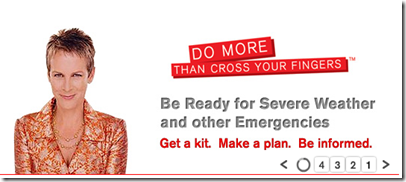
The American Red Cross sponsors a Do More Than Cross Your Fingers preparedness campaign. Spokesperson Jamie Lee Curtis has made a video that can get you started. 

image

You can also follow the Red Cross on Twitter by subscribing to @RedCross.


While 72 hours is considered the minimum amount of  time for which you and your family should be prepared, there is nothing that says you shouldn’t strive to do better than that.


A week or more of emergency supplies is a laudable, and easily obtainable, goal. 


The Red Cross isn’t alone in promoting disaster preparedness. Over the past decade, personal and community preparedness has become a national goal.


For more information, visit:


FEMA http://www.fema.gov/index.shtm

READY.GOV http://www.ready.gov/


It’s really the ethical thing to do.

Tuesday, September 14, 2010

Referral: The Economics Of Citizen Preparedness


# 4899


One of the best things about being a blogger in the Preparedness/Flublogia arena is the company I get to keep. 


Terrific and insightful writers like Scott McPherson, Crawford Kilian, Indigo Girl, Jimmy Jazz at Break Glass, Maryn McKenna, Ian York, John Solomon and others make every day a veritable treat for this humble blogger.


Perhaps the nicest part is that we feel free to work off each others posts, enlarging on (and often improving upon) each other’s thoughts and presentations. 


John, Scott, Indigo, or Crof will often write on a topic and that will spark an idea in me, that I will then write about in my blog.  And I’m happy to say, every once in awhile something I write serves as a muse for one of their blogs.


Which brings me to today’s post by John Solomon on his In Case of Emergency Blog that builds upon something I wrote about last week.


I’m not surprised that John – whose expertise in citizen preparedness far exceeds mine - adds considerable value to the topic.


Read:


The Economics Of Citizen Preparedness: Should Government Officials More Openly Acknowledge Its Readiness Messaging Is Financially, Socially Tiered?

September 14th, 2010 


Highly Recommended.

And if you aren’t already a regular visitor to John’s blog, you should be.

Friday, September 03, 2010

NPM10: The Ethics Of Prepping


Note: This is day 3 of National Preparedness Month.  Follow this campaign on Twitter by searching for the #NPM10 hash tag.


# 4863


There are some who believe that it is unfair, or somehow unethical, to ask those with greater financial means to prepare for disasters while some with fewer resources may be unable to do so.


A noble idea, I suppose.


But the reality is that the more people who are prepared before a crisis, the fewer people that will need emergency assistance later.


And by being prepared, you are in a better position to offer help to a friend, a neighbor, a relative, or your community.


Prepping is ethical.   And it isn’t just me saying that.


In October, 2008 I wrote a blog which highlighted the John's Hopkins Study entitled Ethics and Severe Pandemic Influenza: Maintaining Essential Functions through a Fair and Considered Response


It included the following snippet from the summary provided on  the Johns Hopkins Berman Institute of Bioethics website.


. . .  individuals and families who can afford it should do their best to prepare for any disaster. The paper notes, the more initiative the general public exercises in stockpiling several weeks' worth of food, water, paper goods, batteries medicines, and other needed supplies, the less vulnerable they will be to a break in the supply chain.


It is important for leaders to communicate to the middle class and the wealthy that it is their responsibility to prepare for self-sufficiency in order to free up scarce supplies and allow first responders to direct their attention towards those too poor or vulnerable to prepare themselves.


While this may not have been the main thrust of this paper's message, it is a powerful component.    One that bloggers such as myself have been trying to promote for several years.


As long as our supply chains are intact, grocery store shelves are full and capable of being restocked, and no major shortages exist it is not hoarding, selfish, or unethical to be stockpiling a reasonable amount of emergency supplies for you, your family, and others you might be able to assist during a disaster.


During a crisis relief agencies will have their hands full trying to help those who were unable to prepare, or who lost their preps due to a disaster.


By being prepared in advance, you take some of the burden off these agencies, which will allow them to concentrate their efforts on helping those less able to help themselves.


And by being prepared, you are in a better position to help others.


And that’s a win-win situation. For you, your family, and your community.


The American Red Cross sponsors a Do More Than Cross Your Fingers preparedness campaign, with spokesperson Jamie Lee Curtis that can get you started. 


image


You’ll find scores of other Red Cross videos on the RED CROSS YOUTUBE CHANNEL.  You can also follow the Red Cross on Twitter by subscribing to @RedCross.


While 72 hours is considered the minimum amount of  time you and your family should be prepared for, there is nothing that says you shouldn’t strive to do better than that. 


A week or more of emergency supplies is a laudable goal.


And of course, the Red Cross isn’t alone in promoting disaster preparedness. For more information, you’ll want to visit.


FEMA http://www.fema.gov/index.shtm

READY.GOV http://www.ready.gov/


It’s the ethical thing to do.