Showing posts with label NPM11. Show all posts

Friday, September 30, 2011

NPM11: Living The Prepared Life


Note: This is the final day of National Preparedness Month.  Follow this year’s campaign on Twitter by searching for the #NPM11 hash tag.


image


This month, as part of NPM11, I’ll be rerunning some edited and updated older preparedness essays, along with some new ones.


# 5873


Since this is National Preparedness Month, I’ve been pleased to highlight the subject of disaster and emergency preparedness over the past 30 days. A search of this blog using the term NPM11 will return more than 15 recent preparedness essays.


I must confess that I never intended my life to revolve around emergency preparedness, but fate – and life choices – often end up driving us in unexpected directions.


Like many lads, I was a Boy Scout and later an Explorer Scout, and the motto `Be Prepared’ was drummed into our heads. But more importantly, as a young boy I lived for several years with my family aboard an ancient (circa 1914) 63’ wooden yacht.


image


It was an exciting lifestyle for a young boy, and while we lived mostly in a Marina, we often went out and stayed `on the hook’ for days at a time.


We were more-or-less self contained, with water holding tanks, generators, propane refrigeration, and even a small workshop aboard.


I learned to fish, swim, and handle a rowboat at a very early age. This was also during the height of the cold war, and the Cuban Missile crisis, and so civil defense and preparedness was instilled in all of us via the media and even my elementary school.


Later, as an adult, I would spend more than a dozen years living aboard a couple of different sailboats, and learned about solar power, navigation & map reading, and efficient food storage.  


image

Me, aboard `Island Time’ in 1987.


During the 1980s I took more than a year off and spent it living `on the hook’ and cruising aboard a smaller sloop.


It takes a lot of thought, and preparation, to get a small boat ready for an extended voyage.  And when you are out of radio range, which we were occasionally, calling for help was not an option.


Being prepared for emergencies was essential.


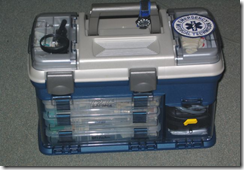
I also spent the better part of the 1970s working first as an EMT, and then as paramedic. There, I learned first-hand how quickly emergencies (large & small) can strike, and how important it was to have a good first aid kit, and the skills to use it.
 

image


And then, much later, for about a decade I even`went back to the land’. 


After spending all but one of my first 40 years in Florida, in 1995 I moved to 24 backwoods acres in the Midwest and attempted to carve a modicum of civilization out of the Missouri wilderness.


It was quite a learning experience.


We lived 30 minutes from the closest town, and during the winter, access to the property could be cut off for days, or even weeks, by ice or snow. We heated with wood, which we cut, split, and stacked ourselves and of course, we grew a garden.


I confess - I’m not really much of a backwoodsman - and while I learned a great deal during that time, I finally was able to return to Florida in 2005 (the statute of limitations had expired).


I hardly fit the popular image of a modern `Survivalist’, and no . . .  I’m not preparing for TEOTWAWKI (The End Of The World As We Know It). But experience has taught me that being well prepared for emergencies can pay big dividends.


I recommend - at a bare minimum – that every household should have a disaster plan, a good first aid kit (and the knowledge to use it), and emergency supplies to last a minimum of 72 hours during a disaster. 


Essentially the same advice you get Ready.gov, FEMA, and Red Cross. And if you do those few things, you will have taken important first steps towards being prepared for a disaster.


image


But there are times - as we’ve seen with the earthquake and tsunami in Japan, the tornado outbreaks in the south and Midwest this past spring, and with Hurricane Katrina in 2005 –  When 72 Hours Isn’t Enough.


Even in the wake of a low category Hurricane Irene, many residents of New England were still without power after 7 days.


Personally, I wouldn’t be happy with anything less than a 2-week stash of emergency supplies. But that’s just me, I live in hurricane country, and I’m sort of a belt-and-suspenders type of guy.


Over the years my preparations have provided me with emergency lighting, heat, and the ability to cook when the power was out for days at a time. And I’ve never had to face an empty cupboard during the aftermath of an ice storm or hurricane.


And just as importantly to me, I’ve been able to offer assistance to friends and neighbors during medical emergences and disasters.


I didn’t set out to live `the prepared life’, but time and again it has proven to be a good decision. As a result, I don’t lie awake at night worrying about massive solar flares, tsunamis, earthquakes, or zombie invasion.


I discovered long ago the secret to sleeping soundly at night; that preparing is easy.


It’s worrying that’s hard

Wednesday, September 28, 2011

NPM11: The Rehydration Solution


# 5866


Note: This is day 28 of National Preparedness Month.  Follow this year’s campaign on Twitter by searching for the #NPM11 hash tag. As a member of the NPM11 coalition, I’ve been running preparedness articles all month.


The blog that follows is a reprint (slightly edited) of a 2007 essay that has easily proven to be the most downloaded blog the nearly 6 year history of AFD.


While it was written with a severe influenza pandemic in mind, emergency hydration can be lifesaving in a variety of situations including heat stroke and severe vomiting or diarrhea. 


# 5867


Dehydration, and severe diarrheal disease, particularly among children in the third world, is a massive killer. Recognizing this threat, more than 25 years ago the WHO (World Health Organization) came up with what is now called ORS, or an Oral Rehydration Solution.


Hundreds of millions of sachets, or packets of this powder, are shipped each year to various third world countries, and there is no doubt that their use has greatly decreased the loss of life due to cholera, dysentery, and other diseases.


In a Flu Pandemic, the need for ORS will be great throughout the world. In western societies, where modern medical care is common, IV’s are generally used instead of ORS. There are economic and psychological reasons for this, although many doctors argue that ORS would be just as effective for the majority of patients.


Dehydration, from a prolonged bout of flu; with it’s fever, vomiting, and diarrhea, can easily kill patients that might have otherwise survived the virus.


As IV’s may well be in short supply, or simply unavailable during a pandemic, the use of ORS may well be the most beneficial treatment that most patients can receive. Certainly, with home care being the most likely venue for most patients, ORS will play a large role in the treatment of pandemic flu.


There are, however, conflicting opinions as to what constitutes the proper formula for making your own ORS. All formulas use a base of sugar and salt, in an appropriate ratio. Some formulas, however, add potassium and Sodium Bicarbonate.


A little Biochemistry


When the human body becomes dehydrated, it loses both water and essential electrolytes, particularly sodium. This condition can quickly become life threatening.


In the human body, fluids tend to move from a less salty environment to the saltier one. As an example, if someone drowns in fresh water, the water in the lungs is less salty than the blood, and so this water is quickly absorbed from the lungs into the surrounding tissues.


If a person drowns in salt water, the water in the lungs is saltier than the blood, and so additional fluid is pulled into the lungs to `dilute’ the salt water. In other words, the body tries to balance both sides of the equation.


This is an important concept when dealing with rehydration therapy.


Ingesting plain water does not help restore the salt content of the body. But ingesting water with too much salt will draw fluids from the body, and make the dehydration worse.


While many believe the exact ratios of sugar and salt to be writ in stone, the truth is, if you have to err, err on the side of less salt.


Sugar is added to the ORS solution for two reasons. First, it was discovered in the early 1960’s that sugar helped with the transport of fluids across the cellular membranes in the bowel. In 1977, the British Medical Journal Lancet called this `possibly the most important medical discovery of the 20th century’.


Sugar also provides needed calories, and as a carbohydrate, can help prevent ketoacidosis from occurring.


But, as with salt, too much sugar can be detrimental, it can promote diarrhea, and make the loss of fluids worse.


This is one concern regarding the use of commercial sports drinks for rehydration therapy. Many of these commercially available mixtures simply have too much sugar.

Making your own ORS

The bottom line, of course, is how to make a cheap, safe, and effective ORS powder yourself.


image


The simplest formula is 3 Tablespoons of sugar, and 1 teaspoon of salt, dissolved in 1 quart of potable water.


An alternative simple formula is 8 teaspoons of sugar, and 1 teaspoon of salt, dissolved in 1 quart of potable water.


This basic formula has been used effectively for more than 30 years by WHO, UNICEF, and other relief agencies and has saved millions of lives.


Over the past year, there has been some debate over the amount of salt and sugar in this formula. The old formula certainly works, and is safe. But some doctors have argued that a lower salt and sugar level might reduce fluid loss by curbing diarrhea.


I’ve elected to create single-serve packets of ORS powder, with each packet designed to be added to 1 liter of water. Two packets would be used for a 2-liter bottle.


I’ve located small plastic baggies, called bagettes sold at Michaels Art Supplies. You will find them in the bead section. Snack sized baggies, though lighter gauge plastic, would work as well. The small 2”x3” bagettes are just a little too small for the amount of powder required. You will need to go to the next size up, which are 3”x5”.


Along with these baggies, you will need table salt and sugar. I am electing to use non-iodized salt, although I am not aware of any reason why iodized salt would present a problem. The only other things you will need are measuring spoons and a felt tipped marker.


Into each baggie I am placing 3 TABLESPOONS of Sugar, and 1 TEASPOON of salt. These do not need to be mixed. I am writing on each Baggie “ORS POWDER- ADD TO 1 LITER OF WATER”.


This is the basic formula recommended by Dr. Grattan Woodson in his GOOD HOME TREATMENT OF INFLUENZA guide.

Home Treatment of Influenza booklet

In his home medical guide, Dr. Woodson writes:


"Preventing or treating dehydration in people with flu will save more lives than any other intervention during the influenza pandemic."


Identification of dehydration


When patients have a fever, vomiting, and/or diarrhea, they lose much more water from the body than is commonly appreciated. Symptoms of dehydration include weakness, dizziness, headache, confusion, and fainting. Signs of dehydration include dryness of the mouth, decreased saliva, lack of or very small urine volume that is dark and highly concentrated, sunken eyes, loss of skin elasticity, low blood pressure, especially upon sitting up or rising from the sitting to the standing position, and fast pulse rate, especially when moving from the lying to sitting or standing positions


Since I make it a practice not to offer specific medical advice in this blog, I would refer you to to Dr. Woodson’s excellent guide for further guidance on the administration (when, how much, etc)  of rehydration fluids.


While you are at it, take a look at the rest of the good doctor’s website for more home care information.


You may elect to add a flavoring to this mixture. Unsweetened Koolaid would add flavor and color, and make the drink more palatable to some. It might, however, prove to be an intestinal irritant to some people. I intend to leave mine unflavored, and will add koolaid to individual liters of solution if desired.


At 15 cents a gallon, the price is right. And for someone who is dehydrated, having this solution on hand can be lifesaving.


CAVEATS


You should never attempt to force fluids by mouth on anyone who is unconscious. An eye dropper may be used to slowly infuse liquids in semi conscious patients but there is a risk of choking.


Better to dilute this powder too much, than too little. DO NOT SKIMP ON THE WATER.


For more complete information on oral rehydration fluids visit the Healthlink Worldwide webpage at

http://rehydrate.org/dd/su19.htm


For more on National Preparedness Month visit:


Monday, September 26, 2011

NPM11: When You Have To `Get Out Of Dodge’ In A Hurry


Note: This is day 26 of National Preparedness Month.  Follow this year’s campaign on Twitter by searching for the #NPM11 hash tag.

image

This month, as part of NPM11, I’ll be rerunning some edited and updated older preparedness essays, along with some new ones.


# 5865


There is probably no harder decision to be made in the face of a disaster than having to decide whether to evacuate from your home. Home is familiar, and home is where your processions are.


Quite understandably, no one wants to leave home during an emergency if they can avoid it.


In fact, it can be such a traumatic decision that some people will risk everything to avoid evacuating. But as the following photo taken in Crystal Beach after Hurricane Ike, staying home in the face of a flood, a hurricane, or other natural disaster can have deadly consequences.


Being able to leave in a hurry means having an emergency `to go’ kit or `BOB’ already equipped, and standing by.


In the vernacular, a `bug-out bag'  or `BOB’ is a bag of emergency supplies, ideally kept at the ready, that one can grab on the way out the door during an emergency.


Some people call it a GOOD bag (Get Out Of Dodge).


Every hurricane season I go through my personal bug out bag, and replace flashlight and radio batteries from last year, and swap out older emergency rations for newer ones.


A BOB isn't supposed to be a survival kit, but rather, is supposed to provide the essentials one might need during the first 72 hours of a forced, and sometimes unexpected, evacuation.


It should contain food, water, any essential prescription medicines, copies of important papers (ID's, insurance, important Phone #s), a first aid kit, portable radio, flashlight, extra batteries, and ideally blankets and extra clothes.


While having to evacuate your home may seem like an unlikely event, every years hundreds of thousands of Americans are forced to do so.  Rivers spill their banks, dams break, brush fires rage out of control, even sudden industrial accidents can force evacuations. 


Unlike with a hurricane, you won’t always have advance warning.


Ready.gov has the following advice on how to prepare for an evacuation order.


Evacuating

There may be conditions under which you will decide to get away, or there may be situations when you are ordered to leave. Plan how you will assemble your family and anticipate where you will go. Choose several destinations in different directions so you have options in an emergency.

Create an evacuation plan:
  • Plan places where your family will meet, both within and outside of your immediate neighborhood.
  • If you have a car, keep a half tank of gas in it at all times in case you need to evacuate.
  • Become familiar with alternate routes and other means of transportation out of your area.
  • If you do not have a car, plan how you will leave if you have to.
  • Take your emergency supply kit unless you have reason to believe it has been contaminated.
  • Lock the door behind you.

Although everyone’s needs will differ, I’ve a brief tour of my Bug Out Bag below:

You should consult the Ready.gov website for specific recommendations about what you should include in your kit.

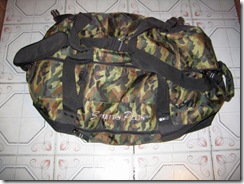
Everything I’ve got fits into a single duffle bag.


I keep mine stocked (and checked for freshness every 6 months), and easily accessible in my home.  If I had to leave on a moment’s notice, at least I’d be leaving with more than the clothes on my back.


Picture 007s


You’ll notice in the pictures below just about everything is kept in plastic bags. 

Picture 001s

First comes the electronics.  


While I would obviously want to grab my cellphone (and my beloved iPod) on the way out the door, some basics that stay in the bag are an LED Lantern, a battery operated radio, extra batteries, a small pocket knife, and a hand-crank flashlight.


Picture 002s

Next in line is 72 hours of food


I’ve a couple of MREs, a couple of `pouch meals’ that can be eaten warm or cold, some soup mixes, some instant oatmeal, and (don’t forget) something to eat and drink out of, and some plastic utensils.


Picture 009


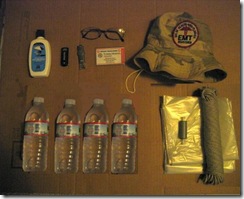
Next come some basic `survival’ items.  


Water (I usually carry 4 or 5 pints), hat, spare glasses, sun block, essential computer backups on flash drives, a copy of my medical history, and some plastic sheeting, duct tape, and some light rope.


With those last three items, I have the makings of an emergency shelter if need be.

Picture 003s

Next comes a combination toiletry kit (toothbrush, paste, floss, toilet paper, small garbage bags)/mini first aid kit.  I’ve also got some aspirin, and 3 prescriptions I’d hate to be caught without in an emergency.


Tucked away inside this kit I also have some quarters, some folding money, and copies of my driver’s license, a list of emergency phone numbers, and copies of some other important papers.


I also threw in a pair of reef-runners.   Light mesh shoes that are good for walking in water.  They dry out quickly.   Admittedly, they are a bit bulky, but this is Hurricane country, and dry shoes could be a godsend in a crisis.


Picture 005s


And lastly, I’ve some dry clothes and a fleece blanket.  Everything, of course, bagged to keep dry.


There you have it.  Total weight, about 22 lbs.


Everything I need to stay warm, dry, nourished, and reasonably comfortable for 72 hours.  Plus the added benefit of having two sources of light, an emergency radio, a little cash, a mini first aid kit, and some basic toiletries.


Things that would take me precious minutes to gather up during an emergency.  Time I simply might not have.


Of course, you’d be hard pressed to put everything for a family of four into one bag.  So each family member should have their own BOB.  


Some items, like the radio, lights, and first aid kit needn’t be duplicated in each bag. 


I keep my BOB within arm’s reach of my first aid kit, and would hopefully be able to grab both, even in an emergency.   Frankly, I’d feel naked without it.


image


Over the years, having a well stocked first aid kit has come in very handy.  It is amazing the peace of mind that comes from being ready for an emergency.


I do these things because preparing is easy.


It’s worrying that is hard.


Note:  For international readers who might be unfamiliar with the Americanism of `get out of dodge’, it comes from the old western radio & TV series Gunsmoke, where the Marshall would warn the bad guys to leave or else . . .


Today, it is often used to mean getting away from any dangerous situation.


Saturday, September 24, 2011

NPM11: Disaster Preparedness For Pets


Note: This is day 24 of National Preparedness Month.  Follow this year’s campaign on Twitter by searching for the #NPM11 hash tag.

image

This month, as part of NPM11, I’ll be rerunning some edited and updated older preparedness essays, along with some new ones.


# 5861


image

Katrina Headed For New Orleans in 2005


When Hurricane Katrina set its course towards the city of New Orleans in 2005, hundreds of thousands of people were told to evacuate on very short notice. Many of these evacuees were pet owners, and they quickly learned that evacuation busses – and  most emergency shelters – were unable to accommodate their beloved animals.


For many, this led to an agonizing decision.


To stay and ride out the storm, or leave their pets behind with food and water for a couple of days, and pray they would be allowed to return in that time.


Something that we know, became impossible for most residents.


In the days and weeks that followed the storm, thousands of animals were rescued from miserable conditions by volunteers, such as those working for the North Shore Animal League.  You can read a number of these rescue accounts by clicking on the image below:

image


In the wake of the tragic images and heartbreaking stories of loss coming from Hurricanes Katrina and Rita that year, Congress passed what is called the PETS Act, which amends the existing Emergency Assistance and Disaster Relief Act to:


“. . . . ensure that State and local emergency preparedness operational plans address the needs of individuals with household pets and service animals following a major disaster or emergency.”


The PETS Act authorizes FEMA to provide rescue, care, shelter, and essential needs for individuals with household pets and service animals, and to the household pets and animals themselves following a major disaster or emergency.”  - PETS Act FAQ


Which means that most counties now have some availability of Pet-Friendly emergency shelters . . .  but space is always limited, some require advance registration, and not all pets owners can be accommodated.


A quick look at my own county’s (Pasco, Fl  Pop. roughly 500K) plan shows that they `will designate one of its schools as an animal shelter. Pet owners, however, will stay at a separate, nearby shelter The shelter is for dogs and cats only.’


And neighboring Pinellas County (pop 900K) has plans for 3 pet-friendly shelters (pre-registration required), which they believe will accommodate a total of about 700 dogs and cats.


Which means you can’t count on getting into a pet-friendly shelter at the last minute.  These shelters should be your last resort, not your first option.  You need to be planning now on how you will provide for your pets during a disaster.


May 14th was National Animal Disaster Preparedness Day, and FEMA asked that you take the time to develop a plan.  They provide advice on how to do that at:


Information for Pet Owners


From the Humane Society of the United States (HSUS), we get this advice (a h/t to Readymom for letting me know the old Humane Society link was dead):


Make a Disaster Plan for Your Pets

Plan ahead and keep your family members—people and pets—safe in case of an emergency or disaster

Get ready: Planning and disaster preparedness


And from the American Red Cross, we get this checklist for keeping your pets safe during and after disaster.


image

(Click image to Enlarge)

And lastly, I’ve found a couple of sites that attempt to provide state and national contact information for pet owners looking for evacuation information.


While I’m sure the following sites make every attempt to be accurate and up-to-date, you’d be well advised to confirm the availability of any pet-friendly services in your area, since local plans can change.


For Floridians, a county-by-county list of pet-friendly evacuation shelters:


FloridaPets.net 2010 Pet-Friendly Emergency Shelter Guide


Another site with good information, and a national listing of contact information for pet-friendly emergency shelters is:


Pet Evacuation, Pet Friendly Emergency Shelters, Disaster Preparedness for Pets


Disaster preparedness, for your family and for your pets, isn’t something to start thinking about once the ground starts shaking, the water starts rising, or storm warnings are raised in your area.


To give yourself, your family and your pets the best chances for survival in any disaster,  Ready.gov is quick to remind us to:


image

Thursday, September 22, 2011

The Gift Of Preparedness: 2011


# 5935


A little over 5 years and nearly 5,000 blogs ago (Nov. 1, 2007 to be precise) I posted an essay called Hickory Farms Will Hate Me For This, where I suggested that instead of buying ugly neckties, holiday-themed sweaters, or an assortment of unidentifiable cheeses for the people on your holiday gift-giving list - that you give them preparedness items instead.


This epiphany came to me one fall day a few years back when I was rummaging through a local warehouse closeout store and found a bin of `shake’ LED flashlights on sale for .77 cents each. You know the type, you shake for a few seconds and it powers the flashlight for several minutes.


image


I bought 40 of them on the spot, and that Christmas they ended up as `stocking stuffers’ for all of my friends.  Since then, whenever possible, I give preparedness gifts.


The great thing is, many of these items can often be had for just a few dollars, yet they can be lifesaving (or at least important to have) in an emergency.


A couple of years ago I ran across a deal on LED headlamps, and bought about 20 of them for $2 apiece.  The following year, I found LED Cap lights (they clip to the bill of a baseball style cap) for $3 each, which I confess I like even better.


image

Hands free light can be a real plus in a crisis.  These too ended up in a number of people's Christmas and birthday packs.


During the year I keep my eye out for bargains such as these, and stock up when I find things on sale. A couple of years ago I picked up a number of LED lanterns for $3 apiece at a closeout store. They are particularly nice, and run about 40 hours on a set of AA batteries.


image


But this year, I found a newer item; a combination LED lantern/flashlight that sells for about $5, and it is rapidly become my new favorite.  Lightweight, versatile, and cheap.  A hard combination to beat.


image


This year, I’m seeing a lot more variety in LED lanterns and flashlights, providing a lot more bang for the buck. Not only do LEDs run a long time on a set of batteries, unlike gas lanterns, they don’t pose a fire safety hazard.


Every home should have a battery operated radio, yet many do not. A few years ago I bought my daughter a combination windup-battery-solar AM/FM/SW radio for under $40, and she uses it every day.


image


Last year, I found a combination AM/FM Weather ALERT radio at a discount store for under $20. Again, every home and business should have an emergency alert radio.


NOAA Radio


A pair of the FRS radios, like the ones I highlighted in this blog, would make an excellent gift for many families, and can be had for less than $25.


image


For Christmas a couple of years back I put together some first aid kits, and distributed them to a number of friends and relatives. You can either put one together yourself, or purchase one already assembled.


image


Living as I do in hurricane country, I’m always aware of the need to store water for emergencies. One of the items I’ve purchased for friends (and myself) are those collapsible 5-gal water carriers. For only about $5, you can store 5 gallons of water, and when not in use they fold up for storage. 


image


Although a bit pricier, I’ve also purchased emergency water filter/purification systems for several friends over the years. Here you’ll find a number of options ranging from purification tablets (chlorine or iodine based) for under $10, to high capacity filtration systems like the one below for about $200.


image


In between you’ll find a lot of filtration options in the $40-$60 range.


Even MREs can make an excellent gift, and a couple of years back I found cases of them heavily discounted at my local Costco warehouse. 


image


Battery chargers, or an inverter to turn any 12 volt battery into a 120 volt electrical source make wonderful gifts as well. 


chargers


Two summers ago, on a particularly hot Florida afternoon, we had a power outage that lasted more than 6 hours.  I wrote about it in Sweltering In Place.


While I was already set up with a 12 volt fan, my Sister and Father weren’t so lucky. . . . they ended up driving across town to sit in an air-conditioned restaurant for several hours.


The next day, I went out and bought them each a battery operated personal cooling fan, one that will run for nearly 24 hours on 4 D-Cells.


I paid about $12 each for them.

personal Fan


Something as simple, and as utilitarian, as a multifunction `Swiss’ army knife or a `Multi-tool’ makes a great preparedness gift.


swiss knife

image


Another inexpensive gift idea: For under $10 you can buy a box of exam gloves, and a box of facemasks.


image


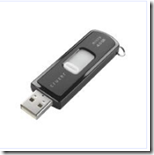
Joel over at Preparedness and Response came up with what I consider to be an excellent preparedness idea, giving USB flash drives to family and friends and instructions on how to back up their important papers and documents.

image


Inexpensive USB Drives start under $10.


He explains it in  his essay Helping others prepare (Personal Preparedness), where he gives his rationale for going with the durable mil-spec and encrypted, but fairly pricey IronKey brand.


My thanks to Joel for a terrific idea.


And lastly, I've put together CD's of preparedness videos, along with copies of online manuals and preparedness guides.  For the cost of a blank CD or DVD, and a little bit of my time, I've at least put this valuable information into my friend's hands.


I may just copy all of this info on to the USB drives I’m giving out this year instead of on CDs.  


These are all useful, indeed, potentially lifesaving items, that most people simply don't think about needing until it is too late.


Giving them as gifts, instead of more traditional items,  not only helps prepare the people you love and care about for an emergency, it opens the door for conversations about pandemic preparedness.


We need to cultivate a culture of preparedness in this country, and around the world.


We can start doing that, one gift at a time.


And one last reminder for the upcoming Holiday Season.


This year, when we think about ways to give back to our community, remember that more people will be relying on community food banks than in years past.


In addition to anything else you might do, this is a good time to go through your pantry and donate foodstuffs that are approaching (but not exceeding) their `use by' date.

Wednesday, September 21, 2011

NOAA: Lessons From The Joplin Tornado


# 5857


The spring of 2011 saw three record-breaking and deadly tornadic outbreaks across the United States.


First, over three days in mid-April (14th-16th), a severe storm system produced 179 confirmed tornadoes across 16 southern states, resulting in 43 fatalities and more than a half billion dollars in damage.


Two weeks later (Apr. 25th-28th), an even larger outbreak – now dubbed the 2011 Super Outbreak - spawned at least 336 tornadoes across 21 states. More than 300 people died, with the largest number of deaths (249) occurring in Alabama. 


Damage estimates for this outbreak exceeded 10 billion dollars.


After a remarkably quiet first three weeks of May, another severe storm system swept across the Midwest spawning at least 180 tornadoes over 5 days (May 21st-26th).


The worst of these was the massive F-5 tornado that struck Joplin, Missouri on May 22nd, killing 159 and injuring more than 1,000.


image

Photo Credit – NOAA 

Given the scale of destruction in Joplin, it is a wonder that more people weren’t killed. Fortunately, the city had at least a 20 minute warning via emergency sirens, NWS warnings, and local broadcasters.


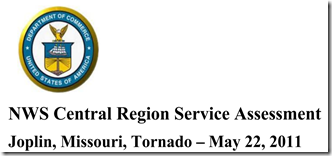
Since this was a `warned event’ - yet yielded a high number of fatalities - the National Weather Service launched an investigation over the summer. More than 100 interviews were conducted in Joplin with tornado survivors, local business owners, EMS personnel, the media, and city officials.


image

PDF Download Link


Among their findings, many of Joplin’s residents did not act immediately when the tornado sirens sounded.  An excerpt from the executive summary explains:


The vast majority of Joplin residents did not immediately take protective action upon receiving a first indication of risk (usually via the local siren system), regardless of the source of the warning.  Most chose to further assess their risk by waiting for, actively seeking, and filtering additional information.


The reasons for doing so were quite varied, but largely depended on an individual‘s ― worldview, formed  mostly by previous experience with severe weather.


Most importantly, the perceived frequency of siren activation in Joplin led the majority of survey participants to become desensitized or complacent to this method of warning.  This suggests that initial siren activations in Joplin (and severe weather warnings in general) have lost a degree of credibility for most residents – one of the most valued characteristics for successful risk communication.  


Instead, the majority of Joplin residents did not take protective action until processing additional credible confirmation of the threat and its magnitude from a non-routine, extraordinary risk trigger.  This was generally achieved in different ways, including  physical observation of the tornado, seeing or hearing confirmation, and urgency of the threat on radio or television, and/or hearing a second, non-routine siren alert.


Having lived in Tornado Alley for a decade, I’m well acquainted with tornado warning fatigue.  Sirens go off with some frequency, and severe weather boxes appear in the corner of your local TV broadcast, but often nothing comes of it.


Nationally, the NWS says that 76% of all tornado warnings end up being false alarms. And even if a tornado is spawned, warnings go out across a broad area when only a small number of people are ultimately impacted.


The result is . . .  people stop responding to every alert.


Again from the report:


This report suggests that in order to improve warning response and mitigate user complacency, the NWS should explore evolving the warning system to better support effective decision making.


This evolution should utilize a simple, impact-based, tiered information structure that promotes warning credibility and empowers individuals to quickly make appropriate decisions in the face of adverse conditions.  Such a system should:  


a. provide a non-routine warning mechanism that prompts people to take immediate life-saving
action in extreme events like strong and violent tornadoes


b. be impact-based more than phenomenon-based for clarity on risk assessment


c. be compatible with NWS technological, scientific, and operational capabilities


d. be compatible with external local warning systems and emerging mobile communications
technology


e. be easily understood and calibrated by the public to facilitate decision making


f. maintain existing ―probability of detection‖ for severe weather events


g. diminish the perception of false alarms and their impacts on credibility


A tall order.


And one that is complicated by the sheer volume of `threat warnings’ we get on a daily basis. Everything from weather alerts, to elevated terrorism levels, to warnings that almost everything you eat, drink, or touch is either contaminated or will give you cancer.


After awhile, these warnings tend to fuzz out, blend in, and lose their impact.


While it is tempting to suggest scaling back these warnings, there are 7 scientists on trial in Italy right now – charged with manslaughter - over their failure to predict, and warn the public about an earthquake in 2009.


Charges levied, even though we don’t currently have the technology to accurately predict earthquakes .


Despite the daily clutter of warnings we receive – many of which never materialize - a failure of agencies to warn about known or suspected threats would not be well tolerated by the public.


For the NWS, the challenge will be to create an easily identifiable `immediate threat’ warning to elevate it above the `background noise’ of more generic or broad-based warnings.


As to the myriad other threats out there, they are all the more reason to incorporate an `all threats’ preparedness plan, instead of focusing on one type of scenario.


If you are well prepared for an earthquake, you are also well equipped to handle a hurricane, a pandemic, or any other type of disaster.


In order to promote this idea, FEMA, Ready.gov, and other agencies are promoting September as National Preparedness Month.  Follow this year’s campaign on Twitter by searching for the #NPM11 hash tag.


image

Monday, September 19, 2011

NPM11: Early CPR Saves Lives


Note: This is day 19 of National Preparedness Month.  Follow this year’s campaign on Twitter by searching for the #NPM11 hash tag.

image

This month, as part of NPM11, I’ll be rerunning some edited and updated older preparedness essays, along with some new ones.


# 5851


As a paramedic I did nearly all of my rescue work in three cardiac prone cities (St. Petersburg Fl, Phoenix AZ, Bradenton Fl), so heart attacks and codes (cardiac arrests) were pretty much a part of every shift.


Even with the addition of ALS (Advance Life Support - defibrillators, cardiac meds, and telemetry) most of our attempts to resuscitate patients in full cardiac arrest failed.


It was simply a matter of timing.


Once the heart stops beating, the patient has maybe 4 to 6 minutes before irreparable damage occurs. Only rarely does an ambulance or rescue squad arrive within that window of opportunity.


There were some happy endings, of course.  Not as many as I’d have liked, but sometimes we got lucky. And a lot of those `saves’ could be credited to quick acting bystanders who began CPR before we arrived.


One of the big contributors to sudden cardiac death at home is a failure to call 911 when coronary symptoms first appear.  Often people will wait hours, hoping the chest pain will go away, before calling for help.


From the CDC’s Heart Attack Information page:

Symptoms of a Heart Attack

The five major symptoms of a heart attack are—

  • Pain or discomfort in the jaw, neck, or back.
  • Feeling weak, light-headed, or faint.
  • Chest pain or discomfort.
  • Pain or discomfort in arms or shoulder.
  • Shortness of breath.

If you think that you or someone you know is having a heart attack, you should call 9–1–1 immediately.


The most dire situation is a sudden cardiac arrest, where the patient’s heart and breathing have stopped. Resuscitation efforts need to be started immediately else the patient is unlikely to survive.


In 2010 the American Heart Association unveiled new CPR Guidelines which encourages lay bystanders to provide compression-only CPR.


Excerpts from the 2010 press release follow:


A New Order for CPR, Spelled C-A-B

Statement Highlights:

- The 2010 AHA Guidelines for CPR and ECC update the 2005 guidelines.

- When administering CPR, immediate chest compressions should be done first.

- Untrained lay people are urged to administer Hands-Only CPR (chest compressions only).


AHA-Stayin-Alive-Web-Page_2STEPS_2

The following video  explains the changes in the new 2010 Guidelines for CPR.


Using humor to drive the point home, the following AHA video carries an important message: 80% of all cardiac arrests occur at home.


Learning CPR means that person you are most likely to save will be a member of your own family.


Today, CPR is easier to do than ever.


Compression-only CPR is now the standard for laypeople, and so you don’t have to worry about doing mouth-to-mouth.


A CPR class, where you will get to learn more and practice these skills only takes a few hours, and it could end up helping you save the life of someone you love.


To find a local CPR course contact your local chapter of the American Red Cross, the American Heart Association, or (usually) your local fire department or EMS can steer you to a class.


For more on the recent changes to bystander CPR, you may wish to visit these recent blogs.


CPR As A Requirement For High School Graduation

AHA Unveils 2010 CPR Guidelines

JAMA: Compression Only CPR

MMWR: Sudden Cardiac Arrest Awareness Month

Saturday, September 17, 2011

NPM11: Emergency Local Communications


Note: This is day 17 of National Preparedness Month.  Follow this year’s campaign on Twitter by searching for the #NPM11 hash tag.

image

This month, as part of NPM11, I’ll be rerunning some edited and updated older preparedness essays, along with some new ones.


# 5847


During a disaster, telephone service - whether via landline or cell phone - may be compromised. Even if the phone system remains intact, the service may overwhelmed by excessive traffic.


Note: Text messaging will sometimes work even when voice communications are down. 


Even if voice comms are available, during a crisis texting whenever possible is still preferable, because it places a lower burden on the phone system.


It can be advantageous, therefore, to have a backup form of short-range communications for when phones are either unavailable or are simply not the best solution.


As a liveaboard sailor, I spent several years without a telephone (or A/C, refrigeration, & running water for that matter). When we weren’t staying in a marina, cruising aboard a sailboat could be the ultimate in social isolation.


Sure, some days we'd gather on larger boats, or dockside, or on some isolated beach and kill some beers and tell some lies. But often we went days without direct human contact.


Of course, boaters just about all have a VHF radio aboard, and that was our link to one another.


Usually twice each day, in an anchorage of any size, we'd have a `radio roundup', where each boater would check in via the radio. If anyone needed anything, whether it was a recipe, a doctor, or a spare part, they could put out the call on the radio net.


Once `business' was taken care of, chit-chat ensued.


With multiple channels available, Boater A would often call upon Boater B to `meet me on Channel X', and they could depart and talk without cluttering main channel.


If a boater failed to check in, someone would usually row over and knock on their boat and make sure they were alright.


During an emergency - like an earthquake, flood, hurricane (or even a pandemic) - these same procedures could prove invaluable for just about any neighborhood or community.


While VHF radios are expensive, and overkill for most neighborhood settings, there is an easy alternative; FRS radio or Family Radio Service.


These are not your father's walkie-talkies.


They operate on a UHF band and are more reliable, and are less prone to static, than the old CB radio. And they are surprisingly inexpensive.


As regular readers are aware, I am a big proponent of the `disaster buddy’ concept - working with your friends and neighbors during an emergency (see In An Emergency, Who Has Your Back?).


Whether you live in a suburban neighborhood or an apartment complex, or a trailer park, these little radios can provide a ready way to communicate with your `disaster buddies’, even if your phone lines or cellular service are down.


For those walking a neighborhood watch patrol, they give an easy way to communicate with others patrolling the neighborhood, or with a home base.


For home security, they are hard to beat. One person can be watching a back door, while you monitor the front door, and you can communicate without shouting.


Or someone can go outside to check out a perceived threat, bring in supplies, or assist a neighbor and still remain in communications with the folks in the main house.


During a pandemic, earthquake, severe storm, search & rescue operation, or any other local or national emergency, they would be a valuable tool.


I own the Motorola T5000, and paid $28 for a pair. Other models are available from as little as $20 a pair. For $100, you could equip yourself, and 6 - 8 neighbors with transceivers. Not a bad bang for the buck.


These units can be purchased at WalMart, Best Buy, Radio Shack, Kmart, or practically any major department store. You can also order them online.


During a crisis, If you set up your own radio net meeting schedule (say 8am and 8pm), you can make sure everyone is safe and accounted for.


If power is available, and you elect to go with the rechargeable units, you can leave them on standby and in the charger 24/7, and anyone can holler if they have a problem.


While the claims of a 5 mile or 8 mile range should be taken with a large grain of salt (think boulder-sized), depending on terrain and man-made obstacles, they can be pretty effective for up to 1 mile.


As with most things, the more you pay, the more you get.


Tech Details (United States)

FRS radios do not require a license.

You may operate on up to 14 channels with an output of 1/2 watt. Some FRS radios (like mine) also give you an additional 8 channels of GMRS (General Mobile Radio Service) which may utilize up to 5 watts of power.


YOU DO NEED A LICENSE to operate on the GMRS bands. But the range of communication will be several time farther than FRS.


If you buy a hybrid unit, you do not need a license to use the lower 14 channels.

While 14 channels may not seem like a lot, each channel can incorporate up to 38 different `privacy codes', which can block the reception of others on your channel.


These CTCSS (Continuous Tone Coded Squelch System) codes effectively give you 532 channels of operation, if you desire. Just set up a common code for your radio net, and you won't hear other's and it is likely that other's won't hear you.


NOTE: This is not `secure-comms', because anyone with an FRS radio can turn off this feature and hear all traffic on any channel.


Most units also provide a channel scan feature, which will pick up traffic on all 14 channels. Other features (dependant on price) include built in GPS, battery indicators, backlighting of dial, VOX support, ear buds, and even vibrating alert.


You other big decision will be the power source. Most units come with rechargeable batteries and a a duel charging stand. You will need 110 volt power, or a battery/inverter setup to keep these charged.


You can also buy units that run off of AAA batteries, in which case you will need lots of replacement batteries. Talk time on disposable batteries is reportedly between 20 and 30 hours. Use the higher output GMRS bands, and that will go down.


As I have a solar panel/battery/inverter setup I elected to go with the charging stand. You can read about my system, and how you can make one for yourself at Preparedness: Solar Power On A Budget.


solar1


If you have neighbors you'd like to remain in contact with, or need a way for a family member to remain in contact while outside or on the other side of the house, these little gems will likely to the job.