Showing posts with label EuroFlu. Show all posts

Saturday, January 19, 2013

EuroFlu: H1N1 & Influenza B Driving Their Flu Season


image

Credit EuroFlu report Week 2


# 6867


Dominated by the H3N2 virus, the United States and Canada continue to see a worse than average flu season (see yesterday’s CDC FluView & Canadian FluWatch reports) – while reports from Europe remain a mixed bag, with many countries reporting H1N1pdm09 or Influenza B leading this year’s viral charge.


Regions where H3N2 predominates generally see a more severe flu season, which may help explain why Europe hasn’t been hit nearly as hard as has North America.


Some excerpts from this week’s EuroFlu Report.


Large variation in influenza activity across the WHO European Region

Summary, week 2/2013


Consultation rates for influenza-like illness (ILI) and/or acute respiratory infection (ARI) are now increasing in almost all countries in the Region.


However, influenza activity is still largely limited to the western part of the Region, where widespread transmission is being reported by most countries currently.


While influenza A(H1N1)pdm09, A(H3N2) and type B viruses are circulating in the Region, the proportion of influenza A(H1N1)pdm09 continues to increase, relative to influenza B and A(H3N2), and accounts for 84% of influenza A viruses subtyped.


The number of reported hospitalizations due to severe acute respiratory infection (SARI) is increasing slowly along with a rising proportion of patients testing positive for influenza.


Virological surveillance for influenza

The number of specimens testing positive for influenza in the Region continues to rise, mainly due to increasing detections in the western part of the Region. Overall, a total of 3495 specimens tested positive for influenza in week 02/2013, the majority of which, 2532 (72%), were influenza A (Fig. 1).

image

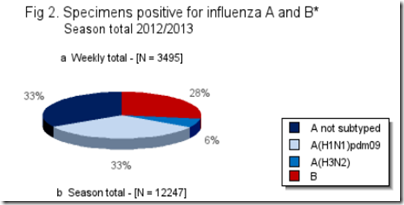
The proportion of influenza A(H1N1)pdm09 viruses relative to A(H3N2) continues to increase. In week 2, among 1363 influenza A viruses subtyped, 1151 (84%) were A(H1N1)pdm09 while 212 (16%) were A(H3N2)(Fig. 2a).

image


This presents a very different picture from the 2011/2012 influenza season when A(H1N1)pdm09 detections were rare. In the 19 countries testing 20 or more sentinel specimens, influenza positivity ranged from 11% to 68%, with a median of 45% (mean: 44%).


Since the beginning of the season (week 40/2012), 12,247 influenza viruses from sentinel and non-sentinel sources have been typed: 8250 (67%) were influenza A and 3997 (33%) influenza B (Fig. 2b). Of the influenza A viruses, 4475 were subtyped: 2945 (66%) as A(H1N1)pdm09and 1530 (34%) as A(H3N2). In addition, since week 40/2012, the lineage has been determined for 497 influenza B viruses: 454 (91%) belonged to the B/Yamagata lineage and 43 (9%) to B/Victoria.
 

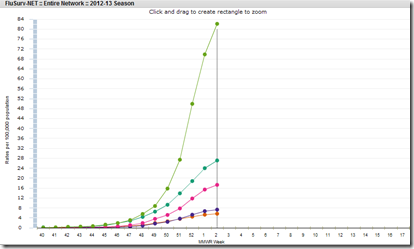
In another telling difference between the North American flu season and Europe’s are the age groups being hospitalized for SARI (Severe Acute Respiratory Infection).


Here in the United States where H3N2 currently reigns, laboratory confirmed influenza hospitalizations are overwhelmingly for those 65 and older (see CDC FluView chart below).
 

image


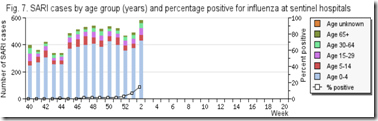
Whereas in Europe it is those under the age of 4 making up the majority of hospitalized cases. Once again, a pattern we’d expect to see when H1N1 and influenza B are the most active strains.


Hospital surveillance for SARI

Hospitalizations due to SARI have increased slightly over the past few weeks along with an increase in the proportion of respiratory specimens from patients testing positive for influenza (Fig. 7). Overall, the great majority of cases reported have been in the age-group 0–4 years (see Country data and graphs for individual country data).
image


While North America is likely about half-way through its flu season, for many parts of Europe flu activity is just starting to ramp up.


Influenza is unpredictable, so we’ll have to wait to see whether their contrarian pattern of seeing mostly H1N1 & Influenza B cases continues throughout the rest of their flu season.

Monday, January 07, 2013

WHO Global Influenza Surveillance & EuroFlu Report

image

Credit WHO


# 6831


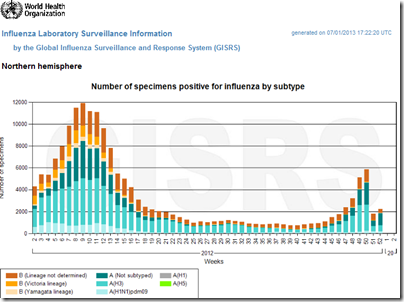
The latest influenza surveillance report from the World Health Organization confirms that North America continues to see the highest rate of influenza in the world, but reports signs that flu transmission is picking up in Europe, Africa, and parts of Asia.


  • Globally flu samples have been predominately Influenza A (72.6%) and of those, nearly 83% were seasonal H3N2.
  • Among the B viruses, Yamagata lineage viruses were leading Victoria lineage by more than 2 to 1.


Out of more than 500 viruses recently tested by Global Influenza Surveillance and Response System (GISRS), all continue to be susceptible to the antiviral drugs oseltamivir and zanamivir.


Influenza virus activity in the world

7 January 2013

Source: Laboratory confirmed data from the Global Influenza Surveillance and Response System (GISRS).

Based on FluNet reporting (as of 3 January 2013, 12:40 UTC), during weeks 50 to 51 (9 December 2012 to 22 December 2012), National Influenza Centres (NICs) and other national influenza laboratories from 77 countries, areas or territories reported data. The WHO GISRS laboratories tested more than 36 007 specimens. 5 528 were positive for influenza viruses, of which 4 013 (72.6%) were typed as influenza A and 1 515 (27.4%) as influenza B. Of the sub-typed influenza A viruses, 431 (17.2%) were influenza A(H1N1)pdm09 and 2 078 (82.8%) were influenza A(H3N2). Of the characterized B viruses, 52 (69.3%) belong to the B-Yamagata lineage and 23 (30.7%) to the B-Victoria lineage.

Summary

During weeks 50 and 51 influenza activity continued to increase in the northern hemisphere while sporadic activity was reported from the southern hemisphere. Influenza A(H3N2) viruses remained the predominant subtype globally, followed by influenza B and A(H1N1)pdm09 viruses.


In North America, influenza activity increased and varied from localized to widespread in both Canada and the United States of America with influenza A(H3N2) as the predominant subtype. In contrast, influenza B viruses were the predominant subtype in Mexico.


In Europe, influenza activity continued to increase across the region. In recent weeks, increased activity was reported from Denmark and France. Influenza A(H1N1)pdm09, A(H3N2) and B viruses co-circulated in the region.


Increased A(H3N2) activity was reported from China and Japan while sporadic activity was reported from the region.


In the Eastern Mediterranean region, increased A(H1N1)pdm09 virus detections were reported from the West Bank and Gaza Strip where 9 deaths were recorded. Increased A(H1N1)pdm09 activity was reported from elsewhere in the region as well as A(H3N2) and influenza B viruses.


In Africa, increased detections of influenza B viruses were reported from Algeria while A(H1N1)pdm09 viruses were detected in the Democratic Republic of the Congo.


In the northern hemisphere, 426 A(H3N2), 49 A(H1N1)pdm09, and 164 B viruses have been tested for antiviral resistance to neuraminidase inhibitors and all have remained resistant to oseltamivir and zanamivir.


In Europe, the Mediterranean, and parts of Africa the A(H1N1)pdm09 virus appear to be a bit more common than is currently being reported in North America. The following is a summary from the latest EuroFlu report (week 52).

 
Influenza activity is increasing mainly due to influenza detections in western Europe

Summary, week 52/2012


Influenza-like illness (ILI) and acute respiratory infection (ARI) consultation rates continue to rise, following a west-to-east progression across the WHO European Region. For the second week, reporting of influenza surveillance data was incomplete, due to the holiday period.


Countries mainly in the western part of the Region reported co-circulation of influenza A(H1N1)pdm09, A(H3N2) and type B viruses. The proportion of A(H1N1)pdm09 is considerably higher in comparison with the same time period last season. The number of reported hospitalizations due to severe acute respiratory infection (SARI) remains low, with no cases being associated with influenza detection.

image

Thursday, January 03, 2013

HPA: Flu Activity In The UK


# 6820


While the United States and Canada have reported an early start to the flu season this year, influenza has yet to take off in Hong Kong (see latest Flu Express (Week 52, 2012), and in the UK and parts of Europe the flu season is just now starting to pick up. 


image

The RED LINE indicates this year’s activity, compared to previous years.  The Blue Line indicates the unusually severe 1999-2000 flu season.


This latest flu updates from the HPA.


HPA National Influenza Report

Report published 3 January 2013

Figures (including all those found in this report) displaying data from these schemes are available to download as a pdf file:

HPA Weekly National Influenza Graphs (PDF, 713 KB)

PDF versions of previous reports are available on the archive page.

This week's report is available as a pdf:

HPA National Influenza Report - week 1 (2013) (PDF, 665 KB)

A summary report will be published weekly. For further information on the surveillance schemes mentioned in this report, please see the Sources of UK Flu Data page.

Increases continue to be seen for several indicators of influenza activity. A letter has been issued to the NHS that GPs may now prescribe antiviral medicines for the prophylaxis and treatment of influenza in accordance with NICE guidance.


Flu activity update: 3 January 2013

3 January 2013

Latest figures from the Health Protection Agency (HPA) up to 30 December 2012 show that flu activity continues to increase based on a number of indicators, including GP consultation rates in England and the proportion of calls to NHS Direct.


The latest figures show that GP consultation rates have increased slightly from 27.4 per 100,000 in week 51 to 32.7 per 100,000 in week 52 ending on 30 December. Meanwhile, 2.1% of the calls received by NHS Direct concerned influenza compared to 1.6% in week 51.


Professor John Watson, head of the respiratory disease department at the HPA said:


“Over the Christmas period we have seen a slight rise in flu activity across several of our indicators in line with the trend we expect to see at this time of year.


“However, the latest data should be interpreted with caution due to GP practices being closed on the bank holidays which may have impacted on GP consultation rates.

(Continue . . . )


Elsewhere in Europe, the most recent EuroFlu report states:


Influenza activity is increasing slowly in the WHO European Region

Summary, week 51/2012

Influenza activity is slowly increasing with more countries in different parts of the Region reporting sporadic co-circulation of influenza A(H1N1)pdm09, A(H3N2) and type B viruses. This week the reporting of influenza surveillance data is incomplete due to the Christmas holidays. This is reflected in the lower number of testing performed. However the percentage of influenza-positive samples from both sentinel and non-sentinel sources are similar to last week. The number of reported hospitalizations due to severe acute respiratory infection (SARI) remains similar to that seen in the previous several weeks: 1 influenza detection was reported (influenza B).

Friday, January 27, 2012

EuroFlu: H3N2 Dominates But Overall Activity Is Low


# 6105


image

Photo Credit- EuroFlu Report.


In stark contrast to this time last year - when much of Europe was seeing significant H1N1 influenza activity - reports of flu for week 3 of 2012 (while rising slowly) - remain low across Europe - and predominantly H3N2 related.


Influenza activity continues to rise slowly in the WHO European Region due to A(H3N2)

  • This issue is based on data for week 3/2012 reported by 46 Member States in the WHO European Region.
  • Consultation rates for influenza-like illness (ILI) and acute respiratory infection (ARI) continue to be relatively low in most countries of the Region, but with many countries reporting increasing activity.
  • 29 % of sentinel specimens tested positive for influenza, which is an increase over last week: 95% of these were influenza A.
  • Of the 352 influenza A viruses from sentinel sources that were subtyped, 99 % were A(H3N2). 

    Comment

    Influenza activity has increased consistently over the past several weeks, but influenza detections remain low compared to the same period of the 2010/2011 season. Influenza A and B viruses are co-circulating in the Region, with the vast majority of detections in both outpatient clinics and hospitals being A(H3N2).

  • We’ll get the latest FluView and FluWatch numbers later today for the United States and Canada.  

    Monday, February 14, 2011

    EuroFlu Surveillance Week 5


    # 5312


    Even though levels of ILIs (Influenza-like Illnesses) have dropped well below the baseline level in the UK (see HPA Weekly Influenza Surveillance), influenza activity continues strong across the rest of Europe.


    In week 5, once again the 2009 H1N1 virus remains the dominant player, although in some countries influenza B levels are equal to, or even exceed that of the old pandemic strain.  


    Unlike here in the United States, seasonal H3N2 continues to circulate across Europe in only low levels.


    While trends and averages can be established, across the 48 reporting nations covered by the EuroFlu weekly report, there still remains a good deal of variance in activity and virus dominance between nations and regions.


    Note: In Europe the acronym SARI is used to denote Severe Acute Respiratory Infection.


    Some excerpts (reformatted for readability) from this week’s report:


    image

    EuroFlu - Weekly Electronic Bulletin
    Week 5 : 31/01/2011-06/02/2011
    11 February 2011, Issue N° 388

    Continued high influenza activity in the WHO European Region

    • This issue is based on data reported in week 5/2011 by 48 Member States in the WHO European Region.
    • Clinical consultation rates for influenza-like illness (ILI) and/or acute respiratory infections (ARI) are increasing in 27 countries, while 9 others have passed peaks in clinical activity.
    • 46% of sentinel specimens from patients with ILI and/or ARI, and 54% of specimens from sentinel SARI patients were positive for influenza in week 5/2011.
    • 98% of antigenically characterized viruses from the 2010/2011 influenza season are similar to the viruses included in the 2010/2011 northern hemisphere influenza vaccines.

    Current situation – week 5/2011

    During week 5/2011, 2 countries (Georgia and Luxembourg) and 3 regions of the Russian Federation reported very high intensity of influenza activity; 6 countries reported high intensity and 25 reported medium intensity. 21 countries reported widespread activity. Of the 25 countries reporting on the impact of influenza on health care systems, 1 (Georgia) reported severe impact; 11 countries reported moderate impact and 13, low impact.


    Clinical data also indicated increasing influenza activity in much of the WHO European Region, as 27 countries reported increasing trends in consultation rates for ILI and/or ARI. Some countries in the central, south-eastern and eastern parts of the Region have reported pronounced increases in clinical ILI or ARI activity. In general, the highest consultation rates were reported for children aged 5–14 and 0–4 years.


    <SNIP>


    Virological situation – week 5/2011

    Pandemic influenza A(H1N1) 2009 was reported to be dominant in 17 countries and co-dominant with influenza B in 12 countries.


    Influenza B was dominant in 5 countries. During the past few weeks, the predominance of influenza B viruses has increased in countries in western Europe, which had predominantly pandemic A(H1N1) viruses circulating at the start of their season.


    In a number of eastern European countries, the earlier predominance of influenza B viruses has now shifted to a predominance of pandemic influenza A(H1N1) 2009 viruses.


    Comment


    ILI and ARI consultation rates continue to increase in the WHO European Region, particularly in the central, eastern and south-eastern parts, and the percentage of sentinel specimens positive for influenza remains high.


    Influenza activity is progressing in a west-to-east manner across the Region, with pandemic influenza A(H1N1) 2009 circulation generally decreasing in the western part of the Region and increasing in the eastern.


    Influenza B is becoming relatively more predominant in countries where the prevalence of pandemic influenza A (H1N1) 2009 is decreasing. This shift, with relatively more A(H1N1) 2009 viruses circulating in the eastern part of the Region, may explain the notable difference in the proportion of influenza A to influenza B viruses among SARI patients in week 5/2011, when compared to all SARI viruses for the cumulative 2010/2011 influenza season.


    This is because most of the countries conducting sentinel SARI surveillance are in the central and eastern part of the WHO European Region. 98% of antigenically characterized viruses from the 2010/2011 influenza season are similar to the viruses recommended for inclusion in the 2010/2011 northern hemisphere influenza vaccines.

    (Continue . . . )


    Sunday, February 06, 2011

    EuroFlu Surveillance Week 4


    # 5293


    While the flu has subsided in the UK, and shows signs of decline in Canada, it continued to rise in the United States and much of Europe during the latest reporting period (week 4).


    Unlike what we’ve seen in the United States, where the seasonal H3N2 virus has been the big player, in Europe it is the 2009 H1N1 virus that predominates.


    This week the ECDC and  EuroFlu both take notice of a growing number of H1N1 virus samples showing an H185T substitution in the HA segment.   Here is the EuroFlu Statement:


    Since the genetic characterization algorithms were put in place for pandemic influenza A(H1N1) viruses at the start of the 2010/2011 influenza season, a new genetic subgroup has been observed to emerge that is geographically dispersed and increasing in prevalence.


    This genetic subgroup is characterized by an S185T substitution in HA and is represented by A/England/142/2010.


    To date, viruses carrying the S185T substitution remain antigenically similar to the current vaccine virus A/California/7/2009.


    At present, 98% of antigenically characterized viruses from the 2010/2011 influenza season are similar to the viruses included in the 2010/2011 northern hemisphere influenza vaccines.


    The clinical significance of this H185T substitution (if any) isn’t immediately apparent.


    Thus far, we are assured that it doesn’t affect this year’s vaccine effectiveness, and that 98% of all flu viruses tested this winter are a good match to the vaccine.


    image

    Influenza Intensity map – week 4.


    EuroFlu - Weekly Electronic Bulletin

    High influenza activity across the European Region


    This week, the EuroFlu bulletin introduces data from sentinel surveillance systems on severe acute respiratory infections (SARI). A footnote gives more information on the minimum criteria for surveillance systems reporting SARI data on the EuroFlu platform.

  • This issue is based on data reported in week 4/2011 by 47 Member States in the WHO European Region.
  • Influenza activity is increasing in most countries in the Region, and 23 report widespread influenza activity.
  • 46% of sentinel specimens from patients with influenza-like illness (ILI) and/or acute respiratory infections (ARI), and 44% of specimens from hospitalized SARI patients were positive for influenza in week 4/2011.
  • At present, 98% of antigenically characterized viruses from the 2010/2011 influenza season are similar to the viruses included in the 2010/2011 northern hemisphere influenza vaccines.


    Current situation – week 4/2011
    During week 4/2011, 2 countries (Georgia and Luxembourg) reported very high intensity of influenza activity; 8 reported high intensity, and 26 reported medium intensity. The geographical spread of influenza activity was reported to be widespread in 23 countries. Of the 25 countries reporting on the impact of influenza on health care systems, 1 (Georgia) reported severe impact, 10 countries reported moderate impact and 14, low impact.

    Clinical data also indicated increasing influenza activity in much of the WHO European Region, as 31 countries reported increasing trends in consultation rates for ILI and/or ARI. In general, the highest consultation rates were reported for children aged 0–4 and 5–14 years. In contrast, declining clinical trends in ILI were observed in Ireland and the United Kingdom, and some southern countries (Israel, Malta, Portugal and Spain).

    Seven countries (Georgia, Kyrgyzstan, Romania, the Republic of Moldova, the Russian Federation, Serbia and Ukraine) reported clinical data on SARI from sentinel hospitals. Hospitalizations due to SARI have increased during recent weeks in Georgia, Kyrgyzstan, Romania, the Russian Federation and Serbia, which also reported increases in clinical consultation rates for ILI or ARI.

    Virological situation – week 4/2011


    Pandemic influenza A(H1N1) 2009 continued to predominate in the Region. It was reported to be dominant in 19 countries and co-dominant with influenza B in 13 countries. Influenza B was dominant in 4 countries.

    (Continue . . . )

  • Saturday, January 22, 2011

    EuroFlu Surveillance: Week 2


    # 5250


    While the UK was hit hard relatively early this winter by a return of the swine flu and influenza B viruses, much of the rest of Europe has so far been spared serious outbreaks of flu.


    In many of the countries reporting widespread influenza activity, the impact and intensity of this year’s flu season has thus far been low or moderate.


    image

    Geographical Spread of Influenza – Week 2


    But of course, there remains several more months of potential flu season ahead, and so even slow increases in activity are worthy of our attention.


    Continued slow increase in influenza activity across Europe

  • This issue is based on data reported in week 2/2011 by 46 Member States in the WHO European Region.
  • Influenza activity has progressed across the Region following a west-to-east trend.
  • 44% of sentinel specimens were positive for influenza.
  • Pandemic influenza A(H1N1) 2009 remains the dominant virus, particularly in the western part of the Region.
  • Countries continue to report cases of severe disease caused mainly by pandemic influenza A(H1N1) 2009 virus infections (see network comments).


    Current situation - week 02/2011
    Of the 38 countries reporting on consultation rates for influenza-like illness (ILI) and acute respiratory infection (ARI), 20 reported increases while 2 reported decreases. In the remaining 16 countries, consultation rates were largely unchanged.

    In general, the highest consultation rates were reported for children aged 0-14 years. Information on the intensity of influenza activity was available for 40 countries. Most countries reported medium (24) or low (13) activity, while 1 (Luxembourg) reported very high influenza activity and 2 others (Ireland and Norway) reported high activity.

    Influenza was reported to be widespread in 15 countries, regional in 7 countries and local in 7 countries; 11 countries reported no or sporadic activity. Influenza levels were highest in the western part of the Region. Of the 23 countries reporting on the impact of influenza on health care systems, 19 described it as low overall. Ireland reported severe impact on its health care capacity, while 3 other countries (Estonia, Georgia and Israel) reported moderate impact.

    (Continue . . . )

  •  


    Interestingly, the virological components of this year’s flu season in Europe is completely opposite of what we’ve seen in North America, where the H3N2 influenza A virus has been dominant.


    A listing of the cumulative virological sampling to date (week 40/2010 – week 2/2011) show, that of 22,479 positive tests:


    16,055 (71%) were influenza A, of which 9866 were subtyped.

    • Of those, 9,327 (95%) as pandemic influenza A(H1)
    • 537 (5%) as influenza A(H3)
    • And, surprisingly, 2 (less than 1%) were identified as the old seasonal A(H1) virus.


    The continued (extremely) low level detection of the old seasonal H1N1 virus is an interesting anomaly. Right now it is impossible to know if these are simply the last gasps of a dying strain, or are tiny viral embers that could once again billow.


    While a return of the old H1N1 at this time seems highly doubtful - given the unpredictability of influenza - one should never bet the farm saying it couldn’t happen.

    Saturday, January 02, 2010

    EuroFlu Report Week 52


    # 4209


    The World Health Organization (WHO) produces a weekly summary of influenza activity in Europe called EuroFlu.   The WHO describes the project this way:


    WHO/Europe influenza surveillance
    (EuroFlu.org)

    On this web site, WHO/Europe collects and presents data on influenza submitted by the Member States in the WHO European Region.

    This regional surveillance aims to help reduce influenza morbidity and mortality in the Region by:

    • collecting and exchanging timely information;
    • contributing to the annual determination of vaccine content;
    • providing relevant information to health professionals and the general public; and
    • contributing to the response to the pandemic (H1N1) 2009.

    Clinicians, epidemiologists and virologists in the 53 countries in the WHO European Region constitute the network reporting to EuroFlu. The laboratory network consists of WHO-recognized national influenza centres, a WHO collaborating centre for reference and research on influenza and two WHO H5 reference laboratories.


    WHO/Europe publishes a weekly surveillance report in English and Russian, which is based on data covering the Region’s total population of 883 million.


    You’ll find weekly reports going back to week 40 of 2009 archived on this webpage.   A hat tip to Ironorehopper on FluTrackers for this link.


    The latest report, dated January 1st 2010, is for week 52 of 2009.  Perhaps most surprising is the high percentage of samples that tested positive for Influenza A (33%).   


    This is nearly 9 times the rate that the US and Canada reported last week (3.9% and 3.7% respectively).


    Tamiflu (oseltamivir) resistant viruses continue to be detected at a low rate, with 26 of 1312 samples (just under 2%) testing positive for the H275Y mutation. 


    A few excerpts from the report.


    Ongoing influenza activity with a high intensity in parts of central and southern Europe
    Key points: week 52/2009

    • This report is based on data received from 39 of the 53 Member States in the WHO European Region.
    • Thirty-three per cent of specimens collected from sentinel sources tested positive for influenza virus.
    • The incidence of clinical respiratory illness has decreased over the past three weeks in 16 reporting countries.
    • Influenza transmission remains high in some areas, particularly in the central and southern part of the Region.
    • Out of 12 countries that reported testing at least 20 sentinel specimens for influenza this week, five reported that 30% of specimens or more had tested positive for influenza.
    • Four countries reported high intensity of influenza activity, with six reporting moderate impact on health services.
    • Pandemic (H1N1) 2009 was dominant in 27 countries and accounted 100% of influenza A virus subtype detections in sentinel specimens and 97% of detections in non-sentinel specimens.
    • 2555 laboratory confirmed pandemic (H1N1) 2009 deaths have been reported in the Region.

    Virological update: week 52/2009


    Sentinel physicians collected 942 respiratory specimens this week, of which 312 (33%) were positive for influenza virus. Of these virus detections, 312 (100%) were type A (300 pandemic A(H1), 12 not subtyped). Of the 13 countries testing 20 or more sentinel specimens this week, influenza-positive rates ranged from 0% (Hungary) to 72% (Greece), with a median of 36% and a mean of 34%.


    Based on the antigenic characterization of 799 influenza viruses reported from week 40/2009 to week 52/2009, 792 were pandemic A(H1N1), A/California/7/2009-like, 3 were A/Perth/16/2009 (H3N2)-like, 2 were A(H3) A/Brisbane/10/2007 (H3N2)-like, 1 was A/Brisbane/59/2007 (H1N1)-like, and 1 was B/Brisbane/60/2008-like. Genetic characterizations were available for 252 isolates; all belonged to the A/California/7/2009 A(H1N1) pandemic influenza lineage.


    Ten countries have tested isolates of pandemic (H1N1) 2009 virus for oseltamivir resistance. Of the 1312 cases tested, 26 were resistant to oseltamivir. All viruses tested for resistance to zanamivir (346/346) have been found to be zanamivir-sensitive and all viruses tested for resistance to adamantanes (64/64) have been found to be resistant. This week the Netherlands reported that one additional patient was retrospectively diagnosed with a monopopulation of H275Y oseltamivir resistant virus. This patient did not receive oseltamivir therapy and the epidemiological investigation is ongoing.

     
    Comment


    Sentinel surveillance systems throughout the Region suggest that influenza activity remains ongoing, and a high intensity of activity continues in parts of central and southern Europe. The percentage of sentinel specimens testing positive for influenza in the Region was 33% during week 52/2009. While this is lower than the peak of 45% that was reached during week 45/2009, this should be interpreted with caution as clinical consultation rates and the testing of sentinel specimens may be impacted by the holiday season.


    image


    Map

    The map presents the qualitative indicators of influenza activity (intensity, trend, geographical spread and impact) and the dominant virus as assessed by each of the countries.