Showing posts with label Hantavirus. Show all posts

Wednesday, July 09, 2014

Texas: Two Recent Hantavirus Cases

Striped field mouse (Apodemus agrarius)

Credit CDC


# 8816


Two weeks ago, in Hantaviruses: Of Mice And Men, we looked at a recent Hantavirus fatality in Saskatchewan, and reviewed some of the history of the these rare – but often fatal – rodent borne diseases.  You may recall that in the fall of 2012, we followed an outbreak at Yosemite National Park (see MMWR: Yosemite Hantavirus) which resulted in 10 infections, and 3 deaths.


Hantavirus infections (aka HPS or Hantavirus Pulmonary Syndrome) in the United States are most common west of the Mississippi.

image
Credit CDC


While admittedly rare, each year the US sees between 20 and 50 cases, of which more than 1/3rd usually prove fatal.

image

Credit CDC


Yesterday, in response to two recent Hantavirus cases in Texas, the Texas Department of State Health Services released the following statement:


New Hantavirus Cases Trigger Precaution Reminder

News Release

July 8, 2014

Two recent cases of hantavirus pulmonary syndrome were confirmed in residents of the Texas Panhandle and South Plains, bringing the year’s total to three.

Texas had one case in 2013. No cases were reported from 2009 to 2012.

The disease is severe and sometimes fatal, prompting the Texas Department of State Health Services to remind people to protect themselves from the virus that causes HPS. A case confirmed earlier this year was a resident of the Panhandle.

Hantavirus is carried by certain species of rats and mice that shed the virus in their urine, droppings and saliva. The virus can be transmitted to people when nesting materials or dust contaminated by infected rat or mouse urine, droppings and saliva are stirred up, allowing the virus to be breathed in by humans. The illness is rare, but HPS cases are frequently associated with spring cleaning.

DSHS recommends general safety precautions that apply to Hantavirus as well as other infectious diseases:

  • Seal openings that may allow rats and mice to enter homes and workplaces.
  • Remove brush, woodpiles, trash and other items that may attract rats and mice.
  • Tightly close garbage cans, pet food containers and other food sources.
  • Before cleaning up nests or droppings found inside, open windows and doors to ventilate the area for at least 30 minutes.
  • If any dust will be stirred up, goggles and a HEPA or N-95 mask are recommended.
  • Wear protective gloves to handle dead mice and rats or to clean up nesting areas, urine or droppings.
  • Do not stir up dust by sweeping or vacuuming. Dampen areas before cleanup with either a 1-to-10 bleach-water mixture or another effective disinfectant, in order to eliminate dust and begin inactivating the virus. After 30 minutes, apply the viricide again and immediately begin the cleaning process.
  • Use the same viricide and apply to dead rodents, nests, urine and droppings before cleaning, with the same 30 minute interval and reapplication process.

Early symptoms of hantavirus infection include fatigue, fever and muscle aches. These symptoms may be accompanied by headaches, dizziness, chills, nausea, vomiting, diarrhea and abdominal pain. Later symptoms include coughing and shortness of breath. If hantavirus is suspected, people should contact their health care provider immediately and inform the practitioner of exposure to rodents, their waste, or their nesting material.

A total of 41 HPS cases have been confirmed in Texas since 1993, the first year it was reported. 14 of those cases resulted in death.


For more information on how you can prevent rodent infestations, the following information is available on the CDC Rodents site. And for more information, the CDC offers a 16 page PDF  on Hantavirus, which is available on their Hantavirus Main page.

image

Wednesday, June 25, 2014

Hantaviruses: Of Mice And Men

Striped field mouse (Apodemus agrarius)


# 8780


While relatively rare, one of the infectious diseases that we tend to hear more about during the summer months is Hantavirus, mostly because during the summer people are more likely to come in contact with mice, and their leavings.  


Overnight, the Canadian Press carried the following report on a recent fatal case in Saskatchewan.


Saskatchewan adult dies from hantavirus; health officials urge caution

REGINA — The Canadian Press

Published Tuesday, Jun. 24 2014, 7:51 PM EDT

Health officials in Saskatchewan say an adult from the southern part of the province is dead after contracting hantavirus.

Hantavirus infection is rare and is transmitted by breathing in airborne particles from the droppings, urine and saliva of infected deer mice.

Exposure can happen when people are camping, opening their cottage, getting an RV or boat ready for the season, moving woodpiles or cleaning out buildings.

“We know that this person had cleaned out an outdoor building. I actually don’t know whether it was a garage or a cabin ... and it was a building that was likely to have had an opportunity to be infested with mice,” Denise Werker, Saskatchewan’s deputy chief medical health officer, said Tuesday.

No details were released about the age or gender of the person who died.

Werker said the death underscores the message that everyone should be careful.

(Continue . . . )


You may recall that in the fall of 2012, we followed an outbreak at Yosemite National Park (see MMWR: Yosemite Hantavirus) which resulted in 10 infections, and 3 deaths. 


Hantaviruses’ are a collective term for a group of viruses carried by various types of  rodents - that vary in distribution, symptomology, and severity around the world.


While in North America, the `Sin Nombre’  virus typically causes a severe form of pneumonia called HPS (Hantavirus Pulmonary Syndrome) and is fatal in about 30% of time, in Europe the Puumala virus, which is carried by the bank vole (Myodes glareolus), is rarely fatal (<1%) in humans.


As you can see by the CDC map below, Hantavirus infections in the United States are most common west of the Mississippi, although the total reported over the past 21 years is less than 640 cases.

image


Although first detected in soldiers during the Korean War (see Hantavirus: An Emerging Infectious Disease), Hantavirus was first identified in the United States in the early 1990s. For a fascinating look at that epidemiological investigation, you may wish to visit: 


Tracking a Mystery Disease:
The Detailed Story of Hantavirus Pulmonary Syndrome


While the odds of contracting Hantavirus are slim -given the high mortality rate - it is well worth heeding the following advice from public health agencies. Canada’s Occupational Safety & Health Agency CCOHS, recommends:


What occupations are at risk?

Cases of Hantavirus infection contracted in Canada and the United States have been associated with these activities:

  • Sweeping out a barn and other ranch buildings
  • Trapping and studying mice
  • Using compressed air and dry sweeping to clean up wood waste in a sawmill
  • Handling grain contaminated with mouse droppings and urine
  • Entering a barn infested with mice
  • Planting or harvesting field crops
  • Occupying previously vacant dwellings
  • Disturbing rodent-infested areas while hiking or camping
  • Living in dwellings with a sizable indoor rodent population

For workers that might be exposed to rodents as part of their normal job duties, employers are required to comply with relevant occupational health and safety regulations in their jurisdiction. Typically, employers are required to develop and implement an exposure control plan to eliminate or reduce the risk and hazard of Hantavirus in their workplace.

How can we prevent exposure to Hantavirus?

There are no vaccines against Hantavirus. Since human infection occurs through inhalation of contaminated material, clean-up procedures must be performed in a way that limits the amount of airborne dust. Treat all mice and droppings as being potentially infected. People involved in clean-up activities where there are not heavy accumulation of droppings should wear disposable protective clothing and gloves (neoprene, nitrile or latex-free), rubber boots and a disposable N95 respirator. For cleaning up rodent contaminated areas with heavy accumulations of droppings it is necessary to use powered air-purifying (PARP) or air-supplied respirators with P100 filters and eye or face protection to avoid contact with any aerosols.

Dead mice, nests and droppings should be soaked thoroughly with a 1:10 solution of sodium hypochlorite (household bleach). Bleach kills the virus and reduces the chance of further transmission. The contaminated material should be placed in a plastic bag and sealed for disposal. Disinfect by wet-wiping all reusable respirator surfaces, gloves, rubber boots and goggles with bleach solution. All disposable protective clothing, gloves and respirators should be placed in plastic bags and sealed for disposal. Please contact your local environmental authorities concerning approved disposal methods.

Thoroughly wash hands with soap and water after removing the gloves.

For more information on how you can prevent rodent infestations, the following information is available on the CDC Rodents site. And for more information, the CDC offers a 16 page PDF  on Hantavirus, which is available on their Hantavirus Main page.

image

Friday, November 23, 2012

MMWR: Yosemite Hantavirus

image

Credit CDC


# 6731


Late last August reports emerged of a handful of Hantavirus infections among recent visitors to the Yosemite National Park campgrounds (see Hantaviruses Revisited) in California.


Hantaviruses’ are a collective term for a group of viruses carried by various types of  rodents - that vary in distribution, symptomology, and severity around the world.


In the United States the most common form is the `Sin Nombre’ (nameless) virus, which can cause a severe form of pneumonia called HPS (Hantavirus Pulmonary Syndrome) and is fatal in about 30% of the cases.


Hantaviruses are not transmissible from person to person.


By the end of August we saw Yosemite Hantavirus Cases Increase To Six, and tens of thousands of summer visitors to the park were urged to seek medical care if they developed signs of respiratory illness.


While most of those infected had stayed at one of the 91 "signature tent cabins" in Curry Village, by mid September we learned of at least 1 `outlier’ who had backpacked and camped along park’s high country called the High Sierra Loop, which provides pre-setup tent camps along the route.


image


This week the CDC’s MMWR carries a `Notes from the Field’ report on the Hantavirus outbreak at Yosemite, which as of October 10th, encompassed 10 cases and 3 fatalities.


Notes from the Field: Hantavirus Pulmonary Syndrome in Visitors to a National Park — Yosemite Valley, California, 2012

Weekly

November 23, 2012 / 61(46);952-952

On August 16, 2012, the California Department of Public Health announced two confirmed cases of hantavirus pulmonary syndrome (HPS) in California residents who had stayed overnight in Yosemite National Park, launching an investigation by the National Park Service, California Department of Public Health, and CDC. On August 27, Yosemite National Park announced two additional cases, and by October 30, 10 cases had been confirmed.


For this outbreak, a confirmed case was defined as detection of 1) a febrile illness and hantavirus (Sin Nombre virus) specific antibodies in serum, or 2) virus antigen in postmortem tissue using immunohistochemistry, in a person who had stayed overnight in Yosemite National Park during June 1–August 28, 2012. CDC notified public health officials and clinical providers in the United States and internationally. The National Park Service notified by e-mail, telephone, or mail all registered overnight Yosemite National Park visitors (approximately 260,000 guests) who had stayed at the park during June 1–September 17, 2012.


The 10 confirmed patients came from three states: California (eight), West Virginia (one), and Pennsylvania (one). Ages ranged from 12 years to 56 years; four were female. Nine patients had typical symptoms of HPS, and one lacked respiratory symptoms; three died.


Nine patients stayed in Curry Village "signature" cabins, which have insulation between the canvas exterior and interior hard walls. Rodent infestations were detected in the insulation, and all 91 signature cabins were closed indefinitely on August 28. In addition, educational interventions were enhanced for staff members and visitors parkwide, and multifaceted rodent control measures, including trapping throughout Curry Village, were implemented.


HPS is a nationally notifiable disease caused in the United States most commonly by Sin Nombre virus. The deer mouse (Peromyscus maniculatus) is the reservoir. Infected mice shed virus in urine, feces, and saliva. Humans become infected through inhalation of aerosolized virus from rodent excreta and via direct contact from rodent bites. The incubation period ranges from 1 to 6 weeks. Early symptoms include fever, chills, myalgia, headache, and gastrointestinal symptoms for 1–7 days, progressing rapidly to respiratory distress and shock (1). Most patients require hospitalization, supplemental oxygen, and intubation. The case-fatality rate is approximately 36% (2). There is no specific treatment for HPS, but early supportive care can reduce mortality (2). Before this outbreak, 58 cases of HPS had been reported among California residents since 1994; two had been visitors to Yosemite National Park before 2012 (California Department of Public Health, unpublished data, 2012).


Clinicians are reminded to consider the diagnosis of hantavirus infection in all persons with febrile illness and sudden onset of respiratory symptoms with a history of rodent exposure. Because HPS is a reportable disease in the United States, clinicians suspecting HPS should notify and consult their state health department about confirmatory testing. More information is available from CDC regarding hantavirus clinical assessment, treatment and diagnostics (3). Park visitors and the public are advised to avoid contact with rodents and their urine, droppings, and nesting materials.


You don’t have to trek the high country of Yosemite National Park, or stay at Curry Village, to risk exposure to the Hantavirus.  As the chart below shows, while rare, this rodent borne disease has a wide range in the United States.


image

Although Colorado, New Mexico, and Arizona are the nation’s hot spots for the virus, a few cases have been reported as far east as Florida and the Eastern Seaboard.


In the United States, fewer than 600 cases of HCPS have been identified over the past 19 years, most of which have occurred in the Southwest. Exposure to mice or rodents, and their droppings, has been established as the primary vector for this virus.


The range of susceptible rodents (predominantly the deer mouse, but also the white footed mouse in the Northeast, and the cotton rat in the south) is such that some risk of exposure is possible practically anywhere in the United States.


While the odds of contracting Hantavirus are slim -given the high mortality rate - it is worth heeding the following advice from the CDC.


Preventing Hantavirus Pulmonary Syndrome (HPS)

Eliminate or minimize contact with rodents in your home, workplace, or campsite. If rodents don't find that where you are is a good place for them to be, then you're less likely to come into contact with them. Seal up holes and gaps in your home or garage. Place traps in and around your home to decrease rodent infestation. Clean up any easy-to-get food.


For more information on how you can prevent rodent infestations, the following information is available on the CDC Rodents site:

Got Mice?

Person using caulk gun to seal holes on exterior of house

Seal Up!

Seal up holes inside and outside the home to keep rodents out.

person baiting a snap trap with peanut butter

Trap Up!

Trap rodents around the home to help reduce the population.

various food containers with properly sealed lids

Clean Up!

Avoid illness: Take precautions before and while cleaning rodent-infested areas.


And for more information, the CDC offers a  16 page PDF  on Hantavirus, which is available on their Hantavirus Main page.


image

Friday, September 07, 2012

`Outlier’ Hantavirus Case Reported At Yosemite


 image

Yosemite High Sierra Campsite – Credit Yosemite National Park


# 6540


Although you are twice as likely to be killed by an errant bolt of lightning in the United States (average 54 deaths/year) than from infection with Hantavirus (roughly 20 deaths/year), the recent high profile outbreak at the campsites in Yosemite National Park has captured the public’s attention here, and around the world.


Hantavirus is an extremely rare rodent-carried virus that is transmitted to humans via their urine and feces. It causes a severe form of pneumonia called HPS (Hantavirus Pulmonary Syndrome) which is fatal in about 30% of the cases, but it is not transmissible from person to person.


Yesterday we learned that the number of cases in that cluster has increased to 8, with 3 fatalities. The latest death coming from a Charleston W.V. man who visited the park earlier this summer (see KCHD Investigating Hantavirus case).


The National Park Service has released a statement indicating that the 8th reported case is an `outlier’, as he did not stay in any of the 91 "signature tent cabins" in Curry Village where the other 7 cases were presumably exposed. 


Instead he backpacked and camped along park’s high country called the High Sierra Loop, which provides pre-setup tent camps along the route.

image


Hantavirus in Yosemite

Information current as of September 7, 2012

(EXCERPTS)

The National Park Service has received confirmations from national and state public health agencies of HPS cases linked to eight individuals who stayed one night or more in Yosemite since June of this year. Three cases have resulted in fatality; the five remaining individuals are either improving or recovering. The confirmed cases include six individuals from California, one from Pennsylvania, and one from West Virginia. The types of hantavirus that cause HPS in the United States cannot be transmitted from one person to another.


Seven of the eight cases of HPS have been linked to the "Signature Tent Cabins" in Curry Village in Yosemite Valley. Those cabins have been closed and parties who stayed overnight since June 10 have been reached out to by the park or the operator of Curry Village, DNC Parks & Resorts at Yosemite, Inc.


The California Department of Public Health (CDPH) has advised the National Park Service that one of the eight confirmed cases of HPS stayed in multiple High Sierra Camps in Yosemite (a different area of the park than Curry Village) in July, and that the stay in the High Sierra Camps is the most likely source of that person's infection. This individual exhibited mild symptoms and is recovering.


You don’t, however, have to trek the high country of Yosemite National Park, or stay at Curry Village, to risk exposure to the Hantavirus.  As the chart below shows, while rare, this rodent borne disease has a wide range in the United States.


image


Although Colorado, New Mexico, and Arizona are the nation’s hot spots for the virus, a few cases have been reported as far east as Florida the Eastern Seaboard.


The range of susceptible rodents (predominantly the deer mouse, but also the white footed mouse in the Northeast, and the cotton rat in the south) is such that some risk of exposure is possible practically anywhere in the country.


image

Mash-up of CDC Data


Nonetheless, infection with HPS is rare in the United States. Still it makes sense to avoid exposure to the virus whenever possible, and so the CDC offers this advice:


Preventing Hantavirus Pulmonary Syndrome (HPS)

Eliminate or minimize contact with rodents in your home, workplace, or campsite. If rodents don't find that where you are is a good place for them to be, then you're less likely to come into contact with them. Seal up holes and gaps in your home or garage. Place traps in and around your home to decrease rodent infestation. Clean up any easy-to-get food.


Recent research results show that many people who became ill with HPS developed the disease after having been in frequent contact with rodents and/or their droppings around a home or a workplace. On the other hand, many people who became ill reported that they had not seen rodents or rodent droppings at all. Therefore, if you live in an area where the carrier rodents are known to live, try to keep your home, vacation place, workplace, or campsite clean.


For more information on how you can prevent rodent infestations, the following information is available on the CDC Rodents site:

Got Mice?

Person using caulk gun to seal holes on exterior of house

Seal Up!

Seal up holes inside and outside the home to keep rodents out.

person baiting a snap trap with peanut butter

Trap Up!

Trap rodents around the home to help reduce the population.

various food containers with properly sealed lids

Clean Up!

Avoid illness: Take precautions before and while cleaning rodent-infested areas.


And for more information, the CDC offers a   16 page PDF  on Hantavirus, which is available on their Hantavirus Main page.


image

Friday, August 31, 2012

Yosemite Hantavirus Cases Increase To Six

Yosemite valley from tunnel view, Yosemite National Park, California, USA

Yosemite National Park, California, USA Credit CDC


# 6526


Overnight we’ve news that two more cases of Hantavirus infection have been detected among recent visitors to Yosemite National Park in California, bringing the total now to six, with two fatalities.


The following press release, from the California Department of Public Health, mentions four new cases, but two of those were previously announced (see Hantaviruses Revisited for earlier reports and background on the virus).


Hantavirus Found in Four More Visitors to Yosemite National Park

Date: 8/30/2012

Number: 12-049

Contact: Anita Gore or Heather Bourbeau - (916) 440-7259

SACRAMENTO

The California Department of Public Health (CDPH) today reported four additional cases of Hantavirus Pulmonary Syndrome (HPS), bringing the total number of people infected with the hantavirus who visited Yosemite National Park to six.


“CDPH is working closely with the National Park Service and the Centers for Disease Control and Prevention to further investigate the cluster of Hantavirus Pulmonary Syndrome cases in Yosemite and reduce the risk of other visitors becoming ill from this virus,” said CDPH Director, Dr. Ron Chapman. “CDPH is continuing to monitor cases of Hantavirus Pulmonary Syndrome in persons who visited Yosemite National Park.”


To date, HPS has been confirmed in six persons who visited the park between early June and mid July 2012. Five are California residents and one is a resident of Pennsylvania. The PA patient and one CA patient have died, three have recovered and one is currently hospitalized but improving. Four, including both fatalities, lodged in the “signature cabins” of the Boystown area of Curry Village, one lodged in an unspecified area of Curry Village, and one is still under investigation.


The six individuals infected are residents from the Sacramento region, San Francisco Bay area, Southern California and one from Pennsylvania.


On August 28, per recommendations from CDPH, Yosemite National Park closed all tent cabins in the Boystown area indefinitely. The National Park Service has issued communications to guests who had stayed in the Boystown area between June 10 and August 24, alerting them to the HPS concerns and recommending that they seek medical attention if ill.

(Continue . . .)

As the epidemiological investigation and search for additional cases continues, a number of local media outlets are reporting that warnings from the state urging that park officials educate campers about the risks from the Hantavirus were not acted upon.


State had warned Yosemite about hantavirus

Christina Jewett, California Watch
Updated 11:07 p.m., Thursday, August 30, 2012

State public health scientists have recommended twice in the past five years that Yosemite National Park authorities educate visitors about hantavirus, a rare disease linked to the deaths of two park visitors this summer - but park officials did not warn tourists until after the disease showed up in recent weeks.

(Continue . . . )


An AP report by Joseph Dearen (see 2 more Yosemite visitors have mouse-borne virus) outlines steps taken by the park service last spring to reduce the threat from Hantavirus after 18% of mice trapped and tested around the park tested positive for the virus.


According to a number of sources, roughly 20% of deer mice routinely carry the virus, making the survey numbers at Yosemite about average.


The State of California maintains a FAQ on Hantaviruses, from which the following is excerpted:


How are hantaviruses maintained in nature?


Hantaviruses are maintained in nature in wild rodents. In California, only deer mice carry and shed SNV. Other rodents such as squirrels, chipmunks, and house mice are rarely, if ever, infected and do not pose a risk of HCPS to humans.

How do you get HCPS?


Infected rodents shed hantavirus in their urine, droppings, and saliva. Most HCPS patients become infected by breathing air contaminated with rodent urine or droppings, such as when cleaning out a rodent-infested space. This most commonly occurs in small, confined spaces where there is little air circulation. Rarely, individuals can also be infected by:

1) consuming food contaminated with rodent urine or droppings;

2) touching surfaces where rodents have been, and then putting their hand in their mouth;

3) being bitten by an infected rodent.


Meanwhile the CDC has updated their Hantavirus web pages in response to this outbreak:


Signs & Symptoms for Hantavirus Pulmonary Syndrome (HPS)

Due to the small number of HPS cases, the "incubation time" is not positively known. However, on the basis of limited information, it appears that symptoms may develop between 1 and 5 weeks after exposure to fresh urine, droppings, or saliva of infected rodents.

Early Symptoms

Early symptoms: fever, headaches, muscle aches, stomach problems, dizziness, chills

Early symptoms include fatigue, fever and muscle aches, especially in the large muscle groups—thighs, hips, back, and sometimes shoulders. These symptoms are universal.


There may also be headaches, dizziness, chills, and abdominal problems, such as nausea, vomiting, diarrhea, and abdominal pain. About half of all HPS patients experience these symptoms.

Late Symptoms

Late symptoms: lungs fill with fluid, shortness of breath

Four to 10 days after the initial phase of illness, the late symptoms of HPS appear. These include coughing and shortness of breath, with the sensation of, as one survivor put it, a "...tight band around my chest and a pillow over my face" as the lungs fill with fluid.

Is the Disease Fatal?

Yes. HPS can be fatal. It has a mortality rate of 38%.


And answers to two very common questions about this disease can be found on the CDC’s Hantavirus Transmission page (emphasis mine).


The types of hantavirus that cause HPS in the United States cannot be transmitted from one person to another. For example, you cannot get the virus from touching or kissing a person who has HPS or from a health care worker who has treated someone with the disease. You also cannot get the virus from a blood transfusion in which the blood came from a person who became ill with HPS and survived.

Can pets transmit HPS to humans?

The hantaviruses that cause HPS in the United States are not known to be transmitted by any types of animals other than certain species of rodents. Dogs and cats are not known to carry hantavirus; however, they may bring infected rodents into contact with people if they catch such animals and carry them home. Guinea pigs, hamsters, gerbils, and rodents from pet stores are not known to carry hantavirus.


You’ll find details on investigation into the Yosemite outbreak at:


August 2012 - Yosemite National Park Outbreak Notice

Updated: August 29, 2012


On August 27, 2012, The National Park Service (NPS) announced that there were 3 confirmed cases and 1 probable case of Hantavirus Pulmonary Syndrome (HPS) in visitors who stayed at Curry Village in Yosemite National Park since June of this year. Public health officials believe that these visitors may have been exposed to Hantavirus while staying at the Signature Tent Cabins in Curry Village. Two people have died. CDC and the California Department of Public Health (CDPH) are working with the National Park Service in responding to the situation.


The park is contacting visitors who stayed in the Signature Tent Cabins from mid-June through the end of August, advising them to seek immediate medical attention if they exhibit symptoms of HPS. Hantavirus is a rare but serious disease and confirmed cases should be reported to CDC via state health departments

(Continue . . .)


And a final note, while hantavirus outbreaks garner a lot of headlines, human infection with this virus is exceedingly rare in the United States. 


Fewer than 600 cases have been registered since the early 1990s.


With roughly 4 million visitors to Yosemite National Park each year, and only six cases so far, the absolute risk of contracting this virus while camping there is extremely low.

Tuesday, August 28, 2012

Hantaviruses Revisited

image

Credit CDC


# 6522


While rare in the United States (see Hantavirus: An Emerging Infectious Disease), Hantavirus infections are back in the news today with the announcement of the second death this summer of a camper who had recently stayed at Yosemite National Park.


Hantavirus Kills Second Yosemite National Park Camper


In addition to these two fatal cases, two other non-fatal cases have been reported out of Yosemite Park this summer. The national park service issued the following press release yesterday:


Hantavirus Pulmonary Syndrome Response Continues at Yosemite National Park


Date: August 27, 2012

Park Takes Additional Steps to Protect Public Health

YOSEMITE NATIONAL PARK - The recent diagnosis of hantavirus pulmonary syndrome (HPS) in two Californians, one of whom died, has prompted Yosemite National Park to scale up its public health response and outreach. The National Park Service Office of Public Health learned over the weekend of a confirmed third case, which resulted in a fatality, and probable fourth case, of hantavirus in individuals who visited Yosemite National Park in June of this year.


An outreach effort is currently underway by the park concessioner to contact visitors who stayed in "Signature Tent Cabins" at Curry Village from mid-June through the end of August. These individuals are being informed of the recent cases and are being advised to seek immediate medical attention if they exhibit any symptoms of hantavirus.

(Continue . . . )


Until the early 1990s, few Americans had ever heard of Hantaviruses, even though the clinical symptoms of the infection were recognized by western medicine during the Korean war.


Roughly 3,000 UN troops stationed in Korea during the the early 1950s were infected with a mysterious viral illness. The mortality rate was 10%-15%, with patients experiencing fever, hypotension, renal failure, and internal bleeding called DIC (disseminated intravascular coagulation).


Originally dubbed Korean Hemorrhagic Fever, this condition is now known as Hemorrhagic Fever with Renal Syndrome (HFRS). Although it was suspected that rodents were the main epidemiological vector, the pathogen responsible wasn’t isolated until the 1970s.


Since then, scientists have identified dozens of viruses within the genus Hantavirus (named after the Hantaan River of Korea) from all around the world. 


In 1993, a major public health investigation was launched after a young Navajo man died suddenly from respiratory failure at a local hospital in New Mexico. It was subsequently discovered that his wife had passed away a few days earlier with the same symptoms.


After several months of investigation, additional cases were identified in the Four Corners region of the American southwest, and the `Sin Nombre’ (Spanish for `No Name’) Hantavirus was finally identified as the cause.


Investigators found it to be widely prevalent in its natural host, the deer mouse. For a detailed history of this epidemiological investigation you may wish to visit:


Tracking a Mystery Disease: The Detailed Story of Hantavirus Pulmonary Syndrome (HPS)


`Hantavirus is a collective term for a group of viruses carried by various types of  rodents - that vary in distribution, symptomology, and severity around the world. 


Like the majority of emerging infectious diseases, Hantavirus is a zoonotic disease; one that can be transmitted between (or are shared by) animals and humans.  


In Europe and Asia the hantavirus commonly presents as HFRS, and the mortality rate varies from 1% to 15% depending upon the specific hantavirus involved.  China reports the highest incidence of HFRS with between 20,000 – 100,000 cases each year.


Germany has recently experienced major epidemic outbreaks (2000+ cases/year) of the Puumala virus, which is carried by the bank vole (Myodes glareolus), which is widely distributed in Germany and across northern Europe.  


Fortunately, Puumala virus infection is rarely fatal (<1%) in humans (cite). The current edition of the CDC’s EID Journal  carries a report on this activity:


Multiple Synchronous Outbreaks of Puumala Virus, Germany, 2010


In the Americas, while infection is far less common, Hantavirus usually presents as Hantavirus Cardio-Pulmonary Syndrome (HCPS or sometimes just HPS), a more severe disease with a fatality rate of between 30% and 50%.


HCPS is marked by respiratory distress (ARDS) and cardiovascular collapse.


In the United States, fewer than 600 cases of HCPS have been identified over the past 19 years, most of which have occurred in the Southwest. Exposure to mice or rodents, and their droppings, has been established as the primary vector for this virus. 


While the odds of contracting Hantavirus are slim -given the high mortality rate - it is worth heeding the following advice from the CDC.


Preventing Hantavirus Pulmonary Syndrome (HPS)

Eliminate or minimize contact with rodents in your home, workplace, or campsite. If rodents don't find that where you are is a good place for them to be, then you're less likely to come into contact with them. Seal up holes and gaps in your home or garage. Place traps in and around your home to decrease rodent infestation. Clean up any easy-to-get food.


Recent research results show that many people who became ill with HPS developed the disease after having been in frequent contact with rodents and/or their droppings around a home or a workplace. On the other hand, many people who became ill reported that they had not seen rodents or rodent droppings at all. Therefore, if you live in an area where the carrier rodents are known to live, try to keep your home, vacation place, workplace, or campsite clean.


For more on all of this, the CDC has a number of resources, including podcasts and brochures,  available on Hantaviruses.


Podcasts

English

emerging infectious disease journal cover page

 Hantavirus Pulmonary Syndrome (July 2011)

speakerListen to this podcast (3:50)

Dr. Adam MacNeil, epidemiologist with Viral Special Pathogens Branch at CDC, discusses hantavirus pulmonary syndrome. Created: 7/14/2011 by National Center for Emerging Zoonotic and Infectious Diseases (NCEZID). Date Released: 7/18/2011.

A Cup of Health with CDC logo Of Mice and Man (January 2010)

speakerListen to this podcast: Long version (4:38) or Short version (0:59)

Hantavirus Pulmonary Syndrome, or HPS, is a disease that is caused by people coming in contact with rodents. HPS is caught when dirt or dust containing rodent excretion or other bodily fluids is stirred up and breathed in or absorbed through broken skin. The result is a serious condition in which one of three reported cases has been fatal. In this podcast, Dr. Barbara Knust discusses HPS. Created: 1/14/2010 by MMWR. Date Released: 1/14/2010.

Spanish

A Cup of Health with CDC logo Cuando entran los ratones

speakerListen to this podcast (1:21)

El síndrome pulmonar por hantavirus o SPH es causado por virus presentes en las excreciones u otros líquidos corporales de los roedores que pueden introducirse al cuerpo humano por la respiración o a través de la piel abierta. El resultado es una enfermedad grave en la cual uno de tres casos reportados suele ser mortal. Este podcast indica los signos y síntomas iniciales del síndrome pulmonar por hantavirus y da consejos sobre qué hacer para evitar la exposición. Created: 1/14/2010 by MMWR. Date Released: 3/15/2011.

Sunday, May 23, 2010

Hantavirus: An Emerging Infectious Disease


# 4589


Striped field mouse (Apodemus agrarius)


We’ve a new report in Eurosurveillance on a recent spike in Hantavirus infections in Germany, and so today seems like a good day to discuss this little known pathogen.


`Hantavirus’ is a  a collective term for a group of viruses –carried by various types of  rodents - that vary in distribution, symptomology, and severity around the world. 


While dozens of hantaviruses have been identified, not all cause disease in humans.


Like the majority of emerging infectious diseases, Hantavirus is a zoonotic disease; one that can be transmitted between (or are shared by) animals and humans.  


The clinical symptoms of Hantavirus were first recognized by western medicine back in the early 1950s during the Korean war, when 3,000 UN troops stationed there were infected with a mysterious viral illness. 


The mortality rate was 10%-15%, with patients experiencing fever, hypotension, renal failure, and internal bleeding (disseminated intravascular coagulation).


Originally called Korean Hemorrhagic Fever, this condition is now known as Hemorrhagic Fever with Renal Syndrome (HFRS). Although it was suspected that rodents were the main epidemiological vector, the pathogen responsible wasn’t isolated until the 1970s.


Scientists have since identified dozens of viruses within the genus Hantavirus (named after the Hantaan River of Korea) from all around the world. 


In Europe and Asia the hantavirus commonly presents as HFRS, and the mortality rate varies from 1% to 15% depending upon the specific hantavirus involved.  China reports the highest incidence of HFRS with between 20,000 – 100,000 cases each year.


In the Americas, while infection is far less common, Hantavirus usually presents as Hantavirus Cardio-Pulmonary Syndrome (HCPS or sometimes just HPS), a more severe disease with a fatality rate of between 30% and 50%.

HCPS is marked by respiratory distress (ARDS) and cardiovascular collapse.


In the United States, only about 500 cases of HCPS have been identified (across 33 states, but most occurring in the Southwest). Exposure to mice or rodents, and their droppings, has been established as the primary vector for this virus. 


So, to sum up, Hantaviruses in Europe and Asia present with a Hemorrhagic Fever with Renal Syndrome, while in the Americas it is less common and generally (but not always)presents as a severe respiratory distress with cardiovascular shock.


This week, Eurosurveillance has a report on a steep rise in Hantavirus infections in Germany during the month of April.  


The good news here is that the Hantavirus being reported here is the Puumala virus, which generally has the mildest symptoms and lowest mortality of the hantaviruses known to infect humans.


Eurosurveillance, Volume 15, Issue 20, 20 May 2010

Rapid communications


Steep rise in notified hantavirus infections in Germany, April 2010


Faber MS, Ulrich RG, Frank C, Brockmann SO, Pfaff GM, Jacob J, Krüger DH, Stark K. Steep rise in notified hantavirus infections in Germany, April 2010. Euro Surveill. 2010;15(20):pii=19574.


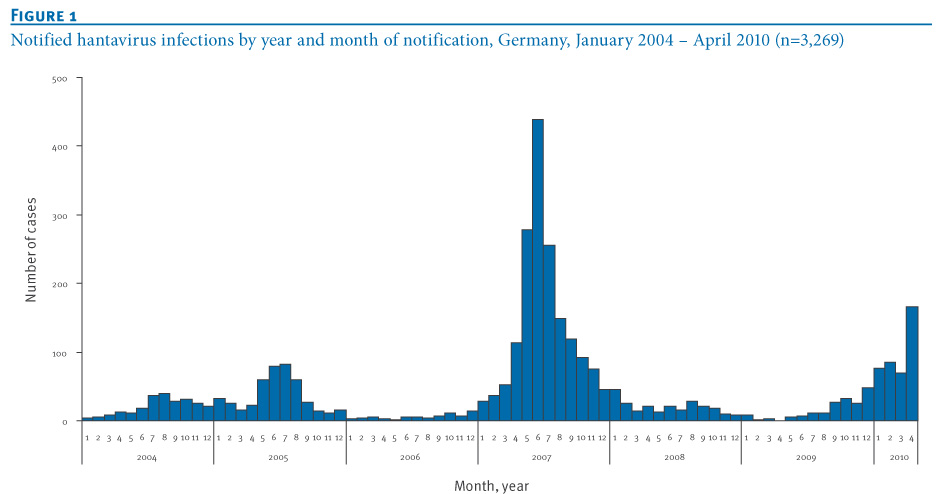
From January to April 2010, 396 hantavirus infections were notified in Germany, a considerable increase compared with previous years (mean: 83 for January–April 2004–2009) including the record-setting year, 2007 (n=232 January–April).

Most patients are residents of known Puumala virus endemic areas in southern Germany. The recent increase in notified hantavirus infections is probably due to an increased population density of the main animal reservoir, the bank vole (Myodes glareolus).

(Continue . . . )


The chart below shows the yearly variability of reported Hantavirus infections in Germany, with 2007 having been a particularly active year.  


Outbreaks of Puumala virus tend to spike every 3 or 4 years and farm workers, who are most likely to come in contact with the dust from Bank Vole droppings, are the most common victims.


image


The `New World’ versions of Hantavirus, including some that are found in South America, produces more severe disease. The CDC recently posted a short audio podcast on this rare, but often fatal, infection.


Hantavirus Pulmonary Syndrome, or HPS, is a disease that is caused 
by people coming in contact with rodents. HPS is caught when dirt or 
dust containing rodent excretion or other bodily fluids is stirred up 
and breathed in or absorbed through broken skin. The result is a serious
 condition in which one of three reported cases has been fatal. In this 
podcast,  Dr. Barbara Knust discusses HPS.

Of Mice and Man (A Cup of Health with CDC)

Listen to the PodcastListen To This Podcast (4:38)

Hantavirus Pulmonary Syndrome, or HPS, is a disease that is caused by people coming in contact with rodents. HPS is caught when dirt or dust containing rodent excretion or other bodily fluids is stirred up and breathed in or absorbed through broken skin. The result is a serious condition in which one of three reported cases has been fatal. In this podcast, Dr. Barbara Knust discusses HPS.  Created: 1/14/2010 by MMWR.   Date Released: 1/14/2010.


Last December the MMWR published this account of 5 rare pediatric cases of HPS from four states during 2009.


Hantavirus Pulmonary Syndrome in Five Pediatric Patients --- Four States, 2009

Hantavirus pulmonary syndrome (HPS) is a reportable infectious disease with a high case-fatality rate, transmitted to humans by exposure to rodents.


Each year, 20--40 cases of HPS occur in the United States; cases in persons aged <17 years make up fewer than 7% of those cases, and cases in children aged <10 years are exceptionally rare.

CDC received reports of five pediatric cases of HPS occurring during May 16--November 25, 2009, among children aged 6--14 years from Arizona, California, Colorado, and Washington. Three of the children were aged <10 years, and all five had exposure to rodents.

(Continue . . . )


The Special Pathogens Branch of the CDC has some information to help you prevent exposure and infection from hantaviruses on their  Hantavirus Pulmonary Syndrome: What You Need To Know webpage.


The following is just an excerpt, follow the link to read the entire guide.


RESERVOIR

The deer mouse (Peromyscus maniculatus) is the primary reservoir of the hantavirus that causes hantavirus pulmonary syndrome (HPS) in the United States.


TRANSMISSION

Infected rodents shed the virus through urine, droppings, and saliva. HPS is transmitted to humans through a process called aerosolization. Aerosolization occurs when dried materials contaminated by rodent excreta or saliva are disturbed. Humans become infected by breathing in these infectious aerosols.


HPS in the United States cannot be transmitted from one person to another.


HPS in the United States is not known to be transmitted by farm animals, dogs, or cats or from rodents purchased from a pet store.


RISK

Anything that puts you in contact with fresh rodent urine, droppings, saliva or nesting materials can place you at risk for infection.


VIRUS

Hantaviruses have been shown to be viable in the environment for 2 to 3 days at normal room temperature. The ultraviolet rays in sunlight kill hantaviruses.


PREVENTION

Rodent control in and around the home remains the primary strategy for preventing hantavirus infection.


CLEANING

Use a bleach solution or household disinfectant to effectively deactivate hantaviruses when cleaning rodent infestations.


I’ve a keen personal interest in the Hantavirus because my ex-wife’s cousin (Ron Voorhees) was one of the original investigators in the famous 4 corner’s outbreak of Hantavirus in 1993 when he worked as an epidemiologist for the state of New Mexico. 


It was during this outbreak that the  New World `Sin Nombre’ (Spanish for `No Name’) Hantavirus was identified, and found to be widely prevalent in its natural host, the deer mouse.


If you would like to learn more about the history of that outbreak, and the epidemiological work done to identify the pathogen, I can direct you to an excellent account at:


Tracking a Mystery Disease:
The Detailed Story of Hantavirus Pulmonary Syndrome