# 5136
Constant readers of this blog are aware that avian influenza strains bind preferentially to the kind of receptor cells commonly found in the digestive and respiratory tracts of birds; alpha 2,3 receptor cells.
Human influenzas – on the other hand - are adapted to bind to the kind of receptor cells that line the surfaces of the human respiratory system; alpha 2,6 receptor cells.
While not an absolute, flu viruses that bind to one type of receptor cell, tend not to bind to the other.
This ability to bind to a specific type of cell has often been described as the host cell being a padlock, and the virus needing a specific key (determined by the genetics of the virus’s Receptor Binding Domain: RBD) to unlock it.

(A Very Simplified Illustration of RBDs)
Now humans do have some avian-like alpha 2,3 receptor cells, particularly deep in the lungs.
This has been suggested as the reason that - when on rare occasions humans contract H5N1 - it is usually a deep lung infection.
It has also been postulated that H5N1’s deeper lung infections may reduce human-to-human transmission, as sneezing is a less common symptom.
The concern is that over time, the H5N1 (or some other avian flu) virus might mutate in such a way as to be able to bind to human α2,6 receptor cells.
And while that may not be the only obstacle keeping the virus from becoming a pandemic strain, it does appear to be a major one.
The two main ways the virus could `learn’ to adapt to humans are through a mutation, or through a reassortment (a sharing of genetic material) with another flu virus.
It is possible for a simple mutation to change the binding preference of an influenza strain, to allow it to bind to a different type of receptor cell (or, to more than one type).
This is actually something we’ve observed with the novel H1N1 virus. The D222G or ``Norway’ mutation has been shown to convey dual receptor specificity for complex α2,3 and α2,6-linked sialic acids (see Study: Receptor Binding Changes With H1N1 D222G Mutation).
Since pigs are known to have both types of receptor cells, they have often been cited as a potential `mixing vessel’ for influenza strains.
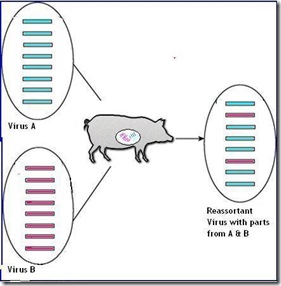
Last January I wrote a blog titled Mixing Vessels For Influenza which mentioned research done by two wildlife disease experts from the San Diego Zoo - Mark Schrenzel and Bruce Rideout – that identified the North American Striped Skunk and the Persian leopard - along with a handful of other small carnivores - as a potential host for influenza reassortment.
Additionally, we’ve seen H5N1 infections among dogs, cats, civets, raccoons, martens, and – of course – humans. And researchers have successfully infected cattle with the H5N1 virus, along with ferrets and mice for testing.
But since avian strains mostly infect birds, the opportunities for avian viruses to encounter human adapted viruses, or to learn to unlock alpha 2,6 receptor cells, are limited.
But perhaps, not quite as limited as we have previously believed.
Which brings us to today’s study, from the Virology Journal, that looks at types of receptor cells detected in a half dozen minor species of poultry.
The condensed version is, some types of poultry have both types of receptor cells . . . but read the entire abstract, or better yet, the entire article.
Characterization of influenza virus sialic acid receptors in minor poultry species
Brian Kimble, Gloria Ramirez Nieto and Daniel R Perez
It is commonly accepted that avian influenza viruses (AIVs) bind to terminal alpha2,3 sialic acid (SA) residues whereas human influenza viruses bind to alpha2,6 SA residues.
By a series of amino acid changes on the HA surface protein, AIVs can switch receptor specificity and recognize alpha2,6 SA positive cells, including human respiratory epithelial cells.
Animal species, like pigs and Japanese quail, that contain both alpha2,3 and alpha2,6 SA become ideal environments for receptor switching. Here, we describe the SA patterns and distributions in 6 common minor domestic poultry species: Peking duck, Toulouse geese, Chinese ring-neck pheasant, white midget turkey, bobwhite quail, and pearl guinea fowl.
Lectins specific to alpha2,3 and alpha2,6 SA (Maakia amurensis agglutinin and Sambuca nigra agglutinin, respectively) were used to detect SA by an alkaline phosphotase-based method and a fluorescent-based method.
Differences in SA moieties and their ability to bind influenza viruses were visualized by fluorescent labeling of 4 different H3N2 influenza viruses known to be specific for one receptor or the other.
The geese and ducks showed alpha2,3 SA throughout the respiratory tract and marginal alpha2,6 SA only in the colon.
The four other avian species showed both alpha2,3 and alpha2,6 SA in the respiratory tract and the intestines. Furthermore, the turkey respiratory tract showed a positive correlation between age and alpha2,6 SA levels.
The fact that these birds have both avian and human flu receptors, combined with their common presence in backyard farms and live bird markets worldwide, mark them as potential mixing bowl species and necessitates improved surveillance and additional research about the role of these birds in influenza host switching.
The complete article is available as a provisional PDF. The fully formatted PDF and HTML versions are in production.
