Showing posts with label Incubation. Show all posts

Thursday, February 27, 2014

Study: Probable Longer Incubation Period For H7N9

image


# 8336


Although individual host responses can vary considerably, public health officials are constantly looking to define the `outside’  duration of viral incubation, as to know when to sound the `all clear’  when someone who has been exposed is out of danger.


The incubation period of novel Influenza – which can be carried sub-clinically, yet potentially still passed on to others – is of particular concern, as those exposed may be quarantined to protect the public. 


And someone with travel history to an area where they might have been exposed to a specific pathogen will more likely be tested if they fell ill within its known incubation period.


The incubation period of viruses varies widely, with seasonal influenza running 1 to 4 days (avg. 2 days), measles running 7 to 21 days (avg. 14 days), MERS-CoV up to 15 days. In late April 2013, just over a month after the first H7N9 cases were announced from China, Hong Kong’s CHP sent a letter to doctors warning that the incubation period could be up to 10 days.


In view of the latest best available evidence, the longest incubation period of human infection with avian influenza A(H7N9) virus has been revised from 7 days to 10 days and the epidemiological criteria of the reporting criteria has been revised accordingly (see attached). Please also note that Taiwan has not been included as an affected area as the case recorded was classified as an imported infection.


Hong Kong has continued to use 10 days as an `outside’ incubation period, for testing and quarantine purposes.  


Just last month, however, in a major release from China’s NHFPC: H7N9 Avian Flu Guidance Update, the incubation period for H7N9 was described as:


According to the incubation period of influenza and human infection with H7N9 avian influenza existing case findings, the incubation period is generally 3 to 4 days.


It is axiomatic that the more cases that are examined, the more studies that are published, the better becomes our knowledge. Which brings me to a new study, appearing this week in the journal Epidemiology & Infection (h/t Crof) , that seems to bear out Hong Kong’s early - more conservative stance - finding the H7N9’s incubation period can range up to 10 days.


Epidemiol Infect. 2014 Feb 24:1-7. [Epub ahead of print]

Probable longer incubation period for human infection with avian influenza A(H7N9) virus in Jiangsu Province, China, 2013.


Huang Y1, Xu K2, Ren DF3, Ai J2, Ji H2, Ge AH2, Bao CJ2, Shi GQ4, Shen T4, Tang FY2, Zhu YF2, Zhou MH2, Wang H2.

Abstract

SUMMARY Human infection with the emerging avian influenza A(H7N9) virus in China in 2013 has raised global concerns. We conducted a retrospective descriptive study of 27 confirmed human influenza A(H7N9) cases in Jiangsu Province, to elaborate poultry-related exposures and to provide a more precise estimate of the incubation periods of the illness.

The median incubation period was 6 days (range 2-10 days) in cases with single known exposure and was 7·5 days (range 6·5-12·5 days) in cases with exposures on multiple days, difference between the two groups was not significant (Z = -1·895, P = 0·058). The overall median incubation period for all patients was estimated to be 7·5 days (range 2-12·5 days).

Our findings further highlight the necessity for public health authorities to extend the period of medical surveillance from 7 days to 10 days.

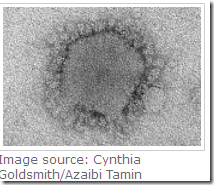
Wednesday, May 29, 2013

Lancet: Clinical Findings On 2 French MERS-CoV Cases


image


# 7337


From The Lancet today, our first good look at the details of an apparent nosocomial transmission of the novel coronavirus at a hospital in France. First a link to the report, then a link to a Helen Branswell article on the prolonged incubation period observed in this case.


Clinical features and viral diagnosis of two cases of infection with Middle East Respiratory Syndrome coronavirus: a report of nosocomial transmission


Benoit Guery, Julien Poissy, Loubna el Mansouf, Caroline Séjourné, Nicolas Ettahar, Xavier Lemaire, Fanny Vuotto, Anne Goffard, Sylvie Behillil, Vincent Enouf, Valérie Caro, Alexandra Mailles, Didier Che, Jean-Claude Manuguerra, Daniel Mathieu, Arnaud Fontanet, Sylvie van der Werf, and the MERS-CoV study group*


Summary


Background Human infection with a novel coronavirus named Middle East Respiratory Syndrome coronavirus (MERS-CoV) was first identified in Saudi Arabia and the Middle East in September, 2012, with 44 laboratory-confirmed cases as of May 23, 2013. We report detailed clinical and virological data for two related cases of MERS-CoV disease, after nosocomial transmission of the virus from one patient to another in a French hospital.

Findings

(Excerpt)

The two patients shared the same room for 3 days. The incubation period was estimated at 9–12 days for the second case. No secondary transmission was documented in hospital staff despite the absence of specific protective measures before the diagnosis of MERS-CoV was suspected. Patient 1 died on May 28, due to refractory multiple organ failure.

Interpretation Patients with respiratory symptoms returning from the Middle East or exposed to a confirmed case should be isolated and investigated for MERS-CoV with lower respiratory tract sample analysis and an assumed incubation period of 12 days. Immunosuppression should also be taken into account as a risk factor


The article (which is of most interest to clinicians) provides a detailed review of the clinical findings on both patients, including lab results, radiographs and CT scans, and genetic analysis of specimens. 


Helen Branswell, who can always be counted upon to cut through the clutter, looks at one of the key findings – that the incubation period for the second patient may have been as long as 12 days.


MERS incubation period may be longer than suspected, study of French cases hints

By: Helen Branswell, The Canadian Press

Wednesday, May. 29, 2013 at 11:10 AMTORONTO - A new study suggests the incubation period for the new MERS coronavirus may be longer than has been believed up until now.


French doctors report that a man who caught the virus from an infected patient he shared a hospital room may have gone 12 days before developing symptoms.


They suggest people who have symptoms of the disease and have travelled to the Middle East or have been in contact with a known MERS patient within the past 12 days should be isolated and investigated as a possible case.

(Continue . . .)