Showing posts with label Maggie Fox. Show all posts

Tuesday, May 13, 2014

Orlando HCWs Being Tested For MERS

image

Coronavirus – Credit CDC PHIL


# 8615


I wasn’t able to listen to the live press conference held by Phillips Hospital earlier today regarding their MERS case, but fortunately Maggie Fox of NBC news did, and we have her report on two hospital employees who are showing symptoms of illness, and are being tested for the virus.


Reportedly about 15 other workers at the Dr. P Philips Hospital, as well as 5 from Orlando’s Regional Medical Center (ORMC) where the infected traveler also visited, are in voluntary home quarantine for the duration of the incubation period.


Florida Hospital Workers Who Treated MERS Patient Fall Ill

By Maggie Fox 

Two of the health care workers who treated a MERS patient in Florida have come down with respiratory symptoms, and are being tested to see if they may have caught the mysterious virus from him, hospital officials say.

In at least one of the cases it’s almost certain not to be MERS — the staffer started showing symptoms just a day after treating the patient, who’s the second person to be diagnosed with MERS in the United States.

The incubation period for MERS — meaning the time it takes from contacting someone who’s infected to showing the first symptoms — is usually about five days.

(Continue . . .)


With the caveat that being exposed (even if symptomatic) doesn’t necessarily mean they are infected, all eyes will be on the test results for these, and others in the coming days.


Stay tuned.

Sunday, May 12, 2013

When Viral Threats Collide

A CDC scientist uses a pipette to transfer H7N9 virus into vials for sharing with partner laboratories for public health research purposes.

A CDC scientist uses a pipette to transfer H7N9 virus into vials for sharing with partner laboratories for public health research purposes.


# 7266


While it may sound like the working title to a George Pal 1950’s Sci-Fi movie, this spring we find ourselves in the decidedly uncomfortable position of watching two novel viruses – each believed to have some degree of pandemic potential – emerge in two different and hard-to-monitor regions of the world.


Rapid fire reports from Asia and the Middle East have had us – and health agencies like the CDC and World Health Organization - bouncing back and forth between the H7N9 avian flu and nCoV (aka MERS) on a daily basis for more than a month.


Today Maggie Fox of NBC News brings us a report on how the CDC is monitoring this two-tiered threat, along with some reaction from experts.  As you’ll see, no one is taking either threat lightly.


Follow the link to read:


Bird flu: US safe from two new viruses - so far

By Maggie Fox, Senior Writer, NBC News

More than 50 travelers just back in the United States from China who had flu-like symptoms have been tested for the H7N9 bird flu virus, federal health officials say. So far, none has tested positive.


But the fact that they’re being tested at all shows just how worried the U.S. government is about this new strain of bird flu, which threatens at the same time as a still-mysterious coronavirus from the Middle East. The test kits had to be specially made up and distributed under an emergency provision.


(Continue . . . )

Thursday, April 25, 2013

The Lancet: Study Links Poultry To H7N9 Transmission


image

Photo Credit – FAO


# 7192


From The Lancet this morning, a fast track study by Chinese researchers, a commentary by Marion Koopmans, Menno D de Jong from the Netherlands, and a podcast interview with Prof Kwok-Yung Yuen MD that points an accusatory finger at poultry in the transmission of the H7N9 virus to humans.


H7N9 transmission from poultry


Poultry has been suspected as the source of human H7N9 transmission in China, where there have been over 100 cases and 20 deaths. In a fast-track Article, Chinese investigators obtained samples from live poultry markets suspected of being linked to human cases of H7N9 influenza. By comparing the viruses found in poultry with those found in human cases, investigators were able to confirm the infected poultry as the source of human H7N9 transmission. The findings have implications for how the outbreak should be controlled, and are discussed in a Comment and podcast.


Human infections with the emerging avian influenza A H7N9 virus from wet market poultry: clinical analysis and characterisation of viral genome

Yu Chen MD, Weifeng Liang MD, Shigui Yang PhD, Nanping Wu PhD, Hainv Gao MD, Jifang Sheng MD, Hangping Yao PhD, Jianer Wo PhD, Qiang Fang MD, Dawei Cui PhD, Yongcheng Li MD, Xing Yao MD, Yuntao Zhang MD, Haibo Wu PhD, Shufa Zheng PhD, Hongyan Diao PhD, Shichang Xia MD, Yanjun Zhang PhD, Kwok-Hung Chan PhD, Hoi-Wah Tsoi MPhil, Jade Lee-Lee Teng PhD, Wenjun Song PhD, Pui Wang PhD, Siu-Ying Lau MPhil, Min Zheng MPhil, Jasper Fuk-Woo Chan, Kelvin Kai-Wang To, Honglin Chen PhD, Prof Lanjuan Li MD, Prof Kwok-Yung Yuen MD

Summary

Background

Human infection with avian influenza A H7N9 virus emerged in eastern China in February, 2013, and has been associated with exposure to poultry. We report the clinical and microbiological features of patients infected with influenza A H7N9 virus and compare genomic features of the human virus with those of the virus in market poultry in Zhejiang, China.

Interpretation

Cross species poultry-to-person transmission of this new reassortant H7N9 virus is associated with severe pneumonia and multiorgan dysfunction in human beings. Monitoring of the viral evolution and further study of disease pathogenesis will improve disease management, epidemic control, and pandemic preparedness.


This study is based on a small number of hospitalized patients (n=4) with established contact with poultry 3-8 days prior to developing severe pneumonia and H7N9 infection.


Researchers reported `The genes of the H7N9 virus in patient 3's isolate were phylogenetically clustered with those of the epidemiologically linked wet market chicken H7N9 isolate.’


The researchers conclude,`These findings suggest sporadic poultry-to-person transmission.’


This study also highlights the clinical picture of infection in these cases (2 of whom died).


The presumed incubation period ranged from 3 to 8 days (mean 5·8 days). Mean age was 56 years (table 1). None of the patients were obese and none had upper-respiratory-tract symptoms or conjunctivitis.


All patients had fever, and lower-respiratory-tract symptoms (including dyspnoea, cough, and sputum), and one had prominent myalgia (table 1).


Chest radiography and CT of all patients showed multilobar patchy consolidation and diffuse alveolar opacities (figure 1A—1F). CT of patients 1 and 4 showed ground glass changes in some areas. Mean time between onset of symptoms and respiratory failure was 9 days.


The Podcast with Dr. Kwok-Yung Yuen, which runs about 10 minutes, is quite informative. You’ll find more perspective in the accompanying comment Avian influenza A H7N9 in Zhejiang, China.


As this report from NBC’s Maggie Fox indicates, if this outbreak is purely transmitted by poultry - and no other reservoir of the virus is found - then this outbreak might be brought under control by slaughtering poultry and disinfecting markets.


Poultry markets likely source of new bird flu in China


By Maggie Fox, Senior Writer, NBC News


Poultry markets where birds are sold live and slaughtered on the spot are the likely source of the new H7N9 bird flu that’s killed more than 20 people in China, researchers said Thursday.


Genetic analysis shows the strain that infected some of the first patients is very similar to a strain found in chickens and pigeons at so-called “wet” markets, the team of Chinese researchers said. Their report was rushed into publication by the Lancet medical journal.


(Continue . . .)

Thursday, October 18, 2012

Detailed Report On Fatal Meningitis Case


image

Exserohilum rostratum – Credit CDC


# 6643


The journal Annals of Internal Medicine has published a letter describing the findings of one of first index cases of fatal meningitis linked to an epidural injection with a contaminated steroid product.


Fatal Exserohilum Meningitis and Central Nervous System Vasculitis after Cervical Epidural Methylprednisolone Injection

Jennifer L. Lyons, MD; Elakkat D. Gireesh, MD; Julie B. Trivedi, MD; W. Robert Bell, MD; Deanna Cettomai, MD; Bryan R. Smith, MD; Sarah Karram, MD; Tiffany Chang, MD; Laura Tochen, MD; Sean X. Zhang, MD, PhD; Chad M. McCall, MD, PhD; David T. Pearce, BS; Karen C. Carroll, MD; Li Chen, MD, PhD; John R. Ratchford, MD, MSc; Daniel M. Harrison, MD; Lyle W. Ostrow, MD, PhD; and Robert D. Stevens, MD


Those who would like to wade through the detailed clinical findings can use the link above, but briefly: The  patient was a 51 year old woman who presented at the local emergency room with a severe headache on August 31st, 2012 a week after receiving an epidural cervical injection at a pain clinic. 


This was before the nationwide alert had gone out about contaminated steroids and fungal meningitis, and so the ER doctors had no reason to suspect that as a cause.


Since headaches are common after a spinal injection, the ER did a CT scan, assured themselves that she wasn’t having a stroke, and sent her home. But the next day she returned, and her symptoms now resembled meningitis (headache, double vision, dizziness, nausea), and so they admitted her. 


Her condition steadily worsened over the next several days while her doctors desperately worked to solve a medical mystery.


They tested her spinal fluid for herpes simplex virus, varicella zoster virus, Epstein–Barr virus, cytomegalovirus, and West Nile virus. Antigen tests for cryptococcal and histoplasma antigens along with bacterial cultures of her cerebral-spinal fluid were negative as well.


After 8 days - despite trying acyclovir, cefepime, vancomycin, doxycycline, and (a bit ironically) methylprednisolone - her condition had grown increasingly grim, as described below:


On day 9, neurologic examination progressed to absent pupillary, corneal, and gag reflexes, and liposomal amphotericin B was added empirically.


On day 10, all brainstem reflexes were lost, and death from neurologic criteria was pronounced.


Exserohilum species was reported in the cerebrospinal fluid the same day.

Autopsy revealed a grossly necrotic brainstem, and microscopic examination showed angioinvasive, septate fungal hyphae associated with diffuse vasculitis (Figure, H) and hemorrhagic infarction in the brain and spinal cord.


In simplest terms, this fungus infected and destroyed her brainstem. The rapid progression of this infection points out how important early diagnosis and treatment will be for those infected.


Maggie Fox of NBC News has more on this story, which you can access at:


First case history shows fungal meningitis can destroy brain fast

By Maggie Fox, NBC News

She had a history of pain, the 51-year-old woman who showed up at the emergency room with a headache so bad it made her face hurt. Within 10 days she was dead, one of the first victims of an outbreak of fungal meningitis that has killed 19 people and made more than 240 sick.


(Continue . . )


According to the New York Times yesterday, doctors are debating the merits of starting prophylactic treatment in asymptomatic patients.


So far, the advice has been strongly against it, primarily because of the potential for antifungal drugs to cause liver, heart, and kidney damage. 


This from the CDC’s Clinical Guidance:


Interim Guidance for Management of Asymptomatic Persons Exposed to Potentially Contaminated Steroid Products

October 14, 2012 4:30 PM EDT

Antifungal prophylaxis for patients who received epidural injections with potentially contaminated steroid products

  • At this time, CDC does not recommend initiation of antifungal prophylaxis in exposed patients who are asymptomatic. These patients should be closely monitored for development of symptoms, with a low threshold for performing lumbar puncture should the patient become symptomatic. When diagnostic lumbar punctures are performed, they should be done through a site other than the site used for epidural injection when possible.


Another concern is since treatment courses could go on for months - with thousands of people exposed - the supply of anti-fungal drugs may not be sufficient to treat asymptomatic cases.


We should get an update later this afternoon on the case counts from the CDC, and perhaps some new guidance. 

Monday, October 15, 2012

CDC/FDA: Multistate Fungal Meningitis Outbreak – Oct 15th

image


# 6637


This afternoon we’ve another twist to the fungal meningitis outbreak that’s been linked to steroids dispensed by a Massachusetts compounding pharmacy, as the FDA issues a warning about two other drugs from that facility that may also have contamination issues. 


FDA Statement on Fungal Meningitis Outbreak


[10-15-2012] As a result of FDA, CDC, and state health departments’ ongoing investigation of contamination at the New England Compounding Center’s (NECC) Framingham, Massachusetts facility, on October 4, the FDA advised providers to not use any NECC products. On October 6, NECC announced a recall of all its products. A complete list of all products subject to this recall can be accessed here [HTML | PDF]. The FDA had previously issued guidance for medical professionals that all products distributed by NECC should be retained, secured, and withheld from use.


Also as a result of the ongoing investigation of NECC, a patient with possible meningitis potentially associated with epidural injection of an additional NECC product, triamcinolone acetonide, has been identified through active surveillance and reported to FDA. Triamcinolone acetonide is a type of steroid injectable product made by NECC. The cases of meningitis identified to date have been associated with methylprednisolone acetate, another similar steroid injectable product.


In addition, two transplant patients with Aspergillus fumigatus infection who were administered NECC cardioplegic solution during surgery have been reported. Investigation of these patients is ongoing; and there may be other explanations for their Aspergillus infection. Cardioplegic solution is used to induce cardiac muscle paralysis during open heart surgery to prevent injury to the heart.


FDA continues to evaluate these reports, and when the agency obtains additional information, it will be promptly relayed to the public. FDA has not confirmed that these three infections were, in fact, caused by an NECC product.

(Continue . . . )


For more on this story we turn to Maggie Fox of NBC News:


More drugs implicated in fungal meningitis outbreak

By Maggie Fox, NBC News

Two more drugs have been implicated in the ongoing outbreak of fungal meningitis linked to contaminated pain injections, federal health officials said Monday.


Both come from the same pharmacy, New England Compounding Center, that distributed the steroids suspected of sickening at least 205 people and killing 15 of them, the Food and Drug Administration said in a statement.

(Continue . . . )


The CDC has posted updated numbers on the expanding outbreak of fungal meningitis linked to potentially contaminated steroid injections. Cases have now been detected in 15 states (Pennsylvania was added today).


Of particular note, there are now 2 confirmed cases of peripheral joint infection (e.g. knee, hip, elbow, shoulder ) reported, in addition to 212 meningitis cases.


A reminder: This type of meningitis is not transmissible between people.  Those who did not receive a steroid injection from one of the suspect lots are not at risk of infection.


The CDC continues to advise:


Patients and clinicians need to remain vigilant for onset of symptoms because fungal infections can be slow to develop. In this outbreak symptoms typically have appeared 1 to 4 weeks following injection, but it’s important to know that longer and shorter periods of time between injection and onset of symptoms have been reported. Therefore, patients and physicians need to closely watch for symptoms for at least several months following the injection. See updated Patient Guidance for more information, and contact your physician if you are concerned you may have become ill from your injection.


Complicating matters, the primary fungus identified so far - Exserohilum - while common in the environment – has never been associated with meningitis before. 


Doctors are working on new treatment protocols, but as the CDC’s Incident Manager for this outbreak, J. Todd Weber MD stated last week, “This is new territory for public health and the clinical community.”


For health care practitioners , the CDC has scheduled another Clinician’s Outreach Call (COCA) for tomorrow afternoon (Oct. 16th).  Details at the link below:


NEW: COCA Conference Call - Multistate Fungal Meningitis Outbreak Investigation Update: Information and Guidance for Clinicians - October 16, 2012


Finally, the following guidance documents have been updated, or added, on the CDC site over the past two days.


UPDATED: Interim Treatment Options for Septic Arthritis Associated With Injection of Potentially Contaminated Steroid Products
October 15, 2012 12:00 PM EDT


UPDATED: Interim Treatment Guidance for Central Nervous System (CNS) and/or Parameningeal Infections Associated with Injection of Potentially Contaminated Steroid Products
October 15, 2012 12:00 PM EDT


UPDATED: Role of Antifungal Prophylaxis in Asymptomatic Patients
October 14, 2012 8:00 PM EDT


NEW: What Should Physicians Be Doing?
October 14, 2012 8:00 PM EDT


UPDATED: Frequently Asked Questions for Clinicians
October 14, 2012 8:00 PM EDT


UPDATED: Instructions for Clinicians Regarding Diagnostic Testing and Specimen Shipping for Central Nervous System and Parameningeal Infections
October 14, 2012 6:00 PM EDT


NEW: Interim Guidance for Management of Asymptomatic Persons Exposed to Potentially Contaminated Steroid Products
October 14, 2012 6:00 PM EDT


NEW: Interim Treatment Options for Septic Arthritis Associated With Injection of Potentially Contaminated Steroid Products
October 14, 2012 6:00 PM EDT


NEW: Interim Treatment Guidance for Central Nervous System (CNS) and/or Parameningeal Infections Associated with Injection of Potentially Contaminated Steroid Products
October 14, 2012 6:00 PM EDT

Wednesday, October 10, 2012

CDC: Update On Fungal Meningitis Outbreak – Oct 10th

image 


# 6623


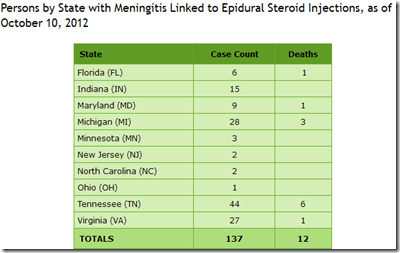
We’ve updated numbers from the CDC this afternoon on the cases of meningitis across the country linked to potentially contaminated injectable steroids, along with an updated Q&A sheet for patients and revised case definitions for clinicians.

 image


While the numbers continue to climb, it is important to note that this type of meningitis is not contagious. All of these cases received an epidural injection from a potentially contaminated steroid.


I’ve only excerpted the opening of the FAQ page for Patients below, follow the link to read it in its entirety.


Frequently Asked Questions For Patients: Multistate Meningitis Outbreak Investigation

October 10, 2012 12:45 PM EDT

About the Outbreak

Background
The Centers for Disease Control and Prevention (CDC) and the Food and Drug Administration (FDA) are currently coordinating a multistate investigation of fungal meningitis among patients who received an epidural steroid injection with a potentially contaminated product. Several of these patients also suffered strokes that are believed to have resulted from their infection.


How many cases have been reported?
Updates about the investigation, including
case counts, are available at http://www.cdc.gov/hai/outbreaks/meningitis.html.


Is the source of the outbreak known?
CDC is investigating medications and products that are associated with this outbreak of meningitis. At this point, the original source of the outbreak has not been determined. However, injectable steroid medication has been linked to the outbreak. The
lotsExternal Web Site Icon of medication that were given to patients have been recalled by the manufacturer.


The type of epidural medication given to patients affected by this outbreak is not the same type of medication as that given to women during childbirth.

(Continue . . . .)


Of interest primarily to clinicians, here is a link to the updated case definitions.


Multistate Outbreak of Meningitis Associated with Injection of Potentially Contaminated Steroid Products


And finally, a report from Maggie Fox of NBC News on the growing controversies surrounding compounding pharmacies.


Compounding pharmacies -- heroes or outlaws?

By Maggie Fox, NBC News

A single compounding pharmacy, one that mixes up drugs to order, appears to be the source of contamination that has killed 12 people and made more than 100 sick with a rare form of fungal meningitis. Some consumer advocates want the Food and Drug Administration to crack down harder on such pharmacies, but the legal battle for regulate them has been long and convoluted.

(Continue . . . )

Monday, December 21, 2009

T-705: Testing A New Antiviral In Japan


# 4180


Maggie Fox of Reuters brings us details tonight of a new, experimental antiviral being developed and tested in Japan, that one day could end up as another arrow in our quiver against pandemic and seasonal influenza.


Mouse studies are encouraging, and phase III human studies are expected to begin shortly.   


New Japanese flu drug protects mice from avian flu


Mon Dec 21, 2009 3:00pm EST

By Maggie Fox, Health and Science Editor

WASHINGTON, Dec 21 (Reuters) - An experimental influenza drug can protect mice against H5N1 avian influenza better than the preferred drug Tamiflu, researchers reported on Monday.


The drug, called T-705 or favipiravir, is made by Fujifilm Holdings Corp (4901.T) unit Toyama Chemical Co. It works differently from Tamiflu and Relenza and seems to work at lower doses, the researchers reported in the Proceedings of the National Academy of Sciences.


Tamiflu, Roche AG (ROG.VX) and Gilead Sciences Inc's (GILD.O) popular pill and Relenza, GlaxoSmithKline's (GSK.L) (GSK.N) and Biota Inc's (BTA.AX) inhaled flu drug, must be given with 48 hours to be fully effective.


"This compound works much better, even three days after infection," Yoshihiro Kawaoka of the University of Tokyo and the University of Wisconsin said in a statement.


"Our results suggest that T-705 is safe and effective in combating H5N1 influenza viruses and is, thus, a promising candidate antiviral for the treatment of highly pathogenic H5N1 patients," Kawaoka and colleagues wrote.


(Continue . . . .)


While mouse studies don’t always predict how a drug will work in humans, this is certainly encouraging news.   We are, however, some time away from seeing this new drug on the pharmacy shelf. 


The press release from the University of Wisconsin is below.


Public release date: 21-Dec-2009
Contact: Yoshihiro Kawaoka
kawaokay@svm.vetmed.wisc.edu
608-265-4925
University of Wisconsin-Madison

Compound found to safely counter deadly bird flu

MADISON — The specter of a drug-resistant form of the deadly H5N1 avian influenza is a nightmare to keep public health officials awake at night.


Now, however, a study published this week (Dec. 21) in the Proceedings of the National Academy of Sciences (PNAS) suggests that a new compound, one on the threshold of final testing in humans, may be more potent and safer for treating "bird flu" than the antiviral drug best known by the trade name Tamiflu.


Known as T-705, the compound even works several days after infection, according to Yoshihiro Kawaoka, a University of Wisconsin-Madison virologist and the senior author of the new PNAS study.


"H5N1 virus is so pathogenic even Tamiflu doesn't protect all the infected animals," explains Kawaoka, a professor of pathobiological sciences at the UW-Madison School of Veterinary Medicine and a world authority on influenza. "This compound works much better, even three days after infection."


The Wisconsin research was conducted in mice and demonstrated that the compound was effective and safe against H5N1 virus, the highly pathogenic bird flu virus, which some scientists fear could spark a global epidemic of deadly influenza. The compound is also effective against seasonal flu and more worrisome varieties such as the H1N1 virus, and has already been tested against circulating seasonal influenza in humans in Japan where it is on the brink of Phase III clinical trials in people.


(Continue . . . )

Tuesday, November 17, 2009

Why They Call It COLD & Flu Season


# 4030


Last week in a blog entitled When The `Flu’ Isn’t The Flu, I wrote about a discovery at the Children’s Hospital of Philadelphia of an  unusually virulent (and possibly new) rhinovirus – essentially a common cold – that began hitting some children hard earlier this fall.


Even during the height of flu season, we know that other respiratory viruses are circulating, and probably making up half or more of all influenza-like-illnesses (ILIs).


These illnesses may range from common rhinoviruses to metapneumovirus, parainfluenzavirus, or respiratory syncytial virus (RSV), to one of the adenoviruses.


This chart (see ILI’s Aren’t Always The Flu) from early October show more than 70% of samples tested by the CDC came back negative for influenza.

image


Now Maggie Fox, Health and Science editor for Reuters, picks up the story with some more details.  Maggie always does terrific reporting, so follow the link to read it in its entirety.


Not just swine flu - new cold virus may lurk, too

Tue Nov 17, 2009 3:24pm EST

By Maggie Fox, Health and Science Editor


WASHINGTON (Reuters) - Runny nose, fever, cough, even pneumonia -- the symptoms sound like swine flu but children hospitalized at one U.S. hospital in fact had a rhinovirus, better known as a common cold virus, doctors said on Tuesday.


Hundreds of children treated at Children's Hospital of Philadelphia had a rhinovirus, and federal health investigators are trying to find out if it was a new strain, and if this is going on elsewhere in the country.


“What began to happen in early September is we started seeing more children coming to our emergency room with significant respiratory illness," said Dr. Susan Coffin, medical director of infection control and prevention at the hospital.


Doctors and parents assumed it was the new pandemic H1N1 swine flu, which would be expected to re-emerge as schools began in September. But it was not, Coffin said in a telephone interview.

(Continue . . . )