
# 9599
For the second day in a row the Saudi MOH is reporting a MERS case in Riyadh, this time a 67 y.o. male. Officials are investigating the possibility of nosocomial exposure.
# 9599
For the second day in a row the Saudi MOH is reporting a MERS case in Riyadh, this time a 67 y.o. male. Officials are investigating the possibility of nosocomial exposure.

# 9254
Last week, in Saudi MOH Statement On Recent MERS Cases In Taif, we saw a promise by the Ministry of Health to take action to combat a steady rise in MERS cases reported in Taif, and strong suggestions that at least some of the cases contracted the virus while being treated at a local hospital dialysis center.
Since the beginning of September, at least 35 MERS cases have been reported in Saudi Arabia, with roughly half of them emanating from Taif.
While the Saudi MOH has maintained that this year’s Hajj was `MERS free’, we’ve seen several recent reports of exported cases of MERS around the time of the Hajj, to both Turkey and Austria, and a number of the cases reported from the Mecca/Taif region where pilgrims gathered.
The virus appears to jump sporadically from animals - likely camels (see KSA MOH Reiterates Camel Warnings On MERS) – to humans, and once there, it can spread to other people. Community spread is believed limited, but hospital settings – particularly dialysis units – have been the site of several significant outbreaks.
We’ve just over two years experience with this virus, but there does appear to be a strong seasonal component to transmission – with human infections rising in the winter and peaking in the late spring.
The Saudi MOH today has issued a follow up statement, urging the public, and healthcare facilities, to take steps to prevent exposure and onward transmission of the virus.
«Health» stresses the importance of compliance with preventive measures to limit the spread of (SK)
03 Muharram 1436
Further to the earlier statement issued by the Ministry of health about HIV cases (SK) (Mirs) in Taif, the Ministry wishes to clarify that it is still sporadic cases of HIV infection, which calls for the importance of adherence to preventive measures to curb the spread of the disease, and not mixing with infected camels, as well as emphasize infection control measures in health facilities.
The Ministry has shown that, thankfully, have finished reviewing application and all precautionary measures and preventive measures to curb the spread of HIV infection in health facilities in Taif, where total unit was run at King Faisal Hospital in Taif urgently include (20) laundry Chair to relieve the pressure, absorbing about one-third of patients. Kidney Center was developed by King Abdulaziz hospital, and additional working time, to service beneficiaries continuously.
The procedures also include sampling for all patients in total units of King Abdul Aziz hospital; to ensure their safety and their transmission, with daily monitoring of vital signs for all patients who are having dialysis, as tight measures on patient visits and navigation units.
In addition, the Ministry is supporting Taif Health Affairs Unit of mobile laboratories, and was operated on at the King Faisal Hospital, enabling the results detected virus in record time, and also measures included more training for health workers about ways to prevent infection.
It added that the coordination of all the confirmed cases to the King Faisal Hospital who had been selected as the reference hospital for treatment (SK) in Taif. As adjustments in patients (SK) hospital to ensure the isolation of suspected cases confirmed cases.
The Ministry has shown that restriction (6) recorded cases in Ta'if were of patients undertaking hemodialysis in King Abdul Aziz hospital in Taif, the first of these cases was related to camels in addition to two operational health at King Faisal Hospital, and the rest gained from mixing with camels.
The statement urging all need to respect health guidelines for the prevention of disease, and the need to take preventive measures to reduce infection when dealing with camels and not mixing with the patient ones.
For more information about ways to prevent the disease through the Ministry's website

# 9349
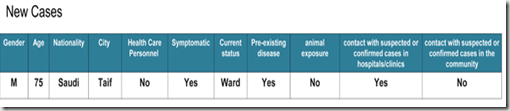
The Taif MERS outbreak – which appears to have been exacerbated by exposures within their healthcare system – continues with the 17th reported case since early September.
Today’s case is an elderly male who appears to have been exposed in the hospital.
On Monday the Saudi MOH announced new, aggressive measures were being taken to try to bring this outbreak to a halt (see Saudi MOH Statement On Recent MERS Cases In Taif).

# 9083
For the second day running, and the fifth case reported over the past 9 days, the Saudi MOH has announced a fresh MERS case, this time in Riyadh which last reported a case 4 days ago (Sept 12th). Essentially all we know is the patient is a 39 year old male, Ex-Pat who is not a HCW, and who is in intensive care.
With the Hajj set to begin in just over two weeks, and with that the influx of more than 2 million pilgrims to the Kingdom, this recent uptick in cases is of particular concern.

# 8675
While not exactly a deluge, after 48 hours the drought of no reports from KSA on MERS appears to be broken. Of note, 2 of the three newly reported cases have already died.
One died just a day after admission to the hospital, but the other - a 39 y.o. female with co-morbidities and a history of exposure to a previously diagnosed case - had been hospitalized for a week.
The third case is listed as stable, and in isolation at home. Four other deaths from previously announced cases were also reported.
Daily Report of (MERS-CoV) Cases
Wednesday 29 Rajab 1435 / 28 May 2014
12 pm Local Time in Makkah

Total number of confirmed cases in the last 24 hours: 3 cases.
Recovered and discharged cases that previously tested positive and are now negative: 4 cases.
The total number of deaths: 6 (2 cases were recorded over the past 24 hours and the other 4 are from previously confirmed cases).
Overview of the Health Status of the Cases:
- 1 stable case.
- 2 deaths.
Health situation of the cases in detail:
a) In Riyadh:
- A 72-year-old male suffering from Diabetes, and Hypertension. He developed respiratory symptoms on May 5, 2014 and was admitted to a government hospital on May 26, 2014. His condition is stable and is isolated at home.
b) In Makkah:
- A 65-year-old suffering from Diabetes, Hypertension, Heart Disease, and Chronic Obstructive Pulmonary Disease. He was admitted to a government hospital on May 26, 2014. He has been in contact with a confirmed case. He passed away on May 27, 2014. May Allah have mercy upon him.
- A 39-year-old female suffering from Diabetes, Hypertension, Systemic Lupus Erythematosus, and is a Steroid user. She developed fever, mild cough, and joints pain. She was admitted to a government hospital on May 21, 2014. She has been in contact with a confirmed case. She passed away on May 27, 2014. May Allah have mercy upon her.
Deaths from previously reported cases:
- A 36-year-old male was admitted to a government hospital in Madinah. He was previously recorded as a confirmed case on May 12, 2014. He passed away on May 27, 2014. May Allah rest his soul.
- A 51-year-old male was admitted to a government hospital in Madinah. He was previously recorded as a confirmed case on May 19, 2014. He passed away on May 27, 2014. May Allah rest his soul.
- A 55-year-old female was admitted to a government hospital in Riyadh. She was previously recorded as a confirmed case on May 14, 2014. She passed away on May 27, 2014. May Allah rest her soul.
- An 80-year-old female was admitted to a government hospital in Riyadh. She was previously recorded as a confirmed case on May 28, 2014. May Allah rest her soul.
Recovery from previously reported cases:
- A 36-year-old female was discharged from a government hospital in Riyadh on May 27th, 2014.
- A 40-year-old female was discharged from a government hospital in Riyadh on May 27th, 2014.
- A 40-year-old female was discharged from a government hospital in Riyadh on May 27th, 2014.
- A 48-year-old female was discharged from a government hospital in Taif on May 27th, 2014.
Coronavirus – Credit CDC PHIL
# 7965
In a follow up to a story which we’ve been following since yesterday (see KSA MERS Investigation: Testing The Beast, Not The Beauty & MERS-CoV: CIDRAP & Dr. Mackay On The Saudi Camel Connection), ProMed Mail has published this afternoon an email from Dr. Ziad Memish , Deputy Minister for Public Health for the Kingdom of Saudi Arabia, that provides some additional details.
I’ve only included some excerpts, you’ll want to follow the link to read the entire release, including commentary by the editors at ProMed.
Published Date: 2013-11-12 13:01:10
Subject: PRO/AH/EDR> MERS-CoV - Eastern Mediterranean (85): animal reservoir, camel, susp, official
Archive Number: 20131112.2051424MERS-COV - EASTERN MEDITERRANEAN (85): ANIMAL RESERVOIR, CAMEL, SUSPECTED, OFFICIAL
A ProMED-mail post http://www.promedmail.org
ProMED-mail is a program of the International Society for Infectious Diseases http://www.isid.orgDate: Tue 12 Nov 2013
From: Ziad Memish <zmemish@yahoo.com> [edited]
The Saudi Ministry of Health [MoH] continues to follow carefully all new cases of MERS-CoV diagnosed in KSA [Kingdom of Saudi Arabia] with routine contact tracing of all contacts inclusive of family contacts and HCWs [healthcare workers] who cared for the patient. On 7 Nov 2013 the Saudi MoH reported a new case: a 43-year-old male from Jeddah, who developed symptoms on 27 Oct 2013. He sought medical treatment on 3 Nov 2013. He is currently in an intensive care unit. The patient does not have any underlying chronic disease. He has no recent travel history outside of Jeddah. He had significant contact with animals but no contact with a known positive human case. To complete the investigation extensive environmental/animal contact sources were pursued. Camels owned by the patient which were symptomatic with fever and rhinorrhea were tested for MERS-CoV and tested positiveThis is the 1st time that a camel related to a case tests positive for MERS-CoV by PCR. Further testing is ongoing to sequence the patient and the camel virus and compare genetic similarity level to conclude causality.
# 7282
The novel coronavirus, which first surfaced on the Arabian peninsula a little more than a year ago, has gone by a variety of names, including novel coronavirus, nCoV, hCoV-EMC, and (even worse for those of us with chronic carpel tunnel problems) betacoronavirus 2c EMC2012.
About 10 days ago Martin Enserink brought us details of a new naming convention (see Picking A Novel Name For A Novel Virus) for the novel coronavirus, proposed by an international group of experts.
Their solution?
Call it Middle East respiratory syndrome coronavirus (MERS-CoV). Or just MERS.
Their paper was published earlier this week in the Journal of Virology (see Middle East Respiratory Syndrome Coronavirus (MERS-CoV); Announcement of the Coronavirus Study Group) and yesterday, the World Health Organization embraced the term in the following statement.
Novel coronavirus update – new virus to be called MERS-CoV
Virologist and blogger Ian MacKay from his Virology Down Under website (which, if you aren’t reading, you should) takes a closer look at how future variants of this virus will be labeled in:
Ian also maintains a terrific webpage on the H7N9 virus (see VDU H7N9) and you’ll find links to his sites on my sidebar.
Admittedly, not everyone is on board with this new name, with some feeling it unfairly stigmatizes a region of the world.
We’ll have to see if the CDC, ECDC, Hong Kong’s CHP, the PHAC, and others follow the WHO’s lead in calling this virus MERS-CoV. Ideal name or not, having everyone on the same page with what we call this virus would be an advantage.
While I’m not exactly in love with the term (for my tastes, it sounds a bit too much like MRSA) - it has now been adopted by the World Health Organization - so I’ll be using MERS and MERS-COV in this blog (with an occasional aka nCoV to aid in the transition) going forward.
A CDC scientist uses a pipette to transfer H7N9 virus into vials for sharing with partner laboratories for public health research purposes.
# 7266
While it may sound like the working title to a George Pal 1950’s Sci-Fi movie, this spring we find ourselves in the decidedly uncomfortable position of watching two novel viruses – each believed to have some degree of pandemic potential – emerge in two different and hard-to-monitor regions of the world.
Rapid fire reports from Asia and the Middle East have had us – and health agencies like the CDC and World Health Organization - bouncing back and forth between the H7N9 avian flu and nCoV (aka MERS) on a daily basis for more than a month.
Today Maggie Fox of NBC News brings us a report on how the CDC is monitoring this two-tiered threat, along with some reaction from experts. As you’ll see, no one is taking either threat lightly.
Follow the link to read:
Bird flu: US safe from two new viruses - so far
By Maggie Fox, Senior Writer, NBC News
More than 50 travelers just back in the United States from China who had flu-like symptoms have been tested for the H7N9 bird flu virus, federal health officials say. So far, none has tested positive.
But the fact that they’re being tested at all shows just how worried the U.S. government is about this new strain of bird flu, which threatens at the same time as a still-mysterious coronavirus from the Middle East. The test kits had to be specially made up and distributed under an emergency provision.
# 7258
Of late, infectious disease blogging has me feeling a bit like an indecisive racetrack tout, unable to pick which horse to recommend. On paper, H7N9 and nCoV (aka MERS) both appear to have some degree of pandemic potential, yet neither has much of a track record.
Our knowledge of where they come from, and how they are spreading to, and among, humans is very limited.
Making handicapping them, exceedingly difficult.
If that’s a dilemma for us bloggers, consider how tough it is for public health agencies and officials who must not only plan for any contingency, but also inform the public of any threat.
To that end, the World Health Organization has been using their Twitter account (@WHO) quite effectively over the past six weeks to keep the public up to date on both emerging viruses.
This morning – while we await word on (now three) contacts of the French nCoV patient who are being tested – WHO’s social media arm has been both busy, and forthright about the limits of what they know.

Of course, WHO is not alone.
The CDC, ECDC, Hong Kong’s CHP, and other agencies have all been putting out fresh advisories, updates, and guidelines – just in case H7N9 or nCoV take off.
A common theme among them has been that these viruses are newly discovered, poorly understood, and that we don’t know how much of a threat they actually pose to global public health.
Admittedly, a difficult message for any public health agency to have to deliver.
But one that has the virtue of being absolutely true.
#7255
A story the newshounds at Flutrackers have been following for about an hour – but via this machine translated news report – has now now made the wire services in English.
Two contacts of the French nCoV patient (see France: More Details On Imported nCoV Case) are apparently displaying signs of infection – but with what – is yet to be determined.
One is a doctor who treated the French traveler, and another a patient who shared a hospital room with him in in Valenciennes, before he was diagnosed and isolated.
Tests are being conducted, and so for now, these are only suspect cases.
This report from Reuters:
Two people in France ill after contact with coronavirus victim
LILLE, France | Fri May 10, 2013 2:45am IST
(Reuters) - Two people who had contact with a Frenchman who is seriously ill with the new SARS-like coronavirus have fallen sick and been admitted to hospital, health officials in northern France said on Thursday.
One is a patient who shared a ward with the 65-year-old man infected with the virus when he was in a hospital in the town of Valenciennes, northern France, at the end of April, and the other is a doctor who treated him there.
With two previously recorded healthcare-related clusters involving this virus, health officials are quick to isolate and test any contacts who display any signs of illness.
We will hopefully get some definitive word on their status in the hours ahead.
# 7253
Yesterday (May 8th) the CDC posted updates to their novel coronavirus webpage, including an updated Q&A overview, and a situation update which includes case definitions, links to a variety of guidance documents, and a brief discussion on what is known about this virus, including its potential for transmission.
Some excerpts below, but follow the links to read them in their entirety.
Novel Coronavirus
Updates-May 2013
In all, 31 people in Saudi Arabia, Qatar, Jordan, the United Kingdom, the United Arab Emirates, and France have been confirmed as having an infection caused by the novel coronavirus. Investigations are being done to figure out the source of the novel coronavirus and how it spreads.
So far, there are no reports of anyone in the U.S. getting infected and sick with the novel coronavirus.
- March 7, 2013 MMWR: Update: Severe Respiratory Illness Associated with a Novel Coronavirus - Worldwide, 2012-2013
- Update and revised case definition for healthcare professionals and state and local health departments
- Travel Notice: Novel (New) Coronavirus in the Arabian Peninsula and United Kingdom
Update, Case Definitions, and Guidance
Update
CDC continues to work closely with the World Health Organization (WHO) and other partners to better understand the public health risk presented by recently reported cases of infection with a novel coronavirus. As of May 8, 2013, 31 laboratory-confirmed cases have been reported to WHO - 22 from Saudi Arabia, two from Qatar, two from Jordan, three from the United Kingdom, one from the United Arab Emirates, and one from France. The onset of illness was between April 2012 and May 2013 (1). Among the 31 cases, 18 were fatal. Two of the 31 cases experienced a mild respiratory illness and fully recovered.
Clusters of cases in Saudi Arabia, Jordan and the United Kingdom are being investigated. The first cluster of two cases, both fatal, occurred near Amman, Jordan, in April 2012. Stored samples from these two cases tested positive retrospectively for the novel coronavirus. This cluster was temporally associated with cases of illness among workers in a hospital (2). A second cluster occurred in October 2012, in Saudi Arabia. Of the four individuals in the household, three were laboratory-confirmed cases, two of them died. In February 2013, a third cluster of three family members was identified in the United Kingdom. All three people tested positive for novel coronavirus. Among them, two died, and one recovered after experiencing a mild respiratory illness. This cluster provides evidence of person-to-person transmission of novel coronavirus. It also provides the first example of mild illness being associated with novel coronavirus infection. A fourth cluster among two family contacts occurred in Saudi Arabia in February 2013. One of the individuals died, and one recovered after experiencing a mild respiratory illness. In May 2013, a fifth cluster was reported in Saudi Arabia and is linked to one healthcare facility. A total of 13 cases have been reported in the cluster, of which seven have died. The Kingdom of Saudi Arabia Ministry of Health is investigating the situation.
There is clear evidence of limited, not sustained, human-to-human transmission, possibly involving different modes of transmission such as droplet and contact transmission. But further studies are required to better understand the risks. The efficiency of person-to-person transmission of novel coronavirus is not well characterized but appears to be low, given the small number of confirmed cases since the discovery of the virus.
The reservoir and route of transmission of the novel coronavirus are still being investigated. Genetic sequencing to date has determined the virus is most closely related to coronaviruses detected in bats. CDC is continuing to collaborate with WHO and affected countries to better characterize the epidemiology of novel coronavirus infection in humans.
Overview of the Novel Coronavirus
Q: What is the new human coronavirus?
A: The new virus is a beta coronavirus. It is different from other coronaviruses that have been found in people before.
Q: Is this virus the same as the SARS virus?
A: No. The novel coronavirus is not the same virus that caused severe acute respiratory syndrome (SARS) in 2003. However, like the SARS virus, the novel coronavirus is most similar to those found in bats. CDC is still learning about this new virus.
Q: How many people have been infected?
A: From April 2012 to May 2013, a total of 31 people from Saudi Arabia, Qatar, Jordan, the United Kingdom, the United Arab Emirates, and France were confirmed to have an infection caused by the novel coronavirus.
Saudi Arabia: 22 people; 13 of them died
Qatar: 2 people; both survived
Jordan: 2 people; both died
UK: 3 people; 2 died, 1 recovered
UAE: 1 person; died
France: 1 person, receiving treatment
For more information, see the World Health Organization (WHO)
.
Q: What are the symptoms of novel coronavirus infection?
A: Most people who got infected with the novel coronavirus developed severe acute respiratory illness with symptoms of fever, cough, and shortness of breath. Only two people experienced a mild respiratory illness.
Q: Does the virus spread from person to person?
A: In the UK, one infected person likely spread the virus to two family members. This cluster of cases provides the first evidence of person-to-person transmission. The UK's Public Health England
# 7249
From Reuters this morning a story that indicates World Health Organization officials will soon visit the hospital where an outbreak of nCoV(aka MERS) has infected at least 13 people.
In a statement by Gregory Hartl, spokesperson for WHO, we learn that one of the areas they will focus on is the hemodialysis unit (see earlier blog Media Reports Blame Saudi nCoV Outbreak On Dialysis Equipment) as playing a potential role in the spread of the virus.
Hartl cautioned, "However, the presence of infection in two family members not associated with the facility itself raises a concern about potential broader transmission in the community.”
Follow the link to read the entire report:
WHO experts to visit Saudi hospital where coronavirus spread
Wed May 8, 2013 11:00am EDT
- SARS-like virus spreads to Europe from Gulf
- First French case reported in man returning from Dubai
- Known infections worldwide total 31, 18 have died
- Experts' concerns are growing over clusters of cases (Recasts, adds details throughout, changes dateline)
By Stephanie Nebehay and Mahmoud Habboush
GENEVA/DUBAI, May 8 (Reuters) - World Health Organization (WHO) experts and local officials will visit a Saudi hospital where the SARS-like coronavirus has spread, killing seven people, the U.N. agency said on Wednesday.

Finite Resources
# 7241
The World Health Organization has released Interim Infection control guidance for the nCoV (MERS) virus based on the limited information available from the small number of cases (n=30) that have been detected to date.
I’ve only excerpted a small portion, follow the link to read it in its entirety.
Interim guidance for infection prevention and control during health care for probable or confirmed cases of novel coronavirus (nCoV) infection
pdf, 164kb 06 May 2013
(EXCERPT)
In addition to Standard Precautions, all individuals, including visitors and HCWs, when in close contact (within 1 m) or upon entering the room or cubicle of patients with probable or confirmed nCoV infection should always:
- wear a medical mask14;
- wear eye protection (i.e. goggles or a face shield);
- wear a clean, non-sterile, long-sleeved gown; and gloves (some procedures may require sterile gloves);
- perform hand hygiene before and after contact with the patient and his or her surroundings and immediately after removal of PPE.
If possible, use either disposable equipment or dedicated equipment (e.g. stethoscopes, blood pressure cuffs and thermometers). If equipment needs to be shared among patients, clean and disinfect it between each patient use. HCWs should refrain from touching their eyes, nose or mouth with potentially contaminated gloved or ungloved hands.
Place patients with probable or confirmed nCoV infection in adequately ventilated single rooms or Airborne Precaution rooms; if possible, situate the rooms used for isolation (i.e. single rooms) in an area that is clearly segregated from other patient-care areas. When single rooms are not available, put patients with the same diagnosis together. If this is not possible, place patient beds at least 1 m apart.
In addition, for patients with probable or confirmed nCoV infection:
- Avoid the movement and transport of patients out of the isolation room or area unless medically necessary. The use of designated portable X-ray equipment and other important diagnostic equipment may make this easier. If transport is required, use routes of transport that minimize exposures of staff, other patients and visitors.
- Notify the receiving area of the patient's diagnosis and necessary precautions as soon as possible before the patient’s arrival.
6- Clean and disinfect patient-contact surfaces (e.g. bed) after use18.
- Ensure that HCWs who are transporting patients wear appropriate PPE and perform hand hygiene afterwards.
In low-resource countries, not all suspected nCoV patients will be admitted to health-care facilities. They may prefer to stay in their homes to avoid the extra cost to their families of transportation and of living away from home. WHO publications are available for patient care at home and in the community.19,20,21
II.5.Duration of isolation precautions for nCoV infection
The duration of infectivity for nCoV infection is unknown. While Standard Precautions should continue to be applied always, additional isolation precautions should be used during the duration of symptomatic illness22 and continued for 24 hours after the resolution of symptoms. Given that little information is currently available on viral shedding and the potential for transmission of nCoV, testing for viral shedding should assist the decision making when readily available. Patient information (e.g. age, immune status and medication) should also be considered in situations where there is concern that a patient may be shedding the virus for a prolonged period.
This document recommends `medical masks’ (defined as disposable surgical or procedure mask) - as opposed to the more protective N95 respirators - for healthcare workers (HCWs) in close proximity to suspected or confirmed nCoV cases.
By way of comparison, a couple of weeks ago the CDC released Interim H7N9 Infection Control Guidelines, that called for fitted N95 respirators, gowns, gloves, and eye protection as a minimum level of PPEs (personal protective equipment) for all HCWs who may have contact with potential or confirmed H7N9 patients.
Given the high mortality rate, and lack of vaccine for nCoV, I would imagine that many HCWs will view medical masks as not being protective enough.
But in terms of practicality, many resource-limited nations would find it difficult to come up with enough surgical masks, much less N95s, to deal with an outbreak of any size.
Making it problematic, I'm sure, to recommend a minimum level of protection that - for many medical environments - would simply be impossible to achieve.
As we’ve discussed before, in any severe pandemic, the world’s supply of PPEs would be quickly put under stress.
Our Strategic National Stockpile contains well over 100 million N95 and surgical masks (see Caught With Our Masks Down), but it is expected that the demand for PPEs during any severe pandemic would eventually exhaust that supply.
Which means that, as the supply of N95 masks dwindles, some adjustments in how, and when they are used, would have to be made in order to maximize their supply.
For more on the, often contentious, debate over the efficacy of surgical masks versus N95s you may wish to revisit:
Influenza Transmission, PPEs & `Super Emitters’
Study: Aerosolized Influenza And PPEs


