Showing posts with label Middle East. Show all posts

Monday, April 14, 2014

The Battle To Control Online MERS Messaging

image


# 8471


While we’ve a (possibly brief) lull in new MERS reports out of the Middle East one of the fascinating sideshows to the past 72 hours has been watching the attempts to control the MERS message  in newspapers, on twitter, and in other social media outlets.


On Saturday, in MERS-CoV: The Twitter Of Their Discontent, I described what appeared to be orchestrated `shout downs’ of MERS rumors, where scores of twitter accounts would tweet word-for-word denials almost simultaneously.


For several hours yesterday Arabic language tweets containing the word كورونا (`SK’ or `Corona’) – for reasons I cannot explain - all but disappeared from twitter. Sharon Sanders captured some of this bizarre behavior and posted it on FluTrackers. Tweets eventually resumed, albeit `delayed’ by several minutes at first, but appear to be back to normal today. 


While it carries the government’s statements regarding the MERS virus (at times ad nauseum), twitter is also rife with dubious advice concerning natural cures for, or preventatives against, the MERS virus, unsubstantiated citizen reports of suspected cases being treated in hospitals in the region, `false’ information regarding school closings or other government announcements, and no small amount of criticism of the Ministries of Health,  Education, and Agriculture.


All of which makes it very difficult for the reassuring official government stance to be heard . . . or believed.  The following tweet pretty much captures the prevailing sentiment online.
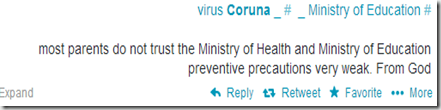
image


Although the Ministry of Education has repeatedly assured that the schools are `free of corona’, many parents have apparently kept their children out of class the past couple of days. This morning, the following announcement authorizing individual schools to decide when, or if, to curtail public gatherings and assemblies is getting a lot of play of twitter.


"Education": for school administrators the power to cancel the morning assembly to prevent the spread of "Corona"

News 24 04/14/2014

Awarded the Ministry of Education, school principals the power to cancel all forms of student groups within schools, so as to avoid the crowds as one of the factors of the spread of the virus, "Corona."

The official spokesman of the ministry, Usaimi Mubarak, according to the "Okaz", that these powers include the queue until the morning and collective activities quarterly.

For its part, said director of one of the girls' schools in Jeddah, said that in connection with the instruction and the reduction of the crowds and gatherings, indicating that they stopped the queue morning as a precautionary measure, and that the students were given sufficient guidance about the disease and its transmission and how to prevent it.

In the same context, said a number of parents of the students, they involuntarily daughters from school out of fear of injury, while others felt it is better to suspend the study until they are safely skip this stage.

The message appearing across the Arabic press this morning from the Saudi MOH seeks to assure that the virus is not easily passed from one person to the next.


Rabigh newspaper - rebounds:

Undersecretary of the Ministry of Health Assistant for preventive health, Dr Abdullah al-Asiri, the Scientific Committee of Infectious Diseases confirmed that the virus "Corona" does not move easily between humans, but does not move as associating directly with pneumonic.

He denied Dr. Asiri that there is a relationship between the change in the atmosphere in the Kingdom and to increase the number of HIV infection, indicating that it did not close any hospital in Jeddah due to a virus Corona, but there has been a focal point for directing some cases to other hospitals to give the opportunity to clean-up operations overall emergency teams in Hospital King Fahd.

He pointed out that the development of a vaccine for the virus, "Corona" is difficult in terms of technology, despite ongoing attempts in this regard, so the current efforts are focused on prevention and assessment of therapeutic approaches available, while continuing research to develop a vaccine for humans and animals.

Meanwhile, in the UAE where on Friday the Ministry Of Interior Announced 6 MERS-CoV Cases (1 Fatality), their MOH is doing all that it can to downplay the situation.  This from Al Bayan news.


Corona virus is not a concern
Source: Abu Dhabi - Lubna Anwar, WAM

Date: April 14, 2014

The Ministry of Health to the World Health Organization confirmed that the virus, corona virus that causes AIDS Middle East respiratory, not a concern for public health at the moment, and it does not require any action to ban travel to any country in the world, and does not require tests early in the ports of entry, and do not impose any restrictions on trade.

For its part, assured the Health Authority Abu Dhabi audience of citizens and residents in the Emirate of Abu Dhabi on the general situation of the disease. The Commission called on everyone to exercise their daily lives as normal, and not to pay attention to rumors or passed on, and return to reliable official sources for information on the disease.

She stressed that the current situation is not a cause for concern, and that the Commission, in coordination with the Ministry of Health and health authorities and stakeholders in the state, has taken the precautionary measures necessary necessary, in accordance with the recommendations of the scientific and conditions and criteria adopted by the World Health Organization, including the testing necessary for all close contacts of the patients, according to global recommendations in this regard approaches available, while continuing research to develop a vaccine for humans and animals.

( Continue . . . )


While these and other official statements continue to get wide replay across twitter and the Arabic press, they continue to be met with considerable skepticism.


Overreaching assurances, such as the one issued above by the UAE, often have the opposite effect on the public, who would much rather have a realistic appraisal of the risks.


A risk communications lesson that needs to be taken to heart if governments hope to remain relevant and credible in this age of global twitter communications and online media.


Friday, November 08, 2013

WHO/UNICEF: Polio Vaccination Response For Syria & Neighboring Countries


Photo Credit WHO


# 7951


The recent resurgence of Polio in the Middle East (see WHO: Confirmation Of Polio In Syria & WHO: WPV1 (Polio) Risks In Israel Remain Moderate to High)  has prompted the World Health Organization and UNICEF to announce a monumental polio vaccination drive to be held in Syria and neighboring countries.   The plan is to immunize 20 million children.


image

The announcement was made simultaneously via the @WHO twitter account (see above), and an emailed statement (see  below).


Over 20 million children to be vaccinated in Syria and neighbouring countries against polio, say WHO and UNICEF

A week after the Middle East declared a polio emergency in the region, mass vaccination against polio and other vaccine-preventable diseases is under way in Syria, its neighbouring countries and beyond

Geneva, New York, 8 November – The largest-ever consolidated immunization response in the Middle East is under way to stop a polio outbreak, aiming to vaccinate over 20 million children in seven countries and territories repeatedly.

Emergency immunization campaigns in and around Syria to prevent transmission of polio and other preventable diseases have vaccinated more than 650,000 children in Syria, including 116,000 in the highly-contested north-east Deir-ez-Zor province where the polio outbreak was confirmed a week ago.
In a region that had not seen polio for nearly a decade, in the last 12 months poliovirus has been detected in sewage samples from Egypt, Israel, the West Bank and Gaza Strip. The outbreak of paralytic polio among children in Syria has catalysed the current mass response. The first polio outbreak in the country since 1999, it has so far left 10 children paralyzed, and poses a risk of paralysis to hundreds of thousands of children across the region. Preliminary evidence indicates that the poliovirus is of Pakistani origin and is similar to the strain detected in Egypt, Israel, the West Bank and Gaza Strip.

Dr. Ala Alwan, the World Health Organization Regional Director for the Eastern Mediterranean noted, “The Middle East has shown exactly the coordinated leadership needed to combat a deadline virus: a consolidated and sustained assault on a vaccine-preventable disease and an extraordinary commitment to a common purpose.”

UNICEF has procured 1.35 billion doses of oral polio vaccine (OPV) to date in 2013 and by the end of the year will have procured up to 1.7 billion doses to meet increased demand. Global supply of OPV was already under constraint with vaccine manufacturers producing at full capacity. The new outbreak in Syria is adding further pressure to the supply but WHO, UNICEF and manufacturers are working to secure sufficient quantities to reach all children.

"The polio outbreak in Syria is not just a tragedy for children; it is an urgent alarm -- and a crucial opportunity to reach all under-immunized children wherever they are,” said Peter Crowley, UNICEF’s Chief of Polio. “This should serve as a stark reminder to countries and communities that polio anywhere is a threat to children everywhere.”

The unprecedented response to polio virus circulation in the region includes plans for a six-month sustained effort of intense immunization activity. Equally important is heightened disease surveillance until the global eradication of polio, to find cases which may have been missed in an environment which was until recently polio-free.

Multiple mass immunization efforts are aimed at protecting as many children as possible. Inside Syria, the campaign is targeting 1.6 million children with vaccines against polio, measles, mumps and rubella. In Jordan over 18,800 children under the age of five were vaccinated against polio in a campaign in the past few days targeting all children at Za’atari camp and a nationwide campaign is currently underway to reach 3.5 million people with polio, measles and rubella. In Iraq, a vaccination campaign has started in the west of the country, with another campaign planned in the Kurdistan Region in the coming days. Lebanon’s nationwide campaign begins later this week and Turkey and Egypt by mid-November.

Syria’s immunization rates have plummeted from more than 90% before the conflict to currently 68%.


NOTES for the Editor:

The seven countries and territories in the consolidated emergency response to the polio outbreak are: Egypt, Iraq, Jordan, Lebanon, the West Bank and Gaza, Syria, Turkey.


The polio virus usually infects children in unsanitary conditions through faecal-oral transmission associated with close person to person contact and consumption of food and drink contaminated with faeces. It attacks the nerves and can kill or paralyse, spreading widely and unnoticed before it starts crippling children. For every one case of polio, 200 children can be infected. There is no cure for polio – it can only be prevented through immunization.


Since 1988, vaccination has reduced polio by more than 99% worldwide, and the disease is slated for complete eradication.

Contacts:
Geneva: Marixie Mercado, UNICEF, +41 79 756 7703; Sona Bari, WHO, +41 79 475 5511; Oliver Rosenbauer, WHO, +41 79 500 6536
New York: Sarah Crowe, UNICEF, +1 646 209 1590.

Tuesday, November 05, 2013

WHO: Stepped Up Polio Immunizations For Travelers To And From Infected Areas

Photo Credit WHO

#7937


The recent resurgence of Polio in the Middle East (see WHO: Confirmation Of Polio In Syria & WHO: WPV1 (Polio) Risks In Israel Remain Moderate to High)  and in Africa (see WHO: Polio Outbreak In Horn Of Africa), along with the continued threat of infection in the three remaining polio-endemic nations (Afghanistan, Nigeria and Pakistan), has highlighted the fragility of the global polio-eradication efforts.


Between civil war in Syria, a war in Afghanistan,  attacks on polio workers in Pakistan, and a deep seated distrust of vaccines in Nigeria, the hoped-for final elimination of this scourge remains elusive.


Today the World Health Organization announced stepped up efforts to prevent the further spread of this disease, by boosting vaccination of travelers. 


Un- or under-immunized travellers from polio-infected areas to receive polio vaccine boost

05-11-2013

The current poliomyelitis (polio) outbreak in the Syrian Arab Republic and remaining polio-endemic countries (Afghanistan, Nigeria and Pakistan), as well as frequent population movements and vaccination gaps in some European countries, increases the risk of the international spread of wild poliovirus. As long as the virus is circulating in the world and vaccination coverage is not optimal, polio threatens to return to the WHO European Region.

Large-scale immunization campaign in the Syrian Arab Republic

In response to the outbreak, the Syrian Arab Republic has launched large-scale supplementary immunization activities to vaccinate more than 1.3 million children against polio (and measles, mumps and rubella) in both government-controlled and contested areas. Further campaigns will be needed to interrupt transmission in infected areas during the next 6 months. Neighbouring countries, including Turkey, have begun planning and implementing supplementary immunization campaigns as part of a multicountry response to prevent the international spread of polio.

WHO’s travel and health advice for polio

WHO’s publication “International travel and health” recommends that all travellers to and from polio-infected areas be fully vaccinated against polio. Countries receiving travellers from polio-infected areas or accommodating people displaced by the Syrian Arab Republic’s conflict should identify anyone who is un- or under-immunized, or with unknown immunization status, and provide him/her with missing doses of polio vaccine according to the national schedule of the country of origin. High immunization coverage against polio across age groups and high-quality surveillance – i.e. acute flaccid paralysis (AFP), environmental or enterovirus (the group of viruses including the poliovirus) surveillance – are essential factors for early alert and all-population protection against polio.

As to resident populations, any vaccination gaps for polio should be checked and all missing vaccine doses provided. Only ensuring that every local community has high vaccination coverage can avert the risk of wide polio spread in case the virus is imported.

Annual review of polio status in the WHO European Region

The European Regional Commission for the Certification of Poliomyelitis Eradication, an independent panel of international public health experts, conducts annual reviews of the risk of local transmission and potential outbreak following importation of poliovirus in countries in the WHO European Region. The evaluation is based on the level of population immunity and ability to detect poliovirus, as well as other factors that indicate the capacity to detect and respond to importation in a timely manner. Releasing its latest report in May 2013, the Commission called for significantly greater efforts in the Region to maintain its polio-free status (declared in 2002) until global polio eradication is achieved.

Tuesday, May 21, 2013

EMHJ: Coronavirus Supplement


 image

# 7303


I’m just starting to work my way though the articles (and there are a dozen of them), but the Eastern Mediterranean Health Journal (EMHJ) – the Periodical of the World Health Organization  Regional Office for the Eastern Mediterranean – has published a supplemental issue dedicated to the emergence of the novel coronavirus.


Included are articles by such well known public health players as Keiji Fukuda, Anthony Mounts (see yesterday’s interview), Dr. Ziad Memish et al, and Gregory Hartl (who includes a generous shout out to several flublogians on twitter).


Although events will undoubtedly overtake some of these articles, what I’ve read so far provides insight into the investigations ongoing in Saudi Arabia on this virus. 


Eastern Mediterranean Health Journal


Volume 19, supplement 1 (Coronavirus)

Editorial: Novel coronavirus infection: time to stay ahead of the curve

Ala Alwan, Jaouad Mahjourand Ziad, A. Memish


Perspective: Emergence of novel coronavirus: global context

Keiji Fukuda


Saudi Arabia and the emergence of a novel coronavirus

Z.A. Memish,R. Alhakeem and G.M. Stephens


Novel coronavirus infections in Jordan, April 2012: epidemiological findings from a retrospective investigation

B. Hijawi,M. AbdallatA. Sayaydeh,S. Alqasrawi,A. Haddadin,N. Jaarour,S. Alsheikh and T. Alsanouri


The early response to a novel coronavirus in the Middle East

A. Mounts,S. De La Rocque,J. Fitzner,E. Garcia, H.L. Thomas, D. Brown, H. Schuster, K. Vandemaele, H. Esmat, S. Eremin and A. Mafi


Novel coronavirus: the challenge of communicating about a virus which one knows little about

G. Härtl


Novel coronavirus infection in the Eastern Mediterranean Region: time to act

M.R. Malik,A.R. Mafi,J. Mahjour,M. Opoka, M. Elhakim and M.O. Muntasir


Infection prevention and control measures for acute respiratory infections in healthcare settings: an update

W.H. Seto, J.M. Conly, C.L. Pessoa-Silva, M. Malik and S. Eremin


Emerging respiratory and novel coronavirus 2012 infections and mass gatherings

J.A. Al-Tawfiq, C.A.H. Smallwood, K.G. Arbuthnott, M.S.K. Malik,M. Barbeschi and Z.A. Memish


Enhanced surveillance and investigation of coronavirus: what is required?

R.G. Pebody, A. Nicoll, U. Buchholz, M. Zambon and A. Mounts


Public health investigations required for protecting the population against novel coronaviruses

A. Nicoll


Highlights and conclusions from the technical consultative meeting on novel coronavirus infection, Cairo, Egypt, 14–16 January 2013

C. Joseph,M.R. Malik, A.W. Mounts, A. R. Mafi,S. Briand, Z.A. Memish and the technical working group for the meeting on novel coronavirus

Tuesday, May 18, 2010

Update On West Bank Bird Flu Outbreak


# 4575


On Friday (see Avian Flu Reported In Palestinian Authority) we heard reports of an H5N1 outbreak in the  West Bank town of Tul Karem.   Today, via IRIN we get a bit more detail on this story.


IRIN (Integrated Regional Information Networks) was founded in 1995, and is part of the UN Office for the Coordination of Humanitarian Affairs.


While technically a part of the UN, it maintains editorial independence, and its reports do not necessarily reflect the views of the United Nations and its agencies, not its member states.


In Brief: Avian flu outbreak prompts West Bank chicken cull


Photo:
Victoria Hazou/IRIN

Some 250,000 chickens have been culled

NETANYA, 17 May 2010 (IRIN) - Animal cases of avian flu in Bala village in the Tul Karem area of the West Bank, northeast of Tel Aviv, have been confirmed, and some 250,000 chickens culled, according to officials.


Bala is a major egg and poultry-producing area and part of its produce is smuggled into Israel due to higher prices there, according to Israeli Agriculture Ministry officials.


''We are always on the lookout for poultry and eggs smuggled into Israel from the Palestinian Authority [PA] but now we are tightening supervision at the PA-Israel crossings,“ the spokesperson’s unit at the Israeli Health Ministry told IRIN.


Israeli veterinary services assisted the PA by transferring the drugs needed for the culling, said Shalom Simchon, Israel’s minister of agriculture, and he called on international organizations to compensate Palestinian farmers for their huge losses. PA forces surrounded Bala to prevent smuggling of poultry during the culling.


Cases of avian flu were also confirmed in Kibbutz Ein Gedi in Israel, on the Dead Sea shore, on 7 May in a zoo; all birds were culled and the Israeli Agriculture Ministry is closely monitoring the area. Under international law, Israel is obliged to cease exports of poultry and poultry products for one month following the discovery of avian flu. Animal avian flu cases have been discovered three times in Israel since 2006. In all cases birds were culled and no human casualties reported.
td/at/cb

Friday, May 14, 2010

Avian Flu Reported In Palestinian Authority


# 4567


With the caveat that early reports are sometimes inaccurate or misleading, we’re seeing numerous reports coming out of TulKarm in the PA (Palestinian Authority) of an outbreak of bird flu.  


image 


At least two reports I’ve seen have referenced the hospitalization of several people, but details are scant, and without more data it is hard to know what to make of these reports.


FluTrackers has a thread were the latest reports are being translated and posted by their volunteer newshounds, and you can follow those reports here.


As you will see, we aren’t getting a lot of detail as yet on what is going on, and ProMed Mail issued an RFI (Request For Information) last night.


AVIAN INFLUENZA (28): PALESTINIAN AUTHORITY, WEST BANK, SUSPECTED, REQUEST FOR INFORMATION
*******************************************

Date: Thu 13 May 2010
Source:
The Marker [in Hebrew, trans. Mod.AS, edited]

Bird flu has appeared in the Palestinian Authority [PA]. Following the death of numerous chickens in Tulkarm, the PA sent several dead birds to the laboratories of the Veterinary Services at Beit Dagan.


The lab investigation revealed the deadly avian influenza.


Israel's] Ministry of Agriculture Inspection Unit for Fauna and Flora, which carries the responsibility for the control upon animal and plant movements, has intensified its control upon the border crossings, gateways and passages between the West Bank and Israel to prevent smuggling of infected poultry.


The Director of Israel's Veterinary Services, Dr Moshe Haimovich, has urged the public to buy poultry and eggs only in regulated stores/enterprises.


Last week, the highly pathogenic avian influenza was discovered in the small children's zoo of Kibbutz Ein Gedi, where all avians were destroyed by the inspectors of the Services to prevent the spread of the epidemic.

[Byline: Amiram Cohen ]


This next report references hospitalizations, and comes from PoultryMed’s infectious diseases reports (h/t  Dr. Nati Elkin, a poultry diseases specialist  and the author of the PoultryMed website who posted it on the FluTrackers thread)


Palestinian authority: H5N1 in poultry in Tul Karm

13 May, 2010

An outbreak of highly pathogenic avian influenza (HPAI) of the type H5N1 was found in poultry (broiler farm) in Tul Karm (Bal'a). Several people were also hospitalized.


The diagnosis was made by the Israeli Veterinary Institute. At the beginning of the week, several chicken farms in the village of Bal'a were quarantined due to a suspected outbreak of salmonella.


Last week, the highly pathogenic avian influenza was discovered in the small children's zoo of Kibbutz Ein Gedi, where all avians were destroyed by the inspectors of the Israeli Services to prevent the spread of the epidemic.


While the strain of avian flu is not specified, the inference here is that this is H5N1. Coming on the heels of a verified outbreak of H5 in neighboring Israel a week ago, this outbreak bears watching.