Showing posts with label H5N1. Show all posts

Tuesday, May 19, 2015

WHO: H5N1 Update & Risk Assessment

 image


# 10,065


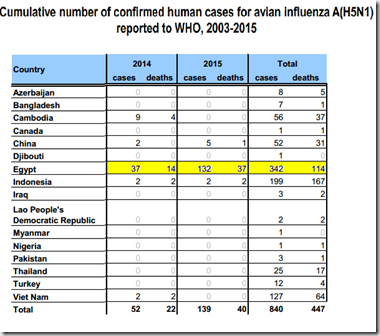
The World Health Organization has posted their latest Influenza at the Human-Animal Interface, monthly risk assessment summary – current through May 1st – which adds 13 additional H5N1 cases from Egypt during the month of April, and 1 from China.
 

image


Influenza at the human-animal interface


Summary and assessment as of 1 May 2015


Human infection with avian influenza A(H5) viruses

From 2003 through 1 May 2015, 840 laboratory-confirmed human cases of avian influenza A(H5N1) virus infection have been officially reported to WHO from 16 countries. Of these cases, 447 have died. 1 Since the last WHO Influenza update on 31 March 2015, 14 new laboratory-confirmed human cases of avian influenza A(H5N1) virus infection, including one fatal case, were reported to WHO from Egypt (13) and China (one).


Of the 13 human cases of influenza A(H5N1) virus infection reported from Egypt, nine had onset of disease in March and the rest had onset of disease in April. The cases were reported from eight different governorates of Egypt (see table 1 in the annex). The age range of the 13 cases is from three to 58 years, with a median of 31 years and 23% of the cases are under 10 years of age. Slightly more females than males were affected. Only one fatal case was reported and the rest have recovered and been discharged from hospital. All cases had exposure to poultry or poultry, all cases were hospitalized and all reportedly received treatment with antiviral medication.


Although all influenza viruses evolve over time, preliminary laboratory investigation has not detected major genetic changes in the limited number of viruses isolated from the patients and animals in Egypt compared to previously circulating isolates thus far, but further in depth analysis is ongoing.


Compared to the previous five months, there has been a decrease in the number of laboratory confirmed human cases of avian influenza A(H5N1) virus infection reported by Egypt since the last risk assessment. The decrease in the number of human cases over the past month is presently unclear. It is likely attributed to a mixture of factors, including fewer outbreaks in poultry, heightened public health awareness of risks and seasonal factors. The proportion of fatal cases has been consistently lower in Egypt than in other countries, especially in children.


China reported one human case of infection with an avian influenza A(H5N1) virus from Yunnan province, where two cases were detected last month. The case has recovered from his illness and was not reported to have had known exposure to poultry before illness.


Various influenza A(H5) subtypes, such as influenza A(H5N1), A(H5N2), A(H5N3), A(H5N6) and A(H5N8), have recently been detected in birds in west Africa, Asia, Europe, and North America, according to reports received by OIE. Although these influenza A(H5) viruses might have the potential to cause disease in humans, so far with the exception of human infections with influenza A(H5N1) and A(H5N6) viruses, no other subtypes of A(H5) virus infection in humans has been reported.


Overall public health risk assessment for avian influenza A(H5) viruses: The human cases reported appear to be sporadic and the virus is known to be endemic in poultry in these countries. Whenever avian influenza viruses are circulating in poultry, sporadic infections and small clusters of human cases are possible in people exposed to infected poultry or contaminated environments. Therefore additional human cases would not be unexpected.

Although an increased number of animal-to-human infections have been reported by Egypt over the past few months, these influenza A(H5) viruses do not currently appear to transmit easily among people. As such, the risk of community-level spread of these viruses remains to be low and the risk assessment remains unchanged.


Further studies are needed to understand the risk factors for human infections and the potential role of mild cases if they are occurring. More analyses on the viruses from both animals and humans need to be undertaken to better understand if any subtle changes in the transmissibility of the virus from animals to humans may be playing a role in the current situation.


A statement on the joint high-level mission to Egypt in March 2015, as well as the executive summary of the mission report, can be found at this link:


http://www.emro.who.int/egy/egypt-news/upsurge-h5n1-human-poultry-cases-may-2015.html


With the rapid spread and magnitude of avian influenza A(H5) outbreaks, notably in areas that had not experienced this disease in animals until recently, there is an increasing need for vigilance in the public health sector. Surveillance should be enhanced to detect, at the earliest stage, human infections if they occur and changes in viruses of transmissibility and pathogenicity that could have significant public health implications.

(Continue . . . )

Friday, May 15, 2015

WHO Statement On Joint H5N1 Mission To Egypt

image


# 10,054


We’ve been following an unprecedented surge in human H5N1 infection in Egypt since late last fall, and while the Egyptian MOH has been less than forthcoming in their public statements regarding the outbreak, between the WHO, the FAO, and the efforts of independent news gatherers like FluTrackers’ Egypt - 2015 WHO/MoH/Provincial Health Depts H5N1 Confirmed Case List we’ve managed to keep reasonable track of its progress.


Two months ago  World Health Organization, along with the  FAO, OIE,  NAMRU-3, CDC & UNICEF were invited to Egypt as a joint mission to investigate and to make recommendations on containing that outbreak.   We’ve been expecting a report on what they found for some time.


As I mentioned earlier this week, a summary report was briefly posted on the WHO EMRO  website on May 3rd, but was taken down almost immediately without explanation. 


Today the WHO has posted a similar - but more abbreviated - summary of their findings along with a link to an executive summary.  Changes from the May 3rd release include updated case counts to the end of April (165 cases, 48 deaths), and the removal of a section with specific recommendations for addressing the crisis, which are now to be found in the executive summary.


Egypt: upsurge in H5N1 human and poultry cases but no change in transmission pattern of infection


15 May 2015 – The recent increase in the number of people affected by the avian influenza virus H5N1 in Egypt is not related to virus mutations but rather to more people becoming exposed to infected poultry, according to a recent mission of six organizations assessing the H5N1 situation in the country.

Since November 2014 to 30 April 2015, the period analysed by the international mission, a total of  165 cases, including 48 deaths were reported. This is by far the highest number of human cases ever reported by a country over a similar period. There are indications that H5N1 is circulating in all sectors of poultry production and in all parts of Egypt.

The mission stressed that the way the influenza H5N1 virus is transmitted in Egypt appears to have remained stable despite the recent upsurge in numbers of human and poultry infections. While the risk for the current situation to escalate into an H5N1 pandemic does not appear to have been changed appreciably, the situation remains a cause for considerable concern.

“Based on all the evidence we have, we believe the upsurge is not explained by changes in the virus itself,” said Dr Keiji Fukuda, WHO Assistant Director-General for Health Security and head of the H5N1 investigation team in Egypt. “The most likely reason for the increase in cases is that more poultry in Egypt are infected by H5N1 and so more people are exposed to this virus. Coupled with insufficient awareness, behavioural patterns and inadequate precautions taken by humans when interacting with poultry this explains what we are seeing.”

For successful reduction of the negative impact on human health and associated economic and food security consequences, it will be essential to strengthen animal and human disease surveillance, biosecurity and disease control programmes, in a context of a strengthened and close collaboration between human health and animal health departments. This includes appropriate animal vaccination programmes through joint efforts by the public and private sector in charge of animal health.

The report found that: 

  • although  human-to-human transmission cannot be excluded, the key epidemiological and demographic features of the recent human cases did not significantly change compared to those reported before the recent increase;  
  • there was no evidence for transmission from patients to health care workers during the upsurge; 
  • the vast majority of recent human cases – approximately 70% – had known exposure to infected backyard poultry; 
  • analysis of the genetic sequence data did not identify changes suggesting more efficient human-to-human transmission.

Although some of the apparent upsurge in cases might be a result of increased testing for H5N1 in humans, this cannot explain the whole picture. The upsurge of infections in poultry and the cases in people has likely been caused by changes in the economy and the poultry industry.

Many small farmers have turned to raising poultry for food and income in an unmonitored and uncontrolled farming sector. The implementation of a proper veterinary control strategy will require strengthening the response capacity, public–private partnerships, vaccination strategies and biosecurity in most poultry production sectors. Ensuring compliance with intergovernmental standards on animal health and regulatory statutes at national level, both in poultry production enterprises or households will be critical for limiting the spread of the H5N1 virus.

The report also notes that Egypt has already recognized the key features leading to the increase in disease, and has recently proposed important structures, sound policies and strategies. However, for them to be effective will require better implementation and concerted commitments at national, governorate and local level. The report recommended that Egypt should make long-term investments in agriculture, veterinary services, health and rural communities to combat H5N1. Policies should be developed to engage the large number of unlicensed commercial and semi-commercial poultry farms in developing new means of implementing and assuring effective disease prevention and control.


 image

The 7-page executive summary, warns:

` . . .  the presence of H5N1 viruses in Egypt with the ability to jump more readily from birds to humans than viruses in other enzootic countries is of concern and requires a high level of vigilance from the Ministries of Health and Agriculture.’


After reviewing their findings, and listing their recommendations, the report concludes:


The way forward

A successful approach to addressing H5N1 requires long-term, sustainable investments in agriculture, health and communities. In particular, close collaboration between sectors is required in communications, policy development, surveillance and response, and the production and sharing of information. Accurate, regular assessment of the impact of control measures is required to evaluate progress.


The government should undertake one or more pilot projects at the district level to determine which changes in policies and practices are most effective in reducing spread of infection among poultry and to humans and sustainable on a medium- to long-term basis. Addressing H5N1 nationally will require long-term changes in policies, practices, culture, awareness and community engagement.

Within three months, a two-year action plan that encompasses these recommendations and includes clear outcomes and indicators for monitoring will be developed by the ministries of health, agriculture and local development. FAO, WHO and OIE will support development of the plan, which will be presented to the NSC.


Hopefully we’ll soon see another Influenza at the Human-Animal Interface report from the WHO updating us on the progress and the epidemiology of this outbreak.

Wednesday, May 13, 2015

Voice Of Iraq: H5N1 Reported in Sulaimaniya Poultry

image

Sulaymaniyah Governorate  - Credit Wikipedia


# 10,047


Via the Voice of Iraq, we get a report indicating that H5N1 has been detected in `a number of poultry farms’  in Sulaymaniyah, a province in Iraqi Kurdistan along the Iranian border.  Assuming this is confirmed by the OIE, this would be the first time Iraq has reported H5N1 since the summer of 2006.


The use of the word `injuries’ below likely refers to poultry, not humans.  Machine translations such as these often produce syntax-challenged results.


Kurdistan cultivation announces registration of bird flu infections in Sulaimaniya


Wed May 13 2015 5:46 p.m. | (Voice of Iraq) - Erbil, announced the Ministry of Agriculture of the Kurdistan region, on Wednesday, for the registration of some infections of bird flu in the province of Sulaymaniyah, and while confirming that the situation is under control, stressed the importance of cooperation between government agencies and citizens. said Minister farming region Abdul Sattar Majid at a press conference, today, in Erbil that "after conducting tests on a number of poultry farms in Bermkron area in the Sulaymaniyah turns out the presence of injuries Pfyrus H5N1 (bird flu)," noting that "it was to inform the Council of Ministers is aware of this Injuries. "

Majid explained that "has been the formation of a higher committee of the Ministry of Agriculture, Interior and Health and municipalities in order to limit and control the injuries," asserting that "the injuries recorded in three villages only and under control." He pointed out that "these injuries and serious need to educate citizens." , while stressing "the importance of cooperation between citizens and government agencies concerned." And that "the Supreme Committee decided to form committees at the provincial level to control and limit injuries if they arise," calling on the media to "deal with the issue realistically and objectively and not spreading fear among citizens . "

The World Health Organization defines as the bird flu virus contagious disease of birds (especially water birds such as wild ducks and geese) does not cause, in most cases, in the emergence of any satisfactory marks. And flu viruses can sometimes go to the poultry and cause outbreaks and tent on a large scale. Reports also indicate that some of these viruses were able to penetrate the species barrier and cause diseases or infections is accompanied by clinical symptoms in humans or other mammals. The suffering of the United States of America is currently the spread of the disease, has invaded 16 states until the moment of writing this report. Reports said that the number of HIV-infected poultry in the United States amounted to about 32 million, which has been eliminated and the other waiting for the same fate.


Over the past 6 months – in addition to the huge territorial gains racked up by HPAI H5N8 and H5N2 – we’ve seen a huge resurgence in H5N1 activity around the world as well.  


Not only has Egypt reported the largest, and longest, outbreak of H5N1 in humans - countries that have not reported the virus in years (i.e. Nigeria, Burkina Faso, Turkey, Russia, Bulgaria, Romania, Hungary, etc.) have reported outbreaks either in poultry, or wild birds.


Why HPAI H5 viruses have suddenly taken flight over the winter of 2014-15 isn’t clear, but we’ve not seen this level of bird flu activity since the great H5N1 diaspora of 2005-2006 (see H5N8: A Case Of Deja Flu?).   As summer is historically the `off season’ for avian flu viruses, one can’t help but wonder what kind of fall lies ahead.


Meanwhile, there are media reports of additional `suspected’ cases of H5N1 in Turkey as well today.

Tuesday, May 12, 2015

Egypt’s H5N1 Outbreak: No News is . . . ?

image

Credit EMRO 


# 10,038


We are coming up on six weeks since the last World Health Organization update on Egypt (see WHO H5N1 Update For Egypt – Thru March 31st), more than 3 weeks since the last FAO interim report (see FAO Reports 6 More Egyptian H5N1 Cases), and Egypt’s MOH site has provided little information now for more than 3 months.


Although the Egyptian press remains filled with with avian flu stories – they are, ironically, all focused on America’s bird outbreak – not their own.  


Doing her best to keep track of all of this is Sharon Sanders at FluTrackers, who curates their Egypt - 2015 WHO/MoH/Provincial Health Depts H5N1 Confirmed Case List. Based on the information currently available, Sharon conservatively shows 143 cases in Egypt since the 1st of January.  But that number is roughly 3 weeks old.


How many cases there really are – and how many have been recorded (but not yet publicly acknowledged) over the past 6 weeks – well, that’s anyone’s guess.  


In Mid-March a joint mission of the WHO, FAO, NAMRU, CDC, and others were invited to Egypt to observe the situation on the ground and make recommendations. A report was produced and provided to the Egyptian government, but I haven’t found it published anywhere.  


A summary report was briefly posted on the EMRO website on May 3rd, but was removed without explanation within hours.  Why?  I have no idea.  


With warmer temperatures now well entrenched across the Middle East, it is possible the number of human infections has dropped appreciably over the past 6 weeks and the outbreak is on the wane. We normally expect to see fewer outbreaks in poultry, and human infections, during the summer months. 


But without timely and credible reporting from the Egyptian MOH, that’s an assumption that is difficult to make.


I fully expect we’ll see an update from the FAO or the WHO in the coming days, and that should give us some kind of clue as to how the H5N1 outbreak is trending in Egypt.  Assuming, of course, the Egyptian MOH is being completely forthright with their reporting to these international agencies.


It is a worrisome trend – one we’re seeing both in China with H7N9 and Egypt with H5N1 (and no doubt, other nations as well) – where nations strategically `manage’ the release of disease outbreak information, likely for political, societal, or economic reasons.  


As we discussed in The New Normal: The Age Of Emerging Disease Threats, the reality of life in this second decade of the 21st century is that disease threats that once were local, can now spread globally in a matter of hours or days.  Vast oceans, and extended travel times no longer offer the protections they once did.


A disease threat anywhere can quickly become a health threat everywhere.  


Making the full and timely disclosure of infectious disease outbreak information a global responsibility for every nation. 

Monday, May 04, 2015

OIE: H5N1 Confirmed In Kastamonu Province, Turkey

image


# 10,007


On Sunday, in Media Reports: Bird Flu (H5N1?) In Turkish Poultry, we saw reports (later confirmed by the FAO) of an unidentified HPAI outbreak in the Bandırma district of the province of Balıkesir (bullseye on the map above).  While HPAI is strongly suspsected, we’ve not seen an official lab report as yet.

Today, however, the OIE has confirmed an outbreak of HPAI H5N1 in a small backyard flock in Kastamonu Province several hundred kilometers further east.


We’ve recently seen HPAI H5N1 showing up in countries in Eastern Europe, including Russia, Bulgaria, and Hungary after an absence of several years.   This becomes Turkey’s first official H5N1 outbreak since 2008.


image

image


Source of the outbreak(s) or origin of infection

  • Unknown or inconclusive

Epidemiological comments
Highly pathogenic avian influenza H5N1 was detected as a result of analysis. Protection and surveillance zones have been established in the area surrounding the outbreak. 92 backyard poultry were destroyed in a 3 km radius area. All holdings containing backyard poultry were cleaned and disinfected after destruction process. Monitoring activities continue in the 10 km radius surveillance zone surrounding the 3 km radius protection zone
.


For reasons that are not entirely clear, H5N1 is on the move again in 2015 after several years of relative quiescence.  It has been reported in at number of countries that have not seen it in five years or longer (Nigeria, Niger, Burkina Faso, Bulgaria, Hungary, Romania, Russia, Turkey) and it continues to cause the largest, and most sustained, human outbreak of the virus we’ve seen to date in Egypt.

Sunday, May 03, 2015

Media Reports: Bird Flu (H5N1?) In Turkish Poultry

image


UPDATE: 05/04  0500hrs EDT:  The FAO has posted a notice of this outbreak, albeit with very few details and no ID on the subtype.


image


# 10,002


It has been seven years since Turkey last reported HPAI H5N1 to the OIE (see Immediate notification), but Turkish officials well remember the impact the virus had in the years between 2006 and 2008, when roughly 200 outbreaks were recorded, along with a dozen human infections and four deaths.


When H5N1 began its big expansion out of Southeast Asia in 2005-06, Turkey was one of dozens of countries suddenly thrust into the battle against bird flu, and the quarantining towns has often been part of their playbook (see  2007 Turkey: Three Villages Quarantined?  & Turkey : 4 More Villages Quarantined,  & 2008 Turkey Quarantines Three Villages).


A pattern which should make today’s headlines and story a bit less urgent sounding that it might at first appear.  It should also be noted that according to these reports, poultry deaths have been ongoing in this town for several months.


In any event, overnight the Turkish language press has been carrying numerous reports of bird flu (`kuÅŸ gribi’ for those who would like to do a Google search) – presumably H5N1 -  having been detected in the Banda District of Balikesir, Turkey. 


I’ve not found any official statement,  but this being a weekend, that isn’t terribly surprising.  Hopefully we’ll get an official notification from the OIE or the FAO in the next day or two.


A few links below, followed by an English Language report from the Today’s Zaman.


He Quarter Bird Flu Quarantine of Receipt  ...

BALIKESİR ' BIRD FLU QUARANTINE POULTRY BAN '  

Bird flu quarantine began 


Turkish town put under quarantine after bird flu outbreak

May 03, 2015, Sunday/ 14:25:59/ TODAYSZAMAN.COM / ISTANBUL

A town in the bandırma district of the province of Balıkesir has been put under quarantine after officials confirmed the existence of bird flu in chickens there. Access to the neighborhood has been restricted to official vehicles only.

According to the Doğan news agency, the Bandırma Directorate of Food, Agriculture and Livestock launched an investigation in Bandırma's Edincik neighborhood over the death of around 40,000 chickens in four months. Samples from the chickens were sent to the Ministry of Food, Agriculture and Livestock's laboratory in İstanbul's Pendik district, where tests found that the mass deaths of the chickens was due to bird flu.

In a statement regarding the issue on Saturday, district governor Ali Mantı said security measures have been increased at the farms where the deaths took place and that chickens there were euthanized.

“Entering and leaving the region has been prohibited except for official vehicles. The samples were sent to the laboratory in Pendik. According to the tests, bird flu was detected. All protection measures have been taken in the farms where bird flu was detected,” Mantı said, adding cleaning was also done after chickens were culled and destroyed.

(Continue . . . )


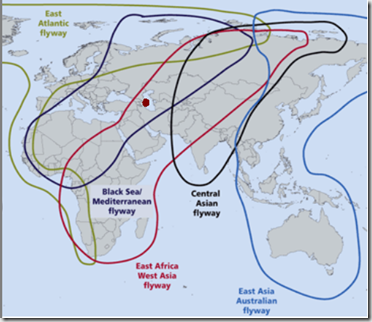
Given the multiple reports of H5N1 being detected in migratory birds and occasionally poultry  in Eastern Europe (see OIE: H5N1 Kills 21 Pelicans In Bulgaria & Russia Reports H5N1 In Migratory Birds) – all sharing the same Black Sea / Mediterranean Migratory Flyway – it wouldn’t be terribly surprising for find Turkey added to the list.


image

Major Global Migratory Flyways – Credit FAO


Since last fall we’ve seen HPAI H5 virus on the move around the world, with H5N8 making it to North America and Europe, and H5N1 showing up in countries that haven't reported outbreaks since 2006-2007. 


Although the emergence of several new (H5N8, H5N2) HPAI viruses - more easily carried by wild and migratory birds -  are undoubtedly part of the reason behind this increased activity, for reasons that are less clear, H5N1 is on the move again as well.


For more on the spread of avian viruses across long distances by migratory birds, you may wish to revisit:


Erasmus Study On Role Of Migratory Birds In Spread Of Avian Flu

PNAS: H5N1 Propagation Via Migratory Birds

EID Journal: A Proposed Strategy For Wild Bird Avian Influenza Surveillance

PLoS One: North Atlantic Flyways Provide Opportunities For Spread Of Avian Influenza Viruses

Monday, April 27, 2015

Russia Reports H5N1 In Migratory Birds

image

Location Of Astrakhan Oblast in Global Flyway


# 9980


While North America has taken center stage in Avian flu reporting these past few weeks we know that various strains of these viruses continue to spread around the globe.  Egypt continues to deal with an unprecedented outbreak of H5N1 – in both humans and in poultry – and reports continue to filter out of South Korea and Taiwan on their battles against the H5N8 virus and its reassortants.


In recent weeks we’ve seen Niger and Burkina Faso battling the H5N1 virus, while Vietnam and China continue to deal with outbreaks of H5N1 and and H5N6.


And earlier this year we saw multiple reports of H5N1 in migratory birds  in Eastern Europe (see OIE: H5N1 Kills 21 Pelicans In Bulgaria), which is part of the Black Sea / Mediterranean Flyway. 


With summer on the way, birds that were wintering in Southern Europe or Africa are now headed north to their summer breeding grounds, and so it is not terribly surprising that we are beginning to see reports of H5N1 in migratory birds along that route.


First a translated media report (one of many on the news wires overnight), followed by the official statement from Russia’s Rosselkhoznadzor (Federal Service for Veterinary and Phytosanitary Surveillance), which carried a small item yesterday announcing the detection of the H5N1 avian virus.


Curiously, neither report indicates when these samples were taken.  First this, from Rio Novosti.


The bird flu virus was recorded in the Astrakhan region

08:35 27.04.2015551

Also, the agency added that the study isolates showed that they belong to the Asian genetic lineage HPAI virus and proximity to isolates of influenza A virus subtype H5N1 bird isolated in the Altai region in 2014, as well as subtypes of the same virus isolated in Vietnam and China in 2012-2014.

MOSCOW, April 27 - RIA Novosti / Prime. Rosselkhoznadzor revealed genome of influenza A virus subtype H5N1 bird in the territory Ikryaninskiy region Astrakhan region, said the Russian authorities.

"Subordinate to the Rosselkhoznadzor Federal Centre for Animal Health in research within the federal epizootic monitoring in samples of biological material selected from the Dalmatian pelicans in the territory Ikryaninskiy region Astrakhan region, identified the gene of influenza A virus subtype H5N1 bird" - said in a statement.

Also, the agency added that the study isolates showed that they belong to the Asian genetic lineage HPAI virus and proximity to isolates of influenza A virus subtype H5N1 bird isolated in the Altai region in 2014, as well as subtypes of the same virus isolated in Vietnam and China in 2012-2014.

Pathogenic avian influenza virus H5N1, which emerged in 2003-2005, is widely circulated among birds. It is dangerous to humans because people have no immunity to it.


  And this statement from he official Rosselkhoznadzor  website.


Clarification of Rosselkhoznadzor flu infected migratory birds in the Astrakhan region

April 26, 2015

Subordinated to the Rosselkhoznadzor Federal Centre for Animal Health in research within the federal epizootic monitoring in samples of biological material taken from the territory of curly pelicans Ikryaninskiy region Astrakhan region, identified the gene of influenza A virus subtype H5N1 bird. Research isolates showed that they belong to the Asian genetic lineage HPAI virus and proximity to isolates of influenza A virus subtype H5N1 bird isolated in the Altai region in 2014, as well as subtypes of the same virus isolated in Vietnam and China in 2012-2014 .


Although we don’t get a lot of reporting out of Russia, you may recall that late last year they announced the detection of H5N8  (see OIE Report: H5N8 Detected In Eastern Russia) in a Eurasian widgeon collected last October -  a full month before Europe reported their first H5N8 outbreak.


These past six months we’ve seen HPAI H5 virus on the move around the world, with H5N8 making it to North America and Europe, and H5N1 showing up in countries that haven't reported outbreaks since 2006-2007.


Although most migratory flyways are predominantly north-south corridors, their overlapping allows for a lateral (east-west) movement of avian viruses as well – often via shared nesting areas and ponds. As you can see, the Black Sea/Mediterranean Flyway shares territory with both the East Africa West Asia flyway, and the East Atlantic Flyway.


For more on how scientists are studying the spread of avian flu viruses via these flyways, you may wish to revisit:

Erasmus Study On Role Of Migratory Birds In Spread Of Avian Flu
PNAS: H5N1 Propagation Via Migratory Birds
EID Journal: A Proposed Strategy For Wild Bird Avian Influenza Surveillance
PLoS One: North Atlantic Flyways Provide Opportunities For Spread Of Avian Influenza Viruses

Monday, April 20, 2015

FAO Reports 6 More Egyptian H5N1 Cases

image


# 9960


While the Egyptian MOH has pretty much abandoned even mentioning H5N1 on their website, and the local media tries not to stray too far from the `official’ line, we continue to see evidence ongoing human infections, although the rate of new case reports seems to have slowed somewhat over the past few  weeks.


The thoroughness of surveillance, testing, and reporting are issues that plague all disease outbreaks, and so it is impossible to state with certainty just how many people have been – and continue to be – infected with the avian flu virus in Egypt.  


The last `official’ WHO H5N1 Update For Egypt – Thru March 31st listed 125 cases and 33 deaths, but since then we saw an update from the FAO (on 04/08) adding 7 additional cases.


Today the FAO has listed 6 more human cases on their RSS feed.  

  1. Confirmed Influenza - Avian in Behera, for human
  2. Confirmed Influenza - Avian in Behera, for human
  3. Confirmed Influenza - Avian in Behera, for human
  4. Confirmed Influenza - Avian in Damietta, for human
  5. Confirmed Influenza - Avian in Qena, for human
  6. Confirmed Influenza - Avian in Kafr El-Shikh, for human


Doing her best to keep track of all of this is Sharon Sanders at FluTrackers, who curates their Egypt - 2015 WHO/MoH/Provincial Health Depts H5N1 Confirmed Case List.  Based on the information currently available, Sharon conservatively shows 143 cases in Egypt since the 1st of January.


Three times more than Egypt has ever previously reported, and more than double the number that any country has ever reported in a single year.


The recent slowdown in case reports – if indeed, that is the case – would not be totally unexpected, as  avian flu transmission tends to decline as the weather warms. 


But the caveat here is - out of these last 6 cases  - 2 were observed in late March and the newest was observed on April 7th.  With reports running two, three, or even more weeks behind it is too soon to celebrate any decline in case reports.


Although we’ve not seen any evidence of increased or efficient human-to-human transmission of the H5N1 virus in Egypt, it is worrisome that this outbreak has now gone on for five full months, and nearly 180 people have been infected.


To put that into some kind of perspective, Egypt – with a population 1/16th that of China - has racked up nearly as many H5N1 human cases over the past 6 months (180) as has China with H7N9 (200).

Thursday, April 16, 2015

FAO: Bhutan Reports H5N1 In Domestic Birds

image


# 9946


Given the amount of H5N1 activity being reported by neighboring India (see H5N1 In Telangana Poultry and Watching India (Again) . . . .), and scattered reports coming out of China, it isn’t a terrible surprise to see a report emerging from the tiny country of Bhutan sandwiched between the two on the eastern edge of the Himalayas.


Bhutan first reported H5N1 in 2010 (see OIE Immediate notification), and while not frequently mentioned as Nepal to its west, has reported outbreaks in 2012 and 2013.


After a couple of years where the H5N1 virus has taken a backseat to H7N9, we are suddenly seeing it (and other HPAI H5 viruses) on the move once more. 


This from the FAO/EMPRES.


image

image

Tuesday, April 14, 2015

WHO H5N1 Risk Assessment (As of 3/31/15)

image


# 9935


Yesterday a (broken) link went up for the World Health Organization’s latest H5N1 summary, along with a new Cumulative number of confirmed human cases of avian influenza A(H5N1) chart.   This morning that link has been fixed, and we get a snapshot of the H5N1 situation – as reported by the Egyptian MOH to WHO – as of two weeks ago.


Before we jump into this report, a brief note regarding case totals:  They are all over the place.


Not only are the actual number of cases likely under reported in Egypt, various agencies have provided different tallies.  Last week, in WHO H5N1 Update For Egypt – Thru March 31st, we saw a report from the WHO’s EMRO division (see chart below) that listed 125 cases, and 33 deaths in Egypt as of the end of March.

image


But yesterday’s WHO cumulative Case chart thru March 31st listed 119 cases, and 30 deaths.

image


It is also worth noting that yesterday’s chart increased Egypt’s 2014 tally to 37 cases and 14 deaths, up from 31 cases and 10 deaths last reported on 3/03/15.   So I suspect that some cases previously listed occurring in 2015 cases – after reviewing their onset dates - have been shifted back into 2014.


The point being that the case data coming out of Egypt is constantly changing and subject to revision. 


Meaning  we should avoid putting too much emphasis on `exact numbers’ for any given cut off date (which are almost certainly wrong) , and look instead at the trends.   Which unfortunately continue to rise.

First some excerpts from the latest WHO Risk Assessment, after which I’ll return with a bit more.


         Summary and assessment as of 31 March 2015

Human infection with avian influenza A(H5) viruses

From 2003 through 31 March 2015, 826 laboratory-confirmed human cases of avian influenza A(H5N1) virus infection have been officially reported to WHO from 16 countries. Of these cases, 440 have died.


Since the last WHO Influenza update on 3 March 2015, 42 new laboratory-confirmed human cases of avian influenza A(H5N1) virus infection, including 11 fatal cases, were reported to WHO from Egypt (37), China (three) and Indonesia (two).


Of the 37 human cases of influenza A(H5N1) virus infection reported from Egypt, 14 had onset of disease in February and the rest had onset of disease in March. The cases were reported from 14 different governorates of Egypt (see table 1 in the annex). The age range of the 37 cases is from one to 77 years, with a median of 24 years and 38% of the cases are under 10 years of age. Almost twice as many females compared to males were affected. Eight of the 37 cases (22%) died and all eight fatal cases were in patients 10 years of age and older. All but one case had exposure to poultry or poultry markets and the exposure history of the one case is still under investigation. All cases were hospitalized and all reportedly received treatment with antiviral medication. Contacts of the cases were followed for 14 days and there have not been reports of cases in any contacts of confirmed cases. The newly-reported cases included one cluster of two confirmed cases in a mother and son from Sharkia governorate. The two cases had onset of illness on the same day and both had exposure to backyard poultry, suggesting common exposure.


Currently, there are reports of an increased number of outbreaks and detections of influenza A(H5N1) viruses in poultry in Egypt compared to previous months and compared to this month in previous years. Although all influenza viruses evolve over time, preliminary laboratory investigation has not detected major genetic changes in the limited number of viruses isolated from the patients and animals compared to previously circulating isolates thus far, but further in depth analysis is ongoing. A new candidate vaccine virus was proposed to better protect against the current circulating H5 clade 2.2.1. viruses (a group which all the recent influenza A( H5N1) virus isolates from Egypt belong to).

For the fourth consecutive month since December 2014, the number of laboratory-confirmed human cases of avian influenza A(H5N1) virus infection in Egypt with disease onsets in each month are the highest numbers reported by any country in a single month. The characteristics of the affected population remain essentially unchanged from previous years in Egypt, with females more commonly affected than males and about one third of the cases occurring in children under ten years of age. The proportion of fatal cases has been consistently lower in Egypt than in other countries, especially in children, although the case fatality rate could change as many cases remain hospitalized.


The increase in the number of human cases is likely attributed to a mixture of factors, including increased circulation of influenza A(H5N1) viruses in poultry, an increasing number of small poultry farms and household flocks, lower public health awareness of risks and seasonal factors such as closer proximity to poultry because of cold weather and possible longer survival of the viruses in the environment.


China reported three human cases of infection with an avian influenza A(H5N1) virus from two provinces. Two cases were reported to have had exposure to live poultry. One of the human cases was a fatal case while the other two cases were still under treatment at the time they were reported. Indonesia reported two fatal human cases of infection with an avian influenza A(H5N1) virus, in a father and a son from Banten province. The investigation surrounding these two cases indicates that they may have had indirect or direct contact with birds near their residence or in another district they visited prior to their onsets of illnesses. Both cases developed severe disease and were hospitalized but passed away. The last human case of infection with an avian influenza A(H5N1) virus in Indonesia was reported in June 2014.


Various influenza A(H5) subtypes, such as influenza A(H5N1), A(H5N2), A(H5N3), A(H5N6) and A(H5N8), have recently been detected in birds in Asia, Europe, and North America, according to reports received by OIE. Although these influenza A(H5) viruses might have the potential to cause disease in humans, so far no human cases of infection have been reported, with exception of the human infections with influenza A(H5N1) viruses and the three human infections with influenza A(H5N6) virus detected in China since 2014.

Overall public health risk assessment for avian influenza A(H5) viruses: The cases reported from these three countries appear to be sporadic cases and the virus is known to be circulating endemically in poultry in these countries. Whenever avian influenza viruses are circulating in poultry, sporadic infections and small clusters of human cases are possible in people exposed to infected poultry or contaminated environments, therefore the additional sporadic human cases would not be unexpected.


Although an increased number of animal-to-human infections have been reported by Egypt over the past few months, these influenza A(H5) viruses do not currently appear to transmit easily among people. As such, the risk of community-level spread of these viruses remains to be low. Although the risk assessment remains unchanged, further studies are needed to understand the risk factors for human infections and the potential role of mild cases if they are occurring. Further analyses on virus isolates from the animal sector and human cases need to be undertaken to better understand if changes in the transmissibility of the virus from animals to humans may be playing a role in the current situation.

(Continue . . . )


While we’ve not seen any evidence of increased or efficient human-to-human transmission of the H5N1 virus in Egypt, it is worrisome that this outbreak has now gone on for five full months, and that in excess of 160 people have been infected.


A couple of weeks ago, in Eurosurveillance: Emergence Of A Novel Cluster of H5N1 Clade 2.2.1.2, we looked at a study that found a new strain of H5N1 has emerged in Egypt and has rapidly become the predominant strain in poultry, and that suggested that genetic changes in this strain may be making it more easily transmitted from birds to humans.


Egypt has also reported heavy rates of poultry infections this winter – even among vaccinated flocks (see Egypt H5N1: Poultry Losses Climbing, Prices Up 25% - which calls into question the effectiveness of the vaccines currently being used.


Whether due to genetic changes to the virus, or simply due to a greater prevalence in Egyptian poultry, this year’s outbreak has reached historic, and unprecedented levels. Heightening concerns that the longer this goes on, the more opportunities the H5N1 virus will have to figure out how to thrive and prosper in a human host.

Media Report: H5N1 In Telangana Poultry

image

Credit Wikipeida


# 9934


Via the Times of India this morning, we’ve a report that H5N1 has been confirmed as the cause of numerous poultry deaths in Telangana, very near Hyderabad, and that 200,000 birds are to be culled.   First the report, then I’ll return with a bit more.


Telangana reports bird flu outbreak, culls poultry

Siddharth Tadepalli,TNN | Apr 14, 2015, 02.38 PM IST

HYDERABAD: The Telangana government sounded a red alert after the highly pathogenic H5N1 bird flu virus broke out in Ranga Reddy district about 20 kilometers from Hyderabad.


In wake of the outbreak, the government swung into action and initiated a process to cull about 2 lakh birds within a 10 kilometre radius and also ban sale of poultry and eggs in Hayathnagar, the main town in the district and issued an advisory to Andhra Pradesh as well.

<SNIP>

"Yes we confirm it as the deadly H5N1 virus and we have advised the animal husbandry department in Telangana and the government to take all appropriate measures," DD Kulkarni, joint director , High-Security Animal Disease Laboratory, Bhopal, told TOI from Bhopal.

(Continue . . . )


A month ago (see Watching India (Again) . . . .) we looked at reported H5N1 outbreaks in a town called Amethi in Uttar Pradesh, where poultry reportedly began dying en masse two weeks earlier, and according to local reports animals (dogs and crows) which consumed dead poultry also died.


While the account of the dogs dying was never confirmed, the OIE notification Follow-up report No. 1 filed on March 25th listed both poultry and crows as testing positive for the H5N1 virus. 


Last fall we also saw outbreaks of H5N1 in India’s southern Kerala state and northern Chandigarh's Sukhna Lake region.  Unlike Egypt, China, and many other Southeast Asian countries which have dealt extensively with H5N1, India has never reported a human infection.


Whether this is due to the clade of the virus circulating in India, the use of antivirals by cullers, less-than-comprehensive surveillance/testing & and reporting, or some other factor is unknown.  


While H5N1 remains difficult for humans to catch, and even more difficult to spread to others, the concern is that after several years during which the H5N1 threat appeared to be slowly waning, it is back this year with a vengeance. 


And this time it has an entourage of promiscuous and unpredictable HPAI friends like H5N8, H5N2, and H5N6.


So we watch outbreaks carefully for any signs that the virus is changing its behavior.

Thursday, April 09, 2015

WHO H5N1 Update For Egypt – Thru March 31st

image


# 9919


We’ve an update today from the World Health Organization’s EMRO division, which is current through March 31st, 2015, that shows 159 H5N1 cases and 49 deaths since this outbreak began in early November of 2014.   


In the first 3 months of the year there have been  125 cases and 33 deaths reported, which is more than triple Egypt’s previous highest one-year total. 

image


Since March 31st we’ve been made aware of at least 7 additional cases via the FAO (see Catching Up With Egypt’s H5N1 Case Count).


Avian influenza A(H5N1) in Egypt, 9 April 2015


Image_influenza_infographic

This infographic provides an overview of the H5N1 situation in Egypt as of 9 April 2015. Click here to view.

08 April 2015 - The Ministry of Health and Population of Egypt has notified WHO of additional laboratory-confirmed human cases of avian influenza A(H5N1) during the last few weeks. With this additional number, the total number of cases reported during the month of March 2015 now stands at 30 cases, including 4 deaths. This increase in reported human cases has been observed since the beginning of November last year.

Since its introduction in Egypt in 2006, avian influenza A(H5N1) virus has been circulating in domestic poultry in the country and has been the source of sporadic human infections. Almost all cases of H5N1 infection reported in humans in recent times have been associated with close contact with infected live or dead birds, or H5N1-contaminated environments. Though the number of cases reported is higher compared to last year, the increase in the number of cases does not change current risk status of avian influenza A(H5N1) virus that is currently circulating at the animal-human interface in the country.

Since it was first reported in March 2006, a total of 336 cases of avian influenza A(H5N1) infections in humans have been reported, including 114 related deaths (case-fatality rate =34%)


Last week, in Eurosurveillance: Emergence Of A Novel Cluster of H5N1 Clade 2.2.1.2, we looked at a study that found a new strain of H5N1 has emerged in Egypt and has rapidly become the predominant strain in poultry, and that suggested that genetic changes in this strain may be making it more easily transmitted from birds to humans.


Whether due to genetic changes to the virus, or simply due to a greater prevalence in Egyptian poultry, this outbreak has reached historic, and unprecedented levels. 


And when you add in the recent emergence of H5N8, H5N6, H5N3 in Asia and novel reassortants of H5N2 and H5N1 in North America, it is easy to understand why the  World Health Organization recently released a pointed warning that H5 Is Currently The Most Obvious Avian Flu Threat.

Friday, April 03, 2015

EID Journal: H5N1 In Nigerian Poultry – 2015

image

H5 Clade Diversity Around the Globe – Credit WHO


# 9899


We’ve discussed the immense, and growing, diversity of avian H5N1 often over the years, including just last week in WER: Development Of Candidate Vaccine Viruses For Pandemic Preparedness, where we saw two new H5 virus candidates (both H5N1 & H5N8) proposed by the World Health Organization.


The continual evolution of HPAI H5 viruses over the past dozen years has resulted in more than 2 dozen different candidate vaccines to either be developed or proposed in order to keep up with the newly emerging clades and subclades of the virus.


Earlier today, in Eurosurveillance: Emergence Of A Novel Cluster of H5N1 Clade 2.2.1.2, we looked a recently formed branch in H5N1’s family tree that is spreading rapidly across Egypt.


Simply put, there are a number of subclades of H5N1 that circulate around the globe, and there can be considerable variability in each strain’s ability to infect, and kill (see Differences In Virulence Between Closely Related H5N1 Strains).  


You can get a sense of how H5N1 has expanded from one clade in 1996, to more than 20 clades and subclades today, by the chart below (note: not all continue to circulate).

    image

(click to load larger image)  (Note: Chart only goes through 2011)


By identifying and charting these variations on an avian H5 theme, you can often track down where a specific clade originated, where it has traveled, and get some sense of its `biological fitness’ - its ability to compete with other strains of the virus. 


All of which serves as prelude to a new report, appearing in the EID Journal, that examines the H5N1 virus which has turned up again in Nigeria after an absence of 7 years, and finds that the recently arrived clade appears to have originated in China.


Specifically clade 2.3.2.1c, which was also isolated from a Nurse who returned to Alberta, Canada from a trip to China (see Alberta Canada Reports Fatal (Imported) H5N1 Infection), and has also been reported in Vietnam, India, Bulgaria, and Indonesia over the past several years.


How clade 2.3.2.1c managed to hopscotch thousands of kilometers and show up in Nigerian poultry last December remains an epidemiological mystery. 


Letter

Highly Pathogenic Avian Influenza A(H5N1) Virus in Poultry, Nigeria, 2015

Isabella Monne1Comments to Author , Clement Meseko1, Tony Joannis, Ismaila Shittu, Mohammed Ahmed, Luca Tassoni, Alice Fusaro, and Giovanni Cattoli

To the Editor: In Nigeria, from February 2006 through July 2008, outbreaks of highly pathogenic avian influenza (HPAI) subtype H5N1 virus infection in poultry negatively affected animal and public health as well as the agricultural sector and trade. These outbreaks were caused by viruses belonging to genetic clades 2.2 and 2.2.1 (1). In January 2015, seven years after disappearance of the virus, clinical signs of HPAI (swollen head and wattles, hemorrhagic shank and feet) and increased mortality rates were observed among backyard poultry in Kano and in a live bird market in Lagos State, Nigeria. The virus was isolated from 2 samples independently collected from the poultry farm (parenchymatous tissues) and the market (tracheal swab), and H5 subtype virus was identified by reverse transcription PCR. The samples were adsorbed onto 2 Flinders Technology Associates cards (GE Healthcare Life Sciences, Little Chalfont, UK), which were sent to the World Organisation for Animal Health/Food and Agriculture Organization of the United Nations Reference Laboratory for Avian Influenza in Italy for subtype confirmation and genetic characterization. Influenza A(H5N1) virus was detected in both samples, and sequencing of the hemagglutinin (HA) gene showed that the viruses possessed the molecular markers for HPAI viruses with a multibasic amino acid cleavage site motif (PQRERRRKR*G).

<SNIP>

The results obtained from whole-genome analysis provide evidence that a novel clade of the A(H5N1) virus, specifically clade 2.3.2.1c, has reached Nigeria. Although ascertaining how and exactly when this has happened is difficult, it seems most likely that the virus entered the country in December 2014, as evidenced by unverified accounts of increased poultry deaths in some live bird markets in Lagos, after the birds had been moved from the north (Kano) to the south during the festive season. The identification of genetic clustering between the strains from Nigeria analyzed here and the HPAI A(H5N1) viruses originally identified in Asia suggests an unknown epidemiologic link between these regions, probably associated with human activities, migratory bird movements, or both.

Considering that this virus is an intersubtype reassortant and has already caused infection in humans, we believe that complete characterization of the strain in terms of virulence and host range is of high priority. Furthermore, because the reemergence of subtype H5N1 virus was followed by epidemiologic amplification (≈265 outbreaks in 18 states as of February 2015; T. Joannis, pers. comm., 2015) for which virus genetic characterization is not yet available, local veterinary and public health services and international organizations should take necessary measures to identify critical control points and stop circulation of this virus.

Eurosurveillance: Emergence Of A Novel Cluster of H5N1 Clade 2.2.1.2

image

Credit Eurosurveillance 


# 9899


Over the past 5 months in Egypt we’ve witnessed the largest, and most sustained, outbreak of H5N1 among humans since the virus first emerged in China in 1996.  While numbers are murky, we are somewhere in the vicinity of 160 confirmed cases since November 1st, and roughly 50 deaths. 


Or roughly 50% higher than the greatest previous one year combined total (for 9 countries) of 115 cases set back in 2006.


Although we’ve seen a few small family clusters where H-2-H transmission may have occurred, we’ve seen no signs of increased human-to-human transmissibility of the H5N1 virus.


But obviously something has changed in Egypt. 


Last January in a CIDRAP report (see FAO Reports Mutations In H5N1 Virus From Egyptian Poultry) we learned that genetic characterizations of H5N1 viruses sampled from Egyptian poultry recently showed signs of several troubling `mammalian adaptations’, and we’ve seen repeated reports of large numbers of poultry outbreaks – even among previously vaccinated poultry (see Egypt H5N1: Poultry Losses Climbing, Prices Up 25%).


Yesterday the journal Eurosurveillance published a Rapid Communications characterizing the genetic changes in a rapidly spreading strain of H5N1 that  appears to have emerged in early 2014, and is quickly supplanting other strains of the virus in that region.


Eurosurveillance, Volume 20, Issue 13, 02 April 2015

Rapid communications

Emergence of a novel cluster of influenza A(H5N1) virus clade 2.2.1.2 with putative human health impact in Egypt, 2014/15

A S Arafa1,2, M M Naguib1,2,3, C Luttermann3, A A Selim1, W H Kilany1, N Hagag1, A Samy1, A Abdelhalim1, M K Hassan1, E M Abdelwhab1, Y Makonnen4, G Dauphin5, J Lubroth5, T C Mettenleiter3, M Beer3, C Grund3, T C Harder ()3


A distinct cluster of highly pathogenic avian influenza viruses of subtype A(H5N1) has been found to emerge within clade 2.2.1.2 in poultry in Egypt since summer 2014 and appears to have quickly become predominant. Viruses of this cluster may be associated with increased incidence of human influenza A(H5N1) infections in Egypt over the last months.


In Egypt, highly pathogenic avian influenza (HPAI) influenza A(H5N1) viruses of clade 2.2.1 and their descendants have been circulating in poultry populations since 2006, causing sporadic human infections [1]. Human influenza A(H5N1) infections in Egypt have been reported since the introduction of the virus in 2006 with 204 cases occurring until end of 2014 and a fatality rate of 35,8% in laboratory-confirmed cases reported to the World Health Organization (WHO). However, since January 2015, the incidence of human H5N1 cases in Egypt has increased dramatically: as of 21 March 2015, 116 human cases including 36 deaths have been reported to WHO [2]. This study was initiated to analyse molecular properties of H5N1 viruses that have caused outbreaks in poultry in Egypt since summer 2014 and to compare them with published sequences from H5N1 viruses obtained from recent human cases.

<SNIP>

Discussion

(Excerpt)


Our data confirm the emergence of an additional virus cluster within the Egyptian 2.2.1.2 clade of H5N1 HPAI viruses. Since November 2014, viruses of this new cluster appear to have become dominant over the previously described clade 2.2.1.2 phylotypes circulating in various poultry species. The only two publicly available sequences of viruses isolated from recent human H5N1 cases in Egypt show similar mutation patterns and fall into the same phylogenetic group. The molecular determinants that may improve the evolutionary fitness of these viruses need to be further clarified. The emergence of new clusters of H5N1 HPAI viruses in Egypt is not without precedence: In late 2007, a subclade of antigenic drift variants, later designated 2.2.1.1, emerged and expanded (clade 2.2.1.1a) in commercial poultry in Egypt but disappeared until end of 2010 [14] and, contrary to the current situation, did not replace 2.2.1 viruses. Viruses of clade 2.2.1.1 that emerged in 2007 hardly caused any human cases: according to the OpenFlu database [15]: only one of 100 H5N1 isolates from humans in Egypt belonged to clade 2.2.1.1; all others belonged to clade 2.2.1 and 2.2.1.2. In contrast, the emerging cluster identified in this study seems to be predominant across all poultry production sectors and has already caused a third of all human infections reported in Egypt since 2006 in only three months of 2015.


Given the endemic status of influenza H5N1 in poultry and the limitations of the reporting system of H5N1 HPAI virus outbreaks in poultry in Egypt, it is difficult to assess whether the altered epidemiological pattern of the emerging phylotype is due to altered biological properties in poultry or whether the increased incidence of infections in poultry merely reflects an increased viral burden across all poultry sectors in Egypt. In any case, the observed recent rise in outbreaks in poultry probably resulted in increased exposure risks for humans in contact with poultry, which may have caused an increased incidence in human cases. However, it can at this point not be excluded with certainty that the emerging phylotype of viruses may have increased zoonotic potential and may be transmitted more efficiently to humans, although this assumption cannot be drawn from the molecular evidence described here. Further studies of the pathogenicity and transmissibility of these viruses in humans, e.g. in the ferret model, are required. Concerted efforts of both veterinary and public health authorities are urgently needed to interrupt virus circulation in poultry in Egypt efficiently. This will help decrease the risk of human exposure to the virus.

(Continue . . .)


While the exact impact of these changes on the transmissibility of H5N1 to humans isn’t certain, its rapid spread among Egyptian poultry has – at the very least – increased the odds of human exposure. 


While the future course of the H5N1 virus is uncertain, the more opportunities it gets to infect humans, the more chances it will have to adapt to our physiology.  


Add in the recent emergence of H5N8, H5N6, H5N3 in Asia and novel reassortants of H5N2 and H5N1 in North America, and it is hardly surprising that the World Health Organization recently released a pointed warning that H5 Is Currently The Most Obvious Avian Flu Threat.