Showing posts with label Nepal. Show all posts

Tuesday, May 12, 2015

Strong M7.3 Aftershock Hits Nepal

image

# 10,037


A little over 2 weeks after the devastating M7.9 earthquake which struck just west of Nepal’s Capital Kathmandu, a pair of strong after shocks (M7.3 & M6.3) have hit roughly 50 miles east of the city.  Damage and injury reports are just coming in, but the USGS estimates the severity potential as Orange in their immediate pager alert.

image image


Aftershocks can go on for weeks or month after a major quake, although the risks for the largest ones (typically 1 level of magnitude lower than the original quake) usually diminish after a couple of weeks.  

Saturday, April 25, 2015

Nepal Struck By A 7.9 Quake – Major Damage Reported (Updated)

image


UPDATED 0700 hrs EST:   The USGS has downgraded this quake to M7.8, but has revised their damage/fatality estimates upwards, with as many as 10,000 deaths possible.   This is a rapidly evolving situation, and we are only now starting to get reports from the ground.


image 


# 9978


Four years ago, in UNDP: Supercities At Seismic Risk, we looked at a United Nations Development Programme study that warned half of the world’s supercities (urban areas with 2 million – 15 million inhabitants) were at high risk of seismic activity.  From their press release:


A significant number of very large cities with high population density such as Tokyo, Mexico City, Port-au-Prince, Istanbul or Kathmandu, many in developing countries with rapidly expanding population, are located near fault zones that have caused major earthquakes in the past – and most likely will again in the future.


Over the past several hours Nepal has seen a cluster of a dozen strong earthquakes – topped off by an M7.9, and followed by an M6.6 – striking in the region Northwest of Kathmandu.  Fortunately, the epicenter of the strongest quake was 50 miles from the heart of Kathmandu.

image


The USGS pager system, which generates likely damage based on location, magnitude, depth, and ground shaking, has estimated between 100 and 1,000 fatalities likely occurred.   (See update above)

image

We’re just starting to get on-the-scene reports of damage and injuries, and those will be coming in for hours, if not days.  Strong aftershocks may continue for weeks as well.


While Nepal is no stranger to strong quakes (M6.8 in 1988, 2011 M6.9 Sikkim Quake ) this is the strongest quake to strike the region since the M8.0+ 1934 Nepal-Bihar earthquake, which claimed at least 10,000 lives.


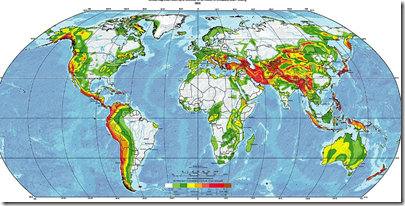
The deep reds in the USGS map below show the areas most at risk of seismic activity, and as you’ll see the boundary where Northern India and the Eurasian plate meet is one the more active regions of the world.
image

Seismically active areas of the world

Earthquakes strike without warning, and literally billions of people live on, or near seismic zones.   Millions more live within range of earthquake driven tsunamis. The ground beneath one’s feet can violently shift in an instant, making it imperative that you, your family, and your business are prepared.


Working to improve earthquake awareness, preparation, and safety is Shakeout.org, which promotes yearly earthquake drills and education around the country (see NPM13: A Whole Lotta Shakeouts Going On).  If you live in one of these seismically active areas, I would encourage you to take part in these yearly drills.

image

Every home should have no less than a 72-hour supply of emergency food and water, for all of its occupants (including pets!).  This is a bare minimum, here in the United States many agencies and organizations recommend that households work towards having a 10-day supply of food, water, and emergency supplies on hand.


In When 72 Hours Isn’t Enough, I highlighted  a colorful, easy-to-follow, 100 page `survival guide’ released by Los Angeles County, that covers everything from earthquake and tsunami preparedness, to getting ready for a pandemic.
image

While admittedly California-threat specific, this useful guide may be downloaded here (6.5 Mbyte PDF).

For more information on emergency preparedness, I would invite you  to visit:

FEMA http://www.fema.gov/index.shtm

READY.GOV http://www.ready.gov/

AMERICAN RED CROSS http://www.redcross.org/

And some of my preparedness blogs, including:

NPM14: The Advantages Of Having A Shaky Preparedness Plan

The Gift Of Preparedness – 2014 Edition

In An Emergency, Who Has Your Back?

Monday, August 26, 2013

Nepal: EDCD Denies H5N1 Report


image


# 7603


In a bit of a follow up to this morning’s report (see Nepal: Human H5N1 Testing (Or Lack Thereof) where news reports suggested two humans may have died from the H5N1 virus, Nepal’s EDCD has reportedly issued a flat denial that bird flu has spread to humans in that country.


Their investigative team reportedly found no contact between the two patients who died and diseased poultry, which they believe rules out H5N1.


Contrary to earlier reports which stated no samples had been taken for testing, this report now claims `a laboratory report . . . confirmed that the victims had not been infected with H5NI virus’.


No mention is made of the remaining case, whose lab tests are supposedly pending. 


Bird flu has not spread to human, says govt

REPUBLICA ONLINE

KATHMANDU, Aug 26: The government has scotched rumors that two women died of bird flu in Bharatpur of Chitwan district.


Issuing a press statement on Monday, the Epidemiology and Disease Control Division (EDCD) of the Ministry of Health and Population (MoHP) made it clear that the deaths of two patients at the Teaching Hospital of College of Medical Science, Bharatpur were not related to the avian influenza or H5N1 virus.


Dr G.D. Thakur, Director of the EDCD, stated that both patients died of pneumonia.


The EDCD had to issue the statement after bird flu was suspected to have caused the deaths of Amrita Shrestha, 25, of Nawalparasi district, and Binu Pudasaini, 41, of Makawanpur district on Saturday.
Both were admitted to the hospital after they suffered from common cold and fever.


(Continue . . .)


I’ve checked Nepal’s Ministry of Health & Population  and the Department of Health Services websites, and have not been able to find  any official announcement.


As always with dueling reports like these, we’ll simply have to wait to see what happens next.

Nepal: Human H5N1 Testing (Or Lack Thereof)

image


# 7601


At the risk of sounding like a broken record, we really don’t know the true number of H5N1 (or MERS-CoV, H7N9, et al.) infections around the world. The quality, availability, and consistency of lab testing varies considerably between (and indeed, even within) countries.


Many nations must send samples to a reference lab outside their borders in order to test for exotic viruses.


As of the 23rd of August, the official World Health Organization  count puts the number of H5N1 cases at 637, with 378 fatalities (CFR 59.3%). 


But over the years we’ve seen a number of `suspected cases’ around the world that were either never tested, or whose negative test results were suspect.


In many places people succumb to diseases without ever seeing the inside of a hospital, much less having lab tests run.  Which may - at least partially - explain why some places report H5N1 in poultry, but have yet to report a human case.


As Dr. Ian Mackay already stated in his blog this morning:


Don't test, don't find. Know nothing.


Today we’ve a report out of Nepal  (h/t Gert van der Hoek on FluTrackers) – a nation which is currently embroiled in a major outbreak of H5N1 in its poultry - that suggests they may have recently missed two recent H5N1 fatalities.


But since they didn’t test (or even collect samples), we will probably never know.  A third case is being tested, and we should have results in a week.


First the report from the Himalayan Times, then I’ll return with more.


Bird flu suspected in two deaths‚ no test conducted

2013-08-26 2:27

SURYA PS.KANDEL

No bird-to-human bird flu transmission has been reported so far in Nepal.


NARAYANGADH: Bird flu has been suspected in the deaths of two women, who suffered from common cold and fever, at the Teaching Hospital of College of Medical Sciences in Bharatpur.


The hospital has written a letter to the District Public Health Office (DPHO) after the twin deaths on Saturday, suspecting that the victims were infected with the avian influenza virus (H5N1). However, no sample was collected from the deceased for further laboratory test.


Another patient suffering from common cold, cough and fever is receiving treatment at the ICU of the same hospital. She is given Tamiflu, the antiviral medicine used to treat bird flu.


According to Public Health Inspector Ram K.C., nasal and throat swabs collected from her have been sent to the National Public Health Laboratory in Kathmandu for the confirmation of suspected virus.

(Continue . . . )


It is a bit difficult to understand why samples weren’t collected - even post-mortem - but this story indicates they were not.  An opportunity lost. 


To be fair - it doesn’t matter where in the world you are, or what disease you are interested in – we really can only guess at its true incidence. Our own CDC can only roughly estimate the number of cases of diseases we have each year.


surveillance

As the pyramid chart above indicates, only a tiny fraction of infectious disease cases  are actually reported to health authorities. - Credit CDC


It was just a week ago, in CDC: Estimate Of Yearly Lyme Disease Diagnoses In The United States, that we learned the true burden of Lyme disease in this country may be as much as 10 times greater than are reported.


And just about 2 months ago, in CID Journal: Estimates Of Human Infection From H3N2v (Jul 2011-Apr 2012), we saw a study that estimated that in 2011 – a year where there were only 12 cases of H3N2v reported – the real number of cases was probably in excess of 2000.


While it is clearly impossible to test everyone for everything, the more testing that we can do, the better will be our understanding of the burden of, and threat posed by, these emerging viruses.


For more on the difficulties in assessing the incidence (and mortality/morbidity rates) of emerging diseases, you may wish to revisit:


Lancet: Clinical Severity Of Human H7N9 Infection
H7N9: CFR Considerations

The Great CFR Divide 

Revisiting The H5N1 CFR Debate

Thursday, August 01, 2013

H5N1: Nepal Bans Chicken Trade In Capital


image


# 5733


From Xinhua News this morning an update on the Nepali H5N1 situation that Crof and I have blogged on in recent days (see Crof’s Nepal: H5N1 situation ‘getting out of hand’ and my Aiding & Abetting H5N1 In Nepal).


With 16 outbreaks reported in the Nepali capital Kathmandu over the past two and a half weeks, and dozens more across the nation, authorities have decided to place a 1 week ban on the trade in chickens in the capital city while they conduct a culling operation.


Although Nepal has frequently reported outbreaks of H5N1 in poultry since late 2009, to date no human cases have been identified in that country.


Bird flu forces Nepal to ban chicken trade in capital

Aug 01,2013

KATHMANDU, Aug. 1 (Xinhua) -- Following the outbreak of 16 bird flu cases in 17 days since July 16 in Kathmandu, the animal health authorities of Nepal on Thursday declared ban on chicken trade in the Nepali capital for one week.


The authorities said the step was necessary to prevent further spread of the H5N1 virus so as to ensure that it does not ultimately affect the people.


Under the ban announced as per Animal Health and Livestock Services Act 1999, chickens cannot be supplied and sold in all three districts of the capital valley, including Lalitpur, Bhaktapur and Kathmandu.


"We expect to control bird flu within one week. If it does not happen, the ban may be extended further," said Bolraj Acharya, Chief of the Department of Livestock Services.


"We will try our best to bring the disease under control. The ban is for the same purpose," said Jay Mukund Khanal, Secretary at the Ministry of Agriculture.


The ban will be effective until August 7 and authorities have plans to cull all the affected chickens by this period.


Last year, the authorities culled 131,632 chickens and destroyed 378,350 eggs and 7,515 kg of feed across the country. In the past two weeks, in Kathmandu alone, authorities culled 31,194 chickens and destroyed 28,172 eggs and 7,715 kg of feed.


Apart from the 16 cases reported alone in the capital, 50 more cases have been reported in different parts of the country in the past two weeks since the beginning of the new fiscal year 2013/14 on July 16.


Bird flu was first reported in Nepal in January 2009 in Jhapa of eastern Terai plains. Since then, its recurrence has been reported time and again.

Monday, July 29, 2013

Aiding & Abetting H5N1 In Nepal

image

Located as it is between two nations with a long history of outbreaks of H5N1 (India and China), and separated by but a few kilometers from Bangladesh – another bird flu hotspot – it isn’t surprising that bird flu continues to show up in Nepal.


# 7524


Over the past couple of days Crof has carried reports on a number of outbreaks of H5N1 in Nepal (see Nepal: Kathmandu reports 12 H5N1 outbreaks in 13 days & Nepal: H5N1 outbreak in Bhaktapur poultry).


Although not as well known for bird flu as Indonesia, Egypt, or Bangladesh, H5N1 has been showing up with some regularity in Nepal since it was first detected in January of 2009 (see Nepal: Concerns Rise Over More Poultry Deaths).


In year’s past, outbreaks have occurred in Nepal primarily during the winter months. What is a bit unusual is the timing of this year’s activity, which has seen outbreaks continuing well into the summer (see OIE Follow up Report #9).


Worldwide the pattern with the H5N1 virus has been that it declines during the warmer summer months, only to increase when cooler weather returns with the fall and winter. 


This pattern is easily seen in the FAO chart below:

image


Of course, outbreaks don’t stop completely during the summer months, particularly in countries where the H5N1 virus is extremely well-entrenched (e.g. Indonesia, Egypt).


But there is clearly a seasonal pattern.


When an outbreak does occur, the procedure is to quarantine the affected farm and set up an exclusion zone around it from which poultry may not be sold or transported until the outbreak is contained.


Infected and exposed birds are culled, while birds in the exclusion zone are tested and monitored for at least 21 days.


At least, that’s how things are supposed to work.


The reality is that farmers will sometime elect not to report outbreaks immediately in hopes it will burn itself out  - or worse - will attempt to sell off or transport exposed birds before they can fall ill, in order to avoid a major financial loss.


Which is what allegedly has recently happened in Nepal, according to this report from the Himalayan Times.


According to this report, not only were two farm outbreaks hidden from authorities, infected birds were supposedly sold to local shops.


Chickens taken for sale from bird flu detected farm seized

Added At:  2013-07-29 3:30 PM

BHAKTAPUR: Police have seized live chickens being transported to Bhairahawa from a bird flu detected poultry farm in Bhaktapur.


The Ganga Jamuna Poultry Farm based in Katunje-2 in Bhaktapur was caught red-handed while transporting 450 live chickens to Bhairahawa.


According to District Livestock Service Office Bhaktapur, acting on a tip-off, chickens were seized from Sundarighat of Lalitpur. The confiscated chickens were buried in a ditch near Sundarighat, District Livestock Service Office Lalitpur chief Dr Mugal Prasad Saha said.

(Continue . . .)


These types of stories are not unusual; we've seen similar reports over the years from China, Vietnam, Egypt, Nigeria and Indonesia. 


Not unexpectedly, these types of actions can lead to a wider spread of the virus, endangering not only the local poultry industry, but the lives of people who come in contact with these infected birds.


For now, H5N1 remains primarily a threat to poultry. The virus remains poorly adapted to human physiology, and despite ample opportunities to cause illness in humans, the virus only causes rare, sporadic infections.


The concern, of course, is that over time the virus will adapt further and pose a pandemic threat to humans.

Monday, October 15, 2012

Nepal: H5N1 Outbreak In Poultry


# 6634


The pattern with the H5N1 virus has been that it declines during the warm summer months, only to return when cooler weather returns with the fall and winter. 


This pattern is easily seen in the FAO chart below:

image


Although not the hotspot for bird flu like Indonesia, Egypt, or Bangladesh, the H5H1 virus has been making its presence known in Nepal each winter since it was first detected in January of 2009 (see Nepal: Concerns Rise Over More Poultry Deaths).


image

Located as it is between two nations with a long history of outbreaks of H5N1 (India and China), and separated by but a few kilometers from Bangladesh – another bird flu hotspot – it isn’t surprising that the bird flu virus has made its way to Nepal.


Ironically, Nepal filed a final bird flu report with the OIE just one week ago, six months after the end of their last outbreak.  But with the return of cooler weather, H5N1 has once again emerged.


Today, we’ve a report in The Himalayan (h/t Giuseppe Michieli on FluTrackers), indicating a fresh outbreak of the virus, killing 1,200 chickens on a poultry farm in Bhaktapur, outside of the capital Kathmandu.


Bird flu confirmed in Bode farm

2012-10-15

ISHWOR K KHAIJU

BHAKTAPUR: At least 1,200 chickens have died of bird flu at a poultry farm in Bode-3 of Madhyapur Thimi in Bhaktapur till Monday noon.

(Continue . . .)


Nepal’s Animal Health Directorate has declared the area a crisis zone, and for the next 90 days will conduct enhanced surveillance.

Sunday, February 05, 2012

Nepal: Bird Flu Reported In Two Provinces


image

Map Credit - Wikipedia


# 6121


Located as it is between two nations with a long history of outbreaks of H5N1 (India and China), and separated by but a few kilometers from Bangladesh – another bird flu hotspot – it isn’t surprising that Nepal finds itself dealing bird flu outbreaks on occasion.


Nepal first confirmed the H5N1 virus in their nation in January of 2009 (see Nepal: Concerns Rise Over More Poultry Deaths).


In early December of last year the OIE was notified of a small outbreak of H5N1 near Kathmandu (see Bird Flu Reports From Nepal). Prior to that outbreak, the last OIE report I can find was filed in February of 2010; Final report 12669.


The media has complained in the past that officials have been slow in dealing bird flu, such as in this report which appeared in the Kathmandu Post last November describing a `cursory probe’ and `lax response’ by public health officials during the most recent outbreak.


One complication for local officials is they must send off samples to labs outside of the country in order to confirm the presence of H5N1, which has led to delays in implementing control methods.


Today, after several days of reports of suspicious poultry deaths in Nepal, we get media confirmation that the H5N1 virus has been detected among poultry in two provinces; Sumari and Ilam.


Two reports from Nepalnews.com:


Lab tests confirm outbreak of bird flu in Sunsari

Sunday, 05 February 2012 13:27 Read this : 105 times

The government authorities Sunday confirmed outbreak of bird flu in Sunsari district where around 5,000 chickens had  died earlier this week.


(Continue . . .)

Bird flu found in Ilam also

Sunday, 05 February 2012 18:28 Read this : 40 times

On the same day bird flu outbreak was confirmed in Sunsari district, local authorities in Ilam Sunday said the the similar case was detected in Ilam district also.


(Continue . . . )


Nepal is finding - as have nations like Vietnam, India, Egypt, Indonesia, and Bangladesh before it - that once the H5N1 virus establishes itself in an area, it can be very difficult to eradicate it completely.


For now, the H5N1 virus remains poorly adapted to human physiology, and while rare human infections have been reported, the virus  has not figured out how to transmit efficiently among humans.


Recent laboratory experiments have shown, however, that there is no biological barrier to the virus someday achieving that ability.


And so we watch outbreaks such as these with considerable interest.

Thursday, December 01, 2011

Bird Flu Reports From Nepal


# 5987


image


Over the past 72 hours we’ve seen several reports of avian influenza spreading among poultry in Nepal.


On FluTrackers, a thread started by Gert van der Hoek on Monday contains confirmed reports of bird flu at a poultry farm in Nepal’s Bhaktapur district.


Suspicious poultry deaths were reported occurring as early as November 9th, but testing only recently confirmed the H5N1 virus.


Yesterday the Kathmandu Post carried an article that describes a `lax’ response by public health officials to residents in the area complaining of `flu like symptoms’.


Bird flu outbreak

  • Govt response: Cursory probe, lax quarantine

Manish Gautam

KATHMANDU, NOV 30 -

A day after officials confirmed bird flu in Bhaktapur and quarantined the area, many locals in and around Madhyapur Thimi Municipality on Wednesday complained of symptoms similar to that of bird flu.


Sita Rai, a resident near the site of the outbreak, said she has sore throat, fever, cough and muscle ache.


However, two health officials at the site, who stayed for less than 20 minutes in the area, said she is fine and that there is nothing to worry about.


(Continue . . . )


It is not uncommon – particularly during the onset of winter weather – for people in this region to be experiencing ILI (influenza-like-illnesses). So while reports of any ILIs around bird flu outbreaks are always of concern, these illnesses are far more likely to be caused by something other than H5N1.


So far, H5N1 has primarily been a threat to poultry, and we’ve seen very few clusters of human infection.


The concern, of course, is that could change.


Today, an AFP report appearing in the Straits Times indicates that – for the first time – bird flu has been detected in poultry in Nepal’s capital city, Kathmandu.


Poultry cull follows Kathmandu bird flu outbreak

Published on Dec 1, 2011


Nepal first reported the bird flu virus in January of 2009 (see Nepal: Concerns Rise Over More Poultry Deaths). After a couple of months the outbreaks were declared over, but the virus returned again over the winter of 2010 (see Nepal: H5N1 In Poultry & Nepal: Problems Containing Bird Flu).


The last OIE report I can find was filed in February of 2010; Final report 12669.


Located as it is between two nations with a history of outbreaks of H5N1 (India and China), and separated by but a few kilometers from Bangladesh – another bird flu hotspot – it isn’t surprising that Nepal finds itself faced with fresh outbreaks of the virus each winter.


Complicating matters, officials must send off samples to labs outside of the country in order to confirm the presence of H5N1, which has led to delays in implementing control methods.


In 2009 and 2010 outbreaks in Nepal were not reported until well into January, so today’s reports are coming unusually early in their winter season.


For now, this appears to be just affecting poultry, but as always, the newshounds on the flu forums will keep a close eye on the situation.

Wednesday, March 17, 2010

Bird Flu Spreading In Nepal


# 4441


One of the difficulties with controlling the H5N1 virus is that it can sometimes take days for some countries to confirm that the virus is the cause of poultry deaths.  During that time, if containment efforts are not taken, the virus can spread.


This appears to be the case in Nepal, where outbreaks of bird flu have been reported again this winter. Testing for the virus is not done locally, and samples must be sent to the UK to confirm the presence of the virus.


Several days ago (see Nepal: Problems Containing Bird Flu) the Himalayan Times had an article on the spread of bird flu in Parasi, and allegations of cover ups by the government and a slow chaotic response to the threat.


Six weeks ago, bird flu was detected in Pokera (see Nepal: H5N1 In Poultry).


The mention of `open disposal’ of chickens below apparently refers to throwing their carcasses into lakes and rivers.  A tactic that is feared will spread the virus further.


Bird flu strikes Nawalparasi as emergency declared

Last Updated : 2010-03-17 12:58 PM


NAWALPARSI: The District Livestock Service Office (DLO), Nawalparasi revealed that bird flu has been detected in different Village Development Committees (VDC) of Nawalparasi on Wednesday. Nawalparsi has been declared as emergency zone after bird flu was acknowledged.


The DLO sent samples for laboratory testing to Britain for suspicion of bird flu after ducks and fowl started dying in Deurali, Deubadi and Tamsariya VDCs, since the last few days.


It is reported that a large number of poultry at Jhyalbas, Guheri, Beluwa, Dihi and Rumsi have died. Similarly, poultry in the neighbouring Deubadi Tamasariya VDC have also started dying.


Fear has gripped the residents in the bird flu areas over fears that the poultry disease might spread rapidly due the open disposal of the dead ducks and fowl.


Balkrishna Panthi, Chief District Officer of Nawalparasi district said that a technical team has already been mobilised to the affected areas for preventive measures.

Sunday, March 14, 2010

Nepal: Problems Containing Bird Flu


# 4429


image


Nestled as it is between two nations with a history of outbreaks of bird flu (India and China), and separated by but a few kilometers from Banglashesh – another H5N1 hotspot – it isn’t surprising that Nepal finds itself in a battle against the H5N1 virus as well.


Officially,  bird flu arrived in Nepal a little over a year ago (see Nepal Faces Challenges Combating Their First Bird Flu Outbreak), although there had been several `scares’ before that.  After a flurry of stories in January and February of 2009, reports of bird flu in Nepal dried up in March, and we heard little again until about six weeks ago (see Nepal: H5N1 In Poultry).


Today the Himalayan Times has an article on the spread of bird flu in Parasi, and allegations of cover ups by the government and a slow chaotic response to the threat.  Charges that are not dissimilar to some that were levied during the 2009 outbreak.


As noted last month, these new outbreaks are being reported in central Nepal, not the Eastern regions as they were last year.


image

Location of Parasi, Nepal


This lengthy report from the Himalayan Times.


Bird flu spreading fast in Parasi

Last Updated : 2010-03-13 11:58 PM

  • Tika R Pradhan

KATHMANDU: The government has been keeping the public in the dark despite the outbreak of bird flu in different parts of the country on the rise, it was learnt today.


Around 500 backyard birds have died in Jhyalbas and Deurali VDCs of Nawalparasi district in the past few weeks.


Following the outbreak, a team of veterinarians led by senior officer at the Animal Health Directorate (AHD), Dr Narayan Prasad Ghimire, was sent to the VDCs for a stamping out operation following verbal orders from Dr Ram Krishna Khatiwada, the programme director, AHD,yesterday.


The team comprised Dr Dayaram Chapagain of Department of Livestock Service (DLS), Chitwan, Dr Laxman Bahadur Dhakal, Chief of DLS Nawalparasi, Dr Damodar Neupane and a technician from the National Avian Laboratory, Chitwan.


However, the team had to return from the VDCs without any job done as they failed to receive a written order from the Department of Livestock Services (DLS) to carry out the same. It is learnt that Dr Khatiwada had assured the team members of the written order from the centre. However, in the last hour, Dr Khatiwada directed the members to return.


Dr Khatiwada said that the report of the sample was not ready. “It might come by Sunday evening,” he said.


When asked about the team sent to the site, he said that was for the diagnosis and to make preparation for culling if the result was found to be positive. “We need to prepare for several things including financial matters before culling the birds in order to maintain international norms,” he said.


One of the team members said the condition in those areas was ‘horrible’ as more birds are being infected and dying fast.
Sources said the birds of local resident Bal Bahadur Bakwal (Magar) of Jhyalbas tested positive for H5N1 virus in the central veterinary laboratory, Tripureswor.


However, the authorities are reluctant to reveal the truth. As per the Bird Flu Control Order- 2064 BS, the government needs to declare “Crisis Zone” after a sample tests positive for H5N1 Avian virus either in the Central Veterinary Laboratory, Tripureswor or in any of the World Organisation for Animal Health reference laboratory. Nepal used to send the samples to the reference laboratory in Waybridge, London, for confirmation.


The government had earlier failed to declare the outbreak in Budhabare-Jhapa, Chainpur-8 in Chitwan, Buddhanagar in Rupandehi and Fultekra in Nepalgunj on time.


It may be noted that the authorities had revealed the outbreak only after The Himalayan Times reported that the government had been keeping the public in the dark.


Nepal Veterinary Association (NVA), Chitwan chapter, has condemned such act of the government and the DLS.


In a statement, the Chitwan chapter of NVA said that the department is being run in an “unethical manner” and at the cost of public health.


The government is once again trying to hide the outbreak of Bird flu in Nawalparasi district.

Wednesday, February 03, 2010

Nepal: H5N1 In Poultry


# 4320


Just a year after the H5N1 virus was first detected in Nepal (see Nepal Faces Challenges Combating Their First Bird Flu Outbreak), once again that nation is dealing with an outbreak of bird flu in poultry.


Thus far, there have been no confirmed human infections in Nepal.


Unlike last year’s outbreaks, which were mainly concentrated in the east of the country, Pokara is in the central region of Nepal.


image

This report from the Himalayan Times.


London tests confirm avian flu in Pokhara

Last Updated : 2010-02-04 12:12 AM


Bharat Koirala/Rajesh Barma

POKHARA/ kATHMANDU: Detection of bird flu in Pokhara has spread panic in the Lake City. Ministry for Agriculture and Cooperatives, in a press meet held in Kathmandu today, stated that ducks and chickens were dying in Pokhara due to bird flu and a high alert has been sounded in Pokhara and the surrounding areas.


Dr Prakashraj Shrestha, head of District Veterinary Office, Kaski, said the samples of the dead ducks and chickens collected from the poultry farm of Gyan Bahadur Khadka in Ghoripatan were tested preliminarily in Pokhara on January 26.


They had to be sent to London as there were no facilities for such tests in Kathmandu. Spokesperson for the ministry, Dr Hari Dahal, stated that the preliminary report of the tests showed that the ducks and chickens had died due to bird flu (H5N1 virus). Dr Dahal said the Rapid Response Team had begun its task to curb the spread of the disease in the affected area. Claiming that the flu would be controlled within seven days, Dr Dahal added that there are nearly 10,000 birds in Ghoripatan, Pokhara.


District Veterinary Office, Kaski, has urged the locals of Ghopripatan area not to consume the meat of dead birds and to bury them properly. The office has also been spraying medicine in the affected areas.


Kaski CDO and chairman of Bird Flu Control Committee Shambhu Koirala said the meeting held today was attended by all the stakeholders and he had directed them to adopt proper methods to curb the disease. He added that the police had already stopped the movement of birds in and out of Pokhara and security personnel had been deployed on major highways and roads connecting Pokhara with other parts of the nation.


Many migratory birds come to Pokhara, increasing the threat of bird flu. District Veterinary Office has assured the poultry entrepreneurs that the disease can be prevented if proper measures are adopted.