Showing posts with label Puerto Rico. Show all posts

Saturday, August 24, 2013

Florida: Dengue Count Rises To 8

image

Martin, St. Lucie & Miami Dade Counties


# 7597


A follow up to last weeks report (see Florida: Three Dengue Cases Reported),  Martin County has reported an additional 3 dengue fever cases and yesterday Miami Dade county reported their first infection of 2013.


Dengue had plagued the state of Florida until after World War II, but was eradicated as a result of an aggressive post-war mosquito spraying program. 


Dengue returned in 2009 to the Florida Keys, probably imported by a traveler who had recently visited another country where the virus is endemic.  A local mosquito bit that visitor, and then went on to transmit the virus to others.


At least 28 people contracted Dengue in Key West that year (some asymptomatic or mild infections were likely never reported), and the virus returned in 2010 with even greater numbers; infecting 65 – including 1 person in Broward County, and another in Miami-Dade County.


2011 and 2012 saw major reductions in case counts – likely due to mosquito control efforts and PSAs on mosquito safety - and we’d not seen any cases this year until last week.


Our first stop is Miami-Dade County’s Dengue alert, issued yesterday.


August 23, 2013

THE FLORIDA DEPARTMENT OF HEALTH IN MIAMI-DADE COUNTY ISSUES A MOSQUITO-BORNE DISEASE ADVISORY FOR MIAMI-DADE COUNTY


FOR IMMEDIATE RELEASE
MOSQUITO-BORNE DISEASE ADVISORY ISSUED FOR MIAMI-DADE COUNTY

--First Confirmed Locally Acquired Dengue Case in Miami-Dade County in 2013--

Miami, August 23, 2013 - Today, the Florida Department of Health in Miami-Dade County has issued a mosquito-borne illness advisory for Miami-Dade County. The first locally acquired Dengue Fever case in 2013 has been confirmed in an 18-year-old male.

Symptoms of Dengue Fever may include headache, fever, fatigue, dizziness, weakness, pain behind the eyes, joint pain, and confusion. Health care providers should contact their county health department if they suspect an individual may meet the case definition for a mosquito-borne illness. Miami-Dade County Mosquito Control and the Florida Department of Health in Miami-Dade County continue surveillance and prevention efforts and encourage everyone to take basic precautions to help limit exposure by following the department of health recommendations.

(Continue . . . )


Martin County’s Health Department reported an additional case on Thursday (bringing their total to 4), but last night local media reported that three more cases had been diagnosed.  This from WPTV.


MARTIN COUNTY: 3 additional cases of dengue cases confirmed in Martin County, bringing total to 7

Posted: 08/23/2013
By: Evan Axelbank

MARTIN COUNTY, Fla - Three new cases of  Dengue Fever have been reported on the Treasure Coast, bringing the total number of cases there to seven.


Though health officials say all seven patients have recovered, doctors say there's real concern of new people getting sick across the state.


(Continue . . .)


As Florida is home to two mosquito species that can transmit Dengue (Aedes aegypti & Aedes albopictus), and each year we see dozens of visitors arrive who are viremic (have the virus in their blood) – the ingredients are there to reintroduce local transmission of the disease.


The State of Florida’s latest Arbovirus Surveillance Report lists :


Imported Dengue:

Sixty-three cases of dengue with onset in 2013 have been reported in individuals with travel history to a dengue endemic country in the two weeks prior to onset. Countries of origin were: Angola, Bangladesh, Barbados, Bolivia, Brazil (3), The Caribbean, Columbia (3), Costa Rica (2), Dominican Republic (5), Haiti (2), Honduras, Indonesia, Jamaica (4), Nigeria, Panama, Philippines (2), Puerto Rico (31) and Saint Martin (2).

Counties reporting cases were: Alachua, Brevard, Broward (4), Clay, Duval, Indian River,Lake, Lee, Miami-Dade (19), Orange (12), Osceola (5), Palm Beach (8), Pasco, Pinellas, Seminole (3), St. Lucie and Volusia (2). Nine of the cases were reported in non-Florida residents. In 2013, 39 of the 66 cases of dengue reported in Florida have been serotyped by PCR. Additional serotyping and strain typing are being conducted.

# of cases per serotype – 2013

DENV-1   28

DENV-2    0

DENV-3    3

DENV-4    8


Puerto Rico, which is dealing with another major Dengue outbreak this year (see Puerto Rico: Dengue Levels Continue Above Epidemic Level), appears to be the origin of nearly half of the imported cases this year.

Puerto Rico Dengue Surveillance through Week 26

image


After the 2009 Key West outbreak the CDC’s MMWR  published on Locally Acquired Dengue, which had this to say about imported cases:

Cases of dengue in returning U.S. travelers have increased steadily during the past 20 years (8). Dengue is now the leading cause of acute febrile illness in U.S. travelers returning from the Caribbean, South America, and Asia (9).


Many of these travelers are still viremic upon return to the United States and potentially capable of introducing dengue virus into a community with competent mosquito vectors.


In 2009 the Natural Resources Defense Council (NRDC) released a report outlining the risks that Dengue could re-establish itself in North America, that included this map showing the areas of the United States that are vulnerable to the introduction of Dengue.

image


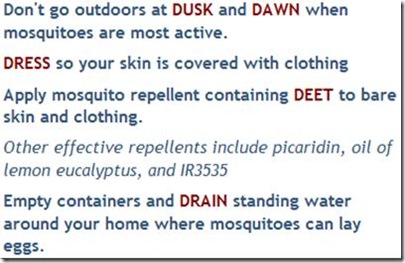
For now, the the overall risk of contracting a mosquito-borne illness in Florida (or elsewhere in the United States) remains small, but sporadic reports of Dengue (along with West Nile, EEE, SLEV, and other rare arboviral threats) are a good enough reason that everyone should remember to follow the `5 D’s’ of mosquito safety:

image

Tuesday, July 23, 2013

Puerto Rico: Dengue Levels Continue Above Epidemic Level

image

Credit CDC


# 7507


It’s been a few months since we last looked at Dengue fever activity in Puerto Rico - and while nowhere near the intensity of the 2010 epidemic (see red line in chart below) - the summer of 2013 is running well above the epidemic level (see chart above).


image


This epidemic ended in December of 2010, but before it was quashed it had infected more than 21,000 people, killing 31 (see MMWR: Dengue Epidemic In Puerto Rico).


The following year (2011) was an average or slightly below average year for Dengue in Puerto Rico, but by the middle of last summer (see Dengue Above Epidemic Threshold In Puerto Rico) dengue numbers began to rise in Puerto Rico.


In October of 2012 Health Secretary Lorenzo Gonzalez of the Puerto Rico Health Department once again declared a Dengue epidemic on the island (PDF Link – in Spanish), stating that at least six people have died, two of them being children (see Puerto Rico Declares Dengue Epidemic).


While mosquitoes exist year-round in Puerto Rico, the end of the rainy season (which normally runs April-Nov) usually signals a drop in their numbers.  But as you can see by the chart at the top of this page, those numbers never dropped below the epidemic level during the spring.


Which brings us to the most recent (week 25) Dengue Surveillance report from the CDC.  (Note: Surveillance figures typically run about 3 weeks behind to give time to compile and analyze the numbers).

image


The true burden of the disease is likely much higher than these numbers reflect, as often the first infection produces only mild symptoms, and may even be completely asymptomatic. 


This from the CDC’s  Clinical Guidance on Dengue


Asymptomatic Infection: As many as one half of all dengue infected individuals are asymptomatic, that is, they have no clinical signs or symptoms of disease.


Undifferentiated Fever: The first clinical course is a relatively benign scenario where the patient experiences fever with mild non-specific symptoms that can mimic any number of other acute febrile illnesses. They do not meet case definition criteria for DF. The non-specific presentation of symptoms make positive diagnosis difficult based on physical exam and routine tests alone. For the majority of these patients, unless dengue diagnostic serological or molecular testing is performed, the diagnosis will remain unknown. These patients are typically young children or those experiencing their first infection, and they recover fully without need for hospital care.

Dengue Fever with or without hemorrhage: The second clinical presentation occurs when a patient develops DF with or without hemorrhage.  These patients are typically older children or adults and they present with two to seven days of high fever (occasionally biphasic) and two or more of the following symptoms: severe headache, retro-orbital eye pain, myalgias, arthralgias, a diffuse erythematous maculo-papular rash, and mild hemorrhagic manifestation.


There are 4 different serotypes of the Dengue Fever virus (Puerto Rico is reporting types DENV1 & DENV4), so a person can easily become infected several times over their lifetime. 


One of the concerns is that travelers visiting dengue endemic areas may carry the virus back home with them, and `seed’ local mosquito populations with the virus. 


The CDC’s MMWR in a report in May of 2010 on Locally Acquired Dengue in Key West, had this to say:


Cases of dengue in returning U.S. travelers have increased steadily during the past 20 years (8). Dengue is now the leading cause of acute febrile illness in U.S. travelers returning from the Caribbean, South America, and Asia (9).


Many of these travelers are still viremic upon return to the United States and potentially capable of introducing dengue virus into a community with competent mosquito vectors.


While Florida has yet to report its first locally acquired dengue case of 2013, the latest Arbovirus Surveillance report (July 13th) shows 43 imported cases of Dengue since the first of the year.


Imported Dengue:

Forty-three cases of dengue with onset in 2013 have been reported in individuals with travel history to a dengue endemic country in the two weeks prior to onset. Countries of origin were: Angola, Barbados, Bolivia, Brazil (3), The Caribbean, Columbia (3), Costa Rica, Dominican Republic (4), Haiti (2), Honduras, Indonesia, Jamaica (4), Nigeria, Panama, Philippines, Puerto Rico (16) and Saint Martin.


Counties reporting cases were: Brevard, Broward (4), Clay, Duval, Indian River, Lee, Miami-Dade (14), Orange (9), Osceola (3), Palm Beach (6), St. Lucie and Volusia. Six of the cases were reported in non-Florida residents.


The odds of contracting Dengue, or any other mosquito transmitted diseases, are actually pretty low.


But with no vaccine, and the potential for serious illness, it makes sense to take reasonable precautions whenever you are around mosquitoes (and not just in Dengue endemic areas).


Those who travel to, or live in areas where mosquitoes are present are reminded that to  follow the `5 D’s’:

image

Wednesday, November 07, 2012

Dengue Update: Puerto Rico, Florida & The Americas


# 6702


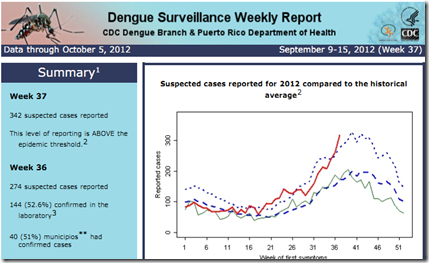
While not reaching the levels we saw during their 2010 Dengue epidemic, Puerto Rico is once again seeing epidemic levels of the mosquito-borne virus, as evidenced by this latest chart from the CDC.  


image

As indicated by the red line, the number of cases over the past couple of weeks has been climbing like a homesick angel. 


Health Secretary Lorenzo Gonzalez of the Puerto Rico Health Department declared a Dengue epidemic on the island (PDF Link – in Spanish) in early October after six people died or the disease, two of them children.


This week, Florida also reported its third locally acquired Dengue case (see Another Central Florida dengue case confirmed) of 2012. This latest case was identified in Osceola County, and a fourth suspected case is being investigated.


While once a serious problem in Florida, through aggressive mosquito control efforts during the 1940s Dengue and Malaria were both eliminated from the Sunshine State – and remained so for nearly a half century.


In 2009 – for the first time in more than 50 years – we started to see a small number of locally acquired Dengue cases showing up in Key West (see MMWR: Dengue Fever In Key West), and in 2010 they totaled 65 cases in Key West and 1 each in Broward and Miami-Dade County.


The number of cases dropped in 2011, and have been low once again in 2012.


The concern is - with millions of visitors arriving each year, many from regions where these diseases are endemic – there are plenty of opportunities to re-introduce the virus.


The CDC’s MMWR in a report in May of 2010 on Locally Acquired Dengue in Key West, had this to say:


Cases of dengue in returning U.S. travelers have increased steadily during the past 20 years (8). Dengue is now the leading cause of acute febrile illness in U.S. travelers returning from the Caribbean, South America, and Asia (9).


Many of these travelers are still viremic upon return to the United States and potentially capable of introducing dengue virus into a community with competent mosquito vectors.


In truth, it may take many such introductions of Dengue or Malaria to an area before the right combination of weather, insect vectors, and ongoing transmission occur to enable it to get a foothold in a community.


But Florida’s latest Arbovirus Surveillance report lists more than 90 cases of Imported Dengue this year:


Ninety-four cases of dengue with onset in 2012 have been reported in individuals with travel history to a dengue endemic country in the two weeks prior to onset. Countries of origin were Brazil, Colombia, Cuba (21), Dominican Republic (9), Ecuador (4), El Salvador (2), Ghana, Guyana (2), Haiti (14), Honduras, India, Jamaica (17), Mexico (2), Nicaragua, Panama, Philippines, Puerto Rico (6), South Africa, Sri Lanka, St. Vincent, Suriname, Trinidad (4), and Turks & Caicos.

Counties reporting cases were Brevard (3), Broward (17), Collier, Duval (2), Hillsborough (4), Lee (2), Marion, Miami-Dade (36), Orange (12), Palm Beach (6), Pinellas (2), Polk, Sarasota (2), Seminole (3), and Volusia (2). Nine of the cases were reported in non-Florida residents.


The state has also reported more than 50 cases of Imported Malaria, although no locally acquired cases have been reported.


Fifty-three imported cases of malaria with onset in 2012 have been reported.  Countries of origin were: Afghanistan (2), Cameroon, Central African Republic, Colombia, Costa Rica, Ethiopia, Ghana (5), Guyana (2), Haiti (9), Honduras (3), India, Ivory Coast (3), Kenya, Liberia (2), Nigeria (8), Pakistan, Peru, Sierra Leone (2), South Africa, Sub Saharan Africa, Sudan, Togo, Uganda, Zambia, and multiple African countries (2).

Counties reporting cases were: Alachua, Brevard, Broward (8), Charlotte, Duval (6), Hillsborough (6), Lake (2), Leon, Manatee, Marion, Martin, Miami-Dade (7), Orange (5), Osceola (2), Palm Beach (4), Pinellas (3), Polk, Seminole, and Volusia. Five of the cases were reported in non-Florida residents.


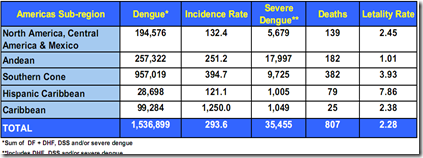
A broader perspective comes from PAHO, who's Oct 31st update shows nearly 1 million cases of Dengue in the Americas this year.

image


An interactive map view of Dengue activity in the Americas, and around the world, can be seen via the CDC-Healthmap collaborative DengueMap.


image


Although the overall risk of contracting a mosquito-borne illness in Florida or Puerto Rico remains very small, reports of Dengue (along with West Nile, EEE, SLEV, and other rare arboviral threats) are reason enough that health departments continue to urge people to remember to follow the `5 D’s’:


image

Wednesday, October 10, 2012

Puerto Rico Declares Dengue Epidemic


# 6622


Dengue fever is endemic in Puerto Rico, but most years the number of cases remains relatively low.  Every few years, however, dengue resurges and an epidemic occurs.


Last year (2011) was an average or below average year for Dengue in Puerto Rico, but the year before – 2010 – saw the worst epidemic in modern memory (see MMWR: Dengue Epidemic In Puerto Rico) with nearly 21,000 cases and 31 fatalities.


This year, the level of Dengue fever infection has been flirting with the epidemic threshold off and on (see Dengue Above Epidemic Threshold In Puerto Rico), but in recent weeks has begun to climb higher.


The most recent surveillance report – current through the middle of September – shows this upward trend.

image


Yesterday Health Secretary Lorenzo Gonzalez of the Puerto Rico Health Department declared a Dengue epidemic on the island (PDF Link – in Spanish) and stated that at least six people have died, two of them being children.


The World Health Organization’s Dengue and Severe Dengue Fact Sheet highlights the following points about the disease.

Key facts
  • Dengue is a mosquito-borne viral infection.
  • The infection causes flu-like illness, and occasionally develops into a potentially lethal complication called severe dengue.
  • The global incidence of dengue has grown dramatically in recent decades.
  • About half of the world's population is now at risk.
  • Dengue is found in tropical and sub-tropical climates worldwide, mostly in urban and semi-urban areas.
  • Severe dengue is a leading cause of serious illness and death among children in some Asian and Latin American countries.
  • There is no specific treatment for dengue/ severe dengue, but early detection and access to proper medical care lowers fatality rates below 1%.
  • Dengue prevention and control solely depends on effective vector control measures.


The explosive growth of Dengue around the world is well illustrated by the following graph, again from the World Health Organization.


Dengue Trends


There are 4 different serotypes of the Dengue Fever virus (Puerto Rico is reporting types DENV1 & DENV4), so a person can become infected several times over their lifetime. Usually, the first infection with a dengue virus results in the milder form of the illness, while more serious illness can occur with subsequent infections.


With roughly 4 million residents and another 4 million annual visitors to Puerto Rico – 4,8165 infections is a miniscule fraction of the exposed population.


The odds of contracting the virus are actually pretty low.  


But they are not zero.


So it makes sense to take reasonable precautions whenever you are around mosquitoes (and not just in Puerto Rico). Those who travel to, or live in areas where mosquitoes are present are reminded that to  follow the `5 D’s’:

image


You can find out more about dengue around the world by visiting the CDC’s Traveler’s Health page on the disease: Update: Dengue in Tropical and Subtropical Regions

Monday, July 16, 2012

Dengue Above Epidemic Threshold In Puerto Rico


# 6435


In 2010 Puerto Rico suffered from the worst dengue outbreak in two decades, which infected more than 20,000 people and killed at least 31.


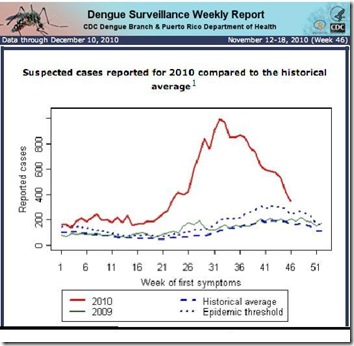
The graph below, taken from week 46 of 2010, shows the level of Dengue activity declining rapidly by year’s end.


image

During that time, I wrote extensively about the outbreak (see here, and here) including this report from the CDC’s  MMWR: Dengue Epidemic In Puerto Rico.


Thankfully, 2011 saw levels of dengue in Puerto Rico drop below the epidemic threshold, and hover right about at historical averages. 

image  2011 Dengue Activity Puerto Rico – Source CDC


The Bahamas, on the other hand, saw a very active dengue season  (see Updating The Bahamas & Florida Dengue Cases), illustrating how variable dengue outbreaks can be from one year to the next.


While a far cry from the epidemic of 2010, the number of dengue case in Puerto Rico are once again on the rise, with the rate running above the epidemic threshold for the past 5 weeks.


image

image


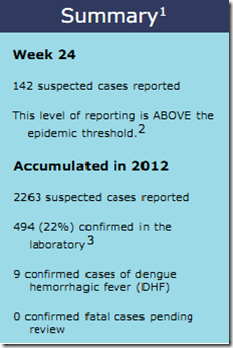
With roughly 4 million residents and another 4 million annual visitors to Puerto Rico – 2,263 infections is a miniscule fraction of the exposed population.


The odds of contracting the virus are actually pretty low.  


But they are not zero.


So it makes sense to take reasonable precautions whenever you are around mosquitoes (and not just in Puerto Rico). Those who travel to, or live in areas where mosquitoes are present are reminded that to  follow the `5 D’s’:

image


The CDC offers the following advice on their Update: Dengue in Tropical and Subtropical Regions


What is Dengue?

Dengue fever is the most common cause of fever in travelers returning from the Caribbean, Central America, and South Central Asia. This disease is spread through the bites of infected mosquitoes and cannot be spread person to person.

Severe dengue can be fatal, but with good treatment, less than 1% of patients die from dengue.

Symptoms of dengue include:

  • fever
  • headache
  • pain behind the eyes
  • joint and muscle pain
  • rash
  • nausea/vomiting
  • mild bleeding, such as nose or gum bleeding or easy bruising

People who have had dengue before may get severe dengue if they are infected again. Anyone with dengue who experiences the following warning signs should go to a doctor or emergency room immediately:

  • Severe abdominal pain or persistent vomiting
  • Red spots or patches on the skin
  • Bleeding from nose or gums
  • Vomiting blood
  • Black, tarry stools (feces, excrement)
  • Drowsiness or irritability
  • Pale, cold, or clammy skin
  • Difficulty breathing

How Can Travelers Protect Themselves?

Travelers can reduce their risk of dengue infection by protecting themselves from mosquito bites:

  • Stay in hotels that are well screened or air conditioned.
  • Use insect repellent on uncovered skin.
    • Look for a repellent that contains one of the following active ingredients: DEET, picaridin (KBR 3023), Oil of Lemon Eucalyptus/PMD, or IR3535.
    • Always follow the instructions on the label when you use the repellent.
    • If sunscreen is needed, apply before applying insect repellent.
    • For more information on the use of insect repellents, see the information on the Mosquito and Tick Protection webpage.
  • Wear loose, long-sleeved shirts and long pants when outdoors.
    • For more protection, clothing may be sprayed with a repellent containing permethrin. (Don't use permethrin on skin.)

If you return from a trip abroad and get sick with a fever, seek medical care right away. Tell the doctor about your recent travel.


Despite the sobering tone of the advice above, the odds of contracting Dengue Fever while visiting Puerto Rico are actually quite low.


None of this should dissuade you from making that long anticipated trip to the Caribbean. But it does pay to be aware of the risks, and to take prudent steps to reduce them.

Tuesday, August 16, 2011

Referral: CDC Blog On Puerto Rico’s 2010 Dengue Epidemic


# 5757


Although it ended last December, for almost all of 2010, Puerto Rico was embroiled in a serious dengue fever epidemic.This time last year close to 900 infections a week were being reported.


Thankfully, cases this summer are running below average.


image

CDC Dengue Surveillance – Week 29, 2011


This morning I ran across an account of what it was like dealing with this outbreak on the CDC’s Public Health Matters blog. It is written by a young EIS (Epidemic Intelligence Service) officer named Tyler Sharpe, who was stationed at the CDC Dengue Branch in San Juan for much of this outbreak.


Not only does this first hand account help to `humanize’ an event we pretty much followed on charts and graphs, it provides a rare glimpse at what it is like to be a part of the EIS during a public health crisis.


Click the link below to read:


Breakbone Fever Attacks Enchanted Island: Battling the 2010 Dengue Epidemic in Puerto Rico

image

August 15th, 2011 11:22 am ET

by tyler sharp


Monday, July 25, 2011

Dengue Roundup: Puerto Rico, Florida, Bahamas


# 5712


Aedes aegypti mosquito

Aedes aegypti


This time last year Dengue fever was a big story in Puerto Rico, and to a lesser extent, also in South Florida and the Bahamas. 


  • The worst epidemic in more than a decade had swept across the island of Puerto Rico, and at one point as many as  900 new cases were being reported each week (see Puerto Rico Dengue Week 31: Cases Back On The Ascendant).
  • Florida, for the second year in a row, was reporting relatively small numbers of Dengue infections - (2010: a total of 63 locally-acquired cases in Key West, one in Broward County, and one in Miami-Dade County) – after more than six decades without a locally acquired case.
  • And last September the Bahamas issued a public health advisory after a rise in Dengue cases and at least one death (see Dengue Reports From The Bahamas).


Outbreaks of Dengue fever are often cyclical, and thus far in 2011 - for Florida, Puerto Rico, and the Bahamas - reports of Dengue fever have been far lower than we saw last year.


The epidemic in Puerto Rico, which claimed 31 lives, finally burned itself out over the winter.  The chart below shows what a difference a year can make.


 image


While fewer than 100 cases are being reported each week right now, it should be noted that the rainy season still lies ahead.  Precautions against mosquitoes are still important.


In Florida, only one locally acquired case of Dengue has been reported in 2011, likely due to the extended drought the state has been experiencing. That situation could change, of course, with the arrival of one good tropical storm.


For now, mosquito activity remains relatively low for this time of year (see report  Florida Arbovirus Surveillance :Week 28: July 10 – July 16, 2011) with only one county (Seminole) under a mosquito-borne illness advisory.


image


According to a recent report in The Bahamas Weekly, the Bahamas are once again seeing a rise in Dengue activity, with two laboratory confirmed cases in New Providence, and another eleven cases awaiting test results. 


DEHS ‘steps up’ source reduction in response to 2 cases of dengue


Jul 21, 2011 - 5:27:13 PM


Across the rest of South America, Central America, and the Caribbean dengue activity varies considerably, with more than 700,000 cases and 400 deaths reported in 2011.


The chart below is gleaned from the latest PAHO Dengue surveillance report.


image 


The explosive growth of Dengue around the world is well illustrated by the following graph from the World Health Organization. . 


Dengue Trends

Since the 1950s a rare, but far more serious form of the disease – DHF or (Dengue Hemorrhagic Fever) –  has emerged.  


The WHO now estimates there may be as many as 50 million dengue infections each year (Dengue and dengue haemorrhagic fever fact sheet).


For an extensive list of my blogs on Dengue and Mosquito Borne Diseases you can select the DENGUE Quick Search here,  on my sidebar.


Despite the lower numbers of dengue cases this year, the threat of mosquito borne illnesses (which may include Dengue, EEE, St. Louis Encephalitis, West Nile Virus, and others) remains.


So if you live in mosquito territory, it pays to be mindful of the 5 D’s.


5 Ds

Wednesday, January 05, 2011

Puerto Rico Dengue Cases Drop Below Epidemic Threshold


Note:  My blogging schedule will be a bit light for the rest of the week as I’ll be on the road, and out of town, until Sunday.  I will attempt to do some brief updates over the next couple of days from my netbook, depending on my schedule and internet availability.


In my absence I would direct you to  Crofsblog, Chen Qi, Arkanoid Legent, A Times Memory, along with The Flu Wiki and FluTrackers for infectious disease news.


For more in depth coverage of selected topics, you may also wish to visit Vincent Racaniello’s Virology blog, Maryn McKenna’s Superbug blog, and Ian York’s Mystery Rays blog.


You’ll find other resources worth exploring in my sidebar as well.


And a reminder, FEMA now has their own blog which you can read here, and the Emergency Management Daily provides an excellent overview of what’s happening in the world of EMS, Security, and Infectious disease threats.


# 5206


Some welcome news.


For the first time since February of 2010, the number of new suspected dengue cases in Puerto Rico has dropped below the epidemic threshold. 


The most recent report (week of Dec 3-9) showed 188 new cases, which is still above the historical average for that date.


image


Although the surveillance numbers are only current through week 49, already Puerto Rico has seen twice as many suspected dengue cases (and 50%  (n=31) greater fatalities) in 2010 than in their last major outbreak (in 1999).


image


In a related story, the latest arbovirus surveillance report from Florida (dated Dec 25th, 2010) listed:


No new cases of dengue associated with Key West were reported this week. In 2010, there have been 63 locally-acquired cases in Key West, one in Broward County, and one in Miami-Dade County.


The odds of acquiring a mosquito-borne disease while visiting any of these locales remain quite small, and will diminish even further over the winter.


But the departments of health continue to advise people to  follow the `5 D’s’:


image


For an extensive list of my blogs on Dengue and Mosquito Borne Diseases you can select the DENGUE Quick Search here,  on my sidebar.

Tuesday, December 14, 2010

Update: Dengue In Puerto Rico


# 5138


Since I featured Vincent Racaniello’s TWiV podcast on Florida’s dengue control efforts earlier this morning, it seems an opportune time for an update on Puerto Rico’s ongoing dengue epidemic, now in its 10th month.


The (very) good news is, that for the 10th week in a row, the number of new cases of dengue being reported by the CDC has dropped dramatically, although the rate remains somewhat above the epidemic threshold.


prdengue

week46


PAHO has also released new numbers on dengue in the Americas for 2010, in this pdf file, dated December 10th.    So far, more than 1.5 million cases have been reported (many more are likely undiagnosed).


image


None of this should dissuade you from making that long anticipated trip to Florida or the Caribbean, of course. The odds of acquiring a mosquito-borne disease while visiting these locales remain quite small, and diminish even further over the winter.


Particularly if you follow the advice of health departments who continue to urge people to follow the `5 D’s’:


image


For an extensive list of my blogs on Dengue and Mosquito Borne Diseases you can select the DENGUE Quick Search here,  on my sidebar.

Tuesday, November 23, 2010

Puerto Rico/Florida Dengue Update


# 5080


With the cholera epidemic raging in Haiti, a rare but high profile bird flu case in Hong Kong, and a plethora of stories on antibiotic resistance over the past couple of weeks, the dengue epidemic in Puerto Rico has taken a bit of a backseat in the news.


Yesterday, however, the CDC updated their dengue surveillance numbers for the past two weeks. It shows that after several weeks of steep decline, a leveling off of new dengue cases, albeit at levels still far above the epidemic threshold.


PR-week43


PR-Summary


Although endemic to the island, the last really big dengue outbreak was in 1998, when just over 10,000 cases were recorded (and 19th deaths). 


Much of Central and South America, along with many islands islands of the Caribbean, are dealing with unusually high numbers of Dengue cases this year.


PAHO, the Pan American Health Organization, recently (Nov. 5th) released updated year-to-date numbers indicating more than 1.5 million total infections for the Americas.


image


A little over a year ago, locally acquired Dengue was reported in Florida after an absence of roughly 60 years.  The Florida Department of Health’s arbovirus surveillance system  - in their latest report (issued Nov 20th) – indicates 2 new Dengue cases last week, both in Key West.


            Year to Date Human Case Summary

                               (Excerpts)

Eastern Equine Encephalitis Acquired in Florida: Four human cases of EEE have been reported in 2010  . . . One incidental infection was reported in Hillsborough County.

West Nile Virus Infection Acquired in Florida: Eleven human cases of WNV have been reported in 2010  . . .  One positive asymptomatic blood donor was reported in Brevard County.

Dengue Acquired in Florida: In 2010, 62 cases of locally acquired dengue have been reported in Broward (1),  Miami-Dade (1) and Monroe (60-Key West) counties. 

Imported Dengue: One hundred and twenty-three cases of dengue with onset in 2010 have been reported in individuals with travel history to a dengue endemic country in the two weeks prior to onset.

Imported Malaria:  One hundred and seven imported cases of malaria with onset in 2010 have been reported. 

Imported cases of Dengue (and Malaria), as you can see, far exceed locally acquired cases.  The CDC  addressed this issue earlier this summer (see MMWR: Travel Associated Dengue Surveillance 2006-2008), warning:


`Clinically recognized cases of travel-associated dengue likely underestimate the risk for importation because many dengue infections are asymptomatic or mildly symptomatic’.


Dengue’s spread has increased dramatically over the past 50 years, and since the 1950s a rare, but far more serious form of the disease – DHF or (Dengue Hemorrhagic Fever) –  has emerged.


Dengue Trends


None of this should dissuade you from making that long anticipated trip to Florida or the Caribbean, of course. The odds of acquiring a mosquito-borne disease while visiting these locales remain quite small.


Particularly if you follow the advice of health departments who continue to urge people to follow the `5 D’s’:


image


For an extensive list of my blogs on Dengue and Mosquito Borne Diseases you can select the DENGUE Quick Search here,  on my sidebar.

Tuesday, November 09, 2010

Dengue Cases Decline In Puerto Rico


# 5041


Although still well above the epidemic level, new reports of suspected Dengue infections on the island of Puerto Rico have declined each of the past five weeks to now just 55% of what they were in week 32.


No new deaths have been reported in the latest CDC surveillance report. 


PR-  41


PR-summary 41


Much of Central and South America, along with many islands islands of the Caribbean, are dealing with unusually high numbers of Dengue cases this year. 


PAHO, the Pan American Health Organization, just released (Nov. 5th) updated year-to-date numbers indicating more than 1.5 million total infections for the Americas.


image


And the Florida Department of Health’s arbovirus surveillance system  - in their latest report – shows two new cases of Dengue in Key West (56 total for the year).  One other case was reported in Broward county over the summer.


For an extensive list of my blogs on Dengue and Mosquito Borne Diseases you can select the DENGUE Quick Search here,  on my sidebar.

Tuesday, November 02, 2010

Puerto Rico & Florida Dengue Surveillance


# 5025


Although still running nearly 3 times above the epidemic threshold for this time of year, the number of new Dengue cases reported by the CDC in their latest weekly surveillance has dropped by nearly 40% over the past couple of months.


PR-Week40


Roughly 600 new suspected Dengue cases were reported during the first week of October, along with 1 death.


The totals for 2010 far exceed that seen in the last big Dengue epidemic on that island back in 1998, when 19 deaths and a little over 10,000 cases were recorded.


PR-Summary 40


The latest weekly surveillance report for Puerto Rico may be found at this link.


While this is a hopeful trend, we’ll have to wait a few weeks to see what impact – if any – the rains brought to Puerto Rico by its brief encounter with Tropical storm Otto in early October ultimately have on the mosquito population and the incidence of disease.


image

Track of T.S. Otto


Over the past year, there have been a relative small handful of Dengue cases reported in Florida as well.


The latest arbovirus surveillance numbers from the Florida Department of Health report a total of 56 locally acquired cases of Dengue in Florida this year.


  • 55 cases in Key West
  • 1 Case in Broward County
  • Additionally, there have been 115 cases of Imported Dengue in Florida (recent travelers returning from Dengue endemic areas)


Although the overall risk of contracting a mosquito-borne illness in Florida is very small, this (along with West Nile, EEE, SLEV, and other rare arboviral threats) is why health departments continue to urge people to remember to follow the `5 D’s’:


image


For more on these, and other vector borne diseases, you may wish to revisit:


ASTMH: Dengue and Insect-Borne EIDs In The US
MMWR: Dengue Epidemic In Puerto Rico
MMWR: Dengue Fever In Key West
Eastern Equine Encephalitis (EEE)

Monday, October 25, 2010

Puerto Rico Dengue Cases: Trending Down


# 5008


While still far above the epidemic threshold, the good news is that once again we are seeing a drop in the number of reported cases of Dengue on the island of Puerto Rico.


In the latest reporting week (39 – Sept 24-30), 722 cases were reported, down from 759 the previous week and down more than 250 cases/wk from the peak recorded in week 32,


This seven week gradual decline in cases - while a positive trend – still leaves the island with a rate 3 times higher than the epidemic threshold for this time of year.


The follow information comes from the CDC’s  weekly Puerto Rico Dengue Surveillance report.


Pr-week 39,


PR-Summary 39


This year’s totals are well above those recorded during the last major outbreak of Dengue on the island in 1998. Then, just over 10,000 people were affected with 19 deaths reported.


Dengue activity is likely to remain elevated on the island over the next couple of months – at least until the end of rainy season.  


Wherever you live, if mosquitoes are in your environment, you are at some (usually slight) risk of contracting a mosquito borne illness.  


This year Florida has reported 54 locally acquired Dengue cases, and of course West Nile Virus, St. Louis Encephalitis, EEE, La Cross Virus, and others can be found across the United States and much of the world.


All are all carried by mosquitoes.


Which is why taking simple precautions against mosquitoes makes sense.   Here are the `5 D’s’ of mosquito disease prevention.


5 Ds


For more on mosquito borne diseases, you might wish to check out these posts.


ASTMH: Dengue and Insect-Borne EIDs In The US
MMWR: Dengue Epidemic In Puerto Rico
MMWR: Dengue Fever In Key West
Eastern Equine Encephalitis (EEE)
What’s The Vector, Victor?