Showing posts with label Reactor. Show all posts

Thursday, April 14, 2011

Fukushima: A 10-Year Decommissioning Plan


# 5492


Although a decade is a long time to deal with a crisis, compared to other estimates (see ABC News Crews 'facing 100-year battle' at Fukushima), today’s report actually sounds optimistic.


image

Photo credit IAEA


The plan comes from manufacturing giant Toshiba, which helped build the Fukushima Daiichi plant, and was generated in consort with 4 US companies in the nuclear industry.


It envisions a 3-phase decommissioning and cleanup strategy, with the first phasecooling and stabilizing the reactors and spent fuel pools – expected to take several months


Phase II – removing the nuclear fuel rods – would take 5 years.


And Phase III - dismantling the reactors and environmental cleanup – will take another 5 years.


NHK World News has more in the following report:


Reactor makers draft 10-year decommission plan

updated at 13:57 UTC, Apr. 14

Tuesday, April 12, 2011

IAEA Briefing On Fukushima Severity Level


# 5486


The International Atomic Energy Agency (IAEA) released an update over the last few hours on the revision to the Fukushima severity level I reported last night (see Fukushima: Brief Fire, 6.4 Aftershock & Severity Level To Be Raised).


While sharing the same severity level as Chernobyl, Japan’s Nuclear and Industrial Safety Agency (NISA) is quick to point out that the amount of radiation released from Fukushima is estimated to be 1/10th that of the Russian disaster.


NISA, however, has come under increasing criticism for its handling of the disaster and the speed in which it has released radiation readings from the reactor facilities and surrounding areas.


There have been frequent calls from the public, international agencies, and world governments for better dissemination of information on the nuclear crisis (including Kyoto News China urges Japan to release timely, precise info on nuke crisis).


Yesterday NISA publicly admitted that their actions have not always been adequate for the task at hand (see NHK News Nuclear safety regrets its response to Fukushima).


Events and admissions that are likely to do little to assuage criticism and frustration over NISA’s ongoing assessment and handling of the nuclear risks at Fukushima.


Here is the IAEA update, followed by links to the NISA announcement.


IAEA Update on Fukushima Nuclear Accident (12 April 2011, 4:45 UTC)

by International Atomic Energy Agency (IAEA) on Tuesday, April 12, 2011 at 12:43am

The Japanese Nuclear and Industrial Safety Agency (NISA) today issued a new provisional rating for the accident at the Fukushima Daiichi nuclear power plant on the IAEA International Nuclear and Radiological Event Scale (INES).


The nuclear accident at Fukushima Daiichi is now rated as a level 7 "Major Accident" on INES. Level 7 is the most serious level on INES and is used to describe an event comprised of "A major release of radioactive material with widespread health and environmental effects requiring implementation of planned and extended countermeasures." Japanese authorities notified the IAEA in advance of the public announcement and the formal submission of the new provisional rating.


The new provisional rating considers the accidents that occurred at Units 1, 2 and 3 as a single event on INES. Previously, separate INES Level 5 ratings had been applied for Units 1, 2 and 3. The provisional INES Level 3 rating assigned for Unit 4 still applies.


The re-evaluation of the Fukushima Daiichi provisional INES rating resulted from an estimate of the total amount of radioactivity released to the environment from the nuclear plant. NISA estimates that the amount of radioactive material released to the atmosphere is approximately 10 percent of the 1986 Chernobyl accident, which is the only other nuclear accident to have been rated a Level 7 event.


Earlier ratings of the nuclear accident at Fukushima Daiichi were assessed as follows:


On 18 March, Japanese authorities rated the core damage at the Fukushima Daiichi 1, 2 and 3 reactor Units caused by loss of all cooling function to have been at Level 5 on the INES scale. They further assessed that the loss of cooling and water supplying functions in the spent fuel pool of the Unit 4 reactor to have been rated at Level 3.


Japanese authorities may revise the INES rating at the Fukushima Daiichi nuclear power plant as further information becomes available.


INES is used to promptly and consistently communicate to the public the safety significance of events associated with sources of radiation. The scale runs from 0 (deviation) to 7 (major accident).


For further information on the INES scale:

http://www-ns.iaea.org/tech-areas/emergency/ines.asp

Further details regarding this development can be found in the following NISA press release:

http://www.nisa.meti.go.jp/english/files/en20110412-4.pdf

Sunday, April 10, 2011

IAEA Fukushima Briefing: April 10th


# 5480


The IAEA (International Atomic Energy Agency) has just released their latest briefing, giving the status of the damaged reactors at the Fukushima Daiichi facility.


I’ve only reproduced the first section of a much longer report, follow the link to read it in its entirety.


IAEA Briefing on Fukushima Nuclear Accident (10 April 2011, 15:00 UTC)


by International Atomic Energy Agency (IAEA) on Sunday, April 10, 2011 at 8:30am

 1. Current Situation

Earthquake of 7th April

External power has been restored at all sites affected by the 7th April earthquake.  The 3 litres of water that were spilled at Onagawa NPP have been cleaned up.


Changes to Fukushima Daiichi Plant Status

Overall, the situation at the Fukushima Daiichi plant remains very serious but there are early signs of recovery in some functions such as electrical power and instrumentation.


In Units 1, 2 and 3, 60,000 tons of contaminated water need to be removed from the turbine buildings and trenches. This water will be transferred to the condensers of each unit and the Radioactive Waste Treatment facility. In addition, temporary storage tanks have been ordered to provide additional capacity for the water and will be located adjacent to the Radioactive Waste Treatment facility. In Unit 2 water transfer from the condenser to the condensate storage tank was completed on 9th April.


Nitrogen gas is being injected into the Unit 1 containment vessel to reduce the possibility of hydrogen combustion within the containment vessel. The pressure in this containment vessel is increasing due to the addition of nitrogen.


In Unit 1 fresh water is being continuously injected into the reactor pressure vessel through feed-water line at an indicated flow rate of 6 m3/h using a temporary electric pump with off-site power. In Units 2 and 3 fresh water is being continuously injected through the fire extinguisher lines at indicated rates of 7 m3/h and 7 m3/h respectively using temporary electric pumps with off-site power.


In Unit 1 the pressure in the RPV is increasing as indicated on both channels of instrumentation. NISA has indicated that some instruments in the reactor vessel may not be working properly. In Units 2 and 3 Reactor Pressure Vessel and Drywell pressures remain at atmospheric pressure.


RPV temperatures remain above cold shutdown conditions, typically less than 95°C.  In Unit 1 temperature at the feed water nozzle of the RPV is 235°C and at the bottom of the RPV is 120°C. In Unit 2 the temperature at the feed water nozzle of the RPV is 145°C. The temperature at the bottom of the RPV was not reported. In Unit 3 the temperature at the feed water nozzle of the RPV is 97°C and at the bottom of the RPV is 109°C.


The concrete pump vehicle sprayed fresh water (90 T) to the spent fuel pool in Unit 4 on 9th April.

There has been no change in status in Units 4,  5 and 6 and the Common Spent Fuel Storage Facility

(Continue . . . )


You can also view the SUMMARY OF REACTOR STATUS report HERE.


image

(Click to view)

Friday, March 25, 2011

Nuke Agency: Reactor #3 Containment Function `Likely Damaged’


# 5444


image

Photo credit IAEA


Yesterday it was widely reported that 3 nuclear plant workers were exposed to high levels of radiation from water they were wading through in the #3 reactor building (see Fukushima IAEA Updates: March 24th).


Today we’ve two follow up reports from NHK World News.


First a report that details the amount of radiation detected in the water in reactor building #3. 


TEPCO has measured 3.9 million becquerels of radioactive substances per cubic centimeter, including 2.2 million becquerels of radioactive cerium-144 and 1.2 million becquerels of iodine-131.


That’s a level of radioactivity 10,000 times higher than would normally be expected.  


High radiation detected in water at plant

Friday, March 25, 2011 08:22 +0900 (JST)


Tokyo Electric Power Company says it has detected high levels of radioactive substances in water that 3 workers were exposed to at the troubled Fukushima Daiichi nuclear power plant.

(Continue . . . )


 Next a statement to the press by Japan’s Nuclear Safety Agency that suggests that the containment function around reactor #3 is `likely damaged’, leading to the excessive radiation in the report above.


Nuke safety agency: No.3 reactor likely be damaged 

Friday, March 25, 2011 12:48 +0900 (JST)

Japan's nuclear safety agency says it is highly likely that the Number 3 reactor of the troubled Fukushima Daiichi nuclear power plant has been damaged, leading to the leak of high levels of radiation.

(Continue . . . )

Monday, March 21, 2011

IAEA Update: The 6 Fukushima Reactors At A Glance


# 5425


With 6 separate reactors at the earthquake damaged Fukushima nuclear facility in Japan, and with each experiencing different levels of damage and concerns, keeping their statuses straight based on text reporting has always been tough. 


The IAEA helps out with this handy reference chart that shows at a glance the status and color-coded level of concern in a variety of categories for each reactor.


image

(Click image to Enlarge)


The above graphic appears as part of a lengthy IAEA report released yesterday, updating the situation at the Fukushima facility.  


You’ll find a brief excerpt below, but follow the link to read it in its entirety.


Japan Earthquake Update (20 March 2011, 21:00 UTC)

(Excerpt)

IAEA Briefing on Fukushima Nuclear Emergency (20 March 2011, 15.30 UTC)

On Sunday, 20 March 2011, Graham Andrew, Special Adviser to the IAEA Director General on Scientific and Technical Affairs, briefed both Member States and the media on the current status of nuclear safety in Japan. His opening remarks, which he delivered at 15:30 UTC at the IAEA headquarters in Vienna, are provided below:

1. Current Situation


There have been some positive developments in the last 24 hours, but the overall situation at the Fukushima Daiichi nuclear power plant remains very serious.


Efforts to restore electrical power to the site continue. Off-site electrical power has been connected to the local substation for Unit 2 today. Work is continuing under difficult conditions to connect power from the substation to the reactor building. Seawater is still being injected into the reactor pressure vessels of Units 1, 2 and 3. Water injection is not needed for Unit 4 as the reactor is in outage.


White smoke or vapour from Unit 3 is still being observed, but it is less intense than on previous days. Spraying of the reactor building with water is in progress.


Following an initial rise in pressure in the Unit 3 reactor pressure vessel, plans were made to vent the vessel should it become necessary. However, from information recently provided by NISA they have decided not to vent as the vessel pressure has started to reduce.


The situation in the reactor spent fuel pools is relatively stable, but is still of concern. Spraying of water into the pool of Unit 4 started yesterday. The Agency still lacks data on water levels and temperatures at the spent fuel pools at Units 1, 2, 3 and 4.


A positive development is that cooling has been restored to the reactor pressure vessels in Units 5 and 6. Temperatures in the spent fuel pools at these two units, which had been rising in the last few days, have now fallen significantly to around 40 degrees centigrade from a maximum of about 69 degrees yesterday. Two diesel generators, one for each Unit, are providing electricity.

(Continue . . .)

Saturday, March 19, 2011

Japan: A Morning Roundup Of Nuke Reports


# 5421


A mixed bag of news this morning, with a few hopeful signs amid more troubling reports on the situation at the Fukushima nuclear facility.


First the good news.


NHK World News now reports that engineers have managed to get two diesel generators that supply power to reactor # 6 operational, and that they are supplying power to the cooling pumps at both reactor #5  &  #6.


Cooling function operable at 2 reactors

Saturday, March 19, 2011 14:07 +0900 (JST)

The government says parts of the cooling systems at 2 of the 6 reactors at the Fukushima Daiichi nuclear power plant have been confirmed to be operable.


The Nuclear and Industrial Safety Agency told a news conference on Saturday that an emergency diesel generator at the No. 6 reactor has resumed operation.


The agency also said that a cooling pump, at the No. 5 reactor, has been confirmed to be usable, and that workers started cooling the spent fuel storage pool there at 5 AM on Saturday.


(Continue . . . )


Efforts are still underway to connect external power to the stricken nuclear power plants, and the cable is reportedly laid and connected to reactor # 2, but the power has not been turned on.


NHK News reports on what the engineers are waiting on:


Efforts under way to reconnect outside power

(EXCERPT)

The company says it will check the status of the motors and pumps that supply cooling water to the reactor, and will start running the equipment, once it has confirmed that there are no abnormalities.

(Continue . . . )


And lastly, Japan’s Defense Minister – speaking at a press conference – revealed that heat measurements taken by a military helicopter flying over the reactors suggest that some of the water spraying attempts have been at least partially successful.


Kitazawa: Reactors surface temperatures below 100C

Japan's Defense Minister says the surface temperatures of the 4 damaged reactors at the Fukushima Daiichi nuclear power plant are lower than 100 degrees Celsius.


Toshimi Kitazawa told a news conference in Tokyo on Saturday that water-spraying proved to be effective.


Admittedly, not a terribly precise report, since actual readings were not revealed.   While not exactly `good news’, this could be filed under `it could be worse’.


Less comforting reports include the discovery of radioactive contamination in the local food supply, although not at levels considered to pose an immediate health hazard.


Again from NHK News:


Radiation detected in milk and spinach

Chief Cabinet Secretary Yukio Edano says the government was informed around 5:30 PM on Friday that higher levels of radiation than the legal standard were detected in fresh milk from cows at a dairy farm in Fukushima Prefecture.


He also said that at 11:00 AM on Saturday, the government received information that six samples of spinach tested at a research institute in Ibaraki Prefecture contained higher levels of radiation than the official standard.


Early on Saturday morning, the health ministry asked Ibaraki Prefecture to determine where the spinach samples came from and their distribution route.

(Continue . . . )


In a similar vein, Kyodo news has recently posted the following flash regarding the detection of radioactive iodine in Tokyo tap water on their website


No details were available at the time of this posting, and I’m always a bit leery of flash reports, so a strong Caveat Lector warning applies.


image


`Traces’ is about as inexact a measurement as you can come up with, and given the sensitivity of modern testing methods, may be so low as to have absolutely no public health impact. 


We’ll have to wait for better data before we can evaluate the significance of this report.


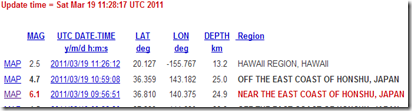
And lastly, the strongest aftershock of the past 48 hours, registering a 6.1, struck at 09:56 UTC near the east coast of Honshu.


There were no immediate reports of damage.
 

image


Given dearth of good news coming out of Japan over the past 8 days, anything even remotely positive is gratefully received.


And quite obviously, given the levels of despair and deprivation in the worst hit regions of northern Japan, government officials are anxious to emphasize whatever progress is being made.


But regardless of short term victories or defeats, the recovery in Japan is going to be a very long, difficult, and painful process. 


One that will likely take years to accomplish, and that has only just barely begun.

Monday, March 14, 2011

NHK News: 2nd Explosion Heard At Fukushima Reactor #2


UPDATE  2035 Hrs:  TEPCO Officials have stated that radiation levels very briefly spiked to 8217 microsieverts/hr outside of reactor #2 after the latest explosion (see Kyodo News Report).


This is roughly 8 times more radiation in an hour than a person might expect to be exposed to in one year.


While those levels have come down considerably, TEPCO cannot discount the possibility that the fuel rods may be damaged or melting.


# 5396


Details are very sketchy at this time, but it appears that another explosion may have struck reactor #2 at the Fukushima nuclear facility at 0614  local time.  


Due to a moderate spike in radiation readings at the plant and a drop in pressure in the suppression pool there is media speculation that there may have been some damage to the containment vessel.


TEPCO officials state they are continuing to inject coolant into the reactor, but some operators have been ordered to evacuate from the facility.   Beyond that, TEPCO officials – even when pressed by reporters – had very little in the way of specifics to relay.


image

Live streaming TV coverage is available from NHK World News.


 image

NHK’s coverage is also available on USTREAM.