Showing posts with label radiation. Show all posts

Monday, September 23, 2013

NPM13: Radiological Emergencies

image

Photo Credit CDC PHE


Note: This is day 23 of National Preparedness Month.  Follow this year’s campaign on Twitter by searching for the #NPM or #NPM13 hash tag.

This month, as part of NPM13, I’ll be rerunning some updated  preparedness essays, along with some new ones (like this one).


# 7801


For most Americans, the idea that we might have to deal with a radiological emergency sounds like something out of the Cold War era (1950s to the1980s), when multiple Soviet warheads were targeted on every major American city and nuclear annihilation seemed all but unavoidable . Today, we’ve pulled back from that brink, have reduced our nuclear stockpiles by 80%, and a global thermonuclear war seems unlikely.


But radiological threats remain, both due to deliberate acts, and due to accidents and natural disasters.   One need look only as far as the Fukushima disaster of 2011 to see how quickly a radiological emergency can affect a large population. 

This from the CDC’s PHE website:


A radiological or nuclear incidents occurring within the U.S. homeland or elsewhere could take a number of forms, including: contamination of food or water with radioactive material; placement of radiation sources in public locations; detonation of radiological dispersal devices that scatter radioactive material over a populated area; an attack on a nuclear power plant or a high-level nuclear waste storage facility; or an improvised nuclear device.


The CDC, HHS, FEMA, and other agencies take these threats seriously, as is evidenced by a multi-million dollar contract let last week by the HHS to stockpile Thrombosomes freeze-dried platelets – used for the treatment of acute radiation sickness.


HHS funds development of freeze-dried platelets for disaster response

New product could improve care for Acute Radiation Syndrome and daily medical care

Date: September 20, 2013

Organization: Cellphire Inc. of Rockville, Md.

Funding: This contract is for $11 million in the first 18 months and can be extended if milestones are met for a total of up to five years and up to $56.7 million.

About this contract:  Cellphire will further develop Thrombosomes as a possible treatment for acute radiation syndrome. Thrombosomes is a novel freeze-dried blood product derived from human platelets.

Using a proprietary stabilization method, Cellphire can convert platelets into a powder that can be stored at room temperature for extended periods. When the product is needed, the powder can be reconstituted rapidly using sterile water and injected to restore normal clotting.

(Continue . . .)


The CDC’s Public Health Emergency Website lists six types of radiological threats, with links to tell you more about them.


Illustration of an IND

Nuclear Emergencies

  • A nuclear emergency involves the explosion of a nuclear weapon or improvised nuclear device (IND).
  • The explosion produces an intense pulse of heat, light, air pressure, and radiation.
  • Nuclear explosions produce fallout (radioactive materials that can be carried long distances by the wind).

Learn more about nuclear emergencies


Illustration of a dirty bomb

Dirty Bomb or Radiological Dispersal Device (RDD)

  • A dirty bomb (also known as a radiological dispersal device) is a mix of explosives such as dynamite, with radioactive powder or pellets.
  • A dirty bomb cannot create an atomic blast.
  • When the explosives are set off, the blast carries radioactive material into the surrounding area.

Learn more about dirty bombs


Illustration of a radiological exposure device

Radiological Exposure Device (RED)

  • A radiological exposure device (also called a hidden sealed source) is made of or contains radioactive material.
  • REDs are hidden from sight to expose people to radiation without their knowledge.

Learn more about radiological exposure devices


Illustration of an power plant accident

Nuclear Power Plant Accident

  • An accident at a nuclear power plant could release radiation over an area.
  • Nuclear power plants have many safety and security procedures in place and are closely monitored by the Nuclear Regulatory Commission (NRC) External Web Site Icon

Learn more about nuclear power plant accidents


Illustration of a transportation accident

Transportation Accidents

  • It is very unlikely that a transportation accident involving radiation would result in any radiation-related injuries or illnesses.
  • Shipments involving significant amounts of radioactive material are required to have documentation, labels, and placards identifying their cargo as radioactive.

Learn more about transportation accidents


Illustration of an occupational accident

Occupational Accidents

  • Radiation sources are found in a wide range of settings such as health care facilities, research institutions, and manufacturing operations.
  • Accidents can occur if the radiation source is used improperly, or if safety controls fail.

Learn more about occupational accidents


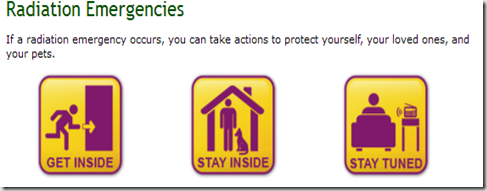
Preparing for a radiological emergency isn’t so very different from what you would do for any other type of disaster.  You want to be prepared to shelter-in-place, stay out of harm’s way, and keep up with advisories.  Steps that are explained on PHE’s  Radiation Emergencies - What should I do?  webpage.


image

Get Inside

Get Inside

In a radiation emergency you may be asked to get inside a building and take shelter for a period of time.

  • This action is called "sheltering in place."
  • Get to the middle of the building or a basement, away from doors and windows.
  • Bring pets inside.

Learn about sheltering options


Stay Inside

Stay Inside

Staying inside will reduce your exposure to radiation.

  • Close and lock windows and doors.
  • Take a shower or wipe exposed parts of your body with a damp cloth.
  • Drink bottled water and eat food in sealed containers.

Learn what to do while taking shelter


Stay Tuned

Stay Tuned

Emergency officials are trained to respond to disaster situations and will provide specific actions to help keep people safe.

  • Use radios, televisions, computers, mobile devices, and other tools to get the latest information.
  • Emergency officials will provide information on where to go to get screened for contamination.
Learn how to stay informed


The goal of NPM2013 is to foster a culture of national preparedness, and to encourage everyone to plan and be prepared to deal with any disaster where they can go at least 72 hours without electricity, running water, local services, or access to a supermarket.

image

These are, of course, minimum goals.


Disruptions that accompany hurricanes, floods, pandemics, and yes . . . even radiological disasters  . .  can potentially last for days or even weeks, and so – if you are able to do so - being prepared for 10 days to 2 weeks makes a good deal of sense (see When 72 Hours Isn’t Enough).


While a radiological hazard may be far down your list of `probable’ threats, the common sense steps you take to prepare for any disaster will serve you well, even in a radiation emergency.  For more on `all hazards’ preparedness, I’d invite you to visit:


FEMA http://www.fema.gov/index.shtm

READY.GOV http://www.ready.gov/

AMERICAN RED CROSS http://www.redcross.org/


And you can use this link to read earlier NPM preparedness posts on this blog.

Tuesday, August 20, 2013

TEPCO Reports New Leak In Fukushima Plant

image

Photo credit IAEA


# 7581


It’s been nearly 2 &1/2 years since the Great East Japan Earthquake and tsunami of March 2011 which sparked the worst nuclear disaster since the Chernobyl meltdown and explosion of 1986.


Over the past 30 months crews have been working to safe and decommission the stricken Fukushima Daiichi #1 nuclear plant – a process that is expected to take decades.


About a month ago, TEPCO (Tokyo Electric Power Company) admitted that the Fukushima nuclear plant was likely leaking contaminated water into the Pacific (see AP article Japan nuclear plant likely contaminating sea).


Overnight, TEPCO announced the discovery of a new leak, which involves highly radioactive water.  The following coverage from AFP, BBC, and Reuters, after which I’ll have more. 


TEPCO reports worst radioactive leak from tank at Japan's Fukushima

AFP

Tuesday, Aug 20, 2013

TOKYO - Some 300 tonnes of radioactive water is believed to have leaked from a tank at Japan's crippled nuclear plant, the worst such leak since the crisis began, the operator said Tuesday.


Tokyo Electric Power Company (TEPCO) said the leak was believed to be continuing Tuesday at Fukushima and it had not yet pinpointed the source of it.


TEPCO said puddles with extremely high radiation levels - about 100 millisieverts per hour - have been found near the water tanks at the ruined plant.


"This means you are exposed to the level of radiation in an hour that a nuclear plant worker is allowed to be exposed to in five years," a TEPCO spokesman told a press conference.

(Continue  . . .)


Fukushima nuclear plant: Radioactive water leak found

BBC 20 August 2013 Last updated at 06:57 ET

Radioactive water has leaked from a storage tank into the ground at Japan's Fukushima plant, its operator says.

Tokyo Electric Power Company (Tepco) said the leak of at least 300 tonnes of the highly radioactive water was discovered on Monday.

(Continue . . .)


Wrecked Fukushima plant springs highly radioactive water leak

By Yoko Kubota and Yuka Obayashi

TOKYO | Tue Aug 20, 2013 10:31am BST

(Reuters) - Contaminated water with dangerously high levels of radiation is leaking from a storage tank at Japan's crippled Fukushima nuclear plant, the most serious setback to the cleanup of the worst nuclear accident since Chernobyl.

(Continue . . .)


While officials are describing this newest leak as a LEVEL 1 incidentthe lowest level of concern on the 7 point International Nuclear and Radiological Event Scale - this is the first such declaration since the initial event in 2011.


The long term effects or implications of this release of radioactive water have not been determined, but at the very least, this is another psychological blow to those living or working in the stricken region.  


Last February, in  WHO: Estimated Health Risks From The Fukushima Radiation Release, we saw a report that stated the radiation risks to those living outside of the immediate Fukushima region were low, but `that the estimated risk for specific cancers in certain subsets of the population in Fukushima Prefecture has increased and, as such, it calls for long term continued monitoring and health screening for those people.’


But the  press release went on to state that cancers are not the only serious long-term health consequences from the Fukushima disaster.


As well as the direct health impact on the population, the report notes that the psychosocial impact may have a consequence on health and well-being. These should not be ignored as part of the overall response, say the experts.


In Disaster’s Hidden Toll, we looked at a report on the  long-term, largely unseen, effect of this disaster on nursing home patients who were forced to evacuate to temporary facilities.


The study showed a 2.4 fold increase in deaths during the 8 months following the earthquake.  Deaths not caused by the quake, tsunami, or radiation release itself – but likely brought on by the stress of having to live in make-shift emergency shelters.


A unusually large number of these excess deaths were due to pneumonia or bronchitis, which many attribute to insufficient emergency shelters provided for the elderly and frail.


We’ve looked at other post-disaster health impacts in the past, such as in Post Disaster Stress & Suicide Rates. One disaster discussed was a 1999 7.3 earthquake that struck in Chi-Chi, Nantou county in central Taiwan killing more than 2,300 people.


A study that subsequently appeared in the Taiwan Journal of Medicine (Disease-specific Mortality Associated with Earthquake in Taiwan Hsien-Wen Kuo, Shu-Jen Wu, Ming-Chu Chiu) found `a considerable increase in the number of suicides after the earthquake’.

PTSD (Post Traumatic Stress Disorder) can often occur in the wake of a disaster or traumatic experience. Symptoms may include anxiety, depression, suicide and PTSD may even lead to drug and alcohol-related disorders.


Two weeks ago in WHO: Guidelines For Post-Trauma Mental Health Care we looked at a new report from the World Health Organization on post-disaster management of stress-related illness.


image

Credit WHO


The aftermath of disasters often results in social, economic, and psychological upheavals (see Surviving A Different Kind Of Aftershock).


Our short attention span, combined with the news media’s proclivity for moving on to the next big disaster or story, can make us forget that the struggle to rebuild devastated families and communities can take years.


Although a good disaster plan and emergency kit are imperative to get you through the opening hours and days of a disaster, knowing how to help friends, family, and neighbors deal with the psychological effects of a disaster can be equally important.


In Psychological First Aid: The WHO Guide For Field Workers we looked a simple guidebook anyone can use to help others in emotional distress.


The CDC also provides a website which contains a number of resources devoted to coping with disasters.


Coping With a Disaster or Traumatic Event

Trauma and Disaster Mental Health Resources

The effects of a disaster, terrorist attack, or other public health emergency can be long-lasting, and the resulting trauma can reverberate even with those not directly affected by the disaster. This page provides general strategies for promoting mental health and resilience. These strategies were developed by various organizations based on experiences in prior disasters.


As does the National Center For PTSD - including videos - on how to provide Psychological First Aid.

Psychological First Aid: Field Operations Guide

Psychological First Aid

For Disaster Responders

Developed jointly with the National Child Traumatic Stress Network, PFA is an evidence-informed modular approach for assisting people in the immediate aftermath of disaster and terrorism: to reduce initial distress, and to foster short and long-term adaptive functioning.


A small reminder that not all wounds bleed, not all fractures will show up on an X-ray, and that the best treatment may not always reside inside your first aid kit.

Thursday, February 28, 2013

WHO: Estimated Health Risks From The Fukushima Radiation Release


 image


# 6973


The World Health Organization has today published a 172-page Health risk assessment from the nuclear accident after the 2011 Great East Japan earthquake and tsunami, based on a preliminary dose estimation  based on a preliminary estimate of radiation doses published in May 2012.


First some excerpts from the press release, then I’ll be back with a little more.


Global report on Fukushima nuclear accident details health risks

News release

28 February 2013 | GENEVA - A comprehensive assessment by international experts on the health risks associated with the Fukushima Daiichi nuclear power plant (NPP) disaster in Japan has concluded that, for the general population inside and outside of Japan, the predicted risks are low and no observable increases in cancer rates above baseline rates are anticipated.


The WHO report ‘Health Risk Assessment from the nuclear accident after the 2011 Great East Japan Earthquake and Tsunami based on preliminary dose estimation’ noted, however, that the estimated risk for specific cancers in certain subsets of the population in Fukushima Prefecture has increased and, as such, it calls for long term continued monitoring and health screening for those people.


Experts estimated risks in the general population in Fukushima Prefecture, the rest of Japan and the rest of the world, plus the power plant and emergency workers that may have been exposed during the emergency phase response.


“The primary concern identified in this report is related to specific cancer risks linked to particular locations and demographic factors,” says Dr Maria Neira, WHO Director for Public Health and Environment. “A breakdown of data, based on age, gender and proximity to the nuclear plant, does show a higher cancer risk for those located in the most contaminated parts. Outside these parts - even in locations inside Fukushima Prefecture - no observable increases in cancer incidence are expected.”


In terms of specific cancers, for people in the most contaminated location, the estimated increased risks over what would normally be expected are:

  • all solid cancers - around 4% in females exposed as infants;
  • breast cancer - around 6% in females exposed as infants;
  • leukaemia - around 7% in males exposed as infants;
  • thyroid cancer - up to 70% in females exposed as infants (the normally expected risk of thyroid cancer in females over lifetime is 0.75% and the additional lifetime risk assessed for females exposed as infants in the most affected location is 0.50%).

For people in the second most contaminated location of Fukushima Prefecture, the estimated risks are approximately one-half of those in the location with the highest doses.


The report also references a section to the special case of the emergency workers inside the Fukushima NPP. Around two-thirds of emergency workers are estimated to have cancer risks in line with the general population, while one-third is estimated to have an increased risk.


The almost-200-page document further notes that the radiation doses from the damaged nuclear power plant are not expected to cause an increase in the incidence of miscarriages, stillbirths and other physical and mental conditions that can affect babies born after the accident.


“The WHO report underlines the need for long-term health monitoring of those who are at high risk, along with the provision of necessary medical follow-up and support services,” says Dr Maria Neira, WHO Director for Public Health and Environment. “This will remain an important element in the public health response to the disaster for decades.”

(Continue . . . )


This press release deals primarily with the relative increases in risk among populations living or working very close to the Fukushima nuclear accident who received the highest exposure to radiation.


While relative risk is a valid way of looking at this accident’s impact - it is also helpful to look at the absolute risk (which is done in the FAQ and in the actual report) - particularly when looking at cancers that have a low baseline rate.


  • The largest increase in relative risk was for developing thyroid cancer among infant girls in their lifetime. The baseline rate in Japan is roughly .75% (1 in 133). Those living closest to the radiation leaks are expected to see a 70% increase, which elevates the absolute risk to approximately 1.25% (1 in 80).


  • Another example is breast cancer, which carries a lifetime risk of 5.53% (1 in 18).  The 6% increase in females exposed as infants raises that to 5.89% (1 in 17).


  • Lifetime leukemia risks in infant boys is estimated at roughly .60% (1 in 165). Adding in the extra Fukushima radiation exposure adds an additional 7% risk, which raises absolute risk to .64%  (1 in 156).


None of which is meant to minimize the overall impact of this nuclear accident in the least, or the devastating individual and family impacts that these additional cancers will bring.


But it does help to put these numbers in perspective.


Additional resources from WHO on the Fukushima radiation release include:


And lastly, as the press release notes, cancers are not the only serious long-term health consequences from the Fukushima disaster.


As well as the direct health impact on the population, the report notes that the psychosocial impact may have a consequence on health and well-being. These should not be ignored as part of the overall response, say the experts.

Tuesday, July 17, 2012

Estimating Fukushima’s Health Impact


image

Photo credit IAEA


# 6438


While the worst fears from last year’s radiation release from Japan's Fukushima Daiichi nuclear disaster have not been realized, the long-term health impacts remain largely unknown. 


Today, researchers at Stanford University have released a modeling study – published in the journal Energy and Environmental Science – that attempts to quantify the mortality and morbidity due to that nuclear release.


Worldwide health effects of the Fukushima Daiichi nuclear accident

John E. Ten Hoeve and Mark Z. Jacobson

Energy Environ. Sci., 2012, Advance Article

Abstract

A 3-D global atmospheric model evaluated against data is used to quantify worldwide health effects from the Fukushima nuclear accident.


As you will see, the actual numbers are fairly low, but the range of possibilities is considerable. The press release from Stanford University provides us with the details.


Stanford researchers calculate global health impacts of the Fukushima nuclear disaster

Radiation from Japan's Fukushima Daiichi nuclear disaster may eventually cause anywhere from 15 to 1,300 deaths and from 24 to 2,500 cases of cancer, mostly in Japan, Stanford researchers have calculated.


The estimates have large uncertainty ranges, but contrast with previous claims that the radioactive release would likely cause no severe health effects.


The numbers are in addition to the roughly 600 deaths caused by the evacuation of the area surrounding the nuclear plant directly after the March 2011 earthquake, tsunami and meltdown.


Recent PhD graduate John Ten Hoeve and Stanford civil engineering Professor Mark Z. Jacobson, a senior fellow at the Precourt Institute for Energy and the Stanford Woods Institute for the Environment, are set to publish their findings Tuesday (July 17) in the journal Energy and Environmental Science. The research constitutes the first detailed analysis of the event's global health effects.


(Continue . . . )


As Professor Emeritus of Statistics at the University of Wisconsin George E. P. Box famously observed:


All models are wrong, but some models are useful.”


While this study may not be the last word on the health impacts from Fukushima, and it only provides a range of effects, it at least provides a starting point. 


Interestingly, the authors modeled what a similar meltdown would look like if it occurred in the United States. 


From the press release:


To test the effects of varying weather patterns and geography on the reach of a nuclear incident, the two researchers also analyzed a hypothetical scenario: an identical meltdown at the Diablo Canyon Power Plant, near San Luis Obispo, Calif.


Despite California's population density being about one-fourth that of Japan's, the researchers found the magnitude of the projected health effects to be about 25 percent larger.


The model showed that rather than being whisked toward the ocean, as with Fukushima, a larger percentage of the Diablo Canyon radioactivity deposited over land, including population centers such as San Diego and Los Angeles.


Jacobson stressed, however, that none of the calculations expressed the full scope of a nuclear disaster.


"There's a lot more to the issue than what we examined, which were the cancer-related health effects," he said. "Fukushima was just such a large disaster in terms of soil and water contamination, displacement of lives, confidence in government oversight, cost and anguish."


In May we saw the WHO Report On Radiation Exposure From Fukushima Reactor Accident, which concluded that:


. . . the estimated effective doses outside Japan from the Fukushima Daiichi NPP accident are below (and often far below) dose levels regarded as being very small by the international radiological protection community. Low effective doses are also estimated in much of Japan.


Another report is expected from the World Health Organization later this summer that will attempt to quantify the short and long term health-risk due to exposure to radioactivity from Fukushima.


It will be interesting to compare those findings with the ones released today.

Wednesday, May 23, 2012

WHO Report On Radiation Exposure From Fukushima Reactor Accident


# 6341


Today, a little more than a year after Japan’s catastrophic earthquake and tsunami, the World Health Organization has released a 120 page preliminary assessment of radiation exposure from the crippled nuclear plants in Fukushima Japan.


Preliminary Dose Estimation from the nuclear accident after the 2011 Great East Japan Earthquake and Tsunami

 Authors:
WHO

Publication details

Number of pages: 120
Publication date: 2012
Languages: English
ISBN: 9789241593662

Downloads
Overview

The earthquake and tsunami in Japan on 11 March 2011 led to releases of radioactive material into the environment from the Fukushima Daiichi nuclear site. This report describes a preliminary estimate of radiation doses to the public resulting from this accident. These doses are assessed for different age groups in locations around the world, using assumptions described in the report.


The dose assessment forms one part of the overall health risk assessment being carried out by WHO of the global impact of the accident at the Fukushima Daiichi nuclear power plant. The health risk assessment is the subject of a separate WHO report which will be published in Summer 2012.

Related links


From the FAQ page, we get the bottom line, and for just about everyone living outside of Fukushima and neighboring prefectures, the news is very reassuring.


Q5. What does the report conclude?

It can be concluded that the estimated effective doses outside Japan from the Fukushima Daiichi NPP accident are below (and often far below) dose levels regarded as being very small by the international radiological protection community. Low effective doses are also estimated in much of Japan.


In the Fukushima prefecture and in neighbouring prefectures the effective doses are estimated to be below 10 mSv, which can be considered within the order of magnitude of the natural radiation background, except in two locations. In these two locations in the most affected part of Fukushima prefecture, the effective doses were estimated to be within a dose band of 10–50 mSv. Please see table 3 for more data on effective doses, and table 8 for comparative effective dose levels in different contexts.


This report focuses on effective dose as an appropriate measure given that it takes into account both internal and external exposures. In addition, the report includes information about thyroid doses because of this organ’s capacity for iodine concentration.


It is important to note that effective doses and thyroid doses are two different quantities that cannot be compared. Thyroid doses are organ-specific equivalent doses. See table 4 for data on specific exposure to thyroid doses.


As far as the short and long term health-risk due to exposure to radioactivity, a report is expected from the WHO later this summer.

Friday, October 21, 2011

BMJ: Another Reassuring Report On Cell Phones & Brain Cancer


image

# 5914


Yesterday, the British Medical Journal published the results of a follow up to large Danish cohort study that found no link between cell phone usage and an increase in brain tumors.


Although evidence for it has been scant, for a number of years some scientists have expressed concerns that prolonged exposure to cell phone RF (radio frequency) electromagnetic fields might cause certain types of head and neck cancers.


In 2010, the International Agency for Research on Cancer (IARC) released their long-delayed INTERPHONE report, which was unable to establish a link between cell phone use and brain tumors  (see The IARC Cell Phone Report).


Despite that initial finding, a year later (May 2011) the IARC released a statement (IARC Press Release N° 208) that listed mobile phone use in same `possibly’ carcinogenic hazard category as exposure to gasoline, engine exhaust and lead.


For details on this statement, you may wish to revisit IARC: Cell Phones `Possibly Carcinogenic’.


A couple of months later we saw a study that appeared in the Journal of the National Cancer Institute (see Reassuring Study On Cell Phones & Brain Cancer Risks) that found no link between cell phone use and brain tumors in children and adolescents.


While it is unlikely to be the final word on the subject, the study published yesterday in the BMJ follows up on the largest cohort study on mobile phone users to date.


And once again, the news is reassuring; long-term subscribers to cellular phone services showed no increase in brain or central nervous system tumors over non-subscribers. 


Use of mobile phones and risk of brain tumours: update of Danish cohort study

OPEN ACCESS

BMJ 2011; 343:d6387

Patrizia Frei, Aslak H Poulsen, Christoffer Johansen,  Jørgen H Olsen, Marianne Steding-Jessen,  Joachim Schüz

ABSTRACT

Participants All Danes aged ≥30 and born in Denmark after 1925, subdivided into subscribers and non-subscribers of mobile phones before 1995.


Main outcome measures Risk of tumours of the central nervous system, identified from the complete Danish Cancer Register. Sex specific incidence rate ratios estimated with log linear Poisson regression models adjusted for age, calendar period, education, and disposable income.


Results 358 403 subscription holders accrued 3.8 million person years. In the follow-up period 1990-2007, there were 10 729 cases of tumours of the central nervous system. The risk of such tumours was close to unity for both men and women. When restricted to individuals with the longest mobile phone use—that is, ≥13 years of subscription—the incidence rate ratio was 1.03 (95% confidence interval 0.83 to 1.27) in men and 0.91 (0.41 to 2.04) in women. Among those with subscriptions of ≥10 years, ratios were 1.04 (0.85 to 1.26) in men and 1.04 (0.56 to 1.95) in women for glioma and 0.90 (0.57 to 1.42) in men and 0.93 (0.46 to 1.87) in women for meningioma. There was no indication of dose-response relation either by years since first subscription for a mobile phone or by anatomical location of the tumour—that is, in regions of the brain closest to where the handset is usually held to the head.


Conclusions In this update of a large nationwide cohort study of mobile phone use, there were no increased risks of tumours of the central nervous system, providing little evidence for a causal association.


While this study was subject (as are all studies) to some limitations, In an accompanying BMJ editorial (Mobile telephones and brain tumours) professors Anders Ahlbom and Maria Feychting called the evidence in this report `reassuring’.


They cautioned, however, that `continued monitoring of health registers and prospective cohorts is still warranted.’

Thursday, June 09, 2011

NHK News:`Widespread’ Strontium-90 Contamination In Fukushima


# 5616


image

Photo credit NHK World NewsVideo Link


Those with long memories will recall that it was concerns over the accumulation of radioactive strontium-90 in milk (and in humans that consumed that milk) that led to the banning of above-ground nuclear testing in 1963.


Prior to that time, incredibly, hundreds of above-ground atomic tests were conducted all around the world, releasing significant quantities of radioactive isotopes including (americium-241, cesium-137, iodine-131, strontium-90).


But it was strontium-90 - which acts much like calcium in the human body - that was of particular concern as it ends up deposited in bones and teeth, raising serious concerns over future cancer risks.


Back in April Crofsblog carried an NHK report on low levels (3.3 to 32 becquerels) of Strontium-90 detected last March in regions around the stricken power plant (see Fukushima: Strontium-90 detected outside 30 km zone).


Today, NHK World News is reporting on considerably higher levels of strontium-90 detected in some of the eleven samples taken outside of the 30km evacuation zone – including Fukushima City - some 60 km from the site of the nuclear accident.


Survey: strontium widespread in Fukushima

Thursday, June 09, 2011 06:02 +0900 (JST)

Soil samples from around Fukushima Prefecture have revealed concentrations of radioactive strontium.
Japan's science ministry conducted a survey for radioactive substances at 11 locations in 10 municipalities from late March to mid-May.


It says strontium-90 was detected in all 11 locations.
In Namie Town, the reading stood at 250 becquerels per kilogram of soil, while in Iitate Village the reading was 120 becquerels per kilogram. The readings in the other locations were between 2 and 18 becquerels.

(Continue . . . )


According to this report, Japan’s Nuclear Safety Commission insists that the detected levels of strontium are minor, and do not pose any immediate health risk.


A radiation expert at a hospital in Fukushima City disagrees.  Dr. Doctor Osamu Saito says even small quantities of strontium-90 pose a high health risk.


Whatever the ultimate health risks involved, the news of greater radioactive contamination – particularly from a persistent isotope like strontium - is bound to increase the public’s concerns.


As I wrote yesterday (see A Different Kind Of Nuclear Fallout), public confidence in the safety of nuclear energy production in Japan will be crucial if the plants that are shut down now – or are scheduled for maintenance shutdown over the next 12 months – are to be restarted.

Tuesday, June 07, 2011

Cutting Through The Fukushima Fog


# 5610

image

Photo credit IAEA


As I noted in The Fog Of Disaster Reporting, written less than 48 hours after the earthquake/tsunami combination that devastated northern Japan, my confidence level in the accuracy of many of the stories coming out of the disaster zone was pretty low.


So low, that in many cases I opted not to use them in this blog.


Since then, we’ve learned that the nuclear accident at the Fukushima Daiichi facility was much worse than first reported. 


Despite what we now know was a meltdown of three reactors within hours of the quake, the severity level of the incident was held at a 5 for a full month (the same as Three Mile Island), before being raised to a  Chernobyl-comparable level 7 on April 11th.


Today, the Yomiuri News Agency is reporting that two of these damaged reactors may have suffered a `Melt Through’ – an even more serious event than a meltdown –where nuclear fuel actually melted through the walls or floors of reactor vessel.


Melted Fuel at Fukushima May Have Leaked Through, Yomiuri Says

By Go Onomitsu - Jun 7, 2011 2:02 AM ET


NHK World News is also reporting that today (Tuesday) a government appointed expert panel met for the first time to investigate the Fukushima nuclear accident (see Govt panel on nuclear accident holds 1st meeting).


The panel is expected to produce an interim report by the end of the year, but according to committee's head - Professor Emeritus at the University of Tokyo, Yotaro Hatamura - will not aim to clarify who is responsible for the accident.


Meanwhile, just hours before the first meeting of this expert panel was held, it was revealed that the amount of radiation released from the damaged Fukushima facility during the first week of the disaster was likely more than double what had previously been estimated.


Japan doubles plant radiation leak estimate

(AFP) – 4 hours ago

TOKYO — Japan has more than doubled its initial estimate of radiation released from the crippled Fukushima nuclear plant in the week after the March 11 tsunami, ahead of the launch of an official probe Tuesday.


The nation's watchdog, the Nuclear and Industrial Safety Agency (NISA), now says it believes 770,000 terabecquerels escaped into the atmosphere in the first week -- compared to its earlier estimate of 370,000 terabecquerels.

(Continue . . . )


The hits, as they say, just keep on coming.


There are now concerns that the environmental contamination surrounding the plant may be worse than previously suspected, and that people beyond the 20 km evacuation radius may have been exposed to more radiation than previously thought.


These belated and incrementally worsening status reports from plant operator TEPCO and Japan’s Nuclear Safety Commission probably won’t do a lot to inspire confidence in their future pronouncements.


Of course, early reports from the ground during any major disaster are usually fragmentary, often misleading, and occasionally just downright wrong.


How much of this `bad information’ is due to attempts to `manage’ the crisis by doling out bad news a piece at a time – and how much comes from a genuine impenetrable `fog’ of disaster – is hard to know.


Often it is a mixture of both.


But as was noted last month in  Sandman & Lanard On Worst-Case Crisis Communications, it is important for officials to get out in front of any crisis.


Playing catch-up, or worse, appearing to intentionally withhold bad news, can make a bad situation worse.


Telling the truth and telling it early, are key points to effective crisis communications.


Simple advice, yet it is often ignored.


In Japan’s nuclear crisis: The need to talk more candidly about worst case scenarios Peter Sandman wrote:


The main communication problem results from the public’s inability to know how much of the situation is under how much control, and what might happen if things get worse. Japanese officials have not helped us to understand that.


Worse, they have not communicated in ways that encourage us both to trust that they are telling us everything they know and everything they’re worried about, and to trust that they know what they are doing.


And earlier, in Cultural differences regarding Fukushima crisis communication Peter wrote about the consensus document on crisis communications from the World Health Organization  entitled “WHO Outbreak Communication Guidelines”.


In an excerpt from the section on Announcing early”, it states:


People are more likely to overestimate the risk if information is withheld. And evidence shows that the longer officials withhold worrisome information, the more frightening the information will seem when it is revealed, especially if it is revealed by an outside source….


Early announcements are often based on incomplete and sometimes erroneous information. It is critical to publicly acknowledge that early information may change as further information is developed or verified.


Peter Sandman Website logo


For anyone even remotely involved as a spokesperson for an agency, organization, or company during a crisis, their site should be viewed as essential reading. 


Unfortunately, the stream of continually revised information coming out of Japan over the past three months appears more akin to the hoary old tale of the wealthy Englishman who, after traveling the world for many months, called home and spoke to his butler.


"Well James, has anything happened in my absence?"


"Yes, sir.  Your dog died."


"He died? Whatever from?  He was a young pup."


"Probably from eating burned horse flesh, sir."


"Burned horseflesh?  Where on earth did he get burned horseflesh?"


"From the stables, Sir. They burned to the ground two weeks ago."


"How did the stables catch fire?"


"Probably flames from the house, sir."


"The house burned down too!  How did that happen?


"We suspect the drapes caught fire from the candles, sir."


"Candles!  We have electricity. Why on earth were you using candles?"


"They were around your mother's coffin in the parlor, sir."


"Mum is dead!  My God James, what happened!"


"Well Sir, we suspect it was from the shock of your wife running off with the gardener . . ."


You get the idea.


While the exchange above may make for good comedy, any semblance of it in the real world makes for lousy crisis communications.

Monday, April 25, 2011

NSC: Fukushima Radiation Leak Underestimated


# 5519


image

Photo credit IAEA


Six weeks after the combination earthquake and tsunami that devastated Japan and severely damaged several nuclear reactors we continue to get revised estimates on the amount of radioactivity that has been (and is being) released into the atmosphere.


On April 5th, Japan’s Nuclear Safety Commission (NSC) estimated that the release of radiation from the Fukushima No. 1 nuclear power plant as being "less than 1 terabecquerel per hour."


Which would make the daily release somewhat under 24 terabecquerels.


Today the Daily Yomiuri (Yomiuri Shimbun) (h/t Makoto on FluTrackers)  is reporting that the NSC revised their estimates over the weekend, raising them to 154 terabecquerels per day as of April 5th.


Or a rate at least 6 times higher than previously stated.


This report from the Yomiuri Shimbun.


Atmospheric radiation leak underestimated

The Yomiuri Shimbun

Data released by the government indicates radioactive material was leaking into the atmosphere from the Fukushima No. 1 nuclear power plant in early April in greater quantities than previously estimated.


Radioactive material was being released into the atmosphere from the plant at an estimated rate of 154 terabecquerels per day as of April 5, according to data released by the Cabinet Office's Nuclear Safety Commission on Saturday.


The NSC previously estimated radiation leakage on April 5 at "less than 1 terabecquerel per hour."

(Continue . . .)


Given that TEPCO’s plans don’t call for stopping the radiation release for another 2 or 3 months, this is less than encouraging news.

Thursday, April 14, 2011

Fukushima: A 10-Year Decommissioning Plan


# 5492


Although a decade is a long time to deal with a crisis, compared to other estimates (see ABC News Crews 'facing 100-year battle' at Fukushima), today’s report actually sounds optimistic.


image

Photo credit IAEA


The plan comes from manufacturing giant Toshiba, which helped build the Fukushima Daiichi plant, and was generated in consort with 4 US companies in the nuclear industry.


It envisions a 3-phase decommissioning and cleanup strategy, with the first phasecooling and stabilizing the reactors and spent fuel pools – expected to take several months


Phase II – removing the nuclear fuel rods – would take 5 years.


And Phase III - dismantling the reactors and environmental cleanup – will take another 5 years.


NHK World News has more in the following report:


Reactor makers draft 10-year decommission plan

updated at 13:57 UTC, Apr. 14

Tuesday, April 12, 2011

IAEA Briefing On Fukushima Severity Level


# 5486


The International Atomic Energy Agency (IAEA) released an update over the last few hours on the revision to the Fukushima severity level I reported last night (see Fukushima: Brief Fire, 6.4 Aftershock & Severity Level To Be Raised).


While sharing the same severity level as Chernobyl, Japan’s Nuclear and Industrial Safety Agency (NISA) is quick to point out that the amount of radiation released from Fukushima is estimated to be 1/10th that of the Russian disaster.


NISA, however, has come under increasing criticism for its handling of the disaster and the speed in which it has released radiation readings from the reactor facilities and surrounding areas.


There have been frequent calls from the public, international agencies, and world governments for better dissemination of information on the nuclear crisis (including Kyoto News China urges Japan to release timely, precise info on nuke crisis).


Yesterday NISA publicly admitted that their actions have not always been adequate for the task at hand (see NHK News Nuclear safety regrets its response to Fukushima).


Events and admissions that are likely to do little to assuage criticism and frustration over NISA’s ongoing assessment and handling of the nuclear risks at Fukushima.


Here is the IAEA update, followed by links to the NISA announcement.


IAEA Update on Fukushima Nuclear Accident (12 April 2011, 4:45 UTC)

by International Atomic Energy Agency (IAEA) on Tuesday, April 12, 2011 at 12:43am

The Japanese Nuclear and Industrial Safety Agency (NISA) today issued a new provisional rating for the accident at the Fukushima Daiichi nuclear power plant on the IAEA International Nuclear and Radiological Event Scale (INES).


The nuclear accident at Fukushima Daiichi is now rated as a level 7 "Major Accident" on INES. Level 7 is the most serious level on INES and is used to describe an event comprised of "A major release of radioactive material with widespread health and environmental effects requiring implementation of planned and extended countermeasures." Japanese authorities notified the IAEA in advance of the public announcement and the formal submission of the new provisional rating.


The new provisional rating considers the accidents that occurred at Units 1, 2 and 3 as a single event on INES. Previously, separate INES Level 5 ratings had been applied for Units 1, 2 and 3. The provisional INES Level 3 rating assigned for Unit 4 still applies.


The re-evaluation of the Fukushima Daiichi provisional INES rating resulted from an estimate of the total amount of radioactivity released to the environment from the nuclear plant. NISA estimates that the amount of radioactive material released to the atmosphere is approximately 10 percent of the 1986 Chernobyl accident, which is the only other nuclear accident to have been rated a Level 7 event.


Earlier ratings of the nuclear accident at Fukushima Daiichi were assessed as follows:


On 18 March, Japanese authorities rated the core damage at the Fukushima Daiichi 1, 2 and 3 reactor Units caused by loss of all cooling function to have been at Level 5 on the INES scale. They further assessed that the loss of cooling and water supplying functions in the spent fuel pool of the Unit 4 reactor to have been rated at Level 3.


Japanese authorities may revise the INES rating at the Fukushima Daiichi nuclear power plant as further information becomes available.


INES is used to promptly and consistently communicate to the public the safety significance of events associated with sources of radiation. The scale runs from 0 (deviation) to 7 (major accident).


For further information on the INES scale:

http://www-ns.iaea.org/tech-areas/emergency/ines.asp

Further details regarding this development can be found in the following NISA press release:

http://www.nisa.meti.go.jp/english/files/en20110412-4.pdf

Monday, April 11, 2011

Fukushima: Brief Fire, 6.4 Aftershock & Severity Level To Be Raised


# 5485


According to NHK World News Japan’s Nuclear Safety Agency today has decided to raise the severity level of the multiple crises at the Fukushima Nuclear facility from a 5 (on par with Three Mile Island) to a 7 – the same level assigned to the 1985 Chernobyl disaster.


It is still believed that the amount of radiation released at the Fukushima plant is less than what was released at Chernobyl, however.


This decision comes a month after the devastating 9.0 earthquake and tsunami that disabled and severely damaged at least 4 reactors at the Fukushima Daiichi facility.


An announcement will be made via a press conference to be held Tuesday morning (Japan Time).  


This from NHK News.


Japan to raise Fukushima crisis level to worst

Tuesday, April 12, 2011 05:47 +0900 (JST)

The Japanese government's nuclear safety agency has decided to raise the crisis level of the Fukushima Daiichi power plant accident from 5 to 7, the worst on the international scale.

The Nuclear and Industrial Safety Agency made the decision on Monday. It says the damaged facilities have been releasing a massive amount of radioactive substances, which are posing a threat to human health and the environment over a wide area.

(Continue . . . )


In other news, a brief fire broke out at reactor # 4 a short time ago (around 6:30 am local time), but appears now to be extinguished.  The following report is from Reuters.


Fire seen at Fukushima nuclear plant; flames no longer visible

  • Mon Apr 11, 2011 7:53pm EDT

(Reuters) - A fire broke out at Japan's crippled Fukushima Daiichi nuclear power plant, operator Tokyo Electric and Power (TEPCO) said on Tuesday, although flames and smoke were no longer visible.

(Continue . . . )


And another strong (6.4 Mag), very shallow (13.1 km) aftershock struck just after 8am local time,  77 km ESE of Tokyo.  No Tsunami warning was issued, and thus far there are no reports of fresh damage or injuries.


image

MAP 6.4  2011/04/11 23:08:16  35.406   140.542 13.1 
NEAR THE EAST COAST OF HONSHU, JAPAN

Wednesday, April 06, 2011

CDC Q&A On Radioactive Iodine In Milk


# 5466


With the reactor crises in Japan still front page news – and likely to remain so for months – naturally there is concern in this country, and around the world, about how radioactive releases may affect our health.


Although there are – according to this New York Times Article – many daunting challenges in the way of safely shutting these reactors down, for now at least, the levels of radiation released from the Fukushima facility do not pose a public health hazard beyond Japan.


Given the often breathless media reporting on the (real and imagined) public health threats posed by radiation being dispersed from these damaged plants, an occasional reality check is advisable.


To that end, the CDC maintains a webpage on Radiation Emergencies, which includes a number of Fukushima specific pages.


image


Although low levels of radioactive iodine 131 have been detected in the United States (and globally), the levels remain well below the level of public health concern.


Due to public interest in the matter, the CDC has released a new Q&A on radioactive iodine in milk:


Frequently Asked Questions About Iodine-131 Found in Milk

Is it safe to drink milk?

Yes. People do not need to stop drinking milk because of concerns about radiation at these low levels. The levels of Iodine-131 found in milk are extremely low, and many times less than the FDA intervention level.

What are the levels that would start to affect my thyroid?

The level of Iodine-131 that would affect thyroid health depends on many factors. The developing fetus, newborns, infants, and young children are particularly sensitive to iodine-131. The FDA’s level for intervention is conservative and provides a large safety margin to protect public health.

How long will there be traces of iodine-131 from Japan in milk?

Given the uncertainty related to the nuclear reactors in Japan, we don’t know how levels of Iodine-131 currently seen in milk may change over time. However, we do know that Iodine-131 becomes less radioactive quickly in the environment. We are continuing to monitor milk so that we know when levels go up or down.

Are there any groups of people that are especially sensitive to iodine-131?

The developing fetus, newborns, infants and young children are particularly sensitive to iodine-131. However, levels being measured now are still many times below the FDA intervention level, even for these groups.

Why does Iodine-131 collect in milk?

Airborne Iodine-131 that deposits on pastures may be consumed by dairy cows.  A portion of the Iodine-131 consumed by a cow would then be transferred into the cow's milk.

Should I drink goat’s milk or other types of milk?

Historically, when cow’s milk has been affected by Iodine-131, so has goat’s milk.

What if I have thyroid disease? Would Iodine-131 affect me any differently?

The effects of Iodine-131 on health depend on many factors.  At this time, levels of Iodine-131 are still many times below the FDA intervention level.  If you have specific questions or concerns, contact your physician.


You’ll also find a variety of Japan-related briefings on nuclear radiation on the CDC website, including:


Japan: Radiation and Health

Fact Sheets


Those with long memories will recall that it was concerns over the accumulation of radioactive strontium-90 in milk (and the environment) that led to the banning of above-ground nuclear testing in 1963.


Prior to that time, incredibly, hundreds of above-ground atomic tests were conducted all around the world, releasing significant quantities of radioactive isotopes including (americium-241, cesium-137, iodine-131, strontium-90).


Strontium-90, which acted much like calcium in the human body, was of particular concern as it ended up deposited in bones and teeth, raising serious concerns over future cancer risks.


It is worth noting that radioactive iodine 131– with a half-life of just 8 days – poses far less danger than strontium-90, whose half-life was nearly 3 decades.


While far removed from today’s situation, some of you may find the  EPA’s extensive web site on above-ground nuclear testing during the `bad old days’, and the types of radioactive isotopes released, worth exploring (see Above-Ground Nuclear Blasts).


For those interested in monitoring local radiation levels in your region, you can visit the EPA’s RadNet website.


image


By visiting the RadNet Site you can click on the map (pictured above) and get real-time readout of current and recently detected radiation readings from scores of locations around the nation.


The EPA is also posting Daily Summaries on the radiation impact on the United States, along with regular statements.

Tuesday, April 05, 2011

NHK: Fukushima Leak `Appears To Be Lessening’


# 5464


Anything remotely resembling optimism on the damaged reactors at the Fukushima nuclear facility has been exceedingly hard to find over the past 3 weeks.


Since the March 11th earthquake and tsunami we’ve watched a steady stream of stories on radiation releases and TEPCO’s failed attempts to stop them coming from the press.


Today, however, from NHK World News; a bit of optimism on TEPCO’s attempts to reduce the flow of highly radioactive water leaking from the reactor into the sea.


After several failed attempts, the injection of liquid glass into the concrete pit appears to have lessened somewhat the rate of flow of radioactive water and further injections are planned.


Whether this leak can be permanently sealed remains to be seen.


This from NHK World News.


Leak at Fukushima appears to be lessening

The operator of the crisis-hit Fukushima nuclear plant has injected a hardening agent beneath a leaking concrete pit in a bid to stem the flow of highly radioactive water into the sea.


The firm says the leakage seems to be decreasing, following the infusion of the hardening agent.


The utility showed reporters a photo of the leak on Tuesday evening, saying it indicates such a decrease.
TEPCO said it will infuse another 1,500 liters of liquid glass.


(Continue . . . )


Elsewhere, the news isn’t nearly as optimistic, with these reports among the top stories out of Japan today.