Showing posts with label Referral. Show all posts

Thursday, May 14, 2015

Referral: Mackay On The Road To Zero Ebola Cases In West Africa

image

Credit Dr. Ian Mackay VDU Blog 


# 10,050


Nine months ago were were staring at a nearly apocalyptic worst case estimate of between 550,000 and 1.4 million Ebola cases in Liberia and Sierra Leone by the end of January 2015  - if interventions were not implemented - (see MMWR: Estimating The Future Number of Cases In The Ebola Epidemic).


Of course, interventions were implemented, and that harrowing estimate was never realized. 


Not that one can take a lot of comfort from a tally that conservatively shows nearly 27,000 cases and just over 11,000 deaths.  This single outbreak affected six times more people than all of the previously known outbreaks (1996-2014) combined.


But it wasn’t as bad as it could have been.  And indications are that – barring something unforeseeable – this West African Ebola outbreak may be nearing an end.


This round up and commentary from Dr. Ian Mackay, from which I’ve only excerpted a snippet.  Follow the link to read it in its entirety:


Liberia gave Ebola the boot...and a virus may soon be removed from the wild

image

The people of Liberia have earned our respect, some time for national celebrations and frankly any other rewards that may flow from denying the Makona variant of Ebola virus any hosts among their community.


The world considered this viral species to be one of the list-toppers when it came to ranking the causes of the most scary acute infectious diseases. Ebola virus has been the basis for all sorts of 'end-of 'the-world' mutating virus horror movies, books, and TV shows. It's not at all surprising that the public view of an Ebola virus infection had long been one of blood, fear and terror.

(Continue . . . )

Thursday, May 07, 2015

Referral: McKenna Blogs On Avian Flu

image

Credit MBAH


# 10,021


Few of my readers will need an introduction to author and blogger Maryn McKenna, who now writes for National Geographic.  The archive of her long-running Wired Superbug blog contains some of the best coverage of the growing antibiotic resistance issues facing modern medicine . Her award winning book Superbug: The Fatal Menace of MRSA is a superlative and eye-opening read.


And Maryn is certainly no stranger to the topics of avian flu and the safety of our food supply.


So, knowing when it is better just make a quick introduction and step quickly aside, I will simply point you towards Maryn’s Nat Geo blog today, entitled:


The Avian Flu Epidemic: Massive Impact, Uncertain Future

by Maryn McKenna

You might have to be an avid reader of medical journals—or a poultry farmer—to notice that the United States is in the midst of a slow-motion disease disaster.

The disease is avian influenza, and though it has not, as yet, affected any people, it is wreaking havoc nonetheless. As of Monday, almost 26 million chickens and turkeys have either died, or been killed to keep the disease from spreading. Three states—Iowa, Minnesota and Wisconsin—have declared states of emergency. Layoffs have begun at poultry farms, and the industry is warning that there may not be enough surviving turkeys to  fill tables at Thanksgiving. The federal government has released $330 million in emergency funds, and in Minnesota, the National Guard has been called out.

(Continue . . . )

Monday, May 04, 2015

Referral: Mackay Recaps H7N9’s 3rd Wave

image

Credit Dr. Ian Mackay – VDU Blog 


# 10,004


By just about all measures, `the fog of flu’ in the two countries hardest hit by HPAI (H7N9 & H5N1), has been unusually thick this winter, with data only slowly and intermittently emerging from China and Egypt. While Egypt’s outbreak appears to be ongoing, case reports out of China have slowly ground to a halt.


Last night Ian Mackay blogged on the dearth of data coming out of China (see Hubei province listed its first H7N9 case in April...some rare detail), while today. Ian  has published a recap of this winter’s 3rd wave of H7N9, with an abundance of updated charts and maps.


Follow both links to read:


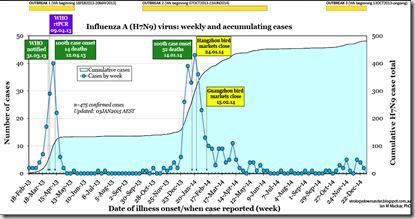
The third outbreak of influenza A(H7N9) virus seems to be over...

Cumulative curves of reported H7N9 cases and deaths in humans.
Click on graph to enlarge.

By the looks of the curve on the right, the rush of cases that defined the third known outbreak of the low pathogenicity avian influenza A virus subtype, H7N9, is over...for another season anyway.


If we get into the nitty gritty, as I have below, there are a couple of interesting things to see. First though - let us remember that these are just reported data:

(Continue . . .)

Friday, May 01, 2015

Referral: CIDRAP NEWS Recaps The Latest Avian Flu Outbreaks

image


# 9996


I was away from my desk for a few hours yesterday, and wasn’t able to to my usual summary of the latest H5N2 news, but luckily we have an excellent overview from CIDRAP NEWS Editor Robert Roos.  


Minnesota reports three additional farms infected, and their first detection of the virus in a wild bird, but the worst effects are being felt in Iowa.


Avian flu taking big toll in Iowa; virus found in Minnesota hawk

Robert Roos

Apr 30, 2015

Nine more outbreaks in Iowa put that state's losses at a quarter of the state's 60 million layer hens.

Nine more H5 avian influenza outbreaks that were reported on Iowa poultry farms in the past 2 days, combined with previous outbreaks, will mean the loss of about a quarter of the state's 60 million layer hens, state officials said today.

In addition, Minnesota officials today announced three more turkey-farm outbreaks and reported finding the virus in a dead hawk, the first known wild-bird infection in the state that has by far the most poultry outbreaks.

Six outbreaks in one Iowa county

The Iowa Department of Agriculture and Land Stewardship (IDALS) reported four outbreaks late yesterday and added five more today. Six of them are in Buena Vista County in the northwestern part of the state.

Initial testing pointed to a highly pathogenic (HP) H5 virus, but there was little doubt that it would be confirmed as H5N2. At an afternoon press conference, Iowa Agriculture Secretary Bill Northey said birds on all the farms are showing clinical signs, "so we highly suspect they'll come back with N2" confirmed.

(Continue . . .)

Wednesday, March 18, 2015

Referral VDU Blog: Catching Ebola: mistakes, messages and madness


image

Credit CDC PHIL


# 9840


One of the early `voices of reason’  on the threat posed by the Ebola Virus outside of Africa, was Dr. Ian Mackay on his VDU Blog. 

While many in  the news media, social media, and the tabloids went nuts last August over improbable `Ebola doomsday scenarios’  (see A Look Down The Ebola Rabbit Hole) –   Ian produced a series of focused, and scientifically grounded looks at the `real risks’ from the virus, and debunked some of the rampant misinformation spreading on the net.


A few examples:

Fake/wrong Ebola virus disease images...

VDU Blog: Droplets vs Airborne - Demystifying Ebola Transmission

Ebola: Blood, sweat and tears...


And a review by Ian and Dr. Katherine Arden in The Lancet, published last November:

Lancet: Mackay & Arden On Ebola In Semen Of Convalescent Men


Today Ian and Kat Arden are back with a look back at the messaging (good and bad) during the height of the Ebola outbreak last fall, and a reality check on the threat Ebola poses to a modern society with decent public health resources.


Follow the link to read:


Catching Ebola: mistakes, messages and madness

Written by Dr. Ian M. Mackay and Dr. Katherine E. Arden

Despite obvious community and media fear, speculation and exclamation that Ebola virus would enter and spread widely within countries outside of the hotzone, such an event did not come to pass in 2014. The early public health messaging on Ebola virus and disease were, for the most part, spot on.


In 2014 and 2015, thousands of cases of Ebola virus disease (EVD) ravaged Guinea, Sierra Leone and Liberia in 2014 (the "hotzone"). A smaller outbreak was defeated in Nigeria [8] and another distinct Ebola virus variant drove an outbreak of EVD in the Democratic Republic of the Congo[7] - they too controlled spread of the virus. Ebola virus traveled from the hotzone to other countries including Senegal, Nigeria, the United States of America (USA), Mali and most recently, the United Kingdom. It did this by hitching a ride in a usually unknowingly infected human host.

(Continue . . . )


Wednesday, February 18, 2015

Referral: VDU Blog On Closure Of Guangdong’s Live Markets

Photo: ©FAO/Tariq Tinazay

Credit FAO


# 9725


Amid news of another H7N9 case reported from Guangdong Province (see CHP notified of additional human case of avian influenza A(H7N9) in Guangdong),  Dr. Ian Mackay weighs in with a blog on the importance of closing live bird markets (LBMs)  in China in order to reduce the spread of the virus.


Follow the link to read:


Guangdong sees sense among the feathers...

Guangdong province in southern China is suspending its poultry markets. All of them. From 15-Feb to 28-Feb.[1] While the closures are only for 2-weeks, this will be very important for stopping human cases of avian influenza, particularity of the H7N9 subtype, during the bustling spring period in China.

Live poultry market closures also remove a traditional dish of fresh cooked chicken. One can be certain that no-one will die because of the substitution of frozen or factory prepared chicken for a fresh chicken, even if chefs don't succumb to the tantrums of last year and refuse to prepare dishes made from anything but fresh market-selected poultry. One can be equally certain that if the markets remain operating during the peak season for influenza virus circulation as they have been, that human infections, and deaths, due to H7N9 infections, will also continue

(Continue . . . )


Last summer, in CDC: Risk Factors Involved With H7N9 Infection we looked at a case-control study conducted by an international group of scientists, including researchers from both the Chinese and the US CDC which concluded.


Exposures to poultry in markets were associated with A(H7N9) virus infection, even without poultry contact. China should consider permanently closing live poultry markets or aggressively pursuing control measures to prevent spread of this emerging pathogen. 


In October of 2013 we saw another study (see The Lancet: Poultry Market Closure Effect On H7N9 Transmission) which found:


Closure of LPMs reduced the mean daily number of infections by 99% (95% credibility interval 93—100%) in Shanghai, by 99% (92—100%) in Hangzhou, by 97% (68—100%) in Huzhou, and by 97% (81—100%) in Nanjing. Because LPMs were the predominant source of exposure to avian influenza A H7N9 virus for confirmed cases in these cities, we estimated that the mean incubation period was 3·3 days (1·4—5·7).


Despite the evidence that it would greatly reduce the transmission of the virus, closing LMBs is a hard sell to the Chinese public. Purchasing live market birds is deeply ingrained in the culture, as it reassures the buyer that the bird is both fresh and healthy. 


China, Indonesia, and other countries have attempted to close or strictly regulate live bird markets in the past – only to be met with tremendous public resistance (see 2009 blog China Announces Plan To Shut Down Live Poultry Markets In Many Cities). 


That ambitious plan, announced more than 5 years ago to `shut live poultry markets in all large and medium-sized cities throughout China’, obviously never happened.


While the temporary closure of markets Guangdong will hopefully reduce the impact of this year’s H7N9 outbreak, as Ian points out temporary closures are only expected to provide temporary relief.  

Tuesday, January 27, 2015

Referral: VDU On Societal Change And H7N9

image

H7N9 Waves – Credit Dr. Ian Mackay VDU Blog


# 9633


With H7N9 surging once again in China (although how badly, is hard to tell), and H5N1 setting `personal best’ records in Egypt this winter, bird flu is back with a vengeance, and we once again find ourselves collectively playing `chicken’ with some very nasty avian threats.  


And if that weren’t enough, in the wings (and legs, breasts, and thighs) are upstarts like H10N8 and H5N6.


The primary conduit of these avian viruses to humans is through direct contact with infected birds - often at live markets - the preferred venue for purchasing meat for hundreds of millions of people around the globe.  Today Dr. Ian Mackay muses on the need for societal change if hope to head off these emerging avian viruses before they figure us out.   


Societal change and H7N9..

The importance of societal change for controlling infectious disease outbreaks really cannot be over-stated. 
For Ebola virus disease, it came down to stopping the tradition of direct contact with the body of those who have died and direct contact in general. For MERS it seems that occasional camel contact triggers insertion of the MERS-CoV virus into hospitals where lax infection prevention and control practices add to the case load.


For influenza A(H7N9) virus cases, it is the habit of obtaining live poultry from retail markets where rare virus-laden chooks are culled and handed over because of a desire to see, choose and purchase the tastiest fresh chicken.

(Continue . . .)


While closing live markets has been proven to reduce the spread of H7N9 (see The Lancet: Poultry Market Closure Effect On H7N9 Transmission), and seems an obvious mitigation step, generations of tradition (and practical considerations in places where home refrigeration is still rare) make it difficult to implement.


We’ve seen China, Egypt, and Indonesia repeatedly try – and fail – to permanently close live markets.


Of course, when it comes to taking what seems like sensible steps to stop the spread of deadly diseases, we in the `Western world’ don’t exactly have clean hands.  Literally.


Lapses in hand hygiene in hospitals still cause tens of thousands of (often fatal) infections each year (see Assessment Of Hand Hygiene Strategies In US Healthcare Facilities  & Hand Hygiene Among Doctors Exposed).

Half of all Americans eschew the flu vaccine every year, and you really don’t want to know the statistics on handwashing in public restrooms (well, if you do, see And Yet, They Still Call It Wellington  & Before You Ask To Borrow Someone’s Cell Phone . . .).


Some days it is hard to be optimistic about the reduction of infectious diseases around the globe when humans seemingly go out of their way to find  ways to aid and abet their spread.  


But on the plus side, as a disease blogger, I’m unlikely to run out of material to write about.

Friday, January 16, 2015

Referral: VDU On MERS In HCWs

image

Credit Dr. Ian Mackay VDU Blog 


# 9584


Dr. Ian Mackay has a new post up today that looks at the unusually high number of Health Care Workers infected with the MERS coronavirus over the past three years. 


As he points out, HCWs are considered `canaries’ in the coalmine, and when those who are supposed to be taking special care not to get infected continue to fall prey to the virus, it is considered a potential red flag.


Along with his patented graphics, Ian provides some excellent commentary the shedding for 42 days of the virus by an infected, but asymptomatic nurse, and how that might help explain some of the community infections for which there is no obvious exposure.


Follow the link to read:


MERS-CoV snapdate on canaries...

MERS-CoV detections among healthcare workers (HCWs)


HCWs are akin to the canary in the coal mine - when HCWs get sick with a particular bug, this can signal that the bug may well be more active in the the wider community.

(Continue . . . )

Saturday, January 03, 2015

Referral: VDU On Recent Uptick In H7N9 Activity

image

Credit Dr. Ian Mackay VDU Blog 

# 9525


After a decade where the H5N1 virus reigned supreme in the avian flu world, a little less than two years ago a new virus emerged in Eastern China, called H7N9.  A reassortant between the ubiquitous, but low path H9N2 poultry virus and a couple of (as yet) unidentified bird flu viruses (see Evolution Of H9N2 And It’s Effect On The Genesis Of H7N9)  this new viral brew produces no symptoms in birds, but in humans produces significant morbidity and mortality.


As the chart above shows, we’ve seen two human waves of the virus - both beginning in mid-winter – and there are signs that a third wave may be beginning to surface. 


While the numbers remain small, there has been a decided uptick in case reports out of China in the past few weeks.  There are, of course, questions over just how well surveillance and reporting are picking up on these cases since they come at the same time as China’s seasonal flu season ramps up.  


As we’ve discussed often - and it doesn’t matter where, or what disease -  not every infection will be detected. And depending on the spectrum of symptoms (asymptomatic or mild – up to severe), the percentage picked up by surveillance can often be the tip of the iceberg – or in the case of the CDC graphic below – of the pyramid (see When No Number Is Right).

surveillance


While the official count remains under 500 cases, there are some researchers who put the real number of symptomatic H7N9 cases in the tens of thousands (see Clinical severity of human infections with avian influenza A(H7N9) virus, China, 2013/14).  


Nobody knows of course, and so we must deal with the numbers we have.


Which is something Dr. Ian Mackay does exceedingly well, producing (along with astute commentary) some of the best Avian Flu, MERS, and Ebola graphics on the web on his Virology Down Under blog.   Today he starts off the new year with a `snapdate’ on China’s H7N9 activity.    Follow the link below to read:


Saturday, 3 January 2015

H7N9 outbreak #3 underway?

What better way to start 2015 than a snapdate!! For those who are new to them here on VDU, they were initiated here and defined here as snap updates - posts that don't have lots of detail and chat...although they almost always end up having lots of chat!

This one is an update of the situation of one of the many avian influenza viruses ("bird flus" if you must) around again - avian influenza A(H7N9) virus, or just 'H7N9'.

(Continue . . . )


Ian also produced a quick overview of the recently emerged H5N6 virus yesterday in:


Influenza A (H5N6) virus in humans...

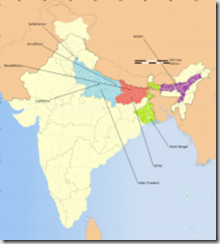
Provinces hosting human cases of H5N6
Adapted from [8]
Click on image to enlarge.

Monday, November 17, 2014

Referral: Mackay On Early Negative Testing For Ebola

image
Credit CDC PHIL


NOTE:  As I am posting this, NBC News is reporting the death of Dr. Martin Salia, who reportedly initially tested negative for the virus even after becoming symptomatic.

Ebola Patient Dr. Martin Salia Has Died in Nebraska: Officials

Dr. Martin Salia, an Ebola patient being treated in Nebraska, has died, medical officials said Monday.

Salia was diagnosed with Ebola in Sierra Leone and was airlifted to Nebraska on Saturday. He was the 10th Ebola patient to be treated on U.S. soil and the third treated at Nebraska Medical Center.


# 9337


We’ve often heard that Ebola tests aren’t conclusive until they are taken 48-72 hours after symptoms first appear, and based on recent media reports (see WaPo’s A doctor’s mistaken Ebola test: ‘We were celebrating. . . . Then everything fell apart’), that appears to have been the case with Dr. Martin Salia who died this morning.


Dr. Ian Mackay gives us some deep background on the testing for Ebola, and why a 48-72 hour window for testing was selected.


Ebola testing: 48-72 hours for a negative to turn positive

Currently, some fraction of the people who present very early after they may have been infected by Ebola virus for testing, return a negative result. This is probably a rare event because the majority of cases arrive for care with Ebola virus disease (EVD) already well underway.


The latest Centers for Disease Control and Prevention (CDC) guidance in these instances is to wait (48 to) 72 hours and see if the patient remains ill, or becomes more unwell. If they do either of these, a second test is performed.[1] If the suspect case recovers from illness, no repeated testing is indicated.


The test we rely on to confirm a clinically suspected EVD case is called a reverse transcriptase polymerase chain reaction (RT-PCR). RT-PCR is a technique designed to  seek out a tiny but very specific region of the Ebola virus's RNA genome, copy it into DNA then amplify those DNA copies a billion-fold by making more copies. Somewhere during that exponential amplification process, the technology of the day (currently fluorescence detection but formerly agarose gel detection, radiation and chemiluminescence) allows us to identify that the specific DNA we seek is appearing above an arbitrary threshold...we have a positive test result for Ebola virus.


(Continue . . . )

Tuesday, October 07, 2014

Sandman & Lanard: Ebola Risk Communications


# 9159


When it comes to risk communications, Dr. Peter Sandman & Dr. Jody Lanard are both highly sought out experts, and over the years I’ve highlighted their work a number of times (you’ll find a small sampling here, here, here & here) . During a crisis, they not only know what needs to be said, they aren’t afraid to say it.


Their website is an invaluable repository of risk management advice, that quite frankly, should be second home for anyone involved in public relations or risk communications.

Peter Sandman Website logo


Today (h/t Crof) they’ve posted three long email responses to reporters on Ebola Risk communications that are a `must read’.   Rather than try to pick and choose excerpts, I’ll simply invite you to go to their website to read:


Ebola Risk Communication: Talking about Ebola in Dallas, West Africa, and the World

by Peter M. Sandman and Jody Lanard

Thursday, October 02, 2014

Mackay On Ebola `Direct Contact’ & Droplet Transmission

image


# 9142


Dr. Ian Mackay once again takes on the subtleties of Ebola transmission on his excellent VDU blog today, and brings a new level of clarity.   As he and I have discussed before (see VDU Blog: Droplets vs Airborne - Demystifying Ebola Transmission), Ebola isn’t an `airborne’ virus – but you can be infected via droplets emanating from an infected individual.


What I’ve dubbed `spittle range’ where large droplets of mucus, blood, sweat, or other bodily fluids could potentially be coughed, sneezed, or otherwise propelled or flung onto another person.  


Last Month, in Ebola: Parsing The CDC’s Low Risk vs High Risk Exposures, we looked at CDC guidance that acknowledged the (low) risks of casual contact; defined as spending a prolonged period of time in the same room with, or within 1 meter, of an infected patient – even without direct physical contact.


image

In the light of all of this, the heavily parsed and highly promoted meme -  that `You can’t get Ebola through air’  -  tends to cause more confusion than reassurance.


To the rescue today comes Dr. Mackay, who explains what `direct contact’  really means.  I’ve only included a snippet, follow the link to read:


It's what falls out of the aerosol that matters....

(Excerpt)

Direct contact.

When we talk about "direct contact" and Ebola virus transmission, we do include the bigger wetter heavier droplets that might be propelled from of a sick person during vomiting, or coughing as a risk for transmitting virus.

Even though that is not physical direct contact, and even though the droplets travel across a gap between people - through the air - it is still a direct line from person A (red in the graphic below) to B (blue). If B is too far away, then those droplets fall to the ground before they hit B. The droplets may remain infectious on the ground. That depends on temperature, humidity, surface type and the type and amount of virus.

(continue . . . .)

Wednesday, October 01, 2014

Referral: Ronan Kelly On AES In India


# 9033


One of the great things about this little part of the internet called Flublogia is that we are blessed with a great many very  smart, dedicated, and talented participants.  I’ve written in the past about the work done by volunteers on the  flu forums (see Newshounds: They Cover The Pandemic Front), but they often do far more than just surf the internet and post reports.


Ronan Kelly, who is a senior moderator at FluTrackers, has devoted an incredible amount of time and effort focusing primarily on infectious diseases on the Indian Subcontinent.


He was recently contacted by the University of New South Wales and invited to put together a blog post on the – as yet unidentified and complicated AES (Acute Encephalitis Syndrome) epidemic– which occurs in the Northeastern states of that country every year. 


So, without further ado, I invite you to follow the link below to read:


Acute Encephalitis Syndrome Outbreaks in India – an ongoing puzzle.

image

By Ronan Kelly.

Ronan Kelly (USA) is a Senior Moderator at www.FluTrackers.com, with an interest in outbreaks in India.

Past history of AES in India

Acute Encephalitis Syndrome (AES) is a growing problem in India. The first major outbreak was in West Bengal in 1973 involving 700 cases and over 300 deaths. Subsequent serological studies identified the Japanese Encephalitis (JE) virus as the cause. (1,2) Between 1978 and 2007, over 100,000 cases of AES with a case fatality rate (CFR) of almost 33% were reported from 13 different states. It was widely presumed that JE was the predominant aetiological agent in these outbreaks. (3,4) However, a study of patients admitted between 1985-1988 at King George’s Medical College (now Shahuji Maharaj Medical University) in Lucknow revealed bacterial meningitis as a diagnosis in 18% of apparent AES patients with JE indicated in only 12% of cases. Measles, Mumps, Malaria also played a part to some smaller degree, but 50% of the cases remained undiagnosed. Reye’s Syndrome was not found in any case.(5) An investigation of repeated AES outbreaks in Saharanpur in the early 2000s found that children were eating beans of the Cassia occidentalis plant which was causing acute hepatomyoencephalopathy. These patients were being misdiagnosed as AES cases. Local government organized removal of the plants and provided information programs for residents. As a result, fatalities in the district dropped from around 100 per year to zero in 2010. (6,7)

(Continue . . . )

Monday, September 29, 2014

Referral: Mackay On The Widening `Control Gap’

image 


# 9122


Dr. Ian Mackay –  presents graphs today showing an intriguing Ebola outbreak trend, and offers a plausible reason behind it, in his latest blog called:


The control gap...

v1.0 290914

I have a theory.


This theory is meant only to apply to disease outbreak/epidemic/pandemic situations, and then only to those which include fatal cases.


This theory of mine has only emerged since I've been plotting Ebola virus cases numbers from the West African epidemic. I precede the explanation with the caveat that there is very probably already a well developed, well-known actual epidemiology term to describe this theory. But I'm not a trained epidemiologist and this is just a blog, so please forgive me my ignorance.


The theory goes that when a gap grows between the number of new cases being reported and the number of deaths or laboratory confirmations in that population, despite the outbreak having been going for a while, this represents an indication that control of the situation is slipping, or has been lost.

(Continue . . . )


Thursday, September 25, 2014

Referral: How Ebola Started, Spread & Spiralled Out Of Control


# 9114


From Ian Mackay, Katherine Arden  & science writer Heather Lander we’ve a terrific overview of how the Ebola outbreak evolved in West Africa, published today in The Conversation.   With a line up like that, there’s nothing for me to do but step aside and invite you to follow the link below to read:


25 September 2014, 5.41am BST

How Ebola started, spread and spiralled out of control

Too slow. Too little, too late. Unprecedented. Out of control. These are just some of the descriptors for the biggest recorded epidemic of human infection by an ebolavirus. The question by some is how…


West African health-care workers are overworked and under-equipped to deal with the outbreak. European Commission DG ECHO/Flickr, CC BY-NC-ND

Too slow. Too little, too late. Unprecedented. Out of control. These are just some of the descriptors for the biggest recorded epidemic of human infection by an ebolavirus.

The question by some is how this happened? As of this writing, 5,347 people are suspected or known to be infected (an undoubted underestimate) in Guinea, Sierra Leone, Liberia, Nigeria and Senegal. And 2,630 have died.

(Continue . . . )


Saturday, August 30, 2014

Referral: Mackay On The Expansion Of Ebola Into Senegal

image

Credit Dr. Ian Mackay VDU Blog


# 9019


In his blog overnight, Dr. Ian Mackay adds Senegal to his Ebola outbreak map, and makes an important point about the uniqueness of each disease outbreak, the human variables that drive them, and the danger of assuming that the public health responses of the past will always suffice in the future.


First a link to Ian’s blog, then I’ll be back with a comment.


The fifth I give you...

Senegal.


According to it's Minister of Health, Awa Marie Coll Seck [1,2], a case of Ebola virus disease (EVD) has been imported from Guinea and it is confirmed by testing at the World Health Organization's collaboration Centre, the Pasteur Institute in Dakar.

Interesting that this occurred one week after Senegal closed its borders (again) with Guinea.[3,4] The infected Guinean student travelled on 29-August to Dakar where he presented to a hospital but did not admit to being in contact with known EVD cases. Senegal had closed its borders around 22-August.[5,6].


(Continue . . . )


After forty years of outbreaks – all of which were geographically limited and comparatively small – Ebola had gained the reputation of being a horrific killer – but basically only of `local concern’. 


Conventional wisdom said that it killed too quickly to allow those infected to spread the disease far. The virus simply didn’t have the `legs’ to spark a major outbreak.


Fast forward to 2014, and those assumptions are taking it on the chin.  Not because the virus has changed, but because Africa has changed (a major point made in Michael Osterholm’s WaPo Article  Aug. 1st).  


Remote villages aren’t nearly as remote as they once were. Cars, busses, trains, even airplanes are far more common today in Africa than they were in 1976 when the virus was first detected.  Society is more mobile today than ever before, and that applies to just about everywhere on this planet.


The world was caught flat-footed in its initial response to this Ebola outbreak – no doubt lulled by earlier successes in containing the virus -  and that has allowed it to spread unchecked. Given its lack of `airborne’ transmission, I fully expect it will eventually be brought under control, albeit at a terrible cost. 


The takeaway lesson here goes beyond Ebola, and well beyond the continent of Africa.


As the world changes, so do the capabilities of its pathogens. A side effect of modern society is that it has become the great enabler of infectious disease.  A novel virus or resistant bacteria can hitch a ride in New Delhi or Shanghai this morning and can be in London, or New York by tonight.


Which means that we no longer have the luxury of ignoring `small disease outbreaks’  anywhere in the world, no matter how remote. 


Because the next pathogen to crawl out of the woodwork may be far more `pandemic-ready’  than Ebola could ever be. 

Monday, August 25, 2014

Referral: Mackay On DRC’s Ebola Outbreak

image


#  8998


Yesterday’s announcement that the  DRC Reported Two `Positive’ Ebola Cases was followed overnight by reports (as yet, uncorroborated) that one of these samples was identified as Ebola Sudan, and the other (a bit perplexingly) was described as a `hybrid’ between Ebola Sudan and Ebola Zaire.


This excerpt from Reuters’  UPDATE 1-Congo declares Ebola outbreak in northern Equateur province.


Numbi said that one of the two cases that tested positive was for the Sudanese strain of the disease, while the other was a mixture between the Sudanese and the Zaire strain -- the most lethal variety.


Given the unusual nature of this claim, I’ll withhold any comment until we can get a confirmation from a WHO Collaborating Centre.  If true, this would appear to exclude the West African Ebola outbreak as the source, along with raising a number of new questions. 


That said, I always take early reports from the field with a sizable grain of salt. We should know more later today or tomorrow.


In the meantime, Dr. Ian Mackay has produced a helpful map, and blog post, on this recent turn of events. 


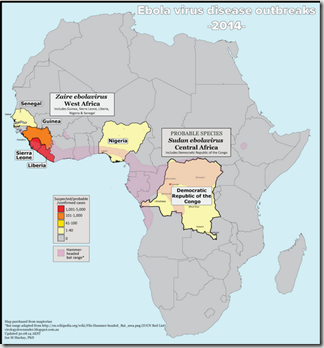
The battle of Ebola gains a second front...the Democratic Republic of Congo (DRC; f. Zaire)

So there are two reasons for this post.

  • It may be a little while before we get solid confirmed information form the DRC and I think maps are useful for those of us who are ignorant of where countries live!
  • I'm looking for a quick post so I can move the previous post's grisly pictures down the page!

We don't know the details yet but early reports from a country that was the site of the first (known) outbreak of a virus (called Ebola virus [1] or EBOV) of species Zaire ebolavirus, suggest 2 confirmed cases.[2]

(Continue . . .)

Sunday, August 24, 2014

Referral : Mackay On Fake/False Ebola Images

image

Credit VDU Blog 


# 8992


One of the tools we bloggers use to glean `real-time’ information is to filter twitter using a #hashtag, so as to view only those tweets dealing with particular subject. If you want Ebola-specific tweets, you search using #Ebola. 


Yesterday I spent most of my time searching #Bárðarbunga, which some wag aptly pointed out was technically an #ashtag.  But more on that later.


While you can often get good information off these twitter streams, they also contain a lot of nonsense.  Some of it, dangerous or even damaging, such as the misinformation spread during and after Hurricane Sandy (see Caveat Twitter).


I isn’t just Twitter, of course. 


A couple of weeks ago in A Look Down The Ebola Rabbit Hole I wrote about some of the alarmist, and false, information being spread on Youtube and Internet websites regarding the Ebola outbreak and the Yellowstone super volcano.


Some of these videos are very professional looking, and by cherry picking (or just making up) facts, they can be very convincing.


Today Ian presents a series of photos from twitter purporting to show the physical manifestations of Ebola infection (warning, you might want to have breakfast first).   Unfortunately, most of these photos are NOT of Ebola patients.  


Follow the link below to read:


Sunday, 24 August 2014

Fake/wrong Ebola virus disease images...

As if there isn't enough misery in the world that we need add false imagery to the mix.


Fake or hoax or just plain misunderstood images purporting to be from cases of Ebola virus disease are everywhere at the moment. The ones below are images I see regularly in the #ebola Twitter stream.

(Continue . . .)


In a bit of synchronicity, in my blog yesterday -  Bárðarbunga Volcano Aviation Alert Raised To Red - I mentioned the twitter feeds for this rumbling volcano (while warning Caveat Lector). 


No sooner had a small  sub-glacial `eruption’ been announced, hundreds of spectacular photos of  volcanoes  violently erupting (but NOT of #Bárðarbunga) – began to appear on twitter announcing the event. 

`Artistic license’, I suppose.  But disappointing nonetheless.


Although I occasionally rail against sensationalistic websites, videos, and pictures I know it is essentially tilting at windmills on my part.  Sadly, there are far too many people out there willing to post nonsense – and a huge audience receptive to such tripe – to hope that it will go away. 

Sunday, August 17, 2014

Mackay On Ebola, Pigs, Primates and People


image
Credit CDC PHIL


# 8964


Yesterday Dr. Ian Mackay et al. produced a terrific overview called Ebola virus may be spread by droplets, but not by an airborne route: what that means which I blogged about here.  


Today Ian is back with another in-depth look at Ebola transmission, this time taking on the much-discussed laboratory experiments that some online pundits have claimed `proves’ airborne transmission.


Ian quite adeptly goes over what we know – and more importantly, what we don’t know – about Ebola transmission.  Both in the lab, and in the wild.  And along the way provides a lesson in critical thinking.


At this point, I’m going to do the smart thing and step out of the way and invite you to read:


Ebola, pigs, primates and people

This is a companion piece to my collaborative article, Ebola virus may be spread by droplets, but not by an airborne route: what that means, posted a couple of days ago. I suggest you read the both together.


In this post, I'd like to make sure we all understand that an airborne route of Ebola virus infection has been used to deliberately infect non-human primates (NHPs). It is possible and it can be done. Okay? I'm not covering up any secret knowledge or trying to conceal facts that only we few evil-society-of-science types know. I don't secretly work for an agency aiming to delude you dear readers into feeling falsely safe about the risks associated with being near an Ebola virus infected person (which most reading this will likely never be). Frankly, I'm learning this as I go.

(Continue . . . )

Saturday, August 16, 2014

VDU Blog: Droplets vs Airborne - Demystifying Ebola Transmission

image

Except from CDC Infographic


# 8962


Almost two weeks ago the CDC released a reassuring infographic (see above) that - among other things - stated that `You can’t get Ebola through Air’, which immediately set off an internet firestorm of disbelief and derision. I considered it a communications misstep at the time, and blogged about it in The Ebola Sound Bite & The Fury.


While I understand the need to reassure the public, and the desire to try to defuse some of more egregious tabloid-style reporting, sometimes reassurance can be overdone.


When people see moon-suited doctors ferrying Ebola patients into Emory University Hospital, and compare that to the CDC’s blanket assurance that `You can’t get Ebola through the Air’  – they rightfully come away confused, and perhaps even a bit suspicious.


Last week, in Ebola: Parsing The CDC’s Low Risk vs High Risk Exposures, we looked at CDC guidance that acknowledged the (low) risks of casual contact; defined as spending a prolonged period of time in the same room with, or within 1 meter, of an infected patient – even without direct physical contact. 


What I dubbed `spittle range’  where large droplets of mucus, blood, sweat, or other bodily fluids could potentially be coughed, sneezed, or otherwise propelled or flung onto another person.  


Today, I’m very pleased to report that Dr. Ian Mackay (along with three other researchers) – all far more qualified to weigh in on this subject than I  – have penned a detailed essay on what we know about Ebola transmission, which will hopefully clear up some of the confusion.  


Follow the link to read:


Ebola virus may be spread by droplets, but not by an airborne route: what that means

An article collaboratively written by (alphabetically)..

Dr. Katherine Arden
A postdoctoral researcher with interests in the detection, culture, characterization and epidemiology of respiratory viruses.

Dr Graham Johnson
A post-doctoral scientist with extensive experience investigating respiratory bioaerosol production and transport during breathing, speech and coughing and determining the physical characteristics of these aerosols.

Dr. Luke Knibbs
A Lecturer in Environmental Health at the University of Queensland. He is interested in airborne pathogen transmission and holds an NHMRC Early Career Fellowship in this area.

A. Prof Ian Mackay
A virologist with interest in everything viral but especially respiratory, gastrointestinal and central nervous system viruses of humans.

________________________

The flight of the aerosol

Understanding what we mean when we discuss airborne virus infection risk


A variant Ebola virus belonging to Zaire ebolavirus (EBOV) is active in four West African countries right now. Much is being said and written about it, and much of that revolves around our movie-influenced idea of an easily spread, airborne horror virus. Many people worry about their risks of catching EBOV, particularly since it hopped on a plane to Nigeria. However, all evidence suggests that this variant is not airborne. The most frequent routes to acquire an EBOV infection involve direct contact with the blood, vomit, sweat or stool of a person with advanced Ebola virus disease (EVD). But what is direct contact? What is an “airborne” route? For that matter what is an aerosol and what role do aerosols play in spreading EVD? How is an aerosol different from a droplet spray? Can droplets carry EBOV through the air?

Direct contact includes physical touch but also contact with infectious droplets; the contact is directly from one human to the next, rather than indirectly via an intermediate object or a lingering cloud of infectious particles. You cannot catch EVD by an airborne route, but you may from droplet sprays. Wait, what?? This is where a simple definition becomes really important.

(Continue . . . )