Showing posts with label Taif. Show all posts

Friday, December 05, 2014

Saudi MOH Reports Another MERS Case From Taif

image


# 9414


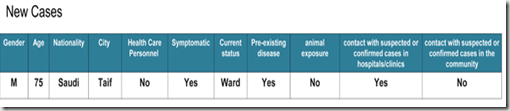
Saudi Arabia reports another MERS Case from Taif, which has been the focus of nearly half of the MERS cases reported over the past couple of months.   This time it involves a 70 year old female, source of infection still unknown.


image


While camels are believed responsible for introducing the virus to humans, once someone is infected they are able to spread the virus on to others, albeit not with great efficiency.  We’ve seen clusters occur in family settings, and even more often linked to healthcare facilities.


Earlier this week the MOH released the following statement concerning a joint WHO/CDC/Saudi ongoing investigation into the outbreak of MERS in Taif.


WHO, CDC WORK WITH SAUDI HEALTH MINISTRY TO FIGHT CORONAVIRUS (MERS-CoV)

03 December 2014

His Excellency Eng. Adel Fakeih, the acting Minister of Health, hosted a meeting recently on the response to MERS-CoV with visiting experts from the World Health Organization and U.S. Centers for Disease Control and Prevention.

Dr. Hassan El Bushra, the WHO’s representative in Saudi Arabia, was joined by three experts from the CDC who spent a week investigating a cluster of MERS-CoV cases in Taif. The experts, who specialize in epidemiology and outbreak investigation, have been advising the Ministry’s Command & Control Center (CCC) on efforts to reduce the risk of infection with this deadly virus, which is thought to be initially transmitted to humans through unprotected contact with camels. Some human to human transmission in healthcare settings has also occurred.

“There was no evidence of widespread community transmission,” said a CDC expert. “We connected the dots on most of the cases to three or four primary cases.”

He recommended that the Ministry continue its rigorous surveillance and infection prevention and control activities in Taif. “Proper infection control procedures are in place,” a CDC expert said. “It’s a matter of continuing those activities and remaining vigilant because there will be more primary cases.”

International collaboration is a hallmark of the preparedness efforts that have been undertaken within the CCC since it was established as the Ministry’s emergency response unit. Outside experts from WHO and CDC have participated in internal meetings and shared international best practices with the Saudi clinicians and public-health experts who are managing the response to MERS-CoV and preparing for other infectious diseases, such as Ebola virus disease.

They were an integral part of the Ministry’s onsite team during the successful Hajj 1435.

Such partnerships, which include a number of top researchers from Saudi universities, have greatly enhanced the Kingdom’s ability to respond to MERS-CoV. In addition to supporting the rigorous training that has contributed to a sharp reduction in the number of secondary MERS-CoV infections involving healthcare workers, WHO and CDC are working with the Ministry to investigate why there was a dramatic increase in MERS-CoV cases last month in Taif.

There have been 805 confirmed cases of MERS-CoV in Saudi Arabia since June 2012, resulting in 342 deaths.

To prevent infection with this virus in healthcare facilities, the Ministry has embarked on a comprehensive infection-prevention program across the Kingdom that includes new training and procedures as well as updated facilities and equipment.

The Ministry recommends avoiding contact with camels. Anyone who comes in close contact with camels should wear a disposable mask, gloves and a face mask to reduce the risk of infection. No one should consume raw camel meat or raw camel milk.

Visit the CCC website to learn more about MERS-CoV and how to reduce the risk of infection. http://www.moh.gov.sa/en/CCC/Pages/default.aspx

Monday, November 24, 2014

Saudi MOH Reports Another MERS Case In Taif

image

# 9368


After reporting no new cases yesterday, the Saudi MOH is back today with another MERS report from Taif – which has been the site of nearly half of all the MERS cases reported since September.  


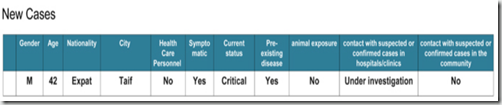
Today’s case is a 42 y.o. Ex-Pat, who is listed in critical condition.  No word as to a possible route of exposure, although the possibility of nosocomial exposure is under investigation. 

image


This is the 21st MERS case reported out of Saudi Arabia for the month of November.

Saturday, November 22, 2014

Saudi MOH: 1 MERS Case In Taif

image

# 9362


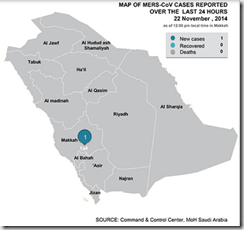
After roughly 10 days without hearing of a case out of Taif, today the Saudi MOH announced that a 58 y.o. male is receiving treatment for the infection.

image

You’ll recall that during September and October Taif was in the news nearly every day, with more than 20 MERS cases reported in that region, sparking several MOH press statements (see MERS Awareness Campaign).

Tuesday, October 28, 2014

Saudi MOH Expects More MERS Cases In Taif

image


# 9261


The recent resurgence of MERS in Saudi Arabia after a relatively quiet July and August has prompted several recent statements from the Health Ministry, including this one yesterday, urging the public, and healthcare facilities, to take steps to prevent exposure and onward transmission of the virus.


Last week, in Saudi MOH Statement On Recent MERS Cases In Taif, we saw a promise by the Ministry of Health to investigate, and bring to a halt, the nosocomial spread of the virus in Taif healthcare facilities.


Today, with internet rumors running rife on Twitter and in social media (see here), the Saudi MOH has issued a refreshingly candid statement, indicating that they are particularly concerned about the ongoing chain of transmission in Taif, and that additional cases could be expected in the coming days or weeks.


MOH: MERS-CoV REMAINS SIGNIFICANT HEALTH THREAT

28 October 2014

MERS-CoV remains a significant health threat in Saudi Arabia, where 38 confirmed cases of the disease have been reported since September 5th, according to the Ministry of Health.


The Command & Control Center, which is responsible for coordinating the response to MERS-CoV, is particularly concerned about breaking the chain of transmission in Taif, where a cluster was identified in September. At least 17 people have been infected with the virus in Taif since September 5th. The primary cases in Taif involved people who had unprotected contact with camels and then came into contact with others, including healthcare workers.


"The available evidence indicates that camels transmit MERS-CoV to humans, who then infect each other through direct contact with droplets that contain the virus," said Dr. Anees Sindi, deputy commander of the MOH Command & Control Center. "The situation in Taif is still under investigation and we expect to see more cases in the coming days and weeks."


The Ministry has developed strict protocols for treating MERS-CoV patients in collaboration with international partners at the World Health Organization and U.S. Centers for Disease Control and Prevention. It has designated hospitals to serve as MERS-CoV Centers of Excellence. These facilities are designed to provide life-saving treatment to people who are infected with the disease while ensuring that healthcare workers are protected from exposure to the virus. Patients are transferred to these Centers of Excellence whenever possible.


"We are taking aggressive action to reduce the rate of infection in Taif," Dr. Sindi said. "This includes educating the public about the importance of avoiding close contact with camels and providing additional training for hospital workers on proper infection-control procedures."The Ministry's Command & Control Center also developed a comprehensive disease surveillance system that provides real-time information about new cases and the capacity of health facilities to provide intensive-care to MERS-CoV patients.


Proper hand washing and coughing etiquette, are basic but essential steps everyone should take to reduce the risk of infection. To prevent MERS-CoV infections, members of the public are also urged to avoid contact with camels and refrain from consuming raw camel milk or undercooked camel meat. Anyone who must come into close contact with camels should wear a disposable mask, gown and face mask to avoid being exposed to the virus.


There have been 780 confirmed symptomatic cases of MERS-CoV since June 2012. At least 435 have been cured and  333 people have died and 12 under treatment.


Call 937 or visit http://www.moh.gov.sa/en/CCC to learn more about MERS-CoV and how to prevent infection

Saturday, October 25, 2014

Saudi MOH Announces A New MERS Case In Taif

image


# 9349


The Taif MERS outbreak – which appears to have been exacerbated by exposures within their healthcare system – continues with the 17th reported case since early September. 


Today’s case is an elderly male who appears to have been exposed in the hospital.

image


On Monday the Saudi MOH announced new, aggressive measures were being taken to try to bring this outbreak to a halt (see Saudi MOH Statement On Recent MERS Cases In Taif).

Monday, October 20, 2014

Saudi Arabia – A MERS Surge?

image

Credit ECDC MERS-CoV Epidemiological Update


# 9219


Roughly six weeks ago, after a relatively quiet July and August, we began to see a slow uptick in the number of MERS-CoV infections being reported out of Saudi Arabia.  While the numbers remain modest – even compared to the same time last year – the clustering in Taif east of  Mecca prior to the Hajj is concerning.

image


Local officials have publically been denying charges of a serious outbreak in the Taif region (see FluTrackers thread Saudi Arabia - Taif government denies coronavirus MERS epidemic in hospitals),  but the following line list put together by Sharon Sanders shows 13 cases in Taif over the past 6 weeks.

Recent MoH announced infections in Taif:


September 2014:
740) #861 - Male, 43, Saudi, hospitalized in ICU - Taif, Saudi Arabia
744) #865 - Male, 27, Saudi, hospitalized in ward - Taif, Saudi Arabia
745) #866 - Male, 65, Saudi, in stable condition - Taif, Saudi Arabia
763) #884 - Male, 37, health care worker, hospitalized in ward - Taif, Saudi Arabia
765) #886 - Male, 40, health care worker, Expat, hospitalized in ICU - Taif, Saudi Arabia
October 2014:
769) #890 - Male, 60, Saudi, hospitalized in ICU, camel exposure - Taif, Saudi Arabia
770) #891 - Male, 69, Saudi, hospitalized in ICU - Taif, Saudi Arabia
772) #893 - Male, 77, Saudi, hospitalized in ICU - Taif, Saudi Arabia
774) #896 - Male, 70, Saudi, hospitalized in ICU - Taif, Saudi Arabia
777) #899 - Female, 42, Expat, health care worker, hospitalized in ward - Taif, Saudi Arabia
778) #900 - Male, 60, Saudi, died - Taif, Saudi Arabia Death
780) #902 - Male, 66, Saudi, hospitalized in ICU - Taif, Saudi Arabia
781) #903 - Male, 65, Saudi, hospitalized in ICU - Taif, Saudi Arabia


These cases were pulled from FluTracker’s detailed 2012-2014 Case List of MoH/WHO Novel Coronavirus MERS nCoV Announced Cases.


While Arabic print media (and even Arabic language social media) has been largely quiet about MERS the past few months  – replaced with stories about the Hajj and Africa’s Ebola threat – over the past couple of days Arabic twitter chatter on MERS has taken off once again.


Unlike last spring, when the role of camels in transmitting the virus was often dismissed (see Saudi MOA Spokesman: Camel Link Unproven), `camels as vectors’ appears to be the newly adopted meme in the media, to the exclusion of any talk of nosocomial or community transmission.


Last September we saw the KSA MOH Reiterates Camel Warnings On MERS, and while the exact role of camels in the transmission of MERS to humans has yet to be established, increasingly camels are being viewed as a  likely zoonotic source of the virus (see EID Journal: Replication & Shedding Of MERS-CoV In Inoculated Camels).


Although certainly a factor, camel-to-human transmission is unlikely to be the cause of the bulk of cases being reported.  A number of cases are reportedly Health care workers, and hospitals have been a frequent amplifying center for MERS outbreaks.


After saying little about the MERS situation in Saudi Arabia for several weeks, yesterday Health Minister Faqih visited King Faisal hospital, and today the media are carrying an obvious `photo opportunity’ along with  warnings  that `additional cases’ might be expected in Taif.

image


Health Minister: No cure for "Corona" .. and we expect other injuries in Taif (Photos)

Designated Health Minister Adel Mohamed Fakih, the citizens and residents of Ta'if should take necessary preventive actions on dealing directly with the camels, to protect themselves from the virus "Corona".

This came during his visit to King Abdul Aziz specialist hospital, the King Faisal Hospital in the province, yesterday. The current infection rates in Taif refers to the possibility of new cases in the next period.

He said: "maybe we can uproot the coronavirus in the near perspective because there is no cure or vaccine yet, but the Health Ministry must do whatever they can and all its potential for treating patients and health practitioners and community protection from HIV infection."

In the same context the command and control center of the Ministry of health a number of immediate actions to curb the infection after recording nine cases of "Corona", including follow-up to the Ministry of public health experts for all close contacts of patients infected with HIV "SK" in Taif, and transfer any cases of Corona to King Faisal Hospital, transfer unit mobile laboratories to Taif, enabling doctors to obtain the results of virus detection in cases of suspected virus "SK" in record time not exceeding 6 hours.


Meanwhile Arabic twitter chatter is rife with speculation that there are several more cases about to be announced.


Stay tuned.

Sunday, October 19, 2014

Saudi MOH Announces 2 More MERS Cases

image


# 9217


The Saudi MOH Announced two more MERS cases today, including the 11th recent case from Taif.   Unless I’ve lost count, this makes 22 cases reported since this uptick began on  September 12th.  


With half of those cases hailing from Taif, and few details released, it begs the question whether these are mostly community acquired cases or part of a nosocomial outbreak.

image

Saturday, October 04, 2014

Saudi MOH Announces Another MERS Case In Taif

image

# 9147


Over the past three weeks Saudi Arabia has announced a dozen new cases of MERS, with six of those cases coming from Taif – located about 60 miles east of the Holy City of Mecca where 2 million pilgrims are gathered for the Hajj.


Today’s case is a 60 year old male who reportedly had recent contact with camels.


In the most recent WHO DON Update On MERS from Saudi Arabia, 4 of the past 15 cases reported contact with camels, sheep, or camel products.


image

image

Sunday, September 28, 2014

Saudi MOH: 5th MERS Case From Taif This Month

image


# 9120


Taif, located just 60 miles east of the Holy City of Mecca – the primary destination for roughly 2 million religious pilgrims who will make the Hajj next week – has reported its fifth MERS case in just over 2 weeks. 


The first case was reported on September 12th, while the last – a Health care worker – was announced on Monday the 22nd.


Today, the MOH is announcing another HCW – a 40 y.o. male expat – has been infected in Taif, and is currently isolated in the ICU.   This makes the 10th MERS case announced by KSA’s MOH since September 12th, which represents a small, but worrisome uptick in cases after a relatively quiet summer.


image