Showing posts with label Saudi Arabia. Show all posts

Tuesday, May 26, 2015

WHO MERS-CoV Update – Saudi Arabia

image


# 10,092


The World Health Organization has published another MERS update, detailing four recent cases from Saudi Arabia.  Two of these cases may be tangentially linked to the Hofuf (aka `Hafoof’, `Hafouf’,`Hufof;) cluster we’ve been following for the past three weeks, but the circumstances of their infection are far from clear.


As we’ve discussed previously, sometimes the route of infection is pretty obvious, but often we don’t really know how community-acquired cases were exposed (see WHO EMRO: Scientific Meeting Reviews MERS Progress & Knowledge Gaps).


Middle East Respiratory Syndrome coronavirus (MERS-CoV) – Saudi Arabia

Disease outbreak news
25 May 2015

Between 18 and 23 May, the National IHR Focal Point for the Kingdom of Saudi Arabia notified WHO of 4 additional cases of Middle East respiratory syndrome coronavirus (MERS-CoV) infection, including 1 death.

Details of the cases are as follows:
  • A 77-year-old female from Hafouf city developed symptoms on 17 May and was admitted to hospital on the same day. A nasopharyngeal swab tested positive for MERS-CoV on 22 May. The patient has comorbidities. She was admitted to the same hospital as a laboratory-confirmed MERS-CoV case (case 2 – see below). Investigation of history of exposure to other known risk factors in the 14 days prior to the onset of symptoms is ongoing. Currently, the patient is in critical condition in ICU.
  • A 48-year-old male from Hafouf city developed symptoms on 1 May and was admitted to hospital on 10 May. The patient, who has comorbidities, was initially diagnosed with a cardiovascular condition. He was transferred to a cardiac center in Hafouf city on 14 May. On 20 May, a nasopharyngeal swab tested positive for MERS-CoV, which led to the patient being transferred to the MERS-CoV reference hospital in Hafouf on the same day. He was admitted to the same ward and treated by the same health workers as a laboratory-confirmed MERS-CoV case that was reported in a previous DON on 24 May (case n. 12). The patient has no history of exposure to other known risk factors in the 14 days prior to onset of symptoms. Currently, he is in critical condition in ICU.
  • A 73-year-old female from Aflaj City developed symptoms on 14 May while admitted to hospital since 2 May due to an unrelated medical condition. The patient had comorbidities. A nasopharyngeal swab tested positive for MERS-CoV on 17 May. Investigation of history of exposure to known risk factors in the 14 days prior to the onset of symptoms is ongoing. The patient passed away on 18 May.
  • A 59-year-old, non-national female from Riyadh city developed symptoms on 15 May and was admitted to hospital in Riyadh on 16 May. A nasopharyngeal swab tested positive for MERS-CoV on 17 May. The patient has comorbidities. Investigation of history of exposure to known risk factors in the 14 days prior to the onset of symptoms is ongoing. Currently, the patient is in stable condition isolated at home.

Contact tracing of household contacts and healthcare contacts is ongoing for these cases.

The National IHR Focal Point for the Kingdom of Saudi Arabia also notified WHO of the death of 3 previously reported MERS-CoV cases. The cases were reported in previous DONs on 24 May (case n. 5, 9) and on 8 May (case n. 1).

Globally, WHO has been notified of 1139 laboratory-confirmed cases of infection with MERS-CoV, including at least 431 related deaths.

Sunday, May 24, 2015

WHO MERS-CoV Update – Saudi Arabia

image

Saudi Arabia


# 10,082


We’ve been watching a growing cluster of cases from Hafuf (aka `Hafoof’, `Hafouf’,`Hufof;) which appears to have begun in mid-April (see here).  A second case – described as `a contact’ of the first was reported on May 5th.  Two days later 4 more cases described as `household contacts of a confirmed case’ were reported.


Since then, three more cases from Hafuf have been reported generically as `contacts’ of a previously confirmed case, the most recent coming yesterday.


What we don’t know is the relationship between these cases, the circumstances of exposure, and why new cases continue to pop up more than a month after the index case was first reported.


Although we’ve seen large nosocomial clusters of MERS infection previously, big household clusters are less common (see Community Case Clusters of Middle East Respiratory Syndrome Coronavirus in Hafr Al-Batin, Kingdom of Saudi Arabia: A Descriptive Genomic study by Z.A. Memish et al.), making the details of these cases of particular interest.


Today the World Health Organization has released an update with details on 12 recent MERS case – 5 of which belong to the Hafuf cluster – but that only states that these cases have `a history of contact with two laboratory-confirmed MERS-CoV cases that were reported in previous DONs on 17 May (case n. 4) and on 29 April (case n. 2)’

Of the 7 other cases reported, 1 (in Jeddah) had direct contact with a previous case, 1 fell ill 10 days after entering a hospital (but also had camel contact), 1 (in Taif) fell ill while admitted to the same ward as another MERS case, 1 had frequent camel contact, and three others (from Riyadh) had no known risk exposures.

Middle East Respiratory Syndrome coronavirus (MERS-CoV) – Saudi Arabia

Disease outbreak news
24 May 2015

Between 11 and 13 May, the National IHR Focal Point for the Kingdom of Saudi Arabia notified WHO of 12 additional cases of Middle East respiratory syndrome coronavirus (MERS-CoV) infection, including 2 deaths.

Details of the cases are as follows:
  • A 66-year-old male from Qunfuthah city developed symptoms on 12 May while admitted to hospital since 3 May due to an unrelated medical condition. A nasopharyngeal swab tested positive for MERS-CoV on 14 May. The patient has a history of frequent contact with camels and sheep as well as consumption of raw camel milk. He has no history of exposure to other known risk factors in the 14 days prior to the onset of symptoms. Currently, the patient is in stable condition in a negative pressure isolation room on a ward.
  • A 31-year-old male from Hafouf city developed symptoms on 4 May and was admitted to hospital on the same day. A nasopharyngeal swab tested positive for MERS-CoV on 13 May. The patient is a smoker and has no comorbid conditions. He has a history of contact with two laboratory-confirmed MERS-CoV cases that were reported in previous DONs on 17 May (case n. 4) and on 29 April (case n. 2). The patient has a history of frequent contact with camels and consumption of raw camel milk. He has no history of exposure to other known risk factors in the 14 days prior to onset of symptoms. Currently, the patient is in stable condition in a negative pressure isolation room on a ward.
  • A 36-year-old male from Jeddah city developed symptoms on 10 May and was admitted to hospital on the same day. A nasopharyngeal swab tested positive for MERS-CoV on 11 May. The patient has no comorbidities. He has a history of contact with a laboratory-confirmed MERS-CoV case that was reported in a previous DON on 17 May (case n. 3). The patient has no history of exposure to other known risk factors in the 14 days prior to the onset of symptoms. Currently, the patient is in stable condition in a negative pressure isolation room on a ward.
  • A 46-year-old, non-national male from Riyadh city developed symptoms on 25 April and was admitted to hospital on 9 May. A nasopharyngeal swab tested positive for MERS-CoV on 10 May. The patient has comorbidities. He has a history of frequent contact with camels and consumption of raw camel milk. The patient has no history of exposure to other known risk factors in the 14 days prior to the onset of symptoms. Currently, he is in stable condition in a negative pressure isolation room on a ward.
  • A 71-year-old male from Riyadh city developed symptoms on 3 May and was admitted to hospital on 6 May. A nasopharyngeal swab tested positive for MERS-CoV on 10 May. The patient has comorbidities. Investigation of history of exposure to known risk factors in the 14 days prior to the onset of symptoms is ongoing.
  • A 33-year-old, non-national male from Riyadh city developed symptoms on 1 May and was admitted to hospital on 7 May. A nasopharyngeal swab tested positive for MERS-CoV on 9 May. The patient has no comorbidities. Investigation of history of exposure to known risk factors in the 14 days prior to the onset of symptoms is ongoing. Currently, the patient is in stable condition in a negative pressure isolation room on a ward.
  • A 33-year-old, non-national male from Riyadh city developed symptoms on 1 May and was admitted to hospital on 6 May. A nasopharyngeal swab tested positive for MERS-CoV on 8 May. The patient had no comorbidities. He passed away on 14 May. Investigation of history of exposure to known risk factors in the 14 days prior to the onset of symptoms is ongoing.
  • A 74-year-old male from Taif city developed symptoms on 9 May while admitted to hospital since 28 April due to an unrelated medical condition. A nasopharyngeal swab tested positive for MERS-CoV on 10 May. The patient had comorbidities. He was admitted to the same ward and treated by the same health workers as a laboratory-confirmed MERS-CoV case that was reported in a previous DON on 17 May (case n. 3). The patient had no history of exposure to other known risk factors in the 14 days prior to the onset of symptoms. He passed away on 10 May.
  • A 30-year-old female from Hafouf city developed symptoms on 4 May and was admitted to hospital on the same day. A nasopharyngeal swab tested positive for MERS-CoV on 10 May. The patient has no comorbidities. She has a history of contact with two laboratory-confirmed MERS-CoV cases that were reported in previous DONs on 17 May (case n. 4) and on 29 April (case n. 2). The patient has no history of exposure to other known risk factors in the 14 days prior to the onset of symptoms. Currently, she is in stable condition in a negative pressure isolation room on a ward.
  • A 59-year-old female from Hafouf city developed symptoms on 4 May and was admitted to hospital on the same day. A nasopharyngeal swab tested positive for MERS-CoV on 10 May. The patient has comorbidities. She has a history of contact with two laboratory-confirmed MERS-CoV cases that were reported in previous DONs on 17 May (case n. 4) and on 29 April (case n. 2). The patient has no history of exposure to other known risk factors in the 14 days prior to the onset of symptoms. Currently, she is in stable condition in a negative pressure isolation room on a ward.
  • A 24-year-old female from Hafouf city developed symptoms on 4 May and was admitted to hospital on the same day. A nasopharyngeal swab tested positive for MERS-CoV on 10 May. She has a history of contact with two laboratory-confirmed MERS-CoV cases that were reported in previous DONs on 17 May (case n. 4) and on 29 April (case n. 2). The patient has no history of exposure to other known risk factors in the 14 days prior to the onset of symptoms. Currently, she is in stable condition in a negative pressure isolation room on a ward.
  • A 30-year-old male national from Hafouf city developed symptoms on 4 May and was admitted to hospital on the same day. A nasopharyngeal swab tested positive for MERS-CoV on 10 May. The patient has no comorbidities. He has a history of contact with two laboratory-confirmed MERS-CoV cases that were reported in previous DONs on 17 May (case n. 4) and on 29 April (case n. 2). The patient has no history of exposure to other known risk factors in the 14 days prior to the onset of symptoms. Currently, the patient is in stable condition in a negative pressure isolation room on a ward.

Contact tracing of household contacts and healthcare contacts is ongoing for these cases.


As we’ve discussed often in the past, sometimes the route of infection is pretty obvious, but most of the time we don’t really know how community-acquired cases were exposed (see WHO EMRO: Scientific Meeting Reviews MERS Progress & Knowledge Gaps).


For more on this, you may wish to revisit The Community Transmission Mystery.

Thursday, May 21, 2015

Saudi MOH: 1 New MERS Case (Hafuf Again)

image


# 10,072


After two days without reporting any cases we learn of yet another case from the town of Hafuf, which has been the site of repeated – apparently epidemiologically related – cases over the past month.   The first case was reported on April 20th, followed by another case on May 5th reported to be `a contact’ of the first case.


Exactly how and when this contact occurred wasn’t specified. Since then, we’ve seen 5 more cases from Hafuf listed at `household contacts of a confirmed case’ – although exactly which of these first two patients (or both) they are related to isn’t clear.


Today we’ve another case listed (even more generically) as a `Contact of a suspected or confirmed case in the Community or Hospital’.    We also don’t get onset dates, further clouding the issues.

image

In any event, this appears to be the 8th case from Hafuf (aka `Hafoof’) over the past 30 days, all of which appear to stem from the index case reported on April 20th.


Hopefully we’ll get a WHO report that can sort out the epidemiological chain of events behind these cases for us.

Sunday, May 17, 2015

WHO MERS-CoV Update – Saudi Arabia

image

Saudi Arabia


# 10,058


The World Health Organization has published a Disease Outbreak News (DON) report on 5 recent MERS cases in KSA, one of which answers a question we’ve had about the index case of a recent cluster of cases in Hofuf, which now appears to have started almost a month ago.   


On April 20th we learned of a case in Hofuf, later described in the April 29th WHO DON as:


A 61-year-old male from Hafouf city developed symptoms on 16 April and was admitted to hospital on 18 April. The patient has comorbidities and a history of frequent contact with camels and sheep as well as consumption of raw camel milk. He has no history of exposure to other known risk factors in the 14 days prior to the onset of symptoms. Currently, the patient is in stable condition in a negative pressure isolation room on a ward.


Two weeks later (May 5th) we saw another announced case from Hofuf, which we now learn is a contact of the April 20th case (the following excerpt comes from today’s DON):

.

A 39-year-old male from Hofuf city developed symptoms on 28 April and was admitted to hospital on 3 May. The patient is a smoker and has no comorbidities. He is a contact of a laboratory-confirmed MERS-CoV case that was reported in a previous DON on 29 April (case n. 2). The patient has no history of exposure to other known risk factors in the 14 days prior to the onset of symptoms. Currently, he is in critical condition in ICU.


This case is listed as `a contact’ of the April 20th case, although it doesn’t say what the relationship with the index case was.  Since then, we’ve seen 5 more cases from Hafuf listed at `household contacts of a confirmed case’ – presumably all part of the same family cluster - although we have yet to see full epidemiological details on those.  


While we’ve seen larger nosocomial or community clusters of MERS infection in Saudi Arabia, this may represent the largest household cluster to date (see Community Case Clusters of Middle East Respiratory Syndrome Coronavirus in Hafr Al-Batin, Kingdom of Saudi Arabia: A Descriptive Genomic study by Z.A. Memish et al.)


It isn’t clear at this point if all seven these Hafof cases are all part of the same household, or perhaps the `household cluster’ only involves the six reported since May 5th.  Details that will hopefully be sorted out soon.


Of the other four unrelated cases reviewed in today’s release, two have no known risk factors, while two others have some level of exposure to camels or sheep (one, however is pretty weak).  While an opportunity for infection, exposure to livestock is no guarantee that was the source of infection.


As we’ve discussed often (see WHO EMRO: Scientific Meeting Reviews MERS Progress & Knowledge Gaps), there remains a lot about how MERS spreads that we simply don’t fully understand, including the role of asymptomatic carriage and transmission of the virus.  


Anyone contemplating a visit to the region will want to review CDC Traveler’s Advice: Umrah, The Hajj and MERS.


Middle East Respiratory Syndrome coronavirus (MERS-CoV) – Saudi Arabia

Disease outbreak news
17 May 2015

Between 4 and 9 May, the National IHR Focal Point for the Kingdom of Saudi Arabia notified WHO of 5 additional cases of Middle East respiratory syndrome coronavirus (MERS-CoV) infection.

Details of the cases are as follows:
  • A 75-year-old male from Abqaiq city developed symptoms on 30 April and was admitted to hospital on 3 May. He is an ex-smoker and has comorbidities. Investigation of history of exposure to known risk factors in the 14 days prior to the onset of symptoms is ongoing. Currently, the patient is in stable condition in a negative pressure room on a ward.
  • A 61-year-old, non-national male from Najran city developed symptoms on 28 April and was admitted to hospital on 1 May. He had comorbidities. The patient had no history of direct contact with camels or consuming raw milk; however, he lived in an area with camels and sheep. The patient had no history of exposure to other known risk factors in the 14 days prior to the onset of symptoms. The patient passed away on 8 May.
  • A 48-year-old male from Taif city developed symptoms on 3 May and was admitted to hospital on 8 May. He has comorbidities. Investigation of history of exposure to known risk factors in the 14 days prior to the onset of symptoms is ongoing. Currently, the patient is in critical condition in ICU.
  • A 39-year-old male from Hofuf city developed symptoms on 28 April and was admitted to hospital on 3 May. The patient is a smoker and has no comorbidities. He is a contact of a laboratory-confirmed MERS-CoV case that was reported in a previous DON on 29 April (case n. 2). The patient has no history of exposure to other known risk factors in the 14 days prior to the onset of symptoms. Currently, he is in critical condition in ICU.
  • A 41-year-old, non-national male from Huraimla city developed symptoms on 13 April and was admitted to hospital on 23 April. He has comorbidities as well as a history of frequent contact with camels and consumption of raw camel milk. The patient has no history of exposure to other known risk factors in the 14 days prior to the onset of symptoms. Currently, he is in critical in ICU.

Contact tracing of household contacts and healthcare contacts is ongoing for these cases.

Globally, WHO has been notified of 1116 laboratory-confirmed cases of infection with MERS-CoV, including at least 423 related deaths.

Thursday, May 14, 2015

KSA: A Sudden Dearth Of MERS Data

image


UPDATED 05/15/15:  Saudi MOH Coronavirus Website Back Up


# 10,051


For the third day in a row the Saudi MOH Coronavirus website seems to be having problems loading (sometimes slow, sometimes displaying an error), and for the past two days another Saudi website wecanstopthis.com has carried a single, daily graphic (see above) showing the location and number of MERS cases, recoveries, or deaths.


Gone are the daily tables, although one summarizing cases from April 19-25th is posted. Hopefully this is just a temporary `fix’ while they get their main website working again. 


But over the past year we’ve seen an ongoing degradation of the MERS data provided by the Saudi MOH, with fewer and fewer epidemiological details being released in their daily reports.  The promise has been made that we’d see full details in weekly summaries, but those have been disappointing as well.


This trend in delayed and minimal reporting is something that we’ve also seen adopted by China this year with their H7N9 outbreak, and even more strikingly, by the Egyptian MOH with their H5N1 outbreak (see More Than One Way to `Contain An Outbreak’).


While these countries are presumably still providing the requisite information to the World Health Organization under the IHR reporting regulations, a growing lack of transparency – coupled with increased restrictions on what the media can report  – are a lousy recipe for effective global disease surveillance.


I’ll withhold judgment on this latest change in the way MERS is being reported by the Saudi’s until we see if it is permanent change or simply a stop-gap measure while they address their website issues.


But based on the trends of the past year, I’m not terribly hopeful.

Wednesday, May 13, 2015

Saudi Arabia: Two More MERS Cases

image 


# 10,045


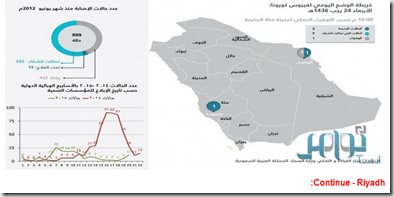
The Saudi Coronavirus Command Center website remains down for a second day, but Arabic media are carrying an MOH graphic showing two new MERS cases for today – one in Mecca and the other in Hafuf.   


Details on these cases are not currently available, beyond the following summation from twasul.info.


The Ministry of Health, on Wednesday, recording two cases of new infection "Corona" in Mecca and Hofuf, in addition to the deaths Balhvov the past 24 hours.

It is noteworthy that the number of cases of HIV infection since its discovery in the Kingdom reached 999 case, recovered, including 552 state, and 432 died, and remained under treatment, 15 cases


Hofuf (aka Hufof) has reported five recent cases (since May 5th), all believed to be part of a family cluster.  It isn’t clear what epidemiological connection – if any – today’s case has with those previously reported cases.

Thursday, March 26, 2015

WHO: MERS Update – Saudi Arabia March 26th

image

Credit WHO


# 9867


The World Health Organization has released two MERS updates, although for reasons that are not explained, the 11 cases cited in the March 25th report are repeated among the 15 cases reported in today’s report.


Disease Outbreak News (DONs)

Recent DONs
  • 26 March 2015
    Middle East respiratory syndrome coronavirus (MERS-CoV) – Saudi Arabia
  • 25 March 2015
    Middle East respiratory syndrome coronavirus (MERS-CoV) – Saudi Arabia


As we’ve seen previously, the probable source of exposure to the virus isn’t known for many of these cases. Of the 15 listed today:

  • 6 have no known risk exposures listed.
  • 4 have possible hospital exposures, but only 1 (HCW) of those is a known contact of an infected patient. 
  • Three have frequent animal contact; 2 with camels and 1 with sheep.  
  • And two are listed as (community) contacts of known cases


As we’ve discussed previously (see The Community Transmission Mystery), while the source of some MERS infections are fairly obvious, for the vast majority we still don’t know how these patients were exposed.  


Middle East respiratory syndrome coronavirus (MERS-CoV) – Saudi Arabia

Disease outbreak news
26 March 2015

Between 11 and 22 March 2015, the National IHR Focal Point for the Kingdom of Saudi Arabia notified WHO of 15 additional cases of Middle East respiratory syndrome coronavirus (MERS-CoV) infection, including 3 deaths. Cases are listed by date of reporting, with the most recent case listed first.

Details of the cases are as follows:
  • A 50-year-old, non-national male from Najran city developed symptoms on 11 March and was admitted to hospital on 20 March. The patient has no comorbidities. Investigation of history of exposure to known risk factors in the 14 days prior to the onset of symptoms is ongoing. Currently, the patient is in stable condition in a negative pressure isolation room on a ward.
  • A 54-year-old, non-national male from Riyadh city developed symptoms on 19 March and was admitted to hospital on 20 March. The patient has comorbidities condition of diabetes mellitus. He is a contact of a laboratory-confirmed MERS-CoV case (case n. 11 – see below). The patient has no history of exposure to other known risk factors in the 14 days prior to the onset of symptoms. Currently, he is in stable condition in a negative pressure isolation room on a ward.
  • A 60-year-old, non-national male from Jeddah city developed symptoms on 15 March and was admitted to hospital on 19 March. The patient has comorbidities and a history of travelling to Madinah during the 14 days prior to onset of symptoms. Investigation of history of exposure to known risk factors in the 14 days prior to the onset of symptoms is ongoing. Currently, the patient is in stable condition in ICU.
  • A 73-year-old male from Riyadh city developed symptoms on 13 March while admitted to hospital since 9 January due to an unrelated medical condition. The patient was admitted to the same hospital as other laboratory-confirmed MERS-CoV cases; investigation of epidemiological links with these cases and with shared health workers is ongoing. The patient has no history of exposure to other known risk factors in the 14 days prior to the onset of symptoms. Currently, he is in critical condition in ICU.
  • A 27-year-old male from Riyadh city developed symptoms on 8 March and was admitted to hospital on 14 March. The patient has a history of frequent visits to the same hospital for an unrelated medical condition; however, he has no history of contact with the laboratory-confirmed MERS-CoV cases that were treated at the hospital. Currently, the patient is in stable condition in a negative pressure isolation room on a ward.
  • A 56-year-old male from Riyadh city developed symptoms on 12 March and was admitted to hospital on 14 March. The patient has comorbidities. Investigation of history of exposure to known risk factors in the 14 days prior to the onset of symptoms is ongoing. Currently, the patient is in stable condition in a negative pressure isolation room on a ward.
  • A 44-year-old, non-national male from AlKhafji city developed symptoms on 4 March and was admitted to hospital on 14 March. The patient has no comorbidities. He has history of frequent contact with camels and consumption of raw camel milk. He has no history of exposure to other known risk factors in the 14 days prior to the onset of symptoms. Currently, the patient is in stable condition in a negative pressure isolation room on a ward.
  • A 60-year-old male from Taima city developed symptoms on 7 March and was admitted to hospital on 11 March. The patient has comorbidities and history of frequent contact with camels and consumption of raw camel milk. He has no history of exposure to other known risk factors in the 14 days prior to the onset of symptoms. Currently, the patient is in stable condition in a negative pressure isolation room on a ward.
  • A 47-year-old male from Alfadliah town developed symptoms on 2 March and was admitted to hospital on 12 March. The patient has comorbidities. Investigation of history of exposure to known risk factors in the 14 days prior to the onset of symptoms is ongoing. Currently, the patient is in stable condition in a negative pressure isolation room on a ward.
  • A 21-year-old non-national male from Riyadh city, Riyadh Region developed symptoms on 8 March and was admitted to hospital on 12 March. The patient has comorbidities. Investigation of history of exposure to known risk factors in the 14 days prior to the onset of symptoms is ongoing. The patient is in critical condition in ICU.
  • A 31-year-old, non-national male from Riyadh city developed symptoms on 1 March and was admitted to hospital on 10 March. The patient was a smoker and had comorbidities. Investigation of history of exposure to known risk factors in the 14 days prior to the onset of symptoms is ongoing. The patient passed away on 12 March.
  • A 45-year-old, non-national, female health worker from Riyadh city developed symptoms on 8 March and was admitted to hospital on 10 March. The patient has no comorbid conditions. She has a history of contact with a laboratory-confirmed MERS-CoV case that was reported in a previous DON on 11 March (case n. 14). Currently, the patient is in stable condition in a negative pressure isolation room on a ward.
  • A 62-year-old female from Riyadh city developed symptoms on 3 March while admitted to hospital since 23 November 2014 due to unrelated medical conditions. The patient was admitted to the same hospital as other laboratory-confirmed MERS-CoV cases; investigation of epidemiological links with these cases and with shared health workers is ongoing. She had no history of exposure to other known risk factors in the 14 days prior to the onset of symptoms. The patient passed away on 15 March.
  • A 59-year-old male from Riyadh city developed symptoms on 7 March and was admitted to hospital on 8 March. The patient had no comorbidities. He was a contact of a laboratory-confirmed MERS-CoV case that was reported in a previous DON on 23 February (case n. 2). He had no history of exposure to known risk factors in the 14 days prior to the onset of symptoms. The patient passed away on 14 March.
  • A 55-year-old, non-national male from Jeddah city developed symptoms on 5 March and was admitted to hospital on 8 March. The patient has no comorbidities and no history of contact with camels; however, he has frequent contacts with sheep and regular consumption of raw sheep products. The patient has no history of exposure to known risk factors in the 14 days prior to the onset of symptoms. Currently, he is in stable condition in a negative pressure isolation room on a ward.

The National IHR Focal Point for the Kingdom of Saudi Arabia also notified WHO of the death of 5 previously reported MERS-CoV cases. The cases were reported in previous DONs on 20 March (cases n. 5, 12), on 11 March (cases n. 2, 10) and on 6 March (case n. 6).

Contact tracing of household contacts and healthcare contacts is ongoing for these cases.

Globally, WHO has been notified of 1090 laboratory-confirmed cases of infection with MERS-CoV, including at least 412 related deaths.

Sunday, March 22, 2015

Saudi MOH Reports 2 MERS Cases

image

#9852


Saudi Arabia announces 2 new MERS cases this morning – one in Riyadh and one in Najran – using the the abbreviated format unveiled yesterday.


While no longer providing hospital or animal exposure histories, a footnote indicates more details will be forthcoming in their recently instituted weekly update.


image

Thursday, February 26, 2015

Deconstructing the 90% Of Camels Have MERS Meme

Photo: ©FAO/Ami Vitale

Credit FAO


# 9757


Earlier this week a big story hit the Arabic press – and has caused heavy (and very concerned)  traffic on Arabic Twitter – stating that 90% of Saudi Camels have the MERS virus.  I mentioned it briefly two days ago in Postcards From The MERS Twitterverse, but have been unable to find any paper, or study to back up this assertion. 


First a media report on this story, after which I’ll be back with reasons why I think this report is off base.


Almost all Gulf camels have MERS, warns Saudi health official

By Courtney Trenwith

Wednesday, 25 February 2015 1:50 PM

Almost all camels in the Gulf are infected with the Middle East Respiratory Syndrome (MERS), a Saudi Health Ministry official has been reported as saying.

The fatal virus, which already has infected more than 1000 and killed at least 376 patients, is believed to have spread from camels to humans.

The high rate of camel infection – 90 percent, according to Saudi Arabia’s undersecretary for preventative health Abdullah Asiri – raises a serious issue for the Gulf, where camels are a deep part of daily life for many locals.

Asiri said exterminating the animals was not an acceptable solution and instead research on a vaccine needed to be accelerated, Arab News reported.

(Continue . . . )

Obviously, if 90% of Saudi Camels are actively infected, this would pose major infectious disease risk. 


But it is makes far more sense that 90% of Saudi Camels have been infected with the MERS coronavirus (i.e. have serum antibodies) sometime in the past. Not that 90% are currently infected (and capable of spreading the disease) as intimated by this report.


It is a small, but important difference.


The idea that camels are a repository for the MERS coronavirus gained traction in August of 2013 when we saw a study in the  Lancet: Camels Found With Antibodies To MERS-CoV-Like Virus, which found specific antibodies to the MERS coronavirus in all 50 (100%) of the dromedary camel samples gathered (from multiple locations) in Oman.


Much lower levels of antibodies were detected in 14% of camels from two dromedary herds tested from the Canary Islands.


The following January (2014) in EID Journal: MERS-Like Antibodies In Camels, UAE 2003-2013, we saw a report showing  97% of  dromedary camel serum samples collected in 2003 and 2013 in the United Arab Emirates (UAE) showed specific antibodies for the MERS coronavirus.


Again in August, in EID Journal: Three Decades Of MERS-CoV Antibodies In Camels, we saw serological evidence showing an infection rate of 81%  going back over 30 years.


But none of these studies were designed to show that these camels were actively infected and shedding the virus.


While we’ve limited reports from the field on active infection with MERS virus in camels, we’ve one study that found 10 of 35 (27%) camels tested during the 2013–14 calving season (see EID Journal: MERS Coronavirus In A Saudi Dromedary Herd) actively shedding the virus. From the report:


At farm A, we detected MERS-CoV in 1 of 4 dromedaries sampled on November 30, none of 11 sampled on December 4, nine of 11 sampled on December 30, and none of 9 sampled on February 14 (Table 1). Of the 10 dromedaries that tested positive for MERS-CoV, 9 had parallel nasal and fecal specimens tested, with virus detected in the nasal swab specimens from 8 and the fecal specimen from 1.

At the December 30 sampling, 7 of 8 calves and 2 of 3 adults tested positive for MERS-CoV, indicating that when MERS-CoV circulates on a farm, both calves and adults can be infected (Technical Appendix[PDF - 81 KB - 3 pages] Table). Because all 12 adults with serum collected before December 30 were seropositive (titers >320), it is likely, though not certain, that the MERS-CoV infections in the 2 adults (nos. 21, 19Dam) sampled on December 30 were reinfections, as has been reported for other CoVs.


And last year (see EID Journal: MERS Coronaviruses in Dromedary Camels, Egypt) we saw a sampling from Egypt that found  4 (3.6%) of nasal swabs (out of 110 tested) were positive for the MERS-CoV virus (via RT-PCR testing). A positive PCR test is indicative of a current infection, with active viral shedding.


Obviously nowhere near the 90% range.


Perhaps even more on point, in EID Journal: Replication & Shedding Of MERS-CoV In Inoculated Camels we saw a study showing that camels intentionally inoculated with the human MERS strain shed copious amounts of the virus via nasal discharge for at least a week.


While there is some evidence that a camel can become re-infected with the MERS coronavirus, we don’t know how often that really happens.  But whether the first infection, or a subsequent one, the `window’ of opportunity for passing on the virus to humans (or other camels) appears limited to a week or two. 


As young camels have the least exposure to the virus, they appear the most susceptible to infection. And that has been postulated as a factor in the spring surge of MERS infections across the Middle East.


Camels appear to be an important conduit for the virus to move into the human population, but we’ve seen estimates that only 3% of cases are caused by direct zoonotic infection (see Dr. Tariq Madani: 97% Of MERS Cases From Human-to-Human Transmission).


If camel-to-human transmission could be eliminated, it might stop the reseeding of the virus into the human population. 


And until a camel vaccine can be developed, and deployed, exercising caution and good infection control practices around camels is certainly advisable.


But as far as the claim that 90% of camels have MERS, that appears to be more than a little overstated.

Monday, February 23, 2015

Saudi Arabia: WHO MERS Mission Summary

image

Saudi Arabia


# 9742


A little over a week ago (see MERS: WHO Mission Invited To Saudi Arabia) we learned that the World Health Organization, along with several other agencies, were invited to Saudi Arabia to consult on the ongoing MERS threat and recent surge in cases.


Today the WHO has released a brief summary of their findings and recommendations.


Although couched in language diplomatic, the overriding message here is that much more research needs to be done in order to understand how the MERS coronavirus is being transmitted – from animals to humans, within the community, and in the healthcare environment. 


First the press release, which also highlights the need for greater consistency in infection control protocols at local hospitals.


Surveillance, forecasting and response


More progress needed to control the Middle East respiratory syndrome coronavirus (MERS-COV) in Saudi Arabia


Riyadh, Saudi Arabia | 23 February 2015 – A team of experts from  the World Health Organization (WHO), the UN’s Food and Agriculture Organization (FAO), the World Organization for Animal Health (OIE) and Institut Pasteur, France concluded a mission to Saudi Arabia to assess the current situation of the Middle East respiratory syndrome (MERS-CoV) following a surge of cases in the past few weeks and to make recommendations for improving the surveillance, prevention and control of the virus. Already this month, more than 50 cases have been reported in several locations in the Kingdom, including infections acquired in health facilities (called nosocomial infections) in Riyadh, Qassim Region and Damman City, eastern region.

Members of the joint mission held discussions with high-level representatives from the Ministry of Health, visited the Command and Control Centre that has been leading all activities related to the control of the MERS-CoV, and toured the emergency and isolation facilities of the Prince Mohammed Bin Abdulaziz Hospital. Government officials and the WHO-led mission shared their concern about the rising number of MERS-CoV cases in recent weeks and in particular in health care facilities.

“The Kingdom did a lot to control the MERS-CoV. We want to hear WHO experts’ feedback on the Kingdom’s progress but also where we can improve. The government is fully committed to implementing the right control and prevention measures and also to funding any activities needed to control this disease,” said Ahmed Bin Aqeel Al Khateeb, the Saudi Arabian Health Minister.

The Minister also stressed the need to enable any hospital, whether government–run or private to handle a MERS-CoV case.

Although data collection and surveillance have improved globally in recent months, critical gaps in knowledge remain, and several challenges in the country will require further work. For example, how and why infections occur in the community is yet to be understood, and  this is critical for stopping the outbreak. In addition, cases that occur in health-care settings require further analysis to fully understand what steps are needed to ensure infection prevention and control measures are adequately implemented. The fact that infections are still occurring in some health-care settings but not in others indicates that current infection control measures are effective but not implemented. 

“When health workers are infected at work, this puts other health-care workers at risk, but also can be a risk to all other patients who seek care for other health conditions. Understanding where the breach in these measures is occurring and taking the steps needed to fully implement infection prevention and control measures can put an end to these nosocomial infections,” said Dr Keiji Fukuda, WHO Assistant-Director General who led the mission to Saudi Arabia.

“The OIE is encouraging close collaboration between public health and animal health at national and international levels.  OIE is ready to help achieve this,” said Dr Ghazi, Regional representative, OIE.

Besides implementing good infection control and prevention measures, efforts to educate professionals and the public are urgently needed. There are also significant gaps in community engagement to fully understand routes of infection and the preventive steps that should be taken. Defining groups that are most at risk, such as the elderly and those with underlying medical conditions, and how to target these groups with the right health messages remains a challenge.

“There are so many aspects of the virus that are still unknown. FAO is determined to use its expertise to better understand the human and animal interface of this virus,” said Dr Berhe Tekola, Director of Animal Production and Health Division, FAO.

The mission, along with the Saudi Arabian health authorities, identified main areas that should be urgently addressed:

  • Understanding the animal/human interface, that is, modes of infection and transmission;
  • Filling critical knowledge gaps in the science and epidemiology of MERS-CoV by conducting further research studies and by sharing the findings widely and rapidly;
  • Improving disease prevention, especially in health facilities that continue to experience avoidable infections; 
  • Intensifying social mobilization, community engagement activities and communications. The mission also stressed the need for intersectoral cooperation and coordination, especially between health, agriculture, and other sectors.

Additional information from research studies is also required to better understand the risk factors for infection and transmission. Results from case-control studies from affected countries are urgently needed, in particular, from the most affected one, Saudi Arabia. Understanding the evolution of the virus is needed, through studies to address the knowledge gaps at the human/animal interface environment.


The recurring theme running through this report can be summed up by the phrase `critical gaps in knowledge remain’ , which includes, but is not limited to, the Saudi’s long promised case-control study (see WHO 2013 case-control study protocol) which has yet to see the light of day.


As we discussed a few weeks ago, in WHO MERS Update & The Community Transmission Mystery, while some cases are identified as having animal, hospital, or community exposures – for most cases the route of infection remains undetermined. 


One of the tools epidemiologist’s use to determine risks for infection is through case-control study, where they compare laboratory-confirmed cases to a large number of uninfected controls, matched for age, sex, and by neighborhood. 


By examining their respective exposures against their outcomes, patterns of risk are often revealed.


Unknown at this time are what roles mildly – or even asymptomatically – infected cases in the community (who are never diagnosed or identified) play in the transmission of the virus.  Nor do we know why MERS cases are predominantly male, and their ages tend to  skew towards an older cohort.  


While we are coming up on three years since the first known outbreak (Jordan, April of 2012), there is still far too much about this virus that we don’t know. 


And with another spring wave expected, we risk having to learn those answers the hard way.

Sunday, February 15, 2015

Saudi MOH: 3 Additional MERS Cases

image


# 9716


Saudi Arabia reports 3 more MERS cases today, bringing their 5 day total to 29. 


One case from Riyadh appears to be community acquired, while two cases from Bureedah appear to be nosocomial. While I don’t find any recent cases reported from Bureedah, it is possible one of the recent Riyadh cases was a transfer from there.  


Hopefully the next WHO report will sort it out for us.


image


Since this recent uptick in cases began on Wednesday, 4 Healthcare workers have been reported infected, and a total of 11 (out of 29) cases are either confirmed or suspected to have been nosocomially acquired.  


The majority of cases, however, report no known risk exposures (see The Community Transmission Mystery).


Despite repeated attempts by the MOH to require better infection control protocols in Saudi healthcare facilities (see Saudi MOH Announces New MERS Infection Control Procedures), hospitals and clinics still appear to be a significant transmission site for the MERS coronavirus.

Saturday, February 14, 2015

MERS: WHO Mission Invited To Saudi Arabia

image

2014 Spring MERS wave – Credit ECDC 11th Update


# 9711


A year ago - 18 months after the first known outbreak of MERS in a Jordanian hospital - the total number of cases worldwide was still under 190 (see VDU blog February 2014 Snapdate  chart below).

image

By the following summer that number had more than quadrupled, and as we approach another spring `MERS season’, we are edging close to 1000 cases. 


All have origins on the Arabian peninsula, and by far the majority have hailed from Saudi Arabia. But the MERS virus has emerged from 10 different Middle Eastern nations, and has been exported to 13 other countries.


In the past few days we’ve seen a decided uptick in MERS cases reported by KSA, and compared to last year, they appear to be starting earlier in the year.  Last year’s spike didn’t begin until roughly week 12. 


The Saudi MOH has instituted a strong public health awareness campaign (see New MERS Awareness Video PSAs), and has ordered stricter infection control protocols in local hospitals, but the Ministry – with a new Minister of Health appointed last December – will likely face major MERS challenges over the next few month.


Yesterday the UN announced the Kingdom had invited a WHO team to visit, in anticipation of this year’s MERS surge.


Saudi Arabia invites UN health team in precautionary measure against spread of respiratory virus

Camels in particular are suspected in spreading the MERS virus. Photo: World Bank/Curt Carnemark


13 February 2015 – The United Nations World Health Organization (WHO) today announced it is dispatching a mission to Saudi Arabia next week at the request of the Government to take preventive measures for a possible upsurge of cases of a respiratory virus linked with camels known as Middle East Respiratory Syndrome coronavirus (MERS-COv).

Globally, there have been reports of at least 975 cases of the MERS virus, with 358 deaths, according to WHO.

“New cases were now being reported on an almost daily basis,” WHO scientist Dr. Peter Ben Embarek told reporters in Geneva today.

There were also reports, for the first time, of a case in the Philippines, involving a nurse who had returned from Saudi Arabia and had tested positive two days earlier, according to WHO. All of her contacts in the Philippines are now being followed, some of whom are showing signs of respiratory syndromes, but have tested negative thus far, the agency added.

Dr. Ben Embarek said that since the latest large outbreak in May/June 2013, there had been a smaller surge in Saudi Arabia, which could typically be explained due to small hospital outbreaks. People were getting it through some sort of contacts with camels, or through close contact with primary cases in hospitals or households.

He also said there were sporadic cases in Oman and the United Arab Emirates, but it was not yet established whether there was a seasonality regarding the disease, or if it was connected to camel husbandry practices.

On why the virus was centred in Saudi Arabia, Dr. Ben Embarek responded to a reporter’s question by saying that it was present in the whole region, with Saudi Arabia being the largest, central country there. Patients in Saudi Arabia also seemed to be more likely to seek medical treatment.

A WHO mission would be going to Riyadh, Saudi Arabia, next week at the request of the Saudi Government, in order to take preventive measures for a possible upsurge of cases in the spring, he said.

Dr. Ben Embarek also said there was a need to increase surveillance in other parts of the world with large camel populations. Camels were not showing severe symptoms, perhaps some mild respiratory syndromes, which would not normally attract attention.

When it came to human cases, said that those with weak immune systems were at most risk, while healthy young adults would normally not show serious symptoms, he said. He noted the fatality rate was 35 percent, and it was not easily transmissible among humans.

Dr. Ben Embarek said that the vast majority of the cases had had exposure to one of the countries in the region. If one was suffering from one of the underlying conditions, one should try to avoid contact with camels, be careful when visiting markets, apply good hygiene practices, and avoid unnecessary visits to health centres, given that the virus was suspected to be circulating there as well.

“Little is known on the exact risk factors and the ways the diseases is transmitted, but close contact with camels and consuming raw camel milk ought to be definitely avoided,” according to the WHO doctor.

Wednesday, February 11, 2015

Philippine Dept Of Health Statement On Imported MERS Case – ex KSA

image

KSA - The International hub of MERS – Credit ECDC 


# 9698


The statement by the Saudi MOH on Monday that so far in 2015, there had been no nosocomial transmission of MERS in the Kingdom may prove to have been premature, as we have news overnight of a 32-year-old Filipino nurse, recently returned from Saudi Arabia, testing positive for MERS in Manila. 


First the (translated) statement from the MOH, followed by a Xinhua report, after which I’ll return with a bit more.


PRESS STATEMENT on MERSCOV CASE IN PH (11 Feb. 2015)

February 11, 2015

During this time, prevent the spread of emerging infectious diseases such ngMERSCOV. Important, continued vigilance of our health workers to spread it and immediately remediate every Filipino infect MERSCOV.

Last day, a patient was admitted to the Research Institute for Tropical Medicine (RITM). A 32 year old nurse from Saudi Arabia felt fever, body aches, cough and difficulty breathing - symptoms compatible with a patient MERSCOV.

Testing was done on the patient and yielded positive results. The patient is currently confined in a negative pressure room at RITM. Patuloy syang sinusubaybayan ng ating mga doctors at health workers.

Sa ngayon, the patient is in stable condition. Contact tracing of other passengers is also being done. Experts, however, say that the possibility of other passengers on the plane being infected is low.

Re-call the Department of Health to the public to collaborate on the lookout to spread beyond the country's emerging infectious diseases such as MERSCOV. Shows flu-like symptoms, and usually gets in the Middle East Region.

Prepared for the government to treat the sick, but early magpapakonsulta great help if anyone feels the same symptoms, especially if saMiddle from East Region.

Philippine gov't takes measures to prevent spread of MERS-CoV

English.news.cn   

MANILA, Feb. 11 (Xinhua) -- Philippine President Benigno Aquino III has ordered Acting Health Secretary Janette Garin to ensure that all necessary preventive measures are being taken following a confirmed case of Middle East respiratory syndrome coronavirus ( MERS-CoV) in the country, a senior government official said Wednesday.

Presidential Communications Operations Office Secretary Herminio Coloma Jr. said that contact tracing is being done to locate fellow passengers of the patient who traveled from Saudi Arabia to Manila last week.

Citing a report of the Department of Health (DOH), he said that a 32-year-old Filipino nurse from Saudi Arabia was tested positive of MERS-CoV after experiencing symptoms related to a patient with such illness.

The patient is currently being treated at state-run Research Institute for Tropical Medicine (RITM).

The DOH said that the patient is currently in stable condition.

The government called on the public to cooperate to ensure that emerging infectious diseases, such as MERS-CoV would not spread in the country.


While MERS is only believed endemic on the Arabian peninsula, cases have been exported to at least 13 countries outside of the Middle East.  All of these exported cases have had a recent travel history to the region or contact with a case that had travelled from there.

image

Credit ECDC RRA January 2015


On Monday,  in WHO Summary & Risk Assessment On MERS-CoV,  the World Health Organization had this to say (emphasis mine) about the likelihood of seeing additional exported MERS cases in the months ahead.


Can we expect additional cases of MERS-CoV infection in the Middle East? And can we expect additional cases exported to other countries?

WHO expects that additional cases of MERS-CoV infection will be reported from the Middle East, and it is likely that cases will continue to be exported to other countries by tourists, travellers, migrant workers or pilgrims who might acquire infection after exposure to an animal (for example, while visiting farms or markets) or human source (possibly in a health care setting). Until more is understood about mode of transmission and risk factors for infection, cases resulting from zoonotic transmission will continue to occur, and will eventually lead to limited community transmission within households and possibly significant hospital-associated outbreaks. Among the recently exported cases who reported performing Umrah in SAU, investigation into their activities while in SAU revealed that they had either visited a healthcare facility or had come into contact with camels or raw camel products while in SAU.


Given the lengthy (up to 14 day) incubation period, there is plenty of time for someone to become infected, and travel extensively around the globe, before any symptoms appear.  


Today’s announcement will no doubt revive calls for additional airport screening. Politically, and in terms of reassuring the public, the screening of passenger arriving at airports and other points of entry probably has some merit.  And it may provide valuable surveillance information as well. 


But practically, as an effective way to keep an emerging virus out of a country, studies continue to show just how unlikely that outcome really is (see MERS: The Limitations Of Airport Screening).


Making it desirable that – whenever possible – outbreaks of emerging viruses are quashed as quickly as possible at the source, before they can board an airplane and spread inexorably around the globe.

Tuesday, January 20, 2015

Saudi Arabia: MOH Cancels Coronavirus Contracts Over Corruption Allegations

image


# 9601


Saudi Arabia’s Ministry of Health has had a bit of a revolving door this past year, with long-time Minister of Health  Dr. Abdullah Al-Rabiah abruptly replaced by Dr. Adel bin Mohammed Faqih (see Saudi Minister Of Health Replaced) last April, presumably over his inability to get control over their growing MERS problem.


On December 8th, we saw the Saudi King Appoints New MOH Amid Sweeping Changes To Ministries, appointing Dr. Muhammad Bin Ali Al-Hayazie to replace Dr. Faqih after just 8 months.


About 24 hours ago the Arabic press – and twitter – began talking about a corruption probe at the Saudi Ministry of Health that reportedly involves more than a billion Riyals (270 million USD) of coronavirus-related expenditures.  Arabic machine translations being what they are (decidedly murky), I decided to wait until an English language report appeared to blog it.


While it only scratches the surface, and doesn’t name names or provide dates, the following report from Arab News at least provides us some idea of the scope of the investigation.  


Follow the link to read the list of `suspect’ contracts.


MoH contracts canceled over corruption

  RIYADH: ARAB NEWS

Published — Tuesday 20 January 2015

The Ministry of Health has suspended 38 contracts from a total of 148 for health-related programs on the suspicion of corruption, sources said.


Sources said the suspicions surrounded 38 contracts worth SR1 billion allocated to fighting the coronavirus. It was found the amount was not spent on preventive measures. The total amount of money spent on the contracts reached SR663 million.


A ministerial order has been issued to form an internal committee to verify these contracts and it has become apparent that some contracts had spent the allocated money in full, according to information revealed by sources.


(Continue . . . )


It isn’t clear from this article exactly who did what, or under whose watch these `suspect’ contracts were let.   Assuming this isn’t handled in-camera, this may get very messy.  Except for the Arab News report above, I don’t mind much else in the English press about this.


If the official Saudi Press Agency (SPA) has covered this story, I’ve been unable to find it.


We are still waiting for the long promised case control study to be released by the Saudi Ministry, and with the height of MERS season soon to be upon us (April & May if last year is any guide), the sooner this gets resolved the better. 

Friday, January 16, 2015

WHO MERS Updates – Oman & Saudi Arabia

image

Credit CDC PHIL


# 9586


The World Health Organization has posted details on five previously announced MERS cases;  2 from Oman, and 3 from Saudi Arabia.  While Saudi Arabia has been reporting sporadic cases since August (after a lull of a couple of months), these are the first cases from Oman in a year.


Middle East respiratory syndrome coronavirus (MERS-CoV) – Oman

Disease outbreak news
16 January 2015

Between 7 and 10 January 2015, the National IHR Focal Point of Oman notified WHO of 2 additional cases of Middle East respiratory syndrome coronavirus (MERS-CoV) infection, including 1 death.

Details of the case are as follows:
  • A 32-year-old male from Dakhelyia Region who developed symptoms on 27 December and was admitted to hospital on 5 January. The patient had comorbidities. He owned a farm and had frequent contact with camels, goats and sheep. The patient had no history of exposure to other known risk factors in the 14 days prior to the onset of symptoms. He was admitted to ICU but passed away on 7 January.
  • A 31-year-old female from Dakhelyia Region who developed symptoms on 8 January and was admitted to hospital on 9 January. The patient has no comorbidities. She is a household contact of the MERS-CoV case reported above. The household owns camels but she had no direct contact with them. The patient is in stable condition and remains in isolation.

Contact tracing of household contacts and healthcare contacts is ongoing for these cases.

Globally, WHO has been notified of 950 laboratory-confirmed cases of infection with MERS-CoV, including at least 350 related deaths.


The latest case in the following update was reported on January 5th.  Since that time we’ve seen an additional 6 cases reported out of Saudi Arabia.   


Middle East respiratory syndrome coronavirus (MERS-CoV) – Saudi Arabia

Disease outbreak news
15 January 2015

Between 3 and 5 January 2015, the National IHR Focal Point for the Kingdom of Saudi Arabia (KSA) notified WHO of 3 additional cases of Middle East respiratory syndrome coronavirus (MERS-CoV) infection.

Details of the cases are as follows:
  • A 69-year-old male from Najran city who developed symptoms on 23 December and was admitted to hospital on 2 January. The patient has comorbidities. Although his neighbours rear camels, the patient has neither a history of direct contact with them nor of consuming raw camel products. In the 14 days prior to the onset of symptoms, he travelled to Yemen. He has no history of exposure to other known risk factors in the 14 days that preceded the onset of symptoms. Currently, the patient is in stable condition and remains in an isolation ward.
  • A 76-year-old male from Taif city who developed symptoms on 26 December and was admitted to hospital on 31 December. The patient has comorbidities as well as a history of frequent contact with camels and raw camel milk consumption. He has no history of exposure to other known risk factors in the 14 days prior to the onset of symptoms. Currently, the patient is in ICU and remains in critical condition.
  • A 45-year-old male from Dammam city who developed symptoms on 31 December and was admitted to hospital on 1 January 2015. The patient has no comorbidities. Although he frequently visits his friends’ camel farm, the patient has no history of direct contact with camels. The patient has no history of exposure to other known risk factors in the 14 days prior to the onset of symptoms. Currently, he is in stable condition and remains in isolation.

Cases are listed by date of reporting, with the most recent case listed first.


Last year we saw the number of MERS cases jump sharply in April  & May (see chart below), exacerbated – in part – by lapses in infection control procedures at Saudi Health Care Facilities.   The Ministry of Health appears to be taking a harder line on infection control protocols this year (see Saudi MOH Closes Riyadh Dialysis Center Over MERS Concerns).


image

Credit BCCDC


We should know in a few months is they were successful.

Wednesday, January 14, 2015

Saudi MOH Announces 2 New MERS Cases

image


# 9577


After several days with no new reported cases, Saudi Arabia is reporting two new MERS cases, 1 in Taif and 1 in Riyadh. .


image

Monday, December 08, 2014

Saudi King Appoints New MOH Amid Sweeping Changes To Ministries

image

Saudi Arabia

****  UPDATED ****


# 9422


It was only last April that the long-standing  Minister of Health  Dr. Abdullah Al-Rabiah  was abruptly replaced by Dr. Adel bin Mohammed Faqih (see Saudi Minister Of Health Replaced), presumably over his inability to get control over their growing MERS problem.


Today we’ve word of a massive reshuffling of Cabinet Ministers in Saudi Arabia that includes replacements for the Ministers of Health and Ministers of Agriculture . . . among others.


I’ll try to get some information of the new Minister of Health Dr. Muhammad Bin Ali Al-Hayazie, meanwhile here is the the bulletin from the Saudi Gazzette, then the individual announcements from the Saudi Press Agency.


King Abdullah rejigs Cabinet; Al-Hayazie new health minister

Last updated: Monday, December 08, 2014 6:11 PM

RIYADH – Custodian of the Two Holy Mosques King Abdullah on Monday appointed Muhammad Bin Ali Al-Hayazie as minister of health and Abdul Aziz Al-Khudairy as minister of culture and information. In a major Cabinet reshuffle, the King replaced six ministers and appointed nine new ministers.


0045 Royal Order Relieves Minister of Transport and Assigns Eng. Abdullah Al-Muqbel as Minister of Transport

0044 Royal Order Relieves Minister of Agriculture and Assigns Eng. Walid Al-Khuraiji as Minister of Agriculture

0043 Royal Order Relieves Minister of Social Affairs and Assigns Soliman Al-Humayyd as Minister of Social Affairs

0042 Royal Order Relieves Minister of Communications and Assigns Dr. Fahad Al-Hamad as Minister of Communications

0041 Royal Order Assigns Dr. Abdulaziz Al-Khudairi as Minister of Culture and Information

0040 Royal Order Assigns Dr. Mohammed Al Hiazaa as Minister of Health

0039 Royal Order Relieves Minister of Higher Education and Assigns Dr. Khalid Al-Sabti as Minister of Higher Education

0038 Royal Order Relieves Minister of Islamic Affairs and Assigns Dr. Suleiman Aba Al-Khail as Minister of Islamic Affairs


*** UPDATE ****

This report has now appeared from Middle East Online.


Saudi names new health minister to fight MERS

Hayazaa replaces Rabiah who was dismissed in April as concerns grew over kingdom's handling of MERS.

Middle East Online

RIYADH - King Abdullah named a new health minister Monday to lead the fight against the MERS virus that has cost more than 350 lives in Saudi Arabia, after his predecessor was sacked.

Mohammad bin Ali bin Hayazaa al-Hayazaa replaces Abdullah al-Rabiah who was dismissed in April as concerns grew over the kingdom's handling of the Middle East Respiratory Syndrome coronavirus (MERS-CoV).

Before Hayazaa's appointment as part of a cabinet reshuffle, Labour Minister Adel Fakieh had been serving as acting health minister.

During the tenure of Fakieh, who promised "transparency" over MERS, the World Health Organisation said a surge in MERS cases had receded but urged continued vigilance.

(Continue . . . )


I’ll leave it to others more expert in the Saudi Government to speculate on the cause, and likely effects, of these developments.