Showing posts with label Vital Signs. Show all posts

Monday, March 03, 2014

CDC Telebriefing (March 4th): Improving Antibiotic Prescribing Practices

image


# 8342


For years we’ve heard dire warnings of a future where most of our most important antibiotics are rendered impotent against drug resistant infections, and increasingly, those predictions are coming true.  Last September the CDC issued a major threat report called Antibiotic resistance threats in the United States, 2013 that provided  a snapshot of the effects of growing antibiotic resistance across the United States.


Among their (conservative) findings:


Each year in the United States, at least 2 million people become infected with bacteria that are resistant to antibiotics and at least 23,000 people die each year as a direct result of these infections. Many more people die from other conditions that were complicated by an antibiotic-resistant infection.


The rise of antibiotic resistance has long been linked to the overuse and misuse of antibiotics. A problem that is wide spread in many parts of the world where antibiotics are not well regulated, but also right here in the United States, where there remains a great variance in prescribing practices among physicians.


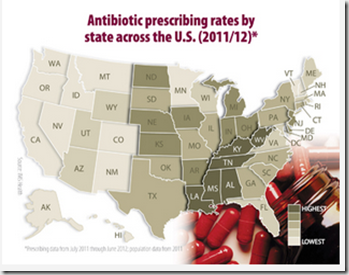
Last November, in AAP/CDC: New Guidance On For Antibiotics For Children, we saw guidelines issued – in part – due to the geographic disparity in the amount of antibiotics being prescribed across this country, with doctors some regions much quicker write ABx scripts than doctors in other areas (see map below).
image


Tp address this growing problem, tomorrow (March 4th) the CDC will hold a Telebriefing on Antibiotic prescribing practices (details below).


CDC Telebriefing: New Vital Signs Report - Are Prescribing Practices Putting Hospital Patients at Risk?

What

Poor antibiotic-prescribing practices in hospitals can needlessly put patients at risk for Clostridium difficile infection (deadly diarrhea) and future drug-resistant infections. This month, the CDC Vital Signs report looks at prescribing practices and variations, and calls on all U.S. hospitals to improve antibiotic-prescribing practices.

Who

Tom Frieden, M.D., M.P.H., Director, Centers for Disease Control and Prevention
John R. Combes, M.D., Senior Vice President, American Hospital Association

When

Tuesday, March 4 at Noon ET   (Content embargoed until 1pm ET)

DIAL-IN:

Media: 888-795-0855
Non-Media: 800-369-1605
International: 1-630-395-0331
PASSCODE: CDC MEDIA

Important Instructions: If you would like to ask a question during the call, press *1 on your touchtone phone. Press *2 to withdraw your question. You may queue up at any time. You will hear a tone to indicate your question is pending.

TRANSCRIPT
A transcript of this media availability will be available following the briefing at CDC’s web site:
www.cdc.gov/media.

###


For more on the importance of proper antibiotic stewardship, you may wish to revisit these earlier blogs.

Chan: World Faces A `Post-Antibiotic Era’

Get Smart About Antibiotics Week

IDSA: Educational Guidelines Lower Antibiotic Use

And for a far more complete discussion of antimicrobial resistance issues, I can think of no better primer than Maryn McKenna’s book SUPERBUG: The Fatal Menace of MRSA.

Superbug (MRSA) Book

Superbug (MRSA) Book

Meanwhile, Maryn’s SUPERBUG Blog, continues to provide the best day-to-day coverage of these issues.

Tuesday, May 03, 2011

MMWR Vital Signs: Asthma In The U.S.


# 5536


Asthma is a chronic inflammation of the bronchial tubes that makes them swell, narrowing the airways, which can seriously affect a person’s ability to breathe.


While most people with asthma are able to control their condition with proper medications (CDC "You Can Control Your Asthma"), more than half of those with Asthma in 2008 reported attacks.  


Asthma triggers like tobacco smoke, mold, pet dander, outdoor air pollution, colds and flu, etc. can suddenly bring on a potentially life threatening episode. Asthma claims about 9 lives each day in the US.


And for reasons that are not completely understood, Asthma is on the rise in the United States.


Back in 2001, 1 in 14 people (about 20 million) had asthma, compared with 1 in 12 (about 25 million) reporting asthma in 2009.


Today the CDC’s  MMWR has released a new Vital Signs Report and this month’s topic is Asthma in the US.


First the link to the MMWR report, then a link and some excerpts from the Vital Signs Report.


Vital Signs: Asthma Prevalence, Disease Characteristics, and Self-Management Education --- United States, 2001--2009

Early Release

May 3, 2011 / 60(Early Release);1-7
Abstract (EXCERPTS)

Methods: CDC analyzed asthma data from the 2001--2009 National Health Interview Survey concerning children and adults, and from the 2001, 2005, and 2009 state-based Behavioral Risk Factor Surveillance System concerning adults.

Results: Among persons of all ages, the prevalence of asthma increased from 7.3% (20.3 million persons) in 2001 to 8.2% (24.6 million persons) in 2009, a 12.3% increase. Prevalence among children (persons aged <18 years) was 9.6%, and was highest among poor children (13.5%) and among non-Hispanic black children (17.0%). Prevalence among adults was 7.7%, and was greatest in women (9.7%) and in adults who were poor (10.6%).

More uninsured persons with asthma than insured could not afford to buy prescription medications (40.3% versus 11.5%), and fewer uninsured persons reported seeing or talking with a primary-care physician (58.8% versus 85.6%) or specialist (19.5% versus 36.9%).

Among persons with asthma, 34.2% reported being given a written asthma action plan, and 68.1% had been taught the appropriate response to symptoms of an asthma attack. Only about one third of children or adults were using long-term control medicine such as inhaled corticosteroids at the time of the survey.

(Continue . . .)


There are wide regional variations in the incidence of asthma reported around the country, as evidenced by the Vital Signs map below.


image


For more background we turn to the Vital Signs report.


image

Asthma is a lifelong disease that causes wheezing, breathlessness, chest tightness, and coughing. It can limit a person's quality of life. While we don't know why asthma rates are rising, we do know that most people with asthma can control their symptoms and prevent asthma attacks by avoiding asthma triggers and correctly using prescribed medicines, such as inhaled corticosteroids.


The number of people diagnosed with asthma grew by 4.3 million from 2001 to 2009. From 2001 through 2009 asthma rates rose the most among black children, almost a 50% increase. Asthma was linked to 3,447 deaths (about 9 per day) in 2007. Asthma costs in the US grew from about $53 billion in 2002 to about $56 billion in 2007, about a 6% increase. Greater access to medical care is needed for the growing number of people with asthma.

Latest Findings
Asthma is increasing every year in the US.

Too many people have asthma.

  • The number of people with asthma continues to grow. One in 12 people (about 25 million, or 8% of the population) had asthma in 2009, compared with 1 in 14 (about 20 million, or 7%) in 2001.
  • More than half (53%) of people with asthma had an asthma attack in 2008. More children (57%) than adults (51%) had an attack. 185 children and 3,262 adults died from asthma in 2007.
  • About 1 in 10 children (10%) had asthma and 1 in 12 adults (8%) had asthma in 2009. Women were more likely than men and boys more likely than girls to have asthma.
  • About 1 in 9 (11%) non-Hispanic blacks of all ages and about 1 in 6 (17%) of non-Hispanic black children had asthma in 2009, the highest rate among racial/ethnic groups.
  • The greatest rise in asthma rates was among black children (almost a 50% increase) from 2001 through 2009.


(Continue . . . )


You’ll find a downloadable version of this page available as a 4-page PDF file.  You’ll also find links to related information, including audio podcasts.


Related Pages