Showing posts with label birds. Show all posts

Friday, June 14, 2013

Vienna: 5 Smuggled Birds Now Reported Positive For H5N1

image

Photo Credit USDA


# 7395


An update to a story mentioned earlier this week by Crof (see Austria: Smuggled bird had H5N1) which told of a couple caught attempting to smuggling 60 birds purchased in Bali through the airport in Vienna.


Out of these 5 dozen exotic birds, 39 had died in transit, and one had tested positive for the H5N1 virus.


Amazingly, these birds had made it through at least 2 other airports before being detected in Vienna.


Today we learn that 5 of those birds have now tested positive for the avian flu virus, and additional testing is underway. This (translated report) from Arkanoid Legent  comes from Radio Niederösterreich.


Czech Republic : Bird flu - Five animals were infected

Machine translated article from Noe.Orf :


After the previous week on the Schwechat Airport 60 birds were discovered in travel bags, there are now additional assay results from five of the smuggled from Bali animals were infected with the bird flu virus.


The investigation of the 60 confiscated birds is still in progress, so the tests are not yet complete. So far, the H5N1 virus could be clearly detected in five animals.

(Continue . . . )


The smuggling of birds, exotic animals, and exotic animal products are all too common, and have the very real potential of introducing exotic diseases to new locales. 


A few high profile examples include:


And just last month, in All Too Frequent Flyers, we saw a Vietnamese passenger, on a flight into Dulles Airport, who was caught with 20 raw Chinese Silkie Chickens in his luggage.


image


Beyond the cruelty perpetrated against these hapless creatures, and the loss of often endangered species, there is a very real danger of importing diseases via smuggled goods.


It was the consumption of exotic bushmeat in `wild flavor’ restaurants in Guangdong province, China that was apparently behind the introduction of SARS to humans in 2003 (see Bushmeat,`Wild Flavor’ & EIDs).


The trade in exotic pets (whether legal or illegal), and in `bush meat’, provides an easy avenue for the cross-border introduction of zoonotic diseases around the globe.


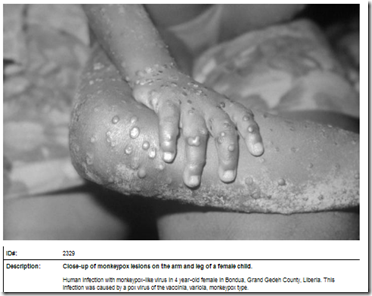
As an example, we saw a rare outbreak of Monkeypox in the United States in 2003, when an animal distributor imported hundreds of small animals from Ghana, which in turn infected prairie dogs that were subsequently sold to the public (see MMWR Update On Monkeypox 2003)

image

(Photo Credit CDC PHIL)


This outbreak infected at least 71 people across 6 states. No vaccine is available for Monkeypox, but the smallpox vaccination is said to reduce the risk of infection.


Two years ago  British papers were filled with reports of `bushmeat’ being sold in the UK. A couple of links to articles include:


Meat from chimpanzees 'is on sale in Britain' in lucrative black market

Chimp meat discovered on menu in Midlands restaurants


The slaughtering of these intelligent primates for food (but mostly profit) is horrific its own right, but it also has the very real potential of introducing zoonotic pathogens to humans.


In 2005, the CDC’s EID Journal carried a perspective article on the dangers of bushmeat hunting by Nathan D. Wolfe, Peter Daszak, A. Marm Kilpatrick, and Donald S. Burke.


It describes how it may take multiple introductions of a zoonotic pathogen to man – over a period of years or decades – before it adapts well enough to human physiology to support human-to-human transmission.


Bushmeat Hunting, Deforestation, and Prediction of Zoonotic Disease


Beyond H5N1, SARS and monkeypox, a few other viruses of concern include Hendra, Nipah, Ebola, other avian influenzas, hemorrhagic fevers, many variations of SIV (Simian immunodeficiency virus), and of course . . .  Virus X.


The one we don’t know about.  Yet.

Thursday, July 05, 2012

Hong Kong Closes Bird Market Due To H5N1


image

Photo Credit – FAO


# 6421


From the Hong Kong government this morning, word that they’ve closed the Mong Kok Bird Garden for the next 21 days after the detection of the H5N1 virus during routine surveillance.


Hong Kong, which endured the brunt of the SARS epidemic in 2003, conducts some of the most rigorous avian flu surveillance in the world.


The press release follows:


H5N1 closes Bird Garden

July 05, 2012

The Agriculture, Fisheries & Conservation Department has shut down the Mong Kok Bird Garden for three weeks due to the detection of the H5N1 virus. It was found in a swab sample collected from a birdcage holding an Oriental magpie robin on June 25.


The department has closed the shop involved and sent its birds to the department's animal management centre in Sheung Shui to be put down. It has ordered all pet bird shop operators in the garden to thoroughly clean their stalls.


The Centre for Health Protection has put all stall operators and workers in the garden under medical surveillance. It has opened a hotline, 2125 1122, to provide health advice to the public.


Three hundred swab samples are collected per month from 39 pet bird stalls, including the 18 stalls in the Bird Garden, to test for avian flu viruses. More than 1,700 swab samples have been collected from stalls so far this year. Of the 3,200 samples tested last year, none were positive for avian influenza.


Meanwhile, a dead house crow found in Yau Yat Chuen on June 29 has tested positive for H5N1. Cleaning and disinfection in the area has been stepped up.

Saturday, May 01, 2010

Thailand: Investigating Thousands Of Dead Storks


# 4540


image


Whenever we hear of large die-offs of birds, particularly in Asia, we immediately think of H5N1.


But we’ve seen bird die-offs in various parts of the world that turned out to be due to something other than bird flu. While suspicious, this incident may have been caused by environmental toxins or even deliberate poisoning.


Since bird flu is a possibility, we’ll obviously watch with interest for any laboratory test results that come out of this.


This report from the Bangkok Post.


Thousands of storks die, bird flu cause debated

  • Published: 2/05/2010 at 02:11 AM
  •  

Thousands of openbill storks in Phra Nakhon Si Ayutthaya's Phak Hai district have died, with avian influenza thought to be a possible cause.


BIRDS IN HAND: A farmer shows carcasses of two openbill storks among thousands which have died in Ayutthaya’s Phak Hai district. Residents fear bird flu is the cause of the deaths. PHOTO: SUNTHORN PONGPAO

A vast wasteland in tambon Khok Chang of Ayutthaya is home to tens of thousands of Asian openbill storks (nok pakhang). It is one of the largest flocks of birds in Ayutthaya.


A few days ago thousands of Asian openbill storks died without apparent cause.


Residents are worried the flock might have been infected with the bird flu virus as Phak Hai district was one of many areas nationwide reported with the virus outbreak last year.


They want authorities to investigate why the birds have died.


<SNIP>


In his view, the bird flu virus was unlikely to be the cause of the deaths, as it usually spreads in the early winter season, not in the summer.


However, it was not being ruled out in the investigation, said the district chief.

Saturday, March 27, 2010

If You’ve Seen One Triple Reassortant Swine Flu Virus . . .


# 4465


You haven’t seen them all.


At least, not according to a letter that appears in the latest edition of the CDC’s Journal of Emerging Infectious Diseases.


Novel H1N1, as everyone knows by now, is a descendent of a triple reassorted H1N1 swine flu virus that first appeared in American swine herds in 1998.  It apparently bounced around in swine herds for a decade before finding the right genetic mutations to adapt to humans.


But H1N1 isn’t the only swine flu virus out there.  Known Swine influenza A viruses include H1N1, H1N2, H3N1, H3N2, and H2N3.


Surveillance and reporting of infected herds is suboptimal in this country and around the world, and many farmers find financial disincentives to testing their herds (see Swine Flu: Don’t Test, Don’t Tell).


Today, we’ve news of another triple-reassortant swine flu virus – this time H3N2 – that has been spreading in pigs for more than a decade, that has now shown up in waterfowl in South Dakota.


Volume 16, Number 4–April 2010
Letter

Triple Reassortant Swine Influenza A (H3N2) Virus in Waterfowl

Muthannan A. Ramakrishnan, Ping Wang, Martha Abin, My Yang, Sagar M. Goyal, Marie R. Gramer, Patrick Redig, Monte W. Fuhrman, and Srinand Sreevatsan 


To the Editor: In 1998, a new lineage of triple reassortant influenza A (H3N2) virus (TR-H3N2) with genes from humans (hemmaglutinin [HA], neuraminidase [NA], and polymerase basic 1 [PB1]), swine (matrix [M], nonstructural [NS], and nucleoprotein [NP]), and birds (polymerase acidic [PA] and PB2) emerged in the U.S. swine population.


Subsequently, similar viruses were isolated from turkeys (1,2), minks, and humans in the United States and Canada (3,4). In 2007, our national influenza surveillance resulted in isolation of 4 swine-like TR-H3N2 viruses from migratory waterfowl (3 from mallards [Anas platyrrhynchos] and 1 from a northern pintail [Anas acuta] of 266 birds sampled) in north-central South Dakota. We report on the characterization of these TR-H3N2 viruses and hypothesize about their potential for interspecies transmission.

(Continue . . . )


For now, this is mostly a scientific curiosity, not a tangible public health threat.   But of course, one could have said the same thing about the triple reassortant H1N1 in pigs 12 months ago.


Which is why many scientists are calling for far more rigorous testing and surveillance of our farm animals. 


While one could argue that these viruses have circulated in pigs and other animals for thousands of years without our knowledge, and only rarely have emerged as human health threats, that ignores the recently introduced dynamic of factory farming. 


We now put thousands of pigs, and sometimes hundreds of thousands of chickens, in unnaturally close quarters to raise them.  This is believed conducive to promoting the spread, and mutation, of certain bacterial and viral pathogens.


Diseases that might never have caught fire fifty years ago, when Old McDonald had a half dozen sows on his farm, have a better opportunity to spread and mutate when introduced into a CAFO (Concentrated Animal Feeding Operation) with thousands of pigs or hundreds of thousands of chickens.


For more perspective on this, you might wish to read Dr. Michael Greger’s  Bird Flu: A Virus Of Our Own Hatching (available free, online) and watch his Human Society video on Flu Factories (online here).


The significance of this finding, of a swine H3N2 virus in waterfowl in South Dakota, is less than clear.  It may have no public health implications at all, or it could be a harbinger of some future health threat.


Without good, ongoing animal surveillance, it is impossible to establish a baseline and impossible to determine if something new or unusual is happening.  


And if the next virus to jump to man is more virulent than novel H1N1, the price of that ignorance could be very high.

Wednesday, January 20, 2010

Study: H1N1 And Birds


# 4271


After four years of blogging about influenza – whether it be human, swine, or avian – very little surprises me.   I’m used to having yesterday’s assumptions trashed by today’s studies.  


And I’m resigned to the possibility that what we think we learned today may be overturned next week or next month.


For the past five years or so the assumption has been that the 1918 H1N1 virus likely arose from an avianlike flu strain that jumped from some unidentified host reservoir nearly simultaneously to humans and swine. 


While suggestive of an avian origin, that has never been proven.  This from a paper published in the  CDC’s EID journal in 2006.


1918 Influenza: the Mother of All Pandemics

EID Journal Jan 2006


Jeffery K. Taubenberger and David M. Morens

(Excerpts)

The 1918 influenza pandemic had another unique feature, the simultaneous (or nearly simultaneous) infection of humans and swine. The virus of the 1918 pandemic likely expressed an antigenically novel subtype to which most humans and swine were immunologically naive in 1918 (12,20).


Recently published sequence and phylogenetic analyses suggest that the genes encoding the HA and neuraminidase (NA) surface proteins of the 1918 virus were derived from an avianlike influenza virus shortly before the start of the pandemic and that the precursor virus had not circulated widely in humans or swine in the few decades before (12,15,24).


More recent analyses of the other gene segments of the virus also support this conclusion. Regression analyses of human and swine influenza sequences obtained from 1930 to the present place the initial circulation of the 1918 precursor virus in humans at approximately 1915–1918 (20).


Thus, the precursor was probably not circulating widely in humans until shortly before 1918, nor did it appear to have jumped directly from any species of bird studied to date (19). In summary, its origin remains puzzling.


Today, several news outlets are carrying details of a study which appears in the February, 2010 edition of the Journal of General Virology, entitled:


1918 and 2009 H1N1 influenza viruses are not pathogenic in birds

Shawn Babiuk1,2, Randy Albrecht3, Yohannes Berhane1, Peter Marszal1, Jürgen A. Richt4, Adolfo García-Sastre3,5,6, John Pasick1 and Hana Weingartl1,7


Typical of the coverage is this, from Medical News Today.


1918 And 2009 H1N1 Flu Probably Not Spread By Birds


Article Date: 20 Jan 2010 - 5:00 PST

The two strains of the H1N1 influenza virus responsible for the 1918 and 2009 global flu pandemics do not cause disease in birds. The results of the study, published in the February issue of the Journal of General Virology, also show it is unlikely that birds played a role in the spread of the H1N1 virus in these pandemics.


Scientists from the Canadian Food Inspection Agency's National Centre for Foreign Animal Disease (NCFAD) in Winnipeg, Canada, together with collaborators in the USA, injected the 2009 and 1918 H1N1 virus strains individually into chickens. None developed flu symptoms or showed any signs of tissue damage up to18 days later, although about half the chickens developed antibodies against the 1918 H1N1 virus showing limited infection. The 1918 H1N1 virus also did not cause disease in ducks.


The origin of the 1918 H1N1 virus is unknown and despite its genetic similarity to avian influenzas, the results of this study show it is unlikely to have jumped the species barrier from chickens to humans.

(Continue . . . )


I can almost hear you say . . .  `Yes, but . . . what about the turkey flocks infected with novel H1N1?


For the answers to that, and other hanging questions, we can go to the study itself.   First from the Abstract:


ABSTRACT


The susceptibility of chickens to both 1918 and 2009 H1N1 influenza virus was evaluated. The intravenous pathogenicity index of 1918 and 2009 H1N1 viruses in chickens was 0. Chickens did not develop clinical signs following experimental inoculation simulating natural infection. No gross pathological changes were observed in any tissues of chickens between 2 and 18 days post-infection (p.i.) and viral RNA was not detected by real-time RT-PCR in mucosal secretions or tissues. Seroconversion was not detected in any of the chickens following inoculation with H1N1 2009 virus, whereas half the chickens developed influenza-specific antibodies at 28 days p.i. with 1918 influenza, suggesting limited infection.


Viral RNA was detected by real-time RT-PCR in mallard ducks following inoculation with 1918 influenza virus at 3 days p.i. in cloacal swabs, but not in tissues, and all ducks seroconverted by 28 days p.i.


Both 1918 and 2009 H1N1 influenza viruses behave as LPAI in gallinaceous poultry.


So . . .  while the title of the study, and the mainstream press reports, refer to `birds’ . . .  in truth this study only looked a chickens, mallard ducks, and gallinaceous poultry.


Gallinaceous poultry refers to heavy-bodied ground-feeding domestic or game birds such as  grouse, turkeys, pheasants and quail.


According to this study, chickens are not particularly susceptible to the novel H1N1 virus, and only marginally to the 1918 strain. 

Mallard ducks were apparently susceptible to the 1918 virus, in that they all seroconverted within 28 days post infection. 


But both chickens and ducks were asymptomatic.


In Turkeys and other gallinaceous poultry, infected birds experienced mild LPAI symptoms, such as a reduction in egg production.


Does all of this mean that birds were not the source of the 1918 H1N1 virus?


No.    And the authors make that point towards the end of their paper.


In any case, our results argue that the 1918 influenza virus, despite its high virulence in mice, ferrets, macaques and humans and its genotypic similarities to avian influenza viruses, replicates poorly in chickens and mallard ducks and therefore was unlikely to have made the direct jump from domestic chicken or mallard duck to humans.


The 1918 influenza might then have originated from an ‘unknown’ avian or other source (Reid et al., 2004) before probably acquiring several adaptive changes through mutation or even reassortment processes with other influenza viruses.


The good news here is that those species of birds most likely to come in close contact with humans (chickens, ducks, turkeys) appear to be poor hosts for the novel H1N1 virus, and (for now) are probably not a factor in the spread of the virus.


As far as the origins of the 1918 pandemic virus goes?


Well . . .  this is another piece of the puzzle, but not the final solution.

Tuesday, October 20, 2009

Branswell Updates The Ontario Turkey Story


# 3860


When a flu story breaks, bloggers like myself eagerly await reportage from one of the the handful of `A list science and health reporters in the mainstream media.  The ones that not only know the science, but have the contacts in the field to get the inside story.


No one fits that description better than Helen Branswell of the Canadian Press


Tonight Ms. Branswell brings us the latest information on the story that emerged just before noon today; the discovery of novel H1N1 infection among turkeys on an Ontario farm.


I’ve only posted the opening paragraphs. Follow the link to read the story in its entirety.


Ontario reports H1N1 in breeder turkeys, urges farmer workers to get flu shots

By Helen Branswell Medical Reporter (CP) –

TORONTO — A turkey breeding operation in southern Ontario has been hit by the H1N1 virus, the province's chief human and animal health officials reported Tuesday. It is only the second time turkeys have been reported to have been infected with the pandemic virus.


The outbreak likely poses no immediate threat to human health, and in particular should not have an impact on the safety of the food chain, the officials said, noting influenza cannot be contracted from well-cooked meat.


But experts do worry about the possibility that mutations could occur if flu viruses jump from one species to another and back again.

(Continue . . . .)

Update On Ontario H1N1 Infected Turkeys


# 3859


The ever-widening host range of the H1N1 virus is something that scientists will be keeping a wary eye on, even if right now it doesn’t constitute an imminent public health risk. 


New hosts bring added potential for the H1N1 virus to mutate or reassort with other flu viruses. That doesn’t mean that it will mutate, only that it provides the virus more venues in which it could happen.


That the virus should end up back in swine really isn’t a surprise, but finding it in Turkeys (twice, now) is a little less expected.  


In fact, it was only last week that a study in Eurosurveilance sought to reassure us that Turkeys weren’t particularly susceptible to the H1N1 virus.    Below is just an excerpt.


Eurosurveillance, Volume 14, Issue 41, 15 October 2009

Rapid communications

Resistance of turkeys to experimental infection with an early 2009 Italian human influenza A(H1N1)v virus isolate

C Terregino1, R De Nardi1, R Nisi1, F Cilloni1, A Salviato1, M Fasolato1, I Capua ()1

Our findings suggest that in its present form, the pandemic H1N1 influenza virus is not likely to be transmitted to meat turkeys and does therefore not represent an animal health or food safety issue for this species.


This begs the question: Is there something genetically different about this H1N1 virus – the one that has infected turkeys in Canada -that sets it apart from the strain used by the research team in Italy?

Something, I should think, scientists will be looking at closely in the coming days.


Here is the latest news report on the Turkey Farm infection, and the OMAFRA (Ministry of Agriculture, Food and Rural Affairs) press release.


Swine flu found in Ontario turkey breeding farm

CTV.ca News Staff

Date: Tuesday Oct. 20, 2009 2:29 PM ET


Ontario has confirmed a swine flu infection at a turkey breeding farm but health officials say it doesn't pose a threat to human health.


Ontario Health Minister Deb Matthews says the outbreak affected a breeder's flock of turkeys, but wouldn't say where the outbreak occurred.


She says the main concern is that the H1N1 infection would spread through the flock.


(Continue . . . )


This press release from the Ministry of Agriculture, Food, & Rural Affairs.


H1N1 Flu Infection Found In An Ontario Turkey Flock

Food Safety Not At Risk
NEWS

October 20, 2009

Turkeys in one barn at an Ontario facility have been found to be infected with the H1N1 flu virus.


Food safety is not at risk. No birds or eggs from this facility have entered the food chain. Proper cooking practices destroy the influenza virus.


As a best practice, all individuals are encouraged to practice proper hygiene and, if they have flu-like symptoms, they should stay at home, and avoid contact with livestock. Ontarians should get vaccinated against both H1N1 and the seasonal flu as the vaccines become available.


Test results indicate that the strain of flu isolated from the turkeys is the same as the H1N1 flu that has been circulating among humans since April 2009.


Local public health units are contacting individuals who may have had contact with the flock. The Ministry of Agriculture, Food and Rural Affairs (OMAFRA), the Ministry of Health and Long-Term Care and the Ministry of Labour will continue to monitor the situation and work with the producer and their employees.


The producer has voluntarily quarantined the infected birds and put movement controls in place.

QUOTES


“Influenza viruses such as this circulate amongst birds, livestock and humans.  This report is a good reminder to farmers to be even more conscientious than usual when it comes to protecting their flocks and ultimately, the people who come in contact with them.”
— Dr. Deb Stark, Chief Veterinarian for Ontario

“I am satisfied that this flock does not pose any threat to the health of the general public. In order to protect themselves and the animals they are working with, I strongly advise all poultry and livestock workers to get immunized against the H1N1 flu virus.”
— Dr. Arlene King, Chief Medical Officer of Health

Ontario Turkey Farm Reportedly With H1N1


# 3858


We’ll get an update apparently later this afternoon.


This is the second report I’ve seen where turkeys have been supposedly infected with the H1N1 swine flu virus. The first case was in Chile in August (see FAO: Concerns Novel H1N1 May Spread In Poultry  and   Chile: H1N1 Jumps To Turkeys).


Turkeys catch swine flu at Ontario farm


October 20, 2009

Theresa Boyle

HEALTH REPORTER

The Ontario government is investigating an outbreak of H1N1 influenza at a turkey farm.


The birds have been infected by the H1N1 virus but there has been no transmission to humans, a source confirms.


Cooking destroys the virus, so no one is at risk from consuming turkey, the source says.


The Chief Veterinarian for Ontario, Dr. Deb Stark, and Chief Medical Officer of Health, Dr. Arlene King, are holding a news conference on the issue at 2 pm Tuesday.

Monday, October 19, 2009

Mounting Questions Over Transmission Of Avian Flu


# 3851


Admittedly, the above title was my second choice for this story.  But it has the advantage of being printable.


Who says science is boring?  


Today, in the New Scientist we learn that avian flu may be a sexually transmitted disease . . . in ducks.


What follows, for some, may be way more than you ever wanted to know about the copulatory habits of water fowl. 


So fair warning.


However, the upshot here is that research has found `that ducks with the smallest penises and tamest sex lives had the highest flu levels’, proving that life is abundantly unfair – even for ducks.


A hat tip to Dutchy on FluTrackers for the most ornithologically ribald story of the day. 


Follow the link to read the story in its entirety.


Avian flu spread through duck sex

Bird flu may be a sexually transmitted infection – at least in ducks. That's the suggestion of an analysis of flu prevalence and mating behaviour that also proposes an easy way to spot duck populations most at risk of harbouring avian flu.


Surprisingly, the more rampant the sex a particular duck species indulges in, the lower the chance of spreading the virus. It's all to do with penis size and the complexity of the females' vagina.


Lethal strains of avian flu virus can evolve from harmless versions and then jump to other species, so it is important to also monitor less dangerous strains in wild birds. Ducks are the main wild hosts of bird flu, but surveillance is difficult without easy markers of infection risk.


Now Gergely Hegyi at Eötvös Loránd University in Budapest, Hungary, and colleagues think they may have found just such a marker: the "covert" wing patches that ducks display during mating. This finding builds on the previous work by the team, in which they found that species with large penises tend to have smaller wing patches, which are also more likely to be a single colour.

(Continue . . . )


Prevalence of avian influenza and sexual selection in ducks

Gergely Hegyia, Anders Pape Møllerb,c, Marcel Eensd and László Zsolt Garamszegie