Showing posts with label Hong Kong. Show all posts

Sunday, May 10, 2015

CHP: Zhejiang, Jiangsu & Fujian (Belatedly) Report 4 H7N9 Cases

image


# 10,032


Reporting on H7N9 cases out of Mainland China during this third winter wave has been frustratingly slow, and often devoid of useful details.  In early March, after a winter of intermittent and inconsistent reporting, daily reports all but dried up (see H7N9: No News Is . . . . Curious). 


Since then we’ve seen a few `bulk’ announcements of older cases, often buried in EOM epidemiological reports, and almost always with little or no epidemiological information.


Hong Kong’s CHP today reports they’ve been informed of 4 additional H7N9 cases – all apparently from between 4 and 6 weeks ago – from three mainland provinces. The fact that they are only now sharing this information with Hong Kong’s Centre For Health Protection underscores how lax reporting from the mainland has become. 


First their statement, then I’ll be back with a bit more.


CHP notified of additional human cases of avian influenza A(H7N9) in Mainland


The Centre for Health Protection (CHP) of the Department of Health (DH) today (May 10) received notification of four additional human cases of avian influenza A(H7N9) with onset of symptoms between March 27 and April 12 from the National Health and Family Planning Commission, and again urged the public to maintain strict personal, food and environmental hygiene both locally and during travel.


The patients comprise two men and two women aged 5 to 67 and two of them (one man and one woman) died. Two cases are from Zhejiang, one is from Fujian and one is from Jiangsu.


From 2013 to date, 640 human cases of avian influenza A(H7N9) have been reported by the Mainland health authorities. Regarding the third wave in the Mainland since November 2014, a total of 200 cases have been reported, including 72 in Guangdong, 40 in Fujian, 40 in Zhejiang, 18 in Jiangsu, eight in Anhui, seven in Xinjiang, six in Shanghai, three in Jiangxi, two in Hunan, two in Shandong, one in Guizhou and one in Hubei.


Today’s announcement brings this year’s `official’ total to 200 cases – considerably more than the 1st wave of 2013 (n=133), but less than the 2nd wave (n=303).


While seemingly an improvement over last year, the continual foot dragging in reporting from the mainland and the dearth of data provided, make it a lot harder to compare this year’s wave to the first two.


Even the best disease surveillance system in the world won’t pick up all of the cases of a disease outbreak. Some cases will have mild symptoms, and never seek medical care. Some may die, untested or misdiagnosed, and never be counted.


The `official’ number is always going to be a subset of the total burden of an outbreak.  The `tip of the iceberg’.


When you have good, consistent, and honest surveillance you can deal without having exact numbers. You can follow trends (increasing or decreasing case loads), geographic spread, or changes in the behavior of the virus (CFR, age or gender shifts, etc.).  


Radically change the way you report cases – as we’ve seen from China during this third wave  - and data comparisons become far more difficult.


It is possible (perhaps even likely) that this 3rd winter wave of H7N9 was less severe than the previous year, perhaps due to the closing of some live bird markets, the weather, or other factors.


But to make that call, you have to be comfortable with the accuracy and completeness of the data. And this year, that’s an open question.

Tuesday, May 05, 2015

Hong Kong: Oriental Robin Tests Positive For H5N6

image

Photo Credit- Wikipedia


# 10,010


Last week, in Hong Kong: Oriental Magpie Tests Positive For H5, we looked at the second detection of a wild bird in Hong Kong with HPAI H5 in a matter of three weeks. While we’ve seen birds carrying H5N1 show up in Hong Kong before, the peregrine falcon discovered on April 9th was the first imported case of HPAI H5N6 ever reported in the Territories.

.  

Today it was announced that the oriental magpie-robin discovered last week was also infected with the H5N6 virus.  This from the Hong Kong Government announcement.


Oriental magpie robin tests positive for H5N6 virus

The Agriculture, Fisheries and Conservation Department said today (May 5) that an oriental magpie robin found in Sai Kung was confirmed to be H5N6 positive after a series of laboratory tests.


The sick bird was found and collected near 10B Sha Kok Mei First Lane, Sai Kung, on April 29.

The AFCD will continue to conduct inspections of poultry farms to ensure that proper precautions against avian influenza have been implemented.


The spokesman reminded people to observe good personal hygiene. "They should avoid personal contact with wild birds or live poultry and clean their hands thoroughly after coming into contact with them," he said.

Ends/Tuesday, May 5, 2015
Issued at HKT 11:28


One of the recently emerged  HPAI H5 viruses, it made headlines almost exactly one year ago when it produced at least one fatal human illness in Nanchong City, China, and  was contemporaneously identified in local poultry (see Sichuan China: 1st Known Human Infection With H5N6 Avian Flu)


Since then it has infected at least two more in China, and has sparked at least 3 dozen poultry outbreaks across China and Vietnam.

image

Credit OIE Follow up Report # 7


Along with H5N8, H5N2, and the venerable H5N1 virus -  this upstart addition to HPAI H5’s lineage has been making impressive gains geographically - presumably being spread by migratory birds.  Before H5N8 began its big move last fall into Europe and North America (and spawned North American HPAI H5N2), the H5N6 virus was very near the top of our `avian flu strains to watch’ list.


In early November 2014, in FAO-EMPRES Report On The Emergence And Threat Of H5N6, we saw our first detailed look at H5N6, along with a short list of other newly emerged HPAI H5 viruses (including H5N8 & H5N3), that presciently warned

image

The possibility exists that wild birds could become infected and spread these viruses to other countries or continents. Migratory birds, which have played a key role in the introduction of H5N1 to Europe and Africa [Kilpatrick et al, 2006] and of H5N8 to the Republic of Korea [Jeong et al, 2014], could spread the viruses to other countries or continents.


Three weeks later it was announced that HPAI H5 had arrived in the Pacific Northwest, and since then it has spread across two provinces in Canada and 18 U.S. states.  H5N8 also winged its way into Europe last winter, making it as far as the UK.


Although not spreading in anywhere near as spectacular fashion as H5N8 or H5N2, the fact that H5N6 has already demonstrated a limited ability to infect humans when its more-traveled cousins have not, provides it with a bit of extra gravitas.


Making H5N6 very much still a virus to watch.

Thursday, April 30, 2015

Hong Kong: Oriental Magpie Tests Positive For H5

image

Photo Credit- Wikipedia


# 9995


You may recall that just two weeks ago, HK authorities reported their first Wild Bird Found Infected With H5N6 – a peregrine falcon – and over the past decade they’ve seen scores of (mostly migratory) birds carrying the H5N1 virus. Hong Kong is one of the few places in the world where public health authorities take notice of something as seemingly inconsequential as a single dead bird.


To understand why, you have to go back to 1997, when the H5N1 Bird Flu virus suddenly appeared in Hong Kong – infecting 18 residents and killing 6. The source of the infection turned out to be their own domesticated poultry industry, likely infected by wild birds.


It was only the complete eradication of all poultry in the territory that managed to halt what many feared could have been a disaster. Since then, Hong Kong has kept a particularly watchful eye on their winged visitors.


The strain of HPAI H5 in today’s case has yet to be determined, but authorities are already advising poultry interests of the potential threat.  


This from Hong Kong’s CHP.


Oriental magpie robin tests positive for H5 virus


Preliminary testing of an Oriental magpie robin found in Sai Kung has returned a positive result for the H5 avian influenza virus, a spokesman for the Agriculture, Fisheries and Conservation Department (AFCD) said today (April 30), adding that further confirmatory tests are being conducted.


The sick Oriental magpie robin was found and collected near 10B Sha Kok Mei First Lane, Sai Kung yesterday (April 29). Oriental magpie robins are common resident birds in Hong Kong.


The spokesman said cleansing and disinfection have been stepped up at the venue, adding that there are no poultry farms within three kilometres of where the dead bird was found.

In view of the case, the AFCD has phoned poultry farmers to remind them to strengthen precautionary and biosecurity measures against avian influenza. Letters have been issued to farmers, pet bird shop owners and licence holders of pet poultry and racing pigeons reminding them that proper precautions must be taken.


The spokesman said the department would conduct frequent inspections of poultry farms and the wholesale market to ensure that proper precautions against avian influenza have been implemented. The department will continue its wild bird monitoring and surveillance.


"People should avoid personal contact with wild birds and live poultry and their droppings. They should clean their hands thoroughly after coming into contact with them. The public can call 1823 for follow-up if they come across suspicious, sick or dead birds, including the carcasses of wild birds and poultry," the spokesman said.


The Food and Environmental Hygiene Department (FEHD) will continue to be vigilant over imported live poultry as well as live poultry stalls. It will also remind stall operators to maintain good hygiene.


The Department of Health will keep up with its health education to remind the public to maintain strict personal and environmental hygiene to prevent avian influenza.


The AFCD, the FEHD, the Customs and Excise Department and the Police will strive to deter the illegal import of poultry and birds into Hong Kong to minimise the risk of avian influenza outbreaks caused by imported poultry and birds that have not gone through inspection and quarantine.


All relevant government departments will continue to be highly vigilant and strictly enforce preventive measures against avian influenza. Health advice is available from the "H5N1 Health Advice" page on the AFCD website at www.afcd.gov.hk.

Ends/Thursday, April 30, 2015
Issued at HKT 20:44
NNNN

Thursday, April 16, 2015

Hong Kong: Wild Bird Found Infected With H5N6

image

Photo Credit- Wikipedia


# 9945


While we rarely hear of avian flu infected wild birds out of China (likely due to less than robust surveillance & reporting) – over the past decade we’ve seen numerous reports out of Hong Kong (see Egrets, They’ve Had A Few . . .  and Hong Kong: Two H5 Positive Gulls Found) of sick or dead migratory birds with the H5N1 virus.


In December of 2008 Hong Kong saw their first outbreak of H5N1 in domesticated poultry in nearly 6 years. In early 2009 it was announced that the H5N1 outbreak was `likely’ caused by infected migratory birds.  See Wild Birds Eyed As Likely Source Of Hong Kong Bird Flu  Outbreak.


Up until the past couple of years, the H5N1 virus has been the primary concern, but with the recent expansion of H5 and H7 viruses in Chinese poultry and the recent arrivals of H5N8 in Taiwan and Japan, H5N1 is now far from the only threat.


Last week is was reported that a Peregrine falcon tested positive for H5 virus in Hong Kong, and that further tests were underway to determine the subtype.  Today we learn that this bird was infected - not with H5N1 – but with the recently emerged H5N6 virus.


First case of H5N6 virus found in wild bird in Hong Kong

A spokesman for the Agriculture, Fisheries and Conservation Department (AFCD) said today (April 16) that the carcass of a peregrine falcon found at a construction site on Hung Yuen Road, Hung Shui Kiu, Yuen Long on April 9 was confirmed to be H5N6-positive after a series of laboratory tests.


It is the first case of H5N6 virus found in a wild bird in the territory. The AFCD will closely monitor the situation.


The AFCD will continue to conduct inspections of poultry farms to ensure that proper precautions against avian influenza have been implemented.


The spokesman reminded people to observe good personal hygiene. "They should avoid personal contact with wild birds or live poultry and clean their hands thoroughly after coming into contact with them," he said.

Ends/Thursday, April 16, 2015
Issued at HKT 18:01


H5N6 is one of several HPAI H5 reassortants that have appeared in China over the past couple of years (others include H5N8, H5N2, H5N3, H5N5), and like its more famous H5N1 cousin – H5N6 has demonstrated the ability to infect humans.


Although we only first heard about H5N6 a year ago (see (see Sichuan China: 1st Known Human Infection With H5N6 Avian Flu), it has since been reported across large swaths of China and as far south as central Vietnam. Last October, in China: H5 AI Rising, we looked at 24 recently reported outbreaks of H5N6 across China.

image


The following month, in FAO-EMPRES Report On The Emergence And Threat Of H5N6, we looked at an analysis of H5N6, and other recently emerged avian flu viruses in China. Since then, two more human cases have been reported see China Reports 3rd H5N6 Case (Fatal) – Yunnan Province), of which only one survived.


Although it has not spread as well or as far as the recently emerged H5N8 virus (and its reassortant progenies),  H5N6 is nonetheless a virus to watch.

Friday, April 10, 2015

Hong Kong Notified Of Additional H7N9 Cases On The Mainland

image


# 9925


On Wednesday, in FluTrackers: Zhejiang Province Reports 10 H7N9 Cases In March, we saw the belated announcement of 10 additional H7N9 cases from Zhejiang province (buried in an EOM spreadsheet). 


This winter we’ve witnessed a disappointing lack of timely and detailed avian flu reporting out of both Egypt and China (see More Than One Way to `Contain An Outbreak’).


Today, Hong Kong’s CHP takes note of those cases, along with three additional cases from Fujian and Shandong, bringing the number of cases reported out of China to 633.


10 April 2015

CHP notified of additional human cases of avian influenza A(H7N9) in Mainland 

The Centre for Health Protection (CHP) of the Department of Health (DH) today (April 10) received notification of 13 additional human cases of avian influenza A(H7N9) with onset of symptoms between February 14 and March 21 from the National Health and Family Planning Commission, and again urged the public to maintain strict personal, food and environmental hygiene both locally and during travel.

The patients comprise nine men and four women aged 32 to 80 and three of them (two men and one woman) died. Ten cases are from Zhejiang, two are from Fujian and one is from Shandong.

To date, 633 cases of human H7N9 infection have been reported by the Mainland health authorities cumulatively since 2013. In the third wave since November 2014, 193 cases have been reported in the Mainland, including 72 cases in Guangdong (see attachment for geographical distribution), 39 cases in Fujian, 38 cases in Zhejiang, 17 cases in Jiangsu, seven cases in Xinjiang Uygur Autonomous Region, seven cases in Anhui, six cases in Shanghai, two cases in Hunan, two cases in Jiangxi, two cases in Shandong and one case in Guizhou.

"Locally, we will remain vigilant and work closely with the World Health Organization and relevant health authorities to monitor the latest developments," a spokesman for the DH said.

(Continue . . .)


We’ve not heard anything from Guangdong province – this year’s H7N9 hotspot through the end of February – for more than a month. Hopefully we’ll see an EOM epidemiological summary from Guangdong, and other provinces, emerge in the coming days.

Wednesday, April 08, 2015

Hong Kong Stands Down From `Serious’ Influenza Response Level

image

# 9911


On December 27th, 2014 we saw Hong Kong Raise Influenza Pandemic Response Level to Serious after their first detection of an imported H7N9 case from the Mainland for the 2014-15 winter season.  This made the 11th such case detected since the virus emerged in the spring of 2013, and would be the first of three cases imported this year.


From the Preparedness Plan for Influenza Pandemic The Government of the Hong Kong Special Administrative Region (2014)

Serious Response Level


9. Serious Response Level corresponds to a situation where the risk of a novel influenza virus causing new and serious impact to human health in Hong Kong is moderate. Generally, it depicts a moderate risk of serious human infections caused by the novel influenza virus in Hong Kong, but serious infections are not expected to be widespread in the short term. Illustrative scenarios are shown in Box 2.

image


With fewer reports of H7N9 coming from the Mainland in the past 30 days, and the last imported case six weeks ago, the government of Hong Kong has decided to reduce the response level from `Serious’ to `Alert’.


Serious influenza response stands down

The Government today (April 8) lowered the response level of the Preparedness Plan for Influenza Pandemic from "Serious" to "Alert".


The response level was raised to "Serious" upon the detection of the first confirmed human case of avian influenza A(H7N9) in winter, imported from the Mainland on December 27, 2014. Since then Hong Kong has so far recorded three confirmed cases, which were all imported. The latest case was confirmed on February 23, 2015. The surveillance system of local public and private hospitals has not detected any new cases for more than a month.


A spokesman for the Centre for Health Protection (CHP) of the Department of Health said that the "Alert" response level was activated in view of the ongoing activity of highly pathogenic avian influenza among poultry outside Hong Kong.


"We will continue to closely monitor the global situation of avian influenza. So far, there is no evidence of efficient human-to-human transmission," the spokesman added.


Members of the public are advised to stay vigilant and maintain good personal and environmental hygiene, including washing hands frequently, particularly after sneezing or coughing; maintaining good indoor ventilation; building up good body immunity by having a balanced diet, regular exercise and adequate rest; and avoiding smoking.

Ends/Wednesday, April 8, 2015
Issued at HKT 14:45

Saturday, March 21, 2015

HK SCEZD: Management Of Contacts of Human Avian Flu Cases

image


# 9851


With 13 imported H7N9 cases over the past two winters, several brushes with H5N1 over the years, and even an occasional H9N2 infection popping up, Hong Kong has a good deal of experience dealing with avian flu cases.


They have also followed up on hundreds of close contacts of these cases, and have even set aside a holiday camp as a quarantine facility (see Hong Kong: Epidemiological Update On Imported H7N9 Case).


Yesterday Hong Kong’s SCEZD (Scientific Committee on Emerging and Zoonotic Diseases) released the following guidance on the management of close contacts of avian flu cases.


20 March 2015

Latest recommendations from SCEZD on management of close contacts of cases of human infection with avian influenza 

The Centre for Health Protection (CHP) of the Department of Health announced today (March 20) the latest recommendations by the Scientific Committee on Emerging and Zoonotic Diseases (SCEZD) on management of close contacts of cases of human infection with avian influenza.


Based on review of the recommendations on contact tracing for human infection with avian influenza cases by the World Health Organization, and experiences and practices of other health authorities, the SCEZD recommends the CHP to continue to conduct contact tracing of contacts of confirmed human cases of avian influenza. Antiviral prophylaxis with oseltamivir (tamiflu) should be given to the close contacts at an appropriate treatment dose for five days.  Medical surveillance is to be undertaken for 10 days after the last exposure, where the close contacts should report to CHP promptly if fever or any respiratory symptom develops.


Moreover, close contacts should wear a face mask for 10 days since last exposure to a confirmed case while the case was infectious. There are no restrictions for work or other daily activities during the surveillance period. If the close contacts are contraindicated / intolerant to or refuse antiviral prophylaxis with oseltamivir, they should be put under quarantine for 10 days since last exposure.


"The above recommendations are based on the most current scientific understanding of the risk of human-to-human transmission of avian influenza A (H7N9) virus, which also apply to human infections with other types of avian influenza viruses with low risk of human-to-human transmission, like avian influenza A (H5N1)," a spokesman for CHP explained.

The SCEZD notes that avian influenza viruses may change unpredictably, including its transmissibility and pathogenicity. It advises CHP to closely monitor the latest scientific development on avian influenza viruses and review the above recommendations if in future new scientific evidence suggests changes in the potential of human-to-human transmission and antiviral susceptibility.

The public may visit the CHP's pages about avian influenza below for more information:
* The avian influenza page (
www.chp.gov.hk/en/view_content/24244.html);
* The weekly Avian Influenza Report (
www.chp.gov.hk/en/view_content/3879.html); and
* Global statistics and affected areas of avian influenza (
www.chp.gov.hk/files/pdf/global_statistics_avian_influenza_e.pdf).

Ends/Friday, March 20, 2015

Friday, March 20, 2015

Hong Kong Prioritizes Groups To Receive Emergency Flu Vaccine

image


# 9848


The effect of this year’s vaccine mismatch due to a `drifted’ H3N2 virus has been keenly felt across the Northern Hemisphere, but perhaps no more so than in Hong Kong which has seen a doubling of severe cases and a tripling of deaths over last season. 


While the flu season is slowly winding down for most of us, Hong Kong continues to report new deaths daily, and historically often endures a second peak of influenza in the summer (see Hong Kong Girds For More Flu).

image

HK’s recent history of `Twin Peaks’ of influenza– Credit Flu Express


Although the Northern Hemisphere flu vaccine was a bust this year, the re-formulated Southern Hemisphere vaccine is due out in the next few weeks, and it includes a strain that should match the `drifted’ H3N2.   In an unusual move,  Hong Kong’s CHP announced last February they had ordered a limited supply of the New Southern Hemisphere flu vaccine (SH SIV), which was expected to arrive in April.


With a population of over 7 million, of which roughly 13% (1 million) are over the age of 65, and only about 100, 000 doses of this new vaccine expected to be available, Hong Kong has had to make the kind of vaccine prioritization decisions that we might expect to see in the opening months or year of a pandemic; deciding who gets part of limited resource.


Since 1.7% of the city’s population – those 85 and older – comprise 53% of this year’s influenza deaths, that cohort will have top priority when the new vaccine arrives (see HK Demographics Chart).  Whatever vaccine remains after this first tier is served will be used for those aged 75-84, although depending on uptake, supplies are likely to fall short of that cohort’s needs.


Despite the original April target delivery date, it now appears this vaccine won’t be deployed until May or June.


This from Hong Kong’s CHP:


Scientific Committee recommends priority groups to receive southern hemisphere influenza vaccine

The Controller of the Centre for Health Protection (CHP) of the Department of Health (DH), Dr Leung Ting-hung, today (March 20) welcomed the recommendations on the use of the southern hemisphere seasonal influenza vaccine (SH SIV) by the CHP's Scientific Committee on Vaccine Preventable Diseases (SCVPD) in Hong Kong.


"The SH SIV contains the currently predominant influenza A/Switzerland/9715293/2013 (H3N2)-like virus strain. Based on the risk assessment, the SCVPD recommends the elderly to be the priority group to receive the SH SIV to protect them from the possible summer influenza season. Besides, the SCVPD recommends all persons living in residential care homes for the elderly (RCHEs) to receive the SH SIV for the prevention of influenza outbreaks," Dr Leung said.


Epidemiology and priority groups


The SCVPD convened two meetings respectively on February 17 and this morning to examine the latest local, neighbouring and overseas epidemiology of seasonal influenza in this winter season, and assess the risk of various groups. It also studied issues related to the use of the SH SIV, including vaccine composition, vaccine effectiveness, any adverse effects and priority groups.


"The elderly, particularly the very old elderly, are the most vulnerable in this season as reflected by the high proportion of severe and fatal cases affecting the elderly, the high influenza admission rate among the elderly and the high proportion of RCHEs having outbreaks of influenza-like illness (ILI)," Dr Leung explained.


As of noon of March 16, among influenza-associated admissions to intensive care unit or deaths in adults aged 18 or above under the enhanced surveillance with public and private hospitals since January 2, 86.0 per cent were the elderly aged 65 or above (41.4 per cent aged 85 or above, 31.3 per cent aged 75 to 84, 13.2 per cent aged 65 to 74). As for deaths, 93.5 per cent were those aged 65 or above (53.0 per cent aged 85 or above, 31.7 per cent aged 75 to 84, 8.8 per cent aged 65 to 74).


The influenza-associated public hospital admission rate for the elderly aged 65 or above peaked at 5.54 cases per 10 000 persons in the last week of January, which is the highest since 2005, and has remained elevated so far. Institutional ILI outbreaks in this season mainly occurred in RCHEs (over 40 per cent).


"The SH SIV, when available, may be given by phases starting from the oldest age group, such as those aged 85 or above, in the community first as they are at higher risk of developing severe illness after infecting influenza. Most of them also have pre-existing underlying illnesses predisposing them to severe illness," Dr Leung remarked.


Programme arrangements

The DH has procured about 100 000 doses of SH SIV from a vaccine supplier by contract upon completion of the tender in accordance with government procurement procedures and requirements. As they are expected to be delivered in late April or early May, the vaccination programme is preliminarily planned to be conducted in May and June.


"Vaccination will be provided to priority groups, i.e. the elderly, under the existing Government Vaccination Programme (GVP) for free. As part of the GVP, the Residential Care Home Vaccination Programme will provide the SH SIV to RCHEs' residents through enrolled Visiting Medical Officers to which an injection fee of $50 per dose will be reimbursed. We will work out the logistics with RCHEs shortly," Dr Leung said.


Regarding the elderly in the community setting, the CHP is working closely with the Hospital Authority on the implementation. The elderly will receive the SH SIV by phases in public hospitals and clinics, with those of higher age to be vaccinated first, followed by other elderly in the next.

Ends/Friday, March 20, 2015
Issued at HKT 13:33

Monday, March 09, 2015

Hong Kong CHP Notified Of 19 H7N9 Cases From Mainland China

image


# 9797


One of the frustrations with this year’s wave of H7N9 in China over the past two years has been the delays in reporting of cases by a number of Mainland provinces.  We’ve looked at this issue several times, including in Jiangsu Province’s Uncertain H7N9 Count, and as a result  the size and scope of this year’s outbreak is difficult to quantify.


Today Hong Kong’s CHP published their notification of 19 H7N9 cases, from 6 different provinces, going back more than six weeks.  Individual case details, however, are not included.


Although we have seen several of these `bulk’ announcements this winter, there are still several provinces that have reported cases in previous years, but that we’ve not heard from this year (including Henan, Jilin, and Hebei).


CHP notified of additional human cases of avian influenza A(H7N9) in Mainland

The Centre for Health Protection (CHP) of the Department of Health (DH) today (March 9) received notification of 19 additional human cases of avian influenza A(H7N9) with the onset dates in the past five weeks prior to February 25 from the National Health and Family Planning Commission, and again urged the public to maintain strict personal, food and environmental hygiene both locally and during travel.


The patients comprise 13 males and six females aged from 3 to 76. Three of them (one man and two women) died and two (one man and one woman) were in critical condition. Eleven cases are from Zhejiang, three are from Jiangsu, two are from Hunan, one is from Fujian, one is from Guizhou and one is from Jiangxi.


To date, 618 human cases of avian influenza A(H7N9) have been reported by the Mainland health authorities in Guangdong (181 cases), Zhejiang (167 cases), Jiangsu (73 cases), Fujian (59 cases), Shanghai (45 cases), Hunan (26 cases), Anhui (24 cases), Xinjiang (10 cases), Jiangxi (10 cases), Shandong (six cases), Beijing (five cases), Henan (four cases), Guangxi (three cases), Jilin (two cases), Guizhou (two cases) and Hebei (one case).

(Continue. . . .)

Monday, March 02, 2015

Hong Kong Girds For More Flu

image

HK’s recent history of `Twin Peaks’ of influenza– Credit Flu Express


# 9773


Although there are some subtle signs that the worst of Hong Kong’s severe flu season may be waning, school and work schedules are just now returning to normal following the Lunar New Year Holiday, and concerns run high that a second surge of flu may ensue.


With 310 flu-related deaths recorded since early January, this year’s flu outbreak is already more than twice as deadly as last year, with the potential for seeing several more months of activity. 


Complicating the situation, Hong Kong often sees a biphasic or `double peaked’  flu season, as the chart at the top of this post , and the following 2008 PLoS One research paper illustrates:


Seasonality of Influenza A(H3N2) Virus: A Hong Kong Perspective (1997–2006)

Julian W. Tang,1,* Karry L. K. Ngai,1 Wai Y. Lam,1 and Paul K. S. Chan1,2

(EXCERPT)

Hong Kong is a subtropical region of almost 7 million people, 95% of whom are ethnic Chinese, with a mean temperature of 24°C and mean relative humidity of 79% [27]. It lies geographically in the Northern hemisphere, and its influenza season occurs during February–April, sometimes with a second peak during June–August, each year.

In contrast, other Northern hemisphere countries usually have a more extended influenza season from November to March/April, whereas the influenza season of Southern hemisphere countries usually occur from May to September [7], [28].

Hence, Hong Kong may be unique in that its biphasic influenza seasonality seems to straddle those of the Northern and Southern hemisphere countries, making the molecular epidemiology of its circulating influenza viruses of great interest. In addition, Hong Kong and Southern China have been referred to as the ‘epicenter’ for new influenza A viruses with pandemic potential for over 25 years now [29]. For all of these reasons, any investigation of the underlying basis for influenza seasonality may benefit greatly from a study of influenza viruses isolated from Hong Kong.

(Continue . . . )


Hong Kong officials are worried enough they are making special arrangements to purchase a quantity of the recently revised Southern Hemisphere vaccine for use in a second wave of vaccination for high risk individuals, as announced recently in New flu vaccine ready by April.

This update from Hong Kong’s CHP.


Latest update of surveillance data in winter influenza season

The Centre for Health Protection (CHP) of the Department of Health today (March 2) reported the latest surveillance data of the winter influenza season, and again urged the public to heighten vigilance and get vaccinated early against seasonal influenza.


"As most schools resumed after the Lunar New Year, we today issued letters to kindergartens, child care centres and primary and secondary schools as well as special schools to alert them to the current influenza activity, which remains at a high level and is expected to remain so for some time. Continued vigilance is warranted," a spokesman for the CHP said.


Schools should continue to actively check the body temperature of all students every day to identify those with fever who should not attend school till 48 hours after it subsides. Staff with respiratory illnesses should also refrain from work," the spokesman added.


Schools may refer to the CHP's Guidelines on Prevention of Communicable Diseases (LINK) for further information.

Regarding severe cases, from noon yesterday (March 1) to noon today, six additional cases of influenza-associated admission to intensive care units or death (including three deaths) among adults aged 18 or above have been recorded under the enhanced surveillance in collaboration with public and private hospitals reactivated since January 2 and an additional death was recorded among previously reported cases, bringing the total to 421 (310 deaths) so far. Among them, 403 were A(H3N2), two were A(H1N1)pdm09, seven were A pending subtype and nine were B. In the last winter season in early 2014, 266 (133 deaths) were filed.


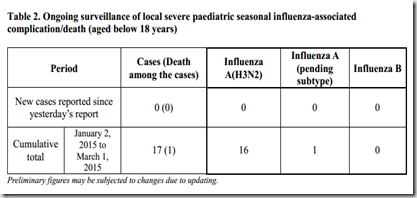
Meanwhile, no additional cases of severe paediatric influenza-associated complication or death among children aged under 18 have been reported since yesterday via the ongoing reporting system and the total this year hence remains at 17 (one death) and all were A(H3N2). In 2014, 27 cases (four deaths) were filed.

(Continue . . . )


Although the two viruses aren’t really comparable, this year’s seasonal flu death toll has now exceeded the number killed in Hong Kong by SARS (n=299)  in 2003 (see SARS and Remembrance).


The difference being that SARS infected fewer than 2000 people in Hong Kong while racking up that toll, while influenza has likely infected hundreds of thousands.


While other areas in Europe, India, and Asia are seeing high levels of seasonal influenza activity right now,  we always pay special attention to Hong Kong’s flu season. Simply because it has excellent surveillance, and its proximity to southern China makes its a credible place to look for the emergence and spread of novel flu viruses.

Sunday, March 01, 2015

HK’s Imported H7N9 Case Dies, Seasonal Flu Continues Strong

image


# 9769


As the City of Hong Kong struggles with a particularly severe H3N2 flu season, its 3rd imported H7N9 case of the winter (and 13th overall) has reportedly died in a local hospital a week after his case was announced.  Of the two other H7N9 cases imported into Hong Kong this season, one has recovered while the other remains hospitalized in critical condition.

H7N9 bird flu infected man dead

Sing Tao Daily 

Had earlier to the mainland, after his return confirmed cases of H7N9 avian influenza in 61-year-old man, extended to 6:30 am dead. Food and Health Secretary Ko Wing-man, said most H7N9 cases in Hong Kong imported from mainland China appealed to the public when the areas affected by avian influenza to be alert.

Last month, the patient twice to Zhangmutou, and go to the market to buy two chickens have been slaughtered, after returning discomfort, admitted to Queen Mary Hospital intensive care unit, extended to 6:35 this morning, where he died.

(Continue . . . )


Of the 602 H7N9 known cases reported by the World Health Organization as of February 23rd, 227 deaths have been reported, yielding an impressive 37% fatality rate.  


But the real CFR (case fatality rate) is likely far lower, as only the `sickest of the sick are likely to be hospitalized, tested, and identified as carrying the virus.  And those people who are sick enough to be hospitalized are also more likely to succumb.


If we could factor in the mild or moderate cases that never get counted, but recover on their own, that sky-high CFR would probably drop precipitously. 


But even a 10-fold drop in mortality would leave us with a very daunting flu, comparable to the 1918 pandemic.


Meanwhile, Hong Kong’s seasonal flu continues unabated, and their Centre for Health Protection has published a YTD report showing its impact.  


Thus far, seasonal flu has claimed at least 307 lives in Hong Kong this winter.  To put that in perspective, last year 133 deaths were reported – and this year’s flu season is far from over.


Update on severe seasonal influenza cases (As of 1 March, 2015, 12 noon)

image

image

Saturday, February 28, 2015

Guangdong & Anhui Provinces Report H7N9 Cases

 image


# 9765


Unlike last winter, day-to-day reporting of H7N9 cases from much of Mainland China has been slow, although it isn’t entirely clear how much of this is due to an actual reduction in cases and how much is due to a change in the way some provinces are reporting. 


We’ve seen some case announcements turn up belatedly in Provincial EOM epidemiological reports.


Earlier this week the World Health Organization, in their most recent Antigenic and genetic characteristics of zoonotic influenza viruses and candidate vaccine viruses developed for potential use in human vaccines, described this year’s H7N9 activity and virus evolution as:


Influenza A(H7N9) activity from 24 September 2014 to 23 February 2015


During this period, 148 human cases of avian influenza A(H7N9) virus infection were reported to WHO, bringing the total number of cases to 602 with 227 deaths reported4. All human cases were detected in China, or in travelers who visited China (2 in Canada). Increased genetic heterogeneity of HA and NA gene sequences was observed among recent viruses from humans, poultry and environmental samples. Comparison of these viruses using haemagglutination inhibition (HI) assays showed that the majority remained antigenically similar to the CVVs derived from A/Anhui/1/2013-like viruses.


`Increased genetic heterogeneity of HA and NA gene sequences’  is evidence  that the H7N9 virus continues to evolve, something we’ve looked at previously in Eurosurveillance: Genetic Tuning Of Avian H7N9 During Interspecies TransmissionEID Journal: H7N9 As A Work In Progress.


Two reports this morning courtesy of Hong Kong’s CHP.


HP notified of additional human case of avian influenza A(H7N9) in Guangdong


The Centre for Health Protection (CHP) of the Department of Health (DH) is today (February 27) closely monitoring an additional human case of avian influenza A(H7N9) in Guangdong notified by the Health and Family Planning Commission of Guangdong Province (GDHFPC), and again urged the public to maintain strict personal, food and environmental hygiene both locally and during travel.


According to the GDHFPC, a male patient aged 80 in Shantou was hospitalised for treatment in critical condition.

To date, 589 human cases of avian influenza A(H7N9) have been reported by the Mainland health authorities in Guangdong (176 cases), Zhejiang (156 cases), Jiangsu (70 cases), Fujian (58 cases), Shanghai (45 cases), Hunan (24 cases), Anhui (19 cases), Xinjiang (10 cases), Jiangxi (nine cases), Shandong (six cases), Beijing (five cases), Henan (four cases), Guangxi (three cases), Jilin (two cases), Guizhou (one case) and Hebei (one case).


After not having reported any H7N9 cases this winter, Anhui Province – which reported two cases on February 25th (see CHP closely monitors three additional human cases of avian influenza A(H7N9) in Mainland) – has apparently notified Hong Kong’s Centre for Health Protection of two more cases (1 from Anqing City and the other from Tongling).


HP closely monitors two additional human cases of avian influenza A(H7N9) in Mainland


The Centre for Health Protection (CHP) of the Department of Health (DH)is today (February 28) closely monitoring two additional human cases of avian influenza A(H7N9) in the Mainland, and again urged the public to maintain strict personal, food and environmental hygiene both locally and during travel.


According to the Health and Family Planning Commission of Anhui Province, a male patient and a female patient, both aged 58 with poultry exposure before onset, were hospitalised for management. They were in critical condition.


To date, 591 human cases of avian influenza A(H7N9) have been reported by the Mainland health authorities in Guangdong (176 cases), Zhejiang (156 cases), Jiangsu (70 cases), Fujian (58 cases), Shanghai (45 cases), Hunan (24 cases), Anhui (21 cases), Xinjiang (10 cases), Jiangxi (nine cases), Shandong (six cases), Beijing (five cases), Henan (four cases), Guangxi (three cases), Jilin (two cases), Guizhou (one case) and Hebei (one case).

Tuesday, February 24, 2015

Hong Kong: Update On 3rd Imported H7N9 Case

image


# 9746


We’ve an update from Hong Kong’s CHP this morning on their epidemiological investigation into this seasons’ 3rd imported H7N9 case. This is the 13th known importation into Hong Kong since H7N9 emerged two years ago, and authorities have contact tracing and surveillance pretty much down to a science. 


While human-to-human transmission of the H7N9 virus has only rarely been reported, the incubation period is thought to be up to 10 days, and so arrangement are being made for asymptomatic contacts to be quarantined at the Lady MacLehose Holiday Village in Sai Kung.

Lady MacLehose Holiday Village

We’ve seen similar arrangements in the past both in Hong Kong and in Singapore (see Singapore MOH Puts Quarantine Chalets On Standby).  Symptomatic contacts are quartered in hospital isolation rooms.


Here is today’s update, after which I’ll return with a bit more:


Update on imported human case of avian influenza A(H7N9)

The Centre for Health Protection (CHP) of the Department of Health (DH) today (February 24) reported the latest updates on the third imported human case of avian influenza A(H7N9) in Hong Kong this winter, and again urged the public to maintain strict personal, food and environmental hygiene both locally and during travel.


Epidemiological investigations by the CHP have so far located 17 close contacts and 99 other contacts of the patient.

(A) Close contacts
------------------
The close contacts will be put under quarantine and prescribed with antiviral presumptive treatment until the completion of the five-day treatment, or 10 days since last exposure to the patient, whichever is earlier. They include:

  • An asymptomatic family member of the patient who tested negative for influenza A virus;
  • Five asymptomatic healthcare workers (HCWs) involved in Queen Mary Hospital (QMH);
  • Seven in-patients admitted to the same cubicle as the confirmed patient in QMH among which six were asymptomatic while the remaining one is under tracing; and
  • Three patients and one who accompanied one of them attending the same private clinic in Aberdeen with the confirmed patient. They are all asymptomatic.

The Lady MacLehose Holiday Village in Sai Kung under the Leisure and Cultural Services Department has been converted to a quarantine centre for asymptomatic close contacts, including the HCWs involved in QMH.

(B) Other contacts
------------------
Other contacts have been put under medical surveillance and they include:

  • Another asymptomatic family member who visited the confirmed patient in QMH;
  • 77 HCWs involved in QMH;
  • 15 asymptomatic clinic contacts including a private doctor, staff and patients of the private clinic; and
  • Six colleagues of the patient among whom one had mild upper respiratory tract infection symptoms before exposure to the patient while the rest are asymptomatic.

Investigations and contact tracing are ongoing.

Ends/Tuesday, February 24, 2015
Issued at HKT 17:18
NNNN


As mentioned yesterday, with this year’s severe, and concurrent, seasonal flu outbreak in Hong Kong there are enhanced concerns that someone could be simultaneously infected by both the H7N9 virus and H3N2.  Although the outcome of such a rare event is unpredictable, it could theoretically lead to the creation of a `hybrid’ or reassortant virus.


Yesterday the HK CHP released the following statement regarding the genetic profile of H7N9 viruses detected this year (excluding the latest one, on which genetic characterization is under way).


"While the activity of avian influenza viruses in the Mainland and human seasonal influenza viruses in Hong Kong remains high this winter and heightened vigilance and extra attention to hygiene are warranted, we will closely monitor the virus activity and genetic nature. Genetic analysis to date has revealed that H7N9 viruses confirmed in Hong Kong have remained to be of avian origin and had no significant differences from those detected in the Mainland, nor has there been evidence of reassortment with genes from human seasonal influenza viruses or resistance to the antiviral oseltamivir (Tamiflu)."


Previously, in the Lancet: Coinfection With H7N9 & H3N2, we saw the first evidence of co-infection with the newly emerged H7N9 virus and a seasonal flu virus in a human. While last October, in EID Journal: Human Co-Infection with Avian and Seasonal Influenza Viruses, China, we looked at co-infections in 2 patients in Hangzhou, in January 2014.


In all of three of these cases, no reassortant virus was detected.  Yet we know from experience that these sorts of events are possible (see pH1N1 – H3N2 A Novel Influenza Reassortment).


While rarely detected, influenza A coinfections are probably more common than we realize.  Luckily, most do not result in the creation of a reassorted virus - and of those that do - most end up being evolutionary failures.


The odds of any one viral tryst producing a viable, humanized virus is probably fairly remote.


The concern is, if these viruses get enough rolls of the genetic dice, they will eventually roll a natural.  Which is why we watch Hong Kong, mainland China, and Egypt so carefully this time of year.

Monday, February 23, 2015

Hong Kong Confirms 3rd Imported H7N9 Case Of This Winter

image


# 9743


The suspected H7N9 case that Crof reported on late last night (see Hong Kong patient, 61, in critical condition with suspected H7N9 bird flu) is now apparently confirmed, although Hong Kong’s CHP has yet to publish an update.  Instead we have a brief announcement from http://www.news.gov.hk.

Imported H7N9 case probed

February 23, 2015

The Centre for Health Protection is investigating an imported H7N9 case in Hong Kong affecting a 61 year-old-man who had travelled to Dongguan.

He travelled to the city twice this month and bought two slaughtered chickens at a wet market there on February 14.

He returned to Hong Kong, and developed a cough and shortness of breath since February 16.

He was admitted to Queen Mary Hospital on February 20 and tested positive for influenza A(H7).

He is in critical condition in the Intensive Care Unit.

His home contacts in Dongguan have no symptoms.


With Hong Kong’s seasonal flu outbreak at near record levels (352 ICU cases & 254 deaths as of Feb 23rd report), once again we are hearing warnings of a `hybrid’ or reassortant flu virus emerging; a low probability-but potentially high impact marriage of H3N2 (or H1N1) and the H7N9 virus.

image

Reassortment is the mechanism where two different flu viruses infect the same cell simultaneously, and swap genetic material, producing a new, hybrid virus. -  Credit AFD


For a more detailed discussion of these concerns, you may wish to revisit my blog  - HK’s Dr. Ko Wing-man On Flu Reassortment Concerns – published a few weeks ago.


Note: I’ll be away from my desk until at least early afternoon.  Check Crofsblog and FluTrackers for any breaking news, and Dr. Ian Mackay’s VDU blog  for recent analysis.

Tuesday, February 17, 2015

H7N9 In Guangdong, Seasonal Flu In Hong Kong

image

Credit HK CHP


# 9721


Hong Kong’s CHP has been notified of an additional H7N9 in Guangdong Province, bringing to 54 the number of cases reported from their neighboring province this winter.  Unfortunately, timely reports from the rest of mainland China are in short supply, making it difficult to characterize this year’s outbreak.

17 February 2015

CHP notified of additional human case of avian influenza A(H7N9) in Guangdong 

The Centre for Health Protection (CHP) of the Department of Health (DH) is today (February 17) closely monitoring an additional human case of avian influenza A(H7N9) notified by the Health and Family Planning Commission of Guangdong Province (GDHFPC), and again urged the public to maintain strict personal, food and environmental hygiene both locally and during travel.

According to the GDHFPC, the female patient aged 33 in Guangzhou was hospitalised for treatment in critical condition.

To date, 574 human cases of avian influenza A(H7N9) have been reported by the Mainland health authorities, respectively in Guangdong (163 cases), Zhejiang (156 cases), Jiangsu (70 cases), Fujian (58 cases), Shanghai (45 cases), Hunan (24 cases), Anhui (17 cases), Xinjiang (10 cases), Jiangxi (nine cases), Shandong (six cases), Beijing (five cases), Henan (four cases), Guangxi (three cases), Jilin (two cases), Guizhou (one case) and Hebei (one case).

(Continue . . . )


Meanwhile, Hong Kong’s severe flu season continues unabated with daily reports painting a grim picture of both the number of ICU admissions and deaths, with the number of fatal flu cases this winter on track to more than double last year’s total.


Latest update of surveillance data in winter influenza season

The Centre for Health Protection (CHP) of the Department of Health today (February 17) reported the latest surveillance data of the winter influenza season, and again urged the public to heighten vigilance and get vaccinated early against seasonal influenza.


Regarding severe cases, from noon yesterday (February 16) to noon today, 22 additional cases of influenza-associated admission to intensive care units or death (including 18 deaths) among adults aged 18 or above have been recorded under the enhanced surveillance in collaboration with public and private hospitals reactivated since January 2, bringing the total to 322 (228 deaths) so far. Among them, 306 were A(H3N2), 10 were A pending subtype and six were B. In the last winter season in early 2014, 266 (133 deaths) were filed.


Meanwhile, no additional cases of severe paediatric influenza-associated complication or death among children aged under 18 have been reported since yesterday via the ongoing reporting system and the total this year hence remains at 14 (no deaths) and all were A(H3N2). In 2014, 27 (four deaths) were filed.

(Continue . . .)


This year’s flu season is so grim - that while located in the Northern Hemisphere - Hong Kong is making arrangements to purchase a quantity of the recently revised Southern Hemisphere vaccine, as announced earlier this month in New flu vaccine ready by April.

As we’ve seen this year in North America, Hong Kong’s flu season has been dominated by a drifted H3N2 virus which has greatly reduced this year’s vaccine effectiveness, and its greatest impact has been on the elderly.


Sunday, January 25, 2015

HK CHP Notified Of 2 More H7N9 Cases In Guangdong Province

image

# 9625


While this winter’s reporting of H7N9 cases out of many of China’s provinces seems suspiciously slow (see Jiangsu Province’s Uncertain H7N9 Count), Guangdong Province has provided almost daily reports of new cases over the past week.


Today Hong Kong’s CHP has been notified of 2 more confirmed infections, making 9 (actually 10, if you count HK’s imported case) from Guangdong Province over the past 7 days.


First today’s update from Hong Kong’s Centre For Health Protection, then I’ll be back with a little more.


CHP notified of two human cases of avian influenza A(H7N9) in Guangdong

The Centre for Health Protection (CHP) of the Department of Health (DH) is today (January 25) closely monitoring two additional human cases of avian influenza A(H7N9) notified by the Health and Family Planning Commission of Guangdong Province (GDHFPC), and again urged the public to maintain strict personal, food and environmental hygiene both locally and during travel.


According to the GDHFPC, the male patient aged 62 in Dongguan and the female patient aged 78 in Shanwei were hospitalised for management. The male patient is in critical condition while the female patient in serious condition.


To date, 493 human cases of avian influenza A(H7N9) have been reported by the Mainland health authorities, respectively in Zhejiang (146 cases), Guangdong (131 cases), Jiangsu (63 cases), Shanghai (44 cases), Fujian (28 cases), Hunan (24 cases), Anhui (17 cases), Jiangxi (nine cases), Xinjiang (nine cases), Shandong (six cases), Beijing (five cases), Henan (four cases), Guangxi (three cases), Jilin (two cases), Guizhou (one case) and Hebei (one case).

(Continue . . . )


Since H7N9 is capable of producing a broad range of symptoms in humans – ranging anywhere from asymptomatic or mild (see Concerns Over Asymptomatic H7N9 Case In Beijing)  to severe pneumonia – the big unknown is how many cases go undetected in the community.


As with any disease, conventional surveillance and reporting can only reveal the tip of the pyramid. 

surveillance

Credit CDC


Simply put, those who are the most severely affected are the ones most likely to seek medical care, and are therefore more likely (but not guaranteed) to be tested for H7N9.  Being sicker, they are also more likely to succumb to the disease.


Inevitably, passive surveillance systems pick up `the sickest of the sick, while mild or moderate infections in the community go untallied, skewing our perception of the mortality rate of the virus.


Attempts have been made to estimate the total size of the H7N9 pyramid (see Lancet: Clinical Severity Of Human H7N9 Infection), but the accuracy of these estimates is unknown.  


Despite their obvious limitations, the passive surveillance systems being used can often tell us if the outbreak is trending up or down  - or spreading to new geographic areas - and it affords an opportunity for epidemiologists to test contacts of known cases to look for signs of human-to-human transmission.


Useful information, as long as you take it with a large grain of salt.

Saturday, January 24, 2015

Hong Kong CHP Update On Imported H7N9 Case

image


# 9623


We’ve an update on the epidemiological investigation into Hong Kong’s second imported H7N9 case of the season, and some comments from CHP Director Dr. Ko Wing-man over concerns that the H7N9 virus could evolve into a more dangerous virus..


Update of imported human case of avian influenza A(H7N9)

The Centre for Health Protection (CHP) of the Department of Health (DH) today (January 24) reported the latest updates of the second imported human case of avian influenza A(H7N9) in Hong Kong this winter, and again urged the public to maintain strict personal, food and environmental hygiene both locally and during travel.


So far, seven close contacts and 62 other contacts have been identified.

(A) Close contacts

The close contacts have been put under quarantine and prescribed with antiviral presumptive treatment until the completion of the five-day treatment or 10 days after last exposure to the patient, whichever is earlier. They include:

  • Two family members who remained asymptomatic;
  • An in-patient admitted to the same cubicle as the patient in the Accident and Emergency Department of Alice Ho Miu Ling Nethersole Hospital (AHNH), who was symptomatic and tested positive for Influenza A (H3) virus; and
  • Four asymptomatic patients who had attended the private clinic in Tai Po with the patient.

(B) Other contacts


The other contacts have been put under medical surveillance and they include:

  • 34 asymptomatic healthcare workers who took care of the patient in AHNH;
  • 24 clinic contacts (including patients and staff of the clinic in Tai Po) in which one was symptomatic and tested positive for Influenza A (H3) virus while the rest being asymptomatic;
  • An immigration officer involved upon patient's arrival in Hong Kong, who was symptomatic and tested negative for Influenza A; and
  • Three asymptomatic ambulance officers involved in patient transfer.

The Lady MacLehose Holiday Village in Sai Kung under the Leisure and Cultural Services Department is being converted as a quarantine centre. Asymptomatic close contacts will be quarantined there.


Investigations are ongoing.

The CHP's hotline (2125 1111) for public enquiries will operate from 9am to 6pm today and tomorrow (January 25).

Ends/Saturday, January 24, 2015
Issued at HKT 19:48


With China’s winter epidemic of H7N9 ramping up, and seasonal H3N2 in full swing, Hong Kong’s CHP Director Dr. Ko Wing-man has publicly expressed concerns over the possibility that this emerging avian flu could evolve into a more dangerous virus. 


First a couple of brief media reports on his concerns, then I’ll return with a bit more.


Ko Wing-man worried about the bird flu virus variants

Secretary for Food and Health, Ko Wing-man, said the second case of human infection appeared in Hong Kong H7N9 bird flu cases, patients have no contact with live poultry, only to over-selling live poultry markets, the citation to these places, there will be the risk of infection, subject to appeal to the public if the visiting birds flu-affected areas, in addition to not touch live poultry, also not to the sale of live poultry locations.

Ko Wing-man said, scientists fear the high incidence of seasonal flu, plus the H7N9, may lead to two viruses in animals or humans cross-infection, the virus appears to make genetic changes, the authorities are very concerned that if a new virus appears, it will immediately for research. Ko Wing-man said, did not receive notice Mainland authorities, resumption of live chickens to Hong Kong, in Hong Kong and mainland cities to Hong Kong chickens and quarantine departments to maintain close liaison.


Hong Kong suffered a bird flu fear flu virus genetic changes
2015-01-24 United Daily News reporter Li Chun ╱ immediate reports

Hong Kong suffered a bird flu seasonal influenza, Hong Kong Secretary for Food and Health Ko admitted that fear there will be changes in the viral genes.

<SNIP>

With the same time, a time when the peak of the flu in Hong Kong, 27 people have died in the past week, the new flu, the occupancy rate increased intensive care unit of public and private hospitals. Ko means worrying situation, appealing for influenza vaccination.

  
Change and adaptation are the hallmarks of all influenza A viruses, but we worry most about novel viruses (like H7N9, H5N1, H10N8) because of their ability to cause severe, often fatal illness in humans. 


Of the novel  viruses currently on our radar, H7N9 seems to be furthest along the path towards mammalian adaptation, and research shows continued evolution over the first two epidemic waves. 


Last summer, in Eurosurveillance: Genetic Tuning Of Avian H7N9 During Interspecies Transmission, we saw a study that identified at least 26 different genotypes of the virus in circulation.  The authors warned:

Overall, due to the genetic tuning procedure, the potential pandemic risk posed by the novel avian influenza A(H7N9) viruses is greater than that of any other known avian influenza viruses.


While there have been fewer than 500 H7N9 cases recorded to date, there are some estimates that put the real number of symptomatic cases in the tens of thousands (see Clinical severity of human infections with avian influenza A(H7N9) virus, China, 2013/14).


Assuming there really are a sizable number of mild cases going undetected, that would increase the chances of seeing a reassortment during this heavy seasonal flu season, with unpredictable results.


image

Reassortment is the mechanism where two different flu viruses infect the same cell simultaneously, and swap genetic material, producing a new, hybrid virus. -  Credit AFD


Admittedly, no one knows how likely this is to happen – or even if an H7N9/H3N2 reassortant would be viable. But since this process has the potential to produce a dangerous hybrid without warning, it remains a genuine concern. 


This isn’t the only evolutionary path that H7N9 could take towards becoming a pandemic virus. It could simply pick up host adaptations as it passages through humans, it could reassort with other influenza viruses in a non-human host, or it could accrue the requisite mutations through antigenic drift


Alternatively, there could be some unknown species barrier that prevents avian flu viruses from ever posing a pandemic threat to humans (see Are Influenza Pandemic Viruses Members Of An Exclusive Club?).


While that would certainly be welcome news, few researchers at this point are willing to bet the farm on our being that lucky.