Showing posts with label farm. Show all posts

Saturday, July 28, 2012

H3N2v: When Pigs Flu


cafo1

Photo Credit (Wikipedia)


#  6457


This week, with news of another small cluster of H3N2v infections in Indiana (see MMWR On The H3N2v Outbreak In LaPorte, Indiana), our attention has turned once again to the potential for a novel swine-origin influenza virus to spread among humans.


For now, the CDC sees no no signs of sustained and efficient transmission of the H3N3v virus in humans, and the public health threat appears low.


And with luck, this virus will end up being nothing more than an interesting footnote in influenza history. But experience shows that swine flus can jump species, and in rare instances, can even cause a pandemic.


While the world was watching for a bird flu pandemic in 2009, we were blindsided by a descendent of a triple reassorted H1N1 swine flu virus that first appeared in North American pigs in the late 1990s.


It spread through swine herds  – picking up genetic changes as it went - for at least a decade before it evolved to spread efficiently among humans.


Granted, the adaptation of a novel swine flu virus to humans is a rare event, and for every successful virus, there are undoubtedly an untold number of failures. 


We occasionally see limited transmission of SOIV (Swine-Origin Influenza Viruses) to humans, mostly among people in direct contact with infected livestock.


For the most part, these viruses don’t appear to transmit well between people - and so far - only rarely are these infections passed on to others.


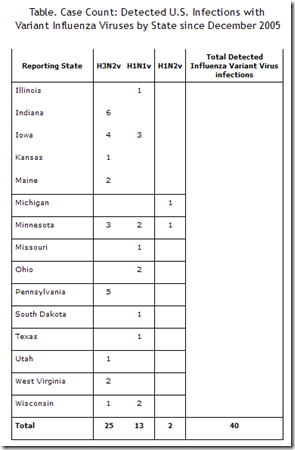
Since 2005 the CDC has documented 40 SOIV human cases (excluding the 2009 H1N1 virus) in the U.S., representing three main strains (H3N2v, H1N1v, H1N2v). Since the summer of 2011, it has been the H3N2v (variant) swine virus which has dominated.
image 

These 40 cases certainly don’t represent the full burden of human infection by these variant viruses, but so far none of these swine flu viruses appear ready for primetime.


It is axiomatic however, that influenza viruses are constantly changing; evolving via two well established routes; Antigenic drift and Antigenic Shift (reassortment).


Antigenic drift causes small, incremental changes in the virus over time. Drift is the standard evolutionary process of influenza viruses, and often come about due to replication errors that are common with single-strand RNA viruses.


Shift occurs when one virus swap out chunks of their genetic code with gene segments from another virus.  This is known as reassortment. While far less common than drift, shift can produce abrupt, dramatic, and sometimes pandemic inducing changes to the virus.


For shift to happen, a host (human, swine, bird) must be infected by two influenza different viruses at the same time.  While that is relatively rare, as any virologist will tell you . . . Shift happens.

Reassortant pig

Reassortment of two Flu viruses


Despite constantly changing, the vast majority of these viruses will prove to be evolutionary dead ends; providing no advantage in replication or transmissibility.


So H3N2v may never turn into a serious public health threat.  Only time will tell.


But as pig production expands to feed a growing global population - we add millions more `mixing vessels’ to nature’s laboratory every year – giving novel flu viruses more opportunities to evolve or mutate.


As the chart below shows, the bulk of this growth in hog farming over the next decade is expected in developing countries, where there is little biosecurity, testing or surveillance.


image

Source: FAO


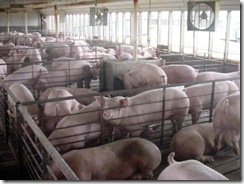
Diseases that might never have taken hold on the family farm  with a dozen hogs or chickens have a far better chance to spread and mutate once introduced into our modern CAFOs (Concentrated Animal Feeding Operations) where thousands of pigs or hundreds of thousands of birds are crowded into close quarters.


Complicating matters – in the interest of economy – livestock are not always raised, fattened, and processed close to home. It is often cheaper to ship a pig to the Midwest – where the feed is – than to ship the feed to where the pig was bred.


And after fattening, hogs may be shipped to yet another state for processing.


The math is simple: a well-traveled pig has more opportunities to pick up, or spread a novel virus than one that never leaves the farm of its birth.


For more perspective on all of this, I heartily recommend Dr. Michael Greger’s free online book  Bird Flu: A Virus Of Our Own Hatching, and Helen Branswell’s terrific piece in SciAm  from late 2010 called Flu Factories.


Flu Factories

The next pandemic virus may be circulating on U.S. pig farms, but health officials are struggling to see past the front gate

By Helen Branswell  | December 27, 2010 |


Vegan dreams aside, the world in not likely to give up the commercials raising of pigs, chickens, and other livestock for meat.


Which makes the prevention, detection,  and containment of zoonotic diseases a priority.


Since county fairs are a nexus where pigs and humans come together, earlier this week the CDC offered Offered Advice To Fair Goers on avoiding infection.


The CDC has also produced guidance to people who raise pigs and for commercial hog farms to help minimize the risks from Swine flu. These stress the importance of workers getting the seasonal flu shot every year (to protect the pigs, as much as the humans), good hand hygiene, and where appropriate, the use of PPEs (Personal Protective Equipment).


Unfortunately, between economic losses suffered during the 2009 `swine flu’ pandemic, and a general feeling that the public health threat from influenza in pigs is overstated, many hog farmers have shown reluctance to allow testing of their herds (see Swine Flu: Don’t Test, Don’t Tell).


And even assuming that American pig producers stringently follow the CDC guidelines (which can only lower the risks), there remain millions of farm operations around the world where no such biosecurity measures are in place.


While the next pandemic could come from a wild bird in Asia, or the bushmeat trade out of Africa (see Bushmeat,`Wild Flavor’ & EIDs), the odds favor it coming from a commercial farm somewhere in the world where large numbers of animals intermingle, swap viruses, and come in daily contact with humans.


Which is why increasing our surveillance of livestock (and humans) for zoonotic diseases must become a global priority.


It may not be possible to prevent next pandemic virus from emerging - but the earlier we spot it - the better shot we will have at limiting its spread and the more time we will have to produce and deploy a vaccine.


For more on swine flus, and viral reassortment, you may wish to revisit some of these earlier blogs:


UK: Flu Prevalence In Pigs
EID Journal: Swine Flu Reassortants In Pigs
You Say You Want An Evolution?
If You’ve Seen One Triple Reassortant Swine Flu Virus . . .

Friday, June 03, 2011

UK: `New MRSA’ Strain Spreading


Updated (see link at bottom)


# 5598


image

Photo Credit – CDC PHIL


If you happen to be an exotic, emerging, and antimicrobial resistant strain of bacteria, then this has  obviously been a big week for you.


Not only do we have a major outbreak across Europe of Shiga toxin-producing E. coli resulting in hundreds of cases of hemolytic uremic syndrome (HUS), and a new report of the nasal carriage of MRSA by firefighters  – we’ve now news this morning on a new strain of MRSA spreading in the UK.


Two studies appear this week (one in The Lancet, the other in Antimicrobial Agents and Chemotherapy ) each independently identifying what are very closely related new strains of MRSA (Methicillin-resistant Staphylococcus aureus) that has been detected both in cows and in humans.


Anna C. Shore, Emily C. Deasy, Peter Slickers, Grainne Brennan, Brian O’Connell, Stefan Monecke, Ralf Ehricht, and David C. Coleman. Detection of Staphylococcal Cassette Chromosome mec Type XI Encoding Highly Divergent mecA, mecI, mecR1, blaZ and ccr Genes in Human Clinical Clonal Complex 130 Methicillin-Resistant Staphylococcus aureus. Antimicrobial Agents and Chemotherapy, published ahead of print on 2 June 2011, doi:10.1128/AAC.00187-11.

Meticillin-resistant Staphylococcus aureus with a novel mecA homologue emerging in human and bovine populations in the UK and Denmark: a descriptive study. The Lancet Infectious Diseases, Online First publication, published Online June 3, 2011 DOI:10.1016/S1473-3099(11)70126-8


Admittedly, even the titles of these two studies are daunting. But luckily we’ve a number of resources that help explain the matter available to us.


First, the press release from the American Society for Microbiology, which describes the AAC study.


New type of MRSA in hospitalized patients probably of animal origin

WASHINGTON, DC -- June 2, 2011 -- A distinctly new type of methicillin resistant Staphylococcus aureus (MRSA) that is not detected by traditional genetic screening methods has been discovered in patients in Irish hospitals according to research to be published in the journal Antimicrobial Agents and Chemotherapy. These findings provide significant insights into how new MRSA strains emerge and highlight the potential for the transmission of infectious agents from animals to humans.

(Continue . . . )


Not only is this new type of MRSA `distinctly different’  from previously described strains it is not identified as antibiotic resistant by conventional and real time DNA-based polymerase chain reaction (PCR) assays.


Which means that humans (or animals) infected with this strain might be treated with ineffective antibiotics, based on standard testing protocols.


From the press release above:


Commenting on the significance of the findings, Professor David Coleman from the University of Dublin said: "The results of our study and the independent United Kingdom study indicate that new types of MRSA that can colonize and infect humans are currently emerging from animal reservoirs in Ireland and Europe and it is difficult to correctly identify them as MRSA. This knowledge will enable us to rapidly adapt existing genetic MRSA detection tests, but has also provided invaluable insights into the evolution and origins of MRSA."


For more on The Lancet study, we’ve a couple of newspaper reports from the UK.


New MRSA strain found in British cows' milkThe Telegraph

The superbug MRSA has been found in the milk of British cows for the first time, scientists have warned.


New strain of MRSA superbug found in cowsBBC


While the impact on human health from this `new strain’ of MRSA has thus far been limited (less than 100 known infections in the UK since 2008), researchers say the rate is increasing each year.


Lead researcher Dr. Mark Holmes, at a news conference on Thursday, was quoted as saying:


"Although there is circumstantial evidence that dairy cows are providing a reservoir of infection, it is still not known for certain if cows are infecting people, or people are infecting cows. This is one of the many things we will be looking into next”


"Drinking milk or eating meat is not a health issue, as long as the milk is pasteurized," he added that the process of making cheese also "generally kills most of the bacteria". 


The authors call it a "credible hypothesis" that the overuse of antibiotics in order to increase production of dairy and meat products may be driving the evolution and emergence of these new resistant strains.


For more on the overuse of antibiotics on farms, and the rise of antimicrobial resistant bacteria, I would strongly recommend visiting Maryn McKenna’s Superbug Blog and reading her 2010 book Superbug: The Fatal Menace of MRSA.


Some of my earlier blogs on this subject include:


The Biohazard In Your Butcher’s Case
WHO Unveils 6-Point Plan To Preserve Antibiotic Effectiveness
CBS Covers Antibiotic Overuse In Farming


UPDATE:  Tara C. Smith, Assistant Professor of Epidemiology, and science writer extraordinaire has detailed look at these new strains on her Aetiology Blog.


When is MRSA not MRSA?

Posted on: June 3, 2011 9:00 AM, by Tara C. Smith


Highly recommended.

Saturday, January 29, 2011

Referral: McKenna On Farm Vectors Of Resistant Bacteria


# 5267


Maryn McKenna has an important and illuminating post on gaps in our surveillance systems and the surprising ways that antibiotic resistant bacteria may be moving around, and off of, farms.


Go read it, and I’ll be back with a brief note.


Farm antibiotics, human illness and what connects them. (It has legs.)


As an interesting aside, from time-to-time over the past 5 years, flies have also been mentioned as possible vectors of bird flu as well.   You’ll find a few of my blogs on the subject listed below.


Indonesian Updates And Vector Concerns
Houseflies Revisited
Cats and Dogs and Flies, Oh My!


All of which shows that the interconnections between man, other species, pathogens, and possible vectors are complex.


And our understanding of how they fit together remains limited.

Thursday, July 15, 2010

FDA Farm Antibiotic Guidance Meets Resistance


# 2727


The use of antibiotics by farmers on their livestock in this country is largely unregulated, and many critics believe this policy is leading to the creation of new and dangerous antibiotic resistant bacteria.


The FDA recently released an updated guidance document recommending that antibiotics be used `judiciously’.   Here is how they define that:


FDA recommends that all antimicrobial drugs for animals and people be used only when necessary and appropriate.


Based on a thorough review of the available scientific information, FDA recommends that the use of medically important antimicrobial drugs in food-producing animals be limited to situations where:


the use of medically important antimicrobial drugs is necessary for assuring animal health; and the use of medically important antimicrobial drugs includes veterinary oversight or consultation.


Guidance papers do not carry the weight of law, however, and so any real changes must pass legislative muster.  According to this report from Reuters, these changes are meeting some resistance on Capitol Hill.


Officials seek limits on livestock antibiotics

WASHINGTON | Wed Jul 14, 2010 9:42pm EDT

WASHINGTON (Reuters) - Proposals to ban the use of antibiotics as a livestock growth promotant could drive up farmers costs without improving public health, skeptical lawmakers said on Wednesday.


Legislation to ban the decades-old practice is unlikely to pass this year, said sponsor Louise Slaughter, but her plan is to move further next year. The Food and Drug Administration recommended on June 28 that antibiotics be used only to prevent or treat livestock disease.

(Continue . . . )


The draft guidance is available from the FDA website as a 19-page PDF file :


The Judicious Use of Medically Important Antimicrobial Drugs in Food-Producing Animals


FDA invites the public to comment on the draft guidance. Submit written comments on the draft guidance to the Division of Dockets Management (HFA-305), Food and Drug Administration, 5630 Fishers Lane, rm. 1061, Rockville, MD 20852. Submit electronic comments to http://www.regulations.gov.

For more information on submitting comments see the Notice of Availability.


A Q&A format information sheet is also available at the FDA site:


Questions and Answers on FDA's Draft Guidance on the Judicious Use of Medically Important Antimicrobial Drugs in Food-Producing Animals


Maryn McKenna – whose book Superbug: The Fatal Menace of MRSA deals with antibiotic resistance – did a series of blogs on her (now archived) Old Superbug website on the dangers of unregulated antibiotic usage in farm animals.


Several of those stories  showcased reports from the CBS Evening News with Katie Couric on the use of antibiotics on the farm.  All of these have video links:


CBS antibiotics and farming package, day one
CBS antibiotics and farming, day 2 - and more on the Danish experience
Antibiotics and farming — CBS follow-up video


If you want a not-exactly-short course on antibiotics in animals, I can think of no better resource than combing through Maryn’s Superbug archives.  


Try using the label search function to narrow down your request.  

http://www.superbugtheblog.com/search/label/animals

will return 81 mostly relevant blog entries.

Thursday, February 11, 2010

CBS News On `The Danish Experiment’


# 4342


The CBS Evening News with Katie Couric aired part II of their look at antibiotic use on factory farms last night, and featured a close look at the `Danish Experiment’ – a move in Denmark away from routine administration of antibiotics to pigs which began 14 years ago.


Since then, the whole of the European Union has adopted this model, although American pork producers are resistant to the idea. 


As most of my readers are aware, the worrisome increase in antibiotic resistant bacteria in humans has, increasingly, been linked to the over-use of antibiotics on the farm. 


This is a story that Maryn McKenna on the Superbug blog has been covering for years, and I can think of no better resource on the subject.


If you missed last night’s report, it is available on the CBS News site, and the transcript is available HERE.


Sunday, October 25, 2009

David Brown: New Scrutiny of Pig Farming


# 3987


David Brown of the Washington Post has a terrific in-depth look today at swine flu viruses, and the hazards they may present to public health.


My thanks and a hat tip to @CP_Branswell on Twitter for mentioning this report.


Back where virus started, new scrutiny of pig farming

By David Brown

Washington Post Staff Writer
Sunday, October 25, 2009

TIPTON, IOWA -- It may be crowded and carpeted in manure, but the long, white building beside State Route 38 is one of the most pathogen-free homes a pig could have.


The animals never know the feel of grass, mud or sunshine, and hardly the touch of man, in their six months of life. But they are also free of many of the infections that slow the growth and occasionally end the lives of their outdoor cousins.


"We're producing the most efficient animal, one that is healthy every day," said Devon Schott, the 34-year-old farmer who owns the building. To do that, he said, "biosecurity is of utmost importance."


Despite the buttoned-up methods of farmers such as Schott, many experts think pig farming presents a serious and overlooked risk to public health. Proof of that assertion -- indirect but indisputable, in the opinion of virologists -- is the 2009 H1N1 pandemic influenza.


Little is known about the origin of the novel H1N1. But one thing is virtually certain: The bug now infecting the people of more than 190 countries began in a pig.


(Continue. . . )


What follows is an examination of the recent history of swine flu viruses, including cases where it has jumped to humans, and discussion of the need for greater surveillance.


Highly recommended.


      *      *      *      *     *     *     *     *     *     *     *   

With growing reluctance on the part of herd owners to test for diseases (see Swine Flu: Don’t Test, Don’t Tell), our ability to track and follow emerging flu viruses is severely limited.


Recent outbreaks of novel H1N1 in places like Japan, Ireland, the UK, Canada, and Norway underscore the importance of enhanced surveillance.


Recent blogs on this subject include:


Japan Testing Swine For Suspected H1N1
Referral: Effect Measure On Human Swine Flu In Pigs
Norway: Swine Flu Infects 14 Farms


You’ll also find a damning assessment of factory farming techniques in Dr. Michael Greger’s most recent video, available online, called Flu Factories.


Dr. Michael Greger Lecture

Dr. Michael Greger Lecture