Friday, November 02, 2012

Shaken, And Hopefully Stirred

image

Location of last weekend’s Earthquake - USGS


# 6691


The 7.7 quake last weekend (see Haida Gwaii Quake & Tsunami Advisories) off the northern coast of British Columbia was a not-so-gentle reminder that the Pacific Northwest is not immune to strong earthquakes.


While the San Andreas fault in Southern California is better known, the Cascadia fault that runs along the Northern California, Oregon, Washington, and B.C. coast (well south of last week’s quake) is believed capable of generating a massive earthquake/tsunami combination, much like we saw with Japan’s Great Earthquake of 2011.


Based primarily on the fact that it’s happened before.


Last year, in Just A Matter Of Time, I described how records showed that 312 years ago an orphan tsunami struck the coast of Japan, without an accompanying earth tremor being felt.


It’s origin remained a mystery for years, but today scientists - looking at sediment levels and tree growth rings – can easily see evidence of a great quake (8.7-9.2)  occurring along the Cascadia fault at that time.


image


Although at the time of my previous blog there was evidence of a series of major quakes along this fault line, going back thousands of years, in August of 2012 a new study was published that suggests another quake is `overdue’.


The study, was published by the USGS, and may be read at the link below:


Turbidite Event History—Methods and Implications for Holocene Paleoseismicity of the Cascadia Subduction Zone

By Chris Goldfinger, C. Hans Nelson, Ann E. Morey, Joel E. Johnson, Jason R. Patton, Eugene Karabanov, Julia Gutiérrez-Pastor, Andrew T. Eriksson, Eulàlia Gràcia, Gita Dunhill, Randolph J. Enkin, Audrey Dallimore, and Tracy Vallier


For those who would prefer not to wade through the paper, we have a press release from the Oregon State University, that explains the findings.  Excerpts follow:


13-year Cascadia study complete – and earthquake risk looms large

8-1-12

CORVALLIS, Ore. – A comprehensive analysis of the Cascadia Subduction Zone off the Pacific Northwest coast confirms that the region has had numerous earthquakes over the past 10,000 years, and suggests that the southern Oregon coast may be most vulnerable based on recurrence frequency.


Written by researchers at Oregon State University, and published online by the U.S. Geological Survey, the study concludes that there is a 40 percent chance of a major earthquake in the Coos Bay, Ore., region during the next 50 years. And that earthquake could approach the intensity of the Tohoku quake that devastated Japan in March of 2011.


“The southern margin of Cascadia has a much higher recurrence level for major earthquakes than the northern end and, frankly, it is overdue for a rupture,” said Chris Goldfinger, a professor in OSU’s College of Earth, Ocean, and Atmospheric Sciences and lead author of the study. “That doesn’t mean that an earthquake couldn’t strike first along the northern half, from Newport, Ore., to Vancouver Island.


“But major earthquakes tend to strike more frequently along the southern end – every 240 years or so – and it has been longer than that since it last happened,” Goldfinger added. “The probability for an earthquake on the southern part of the fault is more than double that of the northern end.”


The publication of the peer-reviewed analysis may do more than raise awareness of earthquake hazards and risks, experts say. The actuarial table and history of earthquake strength and frequency may eventually lead to an update in the state’s building codes.

(Continue . . . )


Since we can’t prevent earthquakes, and accurate prediction of when they will occur is beyond our technology, our only recourse is to prepare for them.


In January of 2011 I profiled a Washington state based preparedness educator Carol Dunn, who maintains an excellent website on the hazards faced by those living in the Pacific Northwest called 2Resilience.


You’ll find numerous resources geared for professional first responders, citizen volunteers, and families, individuals, and businesses looking to improve their level of knowledge and preparedness.

image


Many of us who follow @Caroldn on Twitter find her dedication and enthusiasm on preparedness issues to be quite contagious.  And if your interests lie in that direction I’d certainly recommend you include her feed.


Another resource I strongly recommend is Shakeout.org, which promotes yearly earthquake drills and education around the country.

image


For more on how you can prepare for `the big one’ (even if you live someplace other than Los Angeles), I would recommend you download, read, and implement the advice provided by the The L. A. County Emergency Survival Guide.

image


And to become better prepared as an individual, family, business owner, or community to deal with these types of disasters: visit the following preparedness sites.


FEMA http://www.fema.gov/index.shtm

READY.GOV http://www.ready.gov/

AMERICAN RED CROSS http://www.redcross.org/


Because no matter where you live, its just a matter of time before the next disaster strikes.

CDC HAN Advisory: Additional NECC Products Found Contaminated

image

# 6690


Last night the CDC – as part of their investigation into the multistate fungal meningitis outbreak linked to contaminated steroid products distributed by the New England Compounding Center (NECC) -  issued a pair of HAN Advisories. 


  • The first, is a notification that two additional products produced by NECC (betamethasone and cardioplegia solution) have tested positive for bacterial contamination.  
  • The second advisory is essentially a HAN version of the FDA’s announcement on Wednesday of a total recall of all Ameridose products.  Ameridose is a a sister company to NECC.


The CDC’s Health Alert Network (HAN) is designed to ensure that communities, agencies, health care professionals, and the general public are able to receive timely information on important public health issues.


You can sign up for HAN messages, and scores of other CDC and HHS email notifications, by going to the CDC - Quick Subscribe GovDelivery page


There are 4 types of HAN releases, starting from the highest priority to the lowest.


  • Health Alert - Conveys the highest level of importance; warrants immediate action or attention.
  • Health Advisory - Provides important information for a specific incident or situation; may not require immediate action.
  • Health Update - Provides updated information regarding an incident or situation; unlikely to require immediate action.
  • Info Service -Provides general information that is not necessarily considered to be of an emergent nature.


Yesterday, the CDC also updated the number of confirmed infections due to these contaminated pharmaceuticals, which now total 377 cases of fungal meningitis, and 9 peripheral joint infections.


image


The following are excerpts from last night’s HAN Advisory on NECC contamination issues.


Contamination Identified in Additional Medical Products from New England Compounding Center

Summary: As part of the ongoing investigation of the multistate outbreak of fungal meningitis and other infections, the Centers for Disease Control and Prevention (CDC) and the Food and Drug Administration (FDA) continue to test medical products from the New England Compounding Center (NECC) in Framingham, Mass.

NECC is the firm that distributed and recalled injectable steroid medications implicated in the current outbreak of fungal meningitis and other infections. CDC and FDA are reporting today that product testing has identified bacterial contamination with several Bacillus species and closely related bacterial organisms in unopened vials of betamethasone and cardioplegia solution that were distributed and later recalled by NECC on October 6, 2012. These bacteria are commonly found in the environment and have been rarely reported as a cause of human disease; it is not known how product contamination with these species might affect patients.

Although clinical infection is possible, CDC has not received reports of laboratory-confirmed cases of infection due to Bacillus or closely related organisms linked to these products. CDC’s recommendations to healthcare providers for diagnosing and treating symptomatic patients who have received NECC products have not changed as a result of these findings. Additional microbial organisms may be identified in recalled NECC products as additional laboratory testing is completed.

<SNIP>

As part of the ongoing investigation, FDA and CDC have been testing various NECC products for evidence of contamination. Laboratory testing at CDC and FDA has found multiple species of Bacillus and closely related bacterial organisms in unopened vials of betamethasone and cardioplegia solution, as shown in the table below.

Medication
Lot number
Microbial contamination

Betamethasone
08202012@141
Paenibacillus pabuli/amolyticus, Bacillus idriensis, Bacillus flexus, Bacillus simplex, Lysinibacillus sp.

Betamethasone
07032012@22
Bacillus niabensis, Bacillus circulans

Betamethasone
07302012@52
Bacillus lentus, Bacillus circulans

Cardioplegia solution
09242012@55
Bacillus halmapalus, Brevibacillus choshinensis

Other cultures for these products, including fungal cultures, are pending.

Recommendations to Healthcare Providers
CDC and FDA have previously advised that healthcare professionals should cease use of any product produced by NECC. On October 15, FDA issued a MedWatch Safety Alert advising clinicians to follow-up with patients who received any injectable NECC product, including betamethasone or cardioplegia solution purchased from or distributed by NECC after May 21, 2012. Clinicians were also requested to report any suspected adverse events following use of these products to
FDA's MedWatch program.


CDC continues to investigate reports of potential infections in patients receiving other NECC products. As of November 1, CDC has received no reports of confirmed infections resulting from injection of any NECC product except those from the three recalled lots of preservative-free methylprednisolone acetate.[1]


CDC’s recommendations to healthcare providers for diagnosing and treating symptomatic patients who have received NECC products have not changed as a result of these findings. CDC continues to recommend routine laboratory and microbiologic tests, including bacterial and fungal cultures, deemed necessary by treating clinicians.


These bacteria have been rarely reported as a cause of human disease. Nevertheless, clinicians should consider these product findings when reviewing laboratory results from patients who have been exposed to a NECC product, since Bacillus and related bacteria are often considered in clinical results to be possible skin contaminants. Physicians should continue to report infections potentially related to NECC products to FDA’s MedWatch and to state health departments.


1. NECC lots of methylprednisolone acetate (PF) 80mg/ml:

  • Methylprednisolone Acetate (PF) 80 mg/ml Injection, Lot #05212012@68, BUD 11/17/2012
  • Methylprednisolone Acetate (PF) 80 mg/ml Injection, Lot #06292012@26, BUD 12/26/2012
  • Methylprednisolone Acetate (PF) 80 mg/ml Injection, Lot #08102012@51, BUD 2/6/2013

Thursday, November 01, 2012

A Worrisome Mid-Week Forecast

image

Source NOAA HPC


# 6689


The very last thing that the residents of New England and the Mid-Atlantic states need right now is another storm to deal with, but early indications from NOAA’s HPC (Hydrometeorological Prediction Center) suggest a Nor'easter could be in store by the middle of next week.


The two forecast models above show the model runs for November 7th and November 8th. 


They show a low pressure area – potentially a winter storm – moving up the eastern seaboard during that time frame.


While six days out is a long way off, and the forecast could certainly change, any deterioration in the weather will make the recovery efforts in New York, New Jersey, and surrounding areas that much more difficult.


PRELIMINARY EXTENDED FORECAST DISCUSSION


NWS HYDROMETEOROLOGICAL PREDICTION CENTER COLLEGE PARK MD

947 AM EDT THU NOV 01 2012

VALID 12Z MON NOV 05 2012 - 12Z THU NOV 08 2012

...NOR'EASTER POSSIBLE FOR MID-ATLANTIC/NEW ENGLAND STATES BY ELECTION DAY INTO NEXT THURSDAY...

<SNIP>

GUIDANCE STILL HAVE SOME TIMING/STRENGTH ISSUES BUT COMMONLY AGREE THAT DEEPER LOW DEVELOPMENT WOULD OCCUR MON-THU AS A FRONTAL WAVE OFF THE SOUTHEAST MOVES SLOWLY OFFSHORE AND UP OFF THE EAST COAST.
THIS WOULD BRING BEST ORGANIZED RAINS FROM THE ERN MID-ATLANTIC TO COASTAL NEW ENGLAND.


A TRACK IN THIS VEIN OFFERS POTENTIAL FOR
HEAVIER SNOWS ACROSS INTERIOR NEW ENGLAND WEDNESDAY/THURSDAY AS THE LOW WRAPS INLAND.  INCREASING WINDS ALONG COASTAL NEW ENGLAND (AND POSSIBLY THE COASTAL MID-ATLANTIC STATES IF A MORE WESTERLY
TRACK VERIFIES) TUESDAY ONWARD MAY LEAD TO SOME COASTAL FLOODING AND BEACH EROSION.


IT SHOULD BE NOTED THAT THIS SYSTEM IS
EXPECTED TO BE MUCH WEAKER THAN HURRICANE SANDY AND PRODUCE IMPACTS MUCH LESS EXTREME AND MAINLY AWAY FROM THE REGION MOST
STRONGLY IMPACTED BY SANDY.

Obviously we’ll be watching these developments with keen interest, and the fervent hope that this storm fails to materialize.

MMWR: Evaluating RIDTs


# 6688


RIDTs, or Rapid Influenza Detection Tests, are popular in-office test kits that are designed to detect Influenza A and Influenza B infections in 15 minutes or so.


They are quick, convenient and reasonably inexpensive - but their accuracy has come under scrutiny n the past (see No Doesn’t Always Mean No).


The two main measures of the accuracy of a diagnostic test are sensitivity and specificity.

  • Sensitivity is defined as the ability of a test to correctly identify individuals who have a given disease or condition.
  • Specificity is defined as the ability of a test to exclude someone from having a disease or illness.


The CDC, on their Rapid Diagnostic Testing for Influenza webpage, cautions:


     Reliability and Interpretation of Rapid Test Results

  • The reliability of rapid diagnostic tests depends largely on the conditions under which they are used. Understanding some basic considerations can minimize being misled by false-positive or false-negative results.

    • Sensitivities of rapid diagnostic tests are approximately 50-70% when compared with viral culture or reverse transcription polymerase chain reaction (RT-PCR), and specificities of rapid diagnostic tests for influenza are approximately 90-95%.
    • False-positive (and true-negative) results are more likely to occur when disease prevalence in the community is low, which is generally at the beginning and end of the influenza seasons.
    • False-negative (and true-positive) results are more likely to occur when disease prevalence is high in the community, which is typically at the height of the influenza season.


    Which means that while a positive result carries a pretty high confidence level, a negative result is considered less reliable.


    Today’s MMWR carries an evaluation of 11 commercial  Rapid Influenza Diagnostic Tests that were available during the 2011-2012 season. They were tested against 23 flu viruses (16 A & 6  B strains) that have circulated in the United States since 2006.


    Each virus was tested at five different dilution strengths, in order to gauge relative sensitivity of these tests. All but one managed to correctly return a positive result at the highest tested viral concentration, but at lower titers the results were highly variable.


    It’s a lengthy report, and you’ll probably want to follow the link to read more about the methods, and results. A few excerpts follow, after which I’ll have a little more.


    Evaluation of 11 Commercially Available Rapid Influenza Diagnostic Tests — United States, 2011–2012

    Weekly

    November 2, 2012 / 61(43);873-876

    Accurate diagnosis of influenza is critical for clinical management, infection control, and public health actions to minimize the burden of disease. Commercially available rapid influenza diagnostic tests (RIDTs) that detect the influenza virus nucleoprotein (NP) antigen are widely used in clinical practice for diagnosing influenza because they are simple to use and provide results within 15 minutes; however, there has not been a recent comprehensive analytical evaluation of available RIDTs using a standard method with a panel of representative seasonal influenza viruses.


    This report describes an evaluation of 11 Food and Drug Administration (FDA)–cleared RIDTs using 23 recently circulating influenza viruses under identical conditions in a laboratory setting to assess analytical performance.


    Most RIDTs detected viral antigens in samples with the highest influenza virus concentrations, but detection varied by virus type and subtype at lower concentrations.


    Clinicians should be aware of the variability of RIDTs when interpreting negative results and should collect test samples using methods that can maximize the concentration of virus antigen in the sample, such as collecting adequate specimens using appropriate methods in the first 24–72 hours after illness onset. The study design described in this report can be used to evaluate the performance of RIDTs available in the United States now and in the future.

    (Continue . . . )


    At this point, you may be wondering how doctors are supposed to interpret results from a test that may, or may not, correctly show when a patient has the flu.


    It gets pretty complicated, but the CDC provides guidance on not only how to interpret the results, but also under what circumstances they recommend using these diagnostic kits at:


    Guidance for Clinicians on the Use of Rapid Influenza Diagnostic Tests


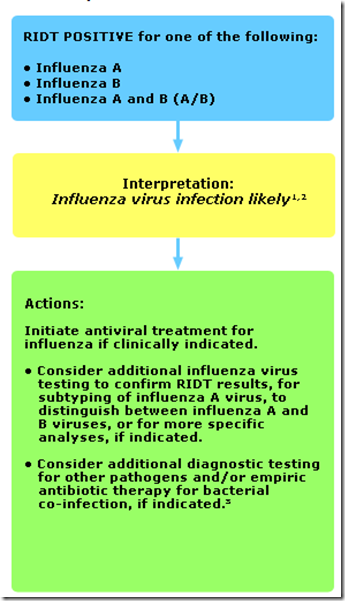
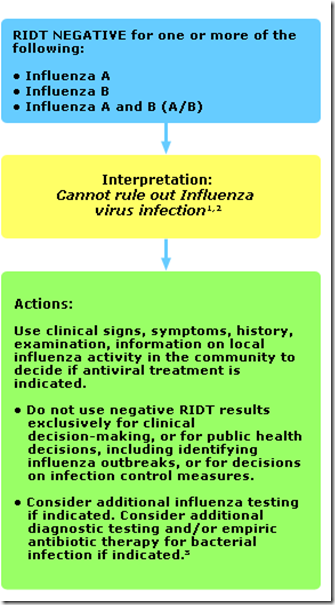
    You’ll find several decision tree charts on this page, including the following two which are used to interpret RIDT results during periods when influenza viruses are circulating in the community.


    In part 1, the RIDT returns a positive result.

    image


    In Part 2, the RIDT returns a Negative result.

    image


    While these test kits can provide help with diagnostic and treatment decisions for individual patients in clinical settings, they are probably more valuable when used to identify influenza outbreaks in institutions, like hospitals, schools, or nursing homes.


    Even if each individual result can’t be fully trusted, a few positive results out of a confined population displaying influenza-like symptoms can help guide decisions regarding prevention and control.


    Of course, better rapid tests are obviously needed.  Not just for common seasonal strains, but ideally for all flu strains.


    But until they become available, doctors must carefully weigh RIDT results along with the patient’s clinical signs and symptoms - and level of flu in the community - in order to come up with the best diagnosis.

    CDC: Laboratory Test Results From Meningitis Outbreak


    # 6687


    Last night the CDC posted updated laboratory test results from patients - and un-opened vials of methylprednisolone produced by the New England Compounding Center  – as part of their investigation into a multi-state outbreak of fungal meningitis.


    The latest numbers from this outbreak, as of 2pm yesterday, are:

    image


    Lab tests have isolated Exserohilum rostratum in 52 of the 54 patients with CDC laboratory-confirmed fungal meningitis. Tests by the CDC and FDA have also found Exserohilum rostratum in unopened vials from two of the three recalled lots of injectable steroids produced by NECC.   Tests are pending on the third lot.


    Here’s the complete CDC Update:


    Laboratory Testing and Results from the Outbreak

    October 31, 2012 6:00 PM EDT

    CDC laboratory-confirmed results found on this page are from three New England Compounding Center (NECC) preservative-free methylprednisolone  acetate (MPA) lots recalled on September 26, 2012.(1)

    CDC’s Fungus Reference Laboratory has the capacity and technology to examine fungal isolates under the microscope and to confirm their identification using DNA sequencing methods.

    CDC scientist examines microscopic slides showing Exserohilum rostratum (on screen) during the multistate meningitis outbreak.

    CDC's Fungus Reference Laboratory has the capacity and technology to examine fungal isolates under the microscope and to confirm their identification using DNA sequencing methods.

    • For the multistate outbreak, the fungus laboratory is working with the Clinical and Environmental Microbiology Branch, Division of Healthcare Quality Promotion, to detect and identify other microbial pathogens. In addition, the Infectious Diseases Pathology Branch, Division of High-Consequence Pathogens and Pathology, is examining tissues from biopsies and autopsy materials.
    • CDC and the states are testing tissue and fluid samples from patients with probable or confirmed fungal infection. CDC scientists are looking to see if the samples contain fungi and other microbial pathogens, and if so, what type.
    • In addition, FDA and CDC are testing vials of NECC preservative-free MPA to see if they contain fungi and other microbial pathogens and if so, what type.

    CDC Laboratory Results

    As of October 22, 2012, Exserohilum rostratum has been found in clinical specimens for all but two of the 54 patients with CDC laboratory-confirmed fungal meningitis who meet the confirmed case definition.(2)


    Tests at CDC and FDA laboratories on the preservative-free MPA vials have confirmed the presence of the same fungus, Exserohilum rostratum, in unopened vials from two of the three recalled lots.(1) Testing on the third lot of preservative-free MPA is ongoing. These laboratory test results strengthen the link between preservative-free MPA vials and the outbreak.


    The fungi found in both patients and in recalled vials are common in the environment but were not recognized as a cause of meningitis before this outbreak.

    India: The H5N1 & Migratory Birds Debate

    image

    Credit U.S. Fish and Wildlife Service


    # 6686


    One of ongoing debates in the world of avian influenza is over exactly how much of a role migratory birds play in the spread of highly pathogenic H5N1.  


    Bird enthusiasts tend to point to the poorly managed poultry trade as being the main source of the spread of bird flu while those in the poultry industry are often quick to blame migratory birds.


    Over the years we’ve studies that either implicate migratory birds in the spread of the virus, or minimizes their role (see  India: The Role Of Migratory Birds In Spreading Bird Flu).


    Personally, I see no reason why these positions should be mutually exclusive.  As far as I can tell, both are important factors in the spread of the virus.


    But the debate goes on, often heatedly.


    The recent outbreak of H5N1 in India (see  Bangalore: More Poultry Culled Due To H5N1) at a government poultry farm is very near Hesaragatta lake - a man-make reservoir and winter nesting ground for migratory birds that has fallen into disrepair in recent years from a lack of water. 


    Reportedly, the number of birds that now visit every year is greatly reduced.


    Nevertheless, several thousand birds continue to stop over at Hesaragatta lake each winter, and that has prompted local officials to suggest that migratory birds are to blame for the current outbreak.


    A position that local ornithologists are taking serious umbrage over.


    First a link to the article from DNA (Daily News & Analysis) that attempts to exonerate wild birds as carriers of the H5N1 virus, then I’ll return with some comments of my own.


    Experts debunk migratory birds theory

    Published: Thursday, Nov 1, 2012, 15:50 IST
    By Aishhwariya Subramanian | Place: Bangalore | Agency: DNA

    The hunt for the elusive cause of the avian influenza outbreak at Central Poultry Development Organisation & Training Institute (CPDOTI) on Tuesday saw officials of animal husbandry department blaming migratory birds for carrying the virus. But ornithologists have debunked the theory despite animal husbandry officials stating that the Hesaraghatta Lake close to CPDOTI facility which attracts migratory birds was the culprit for the outbreak.

    (Continue . . . )


    The arguments being made by the experts interviewed in this article are basically two pronged. 


    • The first seems to be the old canard that `sick birds don’t fly’
    • The second is the reduced number of migratory birds arriving at the reservoir in recent years.


    While it’s true that wild birds that acquire the virus, sicken, and die are less likely to transfer the virus across long distances, the `sick birds don’t fly’  stance ignores the fact that in migratory waterfowl, the H5N1 is often an asymptomatic infection.


    We’ve looked at asymptomatic waterfowl as reservoirs of the virus a number of times in the past, including:

    Reservoir Ducks
    Webster On China's `Silent' Bird Flu Infections
    Mallard Ducks Found To Be Asymptomatic To Bird Flu Virus

    We’ve also witnessed the geographic spread of new clades of the H5N1 virus in migratory waterfowl, and the apparent importation of H5N1 into Hong Kong, Japan, and South Korea by the arrival of migratory birds in the past.


    EID Journal: H5N1 Branching Out
    Study: The Role Of Migratory Birds In Spreading Bird Flu
    Egrets, They’ve Had A Few . . .
    Japan: Hooded Crane Positive For H5N1
    Wild Birds Eyed As Likely Source Of Hong Kong Bird Flu Outbreak
    FAO: On The Trail Of Avian Influenza


    The second argument, that the number of migratory birds arriving each year at Hesaragatta lake has recently dropped may reduce the odds that birds brought the virus to Bangalore, but it certainly doesn’t eliminate the possibility.


    The bottom line - it just takes one infected bird to arrive and introduce the virus to the environment.


    None of which tells us how the H5N1 virus made it to a government poultry operation in Bangalore, but it does help put migratory birds as carriers of avian flu into better perspective.


    Lest bird lovers cry `fowl’, the role of poultry producers in the spread of avian flu – including, but not limited to: poor biosecurity, overcrowded conditions, covering up reports of illnesses or deaths among birds, and smuggling – are well documented in this blog, and elsewhere.


    While migratory birds appear to have a role in introducing avian flu viruses to new regions, poorly run poultry operations obviously help to amplify and spread these viruses further.


    The fact that this debate is unresolved nearly a decade after the re-emergence of H5N1 in 2003 underscores the need for better research and surveillance, both in migratory birds and in poultry operations.


    Until we can clearly understand the various mechanisms by which this virus is spread, the prospects of halting outbreaks in the future remain slim.