Showing posts with label Bat. Show all posts

Saturday, July 26, 2014

Nature Comms: A Chimeric Bat Flu Study

image

Credit CDC


# 8867


Two and a half years ago the influenza world was rocked by news of the detection of a new subtype of influenza A (H17N10), found to reside in little yellow-shouldered bats captured in Guatemala (see A New Flu Comes Up To Bat).  While bats are known to carry other zoonotic diseases,  this was the first time that bats were linked to influenza A.


Since then, another previously unknown subtype (H18N11) has been identified, again in South American Bats (see PLoS Pathogens: New World Bats Harbor Diverse Flu Strains), leading to speculation that these mammalian-adapted flu viruses might someday jump to other species – including man.


The most likely scenario for this to occur would be through the reassortment of a bat and a human virus in an intermediate host, such as a pig. 
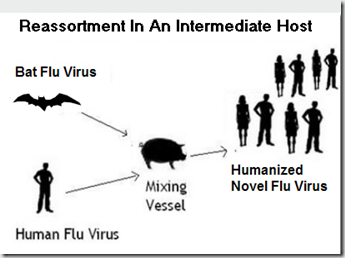
image


The CDC’s Bat Flu Q & A has this to say about the possibility of such a reassortment occurring:


However, the conditions needed for reassortment to occur between human influenza viruses and bat influenza virus remain unknown. A different animal (such as pigs, horses or dogs) would need to serve as a “bridge,” meaning that such an animal would need to be capable of being infected with both this new bat influenza virus and human influenza viruses for reassortment to occur. Additional studies are needed to determine the likelihood that reassortment would occur in nature between bat and human influenza viruses.


We’ve some reassuring news via Nature Communications on this front, suggesting that Bat Flu – at least from the H17N10 subtype – may have a difficult time making the leap from chiropterans to humans.


Since researchers have been unable to isolate and replicate the full H17N10 virus from bats, a chimeric (hybrid) virus was created for this study utilizing six internal genes from the bat virus, combined with the HA and NA or prototypic influenza A viruses

.


An infectious bat-derived chimeric influenza virus harbouring the entry machinery of an influenza A virus

Mindaugas Juozapaitis, Étori Aguiar Moreira, Ignacio Mena, Sebastian Giese, David Riegger, Anne Pohlmann, Dirk Höper, Gert Zimmer, Martin Beer, Adolfo García-Sastre & Martin Schwemmle

Published  23 July 2014

In 2012, the complete genomic sequence of a new and potentially harmful influenza A-like virus from bats (H17N10) was identified. However, infectious influenza virus was neither isolated from infected bats nor reconstituted, impeding further characterization of this virus.

Here we show the generation of an infectious chimeric virus containing six out of the eight bat virus genes, with the remaining two genes encoding the ​haemagglutinin and ​neuraminidase proteins of a prototypic influenza A virus. This engineered virus replicates well in a broad range of mammalian cell cultures, human primary airway epithelial cells and mice, but poorly in avian cells and chicken embryos without further adaptation.

Importantly, the bat chimeric virus is unable to reassort with other influenza A viruses. Although our data do not exclude the possibility of zoonotic transmission of bat influenza viruses into the human population, they indicate that multiple barriers exist that makes this an unlikely event.

(Continue . . . )


The past few years have been busy ones for Chiroptologists.


Roughly 1/4th of all mammal species on earth are bats, and they are increasingly being viewed as naturals hosts for, and potential vectors of, a number of newly recognized emerging pathogens.


Once mainly feared for carrying  rabies, in the 1990s bats gained notoriety with the emergence of the Hendra virus in Australia in 1994 (see Australia: Hendra Vaccine Hurdles) and Nipah in Malaysia in 1999 (see MMWR Update: Outbreak of Nipah Virus -- Malaysia and Singapore, 1999).


The emergence of the SARS coronavirus in 2003 – ultimately linked to bats – and most recently, to the MERS coronavirus in the Middle East (see EID Journal: Detection Of MERS-CoV In Saudi Arabian Bat), has served to cement their reputation as important carriers of emerging infectious diseases.


None of this is meant to demonize bats, as they play an important role in our ecosystem. However, bats are increasingly being associated with diseases deadly to humans, so a degree of caution is warranted. 


To learn how you can stay safe around bats, the CDC offers the following advice.


Take Caution When Bats Are Near

Friday, October 11, 2013

PLoS Pathogens: New World Bats Harbor Diverse Flu Strains

image


#7851


In March of 2012,  researchers from the CDC and the Universidad del Valle of Guatemala announced they had found the first evidence of influenza infection in bats (see A New Flu Comes Up To Bat).  With the addition of an H17 flu subtype, and a new host species, suddenly all of the textbooks and slide presentations on influenza were out of date once more.


(A bit of history: the H16 subtype was discovered in 2004  by a team that included Ron Fouchier).


While preliminary research suggested that while this H17 virus was genetically compatible with human influenza viruses, it did not yet have the ability to infect humans.  The CDC wrote:


As a result, it is possible that these bat viruses could eventually gain the ability to cause infections in humans. However, CDC experts have been unable to grow the bat influenza virus in test tubes, suggesting that the virus is currently not well suited to causing human illness. For the bat influenza virus to infect humans, it would need to obtain some genetic properties of human influenza viruses


The most likely scenario for this to occur would be through the reassortment of a bat and a human virus in an intermediate host, such as a pig. 

image


The CDC’s Bat Flu Q & A has this to say about the possibility of such a reassortment occurring:

However, the conditions needed for reassortment to occur between human influenza viruses and bat influenza virus remain unknown. A different animal (such as pigs, horses or dogs) would need to serve as a “bridge,” meaning that such an animal would need to be capable of being infected with both this new bat influenza virus and human influenza viruses for reassortment to occur. Additional studies are needed to determine the likelihood that reassortment would occur in nature between bat and human influenza viruses.


Today, via the open access journal PLoS Pathogens, we learn that different team of researchers has discovered another flu subtype – classified as  H18N11 – circulating in bats sampled in Peru.  


Research Article

New World Bats Harbor Diverse Influenza A Viruses

Suxiang Tong mail, Xueyong Zhu, Yan Li, Mang Shi, Jing Zhang, Melissa Bourgeois, Hua Yang, Xianfeng Chen, Sergio Recuenco, Jorge Gomez, Li-Mei Chen, Adam Johnson, Ying Tao,  [ ... ], Ruben O. Donis mail

Abstract

Aquatic birds harbor diverse influenza A viruses and are a major viral reservoir in nature. The recent discovery of influenza viruses of a new H17N10 subtype in Central American fruit bats suggests that other New World species may similarly carry divergent influenza viruses. Using consensus degenerate RT-PCR, we identified a novel influenza A virus, designated as H18N11, in a flat-faced fruit bat (Artibeus planirostris) from Peru. Serologic studies with the recombinant H18 protein indicated that several Peruvian bat species were infected by this virus. Phylogenetic analyses demonstrate that, in some gene segments, New World bats harbor more influenza virus genetic diversity than all other mammalian and avian species combined, indicative of a long-standing host-virus association. Structural and functional analyses of the hemagglutinin and neuraminidase indicate that sialic acid is not a ligand for virus attachment nor a substrate for release, suggesting a unique mode of influenza A virus attachment and activation of membrane fusion for entry into host cells. Taken together, these findings indicate that bats constitute a potentially important and likely ancient reservoir for a diverse pool of influenza viruses.

(Continue . . .)

The above is just small excerpt from the study, you’ll want to follow the link to read it in its entirety.   Among their findings:


  • A high seroprevalence of influenza antibodies in bats they tested, suggesting `widespread circulation of influenza A viruses among New World bats’. 
  • The author’s also found, that unlike human influenza viruses,  `The crystal structures of the hemagglutinin and neuraminidase proteins indicate that sialic acid is not a receptor for virus attachment nor a substrate for release, suggesting a novel mechanism of influenza A virus attachment and activation of membrane fusion for entry into host cells.’


The authors summarize their findings in the discussion section:


Multiple lines of evidence suggest that influenza viruses have evolved in bats for an extended period of time: (i) in four of the eight gene segments, genetic diversity exceeds that observed in all other animal species combined; (ii) the divergence into multiple HA subtypes and utilization of alternative mechanisms for sialic acid-independent virion attachment to target cells and subsequent release; and (iii) the widespread geographic distribution in the Americas (Guatemala and Peru sampling sites are ~3,500 km apart) combined with a high seroprevalence in several bat species are indicative of an established infection, while the observation that the bat viruses form a monophyletic group is suggestive of sustained transmission in this species. The postulated ancient relationship of influenza viruses with aquatic migratory birds is consistent with the optimized parasitic relationship of the virus with ducks, involving subclinical infections with multiple virus subtypes as a result of efficient fecal-oral transmission. Although necessarily preliminary in nature, the data presented here suggest that similar ecological and evolutionary strategies may have been exploited by the influenza A viruses of New World bats.


All things considered, the past couple of decades have turned out to be busy ones for Chiroptologists (scientists who study bats). These winged mammals are increasingly being viewed as naturals hosts for, and potential vectors of, a number of newly recognized emerging pathogens.


Long known for vectoring rabies, in the 1990s bats gained notoriety with the emergence of the Hendra virus in Australia in 1994 (see Australia: Hendra Vaccine Hurdles) and Nipah in Malaysia in 1999 (see MMWR Update: Outbreak of Nipah Virus -- Malaysia and Singapore, 1999).


The emergence of the SARS coronavirus in 2003 – ultimately linked to bats – and most recently, to the MERS coronavirus in the Middle East (see EID Journal: Detection Of MERS-CoV In Saudi Arabian Bat), has served to cement their reputation as important carriers of emerging infectious diseases.


None of this is meant to demonize bats, as they play an important role in our ecosystem. However, bats are increasingly being associated with diseases deadly to humans, so a degree of caution is warranted. 


To learn how you can stay safe around bats, the CDC offers the following advice.


Take Caution When Bats Are Near

Saturday, September 29, 2012

Coronavirus `Closely Related’ To HK Bat Strains

image

Japanese pipistrelles – Credit Wikipedia


# 6595


Bats have been long associated with carrying rabies, but only in recent years have other bat-hosted viruses really gained our attention. Among the first, was the Nipah virus, which was first identified in Malaysia in 1998.


The Nipah virus first jumped from bats to local swine herds, probably via bat droppings into the swine’s environment or food. From there, it jumped to humans, resulting in 265 cases of acute encephalitis and more than 100 deaths (cite).


This first human outbreak was initially thought to be due to Japanese encephalitis, and so precautions around pigs were delayed for nearly two months, allowing the virus to spread.


Over the past decade, Nipah has caused a number of small outbreaks across Southern Asia, although the most intense activity has been centered around Bangladesh. In Australia, Hendra (a close relative to Nipah), is also carried by bats, and has infected horses and humans.


In 2003 and 2004, bats once again became a focal point after viruses similar to the SARS coronavirus were found in horseshoe bats in China (cite).  And in recent years, Fruit bats of the Pteropodidae family have been linked to the Ebola virus (cite).


Since the SARS outbreak, researchers have found a growing number of previously unknown coronaviruses carried by various species of bats.


This from the journal Virology, circa July 2006 (reparagraphed and reformatted for readability).


Molecular diversity of coronaviruses in bats.

Woo PC, Lau SK, Li KS, Poon RW, Wong BH, Tsoi HW, Yip BC, Huang Y, Chan KH, Yuen KY.

Source

Department of Microbiology, The University of Hong Kong, University Pathology Building, Queen Mary Hospital, Hong Kong.

Abstract

The existence of coronaviruses in bats is unknown until the recent discovery of bat-SARS-CoV in Chinese horseshoe bats and a novel group 1 coronavirus in other bat species.


Among 309 bats of 13 species captured from 20 different locations in rural areas of Hong Kong over a 16-month period, coronaviruses were amplified from anal swabs of 37 (12%) bats by RT-PCR.


Phylogenetic analysis of RNA-dependent-RNA-polymerase (pol) and helicase genes revealed six novel coronaviruses from six different bat species, in addition to the two previously described coronaviruses.


Among the six novel coronaviruses, four were group 1 coronaviruses (bat-CoV HKU2 from Chinese horseshoe bat, bat-CoV HKU6 from rickett's big-footed bat, bat-CoV HKU7 from greater bent-winged bat and bat-CoV HKU8 from lesser bent-winged bat) and two were group 2 coronaviruses (bat-CoV HKU4 from lesser bamboo bats and bat-CoV HKU5 from Japanese pipistrelles).


An astonishing diversity of coronaviruses was observed in bats.


All of which serves as prelude to a story today out of Hong Kong, where researchers from the University of Hong Kong have compared the gene structure of the newly discovered coronavirus in the Middle East, and find it to be a 90% match to the HKU4 and HKU5 viruses mentioned above.


This story from the South China Morning Post:


Sars-like virus in Middle East 'closely related to Hong Kong bat strains'

Expert says new coronavirus is 90pc similar to two other bugs that were discovered in city

(EXCERPT)

Yuen, an authority in coronaviruses, said the new virus' genetic sequence was 90 per cent similar to the two bat strains found locally, the closest match so far. "We can say the new virus has a common ancestor and come from the same family as the two bat viruses," he said.


No conclusion could be drawn that the Middle Eastern patients had contracted the new virus from bats, he said. It was also genetically distinct from the Sars coronavirus, he added.

(Continue . . . )


While the coronavirus detected in the Middle East is similar to other coronaviruses found in bats, this doesn’t necessarily mean that the two known victims contracted it directly from a bat.  


There may well have been an intermediate host involved (as were the pigs in Malaysia, and possibly civet cats with SARS).


This is another clue, however, in the epidemiological investigation into these two new cases. 


For now – with no sign of additional cases - the World Health Organization (along with many other experts) see the transmission of this virus to humans as being inefficient or `weak’.  


With luck, that status will remain unchanged as we learn more about this emerging virus.


For more on bats, and bat-hosted viruses, you may wish to revisit:


Disease Transmission At The Human-Animal Interface
A New Flu Comes Up To Bat
The Scientific Plausibility of `Contagion’
The Nipah Virus: An Emerging Infectious Threat

Thursday, March 01, 2012

CDC: Bat Flu Q&A


Yellow-shouldered bat found in Guatemala. Photo credit: CDC/OID/NCEZID – Amy T. Gilbert.

# 6188


For a winter with a conspicuous absence of influenza in humans, flu in non-human hosts has been making a lot of headlines.


Last fall came the furor over Fouchier’s ferrets (still ongoing), and then earlier this week, we learned about a new strain of influenza found in an unusual host: bats (see A New Flu Comes Up To Bat).


With the addition of an H17 flu subtype, and a new host species, suddenly all of the textbooks and slide presentations on influenza are out of date once more.


(A bit of history: the H16 subtype was discovered in 2004  by a team that included Ron Fouchier).


In response to the public’s obvious interest in this new discovery, the CDC has set up a Bat Flu Q&A page, with additional background information.


Bat Influenza (Flu)

Questions & Answers

On this Page


You’ll also find an entry on the CDC’s  Have You Heard? website about the discovery of `bat flu’.


Have You Heard?"

Bat Flu


Fruit bat

A new and dramatically different influenza A virus has been discovered in fruit bats. The findings by scientists from the Centers for Disease Control and Prevention working with the Universidad del Valle of Guatemala are described in an article published in the Proceedings of the National Academy of Sciences (PNAS) journal March issue.


This is the first time an influenza virus has been identified in bats, but in its current form the virus is not a human health issue, according to the study’s scientists.  Preliminary research at CDC on the new virus suggests that its genes are compatible with human influenza viruses. As a result, it is possible that these bat viruses could eventually gain the ability to cause infections in humans. However, CDC experts have been unable to grow the bat influenza virus in test tubes, suggesting that the virus is currently not well suited to causing human illness. For the bat influenza virus to infect humans, it would need to obtain some genetic properties of human influenza viruses. This can occur in nature through a process called “reassortment.” Reassortment occurs when two or more influenza viruses infect a single host cell, which allows the viruses to swap genetic information. Reassortment events can sometimes lead to the emergence of new influenza viruses.

(Continue . . . )


As these pages indicate, more research is needed to determine how prevalent influenza viruses are in bats, and what (if any) public health ramifications they present.


I’m certain, as more is learned about this new virus, the CDC will update these pages. So don’t forget to tune in again.


Same bat time, same bat channel.

Monday, February 27, 2012

A New Flu Comes Up To Bat


UPDATED:  Helen Branswell has a report on this story HERE, and you’ll find another report by Virginia Gewin  on Nature.com HERE.


image

Photo Credit- Wikipedia


# 6177


A fascinating story today coming from the journal PNAS, that is eerily reminiscent of fictional MEV-1 virus from the movie Contagion


Researchers report the discovery of never before seen influenza virus, that surprisingly, was detected in bats. Specifically, from little yellow-shouldered bats (Sturnira lilium) captured at two locations in Guatemala.


Scientists have previously identified 16 different hemagglutinin (HA) proteins, and 9 different neuraminidase proteins.


And while birds are the natural host for influenza viruses, they’ve never been isolated in bats before.


This new influenza is described as deviating from the 16 known HAs and is designated as H17. The neuraminidase (NA), and internal genes, are also highly divergent from previously known influenzas.


Despite all of these differences, the authors state this bat virus appears to be genetically compatible with human and avian influenza viruses, and the potential for reassortment exists.


Unfortunately, the entire report is behind a pay wall, but according to an AP report by Mike Stobbe, there remains some questions over exactly what these researchers have uncovered.


One scientist - Richard Fulton of Michigan State University - pointed out that the authors have not been able to grow the virus in cell cultures or egg embryos, and that they only have isolated fragments of the virus.


More research will be needed to determine what, if any, implications this new found pathogen will have to public health. Meanwhile, researchers are already looking for it, and similar viruses, in other hosts and bat colonies.


A distinct lineage of influenza A virus from bats

Suxiang Tong, Yan Li, Pierre Rivailler, Christina Conrardy, Danilo A. Alvarez Castillo, Li-Mei Chen,Sergio Recuenco, James A. Ellison, Charles T. Davis, Ian A. York, Amy S. Turmelle, David Moran, Shannon Rogers, Mang Shi, Ying Tao, Michael R. Weil, Kevin Tang, Lori A. Rowe, Scott Sammons, Xiyan Xu, Michael Frace, Kim A. Lindblade, Nancy J. Cox, Larry J. Anderson, Charles E. Rupprecht, and Ruben O. Donis

Abstract

Influenza A virus reservoirs in animals have provided novel genetic elements leading to the emergence of global pandemics in humans. Most influenza A viruses circulate in waterfowl, but those that infect mammalian hosts are thought to pose the greatest risk for zoonotic spread to humans and the generation of pandemic or panzootic viruses.


We have identified an influenza A virus from little yellow-shouldered bats captured at two locations in Guatemala. It is significantly divergent from known influenza A viruses. The HA of the bat virus was estimated to have diverged at roughly the same time as the known subtypes of HA and was designated as H17. The neuraminidase (NA) gene is highly divergent from all known influenza NAs, and the internal genes from the bat virus diverged from those of known influenza A viruses before the estimated divergence of the known influenza A internal gene lineages.


Attempts to propagate this virus in cell cultures and chicken embryos were unsuccessful, suggesting distinct requirements compared with known influenza viruses. Despite its divergence from known influenza A viruses, the bat virus is compatible for genetic exchange with human influenza viruses in human cells, suggesting the potential capability for reassortment and contributions to new pandemic or panzootic influenza A viruses.