Showing posts with label Community. Show all posts

Wednesday, March 11, 2015

ISDR: The `Stop Disasters’ Simulation Game

image


# 9809


Today marks the 4th anniversary of Japan’s Great earthquake and Tsunami of 2011 (see Four Years After Japan’s Great Earthquake & Tsunami), and while we understandably look back and mourn the losses of that day, we also need to be looking forward towards ways to reduce the impact of future disasters.


Because if there is one thing we can count on in life, it is that disasters (of all kinds) will continue to befall mankind.


It is for this reason that preparedness, and community resilience, are frequent topics in this blog.   As a former paramedic, I know how important `being ready’ can be, and I’m constantly looking for ways to instill that mindset in the community.


In Building Disaster Resilient Cities, which featured a guidebook called How to make cities more resilient: a handbook for local government leaders,  I wrote:


With the clustering of millions of people into relatively small areas, we’ve created a scores of `target-rich environments’ for natural disasters such as earthquakes, floods, and severe storms. 

The equation is pretty simple. More people in a small space = more potential casualties.

And the more densely populated a region is, the more economic impact a disaster will have as well.


In 2011, in UNDP: Supercities At Seismic Risk, we looked at the concerns that half of the world’s supercities  (urban areas with 2 million – 15 million inhabitants) are at risk of significant seismic activity, while in January of 2012 I blogged that a UN Agency Warns On Global Seismic Risks.


Just last week, in The Caribbean’s Hidden Tsunami Potential (Revisited), we looked at the geological and historical evidence for massive tidal waves in the Gulf of Mexico/Caribbean/Atlantic Ocean.


And in 2013, in  Dr. Lucy Jones: `Imagine America Without Los Angeles’, we looked at a presentation   at the  annual meeting of the American Geophysical Union,  that emphasized that should the `big one’ hit Southern California, we could literally `lose’ Los Angeles.


The `next big disaster’ could hit anytime, anywhere.  Hurricanes, earthquakes, tsunamis, tornadoes, floods . . . .


Finding ways to engage the younger generation in disaster planning, and preparedness has been a frequent topic of this blog (see NPM14: Disaster Preparedness For Kids  and  NPM13: Kids & Disaster Preparedness), but most of the efforts I’ve found have been geared towards the younger set (ages 5 to 10). 

image


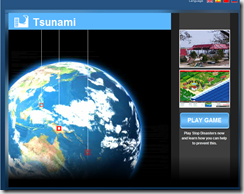
So I am pleased to highlight computer simulation/game geared for teenagers, produced for the UNISDR (United Nations Office for Disaster Risk Reduction) that puts them in control of preparing a city for an expected disaster.


No, it’s not a new game . . . it’s been around for years.  But given today’s anniversary, today seems a good day to remind ourselves that preparedness, and community resilience, can save lives.


The player has five scenarios, with three levels of difficulty in each, to choose from.  Earthquake, tsunami, hurricane, wildfire, flood . . .  you choose


image


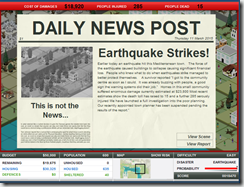
During a timed, and resource limited `setup period’ the player chooses what steps a community should take to prepare for an impending disaster.   Once completed, the disaster simulation runs, telling you just how well (or badly) your mitigation efforts fared.

image

image 


From the game’s FAQ file:


Who can play the Stop Disasters game?
Anyone with internet access can download and play the Stop Disasters game from this web site. The game will not be 'downloadable' as an exe file on your hard drive. Instead it will load into a browser window.

Do I need a special computer?
No, any computer built within the last few years will be sufficient – Mac, PC or Linux based, with a screen resolution of 800x600 pixels.

You’ll need an up to date browser, with Flash Player version 7 or higher. You can download the latest Flash plugin from here:
http://www.adobe.com/go/getflash/

How long does it take?
Each scenario takes between 10 and 20 minutes to play, depending on the disaster you are trying to prevent and your skill level. There are five scenarios to play, and each can be played on easy, medium or hard difficulty levels.

What age do you need to be to play?
The core audience is 9-16 year old children, but anyone can play and enjoy the game, and everyone will learn more about preventing disasters.

How many players can play?
This is a single player game, but groups of children in a classroom environment can play collaboratively and discuss the best course of action to take. Additional learning material for students and teachers is available in the ‘Information’ section of this web site.

How many times can I play?
You can play as many times as you like – we will keep track of your highest scores and record them on the web site, so you can compete against everyone in the world!

However, just like natural hazards in real life some elements are random. There is no ‘perfect solution’ to each scenario and no ‘perfect score’, so every time you play things will be slightly different.

Can I play at school?
If your school allows access to this web site and the computer has the Flash plugin installed, then yes. We have created additional resources for teachers and encourage schools to play this game as a classroom exercise. Why not suggest it to your teacher at school?


Although most parents want to protect their kids from undo worry - when a disaster threatens, it threatens all of us – regardless of our age.  Helping kids to understand more about emergency preparedness and community resilience will help them cope (and perhaps, even help) in the event they, or their community, are caught up in a disaster.

Sunday, June 08, 2014

The Public Health Practices Repository

image


# 8719


While I can’t tell you where the next big public health or community crisis in this country will be, or what event will cause it, I can tell you that the ability of local emergency operations, EMS, healthcare organizations, businesses, schools, and community and faith-based organizations to respond  - in concert with federal and state authorities – will determine just how big of a negative impact it will ultimately have.


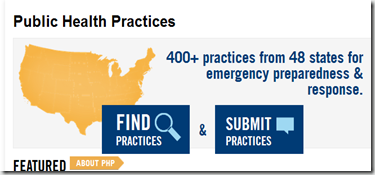
Which is why I try to highlight the Public Health Practices project - a freely accessible repository of public health tools and strategies, sponsored by CIDRAP at the University of Minnesota– once or twice a year.


Their website describes themselves as:


About us

Public Health Practices (PHP) is a curated compendium of tools, strategies, and downloadables created by US health agencies and partners to prepare for and respond to the health consequences of disasters and emergencies.

Practitioners can search the one-stop shop of real-world resources by hazard, strategy, partners, geography, groups being served, agency, tool, language, and key word. PHP encourages peer-to-peer exchange of practices by accepting submissions to the site, showcasing examples in theme-based email newsletters, and hosting social media channels for practitioners.

Public Health Practices features:

  • More than 400 practices addressing a wide range of hazards
  • Successful coalitions and details about what made them possible
  • In-depth stories on how projects were created
  • Communication materials in 40 languages to download or adapt
  • A robust search tool that allows users to apply filters to narrow results as needed
  • A simple submissions process to encourage practitioners to share their work
  • Peer-to-peer information exchange via social media (Twitter and, soon, LinkedIn)


While originally pandemic influenza centric, over the past few years Public Health Practices has broadened its scope to include more than just a pandemic response. You’ll find tools and practices that cover a wide range of public health concerns, including chemical, radiological, and natural disasters.


 image


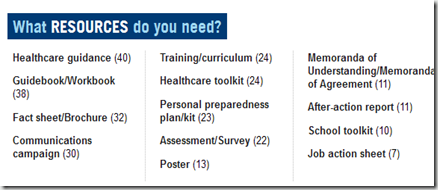
From Bioterrorism to Volcanoes, Public Health Practices has you covered. You’ll find ample resources, including toolkits, outlines, and training modules available.   

image


The task of creating emergency & disaster plans for agencies, organizations, communities, and businesses can be a daunting one, particularly now when resources (read: time, money, & personnel) are in short supply.  Fortunately, you don’t have to be a pioneer, since others have gone before you and are willing to share what they’ve learned.


In addition to the constantly expanding website, there is also a monthly email newsletter you can sign up for. You’ll find an incredible amount of great content on this site, so pack a lunch and plan to stay all day.


Whether you are looking for a specific solution, or simply looking for muse to inspire your organization’s emergency preparedness efforts, visiting Public Health Practicesand returning often – will likely pay tremendous dividends.


You can also follow Public Health Practices on twitter  at @PHPractices


Highly recommended.

Friday, March 01, 2013

Revisiting The Seasonality Of MRSA

 image

Credit CDC PHIL


# 6976


Just shy of two years ago, in MRSA: It’s Got Seasonality, we looked at a PLoS One study that found a significant spike in CA-MRSA infections reported by Rhode Island Emergency rooms during the 3rd & 4th quarters of the year.


Seasonality of MRSA Infections

Mermel LA, Machan JT, Parenteau S (2011) Seasonality of MRSA Infections. PLoS ONE 6(3): e17925. doi:10.1371/journal.pone.0017925


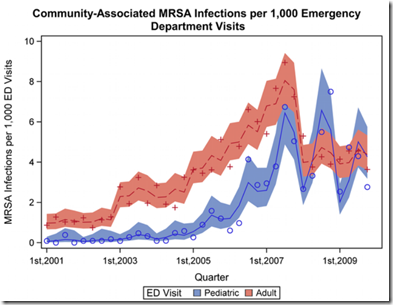
The authors reported that pediatric patients saw roughly 1.85 times as many community-associated CA-MRSA infections and 2.94 times as many hospital-associated HA-MRSA infections in the second two quarters of the year as opposed to the first two quarters.


image


While a similar pattern was observed for adults, it was less pronounced, with 1.14 times as many CA-MRSA infections in the 3rd & 4th quarters, but no detectable increase in adult HA-MRSA infections.


The authors suggested that factors such as excessive hydration of the skin (sweating), summer insect bites, and warm, humid environments conducive to bacterial survival and spread may partially account for the rise, but summer conditions alone cannot not account for the increases.


Temperatures in the 2nd quarter of the year in Rhode Island are normally much higher than during the 4th quarter. 


Fast forward a couple of years, and a new study in the American Journal of Epidemiology finds a similar - but not quite identical – pattern across the United States between 2005 and 2009.


The Changing Epidemiology of Methicillin-Resistant Staphylococcus aureus in the United States: A National Observational Study

Eili Y. Klein, Lova Sun, David L. Smith and Ramanan Laxminarayan*


While the abstract is free, the complete study is behind a subscription/pay wall. Luckily, the following press release from Johns Hopkins Medicine gives us a pretty good overview.


Strains of antibiotic-resistant 'Staph' bacteria show seasonal preference; children at higher risk in summer

Strains of potentially deadly, antibiotic-resistant Staphylococcus aureus bacteria show seasonal infection preferences, putting children at greater risk in summer and seniors at greater risk in winter, according to results of a new nationwide study led by a Johns Hopkins researcher.


It's unclear why these seasonal and age preferences for infection with methicillin-resistant Staph aureus (MRSA) occur, says Eili Klein, Ph.D., lead author on the study and a researcher at the Johns Hopkins Center for Advanced Modeling in the Social, Behavioral and Health Sciences.


But he says that increased use of antibiotics in the winter may be one of the reasons. The winter strain that infects seniors at a greater rate is generally acquired in the hospital and resistant to more antibiotics. On the other hand, the summer strain of MRSA, which is seen with growing frequency in children, is largely a community-transmitted strain that is resistant to fewer antibiotics.


"Overprescribing antibiotics is not harmless," Klein notes. "Inappropriate use of these drugs to treat influenza and other respiratory infections is driving resistance throughout the community, increasing the probability that children will contract untreatable infections."


In fact, the study found that while MRSA strains exhibit a seasonal pattern, overall MRSA infections have not decreased over the last five years, despite efforts to control their spread.


A report on the study, which used sophisticated statistical models to analyze national data for 2005-2009, appears today in the online issue of the American Journal of Epidemiology.


As the researchers report, hospitalizations from infections tied to MRSA doubled in the United States between 1999 and 2005. The ballooning infection numbers were propelled by MRSA acquired in community settings, not hospital or other health care settings, as had been the case prior to 1999.


Specifically, the study found that a strain of MRSA typically seen in community settings is more likely to cause infection during the summer months, peaking around July/August. The authors' data analysis showed children were most at risk of becoming infected with this strain, typically from a skin or soft tissue wound or ailment.


In fact, in examining data for one year — 2008 — the research team found that 74 percent of those under the age of 20 who developed an infection with MRSA had a community-associated MRSA infection.


Meanwhile, the health care-associated MRSA strain, which is typically seen in hospitals, nursing homes and other health care settings, was found to be most prevalent in the winter months, peaking in February/March. Patients aged 65 or older are more likely to acquire a MRSA infection from this strain.


"Our analysis ... shows significant seasonality of MRSA infections and the rate at which they affect different age groups," write the authors of the report titled "The changing epidemiology of methicillin-resistant Staphylococcus aureus in the United States: A national observational study."


Klein said additional research on seasonal patterns of MRSA infections and drug resistance may help with developing new treatment guidelines, prescription practices and infection control programs.


Unlike with the smaller Rhode Island study, these researchers found an increase in HA-MRSA among adults (particularly over the age of 65) that peaked during the 1st quarter. A trend, the authors suggest, that may be linked to the increased use of antibiotics during the winter.


From the Abstract, the authors sum up:


We observed significant differences in infection type by age, with HA-MRSA–related hospitalizations being more common in older individuals. We also noted significant seasonality in incidence, particularly in children, with CA-MRSA peaking in the late summer and HA-MRSA peaking in the winter, which may be caused by seasonal shifts in antibiotic prescribing patterns.

Tuesday, June 12, 2012

Updating Public Health Practices (PHP)


image


# 6381


Every few months I try to highlight the Public Health Practices project (formerly Promising Practices), a freely accessible repository of public health tools and strategies, sponsored by CIDRAP at the University of Minnesota, in partnership with the Association of State and Territorial Health Officials (ASTHO).


I’ve been remiss in not mentioning them since late last year, especially since they are currently seeking feedback from visitors on how they are doing.


After you’ve explored their site, there is a short survey they would appreciate your answering.


Over the past year Public Health Practices has broadened its original scope to include more than just pandemic response. You’ll find tools and practices that cover a wide range of public health concerns, including chemical, radiological, and natural disasters.


image


In addition to the constantly expanding website, there is also a monthly email newsletter you can sign up for.


The About Us page provides an overview of the mission of the Public Health Practices website:


Features of Public Health Practices include:

  • More than 300 public health practices in 9 categories of emergency preparedness and disaster response from state and local health agencies, community-based organizations, and colleges and universities.
  • In-depth stories on how state and local projects were created, communications materials in more than 40 languages, and tools like job action sheets and media campaigns.
  • Expert reviewers' commentary on a practice's effectiveness, reach, sustainability, feasibility, and transferability. Please note: expert review is only available for a select number of practices.
  • A regular e-newsletter featuring our newest practices and other updates from the CIDRAP Public Health Practices staff.
  • The ability to search for practices based on geography, available languages, and key topics in preparedness and response.


If you are interested in starting a community public health, preparedness, or response program - or one for a college or university - a visit to this website could save you and your organization or agency a lot of time, money, and aggravation.


Some recent additions to the site include:


Recent Practices

Curriculum trains children to act as disaster preparedness ambassadors to their families


Guidance helps integrate concerns about sexual violence into the roles and procedures of disaster responders


Parochial Armenian schools develop and implement an earthquake preparedness program


Framework provides strategies for addressing resource scarcity in hospitals and clinics during a regional response


Toolkit paves the way for hospitals to meet children's needs during a disaster


Partnership with Civil Air Patrol allows winter transport of emergency medications to Michigan's Upper Peninsula


Whether you are looking for a specific solution, or simply looking for muse to inspire your organization’s emergency preparedness efforts, visiting Public Health Practicesand returning often – will likely pay tremendous dividends.


Highly recommended.