Showing posts with label Kids. Show all posts

Wednesday, March 11, 2015

ISDR: The `Stop Disasters’ Simulation Game

image


# 9809


Today marks the 4th anniversary of Japan’s Great earthquake and Tsunami of 2011 (see Four Years After Japan’s Great Earthquake & Tsunami), and while we understandably look back and mourn the losses of that day, we also need to be looking forward towards ways to reduce the impact of future disasters.


Because if there is one thing we can count on in life, it is that disasters (of all kinds) will continue to befall mankind.


It is for this reason that preparedness, and community resilience, are frequent topics in this blog.   As a former paramedic, I know how important `being ready’ can be, and I’m constantly looking for ways to instill that mindset in the community.


In Building Disaster Resilient Cities, which featured a guidebook called How to make cities more resilient: a handbook for local government leaders,  I wrote:


With the clustering of millions of people into relatively small areas, we’ve created a scores of `target-rich environments’ for natural disasters such as earthquakes, floods, and severe storms. 

The equation is pretty simple. More people in a small space = more potential casualties.

And the more densely populated a region is, the more economic impact a disaster will have as well.


In 2011, in UNDP: Supercities At Seismic Risk, we looked at the concerns that half of the world’s supercities  (urban areas with 2 million – 15 million inhabitants) are at risk of significant seismic activity, while in January of 2012 I blogged that a UN Agency Warns On Global Seismic Risks.


Just last week, in The Caribbean’s Hidden Tsunami Potential (Revisited), we looked at the geological and historical evidence for massive tidal waves in the Gulf of Mexico/Caribbean/Atlantic Ocean.


And in 2013, in  Dr. Lucy Jones: `Imagine America Without Los Angeles’, we looked at a presentation   at the  annual meeting of the American Geophysical Union,  that emphasized that should the `big one’ hit Southern California, we could literally `lose’ Los Angeles.


The `next big disaster’ could hit anytime, anywhere.  Hurricanes, earthquakes, tsunamis, tornadoes, floods . . . .


Finding ways to engage the younger generation in disaster planning, and preparedness has been a frequent topic of this blog (see NPM14: Disaster Preparedness For Kids  and  NPM13: Kids & Disaster Preparedness), but most of the efforts I’ve found have been geared towards the younger set (ages 5 to 10). 

image


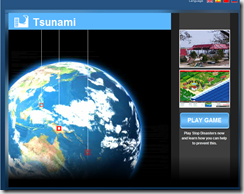
So I am pleased to highlight computer simulation/game geared for teenagers, produced for the UNISDR (United Nations Office for Disaster Risk Reduction) that puts them in control of preparing a city for an expected disaster.


No, it’s not a new game . . . it’s been around for years.  But given today’s anniversary, today seems a good day to remind ourselves that preparedness, and community resilience, can save lives.


The player has five scenarios, with three levels of difficulty in each, to choose from.  Earthquake, tsunami, hurricane, wildfire, flood . . .  you choose


image


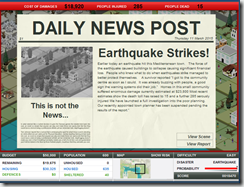
During a timed, and resource limited `setup period’ the player chooses what steps a community should take to prepare for an impending disaster.   Once completed, the disaster simulation runs, telling you just how well (or badly) your mitigation efforts fared.

image

image 


From the game’s FAQ file:


Who can play the Stop Disasters game?
Anyone with internet access can download and play the Stop Disasters game from this web site. The game will not be 'downloadable' as an exe file on your hard drive. Instead it will load into a browser window.

Do I need a special computer?
No, any computer built within the last few years will be sufficient – Mac, PC or Linux based, with a screen resolution of 800x600 pixels.

You’ll need an up to date browser, with Flash Player version 7 or higher. You can download the latest Flash plugin from here:
http://www.adobe.com/go/getflash/

How long does it take?
Each scenario takes between 10 and 20 minutes to play, depending on the disaster you are trying to prevent and your skill level. There are five scenarios to play, and each can be played on easy, medium or hard difficulty levels.

What age do you need to be to play?
The core audience is 9-16 year old children, but anyone can play and enjoy the game, and everyone will learn more about preventing disasters.

How many players can play?
This is a single player game, but groups of children in a classroom environment can play collaboratively and discuss the best course of action to take. Additional learning material for students and teachers is available in the ‘Information’ section of this web site.

How many times can I play?
You can play as many times as you like – we will keep track of your highest scores and record them on the web site, so you can compete against everyone in the world!

However, just like natural hazards in real life some elements are random. There is no ‘perfect solution’ to each scenario and no ‘perfect score’, so every time you play things will be slightly different.

Can I play at school?
If your school allows access to this web site and the computer has the Flash plugin installed, then yes. We have created additional resources for teachers and encourage schools to play this game as a classroom exercise. Why not suggest it to your teacher at school?


Although most parents want to protect their kids from undo worry - when a disaster threatens, it threatens all of us – regardless of our age.  Helping kids to understand more about emergency preparedness and community resilience will help them cope (and perhaps, even help) in the event they, or their community, are caught up in a disaster.

Tuesday, September 16, 2014

NPM14: Disaster Preparedness For Kids

 image


# 9081


Growing up on the west coast of Florida in the 1950s and 1960s – and spending a good part of that time living aboard a boat – I was exposed early to idea that disasters can happen quickly and without warning. Going to bed every night with a life preserver hanging within easy reach quickly imbues one with idea that you should always have an emergency plan.


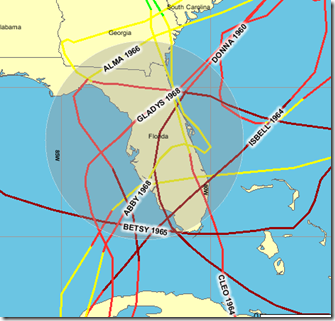
And of course, we lived in Hurricane Alley. Here are the storm tracks of the hurricanes that turned Florida into a tropical shooting gallery during my formative years between 1954-1972. Donna, in 1960 (I was six) howled like a banshee and sent part of an oak tree crashing into our roof.

image


Most kids in Florida kept a hurricane tracking map on their bedroom wall, moving the colored pins several times each day to the coordinates provided by famed local weather forecaster Roy Leep.  Until the mid-1960s, before the Tiros satellites went into service, hurricanes were both mysterious and their tracks notoriously difficult to predict.


Add in the cold war, the 1960 Cuban Missile Crisis, and constant duck & cover drills, evacuations, and Civil Defense films like Survival Under Atomic Attack in elementary school and you’d think you’d have a recipe for night terrors and phobias.


But amazingly, most of us just took it in stride.  In large part, I believe, because we were encouraged at a very young age to participate in disaster preparedness. 


While the atomic attack scenarios were certainly scary, we were empowered by being `prepared for the worst’, even if some of those preparations were a a bit dubious.


Luckily, disaster preparedness – particularly for kids - has come a long way from the `bad old days’ of the cold war.


Today, our concerns are focused on natural disasters, like floods, hurricanes, and earthquakes.  Scenarios that are far more survivable than an all-out nuclear attack, and that can be approached in a more `kid-friendly’ fashion.


But the core message – that disasters happen, and we should all be prepared – hasn’t changed.


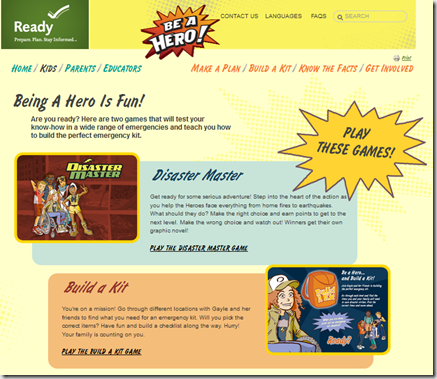
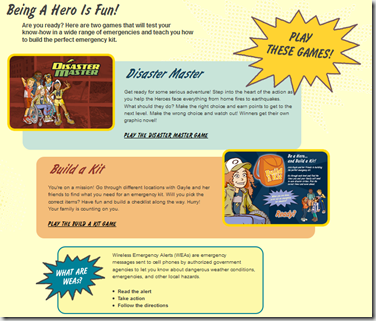
Ready.gov’s kid friendly preparedness page contains games and activities for kids along with  information for parents and educators on how to teach simple, but effective preparedness lessons.  


image


Many states have their own preparedness site for kids, such as Florida Division of Emergency Management’s Kids Get A Plan page, which provides an excellent interactive introduction to preparedness for children. 


image

Florida’s http://www.kidsgetaplan.com/  Disaster Preparedness For Kids


If you’ve got young kids, or grandkids – and would like to introduce them to preparedness concepts without inducing undue trauma - these sites are very much worth while checking out.

Thursday, September 19, 2013

NPM13: Kids & Disaster Preparedness

image

Note: This is day 19 of National Preparedness Month.  Follow this year’s campaign on Twitter by searching for the #NPM or #NPM13 hash tag.

This month, as part of NPM13, I’ll be rerunning some updated  preparedness essays (like this one) , along with some new ones.


# 7790


Disaster preparedness messaging for youngsters has come a long way since I was kid, as evidenced by the Ready.gov/Kids website in the graphic at the top of this page.   In the `bad old days’ of the 1950s and 1960s, preparedness meant `duck & cover’ drills, and a likely futile attempts to survive an atomic attack.


One of the more famous (and least graphic) of these early preparedness PSAs was Bert The Turtle telling kids how to `Duck & Cover’.  


Starker messaging included PSAs like  TARGET YOU, and the equally bleak Survival Under Atomic Attack. If it seems unlikely to you that these sorts of films were routinely presented to school children, I can assure you they were – the fear of imminent nuclear annihilation was rampant back then. 


Today, our concerns are focused on natural disasters, like floods, hurricanes, and earthquakes.  Scenarios that are far more survivable than an all-out nuclear attack, and that can be approached in a more `kid-friendly’ fashion.


But the core message – that disasters happen, and we should all be prepared – hasn’t changed.


Ready.gov’s kid friendly preparedness page contains games and activities for kids along with  information for parents and educators on how to teach simple, but effective preparedness lessons.  

image


Many states have their own preparedness site for kids, such as Florida Division of Emergency Management’s Kids Get A Plan page, which provides an excellent interactive introduction to preparedness for children. 


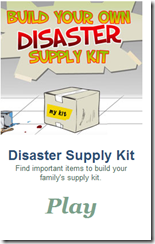
You’ll find audio-stories on topics like lightning safety, wildfires, and hurricanes along with interactive games like the one below, that teaches kids what items are needed for a disaster supply kit.

image

And to go along with these activities for kids, the site provides guides for parents and teachers to help them discuss these issues with kids.


Some of these stories and activities are geared for kids as young as 5 or 6, while others are aimed at slightly older children.


If you’ve got kids, or grandkids – and would like to introduce them to preparedness concepts without inducing undue trauma - this site is very much worth while checking out.


And for even more disaster preparedness for kids, you will also want to check out FEMA/Ready.gov’s  preparedness for kids website which I highlighted last September in NPM12: Preparedness For Kids

image

Sunday, August 04, 2013

More Preparedness For Kids

image

Credit Florida Disaster.org


# 7540


Although I probably would have embraced preparedness had I been raised somewhere else, I’m certain growing up in Florida with early encounters with hurricanes and the Cuban Missile Crisis, along with spending 15 years of my life living aboard boats, had more than a little to do with my mindset.


Growing up on the water I learned to swim, fish, row a boat, throw a cast net, read a map, basic first aid, and (somewhat paradoxically as a boy scout) my way around the `woods’ at a very early age.


In 1962 the Cuban Missile Crisis had the schools handing out graphic pamphlets on radiation poisoning and nuclear war survival to elementary school children, students practicing duck & cover drills each day, and twice-a-week evacuation drills.


Admittedly, not the ideal way for an 8 year-old to learn about preparedness.


Thankfully today preparedness messaging – particularly for kids – is `kinder-and-gentler’ (and far less graphic) than during the `bad-old-days’ of the cold war.


But the core message – that disasters happen, and we should all be prepared – hasn’t changed.


Florida Division of Emergency Management’s Kids Get A Plan page provides an excellent interactive introduction to preparedness for children. 


You’ll find audio-stories on topics like lightning safety, wildfires, and hurricanes along with interactive games like the one below, that teaches kids what items are needed for a disaster supply kit.


image


And to go along with these activities for kids, the site provides guides for parents and teachers to help them discuss these issues with kids.


Some of these stories and activities are geared for kids as young as 5 or 6, while others are aimed at slightly older children.


If you’ve got kids, or grandkids – and would like to introduce them to preparedness concepts without inducing undue trauma - this site is very much worth while checking out.


And for even more disaster preparedness for kids, you will also want to check out FEMA/Ready.gov’s  preparedness for kids website which I highlighted last September in NPM12: Preparedness For Kids


image

Saturday, September 08, 2012

NPM12: Preparedness For Kids

Note: This is day 8 of National Preparedness Month.  Follow this year’s campaign on Twitter by searching for the #NPM or #NPM12 hash tag.


This month, as part of NPM12, I’ll be rerunning some updated  preparedness essays (like this one) , along with some new ones.


# 6543


As any Boy or Girl Scout will tell you, emergency preparedness isn’t just for adults. And the Federal government obviously agrees since they maintain a website called Ready Kids as part of the Ready.gov program.


image


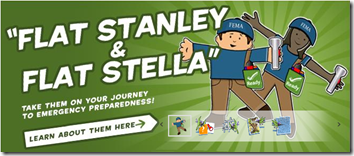
Here – with your guides Flat Stella & Flat Stanley- you’ll find a fun, interactive way to introduce young children to the concept of preparedness. You’ll also find an assortment of  Fun & Games, all with an emergency preparedness theme.


Comic Strip Comic Strip 

Crossword Puzzle Crossword Puzzle

Pack It Up Matching Game Pack It Up Matching Game

Hidden Treasures Activity Hidden Treasures Activity

Word Search Game Word Search Game

Coloring Pages Requires Acrobat Reader Plug-in Coloring Pages


For a somewhat older crowd (teenagers and young adults, mostly), in May of 2011 the CDC unleashed their  highly successful Zombie Preparedness blog - cleverly written by Rear Admiral Ali S. Khan - who told us (with tongue firmly implanted in cheek) that if we are prepared for a Zombie Apocalypse . . . we’re pretty much prepared for anything.


zombie

Photo Credit CDC


Once the news of a `zombie’ blog appearing on the CDC site went viral on Twitter, the number of visitors to the Public Health Matters Blog  temporarily overwhelmed their server.


Heartened by the huge response, six months later the CDC released a sequel to this highly effective campaign, with a 2-part Graphic Novel preaching preparedness, and a number of tie-in posters and even T-Shirts that you can purchase.


All are designed to drive home the importance of Getting a kit, Making a plan, and Being prepared

To learn how, go to the CDC’s  THE ZOMBIE PREPAREDNESS PAGE


Even with the addition of a mock zombie apocalypse, today’s preparedness messages are far kinder and gentler than the ones many of us were exposed to growing up during the height of the cold war.


My generation grew up indoctrinated by Bert the Turtle civil defense cartoons, incessant CONELRAD testing on the radio and TV, and the never-ending threat of nuclear annihilation. 


image image


"This was a test. Had this been a real emergency, you'd have been instructed to turn to your local CONELRAD broadcaster for more information. This was only a test".


During the Cuban Missile crisis, at the age of 8, I got the short course in radiation sickness, fallout shelters, `duck & cover’ drills, and emergency evacuations from my local elementary school. 


I recounted some of those experiences in a blog called NPM11: Creating A Family Communications Plan.


I certainly don’t advocate that preparedness lessons be taught to kids today in such a stark, disturbing, and traumatic fashion today


But the Ready Kids site shows that the subject can be approached in a child-friendly non-threatening manner.


When a disaster threatens, it threatens all of us – regardless of our age. Helping kids to understand more about emergency preparedness will undoubtedly help them cope (and perhaps, even help) in the event they, or their community, are caught up in a disaster.
Sunday, May 06, 2012

Ready Kids

image


# 6317


Disasters are equal opportunity destroyers.


To a tornado, earthquake, flood, or hurricane it matters not whether you are rich or poor, fit or infirmed, or young or old. And the very young and the very old are often the most vulnerable to their effects.


As a parent, I fully understand the desire to protect kids from the grim realities of disaster planning.  But I also know - from personal experience – how vital it is to include our children in our emergency preparations.


Although it is hard to imagine it today, 50 years ago much of Florida was on a war footing, with legitimate fears of a nuclear attack that might come at any time.


In October of 1962, during the height of the Cuban Missile Crisis, armed military personnel were on the streets, schools were running daily `duck & cover’ drills, and thousands of people were hastily preparing fallout shelters.


image


School kids were sent home with civil defense pamphlets on the basics of radiation poisoning and how to build an in-home fallout shelter, while radio and TV stations blared CONALRAD Alert Tests.


At home – in addition to stocking up on extra food and supplies – my parents held several family meetings where my twin brother, older sister, and I were briefed on what to do, and where to go, should an attack occur.


While grim subjects - being able to talk openly about it, and actively do things to prepare – I’m certain empowered me, and made the whole experience far easier for this 8 year-old.


In the end, the Russians blinked, nuclear war was averted, and things eventually returned to an uneasy cold war `normal’.


But it was a very near thing.


Fifty years ago we weren't afraid to openly talk about the threat of atomic annihilation. We actually planned and worked to survive it.  Admittedly, some of the civil defense messaging (especially to children) seems unduly harsh by today’s standards, but this was a far different age.


Sometime in the 1980's it was decided that a nuclear war, with our bigger warheads, wasn't survivable, and the civil defense network was disbanded.


Today the threat of a global nuclear war is greatly reduced, but other threats – ranging from earthquakes, to pandemics, to terrorist attacks – remain. And while fallout shelters are no longer in vogue, disaster preparedness never goes out of style. 


To that end FEMA, CDC, HHS, READY.GOV, and NOAA, along with a variety of state, local, and federal agencies all actively work to get people to prepare for emergencies. 


The messaging has improved and is far less stark than in the `bad old days’ of the cold war – especially for children - but it is no less important.  


Ready.gov has a special site designed for kids, that can help teach them the basics of emergency preparedness.  It is designed to be fun and informative, not scary.


http://www.ready.gov/kids


Using games, comics, quizzes, and culminating in a certificate of graduation from Readiness U, this site provides an easy and painless introduction to emergency preparedness for kids.


image


You’ll also find plenty of information for Parents and Teachers to help you with talking to your kids about disasters and planning.


And after a disaster, FEMA has some advice for adults on how they can Help Kids Cope With Disaster.

While no one likes to think of their kids being affected by a disaster, it happens to millions of children every year. Teaching them what to expect, and what to do in an emergency may literally someday save their lives.

Wednesday, September 07, 2011

NPM11: Preparedness For Kids


Note: This is day 7 of National Preparedness Month.  Follow this year’s campaign on Twitter by searching for the #NPM11 hash tag.


image

This month, as part of NPM11, I’ll be rerunning some edited and updated older preparedness essays, along with some new ones.


# 5819


As any Boy or Girl Scout will tell you, preparedness isn’t just for adults. 


And the Federal government obviously agrees since they maintain a website called Ready Kids as part of the Ready.gov program.


image


Here you’ll find a fun, interactive way to introduce young kids to the concepts of preparedness. Something that should be part of every child’s early education.


As a former scout myself, I learned elementary first aid, map reading, woodcraft & survival skills, and a host of other valuable lessons before I was even a teenager.


And growing up as young boy aboard a boat on the west coast of Florida, I learned about weather hazards, including tropical storms and lightning, and learned the value of becoming an excellent swimmer.


During the Cuban Missile crisis, at the age of 8, I got the short course in radiation sickness, fallout shelters, `duck & cover’ drills, and emergency evacuations from my local elementary school.  I recounted some of those experiences in a recent blog called NPM11: Creating A Family Communications Plan.


While I certainly don’t advocate that preparedness lessons be taught to kids today in such a stark and disturbing fashion - the Ready Kids site shows that the subject can be approached in a child-friendly non-threatening manner.


Later, while still in high school, I took Red Cross First Aid training at the local fire department. Shortly after graduation, in the summer of 1972, I took part in several rescues and helped to set up an emergency aid shelter at our local City Hall during Hurricane Agnes.


By October of that year, I was working on an ambulance and enrolled in the next available EMT class. Going full circle, a few years later as a Paramedic and a Red Cross CPR instructor, I taught hundreds of high school kids how to perform CPR.


One day, my partner and I rolled up on a heart attack scene, and found one of my students doing effective CPR on his grandfather  . . . and yes, I’m happy to report his grandfather survived.


For my family, general preparedness was just considered common sense.  Something to learn, and practice, and make into a lifelong habit.


And that attitude has served me well over the years.


In addition to the Ready Kids site above, FEMA has their own FEMA KIDS site, with loads of child-friendly preparedness resources.


image


If you have kids, or are just a kid at heart, take some time and check out these two resources.