Showing posts with label DVBID. Show all posts

Wednesday, September 25, 2013

DVBID: West Nile Virus Update

image


# 7810


The CDC’s DVBID (Division of Vector Borne Infectious Diseases) has updated their West Nile numbers as reported to them through September 24th, and while these numbers continue to climb, they are far below where we were this time last year. The latest summary reads:


As of September 24, 2013, 48 states and the District of Columbia have reported West Nile virus infections in people, birds, or mosquitoes. A total of 1,135 cases of West Nile virus disease in people, including 44 deaths, have been reported to CDC. Of these, 529 (47%) were classified as neuroinvasive disease (such as meningitis or encephalitis) and 606 (53%) were classified as non-neuroinvasive disease.


Mild cases – called West Nile Fever – often go undiagnosed, with probably only 2%-3% being identified, whereas neuroinvasive cases (which present with meningitis, encephalitis, or flaccid Paralysis) are severe enough that they almost always result in hospitalization and diagnosis.


Neuroinvasive cases are considered a better indicator of the scope of each year’s epidemic, and the map below shows the states hardest hit this year by this more severe form of the illness.


image


As it can take several weeks after a person becomes infected before they are diagnosed and reported to the CDC – and deaths may occur months after infection - the numbers reported as of today are considered `lagging indicators’.  Still, this time last year, the numbers were roughly triple what has been reported to date (see 9/25/12 DVBID Update On West Nile Virus).


Texas. which bore the brunt of last year’s WNV activity (1868 cases, 89 deaths) has only reported 66 cases this summer, and 4 fatalities.


Comparatively speaking, we are seeing a milder season, and with October just a week away, the peak season for West Nile Virus is about over.


But infected mosquitoes are still out there, and so the risk of infection has not gone away entirely. A good reason to heed the advice of our local health departments to  follow the `5 D’s’ of mosquito protection.

image

Tuesday, May 14, 2013

DVBID: 2012 Record Number Of West Nile Fatalities


image

# 7273


Last December in DVBID: Final West Nile Report For 2012, we saw a preliminary accounting of last year’s West Nile virus impact across the country.  From all appearances, 2012 appeared on track to be a record year.


Total cases                5,387 cases

Neuroinvasive cases   2,734 (51%)   

Mild cases                  2,653 (49%)

Deaths                          243


Neuroinvasive cases (which present with meningitis, encephalitis, or flaccid Paralysis) are severe enough that they result in hospitalization and diagnosis, and so they are considered the best indicator of the scope of each year’s epidemic.


Mild cases – called West Nile Fever – often go undiagnosed, with probably only 2%-3% being identified.


Meaning that with more than 2,600 mild cases reported, the true incidence was probably in excess of 100,000 infections.


Yesterday the CDC released their Final West Nile virus national surveillance data for 2012 - which adds in several hundred cases not counted in December, along with more than 40 additional deaths – making 2012 the deadliest year for West Nile in the United States since it first arrived in 2009.


This from the CDC.


Final 2012 West Nile virus update:

In 2012, all 48 contiguous states, the District of Columbia, and Puerto Rico reported West Nile virus infections in people, birds, or mosquitoes. A total of 5,674 cases of West Nile virus disease in people, including 286 deaths, were reported to CDC. Of these, 2,873 (51%) were classified as neuroinvasive disease (such as meningitis or encephalitis) and 2,801 (49%) were classified as non-neuroinvasive disease. The numbers of neuroinvasive, non-neuroinvasive, and total West Nile virus disease cases reported in 2012 are the highest since 2003.


 image

The press release from the CDC follows:


CDC releases final West Nile virus national surveillance data for 2012

What

The Centers for Disease Control and Prevention (CDC) today released the final 2012 national surveillance data for West Nile virus activity.  To access the information, please visit www.cdc.gov/westnile.


A total of 5,674 cases of West Nile virus disease in people, including 286 deaths, were reported to CDC from 48 states (excluding Alaska and Hawaii).  Of all West Nile virus disease cases reported, 2,873 (51 percent) were classified as neuroinvasive disease (e.g., meningitis, encephalitis, or acute flaccid paralysis). The dates of illness onset (when the patients’ illness began) ranged from March through December 2012.


The numbers of neuroinvasive, non-neuroinvasive, and total West Nile virus disease cases reported in 2012 are the highest since 2003. The number of deaths is the highest since cases of WNV disease were first detected in the United States in 1999.


Where

In 2012, 62 percent of all reported West Nile virus cases—were concentrated in California, Louisiana, Michigan, Mississippi, , Oklahoma, South Dakota, and Texas.  Texas reported 33 percent of all reported West Nile virus cases in 2012.


Last summer’s outbreak likely resulted from  many  factors, including higher-than-normal temperatures that influenced mosquito and bird abundance, the replication of the virus in its host mosquitoes, and interactions of birds and mosquitoes in hard-hit areas. Because the factors that lead to West Nile virus disease outbreaks are complex, CDC cannot predict where and when they will occur.


Additional Information


Each spring, CDC releases the final West Nile virus case surveillance data for the previous year. The data include confirmed and probable human disease cases reported to ArboNET by state and local health departments. ArboNET is the national, electronic surveillance system established by CDC to assist states in tracking illness caused by West Nile virus and other viruses transmitted by mosquitoes or ticks.


Last year's large outbreak is a reminder that it is important for people to protect themselves from West Nile virus, especially as we head into summer and mosquitoes become more active. The best way to prevent West Nile virus disease is to avoid mosquito bites:

  • Use insect repellents when you go outdoors.  Use repellents containing DEET, picaridin, IR3535, and para-menthane-diol (PMD) because these repellents provide longer-lasting protection than other products.  Always follow the instructions on the label.
  • Wear long sleeves and pants at dawn and dusk when many mosquitoes are most active.
  • Repair or install screens on windows and doors.  Use air conditioning, if you have it.
  • Help reduce the numbers of mosquitoes around your home.  Empty standing water from items such as gutters, flowerpots, buckets, and kiddie pools. Change birdbaths weekly.


With summer temperatures rising across much of the United States, mosquito season cannot be far behind. So, if you live in, or are visiting one of these areas,  many health departments urge you to follow the `5 D’s’


image


Once again, this summer we’ll be keeping an eye on the level of West Nile, EEE, Dengue, and other arbovirus activity around the country.

Thursday, December 13, 2012

DVBID: Final West Nile Report For 2012

image


# 6779


While final numbers won’t be available until the spring, 2012 looks like it will go down as one of the most active West Nile Fever seasons since the virus arrived in North America in 1999.


The CDC’s  DVBID has released their final tally of cases for 2012 on their West Nile Update Page.  They summarize the season thusly:


2012 West Nile virus update: December 11

This will be the last update for 2012 until final data are available in the spring of 2013.

As of December 11, 2012, 48 states have reported West Nile virus infections in people, birds, or mosquitoes. A total of 5,387 cases of West Nile virus disease in people, including 243 deaths, have been reported to CDC. Of these, 2,734 (51%) were classified as neuroinvasive disease (such as meningitis or encephalitis) and 2,653 (49%) were classified as non-neuroinvasive disease.


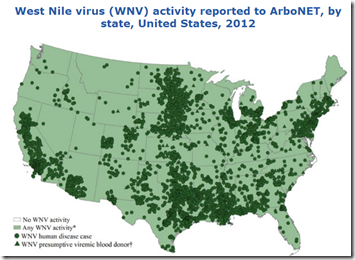
The 5,387 cases reported thus far in 2012 is the highest number of West Nile virus disease cases reported to CDC through the second week in December since 2003. Eighty percent of the cases have been reported from 13 states (Texas, California, Louisiana, Illinois, Mississippi, South Dakota, Michigan, Oklahoma, Nebraska, Colorado, Arizona, Ohio, and New York) and a third of all cases have been reported from Texas.


Neuroinvasive cases (which present with meningitis, encephalitis, or flaccid Paralysis) are severe enough that they result in hospitalization and diagnosis, and so they are considered the best indicator of the scope of each year’s epidemic.


Mild cases – called West Nile Fever – often go undiagnosed, with probably only 2%-3% being identified.


Meaning that with more than 2,600 mild cases reported, the true incidence was probably in excess of 100,000 infections.


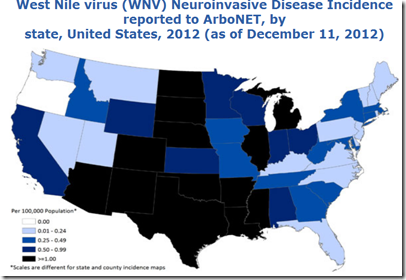
Hardest hit this year was Texas, with more than 1,700 cases and 76 deaths. Far behind, but in second place, was California with 461 cases and 16 deaths. 


Nevertheless, the highest incidence of neuroinvasive disease occurred along the Gulf Coast and into the upper Mid West.


image


Earlier this year the CDC indicated they would be taking a look at this year’s WNV season to see if any changes have occurred in the virus to account for this sudden spike in activity. 


While West Nile season has passed for most of the country, there are still a few areas where mosquitoes are still active.  So, if you live in, or are visiting one of these areas, the advice by many health departments to follow the `5 D’s’ remains intact. 

image

Wednesday, October 24, 2012

DVBID: West Nile Cases Continue To Mount

image


# 6659


While the peak in transmission of the West Nile Virus probably occurred more than a month ago, cases – and fatality reports – continue to come in at a near-record pace. 


This is not entirely unexpected, given the incubation time for the virus (2-15 days), delays in processing local and state reports, and the reality that some patients may succumb after weeks or even months of treatment.


Today’s update from the CDC’s DVBID summarizes the latest numbers below:


2012 West Nile virus update: October 23

As of October 23, 2012, 48 states have reported West Nile virus infections in people, birds, or mosquitoes. A total of 4,725 cases of West Nile virus disease in people, including 219 deaths, have been reported to CDC. Of these, 2,413 (51%) were classified as neuroinvasive disease (such as meningitis or encephalitis) and 2,312 (49%) were classified as non-neuroinvasive disease.


The 4,725 cases reported thus far in 2012 is the highest number of West Nile virus disease cases reported to CDC through the fourth week in October since 2003. Almost 70 percent of the cases have been reported from eight states (Texas, California, Louisiana, Mississippi, Illinois, South Dakota, Michigan, and Oklahoma) and over a third of all cases have been reported from Texas.


The 20% increase in deaths – up from 183 last week, to 219 this week - is indicative of fatality reports being a lagging indicator.


In contrast, the number of new neuroinvasive cases rose only by 120, or about 5%.  Perhaps a sign that the number of new cases is beginning to decline.  


Neuroinvasive cases (which present with meningitis, encephalitis, or flaccid Paralysis) are severe enough that they result in hospitalization and diagnosis, and so they are considered the best indicator of the scope of each year’s epidemic.


Mild cases – called West Nile Fever – often go undiagnosed, with probably only 2%-3% being identified.


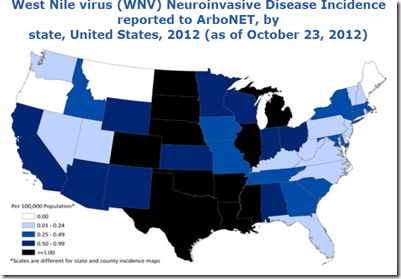
The states hardest hit by the neuroinvasive illness continue to center around the middle of the country, with Texas accounting for roughly 1/3rd of all of the serious WNV infections (n=742) in the nation.


image


Even though cooler fall weather has reduced mosquito activity across much of the country - with no vaccine, and the virus now endemic across much of the country - health departments continue to urge people to follow the `5 D’s’ of protection anytime mosquitoes may be active:


image

Wednesday, October 03, 2012

DVBID: West Nile Infections Continue Record Pace

image

Credit DVBID


# 6604


The DVBID (Division of Vector Borne Infectious Diseases) has updated their West Nile numbers as reported to them through October 2nd, and as expected the number of new cases, and deaths, continues to rise.


2012 West Nile virus update: October 2

As of October 2, 2012, 48 states have reported West Nile virus infections in people, birds, or mosquitoes. A total of 3,969 cases of West Nile virus disease in people, including 163 deaths, have been reported to CDC. Of these, 2,010 (51%) were classified as neuroinvasive disease (such as meningitis or encephalitis) and 1,959 (49%) were classified as non-neuroinvasive disease.


The 3,969 cases reported thus far in 2012 is the highest number of West Nile virus disease cases reported to CDC through the first week in October since 2003. Almost 70 percent of the cases have been reported from eight states (Texas, California, Louisiana, Mississippi, South Dakota, Michigan, Oklahoma, and Illinois) and a third of all cases have been reported from Texas.


The record pace continues, and we can expect – given incubation period of 2 or 3 weeks, and since some people may succumb only after weeks of illness – that we will see these numbers continue to rise for the next couple of months.


The incidence level of the more serious neuroinvasive form of West Nile disease – which can produce encephalitis, meningitis, and/or acute flaccid paralysis – is illustrated by the following chart. 


image


Although the peak period of transmission for WNV may have passed, infected mosquitoes are still out there and are still biting and infecting people.


So we still need to heed the advice of our local health departments to  follow the `5 D’s’ of mosquito protection:

image


And finally, to find out about the West Nile threat in your area, you can visit the DVBID website below:

Links to State and Local Government West Nile Virus Web Sites


Click on a state to link directly to their West Nile virus Web page.

See list below for additional city-level and main State Health Department Web sites.

Image: West Nile Virus Map of States with links to their West Nile Virus pages

Wednesday, September 26, 2012

DVBID Update On West Nile Virus


image

Source DVBID


# 6586


While the big infectious disease news this week has been the novel coronavirus that has killed one Saudi, and seriously sickened a Qatari man, there are other infectious disease threats we follow, including West Nile Disease.


The DVBID has updated their West Nile website, and while the number of new infections is beginning to decline, 13 additional deaths have been reported via ArboNet in the last week.


2012 West Nile virus update: September 25

As of September 25, 2012, 48 states have reported West Nile virus infections in people, birds, or mosquitoes. A total of 3,545 cases of West Nile virus disease in people, including 147 deaths, have been reported to CDC. Of these, 1,816 (51%) were classified as neuroinvasive disease (such as meningitis or encephalitis) and 1,729 (49%) were classified as non-neuroinvasive disease.


The 3,545 cases reported thus far in 2012 is the highest number of West Nile virus disease cases reported to CDC through the last week in September since 2003. Seventy percent of the cases have been reported from eight states (Texas, Mississippi, South Dakota, Michigan, California, Louisiana, Oklahoma, and Illinois) and 38 percent of all cases have been reported from Texas.


It should be noted that the latest numbers reported via ArboNet may lag behind the most recent totals being reported by each state.  


Case in point: Texas,  which is shown to have  1345 cases and 52 deaths in today’s report, is reporting somewhat higher numbers on their website:


image

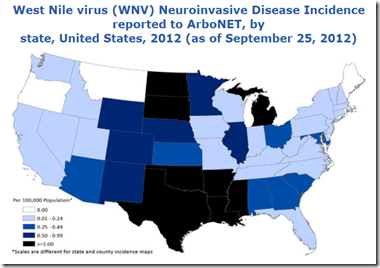
The incidence level of the more serious neuroinvasive form of West Nile disease – which can produce encephalitis, meningitis, and/or acute flaccid paralysis – is illustrated by the following chart. 


image 


Although the peak period of transmission for WNV may have passed, infected mosquitoes are still out there and are still biting and infecting people.


So we still need to heed the advice of our local health departments to  follow the `5 D’s’ of mosquito protection:

image

Wednesday, September 12, 2012

CDC West Nile Update: Sept 12th

image

Source  DVBID 


# 6551


For the fourth week in a row, the CDC hosted a teleconference on the ongoing West Nile Virus outbreak across the nation, today featuring Lyle R. Petersen, M.D., M.P.H.  and Roger S. Nasci, PhD of the CDC’s DVBID.


While hopeful that we may have reached the peak of this year’s West Nile season (based on historical trends), the CDC says new infections (and deaths) are expected to continue to rise over the next couple of months.


The number of neuroinvasive cases reported to date is the highest number ever recorded in the United States through the second week of September.


As of yesterday, more than 2630 WNV infections have been reported via ArboNet – an increase of roughly 35% over last week’s numbers.  Of those, 1405 involve the more serious neuroinvasive disease.


Neuroinvasive cases (which present with meningitis, encephalitis, or flaccid Paralysis) are severe enough that they almost always result in hospitalization and diagnosis, and so they are considered a better indicator of the scope of each year’s epidemic.


Mild cases – called West Nile Fever – often go undiagnosed, with probably only 2%-3% being identified.


Since it can take several weeks after a person becomes infected before they are diagnosed and reported to the CDC – and deaths may occur months after infection - the numbers reported as of today are considered `lagging indicators’. 


The CDC expects, based on the numbers today, that this will end up being the worst year for the WNV since it arrived in the United States in 1999.


Only Hawaii & Alaska have not reported the WNV in either humans, animals, or mosquitoes. The bulk of the cases this year have been seen across just 6 states; Texas  Mississippi, Louisiana, Oklahoma, South Dakota and Michigan.

image

Of the 2,636 WNV cases, 1,405 (53%) were reported as neuroinvasive disease cases and 1,231 (47%) were reported as nonneuroinvasive disease cases. Three hundred and eighty five WNV presumptive viremic blood donors (PVDs) have been reported at this time.- Cite DVBID


With no vaccine, and the virus now endemic across much of the country - health departments are urging people to follow the `5 D’s’ of mosquito protection:

image

To find out about the West Nile threat in your area, you can visit the DVBID website below:

Links to State and Local Government West Nile Virus Web Sites

Click on a state to link directly to their West Nile virus Web page.

See list below for additional city-level and main State Health Department Web sites.


Image: West Nile Virus Map of States with links to their West Nile Virus pages


The CDC is investigating why this year’s outbreak has been so severe, and hopes to release a report with their findings before next year’s WNV season.


A transcript, and audio recording of today’s conference will be posted later today on the CDC NEWSROOM webpage.


UPDATE:  Transcript & Audio are now posted.

image

Wednesday, August 22, 2012

CDC Telebriefing on West Nile Virus


image


# 6510


A public health situation we’ve been following here for the past several weeks (see here, here, here, and here) was the subject of a CDC telebriefing today; the unusually high incidence of West Nile infections across the country, but most noticeably in Texas.


According to the CDC’s Dr. Lyle R. Petersen, director of the DVBID at the CDC, 2012 may be on track to be the worst yet in the 13 year history of the virus in the United States.


Yesterday, the CDC’s DVBID division updated their numbers through August 21st, indicating:


2012 West Nile virus update: as of August 21

Thus far in 2012, 47 states have reported West Nile virus infections in people, birds, or mosquitoes. A total of 1118 cases of West Nile virus disease in people, including 41 deaths, have been reported to CDC. Of these, 629 (56%) were classified as neuroinvasive disease (such as meningitis or encephalitis) and 489 (44%) were classified as non-neuroinvasive disease.


The 1118 cases reported thus far in 2012 is the highest number of West Nile virus disease cases reported to CDC through the third week in August since West Nile virus was first detected in the United States in 1999. Approximately 75 percent of the cases have been reported from 5 states (Texas, Mississippi, Louisiana, South Dakota, and Oklahoma) and almost half of all cases have been reported from Texas.


Of the 1118 cases, nearly half (n=537) are from Texas, and 26 deaths so far this year have been recorded in the Lone Star State. Hard hit Dallas county reported their 11th fatality yesterday.


Elsewhere across the nation, 38 other states have reported West Nile infections in humans, and deaths have been reported across 16 states.


Of note, Louisiana has reported 6 fatalities and Oklahoma has reported 3.


Today’s telebriefing featured Lyle R. Petersen, M.D. and the transcript should be posted on the CDC’s media site tonight or tomorrow (now available at this link).


Lisa Schnirring writing for CIDRAP NEWS has an excellent summary of today’s briefing:


CDC reports surge in US West Nile virus activity

Lisa Schnirring * Staff Writer

Aug 22, 2012 (CIDRAP News) – The United States is experiencing a dramatic rise in the cases of West Nile virus (WNV) infections over the past month, with record-setting numbers expected over the next several weeks and the US Centers for Disease Control and Prevention (CDC) warning people to take key preventive steps.


So far, 38 states have reported human cases, but the epicenter is Texas, which has reported half of the WNV infections. The CDC said so far it has received reports of 1,118 cases, including 629 people with the neuroinvasive form of the disease. Nationally, 41 deaths have been reported.

(Continue . . .)


Given that the WNV season doesn’t usually peak until mid-August, and it can take 2 to 3 weeks for symptoms to develop, many more cases are expected over the next few months.


While 80% of those infected don’t show symptoms, last week WEBMD carried a report (see New West Nile Threat: Kidney Disease) about research conducted by Baylor University West Nile expert Kristy O. Murray, PhD, DVM.


Dr. Murray’s research (see Persistent Infection with West Nile Virus Years after Initial Infection) suggests long-term sequelae may develop among a significant percentage of those who are infected with the West Nile Virus – even among those infected asymptomatically.


Dr. Murray was awarded an NIH grant in 2011 to study the effects of chronic WNV infection on the kidneys and central nervous system.


Reason enough to take seriously the recommendations from health departments across the nation that urge people to follow the `5 D’s’ of mosquito protection:

image

To find out about the West Nile threat in your area, you can visit the DVBID website below:

Links to State and Local Government West Nile Virus Web Sites

 Image: West Nile Virus Map of States with links to their West Nile Virus pages

And as a final note, the CDC recently updated their information on mosquito repellants.

Updated Information regarding Insect Repellents

Wednesday, August 15, 2012

Updating the Texas West Nile Outbreak

image

Credit DVBID  Nearly half of all cases this year are out of Texas


# 6495


In 2011 there were only 2 fatalities linked to the West Nile virus across Texas. This year 16 deaths have already been recorded, and several hundred people have been seriously sickened.


Yesterday Dallas County, Tx confirmed their 10th fatality of the year, and announced that they plan to begin aerial spraying for mosquitoes on Thursday night. Cities and municipalities have until the end of day today to opt out of the plan.


According to the State health department:

Texas has more than 380 state-confirmed cases of West Nile illness for 2012, including 16 related deaths. Texas is on track to have the most cases of West Nile illness since the disease first emerged in the state in 2002. (cite)

Despite these grim statistics, opposition to aerial spraying exists, with online letter writing and petition signings campaigns underway urging the city not to spray (see KDAF-TV report)


The plan is to use two small twin-engine aircrafts, flying at roughly 300 feet, to spray a chemical called DUET, which is EPA approved for use in outdoor and residential areas.


Application rates will average less than 1 ounce per acre, and this spray is chemically similar to the ones used for ground spraying operations.


Aware of concerns over aerial spraying, the State of Texas released this statement on the safety of the program, stating:


Aerial spraying is a very effective and safe way to kill adult mosquitoes in large, densely populated areas. For people concerned about exposure during aerial spraying, health officials suggest the following precautions:

  • Minimize exposure. Avoid being outside, close windows and consider keeping pets inside while spraying occurs.
  • If skin or clothes are exposed, wash them with soap and water.
  • Rinse homegrown fruits and vegetables with water as a general precautionary measure.
  • Cover small ornamental fish ponds.
  • Because the chemical breaks down quickly in sunlight and water, no special precautions are suggested for outdoor swimming areas.


While only about 20% of the people who are infected with WNV ever develop symptoms – and most only experience a mild flu-like illness –a very small percentage will develop the the more severe, and sometimes deadly, `neuroinvasive’ form of WNV.


Although Texas is seeing the brunt of this year’s outbreak, the virus is showing up from coast-to-coast.


Six deaths have been reported in Louisiana, and another half dozen are scattered across  Arizona, California, Mississippi, Missouri, South Dakota, and Pennsylvania.

Neuroinvasive West Nile Disease  has been reported in 27 states so far this year; Alabama, Arizona, Arkansas, California, Colorado, Florida, Georgia, Illinois, Indiana, Iowa, Kansas, Kentucky, Louisiana, Maryland, Michigan, Minnesota, Mississippi, Missouri, Nebraska, New York, North Dakota, Ohio, Oklahoma, Pennsylvania, South Dakota, Tennessee and Texas.

image


Reason enough for health departments across the nation to urge people to follow the `5 D’s’ of mosquito protection:

image

To find out about the West Nile threat in your area, you can visit the DVBID website below:

Links to State and Local Government West Nile Virus Web Sites

Click on a state to link directly to their West Nile virus Web page.

See list below for additional city-level and main State Health Department Web sites.

Image: West Nile Virus Map of States with links to their West Nile Virus pages


And as a final note, the CDC recently updated their information on mosquito repellants.

Updated Information regarding Insect Repellents

Download PDF version formatted for print Adobe Acrobat Reader(32 KB/3 pages)

Repellents are an important tool to assist people in protecting themselves from mosquito-borne diseases.

CDC recommends the use of products containing active ingredients which have been registered by the U.S. Environmental Protection Agency (EPA) for use as repellents applied to skin and clothing. EPA registration of repellent active ingredients indicates the materials have been reviewed and approved for efficacy and human safety when applied according to the instructions on the label.

Repellents for use on skin and clothing:

CDC evaluation of information contained in peer-reviewed scientific literature and data available from EPA has identified several EPA registered products that provide repellent activity sufficient to help people avoid the bites of disease carrying mosquitoes. Products containing these active ingredients typically provide reasonably long-lasting protection:

  • DEET (Chemical Name: N,N-diethyl-m-toluamide or N,N-diethly-3-methyl-benzamide)
  • Picaridin (KBR 3023, Chemical Name: 2-(2-hydroxyethyl)-1-piperidinecarboxylic acid 1-methylpropyl ester )
  • Oil of Lemon Eucalyptus* or PMD (Chemical Name: para-Menthane-3,8-diol) the synthesized version of oil of lemon eucalyptus
  • IR3535 (Chemical Name: 3-[N-Butyl-N-acetyl]-aminopropionic acid, ethyl ester)

(Continue . . . )

Thursday, August 09, 2012

Dallas West Nile Update


 image


# 6483


While we await today’s MMWR and a briefing this afternoon from the CDC on the H3N2v outbreak in Ohio and Indiana, we’ve three more West Nile Virus (WNV) deaths to report in Dallas County, Texas this week (see Ninth West Nile Virus Related Death in Dallas County August 8, 2012). 


Nationally, as of August 7th, 253 neuroinvasive cases of WNV have been reported to ArboNET, along with 137 non-neuroinvasive WNV infections. 


Of those, roughly half have been reported out of the state of Texas (see CHART).


It is estimated that only about 20% of the people who are infected with WNV develop symptoms, and the vast majority of those only experience a mild flu-like illness. Accordingly, mild, asymptomatic, or non-neuroinvasive infections are likely vastly undercounted.


The more severe `neuroinvasive’ form of WNV can produce symptoms that include headache, stiff neck, confusion, coma, convulsions, and even paralysis.


According to the CDC’s  WEST NILE SYMPTOMS Q&A page.


It is estimated that approximately 1 in 150 persons infected with the West Nile virus will develop a more severe form of disease. Serious illness can occur in people of any age, however people over age 50 and some immunocompromised persons (for example, transplant patients) are at the highest risk for getting severely ill when infected with WNV.

<SNIP>

When someone is infected with West Nile virus (WNV) they will typically have one of three outcomes: No symptoms (most likely), West Nile fever (WNF in about 20% of people) or severe West Nile disease, such as meningitis or encephalitis (less than 1% of those who get infected).

If you develop a high fever with severe headache, consult your health care provider.


While many are concerned this week over an emerging swine flu virus, so far we are not aware of any deaths or serious illness from that flu strain.


The same, sadly, cannot be said about mosquito borne illnesses this summer. 


Reason enough for health departments across the nation to urge people to follow the `5 D’s’ of mosquito protection:

image

To find out about the West Nile threat in your area, you can visit the DVBID website below:

 
Links to State and Local Government West Nile Virus Web Sites

Click on a state to link directly to their West Nile virus Web page.

See list below for additional city-level and main State Health Department Web sites.

Image: West Nile Virus Map of States with links to their West Nile Virus pages

Monday, August 06, 2012

Update & Video On The Texas West Nile Outbreak


 image
Map credit – DVBID


# 6476


A week ago, in Texas: West Nile Cases Rising I wrote about the high number of West Nile infections being reported in, and around, Dallas County Texas.  At the time, the DCHHS was reporting three local fatalities from WNV neuroinvasive disease (WNND).


That number has now doubled to six fatalities, according to this press release from the Dallas County Health Department. WNV related deaths have also been reported in Travis County (1) and McLennan County (1).


To put this into some kind of perspective, in previous years the entire state of Texas reported:

  • 2 West Nile human fatalities in 2011
  • 7 West Nile human fatalities in 2010
  • 9 West Nile human fatalities in 2009
  • 1 West Nile human fatalities in 2008
  • 17 West Nile human fatalities in 2007


The latest edition of West Nile Watch indicates 115 human infections in Dallas County Alone – an increase of roughly 40% over last week’s total. Zachary Thompson -director of Dallas County Health and Human Services – is quoted on the department’s website about the seriousness of this outbreak:


image


Last week Baylor Health Care System sponsored a webinar called West Nile in North Texas: What you need to know, and that video is available on Youtube.  Participating in this 23 minute program were:


  • Janet St. James, local Medical reporter with WFAA-TV, Channel 8
  • William Sutker, M.D., chief of infectious disease, Baylor University Medical Center at Dallas
  • Charles Perkins, D.O., medical director, Dallas County Department of Health and Human Services
  • Roger Khetan, M.D., Internal Medicine physician on the medical staff at Baylor University Medical Center at Dallas


While Northern Texas, Oklahoma, and Mississippi are currently reporting the most West Nile Virus activity, the CDC noted last week that 42 states across the nation have reported WNV activity this year.


West Nile virus disease cases up this year


Take steps to protect yourself and your family

The Centers for Disease Control and Prevention is urging people to take steps to prevent West Nile virus infections.  Outbreaks of West Nile virus disease occur each summer in the United States.  This year, some areas of the country are experiencing earlier and greater activity.


Thus far in 2012, 42 states have reported West Nile virus infections in people, birds, or mosquitoes. A total of 241 cases of West Nile virus disease, including four deaths, have been reported to CDC. This is the highest number of cases reported through the end of July since 2004. Almost 80 percent of the cases have been reported from three states, Texas, Mississippi, and Oklahoma.


West Nile virus is transmitted to people by infected mosquitoes.  In the United States, most people are infected from June through September, and the number of these infections usually peaks in mid-August.  Seasonal outbreaks often occur in local areas that can vary from year to year.  Many factors impact when and where outbreaks occur, such as weather, numbers of mosquitoes that spread the virus, and human behavior.


“It is not clear why we are seeing more activity than in recent years,” said Marc Fischer, M.D., M.P.H., medical epidemiologist with CDC’s Arboviral Diseases Branch.  “Regardless of the reasons for the increase, people should be aware of the West Nile virus activity in their area and take action to protect themselves and their family.”


The best way to prevent West Nile virus disease is to avoid mosquito bites:

  • Use insect repellents when you go outdoors. 
  • Wear long sleeves and pants during dawn and dusk.
  • Install or repair screens on windows and doors.  Use air conditioning, if you have it.
  • Empty standing water from items outside your home such as flowerpots, buckets, and kiddie pools.

(Continue . . .)


To find out about the West Nile threat in your area, you can visit the DVBID website below:

Links to State and Local Government West Nile Virus Web Sites


Click on a state to link directly to their West Nile virus Web page.

See list below for additional city-level and main State Health Department Web sites.

Image: West Nile Virus Map of States with links to their West Nile Virus pages

Monday, July 30, 2012

Texas: West Nile Cases Rising


image

Credit DVBID


# 6460


In most places across the country the joys of summer are offset just a little bit by the seasonal surge in our mosquito population. And as often happens this time of year, we start to see small outbreaks of mosquito-borne illnesses.


One of the areas being hit hard right now is Dallas County, Texas which has recorded – as of last Friday – 82 human cases of West Nile Virus (WNV) infection this year.


The Dallas County Dept. of Health and Human Services announced the third local fatality from the virus late last week.


The latest information on positive cases, and areas with infected mosquitoes, can be found in the DCHHS West Nile Watch.

image


Fortunately, about 80% of those infected with WNV experience only mild, or sub-clinical symptoms. Most of the rest may experience a brief febrile illness (West Nile Fever).


A very small percentage (perhaps 1%) may develop WNV neuroinvasive disease (WNND), a form of encephalitis that can sometimes prove fatal. Those over the age of 50 appear to be the most vulnerable to the most serious form of the illness.


The West Nile Virus (WNV) is a relative newcomer to North America. It suddenly appeared in New York City in 1999, and over the next few years spread rapidly across the United States.


From the USGS Factsheet on West Nile Virus

image


Exactly how the virus was imported into the United States remains a mystery, although inter-hemispheric migration bird migration, birds carried by tropical storms, legal or illegal importation of birds from countries where the virus is endemic, or even infected mosquitoes hitching a ride on an international flight have been suggested as possibilities.


But no matter how it arrived, it flourished and spread. By 2005, the West Nile Virus had spread across all 48 contiguous states and had reached into Canada.


The natural reservoir for the West Nile Virus are birds. The virus is spread by mosquitoes that take a blood meal from an infected bird, and then go on to bite another bird, human, or other warm blooded animal.


image

Credit CDC DVBID 


On Friday the Texas Department of Health & Human Services issued this press release on the high number of cases already seen in the state.


DSHS Urges Precautions to Reduce West Nile Exposure

News Release
July 27, 2012

The Texas Department of State Health Services is urging people to take precautions to reduce the risk of contracting West Nile virus, a mosquito borne illness. People should use insect repellent when outdoors and avoid going outside at dusk and dawn.


There has been a higher than usual number of human West Nile cases in Texas this year due to the warm winter and recent rains, particularly in the North Texas region. Statewide there have been 111 human West Nile virus cases and one death reported to DSHS this year. Of those, 71 were West Nile neuroinvasive disease cases, and 40 were West Nile fever cases. Approximately 80 percent of the cases reside in Dallas, Collin, Tarrant and Denton counties.


Over the past 10 years, 49 cases on average were reported to DSHS by this time each year, ranging from a low of 3 cases in 2011 to a high of 171 cases in 2006.

(Continue . . . )


While WNV isn’t the only mosquito-borne disease to be concerned with in the United States, a quick look at the USGS’ DISEASE MAPs show that – right now at least – West Nile is the most active arbovirus reported across the nation.


image


Although the overall risk of contracting a mosquito-borne illness the United States remains pretty small, scattered cases of West Nile, EEE, SLEV, La Crosse Encephalitis, and a few others are reason enough for health departments across the nation to urge people to follow the `5 D’s’ of mosquito protection:


image


And finally, to find out about the West Nile threat in your area, you can visit the DVBID website below:

Links to State and Local Government West Nile Virus Web Sites

Click on a state to link directly to their West Nile virus Web page.


See list below for additional city-level and main State Health Department Web sites.

Image: West Nile Virus Map of States with links to their West Nile Virus pages

Wednesday, June 13, 2012

A Pathogen That Still Plagues Mankind


# 6382


In 1975, after completing my paramedic training in Florida, I was offered an ALS (Advance Life Support) ambulance job in Phoenix, Arizona.


On my first day there, I was given an orientation, which included information about threats I hadn't dealt with in my home state of Florida: Scorpion stings, Gila Monster bites, and bubonic plague.


Albeit rarely, bubonic plague still occurs in the United States. This map, from the CDC, shows areas of the world where plague is endemic, mostly in rodents.


image


The last major urban outbreak of plague in the United States occurred in 1924-25 in Los Angeles.  Since then, only scattered cases have been reported, with about 10-15 cases each year.


Globally, the World Health Organization reports between 1,000 and 3,000 cases occur each year.


Today the Associated Press is reporting on an Oregon man who is hospitalized in critical condition with what appears to be septicemic plague.


Plague: Central Ore. man contracts rare disease

PRINEVILLE, Ore. (AP) — A central Oregon man in his 50s is in critical condition at a Bend hospital after a form of plague infected his blood, according to a Crook County health official.


The disease can spread through contact with a sick animal or a bite from an infected flea. The man, who has not been identified, had contact with a sick cat.

(Continue . . . )


Plague is caused by a gram negative bacteria called Yersinia pestis. There are three types of plague (all caused by the same pathogen); bubonic, septicemic & pneumonic.


From the CDC’s brochure Protect Yourself From Plague, we get the following definitions:

  • Bubonic plague is the most common form of the disease and typically occurs after the bite of an infected lea. The hallmark of bubonic plague is a swollen, painful lymph gland, called a “bubo,” usually in the groin, armpit, or neck. Other symptoms include fever, chills, headache, and extreme exhaustion. A person usually becomes ill with bubonic plague 2 to 7 days after being infected. If not treated early, the bacteria can spread from the bubo to other parts of the body.
  • Septicemic plague occurs when bacteria multiply within the bloodstream. This may occur if bubonic plague is left untreated, but it can also occur in patients without a bubo. Symptoms include high fever, exhaustion, light-headedness and abdominal pain. Septicemic plague can rapidly result in shock and organ failure.
  • Pneumonic plague occurs when the plague bacterium infects the lungs. This happens when bacteria spread through the bloodstream to the lungs or, less often, when bacteria are inhaled directly into the lungs. Symptoms include high fever, chills, cough, breathing difficulty, and bloody sputum. Pneumonic plague is almost always fatal if not treated rapidly.


Although most people are aware that plague is transmitted by the bites of infected fleas (who obtain the plague bacteria from rodents), it can also on rare occasions be transmitted from human-to-human (via droplet or saliva), and and can be contracted from contact with an infected animal, such as a mouse or squirrel. 


While it is uncommon, people can sometimes contract plague from their pets. Cats, which may have contact with infected rodents while roaming, can either bring back infected fleas, or become infected themselves.


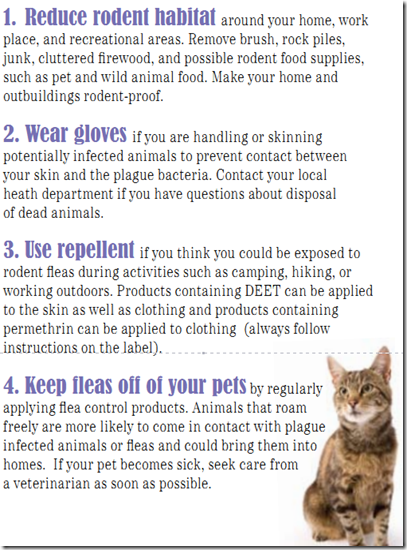
The CDC offers the following advice on avoiding plague:

image


The good news is - that if diagnosed and treated early - plague responds well to several common antibiotics. 


My interest in plague began at the tender age of 11 when I read James Leasor’s  The Plague and The Fire.


image

I’ve no doubt that this account of two incredible years in London’s history (1665-1666) - which began with the Great plague, and ended with the Fire of London – have unduly influenced my life, and interests, over the past 45 years.


A cautionary note, I suppose, regarding what one ought to read at an impressionable age.


While Yersinia Pestis is assumed by most scientists to have been the cause of the Black Death of the Middle ages, there remains some controversy on that topic (see EID Journal: A Scholarly Debate).


Last year, Ed Yong, writing for Discover Magazine took a fresh look at the debate in The lost plague – London graveyards suggest that Black Death strain may be extinct.


While not a common disease in the United States, there have been some concerns that climate change could exacerbate the spread of Yersinia infected rodents, and increase the risks of infection (see Climate Change Eyed As Spreading Diseases).


For more on Plague, the CDC’s  DVBID (Division of Vector-Borne Diseases) maintains an extensive website on the pathgoen at:


http://www.cdc.gov/ncidod/dvbid/plague/