Showing posts with label Demographics. Show all posts

Tuesday, January 14, 2014

Referral: VDU On Recent H7N9 Demographic Trends

image

Credit CDC 


# 8170


Dr. Ian Mackay on his Virology Down Under blog (VDU) takes another look this morning at the shifting demographic trends of recent H7N9 activity in China, charting by both age and gender.  His graphics work is always top notch, and provides us with a far more informative way to look at the line listing data we generally have.


Follow the link to read:


H7N9 age with time: is a younger adult demographic emerging this time around?

This is a big graphic - sorry for that - but I thought it best to show the distribution of age bands (this is updated from the paper I co-authored recently with Joseph Dudley) alongside the shifting age in total numbers and proportion of cases each week. The data are all publicly sourced and verified against the WHO and scientific literature whenever possible and of course FluTrackers excellent case list.

image

(Continue . . . )


Monday, April 22, 2013

WHO H7N9 Study: Preliminary Age & Sex Distribution


image


# 7173


From the Western Pacific Surveillance and Response Journal (WPSAR) we’ve a preliminary review of the age and gender demographics of H7N9 infection among China’s first 63 cases reported through April 16th.


You’ll recall we touched on a similar analysis by CIDRAP of some of these same issues on Friday in H7N9: The Riddle Of The Ages.


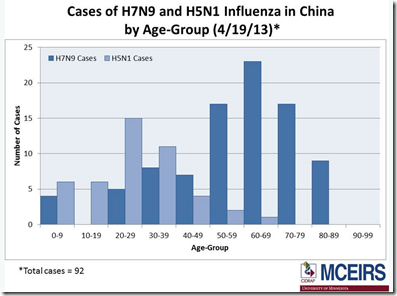
Unlike the previous infection patterns we’ve seen with the H5N1 avian flu in China – which has had its biggest impact in those 15-39 years of age – the H7N9 patients have been conspicuously older.


image

Figure 1. Age group and sex distribution of reported human infections with avian influenza A(H7N9) and A(H5N1) viruses, China, as of 16 April 2013


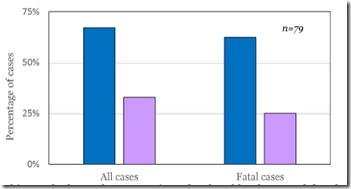
Another notable trend : H7N9 patients have been predominantly male, by a ratio of 2 to 1. 


This skewing towards elderly males runs counter to China’s population demographics, which is heavily weighted towards young and middle-aged adults and where there are more women than men among the elderly.


Today’s study doesn’t provide us with any answers for why these trends are appearing, but it does provide us with three possible avenues of investigation:


(1) differential exposure between males and females due to gender-associated practices and norms;

(2) biological differences between males and females in the clinical course post exposure/infection; and

(3) differential healthcare-seeking/access behaviour between male and females, leading to surveillance/detection bias.


The study, which was conducted by scientists working with the World Health Organization is open access. Below you’ll find some excerpts (slightly reparagraphed for readability) - follow the link to read it in its entirety.


Human infections with avian influenza A(H7N9) virus in China: preliminary assessments of the age and sex distribution

Perspective

Yuzo Arima,a Rongqiang Zu,a Manoj Murhekar,a Sirenda Vong,b Tomoe Shimadaa and the World Health Organization Regional Office for the Western Pacific Event Management Team*

(EXCERPTS)

Since 31 March 2013, the government of China has been notifying the World Health Organization (WHO) of human infections with the avian influenza A(H7N9) virus, as mandated by the International Health Regulations (2005).


While human infections with other subgroups of H7 influenza viruses (e.g. H7N2, H7N3, and H7N7) have previously been reported, the current event in China is of historical significance as it is the first time that A(H7N9) viruses have been detected among humans and the first time that a low pathogenic avian influenza virus is being associated with human fatalities.


In this rapidly evolving situation, detailed epidemiologic and clinical data from reported cases are limited—making assessments challenging—however, some key questions have arisen from the available data. Age and sex data, as one of the first and most readily available data, may be an important proxy for gender-specific behaviours/conditions and an entry point for response.


Here, we describe the age and sex distribution of the human cases of avian influenza A(H7N9) to better inform risk assessments and potential next steps.


Between 31 March and 16 April 2013, there were 63 reported cases of avian influenza A(H7N9). The median age was 64 years (range 4–87), and 45 cases (71%) were male. Notably, 39 of the 63 cases (62%) were ≥ 60 years of age.


When stratified by age and sex, elderly men were the most affected demographic group (Figure 1).


  • < SNIP  lengthy discussion of possible factors that might influence the age/gender demographics of H7N9 infection>

At this time, it is clear that there are more questions than answers. Based on the basic age and sex distribution, we identify several critical questions and options to guide the ongoing investigation:

  • What are the societal norms and common social practices among elderly men in the affected provinces? Qualitative approaches and involvement of anthropologists/ sociologists specializing in the sociology of health of the Chinese population may be beneficial.
  • What is the age and sex distribution of severe acute respiratory illnesses and key risk factors for respiratory illness (e.g. smoking) in the underlying population in the affected provinces? While detailed case-based clinical information is pending, data from the general population may be helpful for initial assessments.
  • What is the age and sex distribution of healthcare utilization in the Chinese population in the affected provinces? Ruling out any possible selection bias will be an important initial step in understanding both the clinical and epidemiologic spectrum of infection.

In these situations, it is easy to dismiss preliminary epidemiologic assessments as being too low in numbers or with too few variables of interest.


There is a need for further case-based information, such as zoonotic exposures and underlying medical conditions. However, for public health workers engaged in rapid response to acute events, it is essential to operate as observational scientists and assess available information to help formulate the next steps.


Following age and sex distributions closely over time may detect important changes in the epidemiology of this virus and with better understanding, high-risk populations, targeted interventions (e.g. gender-specific risk communication messages), prevention and control measures (e.g. vaccination) and treatment options (e.g. antivirals) may be identified.


While this brief and rapid communication cannot offer answers, we hope that public health practitioners involved in similar responses – at various capacities around the world – may consider these key concerns and questions to help them respond to not only the current virus but also other emerging infectious threats.


Over the past 15 years the study of the H5N1 avian flu virus has produced its share of unusual and unexpected findings (see Study: What Makes Avian Flu So Deadly.  Similarly, the 2009 H1N1 pandemic virus behaved in ways that were not anticipated (see There’s No Flu Like A New Flu).


Now it is H7N9 that is challenging our preconceived notions of how influenza viruses should act. 


The mantra of flu researchers is that influenza viruses are notoriously unpredictable.  H7N9, thus far, appears to be no different.

Saturday, April 20, 2013

H7N9: The Riddle Of The Ages

image


# 7169


Were it not killing people, and imbued with a worrisome (but as yet, undetermined) potential to spread further, I suspect that many flu researchers’ reaction would be to peer Spock-like at this emerging H7N9 avian flu virus, arch an eyebrow and mutter, `Fascinating’.


Like H5N1 before it – and to a lesser extent the H1N1 pandemic strain of 2009 - this new virus is challenging conventional wisdom on how novel flu viruses should behave.


Last night, Robert Roos – Editor of CIDRAP NEWS – wrote on an analysis performed by Nick Kelley, PhD on the unusual age and gender demographics of the 90+ patients identified to date.


Thus far, we’ve seen a skewing of age and gender in H7N9 patients towards elderly males, something which has been an ongoing topic of speculation both publicly and privately in the flu world for a couple of weeks.


It’s a good report, with extended remarks from Michael Osterholm, director of CIDRAP.  Follow the link, and I’ll have more when you return.


H7N9 mystery: Why does age profile tilt older?

Robert Roos * News Editor

Apr 19, 2013 (CIDRAP News) – One of the odd mysteries posed by the H7N9 influenza virus emerging in China is why most of the patients are on the older side—a fact that stands in sharp contrast to the pattern seen with that other deadly crossover avian virus, H5N1.


An analysis by Nicholas Kelley, PhD, at the University of Minnesota's Center for Infectious Disease Research and Policy (CIDRAP), publisher of CIDRAP News, shows that the median age of H7N9 case-patients thus far is 61.5 years, with a range of 2 to 89 years.


For comparison, Kelley examined the ages of the 45 H5N1 case-patients in China over the past 10 years and found a median age of only 27. And when he looked only at H5N1 cases in the same provinces where H7N9 cases have turned up, the median age was even younger: 24.


The European Centre for Disease Prevention and Control (ECDC), in an epidemiological update released today, but based on cases as of yesterday, put the median age of H7N9 patients even higher: 64, with a range of 4 to 89.

(Continue . . . )


The following chart shows the stark contrast between the age groups impacted by H5N1 and H7N9, both avian flu viruses.  
image

The predilection of the H5N1 virus for younger patients has evoked a number of theories, but has never been adequately explained.


Another chart, this time from Dr. Ian MacKay’s excellent Avian influenza A virus H7N9 webpage, illustrates the pronounced trend towards male patients as well.
 

image

This graph shows the proportion of males (blue bars) and females (violet bars) contributing to total cases (including deaths) and to fatal cases alone.


There are other mysteries with this virus as well, for which answers (thus far) have been few. Among them:


  • Why would a low pathogenic avian virus produce such severe symptoms in humans?
  • With so few birds testing positive, what are the primary (or hosts) for this virus?
  • How is this virus currently spilling over into humans?
  • Are there substantial numbers of mild, or asymptomatic infections going uncounted?
  • Geographically, how widespread is this virus?
  • Is human-to-human transmission taking place?
  • How rapidly is this virus mutating? How many clades exist?
  • What is this virus’ pandemic potential?


Over the past 24 hours Gregory Hartl, spokesperson for the World Health Organization, has been fielding a number of these questions on Twitter. While solid answers remain elusive, a few of his responses below.


image


Sometimes the hardest answer to give is, “We don’t know yet.”  It may disappoint, but it has the virtue of honesty.


Yet, when you consider that scientists have been studying the H5N1 avian flu virus for more than 15 years – with many questions still unanswered - the amount of information we’ve learned about H7N9 over the past 3 weeks is actually quite impressive.


With yesterday’s announcement that WHO: H7N9 Team Lands In China, hopefully we’ll be getting an even better idea of how this virus behaves – and how much of a threat it poses – over the next couple of weeks.


Stay tuned.